
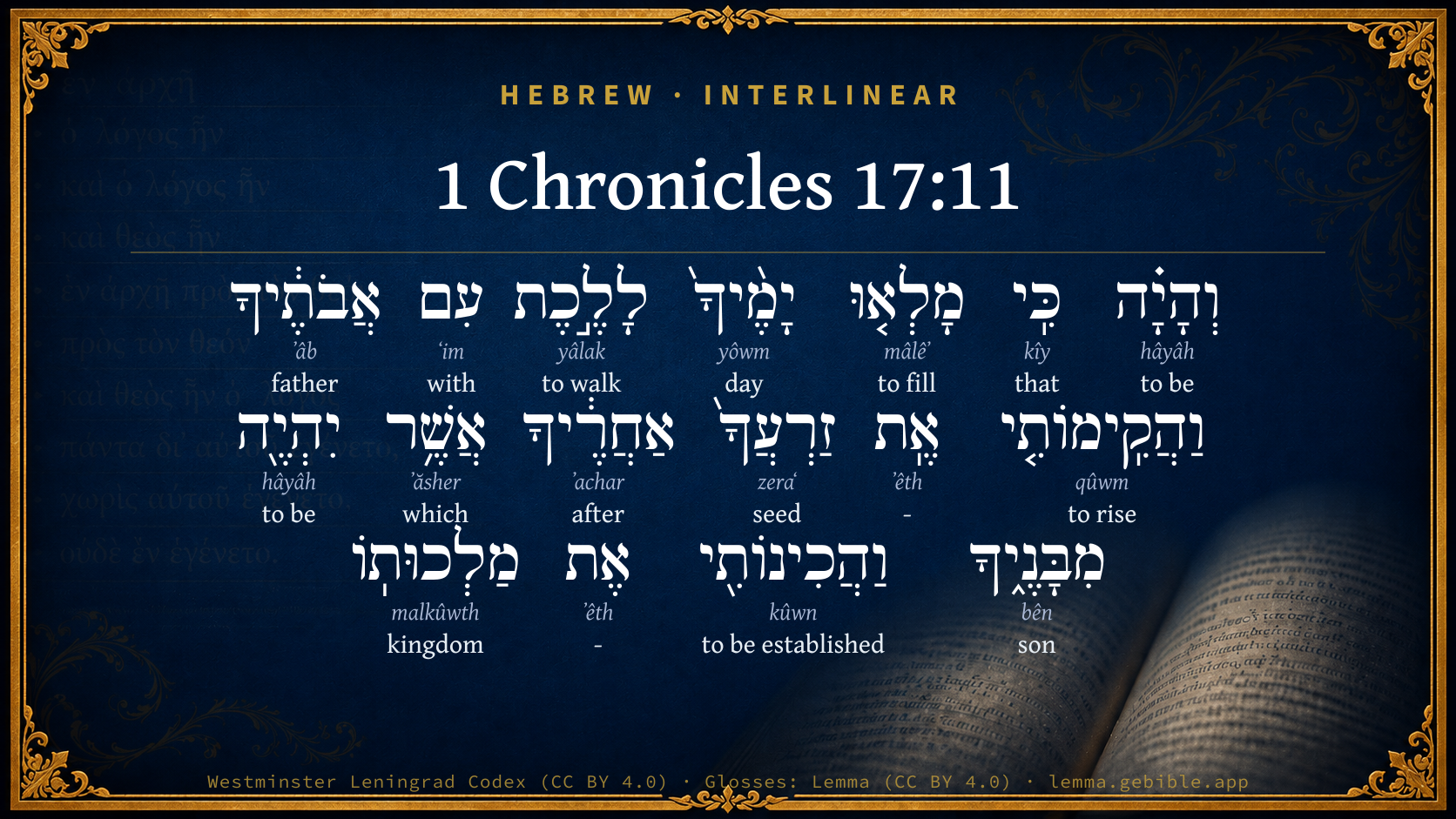
1 Chronicles 17:11

Hebrew (Westminster Leningrad Codex) 1 Chronicles 17:11 appears in the Hebrew Old Testament. The text above is from the Westminster Leningrad Codex. Each word links to its Strong’s number, a concise gloss, and parsing drawn from the Open Scriptures Hebrew Bible morphology. Click any word for its full Brown-Driver-Briggs (BDB) entry.
Download image
Cite this verse

1 Chronicles 17:11 (World English Bible). Public Domain. Lemma interlinear Bible study tool, https://lemma.gebible.app/v/1-chronicles/17/11.

Show BibTeX & RIS
BibTeX
RIS
English Translation
It shall happen, when your days are fulfilled that you must go to be with your fathers, that I will set up your seed after you, who shall be of your sons; and I will establish his kingdom.
World English Bible · Public Domain
Download a study sheet

One document with this verse’s original text, its word-by-word gloss line, the meaning frame, cross-references with their text, attributed commentary, and full source and license credits — printable, and it pastes into notes with its structure intact.

This verse Autodidact and up

Study sheet (.html) Plain text (.txt)

A passage Seminary Student

Up to 50 verses in one chapter. A passage sheet keeps up to 6 commentary sources and 12 cross-references per verse, in the order this page ranks them, and says so on the sheet whenever that leaves anything out. Ask for a single verse and you get the Autodidact verse sheet above.

Everything on this page stays free to read, with no account — the sheet is a download of what is already on screen, not access to it.

Want to remove ads? Support Godless Engineer
Compare translations 3

The same verse in 3 English versions, stacked beneath the original-language interlinear above. Click any original word for its lexicon entry.

Each is an independent rendering of the whole verse — the interlinear is not word-aligned to these translations.

Highlighted words mark where these versions differ — a whole-verse word diff, not a word-by-word alignment.

  • World English Bible Public Domain
    It shall happen, when your days are fulfilled that you must go to be with your fathers, that I will set up your seed after you, who shall be of your sons; and I will establish his kingdom.
  • King James Version Public Domain
    And it shall come to pass, when thy days be expired that thou must go to be with thy fathers, that I will raise up thy seed after thee, which shall be of thy sons; and I will establish his kingdom.
  • unfoldingWord Literal Text CC BY-SA 4.0
    And it will be, when your days are full to go with your fathers, then I will raise up after you your seed who will be from your sons, and I will establish his kingdom.

unfoldingWord Literal Text — © unfoldingWord, licensed CC BY-SA 4.0. Word-aligned USFM3 via Door43 (git.door43.org/unfoldingWord/en_ult).

Versions to compare (up to 4)

3 of 4 selected

Show all 18 translations

Every available English version of this verse, each an independent rendering of the whole verse.

  • World English Bible Public Domain
    It shall happen, when your days are fulfilled that you must go to be with your fathers, that I will set up your seed after you, who shall be of your sons; and I will establish his kingdom.
  • Berean Standard Bible Public Domain
    And when your days are fulfilled and you go to be with your fathers, I will raise up your descendant after you, one of your own sons, and I will establish his kingdom.
  • Majority Standard Bible Public Domain
    And when your days are fulfilled and you go to be with your fathers, I will raise up your descendant after you, one of your own sons, and I will establish his kingdom.
  • King James Version Public Domain
    And it shall come to pass, when thy days be expired that thou must go to be with thy fathers, that I will raise up thy seed after thee, which shall be of thy sons; and I will establish his kingdom.
  • American Standard Version (1901) Public Domain
    And it shall come to pass, when thy days are fulfilled that thou must go to be with thy fathers, that I will set up thy seed after thee, who shall be of thy sons; and I will establish his kingdom.
  • Revised Version (1885) Public Domain
    And it shall come to pass, when thy days be fulfilled that thou must go to be with thy fathers, that I will set up thy seed after thee, which shall be of thy sons; and I will establish his kingdom.
  • Geneva Bible (1599) Public Domain
    And when thy dayes shalbe fulfilled to go with thy fathers, then will I rayse vp thy seede after thee, which shalbe of thy sonnes, and will stablish his kingdome.
  • Douay-Rheims (1899) Public Domain
    And when thou shalt have ended thy days to go to thy fathers, I will raise up thy seed after thee, which shall be of thy sons: and I will establish his kingdom.
  • Young's Literal Translation Public Domain
    and it hath come to pass, when thy days have been fulfilled to go with thy fathers, that I have raised up thy seed after thee, who is of thy sons, and I have established his kingdom,
  • Literal Standard Version CC BY-SA 4.0
    And it has come to pass, when your days have been fulfilled to go with your fathers, that I have raised up your seed after you, who is of your sons, and I have established his kingdom;
  • Unlocked Literal Bible CC BY-SA 4.0
    It will come about that when your days are fulfilled for you to go to your fathers, I will raise up your descendant after you, and for one of your own descendants, I will establish his kingdom.
  • unfoldingWord Literal Text CC BY-SA 4.0
    And it will be, when your days are full to go with your fathers, then I will raise up after you your seed who will be from your sons, and I will establish his kingdom.
  • Darby Bible Public Domain
    And it shall come to pass, when thy days are fulfilled that thou must go [to be] with thy fathers, that I will set up thy seed after thee, which shall be of thy sons; and I will establish his kingdom.
  • World Messianic Bible Public Domain
    It will happen, when your days are fulfilled that you must go to be with your fathers, that I will set up your offspring after you, who will be of your sons; and I will establish his kingdom.
  • Webster's Bible Public Domain
    And it shall come to pass, when thy days shall be ended that thou must go to be with thy fathers, that I will raise up thy seed after thee, who shall be of thy sons; and I will establish his kingdom.
  • Free Bible Version CC BY-SA 4.0
    For when you come to the end of your life and join your ancestors in death, I will bring to power one of your descendants, one of your sons, and make sure his kingdom is successful.
  • Bible in Basic English Public Domain
    And when the time comes for you to go to your fathers, I will put in your place your seed after you, one of your sons, and I will make his kingdom strong.
  • JPS Tanakh (1917) Public Domain
    And it shall come to pass, when thy days are fulfilled that thou must go to be with thy fathers, that I will set up thy seed after thee, who shall be of thy sons; and I will establish his kingdom.

Literal Standard Version (2020), Covenant Press — licensed CC BY-SA 4.0. Text via the HelloAO Bible API (eBible.org). Unlocked Literal Bible (unfoldingWord) — licensed CC BY-SA 4.0. Text via the HelloAO Bible API (eBible.org). unfoldingWord Literal Text — © unfoldingWord, licensed CC BY-SA 4.0. Word-aligned USFM3 via Door43 (git.door43.org/unfoldingWord/en_ult). Free Bible Version, Dr. Jonathan Gallagher — licensed CC BY-SA 4.0. Text via the HelloAO Bible API (eBible.org).

Word by word

More ways to search: Search by grammar → Find every occurrence → Compare this word →

Practice this passage: Drill this verse → Learn its vocabulary →

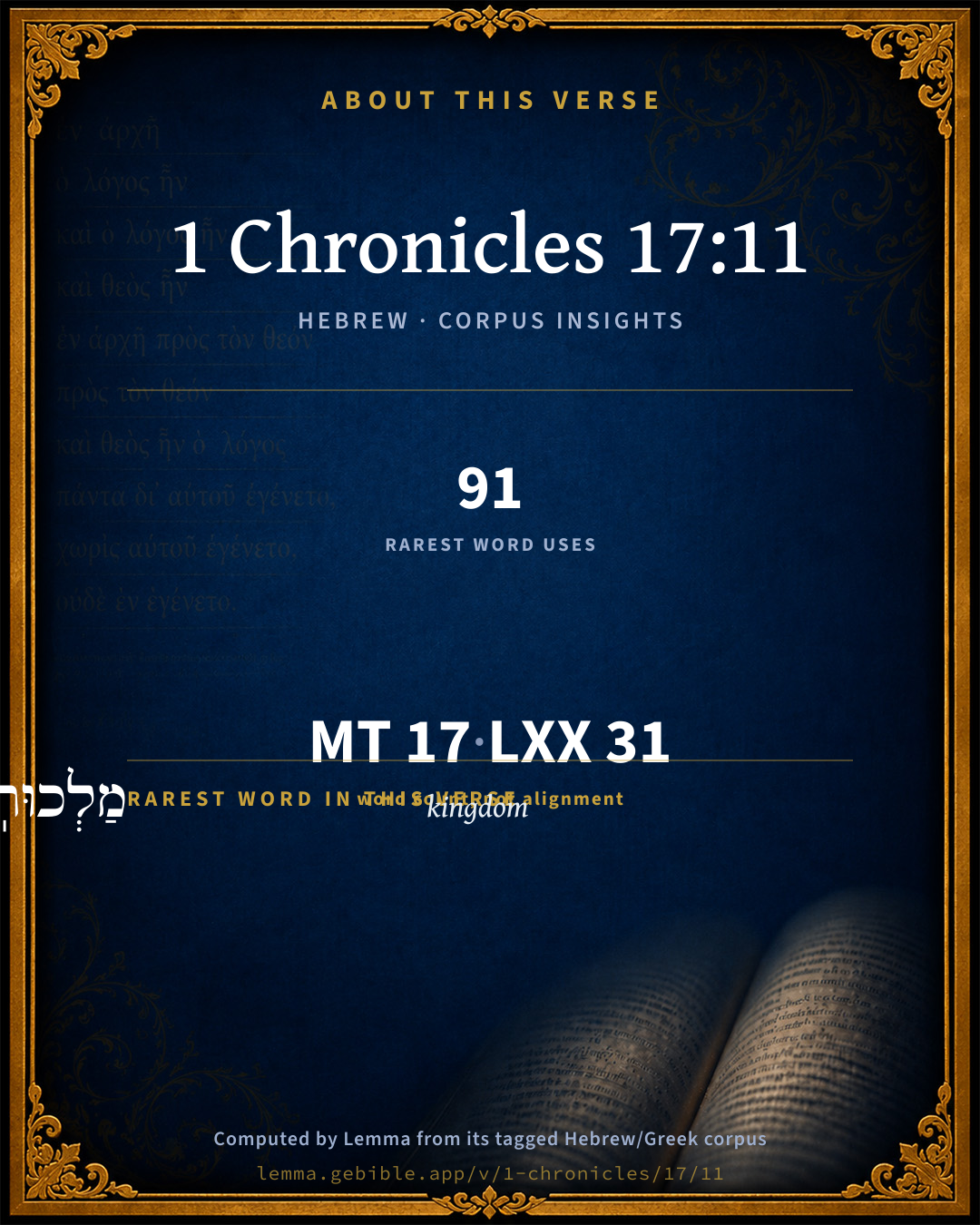
מַלְכוּתֽוֹ
malkûwth
H4438
“kingdom · his”
Noun, Common, Feminine, Singular, Construct + Suffix, Personal, 3rd Person, Masculine, Singular
Part of Speech
Noun
Type
Common
Gender
Feminine
Number
Singular
State
Construct
Full BDB Definition

Origin: from H4427

TWOT: 1199e

royalty, royal power, reign, kingdom, sovereign power - royal power, dominion - reign - kingdom, realm
  1. וְהָיָ֗ה hâyâh H1961 “and · to be” Conjunction + Verb, Qal, Sequential Perfect, 3rd Person, Masculine, Singular
  2. כִּֽי kîy H3588 “that” Conjunction
  3. מָלְא֤וּ mâlêʼ H4390 “to fill” Verb, Qal, Perfect, 3rd Person, Common, Plural
  4. יָמֶ֨יךָ֙ yôwm H3117 “days · your” Noun, Common, Masculine, Plural, Construct + Suffix, Personal, 2nd Person, Masculine, Singular
  5. לָלֶ֣כֶת yâlak H3212 “to walk” Preposition + Verb, Qal, Infinitive Construct
  6. עִם ʻim H5973 “with” Preposition
  7. אֲבֹתֶ֔יךָ ʼâb H1 “fathers · your” Noun, Common, Masculine, Plural, Construct + Suffix, Personal, 2nd Person, Masculine, Singular
  8. וַהֲקִֽימוֹתִ֤י qûwm H6965 “and · to rise” Conjunction + Verb, Hiphil, Sequential Perfect, 1st Person, Common, Singular
  9. אֶֽת ʼêth H853 “-” Particle, Direct Object
  10. זַרְעֲךָ֙ zeraʻ H2233 “seed · your” Noun, Common, Masculine, Singular, Construct + Suffix, Personal, 2nd Person, Masculine, Singular
  11. אַחֲרֶ֔יךָ ʼachar H310 “after · you” Preposition + Suffix, Personal, 2nd Person, Masculine, Singular
  12. אֲשֶׁ֥ר ʼăsher H834 “which” Particle, Relative
  13. יִהְיֶ֖ה hâyâh H1961 “to be” Verb, Qal, Imperfect, 3rd Person, Masculine, Singular
  14. מִבָּנֶ֑יךָ bên H1121 “from · sons · your” Preposition + Noun, Common, Masculine, Plural, Construct + Suffix, Personal, 2nd Person, Masculine, Singular
  15. וַהֲכִינוֹתִ֖י kûwn H3559 “and · to be established” Conjunction + Verb, Hiphil, Sequential Perfect, 1st Person, Common, Singular
  16. אֶת ʼêth H853 “-” Particle, Direct Object

About this verse

These counts appear in no published source. They are computed here, from the morphology-tagged text and Lemma’s own curated glosses. What Lemma adds →

17
words
15
distinct lemmas
Historical
section

Grammatical profile

  • 6 verbs
  • 5 nouns
  • 2 prepositions
  • 1 conjunction
  • 3 particles

Verb forms

  • וְהָיָ֗ה Qal · Sequential Perfect
  • מָלְא֤וּ Qal · Perfect
  • לָלֶ֣כֶת Qal · Infinitive Construct
  • וַהֲקִֽימוֹתִ֤י Hiphil · Sequential Perfect
  • יִהְיֶ֖ה Qal · Imperfect
  • וַהֲכִינוֹתִ֖י Hiphil · Sequential Perfect

Repetition

A word recurs within this verse — often emphatic in Hebrew:

  • וְהָיָ֗ה to be H1961 ×2

Hebrew & Septuagint length

In English translation the verse runs 38 words from the Hebrew and 40 from the Septuagint (LXX English) — closely comparable.

A rough comparison of the two English renderings, which tokenize alike — not a word-level alignment.

Word counts can differ between the Hebrew and the Greek without any difference in meaning — e.g. the Hebrew direct-object marker אֵת has no separate Greek word, and Greek often adds the article ὁ.

In the original languages it is 17 Hebrew tokens and 31 Greek tokens — but the two are counted differently (Hebrew bundles its prefixes and suffixes into one token; the Greek is in lemma form), so that isn’t a like-for-like length.

Cross-references

15

Topical passages linked to 1 Chronicles 17:11 in the Treasury of Scripture Knowledge — connected by theme and wording, ordered by reader-vote popularity; previews shown in the World English Bible.

  • Psalms 132:11 Yahweh has sworn to David in truth. He will not turn from it: "I will set the fruit of your body on your throne.
  • 2 Samuel 7:12–13 When your days are fulfilled, and you shall sleep with your fathers, I will set up your seed after you, who shall proceed out of your bowels, and I will establish his kingdom.
  • Jeremiah 23:5–6 Behold, the days come, says Yahweh, that I will raise to David a righteous Branch, and he shall reign as king and deal wisely, and shall execute justice and righteousness in the land.
  • Romans 1:3–4 concerning his Son, who was born of the seed of David according to the flesh,
  • Genesis 15:15 But you will go to your fathers in peace. You will be buried in a good old age.
  • 2 Samuel 12:24–25 David comforted Bathsheba his wife, and went in to her, and lay with her: and she bore a son, and he called his name Solomon. Yahweh loved him;
  • 1 Kings 1:21 Otherwise it will happen, when my lord the king shall sleep with his fathers, that I and my son Solomon shall be counted offenders.
  • 1 Kings 2:10 David slept with his fathers, and was buried in the city of David.
  • 1 Kings 8:20 Yahweh has established his word that he spoke; for I am risen up in the room of David my father, and sit on the throne of Israel, as Yahweh promised, and have built the house for the name of Yahweh, the God of Israel.
  • 1 Chronicles 28:5 Of all my sons (for Yahweh has given me many sons), he has chosen Solomon my son to sit on the throne of the kingdom of Yahweh over Israel.
  • 1 Chronicles 29:15 For we are strangers before you, and foreigners, as all our fathers were: our days on the earth are as a shadow, and there is no abiding.
  • 1 Chronicles 29:28 He died in a good old age, full of days, riches, and honor: and Solomon his son reigned in his place.
  • Deuteronomy 31:16 Yahweh said to Moses, Behold, you shall sleep with your fathers; and this people will rise up, and play the prostitute after the strange gods of the land, where they go to be among them, and will forsake me, and break my covenant which I have made with them.
  • Acts 2:29 "Brothers, I may tell you freely of the patriarch David, that he both died and was buried, and his tomb is with us to this day.
  • Acts 13:36 For David, after he had in his own generation served the counsel of God, fell asleep, and was laid with his fathers, and saw decay.

Cross-references courtesy of OpenBible.info (CC BY 4.0).

Hebrew and Greek witnesses Masoretic Hebrew ↔ Greek Septuagint

The same verse in the two great witnesses to the Old Testament, shown verse-for-verse.

These are two independent witnesses, not word-aligned to each other, and the Septuagint is shown in lemma (dictionary) form.

Hebrew 1 Chronicles 17:11 Masoretic · Westminster Leningrad Codex

וְהָיָ֗ה כִּֽי מָלְא֤וּ יָמֶ֨יךָ֙ לָלֶ֣כֶת עִם אֲבֹתֶ֔יךָ וַהֲקִֽימוֹתִ֤י אֶֽת זַרְעֲךָ֙ אַחֲרֶ֔יךָ אֲשֶׁ֥ר יִהְיֶ֖ה מִבָּנֶ֑יךָ וַהֲכִינוֹתִ֖י אֶת מַלְכוּתֽוֹ

It shall happen, when your days are fulfilled that you must go to be with your fathers, that I will set up your seed after you, who shall be of your sons; and I will establish his kingdom.

World English Bible · Public Domain

Greek LXX 1 Chronicles 17:11 Septuagint · lemma form

καί εἰμί ὅταν πληρόω ὁ ἡμέρα σύ καί κοιμάω μετά ὁ πατήρ σύ καί ἀναἵστημι ὁ σπέρμα σύ μετά σύ ὅς εἰμί ἐκ ὁ κοιλία σύ καί ἑτοιμάζω ὁ βασιλεία αὐτός

And it shall come to pass when your days shall be fulfilled, and you shall sleep with your fathers, that I will raise up your seed after you, which shall be of your bowels, and I will establish his kingdom.

LXX2012 (modern English Septuagint) · Public Domain

On this verse, Ellicott's Commentary for English Readers discusses the Septuagint’s reading. Read the note in Commentary ↓

Hebrew: Westminster Leningrad Codex (CC BY 4.0). Greek: Septuagint (public domain); English from LXX2012 (modern English Septuagint) (Public Domain). How the Septuagint differs from the Hebrew →

Commentary

Notes on 1 Chronicles 17:11 from classic Christian and Jewish commentators (each source and its license shown beneath its notes). The classic Christian expositions comment on the surrounding passage and are grouped to its opening verse, so a note may address several verses; the Jewish commentaries on the Tanakh (Rashi and others) are per-verse, so they appear only where the commentator wrote on this verse.

Lemma curates 59 commentaries, every one of them public domain or Creative Commons licensed, each selected and text-cleaned for this edition rather than reprinted as found. About our sources →

Trapp's Complete Commentary

John Trapp

1Ch 17:11 And it shall come to pass, when thy days be expired that thou must go [to be] with thy fathers, that I will raise up thy seed after thee, which shall be of thy sons; and I will establish his kingdom.

Ver. 11-14. An excellent text and testimony both for the person of Christ and for his kingdom. Note this both against the Papists, who deny the perfection of the holy Scriptures; and the Anabaptists, who deny that the Old Testament ought to be read: for who can rightly understand why and how Christ is called the son of David, unless he read this chapter?

John Trapp, A Commentary or Exposition upon All the Books of the Old and New Testament (1647–1656) — public domain. Text from a community e-Sword module.

Jamieson, Fausset & Brown

Robert Jamieson, A. R. Fausset & David Brown

I will raise up thy seed--(See on Sa2 7:12).

Jamieson, Fausset & Brown — Commentary Critical and Explanatory on the Whole Bible (1871) — public domain (CC PDM 1.0). Text via the HelloAO Bible API.

Ellicott's Commentary for English Readers

(11) Omit the mark indicating the beginning of a paragraph (¶).

And it shall come to pass.—In accordance with the promise, “The Lord will build thee an house” (1Ch_17:10). The phrase is wanting in Samuel, and should probably be supplied, with LXX.

Be expired.—Are fulfilled (perfect; Samuel has imperfect tense).

That thou must go to be with thy fathers.—Literally, to go with thy fathers—an unusual expression, for which Samuel has the ordinary, “and thou lie down with thy fathers.” (Comp. 1Ki_2:2 : “Go the way of all the earth.”)

Which shall be (shall arise or come, Gen_17:16) of thy sons.—Samuel has the more original, “which shall go forth from thy bowels.” The chronicler has paraphrased this, to suit the taste of a later age.

His kingdom.—Heb., malkûthô—a later word than the synonym in Samuel (mamlakhtô).

A Bible Commentary for English Readers, edited by Charles John Ellicott (1878–1897) — public domain. Text from a community e-Sword module.

The Cambridge Bible for Schools and Colleges

gen. ed. J. J. S. Perowne

11. be expired] R.V. be fulfilled, as Sam.

that thou must go to be with] Sam. and thou shalt sleep with.

which shall be of thy sons] Sam. which shall proceed out of thy bowels.

The Cambridge Bible for Schools and Colleges (gen. ed. J. J. S. Perowne; Cambridge University Press, 1878–1918) — public domain. Text from a community e-Sword module.

Haydock's Catholic Bible Commentary

Seed, even till Christ shall be born of the Blessed Virgin, of the family of David.

George Leo Haydock (1774–1849), Haydock's Catholic Family Bible and Commentary, 1859 edition — public domain. Excludes Psalms (Douay-Rheims chapter numbering differs from Protestant) and Deuterocanonical books (Catholic canon only).

The Pulpit Commentary

The promise is now, not to "David and his seed," but to David personally. The verse contains, no doubt, the original of the Apostle Peter"s quotation (Act_2:29, Act_2:30; see also Act_13:34; Luk_1:32, Luk_1:33) The last clause of this verse has Solomon, for the object of its pronoun "his.

Vers. 11-15.

The purposes of God concerting Solomon.

In the Divine communication made to David through the Prophet Nathan, there is a tone of very tender consideration, and an evident desire to solace and comfort the aged servant of God, whose request it was found necessary to refuse. In one way the desire of his heart could be met. He should have an immortality in his descendants and in his dynasty. He should live on in his son, and accomplish even his purpose concerning the temple. And he may have, before he dies, the comforting assurance that God"s purposes were set upon his son, and the Divine favour would overshadow his reign. Those gracious Divine purposes are indicated in these verses. Man"s brief life on the earth, which so seldom permits him to accomplish any great thing, would be very painful to him were it not for the hope he cherishes that he will live on in his children, and by them his great life-work may win completion. We cannot bear to think that death cuts off our influence and spoils our work. Man can scarcely say a thing that hurts him more in the saying than this, "My purposes are broken off." What is called fame may be won by but the few among even good men; but every true-hearted and earnest servant of God may be sure that his personal impress is an abiding one; it will get its continuance in those who have known him and live after him; his spirit, his principles, his witness, even in measure his experience will be still working. Philips Brooks well says, "No man or woman of the humblest sort can really be strong, gentle, pure, and good, without the world being the better for it, without somebody being helped and comforted by the very existence of that goodness." Illustrate how a man lives on in a book he has written, or a building he has raised. So a man lives on, oftentimes, in the son who takes up his work. David really lived on in Solomon, and did, in fact, build the temple, seeing that Solomon used the materials he had gathered, and carried out the plans which he had arranged. It is interesting to notice what in the temple which was actually reared was due to the genius and consecration of David, and what in it bore the personal stamp of Solomon. "The design fixed upon indicates fully the spirit of the times and of the king. A general relation to the older tabernacle must be carefully preserved the outline of the form, the proportions, and the principal division of thebuilding into holy place and most holy must be continued; but where Moses permitted ornamentation and decoration it was developed, and almost carried to an extravagant extent." In view of God"s unfolding to David his purposes concerning Solomon, we may learn that it is full of comfort to the man who is passing away from earth to be assured that his son will virtually have

I HIS WORK TO DO; at least, in its more prominent and important aspects. Certainly his work in the large sense of living for God, and doing his will.

II That he will have, if he seeks it, the same GRACE FOR THE DOING. God"s years are throughout all generations, and will give our children the joy and help of the same fatherly relations that he has given us (ver. 13).

It may be shown that, still, saints pass away from earth, made willing to leave their life-work incomplete, and their most cherished desires unfulfilled, and restfully saying in their hearts, "God"s grace remains, though I pass away. That grace is working on, and working out, the great purpose, and will surely raise up other agencies." David may die, but he may know this the temple will be built; the kingdom he had founded shall be secured, and even for him the veil shall be uplifted, and he shall see the glory of this Divine purpose. In a high and spiritual sense David"s kingdom shall, in his greater Son, be established for ever and ever. R.T.

The Pulpit Commentary (1880–1919), ed. H.D.M. Spence-Jones & Joseph S. Exell — public domain. Text from a community e-Sword module.

Kretzmann's Popular Commentary

Paul E. Kretzmann

David Accepts God’s Promises With Thankfulness

v. 10. Furthermore I tell thee that the Lord will build thee an house. (Cf with the entire passage 2Sa 7:12-29, and note that the peculiarity of prophecy to combine thoughts near at hand with those afar off is very marked in this paragraph. )

v. 11. And it shall come to pass, when thy days be expired that thou must go to be with thy fathers, to await the great resurrection of the dead, that I will raise up thy Seed after thee, which shall be of thy sons; and I will establish His kingdom. The nearest reference is probably that concerning Solomon, but the Messianic idea comes out more strongly as the announcement progresses.

v. 12. He shall build Me an house, and I will establish His throne forever. The thought clearly looks forward to the house of the Church, the kingdom of the Messiah, and not only to the building of the Temple.

v. 13. I will be His Father, and He shall be My Son. And I will not take My mercy away from Him as I took it away from him that was before thee, Saul having been rejected on account of his disobedience;

v. 14. but I will settle Him in Mine house and in My kingdom forever; and His throne shall be established forevermore, not only through the nearest line of David’s posterity, but, in the person of his greatest Son, to all eternity.

v. 15. According to all these words and according to all this vision, so did Nathan speak unto David.

v. 16. And David the king came and sat before the Lord, in the Tabernacle erected by him, over against the ark, and said, realizing that the Lord’s promise went far beyond a mere promise of establishing a dynasty, Who am I, O Lord God, and what is mine house, that Thou hast brought me hitherto? Cf 2Sa 7:18-29.

v. 17. And yet this, all the temporal blessings which had been given to him from his early youth, was a small thing in Thine eyes, O God; for Thou hast also spoken of Thy servant’s house for a great while to come, and hast regarded me according to the estate of a man of high degree, O Lord God. The exact text may here be rendered: "Thou hast let me see what Thou hast determined concerning a man who out of the height is Jehovah God. " It was the greatness of this honor which caused such unusual expressions of humility on the part of David, the fact that his house was to be the bearer of the Messianic blessing.

v. 18. What can David speak more to Thee for the honor of Thy servant? For Thou knowest Thy servant. God knew that David in himself was utterly unworthy of the honor bestowed upon him, but He vouchsafed it out of pure grace.

v. 19. O Lord, for Thy servant’s sake and according to Thine own heart hast Thou done all this greatness, in making known all these great things. The entire matter, therefore, redounded to the glory of God alone.

v. 20. O Lord, there is none like Thee, neither is there any God beside Thee, according to all that we have heard with our ears. To this conclusion and confession David was driven by the consideration of God’s unparalleled mercy.

v. 21. And what one nation in the earth is like Thy people Israel, including the spiritual Israel of God’s people of all times, whom God went to redeem to be His own people, to make Thee a name of greatness and terribleness, one which would be feared by the enemies, by driving out nations from before Thy people, whom Thou hast redeemed out of Egypt? The deliverance from the bondage of Egypt has always been a picture of the greater deliverance and salvation of Jesus Christ, the Messiah.

v. 22. For Thy people Israel didst Thou make Thine own people forever; and Thou, Lord, becamest their God, the spiritual Israel, the Church of God, holding this same truth to this day.

v. 23. Therefore, now, Lord, let the thing that Thou hast spoken concerning Thy servant and concerning his house, the wonderful Messianic promise, be established forever, and do as Thou hast said.

v. 24. Let it even be established that Thy name may be magnified forever, saying, The Lord of hosts is the God of Israel, even a God to Israel; and let the house of David; Thy servant, be established before Thee.

v. 25. For Thou, O my God, hast told Thy servant, literally, "opened the ears of Thy servant," that Thou wilt build him an house, the fact that chiefly a spiritual temple is meant again standing out here; therefore Thy servant hath found in his heart to pray before Thee.

v. 26. And now, Lord, Thou art God, and hast promised this goodness unto Thy servant;

v. 27. now, therefore, let it please Thee to bless the house of Thy servant that it may be before Thee forever; for Thou blessest, O Lord, and it shall be blessed forever. Cf Psa 33:9. The temple to which reference is chiefly, if not exclusively, made, is that of the Christian Church, of the communion of saints. The Church is a habitation of God through the Spirit, it is the kingdom of Jesus Christ. The Lord Himself lives and rules in this kingdom throughout eternity, and all His saints, who have here tasted His mercy, will there partake of His glory, world without end.

Paul E. Kretzmann, Popular Commentary of the Bible (1921–1924) — public domain. Text from a community e-Sword module.

unfoldingWord translationNotes

Door43 World Missions Community

Connecting Statement:

Yahweh continues describing his promises to King David through the prophet Nathan.

It will come about

"It will happen"

when your days are fulfilled for you to go to your fathers

The two phrases "when your days are fulfilled" and "go to your fathers" have similar meanings and are combined for emphasis. They both are polite ways to refer to death and dying. (See: Parallelism and Euphemism)

I will raise up your descendant after you

God appointing David's descendant is spoken of as if Yahweh would raise or lift him up. (See: Metaphor)

I will establish his throne forever

The right to rule as king is described by the place where a king sits. AT: "I will make his rule over Israel to last forever" (See: Metonymy)

translationWords

fulfill

descend

kingdom

house of God

throne

eternity

unfoldingWord translationNotes — © Distant Shores Media and the Door43 World Missions Community, licensed CC BY-SA 4.0. Source: git.door43.org/Door43/en_tn.

Rashi

Rabbi Shlomo Yitzchaki (Rashi)

And it will come to pass when your days are finished to go with your forefathers That is to say, do not fear that I will hasten the matter, but when your days are finished, then it will come about, and I shall raise up your seed after you. and I shall establish his kingdom And so he says of Solomon, (I Kings 2:12): “... and his kingdom was firmly established.”

Rashi on the Tanakh — English translations: “The Judaica Press complete Tanach with Rashi, translated by A. J. Rosenberg” (CC BY 4.0); “Pentateuch with Rashi's commentary by M. Rosenbaum and A.M. Silbermann, 1929-1934” (public domain); “The Metsudah Tanach series, Lakewood, N.J” (CC BY 4.0); and “The Book of Joshua, Metsudah Publications, 1997” (CC BY 4.0). Text via Sefaria.

Lesson kit

Teaching starters — assembled from the data on this page, not authored interpretation. Every prompt links to the verse data it draws on. Edit before teaching.

1 Chronicles, in the Historical, opens this verse with 17 words (15 distinct Hebrew lemmas). Its most distinctive word is malkûwth (“kingdom”). A historical commentator’s framing appears above. Read the whole chapter for the surrounding context.

Discussion questions

  1. The word malkûwth carries the sense “kingdom.” How does it shape the verse?
  2. How does Psalms 132:11, which shares this passage’s theme, read alongside this verse?
  3. What does the repetition of “to be” (2× in this one verse) do in this verse?
  4. The translations on this page render this verse differently — a whole-verse word diff, not a word-by-word alignment. What might account for the different wordings?
  5. «וְהָיָ֗ה» is a Qal Sequential Perfect verb. How does that grammatical form shape the action described?
  6. Compare how Trapp's Complete Commentary and Jamieson, Fausset & Brown read this verse. Where do they agree or differ?

Things to notice

Reading settings

Reading text

Shown beneath each verse's original-language words.

Old Testament
Old Testament edition

Read the OT as the Masoretic Hebrew (MT) or the Greek Septuagint (LXX).

English shown for the Greek Septuagint (in the Hebrew ↔ Greek comparison).

Comparing translations? Open the Compare panel on any verse page to stack up to four side by side.