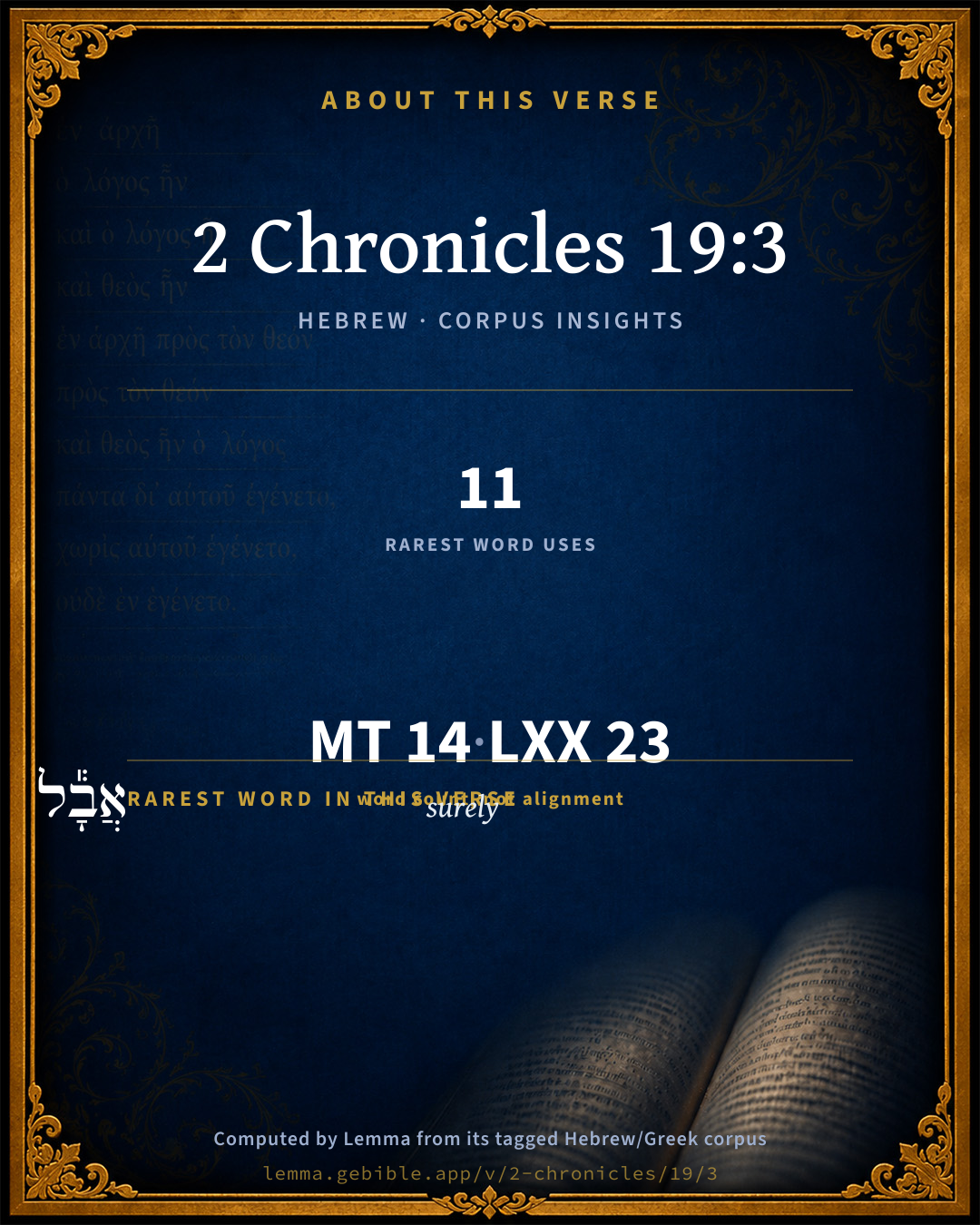
2 Chronicles 19:3

Hebrew (Westminster Leningrad Codex) 2 Chronicles 19:3 appears in the Hebrew Old Testament. The text above is from the Westminster Leningrad Codex. Each word links to its Strong’s number, a concise gloss, and parsing drawn from the Open Scriptures Hebrew Bible morphology. Click any word for its full Brown-Driver-Briggs (BDB) entry.
Download image
Cite this verse

2 Chronicles 19:3 (World English Bible). Public Domain. Lemma interlinear Bible study tool, https://lemma.gebible.app/v/2-chronicles/19/3.

Show BibTeX & RIS
BibTeX
RIS
English Translation
Nevertheless there are good things found in you, in that you have put away the Asheroth out of the land, and have set your heart to seek God.
World English Bible · Public Domain
Download a study sheet

One document with this verse’s original text, its word-by-word gloss line, the meaning frame, cross-references with their text, attributed commentary, and full source and license credits — printable, and it pastes into notes with its structure intact.

This verse Autodidact and up

Study sheet (.html) Plain text (.txt)

A passage Seminary Student

Up to 50 verses in one chapter. A passage sheet keeps up to 6 commentary sources and 12 cross-references per verse, in the order this page ranks them, and says so on the sheet whenever that leaves anything out. Ask for a single verse and you get the Autodidact verse sheet above.

Everything on this page stays free to read, with no account — the sheet is a download of what is already on screen, not access to it.

Want to remove ads? Support Godless Engineer
Compare translations 3

The same verse in 3 English versions, stacked beneath the original-language interlinear above. Click any original word for its lexicon entry.

Each is an independent rendering of the whole verse — the interlinear is not word-aligned to these translations.

Highlighted words mark where these versions differ — a whole-verse word diff, not a word-by-word alignment.

  • World English Bible Public Domain
    Nevertheless there are good things found in you, in that you have put away the Asheroth out of the land, and have set your heart to seek God.
  • King James Version Public Domain
    Nevertheless there are good things found in thee, in that thou hast taken away the groves out of the land, and hast prepared thine heart to seek God.
  • unfoldingWord Literal Text CC BY-SA 4.0
    However, good things have been found with you, for you removed the Asherah from the land, and you established your heart to seek God.”

unfoldingWord Literal Text — © unfoldingWord, licensed CC BY-SA 4.0. Word-aligned USFM3 via Door43 (git.door43.org/unfoldingWord/en_ult).

Versions to compare (up to 4)

3 of 4 selected

Show all 18 translations

Every available English version of this verse, each an independent rendering of the whole verse.

  • World English Bible Public Domain
    Nevertheless there are good things found in you, in that you have put away the Asheroth out of the land, and have set your heart to seek God.
  • Berean Standard Bible Public Domain
    However, some good is found in you, for you have removed the Asherah poles from the land and have set your heart on seeking God.”
  • Majority Standard Bible Public Domain
    However, some good is found in you, for you have removed the Asherah poles from the land and have set your heart on seeking God.”
  • King James Version Public Domain
    Nevertheless there are good things found in thee, in that thou hast taken away the groves out of the land, and hast prepared thine heart to seek God.
  • American Standard Version (1901) Public Domain
    Nevertheless there are good things found in thee, in that thou hast put away the Asheroth out of the land, and hast set thy heart to seek God.
  • Revised Version (1885) Public Domain
    Nevertheless there are good things found in thee, in that thou hast put away the Asheroth out of the land, and hast set thine heart to seek God.
  • Geneva Bible (1599) Public Domain
    Neuertheles good things are found in thee, because thou hast taken away ye groues out of the land, and hast prepared thine heart to seeke God.
  • Douay-Rheims (1899) Public Domain
    But good works are found in thee, because thou hast taken away the groves out of the land of Juda, and hast prepared thy heart to seek the Lord the God of thy fathers.
  • Young's Literal Translation Public Domain
    but good things have been found with thee, for thou hast put away the shrines out of the land, and hast prepared thy heart to seek God.'
  • Literal Standard Version CC BY-SA 4.0
    but good things have been found with you, for you have put away the Asheroth out of the land, and have prepared your heart to seek God.”
  • Unlocked Literal Bible CC BY-SA 4.0
    However, there is some good to be found in you, in that you have taken the Asherah poles out of the land, and you have fixed your heart to seek God.”
  • unfoldingWord Literal Text CC BY-SA 4.0
    However, good things have been found with you, for you removed the Asherah from the land, and you established your heart to seek God.”
  • Darby Bible Public Domain
    Nevertheless there are good things found in thee; for thou hast put away the Asherahs out of the land, and hast directed thy heart to seek God.
  • World Messianic Bible Public Domain
    Nevertheless there are good things found in you, in that you have put away the Asheroth out of the land, and have set your heart to seek God.”
  • Webster's Bible Public Domain
    Nevertheless, there are good things found in thee, in that thou hast taken away the groves out of the land, and hast prepared thy heart to seek God.
  • Free Bible Version CC BY-SA 4.0
    Even so you've done some good things such as destroying the Asherah poles throughout the country, and you have made a sincere commitment to follow God.”
  • Bible in Basic English Public Domain
    But still there is some good in you, for you have put away the wood pillars out of the land, and have given your heart to the worship of God.
  • JPS Tanakh (1917) Public Domain
    Nevertheless there are good things found in thee, in that thou hast put away the Asheroth out of the land, and hast set thy heart to seek God.'

Literal Standard Version (2020), Covenant Press — licensed CC BY-SA 4.0. Text via the HelloAO Bible API (eBible.org). Unlocked Literal Bible (unfoldingWord) — licensed CC BY-SA 4.0. Text via the HelloAO Bible API (eBible.org). unfoldingWord Literal Text — © unfoldingWord, licensed CC BY-SA 4.0. Word-aligned USFM3 via Door43 (git.door43.org/unfoldingWord/en_ult). Free Bible Version, Dr. Jonathan Gallagher — licensed CC BY-SA 4.0. Text via the HelloAO Bible API (eBible.org).

Word by word

More ways to search: Search by grammar → Find every occurrence → Compare this word →

Practice this passage: Drill this verse → Learn its vocabulary →

אֲבָ֕ל
ʼăbâl
H61
“surely”
Adverb
Part of Speech
Adverb
Full BDB Definition

Origin: apparently from H56 through the idea of negation

TWOT: 8

truly, verily, surely - but, however, howbeit - contrariwise, nay rather (negative)
  1. דְּבָרִ֥ים dâbâr H1697 “words” Noun, Common, Masculine, Plural, Absolute
  2. טוֹבִ֖ים ṭôwb H2896 “good” Adjective, Adjective, Masculine, Plural, Absolute
  3. נִמְצְא֣וּ mâtsâʼ H4672 “to find” Verb, Niphal, Perfect, 3rd Person, Common, Plural
  4. עִמָּ֑ךְ ʻim H5973 “with · you” Preposition + Suffix, Personal, 2nd Person, Feminine, Singular
  5. כִּֽי kîy H3588 “that” Conjunction
  6. בִעַ֤רְתָּ bâʻar H1197 “to burn” Verb, Piel, Perfect, 2nd Person, Masculine, Singular
  7. הָאֲשֵׁרוֹת֙ ʼăshêrâh H842 “the · Asherah” Particle, Definite Article + Noun, Proper
  8. מִן min H4480 “from” Preposition
  9. הָאָ֔רֶץ ʼerets H776 “the · land” Particle, Definite Article + Noun, Common, Both, Singular, Absolute
  10. וַהֲכִינ֥וֹתָ kûwn H3559 “and · to be established” Conjunction + Verb, Hiphil, Perfect, 2nd Person, Masculine, Singular
  11. לְבָבְךָ֖ lêbâb H3824 “heart · your” Noun, Common, Masculine, Singular, Construct + Suffix, Personal, 2nd Person, Masculine, Singular
  12. לִדְרֹ֥שׁ dârash H1875 “to seek” Preposition + Verb, Qal, Infinitive Construct
  13. הָֽאֱלֹהִֽים ʼĕlôhîym H430 “the · God(s)” Particle, Definite Article + Noun, Common, Masculine, Plural, Absolute

About this verse

These counts appear in no published source. They are computed here, from the morphology-tagged text and Lemma’s own curated glosses. What Lemma adds →

14
words
14
distinct lemmas
Historical
section

Notable vocabulary

The rarest word here is אֲבָ֕ל surely H61 — appearing just 11 times in the whole Hebrew Bible.

Shared distinctive vocabulary

אֲבָ֕ל surely H61 occurs in 11 verses of the Hebrew Bible. Also found in:

Grammatical profile

  • 4 verbs
  • 5 nouns
  • 1 adjective
  • 2 prepositions
  • 1 conjunction
  • 1 adverb

Verb forms

  • נִמְצְא֣וּ Niphal · Perfect
  • בִעַ֤רְתָּ Piel · Perfect
  • וַהֲכִינ֥וֹתָ Hiphil · Perfect
  • לִדְרֹ֥שׁ Qal · Infinitive Construct

Hebrew & Septuagint length

In English translation the verse runs 28 words from the Hebrew and 31 from the Septuagint (LXX English) — closely comparable.

A rough comparison of the two English renderings, which tokenize alike — not a word-level alignment.

Word counts can differ between the Hebrew and the Greek without any difference in meaning — e.g. the Hebrew direct-object marker אֵת has no separate Greek word, and Greek often adds the article ὁ.

In the original languages it is 14 Hebrew tokens and 23 Greek tokens — but the two are counted differently (Hebrew bundles its prefixes and suffixes into one token; the Greek is in lemma form), so that isn’t a like-for-like length.

Cross-references

8

Topical passages linked to 2 Chronicles 19:3 in the Treasury of Scripture Knowledge — connected by theme and wording, ordered by reader-vote popularity; previews shown in the World English Bible.

  • 2 Chronicles 12:12 When he humbled himself, the wrath of Yahweh turned from him, so as not to destroy him altogether: and moreover in Judah there were good things [found].
  • 1 Kings 14:13 All Israel shall mourn for him, and bury him; for he only of Jeroboam shall come to the grave, because in him there is found some good thing toward Yahweh, the God of Israel, in the house of Jeroboam.
  • Ezra 7:10 For Ezra had set his heart to seek the law of Yahweh, and to do it, and to teach in Israel statutes and ordinances.
  • 2 Chronicles 30:19 who sets his heart to seek God, Yahweh, the God of his fathers, though not [cleansed] according to the purification of the sanctuary.
  • 2 Chronicles 12:14 He did that which was evil, because he didn't set his heart to seek Yahweh.
  • 2 Chronicles 17:3–6 Yahweh was with Jehoshaphat, because he walked in the first ways of his father David, and didn't seek the Baals,
  • Psalms 57:7 My heart is steadfast, God, my heart is steadfast. I will sing, yes, I will sing praises.
  • Romans 7:18 For I know that in me, that is, in my flesh, dwells no good thing. For desire is present with me, but I don't find it doing that which is good.

Cross-references courtesy of OpenBible.info (CC BY 4.0).

Hebrew and Greek witnesses Masoretic Hebrew ↔ Greek Septuagint

The same verse in the two great witnesses to the Old Testament, shown verse-for-verse.

These are two independent witnesses, not word-aligned to each other, and the Septuagint is shown in lemma (dictionary) form.

Hebrew 2 Chronicles 19:3 Masoretic · Westminster Leningrad Codex

אֲבָ֕ל דְּבָרִ֥ים טוֹבִ֖ים נִמְצְא֣וּ עִמָּ֑ךְ כִּֽי בִעַ֤רְתָּ הָאֲשֵׁרוֹת֙ מִן הָאָ֔רֶץ וַהֲכִינ֥וֹתָ לְבָבְךָ֖ לִדְרֹ֥שׁ הָֽאֱלֹהִֽים

Nevertheless there are good things found in you, in that you have put away the Asheroth out of the land, and have set your heart to seek God.

World English Bible · Public Domain

Greek LXX 2 Chronicles 19:3 Septuagint · lemma form

ἀλλά ἤ λόγος ἀγαθός εὑρίσκω ἐν σύ ὅτι ἐκαἴρω ὁ ἄλσος ἀπό ὁ γῆ ἰουδά καί καταεὐθύνω ὁ καρδία σύ ἐκζητέω ὁ κύριος

Nevertheless some good things have been found in you, forasmuch as you did remove the groves from the land of Juda, and did direct your heart to seek after the Lord.

LXX2012 (modern English Septuagint) · Public Domain

Hebrew: Westminster Leningrad Codex (CC BY 4.0). Greek: Septuagint (public domain); English from LXX2012 (modern English Septuagint) (Public Domain). How the Septuagint differs from the Hebrew →

Commentary

Notes on 2 Chronicles 19:3 from classic Christian and Jewish commentators (each source and its license shown beneath its notes). The classic Christian expositions comment on the surrounding passage and are grouped to its opening verse, so a note may address several verses; the Jewish commentaries on the Tanakh (Rashi and others) are per-verse, so they appear only where the commentator wrote on this verse.

Lemma curates 59 commentaries, every one of them public domain or Creative Commons licensed, each selected and text-cleaned for this edition rather than reprinted as found. About our sources →

Trapp's Complete Commentary

John Trapp

2Ch 19:3 Nevertheless there are good things found in thee, in that thou hast taken away the groves out of the land, and hast prepared thine heart to seek God.

Ver. 3. Nevertheless there are good things found in thee.] Therefore God, rewarding his own graces in thee, will not suffer his whole wrath to arise against thee, but even in judgment remember mercy. Thus God "spareth" his people, "as a man spareth his own son that serveth him." {Mal 3:17} {See Trapp on "Mal 3:17"} As for the good works we do, Certum est nos facere quod facimus, sed Deus facit ut faciamus; He doeth all.

John Trapp, A Commentary or Exposition upon All the Books of the Old and New Testament (1647–1656) — public domain. Text from a community e-Sword module.

Ellicott's Commentary for English Readers

(3) Nevertheless.—Yet the Divine wrath will not pursue thee to destruction, for there are good things found in thee. (So 2Ch_12:12; comp. also 1Ki_14:13.)

Thou hast taken away the groves.—Thou hast consumed (or exterminated ) the Ashçrahs. (Deu_13:6; 2Ki_23:24.) So Asa had done (2Ch_17:4). (Ashçrôth, as equivalent to Ashçrîm, recurs in 2Ch_33:3 and in Jdg_3:7 only.)

And hast prepared.—Or, directed. The contrary was said of Rehoboam (2Ch_12:14.)

A Bible Commentary for English Readers, edited by Charles John Ellicott (1878–1897) — public domain. Text from a community e-Sword module.

The Cambridge Bible for Schools and Colleges

gen. ed. J. J. S. Perowne

3. good things] Cp. 2Ch_12:12 (note).

taken away the groves] R.V. put away the Asheroth (plur. of “Asherah”); cp. 2Ch_17:6 (note).

The Cambridge Bible for Schools and Colleges (gen. ed. J. J. S. Perowne; Cambridge University Press, 1878–1918) — public domain. Text from a community e-Sword module.

John Gill's Exposition

Nevertheless, there are good things found in thee,.... Principles of grace, righteousness, and holiness, faith, love, zeal, and other graces, true and genuine, from whence sprung many good works done by him:

in that thou hast taken away the groves out of the land; cut down the groves of trees, and destroyed the idols and images in them:

and hast prepared thine heart to seek God; through the grace of God his heart was disposed to serve and worship the Lord, and to seek his honour and glory.

John Gill's Exposition of the Whole Bible (1746–1763) — public domain (CC PDM 1.0). Text via the HelloAO Bible API.

Haydock's Catholic Bible Commentary

Works. Sept. "words." Prot. "things." H. --- The merit of Josaphat screened him from punishment. T. --- Prepared. Sept. "directed." M. --- Syriac, "disposed." Faith teaches that we can do no good of ourselves, but that we have free will to choose either good or evil.

George Leo Haydock (1774–1849), Haydock's Catholic Family Bible and Commentary, 1859 edition — public domain. Excludes Psalms (Douay-Rheims chapter numbering differs from Protestant) and Deuterocanonical books (Catholic canon only).

Matthew Poole's English Annotations

There are good things found in thee, i.e. good works proceeding from an honest heart; which God more regards than this particular error; and therefore though he will chasten thee, yet he will not utterly destroy thee. Or, directed or set thy heart, i.e. thou hast sought and served God with all thy heart, and not feignedly, as many others do. And this work of preparing or directing his heart is here ascribed to Jehoshaphat, as elsewhere it is attributed to God, Pro 16:1; Phi 2:13, because it is man’s action, but performed by God’s grace, preventing, enabling, and inclining him to it.

Matthew Poole's English Annotations on the Holy Bible (1683–1685) — public domain. Text from a community e-Sword/MySword module.

Whedon's Commentary on the Bible

Daniel D. Whedon

3. Nevertheless — The seer has for Jehoshaphat words of encouragement as well as words of blame, and reminds the king that in taking away the groves [the Asherah images, 1Ki_14:15, note] he had shown the true theocratic spirit, which would not fail to be recognized and blessed of God. And this oracle of blame and of praise inspired the king to attempt further reforms.

Daniel D. Whedon (gen. ed.), Commentary on the Old and New Testaments (1874–1909) — public domain. Text from a community e-Sword module.

The Pulpit Commentary

Nevertheless; Hebrew, lka one of the few particles that were affirmative in the earlier Hebrew, (Gen_42:21) but adversative in the later (2Ch_1:4; Dan_10:7, Dan_10:21) It may be well rendered, "on the other hand." The expression here recalls the less favourable "notwithstanding" of Rev_2:20. There are good things found in thee. (see 2Ch_17:1-9)

The Pulpit Commentary (1880–1919), ed. H.D.M. Spence-Jones & Joseph S. Exell — public domain. Text from a community e-Sword module.

John Wesley's Explanatory Notes

Good things - Good marks proceeding from an honest heart; which God more regards than this particular error: and therefore though he will chasten thee, yet he will not utterly destroy thee.

John Wesley, Explanatory Notes Upon the Whole Bible (1754–1765) — public domain. Text via the GEBible commentary corpus.

Scofield Reference Notes

C. I. Scofield

groves

(See Scofield "Deu 16:21"). See Scofield "Jdg 3:7".

The Scofield Reference Bible (1917 edition), notes by C. I. Scofield — public domain. Text from a community e-Sword module.

Rashi

Rabbi Shlomo Yitzchaki (Rashi)

for you have abolished the asheroth as above (17:6), “and he removed the high places [and the asherim], etc.”

to seek God as above (17:4): “but he inquired of the God of his father, etc.”

Rashi on the Tanakh — English translations: “The Judaica Press complete Tanach with Rashi, translated by A. J. Rosenberg” (CC BY 4.0); “Pentateuch with Rashi's commentary by M. Rosenbaum and A.M. Silbermann, 1929-1934” (public domain); “The Metsudah Tanach series, Lakewood, N.J” (CC BY 4.0); and “The Book of Joshua, Metsudah Publications, 1997” (CC BY 4.0). Text via Sefaria.

Lesson kit

Teaching starters — assembled from the data on this page, not authored interpretation. Every prompt links to the verse data it draws on. Edit before teaching.

2 Chronicles, in the Historical, opens this verse with 14 words (14 distinct Hebrew lemmas). Its most distinctive word is ʼăbâl (“surely”). A historical commentator’s framing appears above. Read the whole chapter for the surrounding context.

Discussion questions

  1. How does “surely” (ʼăbâl) shape what this verse is saying?
  2. How does Genesis 17:19, which shares the word «surely», read alongside this verse?
  3. These translations render this verse differently. What is at stake in choosing one wording over another?
  4. «נִמְצְא֣וּ» is a Niphal Perfect verb. How does that grammatical form shape the action described?
  5. Compare how Trapp's Complete Commentary and Ellicott's Commentary for English Readers read this verse. Where do they agree or differ?

Things to notice

Reading settings

Reading text

Shown beneath each verse's original-language words.

Old Testament
Old Testament edition

Read the OT as the Masoretic Hebrew (MT) or the Greek Septuagint (LXX).

English shown for the Greek Septuagint (in the Hebrew ↔ Greek comparison).

Comparing translations? Open the Compare panel on any verse page to stack up to four side by side.