Zechariah 5:11

Hebrew (Westminster Leningrad Codex) Zechariah 5:11 appears in the Hebrew Old Testament. The text above is from the Westminster Leningrad Codex. Each word links to its Strong’s number, a concise gloss, and parsing drawn from the Open Scriptures Hebrew Bible morphology. Click any word for its full Brown-Driver-Briggs (BDB) entry.
Download image
Cite this verse

Zechariah 5:11 (World English Bible). Public Domain. Lemma interlinear Bible study tool, https://lemma.gebible.app/v/zechariah/5/11.

Show BibTeX & RIS
BibTeX
RIS
English Translation
He said to me, "To build her a house in the land of Shinar. When it is prepared, she will be set there in her own place."
World English Bible · Public Domain
Highlights
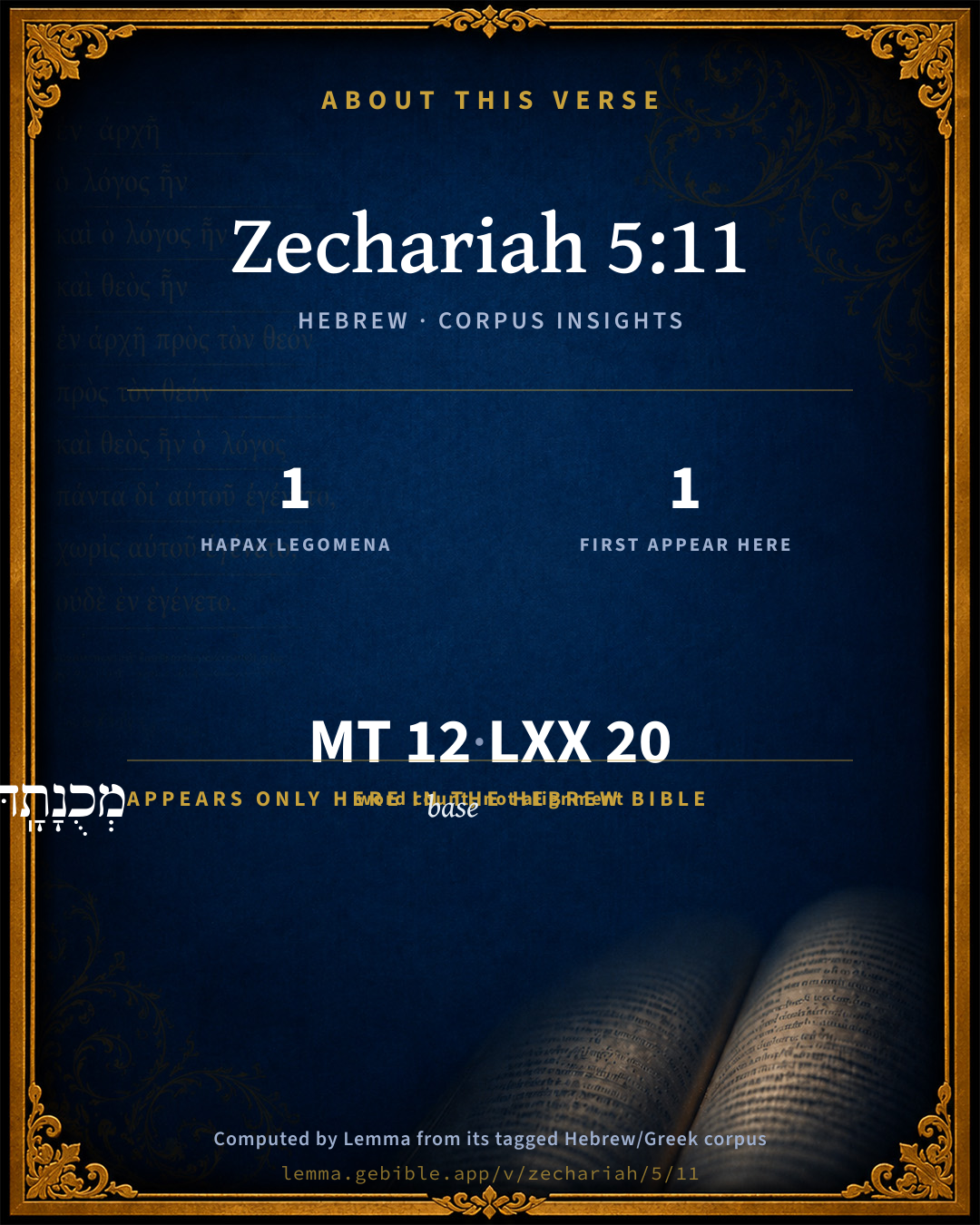
  • 1 hapax legomenon — only here in the Hebrew Bible
  • 1 first appearance in the Hebrew Bible
Full analysis ↓
Download a study sheet

One document with this verse’s original text, its word-by-word gloss line, the meaning frame, cross-references with their text, attributed commentary, and full source and license credits — printable, and it pastes into notes with its structure intact.

This verse Autodidact and up

Study sheet (.html) Plain text (.txt)

A passage Seminary Student

Up to 50 verses in one chapter. A passage sheet keeps up to 6 commentary sources and 12 cross-references per verse, in the order this page ranks them, and says so on the sheet whenever that leaves anything out. Ask for a single verse and you get the Autodidact verse sheet above.

Everything on this page stays free to read, with no account — the sheet is a download of what is already on screen, not access to it.

Want to remove ads? Support Godless Engineer
Compare translations 3

The same verse in 3 English versions, stacked beneath the original-language interlinear above. Click any original word for its lexicon entry.

Each is an independent rendering of the whole verse — the interlinear is not word-aligned to these translations.

Highlighted words mark where these versions differ — a whole-verse word diff, not a word-by-word alignment.

  • World English Bible Public Domain
    He said to me, "To build her a house in the land of Shinar. When it is prepared, she will be set there in her own place."
  • King James Version Public Domain
    And he said unto me, To build it an house in the land of Shinar: and it shall be established, and set there upon her own base.
  • unfoldingWord Literal Text CC BY-SA 4.0
    And he said to me, “To build for her a house in the land of Shinar. And it will be established, and she will be set down there on her base.”

unfoldingWord Literal Text — © unfoldingWord, licensed CC BY-SA 4.0. Word-aligned USFM3 via Door43 (git.door43.org/unfoldingWord/en_ult).

Versions to compare (up to 4)

3 of 4 selected

Show all 18 translations

Every available English version of this verse, each an independent rendering of the whole verse.

  • World English Bible Public Domain
    He said to me, "To build her a house in the land of Shinar. When it is prepared, she will be set there in her own place."
  • Berean Standard Bible Public Domain
    “To build a house for it in the land of Shinar,” he told me. “And when it is ready, the basket will be set there on its pedestal.”
  • Majority Standard Bible Public Domain
    “To build a house for it in the land of Shinar,” he told me. “And when it is ready, the basket will be set there on its pedestal.”
  • King James Version Public Domain
    And he said unto me, To build it an house in the land of Shinar: and it shall be established, and set there upon her own base.
  • American Standard Version (1901) Public Domain
    And he said unto me, To build her a house in the land of Shinar: and when it is prepared, she shall be set there in her own place.
  • Revised Version (1885) Public Domain
    And he said unto me, To build her an house in the land of Shinar: and when it is prepared, she shall be set there in her own place.
  • Geneva Bible (1599) Public Domain
    And hee saide vnto mee, To builde it an house in the lande of Shinar, and it shall be established and set there vpon her owne place.
  • Douay-Rheims (1899) Public Domain
    And he said to me: That a house may be built for it in the land of Sennaar, and that it may be established, and set there upon its own basis.
  • Young's Literal Translation Public Domain
    And he saith unto me, `To build to it a house in the land of Shinar.' And it hath been prepared and hath been placed there on its base.
  • Literal Standard Version CC BY-SA 4.0
    And he says to me, “To build a house for it in the land of Shinar.” And it has been prepared and has been placed there on its base.
  • Unlocked Literal Bible CC BY-SA 4.0
    He said to me, “To build a temple in the land of Shinar for it, so that when the temple is ready, the basket will be set there on its prepared base.”
  • unfoldingWord Literal Text CC BY-SA 4.0
    And he said to me, “To build for her a house in the land of Shinar. And it will be established, and she will be set down there on her base.”
  • Darby Bible Public Domain
    And he said unto me, To build it a house in the land of Shinar; and it shall be established, and set there upon its own base.
  • World Messianic Bible Public Domain
    He said to me, “To build her a house in the land of Shinar. When it is prepared, she will be set there in her own place.”
  • Webster's Bible Public Domain
    And he said to me, To build for it a house in the land of Shinar: and it shall be established, and set there upon her own base.
  • Free Bible Version CC BY-SA 4.0
    “They're taking it to the land of Babylon to build a house for it. When the house is ready, the barrel will be placed at its base.”
  • Bible in Basic English Public Domain
    And he said to me, To make a house for her in the land of Shinar: and they will make a place ready, and put her there in the place which is hers.
  • JPS Tanakh (1917) Public Domain
    And he said unto me: 'To build her a house in the land of Shinar; and when it is prepared, she shall be set there in her own place.

Literal Standard Version (2020), Covenant Press — licensed CC BY-SA 4.0. Text via the HelloAO Bible API (eBible.org). Unlocked Literal Bible (unfoldingWord) — licensed CC BY-SA 4.0. Text via the HelloAO Bible API (eBible.org). unfoldingWord Literal Text — © unfoldingWord, licensed CC BY-SA 4.0. Word-aligned USFM3 via Door43 (git.door43.org/unfoldingWord/en_ult). Free Bible Version, Dr. Jonathan Gallagher — licensed CC BY-SA 4.0. Text via the HelloAO Bible API (eBible.org).

Word by word

More ways to search: Search by grammar → Find every occurrence → Compare this word →

Practice this passage: Drill this verse → Learn its vocabulary →

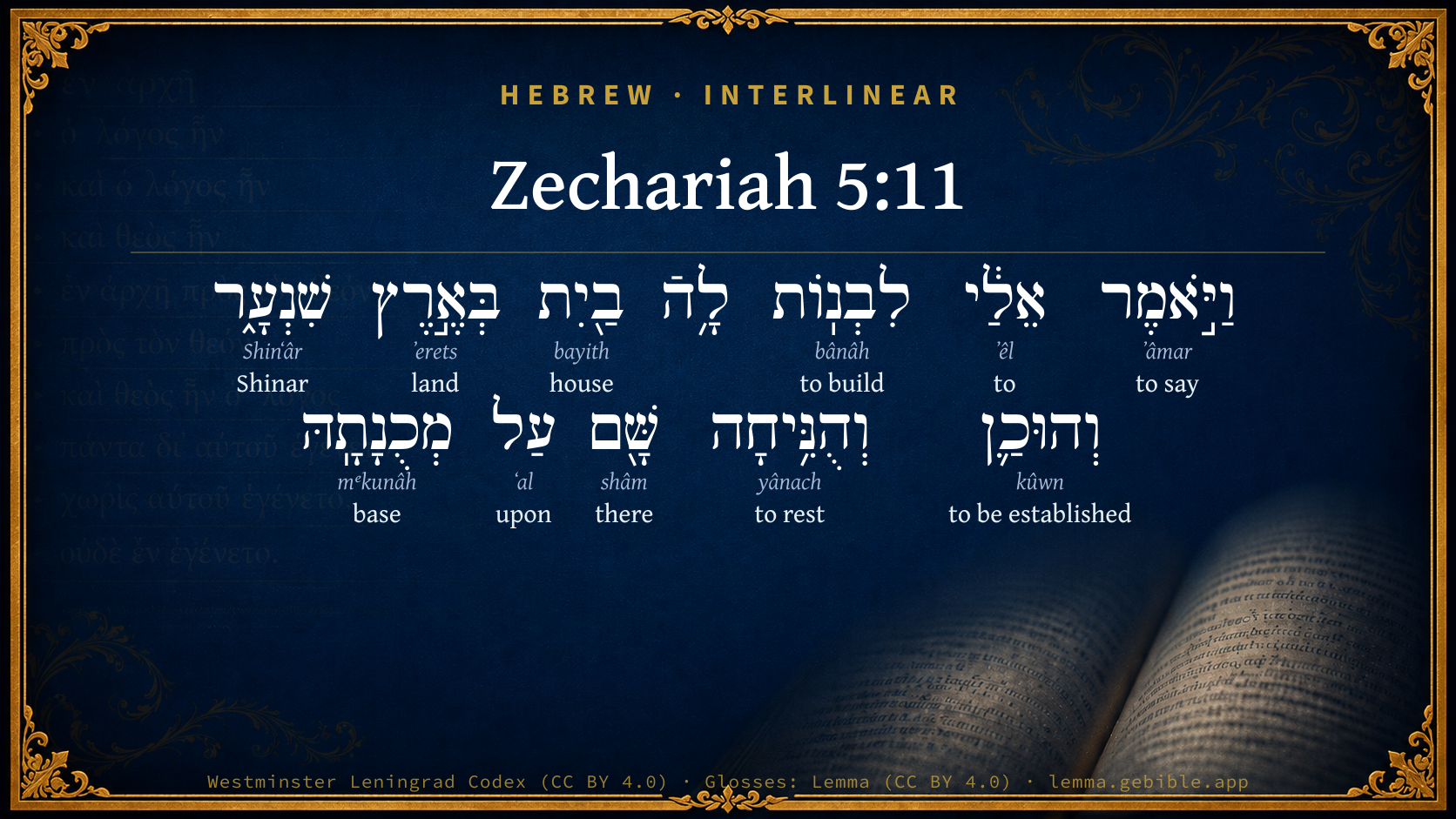
מְכֻנָתָֽהּ
mᵉkunâh
H4369
“base · her”
Noun, Common, Feminine, Singular, Construct + Suffix, Personal, 3rd Person, Feminine, Singular
Part of Speech
Noun
Type
Common
Gender
Feminine
Number
Singular
State
Construct
Full BDB Definition

Origin: the same as H4350

TWOT: 964d

resting place, base
  1. וַיֹּ֣אמֶר ʼâmar H559 “and · to say” Conjunction + Verb, Qal, Sequential Imperfect, 3rd Person, Masculine, Singular
  2. אֵלַ֔י ʼêl H413 “to · me” Preposition + Suffix, Personal, 1st Person, Common, Singular
  3. לִבְנֽוֹת bânâh H1129 “to build” Preposition + Verb, Qal, Infinitive Construct
  4. בַ֖יִת bayith H1004 “house” Noun, Common, Masculine, Singular, Absolute
  5. בְּאֶ֣רֶץ ʼerets H776 “in/at · land of” Preposition + Noun, Common, Both, Singular, Construct
  6. שִׁנְעָ֑ר Shinʻâr H8152 “Shinar” Noun, Proper
  7. וְהוּכַ֛ן kûwn H3559 “and · to be established” Conjunction + Verb, Hophal, Sequential Perfect, 3rd Person, Masculine, Singular
  8. וְהֻנִּ֥יחָה yânach H3240 “and · to rest” Conjunction + Verb, Hophal, Sequential Perfect, 3rd Person, Feminine, Singular
  9. שָּׁ֖ם shâm H8033 “there” Adverb
  10. עַל ʻal H5921 “upon” Preposition

About this verse

These counts appear in no published source. They are computed here, from the morphology-tagged text and Lemma’s own curated glosses. What Lemma adds →

12
words
11
distinct lemmas
Prophets
section

Notable vocabulary

1 hapax legomenon — a word that appears only here in the entire Hebrew Bible:

  • מְכֻנָתָֽהּ base H4369

First appearance in Scripture

This word makes its first canonical appearance in the Hebrew Bible here:

  • מְכֻנָתָֽהּ base H4369

Shared distinctive vocabulary

שִׁנְעָ֑ר Shinar H8152 occurs in 8 verses of the Hebrew Bible. Also found in:

Grammatical profile

  • 4 verbs
  • 4 nouns
  • 3 prepositions
  • 1 adverb

Verb forms

  • וַיֹּ֣אמֶר Qal · Sequential Imperfect
  • לִבְנֽוֹת Qal · Infinitive Construct
  • וְהוּכַ֛ן Hophal · Sequential Perfect
  • וְהֻנִּ֥יחָה Hophal · Sequential Perfect

Hebrew & Septuagint length

In English translation the verse runs 27 words from the Hebrew and 32 from the Septuagint (LXX English) — closely comparable.

A rough comparison of the two English renderings, which tokenize alike — not a word-level alignment.

Word counts can differ between the Hebrew and the Greek without any difference in meaning — e.g. the Hebrew direct-object marker אֵת has no separate Greek word, and Greek often adds the article ὁ.

In the original languages it is 12 Hebrew tokens and 20 Greek tokens — but the two are counted differently (Hebrew bundles its prefixes and suffixes into one token; the Greek is in lemma form), so that isn’t a like-for-like length.

Cross-references

9

Topical passages linked to Zechariah 5:11 in the Treasury of Scripture Knowledge — connected by theme and wording, ordered by reader-vote popularity; previews shown in the World English Bible.

  • Genesis 10:10 The beginning of his kingdom was Babel, Erech, Accad, and Calneh, in the land of Shinar.
  • Genesis 11:2 It happened, as they traveled east, that they found a plain in the land of Shinar; and they lived there.
  • Daniel 1:2 The Lord gave Jehoiakim king of Judah into his hand, with part of the vessels of the house of God; and he carried them into the land of Shinar to the house of his god: and he brought the vessels into the treasure-house of his god.
  • Genesis 14:1 It happened in the days of Amraphel, king of Shinar, Arioch, king of Ellasar, Chedorlaomer, king of Elam, and Tidal, king of Goiim,
  • Isaiah 11:11 It shall happen in that day, that the Lord will set his hand again the second time to recover the remnant of his people, who shall remain, from Assyria, and from Egypt, and from Pathros, and from Cush, and from Elam, and from Shinar, and from Hamath, and from the islands of the sea.
  • Jeremiah 29:28 because he has sent to us in Babylon, saying, [The captivity] is long: build you houses, and dwell in them; and plant gardens, and eat the fruit of them?
  • Luke 21:24 They will fall by the edge of the sword, and will be led captive into all the nations. Jerusalem will be trampled down by the Gentiles, until the times of the Gentiles are fulfilled.
  • Hosea 3:4 For the children of Israel shall abide many days without king, and without prince, and without sacrifice, and without sacred stone, and without ephod or idols.
  • Deuteronomy 28:59 then Yahweh will make your plagues wonderful, and the plagues of your seed, even great plagues, and of long continuance, and sore sicknesses, and of long continuance.

Cross-references courtesy of OpenBible.info (CC BY 4.0).

Hebrew and Greek witnesses Masoretic Hebrew ↔ Greek Septuagint

The same verse in the two great witnesses to the Old Testament, shown verse-for-verse.

These are two independent witnesses, not word-aligned to each other, and the Septuagint is shown in lemma (dictionary) form.

Hebrew Zechariah 5:11 Masoretic · Westminster Leningrad Codex

וַיֹּ֣אמֶר אֵלַ֔י לִבְנֽוֹת לָ֥הֿ בַ֖יִת בְּאֶ֣רֶץ שִׁנְעָ֑ר וְהוּכַ֛ן וְהֻנִּ֥יחָה שָּׁ֖ם עַל מְכֻנָתָֽהּ

He said to me, "To build her a house in the land of Shinar. When it is prepared, she will be set there in her own place."

World English Bible · Public Domain

Greek LXX Zechariah 5:11 Septuagint · lemma form

καί εἶπον πρός ἐγώ οἰκοδομέω αὐτός οἰκία ἐν γῆ βαβυλών καί ἑτοιμάζω καί τίθημι αὐτός ἐκεῖ ἐπί ὁ ἑτοιμασία αὐτός

And he said to me, To build it a house in the land of Babylon, and to prepare a place for it; and they shall set it there on its own base.

LXX2012 (modern English Septuagint) · Public Domain

On this verse, The Pulpit Commentary discusses the Septuagint’s reading. Read the note in Commentary ↓

Hebrew: Westminster Leningrad Codex (CC BY 4.0). Greek: Septuagint (public domain); English from LXX2012 (modern English Septuagint) (Public Domain). How the Septuagint differs from the Hebrew →

Targum (Aramaic paraphrase)

1

The Targum is the ancient Jewish Aramaic paraphrase of the Hebrew Scriptures — an interpretive translation, not the Hebrew text itself. Onkelos (literal) and Pseudo-Jonathan (expansive) render the Torah, and Jonathan the Prophets. Coverage is partial: where no permissively-licensed English translation exists for a verse, only the Aramaic is shown. This is verse-level text, not a word-by-word alignment to the Hebrew.

  1. Targum Jonathan Prophets (Joshua–Malachi)
    וַאֲמַר לִי לְאִתְקַנָאָה לְהוֹן אֲתַר בִּמְדִינַת בָּבֶל וְיִתְעַכְּבוּן וְיִתְאַחֲרוּן תַּמָן עַד דְיִמְטוּ זִמְנֵיהוֹן:

    (no public-domain English translation for this verse)

    Targum Jonathan — Aramaic: “Mikraot Gedolot” (public domain). English: “Sefaria Community Translation” (CC0 1.0 (public-domain dedication)); “London "Chaldee Paraphrase," 1871” (public domain). Text via Sefaria.

Commentary

Notes on Zechariah 5:11 from classic Christian and Jewish commentators (each source and its license shown beneath its notes). The classic Christian expositions comment on the surrounding passage and are grouped to its opening verse, so a note may address several verses; the Jewish commentaries on the Tanakh (Rashi and others) are per-verse, so they appear only where the commentator wrote on this verse.

Lemma curates 59 commentaries, every one of them public domain or Creative Commons licensed, each selected and text-cleaned for this edition rather than reprinted as found. About our sources →

Trapp's Complete Commentary

John Trapp

Zec 5:11 And he said unto me, To build it an house in the land of Shinar: and it shall be established, and set there upon her own base.

Ver. 11. To build it an house in the land of Shinar] That is, of Babylon, Gen 10:10; Gen 11:2, where various of the Jews still remained in wilful exile, as loth to leave their houses and gardens, which they had builded and planted there, Jer 29:5, preferring captivity before liberty, see 1Ch 4:22-23. Hence, upon their final dispersion by the Romans, various of them resorted there for entertainment. There Peter, the apostle of the circumcision, had collected an elected Church, 1Pe 5:13, and thence he writeth his epistle to the sojourning Jews scattered through those eastern parts, 1Pe 1:1, from whence also those kings of the east, Rev 16:12, the converted Jews (as some expound it), are expected. And who can tell whether this land of Shinar be not the same with that land of Sinim? Isa 49:12; confer Isa 11:16 Zec 10:11. Or, by the land of Shinar here, may be meant exilium totius orbis, their general rejection by all nations; the whole world being to them Shinar, that is, a land of excussion.

And it shall be established, &c.] This denoteth the diuturnity or perpetuity of their punishment.

John Trapp, A Commentary or Exposition upon All the Books of the Old and New Testament (1647–1656) — public domain. Text from a community e-Sword module.

Tyndale Open Study Notes

Tyndale Open Resources

5:11 Idolatry is potently and aggressively evil; it cannot be confined, but must be shipped back to its source (Babylonia) by God’s decree. This symbolism indicates that God is able to purge his people of all the various forms of wickedness that separated them from him. • The land of Babylonia was the land of Hebrew captivity (Mic 4:10). The prophets condemn it as wicked and idolatrous (Isa 46–47; Jer 50–51). In the New Testament, Babylon represents the evil Roman Empire (Rev 17:5; 18:2; see 1 Pet 5:13).

Tyndale Open Study Notes — © Tyndale Open Resources, licensed CC BY-SA 4.0. Text via the HelloAO Bible API.

Geneva Bible (1599)

Geneva Bible translators

To remove the iniquity and affliction that came for the same from Judah, to place it forever in Babylon.

Geneva Bible (1599) marginal notes — public domain. Text via Bolls.life.

Jamieson, Fausset & Brown

Robert Jamieson, A. R. Fausset & David Brown

To build . . . house in . . . Shinar--Babylonia (Gen 10:10), the capital of the God-opposed world kingdoms, and so representing in general the seat of irreligion. As the "building of houses" in Babylon (Jer 29:5, Jer 29:28) by the Jews themselves expressed their long exile there, so the building of an house for "wickedness" there implies its permanent stay.

set . . . upon her own base--fixed there as in its proper place. "Wickedness" being cast out of Judah, shall for ever dwell with the antichristian apostates (of whom Babylon is the type), who shall reap the fruit of it, which they deserve.

Next: Zechariah Chapter 6

Jamieson, Fausset & Brown — Commentary Critical and Explanatory on the Whole Bible (1871) — public domain (CC PDM 1.0). Text via the HelloAO Bible API.

Adam Clarke's Commentary

Verse 11. To build it a house in the land of Shinar] The land of Shinar means Babylon; and Babylon means Rome, in the Apocalypse. The building the house for the woman imprisoned in the ephah may signify, that there should be a long captivity under the Romans, as there was under that of Shinar or Babylon, by which Rome may here be represented. That house remains to the present day: the Jewish woman is still in the ephah; it is set on its own base-continues still as a distinct nation; and the talent of lead-God's displeasure-is still on the top. O Lord, save thy people, the remnant of Israel!

Adam Clarke's Commentary on the Bible (1810–1826) — public domain. Text from a community e-Sword/MySword module.

Ellicott's Commentary for English Readers

(11) Land of Shinar.—Where mankind had first organised a rebellion against God (Gen_12:2); it was also the land of the Captivity of the Jews (Babylonia).

This vision is a circumstantial symbolisation of the promise given in Zec_3:9 : “I will remove the iniquity of the land in one day.” While it is a promise of the remission of the punishment of their iniquity (for in Hebrew, “iniquity” often means punishment), it serves also as an exhortation to the returned exiles to leave in Babylon the iniquity which had been the cause of their being transported thither.

A Bible Commentary for English Readers, edited by Charles John Ellicott (1878–1897) — public domain. Text from a community e-Sword module.

The Cambridge Bible for Schools and Colleges

gen. ed. J. J. S. Perowne

11. To build it a house] The word “it” is feminine (lit. her), and may refer either to the ephah or to the woman, as the words, on her own base, at the end of the verse may also do. It is perhaps simplest to understand the reference in both cases to be to the woman, whose destination was by implication asked in the prophet’s question, Zec_5:10. The house may be either a dwelling-place, or possibly a temple, “as Dagon (1Sa_5:2-5), or Ashtaroth (Ib. 1Sa_5:10), or Baal (2Ki_10:23), had their houses or temples, a great idol temple in which the God of this world should be worshipped.” Pusey.

in the land of Shinar] i.e. Babylonia, with a reference perhaps to “that first attempt to array a world-empire against God,” which took place in “the land of Shinar.” Gen_11:2.

it shall be established] i.e. the house.

and set there] Rather, and she (the woman) shall be made to rest there. The whole verse will then read, as in R. V., To build her an house in the land of Shinar: and when it is prepared, she shall be set there in her own place.

The Eighth Vision. The Four Chariots, Zec_6:1-8. In this vision four chariots appear to the prophet coming upon the scene, along the valley or defile between two mountains of brass or copper, Zec_5:1. The chariots are drawn by horses of different colours, Zec_5:2-3. In answer to the prophet’s enquiry, Zec_5:4, the Interpreting Angel informs him that these chariots represent the four spirits or winds of heaven, which are coming forth from the immediate presence of God, charged with the commands which He had there laid upon them, Zec_5:5. Of three of these chariots, distinguishing them by the colours of the horses which are yoked to them, the angel then announces the destination. Passing by the first chariot to which red horses were attached, he says that the second which had black horses was on its way to “the north country,” the land of Babylon, to be followed thither by the third which was drawn by white horses. The fourth chariot, with its speckled, or piebald horses, was about to visit “the south country,” Zec_5:6; but inasmuch as its horses were specially “strong,” their commission was extended, and the whole earth granted them for their course, Zec_5:7. Upon this the Interpreting Angel cries aloud to the prophet in the name of Jehovah, that by the mission of these His messengers of wrath, His sore displeasure (chap. Zec_1:15) against His enemies and the enemies of His people in the north country is appeased, and His spirit quieted, Zec_5:8.

The Cambridge Bible for Schools and Colleges (gen. ed. J. J. S. Perowne; Cambridge University Press, 1878–1918) — public domain. Text from a community e-Sword module.

John Gill's Exposition

And he said unto me, To build it an house in the land of Shinar,.... That is, in the province of Babylon, as the Targum paraphrases it; for Babel, or Babylon, was in the land of Shinar, Gen 10:10 whither the Jews were carried captive, Dan 1:2 Isa 11:11, and the bearing of the "ephah" thither may denote the cause of their captivity, the measure of sins filled up by them: though this some understand of the like injuries, oppressions, and vexations, brought upon the Chaldeans in the land of Shinar, which they before exercised towards and upon the Jews; and others of the rejection of wicked men from among the Jews, by Ezra and Nehemiah, transporting them as it were back to Babylon again: others of the dispersion of the Jews by the Romans, who chiefly settled after that in the eastern parts of the world; though indeed the whole world was a land of Shinar, or "shaking out" (n) unto them; they being shook out of their own land, and scattered about everywhere; which dispersion has been long and lasting, notorious and conspicuous; and they are now settled upon their own base, established upon their former principles of legality and self-righteousness, and rejection of the true Messiah; or rather this may be understood of the transfer of the ephah, or whole measure of iniquity, into mystical Babylon. The antichristian church of Rome is called Babylon; she is represented as a sink of sin, a mystery of iniquity, Rev 17:5 and a house being built for this man of sin, antichrist, denotes the continuance of him; and being established on its own base, shows the false foundation on which the church of Rome is built, and her carnal security. So Cocceius, by the "two women", understands the two kingdoms or powers of antichrist, the civil and ecclesiastical powers; which support the man of sin, lift him up, and give him the highest place in the church, and fix his seat where idolatry and persecution reign, as formerly did in Babylon, in the land of Shinar. Though the whole may very well be applied to the last and everlasting punishment of sin and sinners, when the whole measure is filled up. The end of sin and sinners is death and everlasting destruction. The ephah, and the woman in it, are carried, not upwards to heaven, nor to the New Jerusalem, but to the land of Shinar, the land of shaking; to hell, where are utter darkness, weeping, wailing, and gnashing of teeth; where a house is built for them, which denotes their continuance there; and which, being established on its own base, shows their punishment shall forever remain; their worm never dies; their fire is not quenched; the smoke of it ascends for ever and ever; their destruction is an everlasting destruction.

(n) "terra excussionis", Menoch ins.

Next: Zechariah Chapter 6

John Gill's Exposition of the Whole Bible (1746–1763) — public domain (CC PDM 1.0). Text via the HelloAO Bible API.

Albert Barnes' Notes on the Bible

To build it an house in the land of Shinar - The name of Shinar, though strictly Babylonia, carries back to an older power than the world-empire of Babylon; which now too was destroyed. “In the land of Shinar” Gen 11:2 was that first attempt to array a world-empire against God, ere mankind was ye dispersed. And so it is the apter symbol of the antitheist or anti-Christian world, which by violence, art, falsehood, sophistry, wars against the truth. To this great world-empire it was to be removed; yet to live there, no longer cramped and confined as within an Ephah, but in pomp and splendor. A house or temple was to be built for it, for its honor and glory; as Dagon 1Sa 5:2-5 or Ashtaroth 1Sa 31:10, or Baal 2Ki 10:23 had their houses or temples, a great idol temple, in which the god of this world should be worshiped.

And it - - “The house,” “shall be established” firmly on its base, like the house of God, and it, (wickedness) shall be tranquilly rested on its base, as an idol in its temple, until the end come. In the end, the belief of those of old was, that the Jews would have great share in the antagonism to Christ and His empire. At the first, they were the great enemies of the faith, and sent forth, Justin says, , those everywhere who should circulate the calumnies against Christians, which were made a ground of early persecutions. In the end, it was believed, that antichrist should be from them, that they would receive him as their Christ, the last fulfillment of our Lord’s words, “I am come in My Father’s name and ye receive Me not; another shall come in his own name, him ye will receive” Joh 5:43.

Albert Barnes' Notes on the Bible (1834–1885) — public domain. Text from a community e-Sword/MySword module.

Haydock's Catholic Bible Commentary

the land of Sennaar, where Babel or Babylon was built; (Genesis ix.) where note that Babylon, in holy writ, is often taken for the city of the devil, (that is, for the whole congregation of the wicked) as Jerusalem is taken for the city and people of God. (Challoner) --- Antichrist will begin his reign at Babylon. (Worthington) --- Yet this is not clear. (Haydock) --- The Chaldeans are driven from the countries which they had seized, and confined to their own territory, by the Persians and Greeks; or, if we explain it of the Jews, many of them remained at Babylon, and did not return to defile their own country. Only those whose hearts were touched by God returned, 1 Esdras i. 5. (Calmet) --- Sennaar means "excussion." The Jews have been driven by the Chaldeans and Romans into all parts. (Menochius)

George Leo Haydock (1774–1849), Haydock's Catholic Family Bible and Commentary, 1859 edition — public domain. Excludes Psalms (Douay-Rheims chapter numbering differs from Protestant) and Deuterocanonical books (Catholic canon only).

Matthew Poole's English Annotations

The angel gives him an answer fuller than his question, and first tells the prophet what was to be done with it.

To build it a house, not in mercy, but in judgment, as intending the next deportation should not be, as the first, for seventy years, but for ever they should never return.

In the land of Shinar; of Babylon, whither many of the Jews fled, and so by voluntary exile fulfilled this prophecy; Whither other’s of them were forced by the Romans.

It shall be established, and set there; there they shall be confined without hope of release.

Upon her own base; not on the foundation of God’s promise and covenant, but the base of their sins.

Matthew Poole's English Annotations on the Holy Bible (1683–1685) — public domain. Text from a community e-Sword/MySword module.

The Pulpit Commentary

To build it (her) a house. The LXX refers the pronoun to the ephah, but it seems more natural to refer it to a person, the woman. The feminine gender of the original would apply to either. She is carried away from Judaea to have a permanent dwelling in a land more suited to her. Pusey thinks that possibly a temple may be intended, "a great idol temple, in which the god of this world should be worshipped." In the land of Shinar; i.e. the ideal land of unholiness, where the world power first arrayed itself against God in the attempt at Babel. Septuagint, en gh Babulwnov , . (Gen_11:2, etc.) Shinar, equivalent to Sumer in the Assyrian monuments, denotes Lower or Southern Babylon; Accad, Upper or Northern Babylon. And it shall be established. The house shall be firmly fixed there. Others render, "when it is ready." And set there. The gender shows that the woman is meant, not the house: "And she shall be set there in her own place." Thus from the spiritual Zion all wickedness shall be abolished (Zec_3:9) and sent to its own place prepared for the enemies of God and holiness. Doubtless, too, a warning is here conveyed to those Jews who still lingered in Babylon, that they were dwelling in a land accursed of God, and were liable to be involved in the fate which pursues ungodliness. Orelli and some others see in these two visions an analogy to the two goats on the Day of Atonement, of which one was sacrificed for the sins of the people, and the other bore away their iniquity to the demons" abode, the wilderness (Leviticus 16).

The Pulpit Commentary (1880–1919), ed. H.D.M. Spence-Jones & Joseph S. Exell — public domain. Text from a community e-Sword module.

John Wesley's Explanatory Notes

To build - Not in mercy, but in judgment. Of Shinar - Of Babylon whither many of the Jews fled, and others of them were forced by the Romans. Set there - There they shall be confined without hope of release. Her own base - They are settled upon the lees of their own unbelief: their wickedness is established on its own bases.

John Wesley, Explanatory Notes Upon the Whole Bible (1754–1765) — public domain. Text via the GEBible commentary corpus.

Scofield Reference Notes

C. I. Scofield

Shinar

i.e. Babylonia. Dan 1:2

The Scofield Reference Bible (1917 edition), notes by C. I. Scofield — public domain. Text from a community e-Sword module.

Rashi

Rabbi Shlomo Yitzchaki (Rashi)

and it will be prepared, and they shall place it there And the house shall be prepared, and the ephah shall be placed there with the wicked that are within it.

there In that house.

on its base On its permanence and on its base. Here He hinted [to Zechariah] that, because of the iniquity of Israel, who measured out [so to speak] with the measure of sins and wickedness, they were punished with the same measure. And there came two nations that ruled together; they were Babylon and the Chaldeans - the army of Nebuchadnezzar - and exiled [Israel] to Babylon where [Israel] stayed fixed on a base, a base that was established for them. That is according to the completion of the seventy years until now, when they returned. This interpretation leans partially toward that of Jonathan. This [phrase] is interpreted in many [other] ways, but they are not satisfactory to me. Our Sages, however, explained and learned from here that the evil inclination was given into the hands of the men of the Great Assembly, and they cast it into a leaden cauldron and covered it with lead, because lead absorbs the sound, as is stated in tractate Sanhedrin (24a) and in tractate Yoma (69b). My interpretation of the kingdom of Nebuchadnezzar as doubled - composed of two nations - I saw in Midrash Psalms (6:2, 18: 10), that the following four kingdoms that subjugated Israel were double: Babylon and the Chaldeans, Media and Persia, Greece and Macedon, Edom and Ishmael, and for this reason the Kalir composed (in Piyutim for Shemini Azereth), “It is the fourth; it is the eighth,” concerning Edom.

Rashi on the Tanakh — English translations: “The Judaica Press complete Tanach with Rashi, translated by A. J. Rosenberg” (CC BY 4.0); “Pentateuch with Rashi's commentary by M. Rosenbaum and A.M. Silbermann, 1929-1934” (public domain); “The Metsudah Tanach series, Lakewood, N.J” (CC BY 4.0); and “The Book of Joshua, Metsudah Publications, 1997” (CC BY 4.0). Text via Sefaria.

Lesson kit

Teaching starters — assembled from the data on this page, not authored interpretation. Every prompt links to the verse data it draws on. Edit before teaching.

Zechariah, in the Prophets, opens this verse with 12 words (11 distinct Hebrew lemmas). Its most distinctive word is mᵉkunâh (“base”). A historical commentator’s framing appears above. Read the whole chapter for the surrounding context.

Discussion questions

  1. The word mᵉkunâh carries the sense “base.” How does it shape the verse?
  2. This verse holds 1 word here found nowhere else in the Hebrew Bible. What might the rare word draw attention to?
  3. The word “base” first appears here in Scripture. What is being introduced at this debut?
  4. Genesis 10:10 shares the word «Shinar» with this verse. How do the two illuminate each other?
  5. These translations render this verse differently; the difference is in the English rendering, not the original. What questions does that raise?
  6. The verb «וַיֹּ֣אמֶר» is Qal Sequential Imperfect. How does its form color the action?
  7. Reading how Trapp's Complete Commentary and Tyndale Open Study Notes read this verse, where do the two commentators agree and where do they part?

Things to notice

Reading settings

Reading text

Shown beneath each verse's original-language words.

Old Testament
Old Testament edition

Read the OT as the Masoretic Hebrew (MT) or the Greek Septuagint (LXX).

English shown for the Greek Septuagint (in the Hebrew ↔ Greek comparison).

Comparing translations? Open the Compare panel on any verse page to stack up to four side by side.