Jeremiah 30:20

Hebrew (Westminster Leningrad Codex) Jeremiah 30:20 appears in the Hebrew Old Testament. The text above is from the Westminster Leningrad Codex. Each word links to its Strong’s number, a concise gloss, and parsing drawn from the Open Scriptures Hebrew Bible morphology. Click any word for its full Brown-Driver-Briggs (BDB) entry.
Download image
Cite this verse

Jeremiah 30:20 (World English Bible). Public Domain. Lemma interlinear Bible study tool, https://lemma.gebible.app/v/jeremiah/30/20.

Show BibTeX & RIS
BibTeX
RIS
English Translation
Their children also shall be as before, and their congregation shall be established before me; and I will punish all who oppress them.
World English Bible · Public Domain
Download a study sheet

One document with this verse’s original text, its word-by-word gloss line, the meaning frame, cross-references with their text, attributed commentary, and full source and license credits — printable, and it pastes into notes with its structure intact.

This verse Autodidact and up

Study sheet (.html) Plain text (.txt)

A passage Seminary Student

Up to 50 verses in one chapter. A passage sheet keeps up to 6 commentary sources and 12 cross-references per verse, in the order this page ranks them, and says so on the sheet whenever that leaves anything out. Ask for a single verse and you get the Autodidact verse sheet above.

Everything on this page stays free to read, with no account — the sheet is a download of what is already on screen, not access to it.

Want to remove ads? Support Godless Engineer
Compare translations 3

The same verse in 3 English versions, stacked beneath the original-language interlinear above. Click any original word for its lexicon entry.

Each is an independent rendering of the whole verse — the interlinear is not word-aligned to these translations.

Highlighted words mark where these versions differ — a whole-verse word diff, not a word-by-word alignment.

  • World English Bible Public Domain
    Their children also shall be as before, and their congregation shall be established before me; and I will punish all who oppress them.
  • King James Version Public Domain
    Their children also shall be as aforetime, and their congregation shall be established before me, and I will punish all that oppress them.
  • unfoldingWord Literal Text CC BY-SA 4.0
    Then their people will be like before, and their assembly will be established before me when I punish all the ones who are now tormenting them.

unfoldingWord Literal Text — © unfoldingWord, licensed CC BY-SA 4.0. Word-aligned USFM3 via Door43 (git.door43.org/unfoldingWord/en_ult).

Versions to compare (up to 4)

3 of 4 selected

Show all 18 translations

Every available English version of this verse, each an independent rendering of the whole verse.

  • World English Bible Public Domain
    Their children also shall be as before, and their congregation shall be established before me; and I will punish all who oppress them.
  • Berean Standard Bible Public Domain
    Their children will be as in days of old, and their congregation will be established before Me; and I will punish all their oppressors.
  • Majority Standard Bible Public Domain
    Their children will be as in days of old, and their congregation will be established before Me; and I will punish all their oppressors.
  • King James Version Public Domain
    Their children also shall be as aforetime, and their congregation shall be established before me, and I will punish all that oppress them.
  • American Standard Version (1901) Public Domain
    Their children also shall be as aforetime, and their congregation shall be established before me; and I will punish all that oppress them.
  • Revised Version (1885) Public Domain
    Their children also shall be as aforetime, and their congregation shall be established before me, and I will punish all that oppress them.
  • Geneva Bible (1599) Public Domain
    Their children also shall be as afore time, and their congregation shall be established before me: and I will visite all that vexe them.
  • Douay-Rheims (1899) Public Domain
    And their children shall be as from the beginning, and their assembly be permanent before me: and I will against all that afflict them.
  • Young's Literal Translation Public Domain
    And his sons have been as aforetime, And his company before Me is established, And I have seen after all his oppressors.
  • Literal Standard Version CC BY-SA 4.0
    And his sons have been as before, || And his congregation is established before Me, || And I have seen after all his oppressors.
  • Unlocked Literal Bible CC BY-SA 4.0
    Then their people will be like before, and their assembly will be established before me when I punish all the ones who are now tormenting them.
  • unfoldingWord Literal Text CC BY-SA 4.0
    Then their people will be like before, and their assembly will be established before me when I punish all the ones who are now tormenting them.
  • Darby Bible Public Domain
    And their sons shall be as aforetime; and their assembly shall be established before me; and I will punish all that oppress them.
  • World Messianic Bible Public Domain
    Their children also will be as before, and their congregation will be established before me. I will punish all who oppress them.
  • Webster's Bible Public Domain
    Their children also shall be as in former time, and their congregation shall be established before me, and I will punish all that oppress them.
  • Free Bible Version CC BY-SA 4.0
    Their children will be looked after like they used to be. I will make their nation strong again, and punish anyone who attacks them.
  • Bible in Basic English Public Domain
    And their children will be as they were in the old days, and the meeting of the people will have its place before me, and I will send punishment on all who are cruel to them.
  • JPS Tanakh (1917) Public Domain
    Their children also shall be as aforetime, and their congregation shall be established before Me, and I will punish all that oppress them.

Literal Standard Version (2020), Covenant Press — licensed CC BY-SA 4.0. Text via the HelloAO Bible API (eBible.org). Unlocked Literal Bible (unfoldingWord) — licensed CC BY-SA 4.0. Text via the HelloAO Bible API (eBible.org). unfoldingWord Literal Text — © unfoldingWord, licensed CC BY-SA 4.0. Word-aligned USFM3 via Door43 (git.door43.org/unfoldingWord/en_ult). Free Bible Version, Dr. Jonathan Gallagher — licensed CC BY-SA 4.0. Text via the HelloAO Bible API (eBible.org).

Word by word

More ways to search: Search by grammar → Find every occurrence → Compare this word →

Practice this passage: Drill this verse → Learn its vocabulary →

לֹחֲצָֽיו
lâchats
H3905
“oppressing · him”
Verb, Qal, Participle Active, Masculine, Plural, Construct + Suffix, Personal, 3rd Person, Masculine, Singular
Part of Speech
Verb
Stem
Qal
Form
Participle Active
Gender
Masculine
Number
Plural
State
Construct
Full BDB Definition

Origin: a primitive root

TWOT: 1106

to squeeze, press, oppress - (Qal) - to squeeze, press - to oppress - (Niphal) to squeeze oneself
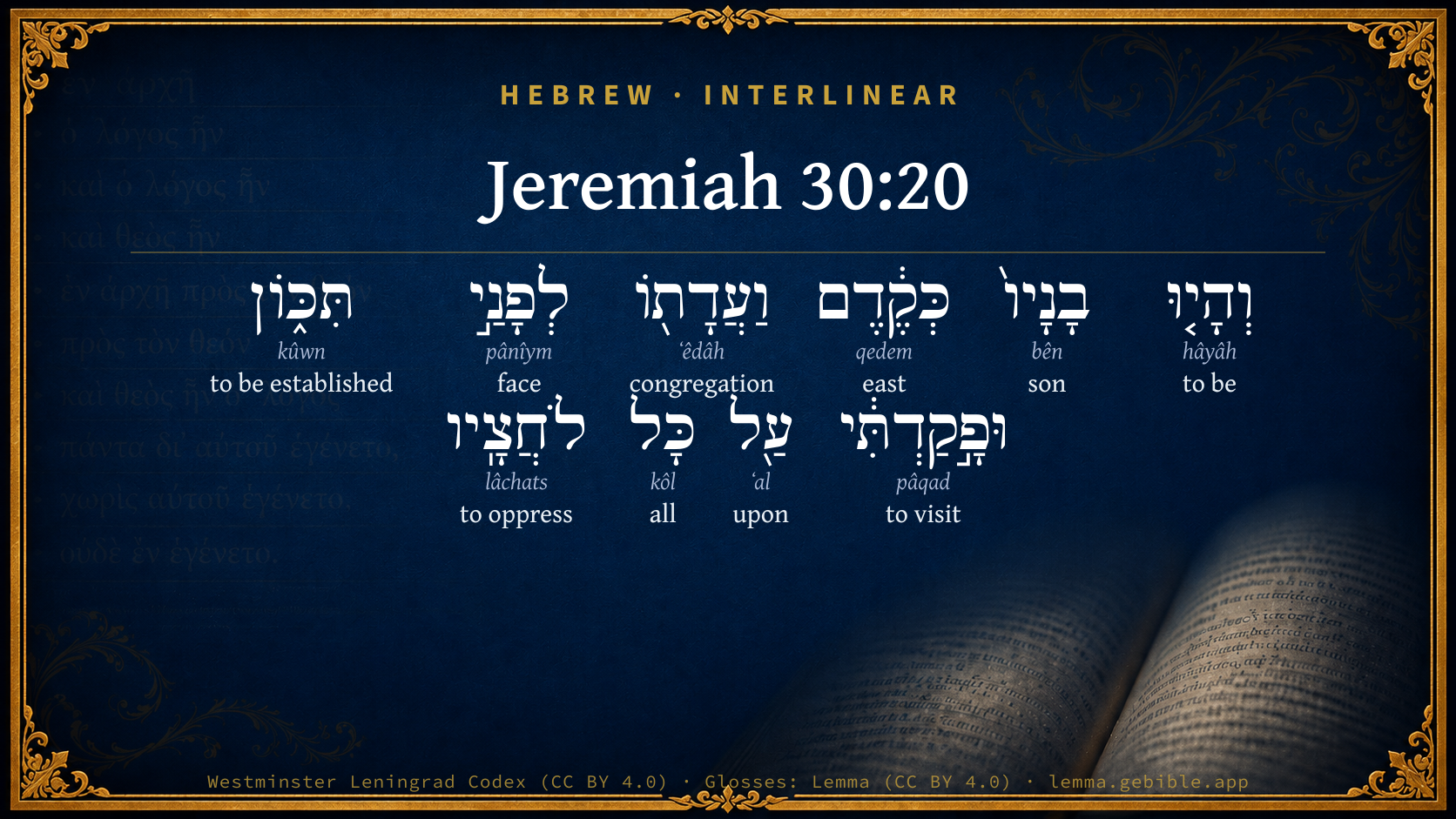
  1. וְהָי֤וּ hâyâh H1961 “and · to be” Conjunction + Verb, Qal, Sequential Perfect, 3rd Person, Common, Plural
  2. בָנָיו֙ bên H1121 “sons · his” Noun, Common, Masculine, Plural, Construct + Suffix, Personal, 3rd Person, Masculine, Singular
  3. כְּקֶ֔דֶם qedem H6924 “like/as · east” Preposition + Noun, Common, Masculine, Singular, Absolute
  4. וַעֲדָת֖וֹ ʻêdâh H5712 “and · congregation · his” Conjunction + Noun, Common, Feminine, Singular, Construct + Suffix, Personal, 3rd Person, Masculine, Singular
  5. לְפָנַ֣י pânîym H6440 “to/for · face(s) · my” Preposition + Noun, Common, Both, Plural, Construct + Suffix, Personal, 1st Person, Common, Singular
  6. תִּכּ֑וֹן kûwn H3559 “to be established” Verb, Niphal, Imperfect, 3rd Person, Feminine, Singular
  7. וּפָ֣קַדְתִּ֔י pâqad H6485 “and · to visit” Conjunction + Verb, Qal, Sequential Perfect, 1st Person, Common, Singular
  8. עַ֖ל ʻal H5921 “upon” Preposition
  9. כָּל kôl H3605 “all of” Noun, Common, Masculine, Singular, Construct

About this verse

These counts appear in no published source. They are computed here, from the morphology-tagged text and Lemma’s own curated glosses. What Lemma adds →

10
words
10
distinct lemmas
Prophets
section

Notable vocabulary

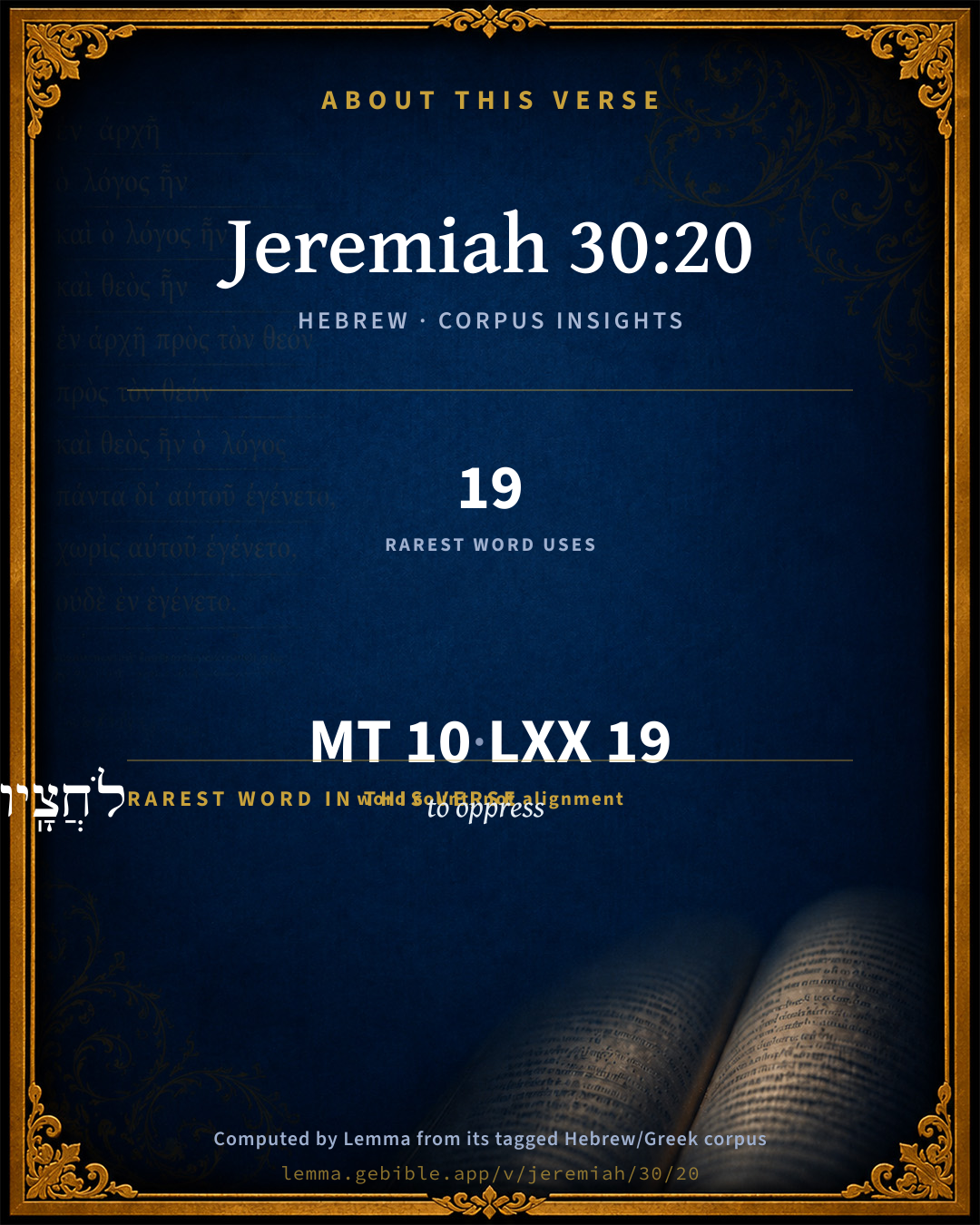
The rarest word here is לֹחֲצָֽיו to oppress H3905 — appearing just 19 times in the whole Hebrew Bible.

Shared distinctive vocabulary

לֹחֲצָֽיו to oppress H3905 occurs in 18 verses of the Hebrew Bible. Also found in:

Grammatical profile

  • 4 verbs
  • 5 nouns
  • 1 preposition

Verb forms

  • וְהָי֤וּ Qal · Sequential Perfect
  • תִּכּ֑וֹן Niphal · Imperfect
  • וּפָ֣קַדְתִּ֔י Qal · Sequential Perfect
  • לֹחֲצָֽיו Qal · Participle Active

Hebrew & Septuagint length

In the original languages it is 10 Hebrew tokens and 19 Greek tokens — but the two are counted differently (Hebrew bundles its prefixes and suffixes into one token; the Greek is in lemma form), so that isn’t a like-for-like length.

Cross-references

12

Topical passages linked to Jeremiah 30:20 in the Treasury of Scripture Knowledge — connected by theme and wording, ordered by reader-vote popularity; previews shown in the World English Bible.

  • Jeremiah 32:39 and I will give them one heart and one way, that they may fear me forever, for the good of them, and of their children after them:
  • Jeremiah 2:3 Israel [was] holiness to Yahweh, the first fruits of his increase: all who devour him shall be held guilty; evil shall come on them, says Yahweh.
  • Jeremiah 50:33–34 Thus says Yahweh of hosts: The children of Israel and the children of Judah are oppressed together; and all who took them captive hold them fast; they refuse to let them go.
  • Genesis 17:5–9 Neither will your name any more be called Abram, but your name will be Abraham; for the father of a multitude of nations have I made you.
  • Psalms 102:18 This will be written for the generation to come. A people which will be created will praise Yah.
  • Psalms 102:28 The children of your servants will continue. Their seed will be established before you."
  • Isaiah 49:26 I will feed those who oppress you with their own flesh; and they shall be drunken with their own blood, as with sweet wine: and all flesh shall know that I, Yahweh, am your Savior, and your Redeemer, the Mighty One of Jacob.
  • Isaiah 51:22 Thus says your Lord Yahweh, and your God who pleads the cause of his people, Behold, I have taken out of your hand the cup of staggering, even the bowl of the cup of my wrath; you shall no more drink it again:
  • Psalms 90:16–17 Let your work appear to your servants; Your glory to their children.
  • Isaiah 54:14 In righteousness shall you be established: you shall be far from oppression, for you shall not be afraid; and from terror, for it shall not come near you.
  • Jeremiah 30:16 Therefore all those who devour you shall be devoured; and all your adversaries, everyone of them, shall go into captivity; and those who despoil you shall be a spoil, and all who prey on you will I give for a prey.
  • Isaiah 1:26–27 I will restore your judges as at the first, And your counselors as at the beginning. Afterward you shall be called 'The city of righteousness, A faithful town.'

Cross-references courtesy of OpenBible.info (CC BY 4.0).

Hebrew and Greek witnesses Masoretic Hebrew ↔ Greek Septuagint

The same verse in the two great witnesses to the Old Testament, shown verse-for-verse.

These are two independent witnesses, not word-aligned to each other, and the Septuagint is shown in lemma (dictionary) form.

Hebrew Jeremiah 30:20 Masoretic · Westminster Leningrad Codex

וְהָי֤וּ בָנָיו֙ כְּקֶ֔דֶם וַעֲדָת֖וֹ לְפָנַ֣י תִּכּ֑וֹן וּפָ֣קַדְתִּ֔י עַ֖ל כָּל לֹחֲצָֽיו

Their children also shall be as before, and their congregation shall be established before me; and I will punish all who oppress them.

World English Bible · Public Domain

Greek LXX Structure differs

In the Septuagint, Jeremiah is about an eighth shorter than the Hebrew and arranges its material differently — the Oracles Against the Nations (Hebrew chapters 46–51) appear in the middle of the Greek book, after 25:13. Because the chapter and verse boundaries do not line up, a verse-for-verse comparison with the Hebrew is not shown.

A verse-for-verse comparison isn’t shown here because the chapters and verses don’t line up. Switch to the LXX edition with the MT / LXX toggle above to read the Greek directly.

Hebrew: Westminster Leningrad Codex (CC BY 4.0). Greek: Septuagint (public domain); English from a public-domain English Septuagint. How the Septuagint differs from the Hebrew →

Targum (Aramaic paraphrase)

1

The Targum is the ancient Jewish Aramaic paraphrase of the Hebrew Scriptures — an interpretive translation, not the Hebrew text itself. Onkelos (literal) and Pseudo-Jonathan (expansive) render the Torah, and Jonathan the Prophets. Coverage is partial: where no permissively-licensed English translation exists for a verse, only the Aramaic is shown. This is verse-level text, not a word-by-word alignment to the Hebrew.

  1. Targum Jonathan Prophets (Joshua–Malachi)
    וְיִסְגוֹן בְּנֵיהוֹן כִּדְמַלְקַדְמִין וּכְנִשְׁתְּהוֹן קֳדָמָי תְּתַקֵן וְאַסְעַר בִּישְׁתָא עַל כָּל דָחְקֵיהוֹן:

    (no public-domain English translation for this verse)

    Targum Jonathan — Aramaic: “Mikraot Gedolot” (public domain). English: “Sefaria Community Translation” (CC0 1.0 (public-domain dedication)); “London "Chaldee Paraphrase," 1871” (public domain). Text via Sefaria.

Commentary

Notes on Jeremiah 30:20 from classic Christian and Jewish commentators (each source and its license shown beneath its notes). The classic Christian expositions comment on the surrounding passage and are grouped to its opening verse, so a note may address several verses; the Jewish commentaries on the Tanakh (Rashi and others) are per-verse, so they appear only where the commentator wrote on this verse.

Lemma curates 59 commentaries, every one of them public domain or Creative Commons licensed, each selected and text-cleaned for this edition rather than reprinted as found. About our sources →

Trapp's Complete Commentary

John Trapp

Jer 30:20 Their children also shall be as aforetime, and their congregation shall be established before me, and I will punish all that oppress them.

Ver. 20. Their children also shall be as aforetime.] How easily can the Lord "turn again the captivity of his people," set them statu quo prius? "They shall be as if I had not cast them off." {Zec 10:6} {See Trapp on "Zec 10:6"}

John Trapp, A Commentary or Exposition upon All the Books of the Old and New Testament (1647–1656) — public domain. Text from a community e-Sword module.

Jamieson, Fausset & Brown

Robert Jamieson, A. R. Fausset & David Brown

as aforetime--as flourishing as in the time of David.

Jamieson, Fausset & Brown — Commentary Critical and Explanatory on the Whole Bible (1871) — public domain (CC PDM 1.0). Text via the HelloAO Bible API.

Adam Clarke's Commentary

Verse 20. Their children also] They shall have the education of their own children as formerly.

And their congregation] Their religious assemblies.

Shall be established] Being, in the latter days, incorporated with those "who serve the Lord their God, and worship the Messiah, the son of David."

Adam Clarke's Commentary on the Bible (1810–1826) — public domain. Text from a community e-Sword/MySword module.

John Calvin's Commentaries

This abundance of words which the Prophet employs is by no means useless; for we ought always to remember how hard were their temptations when no token of God’s favor appeared for seventy years. It was hence necessary to sustain minds overwhelmed with evils by many supports, so that they might not wholly faint; and he adds promises to promises, that the Jews might see as it were a spark of light from the deep abyss. And hence, also, we may gather a useful admonition: Though the Lord may favor us today, so that we are not exercised by very grievous trials, yet every one knows by his own experience, how prone we are to despond; and then when we once begin to faint, how difficult it is to be raised up to the confidence of hope. Let us then learn to join promises to promises, so that if one will not suffice, another may.

He now says that their children would be as from the beginning Some give this refined explanation, that the children of the Church would be as from the beginning, that is, before the Law; for the covenant of grace was made by God with Abraham before the Law was proclaimed: they hence think that the abrogation of the Law is here denoted, as though he had said, that the Church would be free when Christ came, and that the servile yoke of the Law would then be removed. But this kind of refinement I cannot approve; for I do not think that such a notion ever entered into the mind of the Prophet. I have then no doubt but that the reference here is to the kingdom of David, as though the Prophet had said, that the state of the Church would be no less prosperous and happy under Christ than formerly under David. Were any one to object and say, that Christ’s kingdom is much more happy than that of David: this I grant; but the prophets ever compare the kingdom of Christ with the kingdom of David, and they were content with this way of teaching, as it exceeded the hope of the people; for the Jews thought it not credible that they could ever attain their ancient renown. When, therefore, he says here, that the children of Judah would be as at the beginning, there is no doubt with me but that he had a regard to that promise, which declares that the seed of David would be for ever on his throne, as long as the sun and moon shone in the heavens. (Psalm 89:37)

The meaning is, that though the kingdom would through a dreadful ruin become extinct, together with all its dignity, the Jews would yet, through Christ, recover what they had lost through their sins, ingratitude, and perverseness.

He afterwards adds, His seed shall be established before my face, and I will visit all his oppressors Here again God confirms the promise concerning the perpetuity of his Church. He therefore says that the assembly of the people would be established before him, by which words he bids the Jews to look upwards, for in the world nothing was to be found but despair. God then calls the attention of the Jews to himself, when he says that the Church would be established before his face. And as the power of enemies was so great, that the faithful might justly object and say, that every avenue was closed up against God’s favor, he adds, that God on the other hand had sufficient power to destroy and to reduce to nothing all their enemies; and he mentions all, because the Chaldean monarchy was widely extended and consisted of many nations; and there was no part of it which was not most hostile to the Jews. As, then, the miserable exiles saw that not only the Chaldeans were inimical to them, but also other nations, so that they were hated almost by the whole world, God here comes to their aid, and declares that he had power enough to destroy all their enemies.

A useful doctrine may be hence deduced: The Church was in such a manner perpetual, that its condition was yet variable; for it often seemed good to God to break off the course of his favor before the coming of Christ. What then happened we may accommodate to our own time. As, then, the Prophet says here, that the children of the Church would be as at the beginning, we need not wonder when the Church happens at any time to be scattered, as indeed the case was under the Papacy. For the Church was not only dead, but also buried, and was not only as a putrid carcase, but like the dust it had wholly vanished; for what remnants could have been found fifty years ago? We hence see that what happened under the Law has also taken place under the kingdom of Christ; for the Church has sometimes been overwhelmed with troubles, and has been hid without any glory or beauty. But, in the meantime, we embrace this promise, that the children of the godly shall be as formerly; for as the kingdom of Christ in former times flourished, so we ought to feel assured that there is sufficient power in God to restore to the Church its glory, so that Christ’s kingdom may again rise up, and all God’s blessings shine forth in it. But as many enemies surround the Church on every side, and the Devil ever excites everywhere commotions and disturbances, let us know that there is another clause added, even that God will be the defender of his people; so that how much soever the whole world may attempt to tread under foot his favor, he will yet not suffer them to accomplish their fury; for he has the power not only to restrain their assaults, but also wholly to destroy them and to obliterate their memory; for this is what is implied in the word visiting. It then follows —

John Calvin's Commentaries (1540-1563) — public domain. Text from the Calvin Translation Society English edition (1840s-50s) via the Christian Classics Ethereal Library (ccel.org). Calvin's coverage is partial (roughly two-thirds of the Bible); uncommented books and verses are honest gaps, never fabricated. The 19th-century editor's footnotes and remarks are omitted so the notes are faithfully Calvin's own voice.

The Cambridge Bible for Schools and Colleges

gen. ed. J. J. S. Perowne

20. as aforetime] as in the times of David and Solomon, the golden age of the Jewish kingdom.

congregation] the people collectively, but considered from the ecclesiastical point of view, and thus an expression suggestive of a post-exilic date.

before me] under my care. Cp. Gen_17:18; Psa_102:28; Hos_6:2.

The Cambridge Bible for Schools and Colleges (gen. ed. J. J. S. Perowne; Cambridge University Press, 1878–1918) — public domain. Text from a community e-Sword module.

John Gill's Exposition

Their children also shall be as aforetime,.... In the streets of Jerusalem, numerous and free; no more in a strange land, or subject to others, Zac 8:5; and educated in a religious manner. Some think it refers to the times of the patriarchs before the law was given; and that the meaning is, that the law being abrogated, and they now sensible of it, shall live without it, as their forefathers did. It may be understood of the church's children in a spiritual sense; that great numbers should be born again in her as formerly, who shall profess the Christian religion, and behave according to it:

and their congregation shall be established before me; the church, consisting of them; or their church state shall be settled and confirmed, and no more be destroyed, as it formerly was:

and I will punish all that oppress them; or rather, have oppressed them; all the antichristian nations, who will now suffer the wrath of God; and after this there will be no more oppressors and persecutors of the church of God.

John Gill's Exposition of the Whole Bible (1746–1763) — public domain (CC PDM 1.0). Text via the HelloAO Bible API.

Matthew Poole's English Annotations

Their posterity also shall be as happy, and in as much repute, as they were before this carrying into Babylon. Their church, or the body of the people of the Jews, shall from generation to generation be established. And though in those times there will be some that will oppress them, yet they shall not escape my vengeance that do it, for I will protect and defend them.

Matthew Poole's English Annotations on the Holy Bible (1683–1685) — public domain. Text from a community e-Sword/MySword module.

Whedon's Commentary on the Bible

Daniel D. Whedon

20. Children… congregation — Unmistakable signs of established life and prosperity.

Daniel D. Whedon (gen. ed.), Commentary on the Old and New Testaments (1874–1909) — public domain. Text from a community e-Sword module.

The Pulpit Commentary

Their children; rather, his children; i.e. the "children of Israel."

The Pulpit Commentary (1880–1919), ed. H.D.M. Spence-Jones & Joseph S. Exell — public domain. Text from a community e-Sword module.

unfoldingWord translationNotes

Door43 World Missions Community

General Information:

Yahweh continues speaking to the people of Israel.

their assembly will be established before me

This can be translated in active form. AT: "I will establish them as a people before me" (See: Active or Passive)

who would dare come close to me?

Yahweh uses a question to emphasize that no one would have the courage to approach him unless Yahweh invited the person. (See: Rhetorical Question)

this is Yahweh's declaration

Yahweh speaks of himself by name to express the certainty of what he is declaring. See how you translates this in Jeremiah 1:8. AT: "this is what Yahweh has declared" or "this is what I, Yahweh, have declared" (See: First, Second, or Third Person)

translationWords

assembly

punish

torment

people of God

God

unfoldingWord translationNotes — © Distant Shores Media and the Door43 World Missions Community, licensed CC BY-SA 4.0. Source: git.door43.org/Door43/en_tn.

Lesson kit

Teaching starters — assembled from the data on this page, not authored interpretation. Every prompt links to the verse data it draws on. Edit before teaching.

Jeremiah, in the Prophets, opens this verse with 10 words (10 distinct Hebrew lemmas). Its most distinctive word is lâchats (“to oppress”). A historical commentator’s framing appears above. Read the whole chapter for the surrounding context.

Discussion questions

  1. What does “to oppress” (lâchats) contribute to the verse as a whole?
  2. Exodus 3:9 shares the word «to oppress» with this verse. How do the two illuminate each other?
  3. These translations render this verse differently. What is at stake in choosing one wording over another?
  4. The verb «וְהָי֤וּ» is Qal Sequential Perfect. How does its form color the action?
  5. Reading how Trapp's Complete Commentary and Jamieson, Fausset & Brown read this verse, where do the two commentators agree and where do they part?

Things to notice

Reading settings

Reading text

Shown beneath each verse's original-language words.

Old Testament
Old Testament edition

Read the OT as the Masoretic Hebrew (MT) or the Greek Septuagint (LXX).

English shown for the Greek Septuagint (in the Hebrew ↔ Greek comparison).

Comparing translations? Open the Compare panel on any verse page to stack up to four side by side.