Exodus 16:5

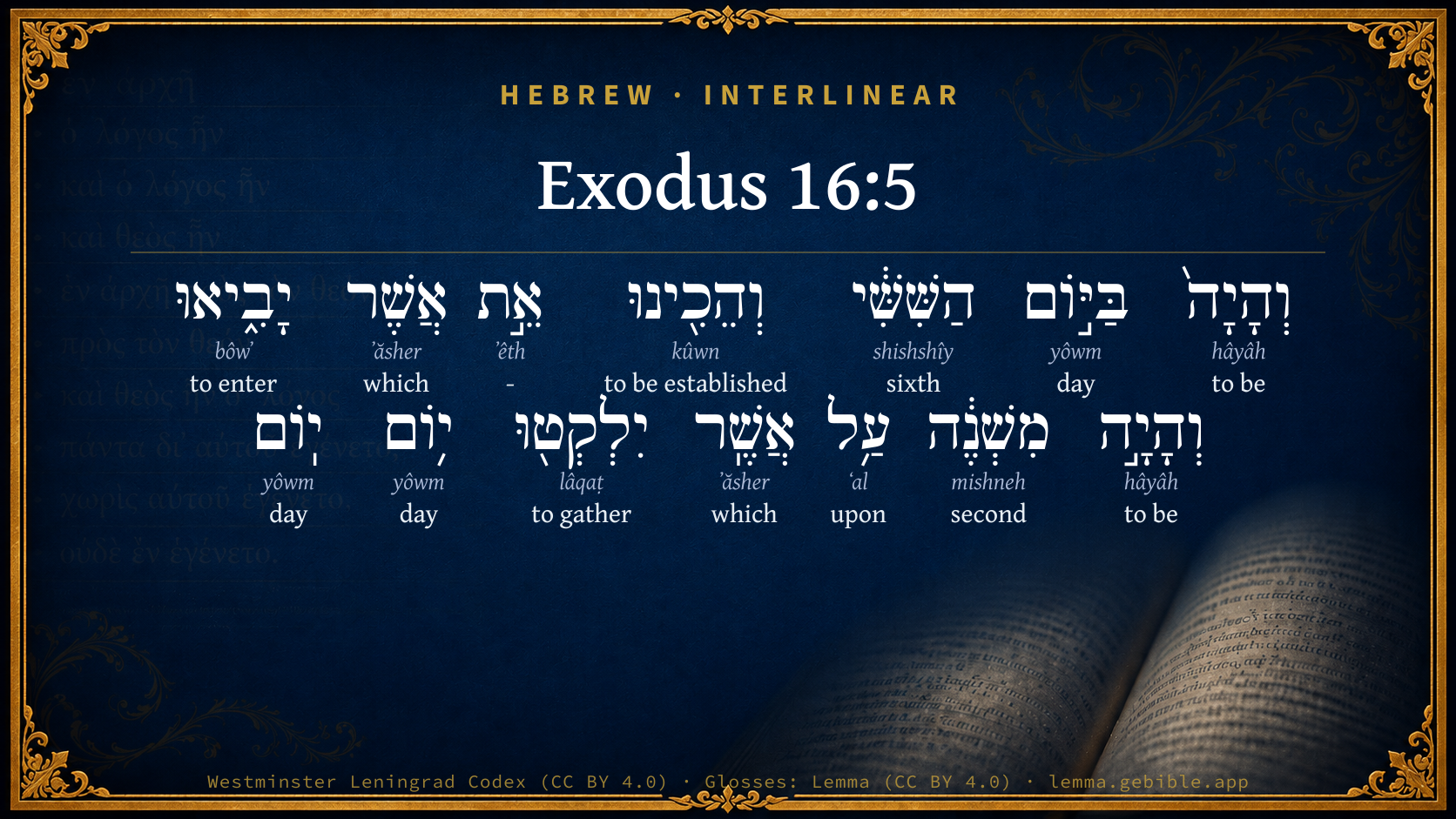
Hebrew (Westminster Leningrad Codex) Exodus 16:5 appears in the Hebrew Old Testament. The text above is from the Westminster Leningrad Codex. Each word links to its Strong’s number, a concise gloss, and parsing drawn from the Open Scriptures Hebrew Bible morphology. Click any word for its full Brown-Driver-Briggs (BDB) entry.
Download image
Cite this verse

Exodus 16:5 (World English Bible). Public Domain. Lemma interlinear Bible study tool, https://lemma.gebible.app/v/exodus/16/5.

Show BibTeX & RIS
BibTeX
RIS
English Translation
It shall come to pass on the sixth day, that they shall prepare that which they bring in, and it shall be twice as much as they gather daily."
World English Bible · Public Domain
Download a study sheet

One document with this verse’s original text, its word-by-word gloss line, the meaning frame, cross-references with their text, attributed commentary, and full source and license credits — printable, and it pastes into notes with its structure intact.

This verse Autodidact and up

Study sheet (.html) Plain text (.txt)

A passage Seminary Student

Up to 50 verses in one chapter. A passage sheet keeps up to 6 commentary sources and 12 cross-references per verse, in the order this page ranks them, and says so on the sheet whenever that leaves anything out. Ask for a single verse and you get the Autodidact verse sheet above.

Everything on this page stays free to read, with no account — the sheet is a download of what is already on screen, not access to it.

Want to remove ads? Support Godless Engineer
Compare translations 3

The same verse in 3 English versions, stacked beneath the original-language interlinear above. Click any original word for its lexicon entry.

Each is an independent rendering of the whole verse — the interlinear is not word-aligned to these translations.

Highlighted words mark where these versions differ — a whole-verse word diff, not a word-by-word alignment.

  • World English Bible Public Domain
    It shall come to pass on the sixth day, that they shall prepare that which they bring in, and it shall be twice as much as they gather daily."
  • King James Version Public Domain
    And it shall come to pass, that on the sixth day they shall prepare that which they bring in; and it shall be twice as much as they gather daily.
  • unfoldingWord Literal Text CC BY-SA 4.0
    And so it will be, on the sixth day, that they shall prepare what they bring in, and that will be twice as much as what they gather daily.”

unfoldingWord Literal Text — © unfoldingWord, licensed CC BY-SA 4.0. Word-aligned USFM3 via Door43 (git.door43.org/unfoldingWord/en_ult).

Versions to compare (up to 4)

3 of 4 selected

Show all 18 translations

Every available English version of this verse, each an independent rendering of the whole verse.

  • World English Bible Public Domain
    It shall come to pass on the sixth day, that they shall prepare that which they bring in, and it shall be twice as much as they gather daily."
  • Berean Standard Bible Public Domain
    Then on the sixth day, when they prepare what they bring in, it will be twice as much as they gather on the other days.”
  • Majority Standard Bible Public Domain
    Then on the sixth day, when they prepare what they bring in, it will be twice as much as they gather on the other days.”
  • King James Version Public Domain
    And it shall come to pass, that on the sixth day they shall prepare that which they bring in; and it shall be twice as much as they gather daily.
  • American Standard Version (1901) Public Domain
    And it shall come to pass on the sixth day, that they shall prepare that which they bring in, and it shall be twice as much as they gather daily.
  • Revised Version (1885) Public Domain
    And it shall come to pass on the sixth day, that they shall prepare that which they bring in, and it shall be twice as much as they gather daily.
  • Geneva Bible (1599) Public Domain
    But the sixt daye they shall prepare that, which they shall bring home, and it shalbe twise as much as they gather dayly.
  • Douay-Rheims (1899) Public Domain
    But the sixth day let them provide for to bring in: and let it be double to that they were wont to gather every day.
  • Young's Literal Translation Public Domain
    and it hath been on the sixth day, that they have prepared that which they bring in, and it hath been double above that which they gather day `by' day.'
  • Literal Standard Version CC BY-SA 4.0
    and it has been on the sixth day, that they have prepared that which they bring in, and it has been double above that which they gather day [by] day.”
  • Unlocked Literal Bible CC BY-SA 4.0
    It will come about on the sixth day, that they will gather twice as much as what they gathered every day before, and they will cook what they bring in.”
  • unfoldingWord Literal Text CC BY-SA 4.0
    And so it will be, on the sixth day, that they shall prepare what they bring in, and that will be twice as much as what they gather daily.”
  • Darby Bible Public Domain
    And it shall come to pass on the sixth day, that they shall prepare what they have brought in; and it shall be twice as much as they shall gather daily.
  • World Messianic Bible Public Domain
    It shall come to pass on the sixth day, that they shall prepare that which they bring in, and it shall be twice as much as they gather daily.”
  • Webster's Bible Public Domain
    And it shall come to pass, that on the sixth day they shall prepare that which they bring in; and it shall be twice as much as they gather daily.
  • Free Bible Version CC BY-SA 4.0
    On the sixth day they are to collect twice as much as usual and prepare it.”
  • Bible in Basic English Public Domain
    And on the sixth day they are to make ready what they get in, and it will be twice as much as they get on the other days.
  • JPS Tanakh (1917) Public Domain
    And it shall come to pass on the sixth day that they shall prepare that which they bring in, and it shall be twice as much as they gather daily.'

Literal Standard Version (2020), Covenant Press — licensed CC BY-SA 4.0. Text via the HelloAO Bible API (eBible.org). Unlocked Literal Bible (unfoldingWord) — licensed CC BY-SA 4.0. Text via the HelloAO Bible API (eBible.org). unfoldingWord Literal Text — © unfoldingWord, licensed CC BY-SA 4.0. Word-aligned USFM3 via Door43 (git.door43.org/unfoldingWord/en_ult). Free Bible Version, Dr. Jonathan Gallagher — licensed CC BY-SA 4.0. Text via the HelloAO Bible API (eBible.org).

Word by word

More ways to search: Search by grammar → Find every occurrence → Compare this word →

Practice this passage: Drill this verse → Learn its vocabulary →

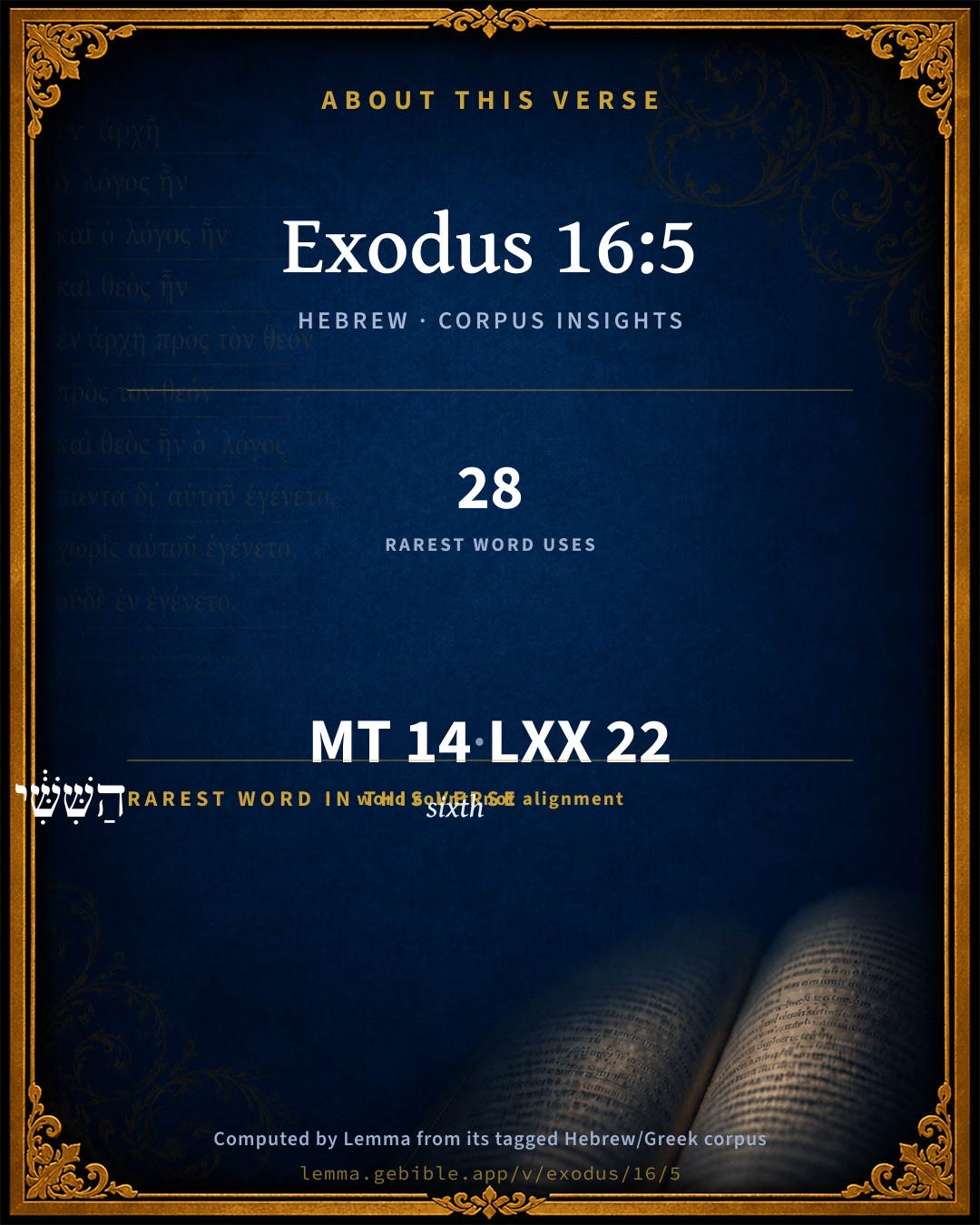
הַשִּׁשִּׁ֔י
shishshîy
H8345
“the · sixth”
Particle, Definite Article + Adjective, Ordinal number, Masculine, Singular, Absolute
Part of Speech
Particle + Adjective
Type
Ordinal number
Gender
Masculine
Number
Singular
State
Absolute
Full BDB Definition

Origin: from H8337

TWOT: 2336b

sixth - sixth (ordinal number) - sixth (as fraction)
  1. וְהָיָה֙ hâyâh H1961 “and · to be” Conjunction + Verb, Qal, Perfect, 3rd Person, Masculine, Singular
  2. בַּיּ֣וֹם yôwm H3117 “in/at the · day” Preposition, Determined + Noun, Common, Masculine, Singular, Absolute
  3. וְהֵכִ֖ינוּ kûwn H3559 “and · to be established” Conjunction + Verb, Hiphil, Perfect, 3rd Person, Common, Plural
  4. אֵ֣ת ʼêth H853 “-” Particle, Direct Object
  5. אֲשֶׁר ʼăsher H834 “which” Particle, Relative
  6. יָבִ֑יאוּ bôwʼ H935 “to enter” Verb, Hiphil, Imperfect, 3rd Person, Masculine, Plural
  7. וְהָיָ֣ה hâyâh H1961 “and · to be” Conjunction + Verb, Qal, Perfect, 3rd Person, Masculine, Singular
  8. מִשְׁנֶ֔ה mishneh H4932 “second” Noun, Common, Masculine, Singular, Absolute
  9. עַ֥ל ʻal H5921 “upon” Preposition
  10. אֲשֶֽׁר ʼăsher H834 “which” Particle, Relative
  11. יִלְקְט֖וּ lâqaṭ H3950 “to gather” Verb, Qal, Imperfect, 3rd Person, Masculine, Plural
  12. י֥וֹם yôwm H3117 “day” Noun, Common, Masculine, Singular, Absolute
  13. יֽוֹם yôwm H3117 “day” Noun, Common, Masculine, Singular, Absolute

About this verse

These counts appear in no published source. They are computed here, from the morphology-tagged text and Lemma’s own curated glosses. What Lemma adds →

14
words
10
distinct lemmas
Pentateuch
section

Shared distinctive vocabulary

הַשִּׁשִּׁ֔י sixth H8345 occurs in 26 verses of the Hebrew Bible. Also found in:

Grammatical profile

  • 5 verbs
  • 4 nouns
  • 1 adjective
  • 1 preposition
  • 3 particles

Verb forms

  • וְהָיָה֙ Qal · Perfect
  • וְהֵכִ֖ינוּ Hiphil · Perfect
  • יָבִ֑יאוּ Hiphil · Imperfect
  • וְהָיָ֣ה Qal · Perfect
  • יִלְקְט֖וּ Qal · Imperfect

Repetition

Words recur within this verse — often emphatic in Hebrew:

  • בַּיּ֣וֹם day H3117 ×3
  • וְהָיָה֙ to be H1961 ×2
  • אֲשֶׁר which H834 ×2

Hebrew & Septuagint length

In English translation the verse runs 29 words from the Hebrew and 34 from the Septuagint (LXX English) — closely comparable.

A rough comparison of the two English renderings, which tokenize alike — not a word-level alignment.

Word counts can differ between the Hebrew and the Greek without any difference in meaning — e.g. the Hebrew direct-object marker אֵת has no separate Greek word, and Greek often adds the article ὁ.

In the original languages it is 14 Hebrew tokens and 22 Greek tokens — but the two are counted differently (Hebrew bundles its prefixes and suffixes into one token; the Greek is in lemma form), so that isn’t a like-for-like length.

Cross-references

3

Topical passages linked to Exodus 16:5 in the Treasury of Scripture Knowledge — connected by theme and wording, ordered by reader-vote popularity; previews shown in the World English Bible.

  • Exodus 16:22–23 It happened that on the sixth day they gathered twice as much bread, two omers for each one, and all the rulers of the congregation came and told Moses.
  • Leviticus 25:21–22 then I will command my blessing on you in the sixth year, and it shall bring forth fruit for the three years.
  • Exodus 35:2–3 'Six days shall work be done, but on the seventh day there shall be a holy day for you, a Sabbath of solemn rest to Yahweh: whoever does any work in it shall be put to death.

Cross-references courtesy of OpenBible.info (CC BY 4.0).

Hebrew and Greek witnesses Masoretic Hebrew ↔ Greek Septuagint

The same verse in the two great witnesses to the Old Testament, shown verse-for-verse.

These are two independent witnesses, not word-aligned to each other, and the Septuagint is shown in lemma (dictionary) form.

Hebrew Exodus 16:5 Masoretic · Westminster Leningrad Codex

וְהָיָה֙ בַּיּ֣וֹם הַשִּׁשִּׁ֔י וְהֵכִ֖ינוּ אֵ֣ת אֲשֶׁר יָבִ֑יאוּ וְהָיָ֣ה מִשְׁנֶ֔ה עַ֥ל אֲשֶֽׁר יִלְקְט֖וּ י֥וֹם יֽוֹם

It shall come to pass on the sixth day, that they shall prepare that which they bring in, and it shall be twice as much as they gather daily."

World English Bible · Public Domain

Greek LXX Exodus 16:5 Septuagint · lemma form

καί εἰμί ὁ ἡμέρα ὁ ἕκτος καί ἑτοιμάζω ὅς ἐάν εἰςφέρω καί εἰμί διπλοῦς ὅς ἐάν συνἄγω ὁ κατά ἡμέρα εἰς ἡμέρα

And it shall come to pass on the sixth day that they shall prepare whatever they have brought in, and it shall be double of what they shall have gathered for the day, daily.

LXX2012 (modern English Septuagint) · Public Domain

Hebrew: Westminster Leningrad Codex (CC BY 4.0). Greek: Septuagint (public domain); English from LXX2012 (modern English Septuagint) (Public Domain). How the Septuagint differs from the Hebrew →

Targum (Aramaic paraphrase)

2

The Targum is the ancient Jewish Aramaic paraphrase of the Hebrew Scriptures — an interpretive translation, not the Hebrew text itself. Onkelos (literal) and Pseudo-Jonathan (expansive) render the Torah, and Jonathan the Prophets. Coverage is partial: where no permissively-licensed English translation exists for a verse, only the Aramaic is shown. This is verse-level text, not a word-by-word alignment to the Hebrew.

  1. Targum Onkelos Torah (Genesis–Deuteronomy)
    וִיהֵי בְּיוֹמָא שְׁתִיתָאָה וִיתַקְנוּן יָת דְיַיְתוּן וִיהֵי עַל חַד תְּרֵין עַל דְיִלְקְטוּן יוֹם יוֹם:

    (no public-domain English translation for this verse)

    Targum Onkelos — Aramaic: “Onkelos Genesis” (public domain); “Onkelos Exodus” (public domain); “Onkelos Leviticus” (public domain); “Onkelos Numbers” (public domain); “Onkelos Deuteronomy” (public domain). English: “Sefaria Community Translation” (CC0 1.0 (public-domain dedication)); “J.W. Etheridge. The Targums of Onkelos and Jonathan Ben Uzziel on the Pentateuch. London: Longmans, Green, 1862” (public domain). Text via Sefaria.

  2. Targum Pseudo-Jonathan Torah (Genesis–Deuteronomy)
    וִיהֵי בְּיוֹמָא שְׁתִיתָאֵי וְיִזְמְנוּן מַה דְּיַיְתוּן לְקָמֵיהוֹן לְמֵיכַל בְּיוֹמָא דְּשַׁבַּתָּא וִיעַרְבוּן בְּבָתַּיָא וְיִשְׁתַּתְּפוּן בְּדָרָתֵיהוֹן בְּגִין לְמֵיתַיָיא מִדֵּין לְדֵין וִיהֵי לְהוֹן בְּכוּפְלָא עַל מַה דִּמְלַקְטוּן יוֹמָא יוֹמָא

    And on the sixth day they shall prepare what they set before them to eat on the day of the Sabbath; and they shall mix in the houses and communicate in their dwellings, so that by carrying this to that, they may have double of that which they gather from day to day.

    Targum Pseudo-Jonathan — Aramaic: “Targum Jonathan on Genesis” (public domain); “Targum Jonathan on Exodus” (public domain); “Targum Jonathan on Leviticus” (public domain); “Targum Jonathan on Numbers” (public domain); “Targum Jonathan on Deuteronomy” (public domain). English: “The Targum of Jonathan ben Uzziel, trans. J. W. Etheridge, London, 1862” (public domain). Text via Sefaria.

Commentary

Notes on Exodus 16:5 from classic Christian and Jewish commentators (each source and its license shown beneath its notes). The classic Christian expositions comment on the surrounding passage and are grouped to its opening verse, so a note may address several verses; the Jewish commentaries on the Tanakh (Rashi and others) are per-verse, so they appear only where the commentator wrote on this verse.

Lemma curates 59 commentaries, every one of them public domain or Creative Commons licensed, each selected and text-cleaned for this edition rather than reprinted as found. About our sources →

Trapp's Complete Commentary

John Trapp

Exo 16:5 And it shall come to pass, that on the sixth day they shall prepare [that] which they bring in; and it shall be twice as much as they gather daily.

Ver. 5. On the sixth dug they shall prepare.] The Jews’ preparation for the Sabbath began at three o’clock in the afternoon. The best and wealthiest of them, even those that had many servants, did with their own hands further the preparation. So that sometimes the masters themselves would chop herbs, sweep the house, cleave wood, kindle the fire, &c. {a}

{a} Buxtorf., Synagog.

John Trapp, A Commentary or Exposition upon All the Books of the Old and New Testament (1647–1656) — public domain. Text from a community e-Sword module.

Joseph Benson's Commentary

Exo 16:5-6. They shall prepare — Lay up, grind, bake, or boil. The Lord brought you out of Egypt — And not we, as you suggest, by our own counsel.

Joseph Benson's Commentary on the Old and New Testaments (1811–1818) — public domain. Text from a community e-Sword module.

Ellicott's Commentary for English Readers

(5) On the sixth day—i.e., the sixth day after the first giving of the manna (Kalisch). Although in Babylonia, from a time certainly earlier than the Exodus, a Sabbath was observed on the seventh, fourteenth, twenty-first, and twenty-eighth day of each month (Sayce: Records of the Past, vol. vii., pp. 157-167), yet we have no evidence that the year was divided into weeks, much less that the several days of the week were known as the first, second, third, fourth, &c. In Egypt, the week of seven days was at this time unknown.

They shall prepare.—On the method of preparation see Num_11:8.

It shall be twice as much.—Some suppose this to be a command—“Ye shall gather twice as much;” but it is more natural to take it as an announcement of a fact—“You will find that what you have gathered turns out to be twice as much.” (So Kurtz, Kalisch, and Knobel.) A miraculous doubling of the quantity seems to be intended. (Comp. Exo_16:22.)

A Bible Commentary for English Readers, edited by Charles John Ellicott (1878–1897) — public domain. Text from a community e-Sword module.

The Cambridge Bible for Schools and Colleges

gen. ed. J. J. S. Perowne

5. prepare] viz. for eating (see Num_11:8); cf. Gen_43:16 (‘make ready’).

twice as much] The meaning seems to be that, as the supply will be more abundant on the 6th day, so every one will naturally gather more; and when they come to prepare it, they will find that it is just twice a much as they gather usually.

Vv. 9–12 should follow here. The verses are accidentally misplaced: as they stand, the message given to the people (vv. 6–8) precedes the command to deliver it (vv. 9–12).

The Cambridge Bible for Schools and Colleges (gen. ed. J. J. S. Perowne; Cambridge University Press, 1878–1918) — public domain. Text from a community e-Sword module.

John Gill's Exposition

And it shall come to pass, that on the sixth day,.... Of the week, and from the raining of the bread, which was on the first day of the week:

they shall prepare that which they bring in; the Targum of Jonathan adds, to eat on the sabbath day; what they did not consume on the sixth day was to be prepared and reserved for the seventh day; that is, it was to be baked or boiled as they thought fit to have it, or eat it as it was, which they pleased, see Exo 16:23 only one part of it was to be kept till the next day:

and it shall be twice as much as they gather daily: on that day should be rained double what fell on other days, and so twice as much should be gathered up; the reason for which is not here mentioned, but afterwards given; though Moses no doubt was now made acquainted with it, or otherwise he could not have informed the princes and people of it, as he afterwards did, Exo 16:23.

John Gill's Exposition of the Whole Bible (1746–1763) — public domain (CC PDM 1.0). Text via the HelloAO Bible API.

Albert Barnes' Notes on the Bible

It shall be twice as much - They should collect and prepare a double quantity.

Albert Barnes' Notes on the Bible (1834–1885) — public domain. Text from a community e-Sword/MySword module.

Haydock's Catholic Bible Commentary

Provide. Hence, this day was called Parasceve, or the day of preparation.

George Leo Haydock (1774–1849), Haydock's Catholic Family Bible and Commentary, 1859 edition — public domain. Excludes Psalms (Douay-Rheims chapter numbering differs from Protestant) and Deuterocanonical books (Catholic canon only).

Matthew Poole's English Annotations

Prepare; lay up, grind, bake, or seethe. See Exo 16:23. and Num 11:8.

Matthew Poole's English Annotations on the Holy Bible (1683–1685) — public domain. Text from a community e-Sword/MySword module.

The Pulpit Commentary

On the sixth day. That a period of seven days was known to the Hebrews as a week appears from the story of Jacob and Laban. (Gen_29:27) But there is no distinct evidence that the year was as yet divided into weeks, much less that the several days of the week were as yet distinguished as the first, second, third day, etc. "The sixth day," here probably means (as Kalisch says), "the sixth day after" the first supply of the manna. They shall prepare. The preparation would be, first, by measurement (ver. 18), and then by pounding and grinding. (Num_11:8) It shall be double. Some commentators suppose that in these words is implied an order that on the sixth day they should set themselves to gather a double quantity. But the natural meaning of the words is, that, having gathered the usual quantity, they should find, when they measured it, that, by miracle, the supply sufficient for one day was multiplied, so as to suffice for two. (So Kalisch, Knobel, Kurtz, and others.) This view is in harmony with verse 18, which tells of a miraculous expansion and diminution of the manna after it had been gathered, and with verse 22, which shows us "the rulers" surmised by the miracle of the sixth day.

The Pulpit Commentary (1880–1919), ed. H.D.M. Spence-Jones & Joseph S. Exell — public domain. Text from a community e-Sword module.

John Wesley's Explanatory Notes

They shall prepare - Lay up, grind, bake or boil.

John Wesley, Explanatory Notes Upon the Whole Bible (1754–1765) — public domain. Text via the GEBible commentary corpus.

Rashi

Rabbi Shlomo Yitzchaki (Rashi)

והיה משנה AND IT SHALL BE DOUBLE — for today and for tomorrow.

משנה DOUBLE of what they were accustomed to collect on each day of the other days of the week. I say that the words, אשר יביאו והיה משנה “what they bring shall be double”, imply that after they have brought it home they will find it double in measure of what they had been gathering and measuring each day. This is the force of: “they collected double bread” (v. 22) — when it was collected it was found by them to be double food, and this is the meaning of (v. 29), “therefore he giveth you on the sixth day the bread of two days”: He gives you a blessing — old French foison, — abundance in the house that you may fill the Omer twice, as bread for two days.

Rashi on the Tanakh — English translations: “The Judaica Press complete Tanach with Rashi, translated by A. J. Rosenberg” (CC BY 4.0); “Pentateuch with Rashi's commentary by M. Rosenbaum and A.M. Silbermann, 1929-1934” (public domain); “The Metsudah Tanach series, Lakewood, N.J” (CC BY 4.0); and “The Book of Joshua, Metsudah Publications, 1997” (CC BY 4.0). Text via Sefaria.

Lesson kit

Teaching starters — assembled from the data on this page, not authored interpretation. Every prompt links to the verse data it draws on. Edit before teaching.

Exodus, in the Pentateuch, opens this verse with 14 words (10 distinct Hebrew lemmas). Its most distinctive word is shishshîy (“sixth”). A historical commentator’s framing appears above. Read the whole chapter for the surrounding context.

Discussion questions

  1. How does “sixth” (shishshîy) shape what this verse is saying?
  2. Genesis 1:31 shares the word «sixth» with this verse. How do the two illuminate each other?
  3. “day” occurs 3× in this one verse. What is the effect of the repetition?
  4. The translations on this page render this verse differently — a whole-verse word diff, not a word-by-word alignment. What might account for the different wordings?
  5. The verb «וְהָיָה֙» is Qal Perfect. How does its form color the action?
  6. Reading how Trapp's Complete Commentary and Joseph Benson's Commentary read this verse, where do the two commentators agree and where do they part?

Things to notice

Reading settings

Reading text

Shown beneath each verse's original-language words.

Old Testament
Old Testament edition

Read the OT as the Masoretic Hebrew (MT) or the Greek Septuagint (LXX).

English shown for the Greek Septuagint (in the Hebrew ↔ Greek comparison).

Comparing translations? Open the Compare panel on any verse page to stack up to four side by side.