
Proverbs 21:31

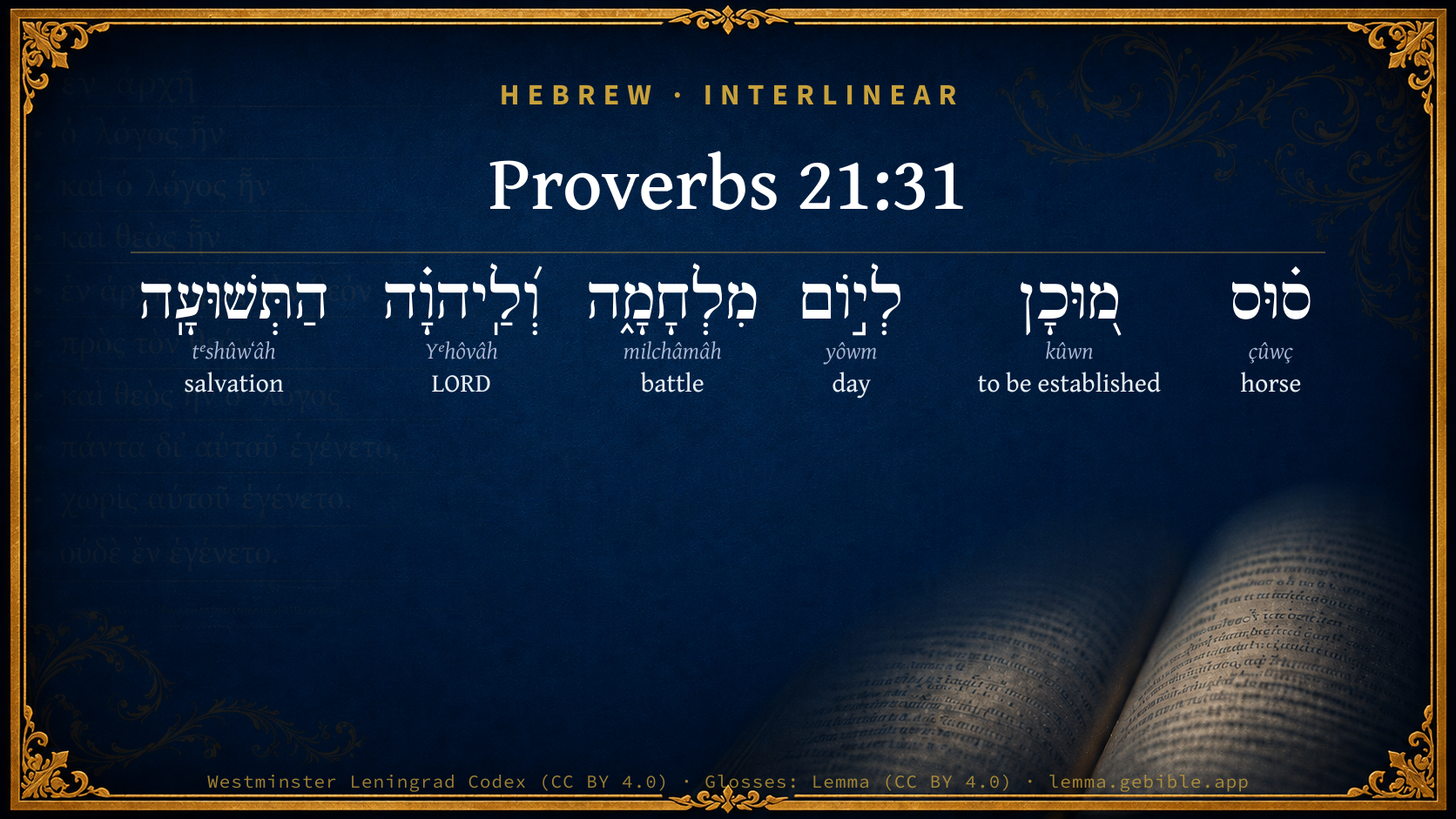
Hebrew (Westminster Leningrad Codex) Proverbs 21:31 appears in the Hebrew Old Testament. The text above is from the Westminster Leningrad Codex. Each word links to its Strong’s number, a concise gloss, and parsing drawn from the Open Scriptures Hebrew Bible morphology. Click any word for its full Brown-Driver-Briggs (BDB) entry.
Download image
Cite this verse

Proverbs 21:31 (World English Bible). Public Domain. Lemma interlinear Bible study tool, https://lemma.gebible.app/v/proverbs/21/31.

Show BibTeX & RIS
BibTeX
RIS
English Translation
The horse is prepared for the day of battle; But victory is with Yahweh.
World English Bible · Public Domain
Download a study sheet

One document with this verse’s original text, its word-by-word gloss line, the meaning frame, cross-references with their text, attributed commentary, and full source and license credits — printable, and it pastes into notes with its structure intact.

This verse Autodidact and up

Study sheet (.html) Plain text (.txt)

A passage Seminary Student

Up to 50 verses in one chapter. A passage sheet keeps up to 6 commentary sources and 12 cross-references per verse, in the order this page ranks them, and says so on the sheet whenever that leaves anything out. Ask for a single verse and you get the Autodidact verse sheet above.

Everything on this page stays free to read, with no account — the sheet is a download of what is already on screen, not access to it.

Want to remove ads? Support Godless Engineer
Compare translations 3

The same verse in 3 English versions, stacked beneath the original-language interlinear above. Click any original word for its lexicon entry.

Each is an independent rendering of the whole verse — the interlinear is not word-aligned to these translations.

Highlighted words mark where these versions differ — a whole-verse word diff, not a word-by-word alignment.

  • World English Bible Public Domain
    The horse is prepared for the day of battle; But victory is with Yahweh.
  • King James Version Public Domain
    The horse is prepared against the day of battle: but safety is of the LORD.
  • unfoldingWord Literal Text CC BY-SA 4.0
    A horse is made ready for the day of battle, but the salvation of Yahweh.

unfoldingWord Literal Text — © unfoldingWord, licensed CC BY-SA 4.0. Word-aligned USFM3 via Door43 (git.door43.org/unfoldingWord/en_ult).

Versions to compare (up to 4)

3 of 4 selected

Show all 18 translations

Every available English version of this verse, each an independent rendering of the whole verse.

  • World English Bible Public Domain
    The horse is prepared for the day of battle; But victory is with Yahweh.
  • Berean Standard Bible Public Domain
    A horse is prepared for the day of battle, but victory is of the LORD.
  • Majority Standard Bible Public Domain
    A horse is prepared for the day of battle, but victory is of the LORD.
  • King James Version Public Domain
    The horse is prepared against the day of battle: but safety is of the LORD.
  • American Standard Version (1901) Public Domain
    The horse is prepared against the day of battle; But victory is of Jehovah.
  • Revised Version (1885) Public Domain
    The horse is prepared against the day of battle: but victory is of the LORD,
  • Geneva Bible (1599) Public Domain
    The horse is prepared against the day of battell: but saluation is of the Lord.
  • Douay-Rheims (1899) Public Domain
    The horse is prepared for the day of battle: but the Lord giveth safety.
  • Young's Literal Translation Public Domain
    A horse is prepared for a day of battle, And the deliverance `is' of Jehovah!
  • Literal Standard Version CC BY-SA 4.0
    A horse is prepared for a day of battle, || And the deliverance [is] of YHWH!
  • Unlocked Literal Bible CC BY-SA 4.0
    The horse is prepared for the day of battle, but the victory belongs to Yahweh.
  • unfoldingWord Literal Text CC BY-SA 4.0
    A horse is made ready for the day of battle, but the salvation of Yahweh.
  • Darby Bible Public Domain
    The horse is prepared for the day of battle; but safety is of Jehovah.
  • World Messianic Bible Public Domain
    The horse is prepared for the day of battle; but victory is with the LORD.
  • Webster's Bible Public Domain
    The horse is prepared against the day of battle: but safety is from the LORD.
  • Free Bible Version CC BY-SA 4.0
    You can get your horse ready for battle, but the victory is the Lord's.
  • Bible in Basic English Public Domain
    The horse is made ready for the day of war, but power to overcome is from the Lord.
  • JPS Tanakh (1917) Public Domain
    The horse is prepared against the day of battle; but victory is of the LORD.

Literal Standard Version (2020), Covenant Press — licensed CC BY-SA 4.0. Text via the HelloAO Bible API (eBible.org). Unlocked Literal Bible (unfoldingWord) — licensed CC BY-SA 4.0. Text via the HelloAO Bible API (eBible.org). unfoldingWord Literal Text — © unfoldingWord, licensed CC BY-SA 4.0. Word-aligned USFM3 via Door43 (git.door43.org/unfoldingWord/en_ult). Free Bible Version, Dr. Jonathan Gallagher — licensed CC BY-SA 4.0. Text via the HelloAO Bible API (eBible.org).

Word by word

More ways to search: Search by grammar → Find every occurrence → Compare this word →

Practice this passage: Drill this verse → Learn its vocabulary →

About this verse

These counts appear in no published source. They are computed here, from the morphology-tagged text and Lemma’s own curated glosses. What Lemma adds →

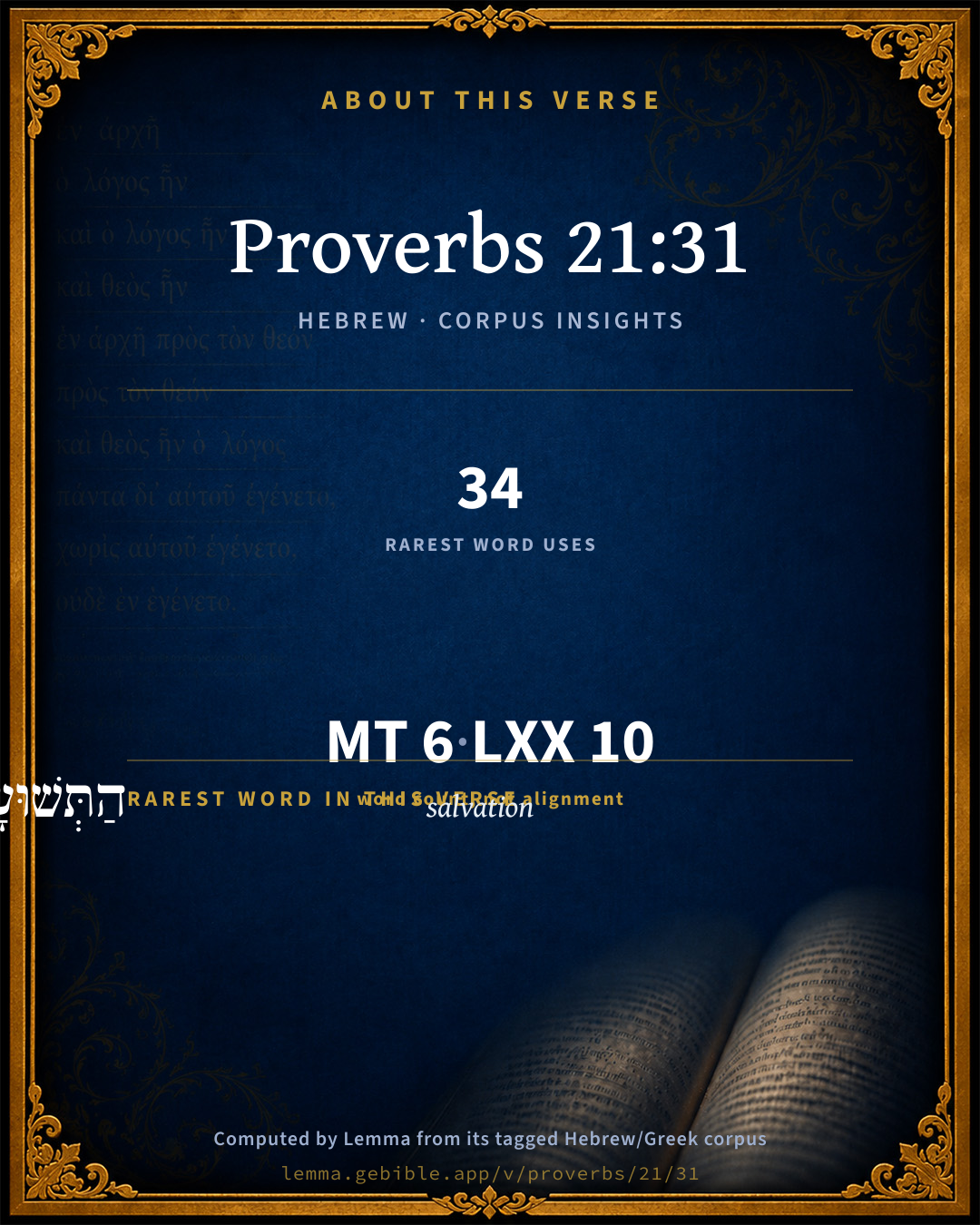
6
words
6
distinct lemmas
Wisdom
section

Shared distinctive vocabulary

הַתְּשׁוּעָֽה salvation H8668 occurs in 32 verses of the Hebrew Bible. Also found in:

Grammatical profile

  • 1 verb
  • 5 nouns

Verb forms

  • מ֭וּכָן Hophal · Participle Passive

Hebrew & Septuagint length

In English translation the verse runs 14 words from the Hebrew and 15 from the Septuagint (LXX English) — closely comparable.

A rough comparison of the two English renderings, which tokenize alike — not a word-level alignment.

Word counts can differ between the Hebrew and the Greek without any difference in meaning — e.g. the Hebrew direct-object marker אֵת has no separate Greek word, and Greek often adds the article ὁ.

In the original languages it is 6 Hebrew tokens and 10 Greek tokens — but the two are counted differently (Hebrew bundles its prefixes and suffixes into one token; the Greek is in lemma form), so that isn’t a like-for-like length.

Cross-references

10

Topical passages linked to Proverbs 21:31 in the Treasury of Scripture Knowledge — connected by theme and wording, ordered by reader-vote popularity; previews shown in the World English Bible.

  • Psalms 20:7 Some trust in chariots, and some in horses, But we trust the name of Yahweh our God.
  • Isaiah 31:1 Woe to those who go down to Egypt for help, and rely on horses, and trust in chariots because they are many, and in horsemen because they are very strong, but they don't look to the Holy One of Israel, neither seek Yahweh!
  • Psalms 33:17–18 A horse is a vain thing for safety, Neither does he deliver any by his great power.
  • Psalms 147:10 He doesn't delight in the strength of the horse. He takes no pleasure in the legs of a man.
  • Psalms 3:3 But you, Yahweh, are a shield around me, My glory, and the one who lifts up my head.
  • Psalms 68:20 God is to us a God of deliverance. To Yahweh, the Lord, belongs escape from death.
  • Psalms 3:8 Salvation belongs to Yahweh. Your blessing be on your people. Selah.
  • Ecclesiastes 9:11 I returned, and saw under the sun, that the race is not to the swift, nor the battle to the strong, neither yet bread to the wise, nor yet riches to men of understanding, nor yet favor to men of skill; but time and chance happen to them all.
  • Psalms 144:10 You are he who gives salvation to kings, Who rescues David, his servant, from the deadly sword.
  • Jeremiah 3:23 Truly in vain is [the help that is looked for] from the hills, the tumult on the mountains: truly in Yahweh our God is the salvation of Israel.

Cross-references courtesy of OpenBible.info (CC BY 4.0).

Hebrew and Greek witnesses Masoretic Hebrew ↔ Greek Septuagint

The same verse in the two great witnesses to the Old Testament, shown verse-for-verse.

These are two independent witnesses, not word-aligned to each other, and the Septuagint is shown in lemma (dictionary) form.

Hebrew Proverbs 21:31 Masoretic · Westminster Leningrad Codex

ס֗וּס מ֭וּכָן לְי֣וֹם מִלְחָמָ֑ה וְ֝לַֽיהוָ֗ה הַתְּשׁוּעָֽה

The horse is prepared for the day of battle; But victory is with Yahweh.

World English Bible · Public Domain

Greek LXX Proverbs 21:31 Septuagint · lemma form

ἵππος ἑτοιμάζω εἰς ἡμέρα πόλεμος παρά δέ κύριος ὁ βοήθεια

A horse is prepared for the day of battle; but help is of the Lord.

LXX2012 (modern English Septuagint) · Public Domain

On this verse, The Pulpit Commentary discusses the Septuagint’s reading. Read the note in Commentary ↓

Hebrew: Westminster Leningrad Codex (CC BY 4.0). Greek: Septuagint (public domain); English from LXX2012 (modern English Septuagint) (Public Domain). How the Septuagint differs from the Hebrew →

Commentary

Notes on Proverbs 21:31 from classic Christian and Jewish commentators (each source and its license shown beneath its notes). The classic Christian expositions comment on the surrounding passage and are grouped to its opening verse, so a note may address several verses; the Jewish commentaries on the Tanakh (Rashi and others) are per-verse, so they appear only where the commentator wrote on this verse.

Lemma curates 59 commentaries, every one of them public domain or Creative Commons licensed, each selected and text-cleaned for this edition rather than reprinted as found. About our sources →

Trapp's Complete Commentary

John Trapp

Pro 21:31 The horse [is] prepared against the day of battle: but safety [is] of the LORD.

Ver. 31. The horse is prepared against the day, &c.] A very serviceable creature, and in battle full of terror; so swift in service that the Persians dedicated him to their god, the sun, ασπερ το ταλιστον τω ταχυτατω, as Pausanias hath it. But as the sun in heaven can neither be outrun nor stopped in his race, so neither by men, though wise, nor by means, though likely, can God’s purposes be disappointed. "A horse is a vain thing for safety; neither shall he deliver any by his great strength." {Psa 33:17}

But safety (or victory) is of the Lord.] He gives it to which side he pleaseth, as he did to the Israelites in the conquest of Canaan, though they had no horses to help them, as their adversaries had, and chariots too, both Egyptians and Canaanites.

John Trapp, A Commentary or Exposition upon All the Books of the Old and New Testament (1647–1656) — public domain. Text from a community e-Sword module.

Joseph Benson's Commentary

Pro 21:31. The horse is prepared, &c. — Under which particular all warlike preparations are comprehended; but safety is of the Lord — The success of the battle depends not upon any human strength or art, but upon God’s providence, who gives the victory when and to whom he pleases, and frequently to those that have least reason to expect it.

Joseph Benson's Commentary on the Old and New Testaments (1811–1818) — public domain. Text from a community e-Sword module.

Adam Clarke's Commentary

Verse 31. The horse is prepared against the day of battle] Horses were not used among the Jews before the time of Solomon. There was a Divine command against them, De 17:16; but Solomon transgressed it; see 1Kg 10:29. But he here allows that a horse is a vain thing for safety; and that however strong and well appointed cavalry may be, still safety, escape, and victory, are of the Lord. Among the ancient Asiatics, the horse was used only for war; oxen laboured in the plough and cart; the ass and the camel carried backloads; and mules and asses served for riding. We often give the credit of a victory to man, when they who consider the circumstances see that it came from God.

Adam Clarke's Commentary on the Bible (1810–1826) — public domain. Text from a community e-Sword/MySword module.

Ellicott's Commentary for English Readers

(31) The horse is prepared against the day of battle.—These had been imported largely from Egypt in Solomon’s time, though this was in direct contravention of the Law (1Ki_4:26, and Deu_17:16).

A Bible Commentary for English Readers, edited by Charles John Ellicott (1878–1897) — public domain. Text from a community e-Sword module.

The Cambridge Bible for Schools and Colleges

gen. ed. J. J. S. Perowne

31. safety] Rather, victory (A.V. marg. R.V. text), or deliverance (R.V. marg.). “Two companion proverbs (Pro_21:30-31). Nothing avails against, nothing without, God.” (Speaker’s Comm.)

The Cambridge Bible for Schools and Colleges (gen. ed. J. J. S. Perowne; Cambridge University Press, 1878–1918) — public domain. Text from a community e-Sword module.

John Gill's Exposition

The horse is prepared against the day of battle,.... The horse is a warlike creature, and was much used formerly, as now, in war; these are prepared against the day of battle, to mount the cavalry with; and men are apt to put too great confidence in them: this is mentioned instead of all other military preparations and instruments of war;

but safety is of the Lord; a horse is a vain thing for safety, Psa 33:17; victory is only of the Lord; salvation depends upon him; it is he that covers men's heads in the day of battle, and gives them victory over their enemies: or "salvation is of the Lord" (o); this is true of spiritual and eternal salvation, as well as of temporal salvation; it is of the Lord, Father, Son and Spirit; and so is the safety of the saints; and their final perseverance to eternal glory, which is owing to the love of God, covenant interest, security in Christ, the grace of the Spirit, and the power of God; see Hos 14:3.

(o) "a Domino autem (datur) salus". Tigurine version; "Domino est salvatio", Cocceius; "Jehovae est salus", Schultens; so Junius & Tremellius, Mercerus, Gejerus.

Next: Proverbs Chapter 22

John Gill's Exposition of the Whole Bible (1746–1763) — public domain (CC PDM 1.0). Text via the HelloAO Bible API.

Haydock's Catholic Bible Commentary

Battle. It was kept for no other purpose by the eastern nations, who used oxen to till the land; asses and camels to carry burdens, Job xxxix. 18., and Psalm xix. 8., and xxxii. 17. (Calmet)

George Leo Haydock (1774–1849), Haydock's Catholic Family Bible and Commentary, 1859 edition — public domain. Excludes Psalms (Douay-Rheims chapter numbering differs from Protestant) and Deuterocanonical books (Catholic canon only).

Matthew Poole's English Annotations

The horse; under which particular all warlike provisions are comprehended.

Safety is of the Lord; the success of the battle depends not upon any human strength or art, but merely upon God’s providence, who gives the victory when and to whom he pleaseth, and ofttimes to those that have least reason to expect it. Compare Ecc 9:11.

Matthew Poole's English Annotations on the Holy Bible (1683–1685) — public domain. Text from a community e-Sword/MySword module.

Whedon's Commentary on the Bible

Daniel D. Whedon

31. The horse is prepared against… battle — This verse connects with the preceding. Its import is, that no preparation for war, however great, however confided in, can be successful without God’s blessing. We find horses first in Egypt. Gen_49:17; Exo_9:3; Exo_14:6-28. They are mentioned by Job, (Job_39:19.) Egypt was celebrated for its horses, 1Ki_10:28; Isa_31:1; Isa_36:9; Eze_17:5. Joshua encountered chariots and horsemen in the north of Palestine. Jos_11:4-9. Anciently horses were generally used for war purposes: for the more peaceful avocations the ass was employed. Zec_9:9. Solomon first introduced the raising of horses among the Hebrews. The hundred reserved (2Sa_8:4; 1Ch_18:4) were for the use of David himself, whose example was imitated by Absalom. 2Sa_15:1. God had expressly forbidden the ruler of the Jews to multiply horses, (Deu_17:16 :) but Solomon seems to have paid no attention to this injunction, and after his time the Hebrews were never destitute of horses. They had both horsemen and chariots of war.

Safety is of the Lord — The deliverance belongs to Jehovah. It is his to give victory. Compare 1Sa_17:47; Psa_3:8; Psa_33:17. Miller singularly enough translates the last clause, “and salvation against Jehovah!” that is, as he explains, Salvation is “prepared,” “made ready,” against the “day of Jehovah!”

Daniel D. Whedon (gen. ed.), Commentary on the Old and New Testaments (1874–1909) — public domain. Text from a community e-Sword module.

The Pulpit Commentary

The horse is prepared against the clay of battle. The horse is an emblem of military power and activity. To the earlier Jews, who were unaccustomed to its use, and indeed forbidden to employ it, (Deu_17:16) the horse and horse-drawn chariots were objects of extreme terror, (Jos_17:16 Jud_1:4:3) and though Solomon had largely imported them from Egypt, (1Ki_4:26 1Ki_10:26, etc.) these animals were used exclusively for war, and, at this time, their services were never applied to agricultural purposes. The proverb asserts that, though all preparations are made for the battle, and material forces are of the best and strongest description, but safety (victory) is of the Lord. (see Psa_20:7 Psa_33:16, etc.) Septuagint, "But from the Lord is the help (h bohyeia )." The great truth here taught may be applied to spiritual matters. The only safety against spiritual enemies is the grace of God; we can cry, with St. Paul, (1Co_15:57) "Thanks be to God, which giveth us the victory through our Lord Jesus Christ." "By the name "horse, says St. Gregory ("Moral.," 31:43), "is understood the preparation of right intention, as it is written, "The horse is prepared," etc.; because the mind prepares itself indeed against temptation, but contends not healthfully unless it be assisted from above.

National defence.

The Jews were repeatedly warned against keeping cavalry. Cavalry were for pitched battles, and could only be used on the plains. But the old successful Jewish warfare was among the hills. As a question of military tactics, the advice meant that it was better for the Jews to act on the defensive in their impregnable strongholds than to descend into the field for open warfare. A deeper thought was that, while defensive warfare might sometimes be required, the Jews were not to embroil themselves m the affairs of their neighbours. This was especially desirable for a little state wedged in between the two great empires of Egypt and Assyria, like Afghanistan between Russia and India. A still deeper and more momentous thought has yet to be reached. The Jews were to learn that their true defence was not in armies, not in military prowess, not in naturally strong fortresses. God was their Rock and Tower of strength, Now, we have no reason to consider that the idea which was brought out in the history of Israel with magnificent emphasis applies to that little ancient race alone. It is true of every nation that will recognize God, that "safety is of the Lord." We undergo periodical panics concerning our national dangers. It would be well if we could rise to the position urged upon Israel by the teachers of Old Testament days.

I OBSERVE HOW SAFETY COMES FROM GOD.

1. By a providential control of events. God delivered Israel from Egypt by opening a path through the Red Sea. He saved Jerusalem from Sennacherib by the sword of the destroying angel. He protected England from the Spanish Armada by the tempest that strewed the coast of Norway with the wrecks of Spanish galleons. When no such marked events occur, God can save his people by the quiet, unseen control of the course of history.

2. By a Divine influence exerted over the minds of men. God is in the secret counsels of the most astute statesmen. He can suggest and direct their thoughts and plans. He can awaken conscience in the reckless invader, and allay the passions of the enraged enemy. Thus God saved Jacob from Esau.

3. By help given to the attacked in the hour of danger. God"s interference may be so as to guide and strengthen those who trust in him, and so to lead them on to safety. There is much to be done through wise counsels, righteous decisions, and brave, true actions. These God can inspire.

4. By final deliverance from all trouble.

(1) After death. God"s people may be killed; yet he will save them and take them home to himself.

(2) On earth. National deliverance may come after national calamity. It may be just and right and necessary that a fearful defeat should come. Yet God may bring ultimate salvation a missing up of the fallen from their shame and distress.

II CONSIDER, HOW SAFETY MAY BE OBTAINED FROM GOD. We have no right to believe ourselves to be privileged people whom God will favor in preference to Russia, or France, or Germany. All the nations are cared for by God, and no nation can be assured of his protection without pursuing the right means to find it. We have no right to pray that God will scatter our enemies, if they are in the right, and ours are the "knavish tricks." How, then, is safety to be found in God?

1. By acting justly towards our neighbours. God will never protect us when we are wronging another nation.

2. By living at peace with God. If our conduct at home is inimical to God, we cannot expect him to defend us in the field. Godlessness in peace will bring God desertion in war. National sin will alienate the protection of God. The first step must be national repentance.

3. By trusting God. If we are reconciled to God, and seeking to do the right, we can pray for his help, and believe we shall have it, with our armies if they must be called out; but, better far, without them, in maintaining peace.

The Pulpit Commentary (1880–1919), ed. H.D.M. Spence-Jones & Joseph S. Exell — public domain. Text from a community e-Sword module.

John Wesley's Explanatory Notes

The horse - Under which all war-like provisions are comprehended.

John Wesley, Explanatory Notes Upon the Whole Bible (1754–1765) — public domain. Text via the GEBible commentary corpus.

Kretzmann's Popular Commentary

Paul E. Kretzmann

v. 31. The horse is prepared against the day of battle, that is, men may make all arrangements and preparations for war, deeming the victory as good as gained; but safety is of the Lord, it is in His hand to give victory or defeat, it rests with Him to decide the issues, 1Sa 17:47.

Paul E. Kretzmann, Popular Commentary of the Bible (1921–1924) — public domain. Text from a community e-Sword module.

Lesson kit

Teaching starters — assembled from the data on this page, not authored interpretation. Every prompt links to the verse data it draws on. Edit before teaching.

Proverbs, in the Wisdom, opens this verse with 6 words (6 distinct Hebrew lemmas). Its most distinctive word is tᵉshûwʻâh (“salvation”). A historical commentator’s framing appears above. Read the whole chapter for the surrounding context.

Discussion questions

  1. The word tᵉshûwʻâh carries the sense “salvation.” How does it shape the verse?
  2. Judges 15:18 shares the word «salvation» with this verse. How do the two illuminate each other?
  3. These translations render this verse differently. What is at stake in choosing one wording over another?
  4. The verb «מ֭וּכָן» is Hophal Participle Passive. How does its form color the action?
  5. Reading how Trapp's Complete Commentary and Joseph Benson's Commentary read this verse, where do the two commentators agree and where do they part?

Things to notice

Reading settings

Reading text

Shown beneath each verse's original-language words.

Old Testament
Old Testament edition

Read the OT as the Masoretic Hebrew (MT) or the Greek Septuagint (LXX).

English shown for the Greek Septuagint (in the Hebrew ↔ Greek comparison).

Comparing translations? Open the Compare panel on any verse page to stack up to four side by side.