
2 Chronicles 12:14

Hebrew (Westminster Leningrad Codex) 2 Chronicles 12:14 appears in the Hebrew Old Testament. The text above is from the Westminster Leningrad Codex. Each word links to its Strong’s number, a concise gloss, and parsing drawn from the Open Scriptures Hebrew Bible morphology. Click any word for its full Brown-Driver-Briggs (BDB) entry.
Download image
Cite this verse

2 Chronicles 12:14 (World English Bible). Public Domain. Lemma interlinear Bible study tool, https://lemma.gebible.app/v/2-chronicles/12/14.

Show BibTeX & RIS
BibTeX
RIS
English Translation
He did that which was evil, because he didn't set his heart to seek Yahweh.
World English Bible · Public Domain
Download a study sheet

One document with this verse’s original text, its word-by-word gloss line, the meaning frame, cross-references with their text, attributed commentary, and full source and license credits — printable, and it pastes into notes with its structure intact.

This verse Autodidact and up

Study sheet (.html) Plain text (.txt)

A passage Seminary Student

Up to 50 verses in one chapter. A passage sheet keeps up to 6 commentary sources and 12 cross-references per verse, in the order this page ranks them, and says so on the sheet whenever that leaves anything out. Ask for a single verse and you get the Autodidact verse sheet above.

Everything on this page stays free to read, with no account — the sheet is a download of what is already on screen, not access to it.

Want to remove ads? Support Godless Engineer
Compare translations 3

The same verse in 3 English versions, stacked beneath the original-language interlinear above. Click any original word for its lexicon entry.

Each is an independent rendering of the whole verse — the interlinear is not word-aligned to these translations.

Highlighted words mark where these versions differ — a whole-verse word diff, not a word-by-word alignment.

  • World English Bible Public Domain
    He did that which was evil, because he didn't set his heart to seek Yahweh.
  • King James Version Public Domain
    And he did evil, because he prepared not his heart to seek the LORD.
  • unfoldingWord Literal Text CC BY-SA 4.0
    And he did evil, for he did not establish his heart to seek Yahweh.

unfoldingWord Literal Text — © unfoldingWord, licensed CC BY-SA 4.0. Word-aligned USFM3 via Door43 (git.door43.org/unfoldingWord/en_ult).

Versions to compare (up to 4)

3 of 4 selected

Show all 18 translations

Every available English version of this verse, each an independent rendering of the whole verse.

  • World English Bible Public Domain
    He did that which was evil, because he didn't set his heart to seek Yahweh.
  • Berean Standard Bible Public Domain
    And Rehoboam did evil because he did not set his heart to seek the LORD.
  • Majority Standard Bible Public Domain
    And Rehoboam did evil because he did not set his heart to seek the LORD.
  • King James Version Public Domain
    And he did evil, because he prepared not his heart to seek the LORD.
  • American Standard Version (1901) Public Domain
    And he did that which was evil, because he set not his heart to seek Jehovah.
  • Revised Version (1885) Public Domain
    And he did that which was evil, because he set not his heart to seek the LORD.
  • Geneva Bible (1599) Public Domain
    And he did euill: for hee prepared not his heart to seeke the Lord.
  • Douay-Rheims (1899) Public Domain
    But he did evil, and did not prepare his heart to seek the Lord.
  • Young's Literal Translation Public Domain
    and he doth the evil thing, for he hath not prepared his heart to seek Jehovah.
  • Literal Standard Version CC BY-SA 4.0
    and he does evil, for he has not prepared his heart to seek YHWH.
  • Unlocked Literal Bible CC BY-SA 4.0
    He did what was evil, because he did not fix his heart to seek Yahweh.
  • unfoldingWord Literal Text CC BY-SA 4.0
    And he did evil, for he did not establish his heart to seek Yahweh.
  • Darby Bible Public Domain
    And he did evil, for he applied not his heart to seek Jehovah.
  • World Messianic Bible Public Domain
    He did that which was evil, because he didn’t set his heart to seek the LORD.
  • Webster's Bible Public Domain
    And he did evil, because he prepared not his heart to seek the LORD.
  • Free Bible Version CC BY-SA 4.0
    But Rehoboam did what was evil because he did not commit himself to following the Lord.
  • Bible in Basic English Public Domain
    And he did evil because his heart was not true to the Lord.
  • JPS Tanakh (1917) Public Domain
    And he did that which was evil, because he set not his heart to seek the LORD.

Literal Standard Version (2020), Covenant Press — licensed CC BY-SA 4.0. Text via the HelloAO Bible API (eBible.org). Unlocked Literal Bible (unfoldingWord) — licensed CC BY-SA 4.0. Text via the HelloAO Bible API (eBible.org). unfoldingWord Literal Text — © unfoldingWord, licensed CC BY-SA 4.0. Word-aligned USFM3 via Door43 (git.door43.org/unfoldingWord/en_ult). Free Bible Version, Dr. Jonathan Gallagher — licensed CC BY-SA 4.0. Text via the HelloAO Bible API (eBible.org).

Word by word

More ways to search: Search by grammar → Find every occurrence → Compare this word →

Practice this passage: Drill this verse → Learn its vocabulary →

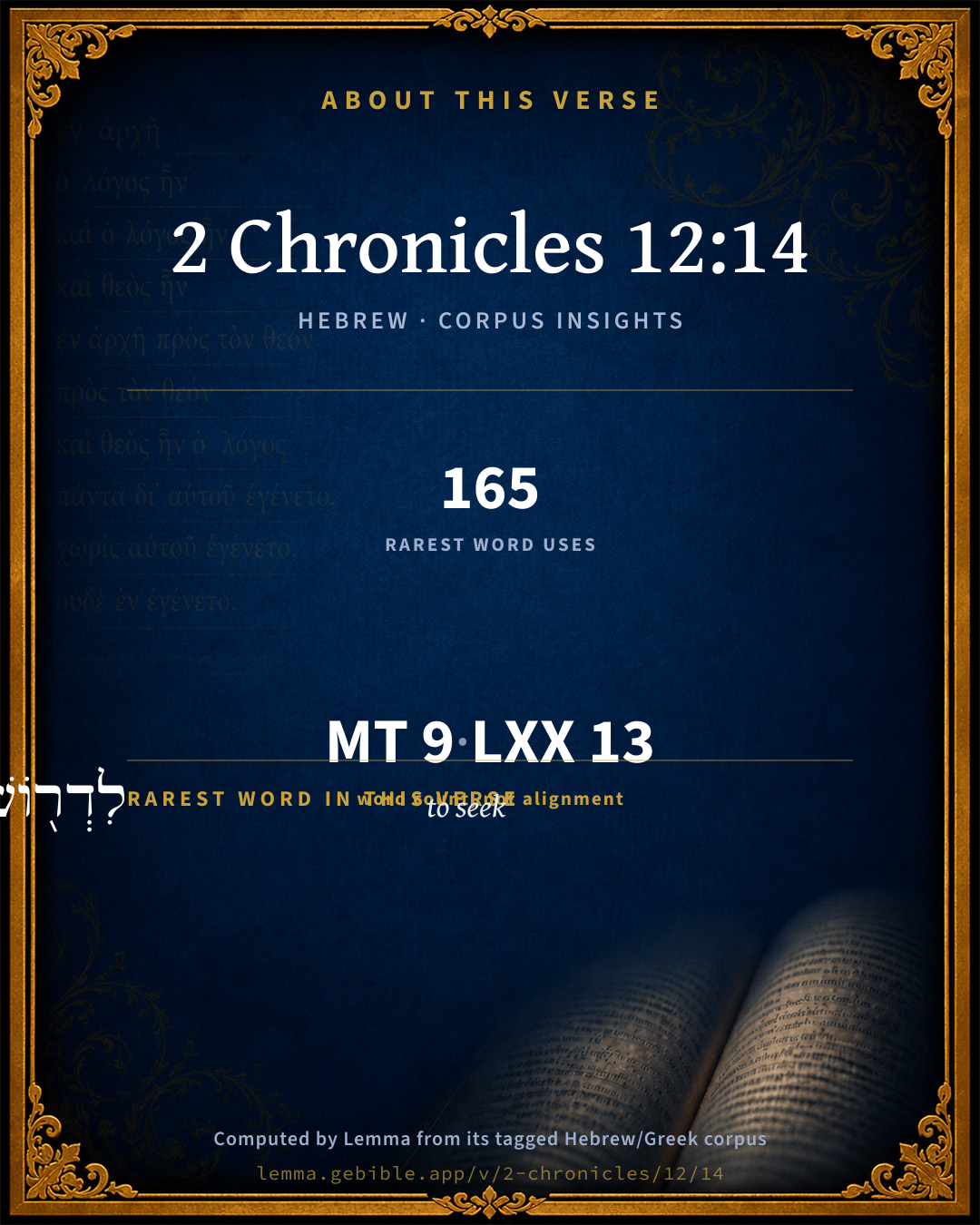
לִדְר֖וֹשׁ
dârash
H1875
“to seek”
Preposition + Verb, Qal, Infinitive Construct
Part of Speech
Preposition + Verb
Stem
Qal
Form
Infinitive Construct
Full BDB Definition

Origin: a primitive root

TWOT: 455

to resort to, seek, seek with care, enquire, require - (Qal) - to resort to, frequent (a place), (tread a place) - to consult, enquire of, seek - of God - of heathen gods, necromancers - to seek deity in prayer and worship - God - heathen deities - to seek (with a demand), demand, require - to investigate, enquire - to ask for, require, demand - to practice, study, follow, seek with application - to seek with care, care for - (Niphal) - to allow oneself to be enquired of, consulted (only of God) - to be sought, be sought out - to be required (of blood)
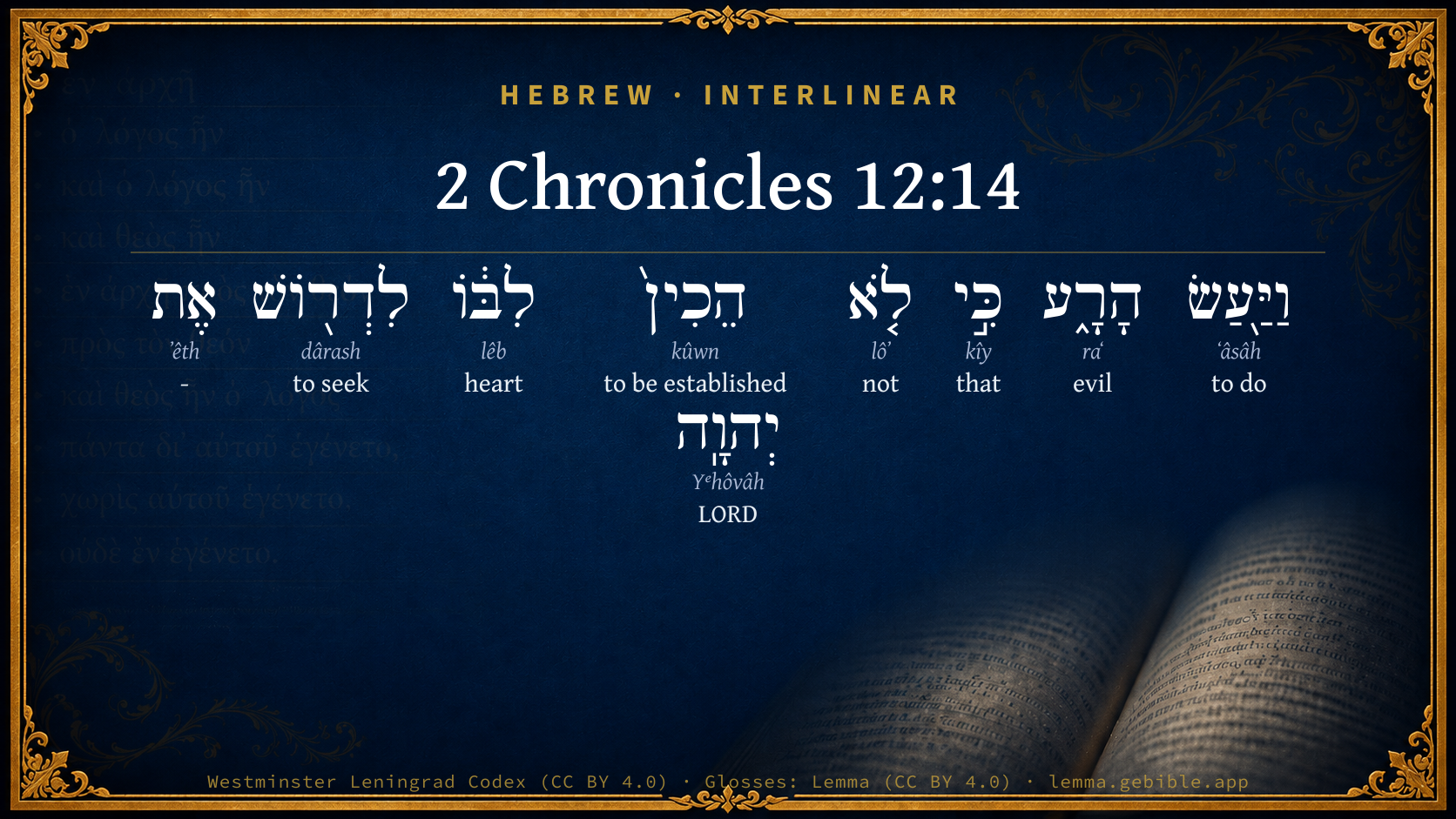
  1. וַיַּ֖עַשׂ ʻâsâh H6213 “and · to do” Conjunction + Verb, Qal, Sequential Imperfect, 3rd Person, Masculine, Singular
  2. הָרָ֑ע raʻ H7451 “the · evil” Particle, Definite Article + Adjective, Adjective, Masculine, Singular, Absolute
  3. כִּ֣י kîy H3588 “that” Conjunction
  4. לֹ֤א lôʼ H3808 “not” Particle, Negative
  5. הֵכִין֙ kûwn H3559 “to be established” Verb, Hiphil, Perfect, 3rd Person, Masculine, Singular
  6. לִבּ֔וֹ lêb H3820 “heart · his” Noun, Common, Masculine, Singular, Construct + Suffix, Personal, 3rd Person, Masculine, Singular
  7. אֶת ʼêth H853 “-” Particle, Direct Object
  8. יְהוָֽה Yᵉhôvâh H3068 “LORD” Noun, Proper

About this verse

These counts appear in no published source. They are computed here, from the morphology-tagged text and Lemma’s own curated glosses. What Lemma adds →

9
words
9
distinct lemmas
Historical
section

Grammatical profile

  • 3 verbs
  • 2 nouns
  • 1 adjective
  • 1 conjunction
  • 2 particles

Verb forms

  • וַיַּ֖עַשׂ Qal · Sequential Imperfect
  • הֵכִין֙ Hiphil · Perfect
  • לִדְר֖וֹשׁ Qal · Infinitive Construct

Hebrew & Septuagint length

In English translation the verse runs 15 words from the Hebrew and 14 from the Septuagint (LXX English) — closely comparable.

A rough comparison of the two English renderings, which tokenize alike — not a word-level alignment.

Word counts can differ between the Hebrew and the Greek without any difference in meaning — e.g. the Hebrew direct-object marker אֵת has no separate Greek word, and Greek often adds the article ὁ.

In the original languages it is 9 Hebrew tokens and 13 Greek tokens — but the two are counted differently (Hebrew bundles its prefixes and suffixes into one token; the Greek is in lemma form), so that isn’t a like-for-like length.

Cross-references

16

Topical passages linked to 2 Chronicles 12:14 in the Treasury of Scripture Knowledge — connected by theme and wording, ordered by reader-vote popularity; previews shown in the World English Bible.

  • 2 Chronicles 19:3 Nevertheless there are good things found in you, in that you have put away the Asheroth out of the land, and have set your heart to seek God.
  • Isaiah 45:19 I have not spoken in secret, in a place of the land of darkness; I didn't say to the seed of Jacob, Seek you me in vain: I, Yahweh, speak righteousness, I declare things that are right.
  • Isaiah 55:6–7 Seek you Yahweh while he may be found; call you on him while he is near:
  • Ezekiel 33:31 They come to you as the people comes, and they sit before you as my people, and they hear your words, but don't do them; for with their mouth they show much love, but their heart goes after their gain.
  • 1 Corinthians 15:58 Therefore, my beloved brothers, be steadfast, immovable, always abounding in the Lord's work, because you know that your labor is not in vain in the Lord.
  • 1 Corinthians 16:13 Watch! Stand firm in the faith! Be courageous! Be strong!
  • 2 Chronicles 11:16 After them, out of all the tribes of Israel, such as set their hearts to seek Yahweh, the God of Israel, came to Jerusalem to sacrifice to Yahweh, the God of their fathers.
  • 2 Chronicles 30:19 who sets his heart to seek God, Yahweh, the God of his fathers, though not [cleansed] according to the purification of the sanctuary.
  • Psalms 78:8 And might not be as their fathers, A stubborn and rebellious generation, A generation that didn't make their hearts loyal, Whose spirit was not steadfast with God.
  • Psalms 78:37 For their heart was not right with him, Neither were they faithful in his covenant.
  • Psalms 105:3–4 Glory in his holy name. Let the heart of those who seek Yahweh rejoice.
  • Deuteronomy 5:29 Oh that there were such a heart in them, that they would fear me, and keep all my commandments always, that it might be well with them, and with their children forever!
  • 1 Samuel 7:3 Samuel spoke to all the house of Israel, saying, If you do return to Yahweh with all your heart, then put away the foreign gods and the Ashtaroth from among you, and direct your hearts to Yahweh, and serve him only; and he will deliver you out of the hand of the Philistines.
  • 1 Chronicles 29:18 Yahweh, the God of Abraham, of Isaac, and of Israel, our fathers, keep this forever in the imagination of the thoughts of the heart of your people, and prepare their heart to you;
  • Psalms 57:7 My heart is steadfast, God, my heart is steadfast. I will sing, yes, I will sing praises.
  • Matthew 7:7 "Ask, and it will be given you. Seek, and you will find. Knock, and it will be opened for you.

Cross-references courtesy of OpenBible.info (CC BY 4.0).

Hebrew and Greek witnesses Masoretic Hebrew ↔ Greek Septuagint

The same verse in the two great witnesses to the Old Testament, shown verse-for-verse.

These are two independent witnesses, not word-aligned to each other, and the Septuagint is shown in lemma (dictionary) form.

Hebrew 2 Chronicles 12:14 Masoretic · Westminster Leningrad Codex

וַיַּ֖עַשׂ הָרָ֑ע כִּ֣י לֹ֤א הֵכִין֙ לִבּ֔וֹ לִדְר֖וֹשׁ אֶת יְהוָֽה

He did that which was evil, because he didn't set his heart to seek Yahweh.

World English Bible · Public Domain

Greek LXX 2 Chronicles 12:14 Septuagint · lemma form

καί ποιέω ὁ πονηρός ὅτι οὐ καταεὐθύνω ὁ καρδία αὐτός ἐκζητέω ὁ κύριος

And he did evil, for he directed not his heart to seek the Lord.

LXX2012 (modern English Septuagint) · Public Domain

Hebrew: Westminster Leningrad Codex (CC BY 4.0). Greek: Septuagint (public domain); English from LXX2012 (modern English Septuagint) (Public Domain). How the Septuagint differs from the Hebrew →

Commentary

Notes on 2 Chronicles 12:14 from classic Christian and Jewish commentators (each source and its license shown beneath its notes). The classic Christian expositions comment on the surrounding passage and are grouped to its opening verse, so a note may address several verses; the Jewish commentaries on the Tanakh (Rashi and others) are per-verse, so they appear only where the commentator wrote on this verse.

Lemma curates 59 commentaries, every one of them public domain or Creative Commons licensed, each selected and text-cleaned for this edition rather than reprinted as found. About our sources →

Trapp's Complete Commentary

John Trapp

2Ch 12:14 And he did evil, because he prepared not his heart to seek the LORD.

Ver. 14. Because he prepared not.] Some good resolutions he had, but they were flashy and fleeting: he drew them not into execution, but was soon off all again; his quicksilver was not fixed. See 2Ch 12:6.

John Trapp, A Commentary or Exposition upon All the Books of the Old and New Testament (1647–1656) — public domain. Text from a community e-Sword module.

The Biblical Illustrator

Joseph S. Exell

2Ch_12:14

He prepared not his heart to seek the Lord.

Rehoboam the unready

I. He did not begin life with seeking the Lord.

II. He showed no heart in seeking the Lord afterwards.

III. He was not fixed and persevering seeking the Lord.

IV. He had no care to seek the Lord thoroughly. (C. H. Spurgeon.)

Rehoboam

I. Implied obligation. To seek the Lord is the obligation of all This is suggestive--

1. Of the loss sustained. How is God lost to man? He has lost--

(1) The true knowledge of His character.

(2) The conscious enjoyment of His favour.

(3) The blessedness of communion with Him.

2. Of its retrievableness. For this purpose--

(1) God has revealed Himself to man in His own nature.

(2) The redemptive work of Christ is made known.

(3) The Holy Spirit performs His beneficent functions.

3. Of the importance of its recovery.

II. Mental conviction. In Rehoboam we see mental conviction arising from knowledge of duty, promptings of conscience, consciousness of guilt. This is a mental state of frequent occurrence. It may be observed--

1. As the effect of truth. The Word of God is a discoverer of the thoughts and intents of the heart. Felix. There are many Felixes.

2. As intensified by circumstances.

3. As critical in its results. How much depends on moments of conviction! They are often the turning-points of destiny. It does not seem that Rehoboam ever paused in his downward career from this time forward.

III. Moral infirmity. There was want of decision in Rehoboam. He did not prepare his heart to seek the Lord. This may be traced--

1. To sensual habits (2Ch_11:18-23; 1Ki_14:21-24).

2. To evil companionship.

3. To Satanic temptation.

IV. Accumulated guilt. He did evil because, etc. This sin was parent of a host. He sinned in this neglect of known duty, and in what resulted from it. So do all who pursue a like course. They sin--

1. In resisting their convictions.

2. In self-depravation. Beware lest any of you be hardened through the deceitfulness of sin.

3. The depravation of others. Through his guilty conduct the people were corrupted. One sinner destroyeth much good. (S. A. Browning.)

A heart not fixed

The marginal reading is, He fixed not his heart upon the Lord. This was a favourite expression of Davids. My heart is fixed, O God, my heart is fixed. His heart is fixed, trusting in the Lord. Perhaps it was intended to draw a contrast between the character of Rehoboam and his far worthier ancestor. Religion is not a thing that can be taken up in a loose, careless manner. It claims the whole purpose and energy of the heart. In the Pilgrims Progress, Prudence wished to know from Christian how he was enabled to overcome his temptations and to persevere in the good and holy way. Christians reply was, When I think of what I saw at the Cross, that will do it; when I look upon my broidered coat, that will do it; when I look into the roll that I carry in my bosom, that will do it; and when my thoughts wax warm about whither I am going, that will do it. I cannot do better than follow in the line of the great dreamers allegory.

I. The first condition of a fixed heart is a sight of the Cross. The worlds religion ends with forgiveness; Gods religion begins with it. There is nothing that imparts such solidity to character, and such strength and dignity to life, as conscious peace with Heaven.

II. The next thing is to look upon your broidered coat--the righteousness that is unto all and upon all them that believe.

III. Bunyans pilgrim looked also oftentimes into the roll which he carried in his bosom. Habitual study of the Bible is indispensable to a healthy condition of the soul. McCheyne would not speak to any one in the morning till he had first of all heard the voice of God. It gives a tone to the whole day, when we begin the day with Him.

IV. when his thoughts waxed warm about whither he was going, that gave fixedness to Christians heart. You may be none the less shrewd as to the interests of time because you are wise as to the concerns of eternity; like a trusty pilot, who, though his eyes are on the stars, keeps his hand upon the helm. (J. T. Davidson, D.D.)

True and false seeking

I. There is what one may call natural seeking. Seeking is the language of human want. The cravings of life will always demand attention. All the industries of the world, with their ten thousand beneficent developments, are the products of human wisdom to supply human wants. Human life is but a seeking in so many ways, from the cradle to the grave.

II. Seeking the Lord. This is not born of nature, but of grace. Seeking the Lord implies a conscious sense of weakness and insufficiency.

III. Heart preparation. All true and successful seeking of the Lord comes of prepared hearts. The heart is always the part that makes our hearing, believing, praying, and doing right or wrong. As soon as the sun rises in the morning the birds are ready to go forth from their nests to sing. So it is with all the moral forces or faculties of the soul when the heart is prepared to seek the Lord. The heart is to the whole man what the main-spring is to the watch--it sets all the other powers in motion. But as the bowl, says one, runs as the bias inclines it, and as the ship moves as the rudder steers it, so man seeks as the heart prompts him. A prepared heart is a loving heart, believing true and clean. It enters into the secret place of the Most High as a loving child enters into his fathers home. Whence cometh this preparation? There must be some efficient cause to account for the differences we see among men. The difference between the common field and the garden to-day has been brought about by the application of human thought and manual skill. It is even so with respect to differences among men. As the garden did not enclose itself, or of itself become more fertile than the field, neither have men become different among their fellows or before God except by different resolutions of will and energy of character. Those who exercise no forethought or natural sagacity become as the man who built his house upon the sand.

IV. The evil of neglecting to prepare the heart. Men may do evil by failing to do well. Mere neglect is sufficient to ruin a man. A man need not be openly profane or wicked to be excluded from Gods presence; he has but to neglect the means of grace, or to prepare his heart to seek the Lord while He may be found, to call upon Him while He is near. (John Kerr Campbell, D.D.)

.

The Biblical Illustrator, edited by Joseph S. Exell (c. 1880s–1900s) — public domain. Text from a community e-Sword module.

Joseph Benson's Commentary

2Ch 12:14. He prepared not his heart, &c. — Directed not, or settled not, &c. That is, although he humbled himself, and seemed penitent for a season, and professed the true religion and worship of God; yet he quickly relapsed into his former sins, because he was not sincere and serious in his actions, and his heart was not right with God. To seek the Lord — He did not serve the Lord, because he did not seek the Lord. He did not pray to the Lord, as Solomon did, for wisdom and grace. Or he did not consult the word of God, did not seek to that as his oracle. Hence, what little goodness he had, passed away like the morning cloud, and he did evil because he was not fully determined for that which was good. Those are easily drawn aside to evil by Satan, who are wavering and inconstant in that which is good, and are not persuaded to make religion their business.

Joseph Benson's Commentary on the Old and New Testaments (1811–1818) — public domain. Text from a community e-Sword module.

Ellicott's Commentary for English Readers

(14) And he did evil.—Syriac adds “before the Lord.” The nature of his evil-doing is explained immediately: “for he directed not his heart to seek Jehovah.” This estimate of Rehoboam’s conduct seems to refer to the early years of his reign, which ended in the catastrophe of Shishak’s invasion. 1Ki_14:22, says, “And Judah did evil in the eyes of Jehovah “; and then goes on to tell of the acts of apostacy which brought that judgment upon the nation.

The phrase “direct or prepare the heart to seek the Lord,” recurs 2Ch_19:3; 2Ch_30:19; Ezr_7:10.

The book.—History.

Concerning genealogies.—For registration (lehithyahçsh). On the authorities here named, see the Introduction. The important particulars about the reign which are not given in Kings, e.g., the fortification of the southern cities, the migration of the priests, and Rehoboam’s private relations, were probably drawn by the chronicler from these sources.

First and last.—The former and the latter. (See on, 2Ch_17:3.)

And there were wars.—And the wars of Rehoboam and Jeroboam [continued] all the days, i.e., throughout the reign. So 1Ki_14:30, “Now there had been war between Rehoboam and Jeroboam all the days.” Reuss is wrong in regarding this as “a contradiction” of 2Ch_11:4. What Shemaiah forbade was a particular attempt to recover the obedience of the northern kingdom by force of arms. The permanent attitude of the rival kings could hardly be other than hostile, especially as Jeroboam appears to have instigated the Egyptian invasion of Judah; and this hostility must often have broken out into active injuries.

A Bible Commentary for English Readers, edited by Charles John Ellicott (1878–1897) — public domain. Text from a community e-Sword module.

The Cambridge Bible for Schools and Colleges

gen. ed. J. J. S. Perowne

14. he prepared not his heart] R.V. he set not his heart. The phrase implies steady purpose.

The Cambridge Bible for Schools and Colleges (gen. ed. J. J. S. Perowne; Cambridge University Press, 1878–1918) — public domain. Text from a community e-Sword module.

John Gill's Exposition

Now the acts of Rehoboam,.... Of these two verses; see Gill on Kg1 14:29. Kg1 14:30. Kg1 14:31.

Next: 2 Chronicles Chapter 13

John Gill's Exposition of the Whole Bible (1746–1763) — public domain (CC PDM 1.0). Text via the HelloAO Bible API.

Albert Barnes' Notes on the Bible

He prepared not his heart ... - See the margin. Rehoboam’s sin was want of earnestness and consistency.

Albert Barnes' Notes on the Bible (1834–1885) — public domain. Text from a community e-Sword/MySword module.

Haydock's Catholic Bible Commentary

Lord, with sincerity, being actuated only by a servile fear. He died impenitent. (Calmet)

George Leo Haydock (1774–1849), Haydock's Catholic Family Bible and Commentary, 1859 edition — public domain. Excludes Psalms (Douay-Rheims chapter numbering differs from Protestant) and Deuterocanonical books (Catholic canon only).

Matthew Poole's English Annotations

Prepared not, or directed not, or settled not, &c, i.e. although he humbled himself, and seemed penitent for a season, and professed the true religion and worship of God; yet he quickly relapsed into his former sins, because he was not sincere nor serious in his actions, and his heart was not right with God.

Matthew Poole's English Annotations on the Holy Bible (1683–1685) — public domain. Text from a community e-Sword/MySword module.

The Pulpit Commentary

These summarizing moral estimates of the character of the succeeding kings are, indeed, common to the compilers of both Chronicles and Kings, though absent, in the case of Rehoboam, from the parallel.

The Pulpit Commentary (1880–1919), ed. H.D.M. Spence-Jones & Joseph S. Exell — public domain. Text from a community e-Sword module.

John Wesley's Explanatory Notes

Did evil - Or, settled not, although he humbled himself, for a season, yet he quickly relapsed into sin, because his heart was not right with God.

John Wesley, Explanatory Notes Upon the Whole Bible (1754–1765) — public domain. Text via the GEBible commentary corpus.

Lesson kit

Teaching starters — assembled from the data on this page, not authored interpretation. Every prompt links to the verse data it draws on. Edit before teaching.

2 Chronicles, in the Historical, opens this verse with 9 words (9 distinct Hebrew lemmas). Its most distinctive word is dârash (“to seek”). A historical commentator’s framing appears above. Read the whole chapter for the surrounding context.

Discussion questions

  1. The word dârash carries the sense “to seek.” How does it shape the verse?
  2. 2 Chronicles 19:3 shares this passage’s theme. How do the two illuminate each other?
  3. These translations render this verse differently; the difference is in the English rendering, not the original. What questions does that raise?
  4. The verb «וַיַּ֖עַשׂ» is Qal Sequential Imperfect. How does its form color the action?
  5. Reading how Trapp's Complete Commentary and The Biblical Illustrator read this verse, where do the two commentators agree and where do they part?

Things to notice

Reading settings

Reading text

Shown beneath each verse's original-language words.

Old Testament
Old Testament edition

Read the OT as the Masoretic Hebrew (MT) or the Greek Septuagint (LXX).

English shown for the Greek Septuagint (in the Hebrew ↔ Greek comparison).

Comparing translations? Open the Compare panel on any verse page to stack up to four side by side.