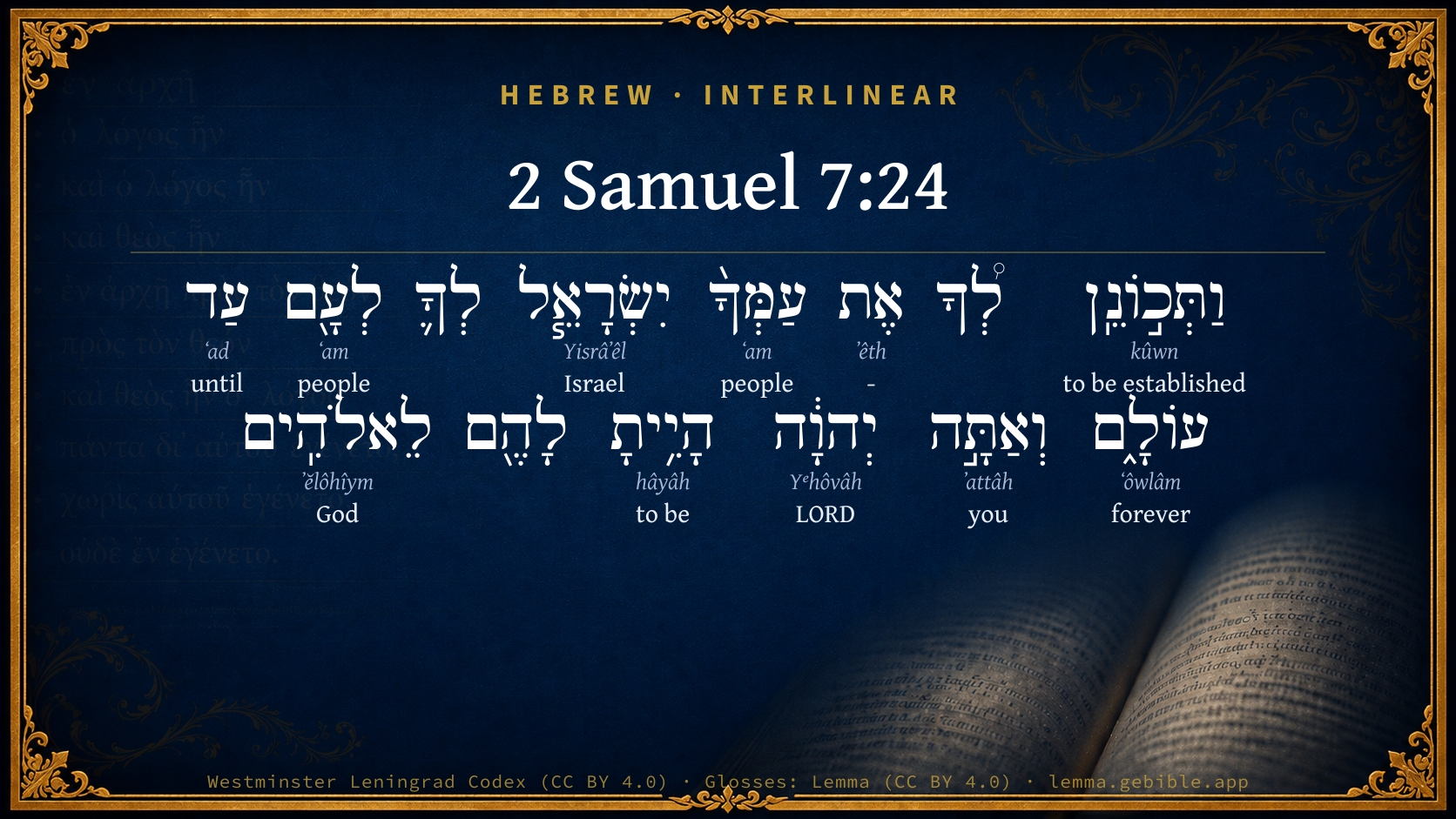
2 Samuel 7:24

Hebrew (Westminster Leningrad Codex) 2 Samuel 7:24 appears in the Hebrew Old Testament. The text above is from the Westminster Leningrad Codex. Each word links to its Strong’s number, a concise gloss, and parsing drawn from the Open Scriptures Hebrew Bible morphology. Click any word for its full Brown-Driver-Briggs (BDB) entry.
Download image
Cite this verse

2 Samuel 7:24 (World English Bible). Public Domain. Lemma interlinear Bible study tool, https://lemma.gebible.app/v/2-samuel/7/24.

Show BibTeX & RIS
BibTeX
RIS
English Translation
You did establish to yourself your people Israel to be a people to you forever; and you, Yahweh, became their God.
World English Bible · Public Domain
Download a study sheet

One document with this verse’s original text, its word-by-word gloss line, the meaning frame, cross-references with their text, attributed commentary, and full source and license credits — printable, and it pastes into notes with its structure intact.

This verse Autodidact and up

Study sheet (.html) Plain text (.txt)

A passage Seminary Student

Up to 50 verses in one chapter. A passage sheet keeps up to 6 commentary sources and 12 cross-references per verse, in the order this page ranks them, and says so on the sheet whenever that leaves anything out. Ask for a single verse and you get the Autodidact verse sheet above.

Everything on this page stays free to read, with no account — the sheet is a download of what is already on screen, not access to it.

Want to remove ads? Support Godless Engineer
Compare translations 3

The same verse in 3 English versions, stacked beneath the original-language interlinear above. Click any original word for its lexicon entry.

Each is an independent rendering of the whole verse — the interlinear is not word-aligned to these translations.

Highlighted words mark where these versions differ — a whole-verse word diff, not a word-by-word alignment.

  • World English Bible Public Domain
    You did establish to yourself your people Israel to be a people to you forever; and you, Yahweh, became their God.
  • King James Version Public Domain
    For thou hast confirmed to thyself thy people Israel to be a people unto thee for ever: and thou, LORD, art become their God.
  • unfoldingWord Literal Text CC BY-SA 4.0
    And you established for yourself your people Israel as a people for yourself to forever. And you, Yahweh, you became God to them.

unfoldingWord Literal Text — © unfoldingWord, licensed CC BY-SA 4.0. Word-aligned USFM3 via Door43 (git.door43.org/unfoldingWord/en_ult).

Versions to compare (up to 4)

3 of 4 selected

Show all 18 translations

Every available English version of this verse, each an independent rendering of the whole verse.

  • World English Bible Public Domain
    You did establish to yourself your people Israel to be a people to you forever; and you, Yahweh, became their God.
  • Berean Standard Bible Public Domain
    For You have established Your people Israel as Your very own forever, and You, O LORD, have become their God.
  • Majority Standard Bible Public Domain
    For You have established Your people Israel as Your very own forever, and You, O LORD, have become their God.
  • King James Version Public Domain
    For thou hast confirmed to thyself thy people Israel to be a people unto thee for ever: and thou, LORD, art become their God.
  • American Standard Version (1901) Public Domain
    And thou didst establish to thyself thy people Israel to be a people unto thee for ever; and thou, Jehovah, becamest their God.
  • Revised Version (1885) Public Domain
    And thou didst establish to thyself thy people Israel to be a people unto thee for ever; and thou, LORD, becamest their God.
  • Geneva Bible (1599) Public Domain
    For thou hast ordeyned to thy selfe thy people Israel to be thy people for euer: and thou Lord art become their God.
  • Douay-Rheims (1899) Public Domain
    For thou hast confirmed to thyself thy people Israel to be an everlasting people: and thou, O Lord God, art become their God.
  • Young's Literal Translation Public Domain
    Yea, Thou dost establish to Thee Thy people Israel, to Thee for a people unto the age, and Thou, Jehovah, hast been to them for God.
  • Literal Standard Version CC BY-SA 4.0
    Indeed, You establish Your people Israel for Yourself, for a people for Yourself for all time, and You, YHWH, have been to them for God.
  • Unlocked Literal Bible CC BY-SA 4.0
    You established Israel as your own people forever, and you, Yahweh, became their God.
  • unfoldingWord Literal Text CC BY-SA 4.0
    And you established for yourself your people Israel as a people for yourself to forever. And you, Yahweh, you became God to them.
  • Darby Bible Public Domain
    And thou hast established to thyself thy people Israel to be a people unto thee for ever; and thou, Jehovah, art become their God.
  • World Messianic Bible Public Domain
    You established for yourself your people Israel to be your people forever; and you, LORD, became their God.
  • Webster's Bible Public Domain
    For thou hast confirmed to thyself thy people Israel to be a people to thee for ever: and thou, LORD, art become their God.
  • Free Bible Version CC BY-SA 4.0
    You made your people Israel your own forever, and you, Lord, have become their God.
  • Bible in Basic English Public Domain
    But you took and made strong for yourself your people Israel, to be your people for ever; and you, Lord, became their God.
  • JPS Tanakh (1917) Public Domain
    And Thou didst establish to Thyself Thy people Israel to be a people unto Thee for ever; and Thou, LORD, becamest their God.

Literal Standard Version (2020), Covenant Press — licensed CC BY-SA 4.0. Text via the HelloAO Bible API (eBible.org). Unlocked Literal Bible (unfoldingWord) — licensed CC BY-SA 4.0. Text via the HelloAO Bible API (eBible.org). unfoldingWord Literal Text — © unfoldingWord, licensed CC BY-SA 4.0. Word-aligned USFM3 via Door43 (git.door43.org/unfoldingWord/en_ult). Free Bible Version, Dr. Jonathan Gallagher — licensed CC BY-SA 4.0. Text via the HelloAO Bible API (eBible.org).

Word by word

More ways to search: Search by grammar → Find every occurrence → Compare this word →

Practice this passage: Drill this verse → Learn its vocabulary →

וַתְּכ֣וֹנֵֽן
kûwn
H3559
“and · to be established”
Conjunction + Verb, Polel, Sequential Imperfect, 2nd Person, Masculine, Singular
Part of Speech
Conjunction + Verb
Stem
Polel
Form
Sequential Imperfect
Person
2nd Person
Gender
Masculine
Number
Singular
Full BDB Definition

Origin: a primitive root

TWOT: 964

to be firm, be stable, be established - (Niphal) - to be set up, be established, be fixed - to be firmly established - to be established, be stable, be secure, be enduring - to be fixed, be securely determined - to be directed aright, be fixed aright, be steadfast - to prepare, be ready - to be prepared, be arranged, be settled - (Hiphil) - to establish, set up, accomplish, do, make firm - to fix, make ready, prepare, provide, provide for, furnish - to direct toward (moral sense) - to arrange, order - (Hophal) - to be established, be fastened - to be prepared, be ready - (Polel) - to set up, establish - to constitute, make - to fix - to direct - (Pulal) to be established, be prepared - (Hithpolel) to be established, be restored

  1. אֶת ʼêth H853 “-” Particle, Direct Object
  2. עַמְּךָ֨ ʻam H5971 “people · your” Noun, Common, Masculine, Singular, Construct + Suffix, Personal, 2nd Person, Masculine, Singular
  3. יִשְׂרָאֵ֧ל Yisrâʼêl H3478 “Israel” Noun, Proper
  4. לְעָ֖ם ʻam H5971 “to/for · people” Preposition + Noun, Common, Masculine, Singular, Absolute
  5. עַד ʻad H5704 “until” Preposition
  6. עוֹלָ֑ם ʻôwlâm H5769 “forever” Noun, Common, Masculine, Singular, Absolute
  7. וְאַתָּ֣ה ʼattâh H859 “and · you” Conjunction + Pronoun, Personal, 2nd Person, Masculine, Singular
  8. יְהוָ֔ה Yᵉhôvâh H3068 “LORD” Noun, Proper
  9. הָיִ֥יתָ hâyâh H1961 “to be” Verb, Qal, Perfect, 2nd Person, Masculine, Singular
  10. לֵאלֹהִֽים ʼĕlôhîym H430 “to/for · God(s)” Preposition + Noun, Common, Masculine, Plural, Absolute

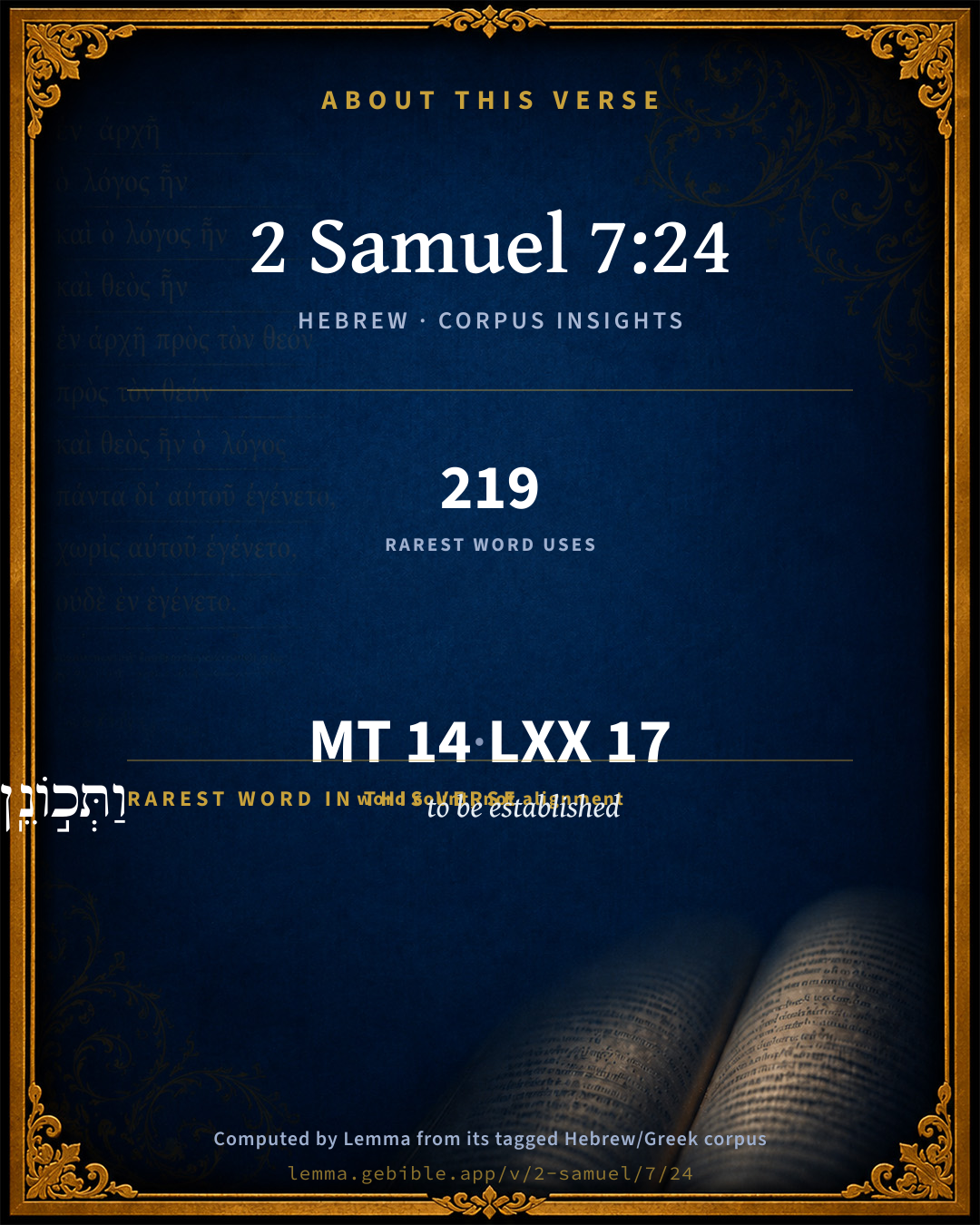
About this verse

These counts appear in no published source. They are computed here, from the morphology-tagged text and Lemma’s own curated glosses. What Lemma adds →

14
words
10
distinct lemmas
Historical
section

Grammatical profile

  • 2 verbs
  • 6 nouns
  • 1 pronoun
  • 4 prepositions
  • 1 particle

Verb forms

  • וַתְּכ֣וֹנֵֽן Polel · Sequential Imperfect
  • הָיִ֥יתָ Qal · Perfect

Repetition

A word recurs within this verse — often emphatic in Hebrew:

  • עַמְּךָ֨ people H5971 ×2

Hebrew & Septuagint length

In English translation the verse runs 21 words from the Hebrew and 22 from the Septuagint (LXX English) — closely comparable.

A rough comparison of the two English renderings, which tokenize alike — not a word-level alignment.

Word counts can differ between the Hebrew and the Greek without any difference in meaning — e.g. the Hebrew direct-object marker אֵת has no separate Greek word, and Greek often adds the article ὁ.

In the original languages it is 14 Hebrew tokens and 17 Greek tokens — but the two are counted differently (Hebrew bundles its prefixes and suffixes into one token; the Greek is in lemma form), so that isn’t a like-for-like length.

Cross-references

17

Topical passages linked to 2 Samuel 7:24 in the Treasury of Scripture Knowledge — connected by theme and wording, ordered by reader-vote popularity; previews shown in the World English Bible.

  • Deuteronomy 26:18 and Yahweh has declared you this day to be a people for his own possession, as he has promised you, and that you should keep all his commandments;
  • 1 Peter 2:10 who in time past were no people, but now are God's people, who had not obtained mercy, but now have obtained mercy.
  • Genesis 17:7 I will establish my covenant between me and you and your seed after you throughout their generations for an everlasting covenant, to be a God to you and to your seed after you.
  • Psalms 48:14 For this God is our God forever and ever. He will be our guide even to death.
  • Isaiah 12:2 Behold, God is my salvation. I will trust, and will not be afraid; for Yah, Yahweh, is my strength and song; and he has become my salvation."
  • Jeremiah 31:33 But this is the covenant that I will make with the house of Israel after those days, says Yahweh: I will put my law in their inward parts, and in their heart will I write it; and I will be their God, and they shall be my people:
  • John 1:12 But as many as received him, to them he gave the right to become God's children, to those who believe in his name:
  • Exodus 6:7 and I will take you to me for a people, and I will be to you a God; and you shall know that I am Yahweh your God, who brings you out from under the burdens of the Egyptians.
  • Exodus 15:2 Yah is my strength and song, He has become my salvation: This is my God, and I will praise him; My father's God, and I will exalt him.
  • Deuteronomy 27:9 Moses and the priests the Levites spoke to all Israel, saying, Keep silence, and listen, Israel: this day you are become the people of Yahweh your God.
  • 2 Samuel 7:23 What one nation in the earth is like your people, even like Israel, whom God went to redeem to himself for a people, and to make him a name, and to do great things for you, and awesome things for your land, before your people, whom you redeem to you out of Egypt, [from] the nations and their gods?
  • 1 Chronicles 17:22 For your people Israel did you make your own people forever; and you, Yahweh, became their God.
  • Jeremiah 31:1 At that time, says Yahweh, will I be the God of all the families of Israel, and they shall be my people.
  • Jeremiah 32:38 and they shall be my people, and I will be their God:
  • Hosea 1:10 Yet the number of the children of Israel will be as the sand of the sea, which can't be measured nor numbered; and it will come to pass that, in the place where it was said to them, 'You are not my people,' they will be called 'sons of the living God.'
  • Zechariah 13:9 I will bring the third part into the fire, And will refine them as silver is refined, And will test them like gold is tested. They will call on my name, and I will hear them. I will say, 'It is my people;' And they will say, 'Yahweh is my God.'"
  • Romans 9:25–26 As he says also in Hosea, "I will call them 'my people,' which were not my people; And her 'beloved,' who was not beloved."

Cross-references courtesy of OpenBible.info (CC BY 4.0).

Hebrew and Greek witnesses Masoretic Hebrew ↔ Greek Septuagint

The same verse in the two great witnesses to the Old Testament, shown verse-for-verse.

These are two independent witnesses, not word-aligned to each other, and the Septuagint is shown in lemma (dictionary) form.

Hebrew 2 Samuel 7:24 Masoretic · Westminster Leningrad Codex

וַתְּכ֣וֹנֵֽן לְ֠ךָ אֶת עַמְּךָ֨ יִשְׂרָאֵ֧ל לְךָ֛ לְעָ֖ם עַד עוֹלָ֑ם וְאַתָּ֣ה יְהוָ֔ה הָיִ֥יתָ לָהֶ֖ם לֵאלֹהִֽים

You did establish to yourself your people Israel to be a people to you forever; and you, Yahweh, became their God.

World English Bible · Public Domain

Greek LXX 2 Samuel 7:24 Septuagint · lemma form

καί ἑτοιμάζω σεαυτοῦ ὁ λαός σύ ἰσραήλ λαός ἕως αἰών καί σύ κύριος γίγνομαι αὐτός εἰς θεός

And you have prepared for yourself your people Israel to be a people for ever, and you, Lord, are become their God.

LXX2012 (modern English Septuagint) · Public Domain

On this verse, The Pulpit Commentary discusses the Septuagint’s reading. Read the note in Commentary ↓

Hebrew: Westminster Leningrad Codex (CC BY 4.0). Greek: Septuagint (public domain); English from LXX2012 (modern English Septuagint) (Public Domain). How the Septuagint differs from the Hebrew →

Targum (Aramaic paraphrase)

1

The Targum is the ancient Jewish Aramaic paraphrase of the Hebrew Scriptures — an interpretive translation, not the Hebrew text itself. Onkelos (literal) and Pseudo-Jonathan (expansive) render the Torah, and Jonathan the Prophets. Coverage is partial: where no permissively-licensed English translation exists for a verse, only the Aramaic is shown. This is verse-level text, not a word-by-word alignment to the Hebrew.

  1. Targum Jonathan Prophets (Joshua–Malachi)
    וְאַתְקֵינְתָּא לָךְ יַת עַמָךְ יִשְׂרָאֵל קֳדָמָךְ לְעַם עַד עָלְמָא וְאַתְּ יְיָ הֱוֵיתָא לְהוֹן לֵאלָהָא:

    (no public-domain English translation for this verse)

    Targum Jonathan — Aramaic: “Mikraot Gedolot” (public domain). English: “Sefaria Community Translation” (CC0 1.0 (public-domain dedication)); “London "Chaldee Paraphrase," 1871” (public domain). Text via Sefaria.

Commentary

Notes on 2 Samuel 7:24 from classic Christian and Jewish commentators (each source and its license shown beneath its notes). The classic Christian expositions comment on the surrounding passage and are grouped to its opening verse, so a note may address several verses; the Jewish commentaries on the Tanakh (Rashi and others) are per-verse, so they appear only where the commentator wrote on this verse.

Lemma curates 59 commentaries, every one of them public domain or Creative Commons licensed, each selected and text-cleaned for this edition rather than reprinted as found. About our sources →

Trapp's Complete Commentary

John Trapp

2Sa 7:24 For thou hast confirmed to thyself thy people Israel [to be] a people unto thee for ever: and thou, LORD, art become their God.

Ver. 24. For thou hast confirmed to thyself,] i.e., All the Israel of God by a perpetual covenant: by thy benefits also thou hast gained them unto thee, and to thine obedience.

John Trapp, A Commentary or Exposition upon All the Books of the Old and New Testament (1647–1656) — public domain. Text from a community e-Sword module.

Joseph Benson's Commentary

2Sa 7:24-26. For thou hast confirmed — Partly by thy promises, and that solemn and sure covenant into which thou hast entered with them; and partly by thy glorious works wrought on their behalf, as it appears this day. Thou art become their God — In a peculiar manner, and by special relation and covenant; for otherwise he is the God and Father of all. The word concerning thy servant and his house, establish thou it — And yet he did not desire this great kindness merely for his own sake and the sake of his family, but that God might be glorified in what he did for him and them. Thus it follows, And let thy name be magnified for ever — Never cease to manifest thyself to be the God and governor of Israel, and let all men acknowledge that the God of Israel is the Lord of hosts, the Lord of heaven and earth, of angels and men, and faithful in his promises to the house of David.

Joseph Benson's Commentary on the Old and New Testaments (1811–1818) — public domain. Text from a community e-Sword module.

Tyndale Open Study Notes

Tyndale Open Resources

7:24 David praised God for his goodness in redeeming and establishing the nation of Israel (7:23-24), not just David and his royal line (7:18-21). His prayer is corporate rather than just personal.

Tyndale Open Study Notes — © Tyndale Open Resources, licensed CC BY-SA 4.0. Text via the HelloAO Bible API.

Geneva Bible (1599)

Geneva Bible translators

He showeth that God’s free election is the only cause, why the Israelites were chosen to be his people.

Geneva Bible (1599) marginal notes — public domain. Text via Bolls.life.

The Cambridge Bible for Schools and Colleges

gen. ed. J. J. S. Perowne

24. thou hast confirmed] Established, the same word as in 2Sa_7:13. Cp. Deu_32:6.

art become their God] Hast proved Thyself to be their God, in fulfilment of the promises in Gen_17:7-8; Exo_6:7.

The Cambridge Bible for Schools and Colleges (gen. ed. J. J. S. Perowne; Cambridge University Press, 1878–1918) — public domain. Text from a community e-Sword module.

John Gill's Exposition

For thou hast confirmed to thyself thy people Israel to be a people unto thee for ever,.... So long as they were obedient to him, and observed his laws and statutes, and abode by his worship and ordinances, otherwise he would write a "loammi" on them, as he has, see Hos 1:9,

and thou, Lord, art become their God; their covenant God, they having avouched him to be their God, and he having avouched them to be his people, Deu 26:17.

John Gill's Exposition of the Whole Bible (1746–1763) — public domain (CC PDM 1.0). Text via the HelloAO Bible API.

Matthew Poole's English Annotations

Thou hast confirmed to thyself; partly by thy promises, and that sure covenant which thou hast made with them; and partly by thy glorious works wrought on their behalf, as it appears this day.

Thou art become their God, in a peculiar manner, and by special relation and covenant; for otherwise he is the God and Father of all things, 1Co 8:6.

Matthew Poole's English Annotations on the Holy Bible (1683–1685) — public domain. Text from a community e-Sword/MySword module.

The Pulpit Commentary

For thou hast confirmed. The word means "thou hast firmly and securely established Israel to "be thy people." This plainly refers to he settlement in Canaan, now at last completed by David"s victories, and not to the deliverance from Egypt. In the words that follow David recognizes the spiritual importance, not only of the permanent continuance of his house, but also of the empire given unto him. For Israel is now to be a people forever: and thou, Jehovah, art become their God. It is very necessary to retain here the personal name, Jehovah, as it is in the Hebrew, and not dilute it down to the Lord of the Septuagint. For now, to David"s mind, the covenant seemed complete, and ratified forever. Israel is to have an everlasting existence a promise belonging to it in its full sense only spiritually. For as long as the world lasts, it is against the spiritual Israel that the gates of hell shall never prevail. And next, first as the theocratic people, and then as the Church, it is to hold a unique relation to Jehovah, who is to be its God. For Israel, that is, the Jewish and the Christian Church, worships, not the God of nature, Elohim, but Jehovah, the God of grace; and they learn his attributes, not from philosophy, nor by metaphysical inquiry, but from his own revealed will, in which he teaches us what he is, what we are, and how we are to become one with him.

The Pulpit Commentary (1880–1919), ed. H.D.M. Spence-Jones & Joseph S. Exell — public domain. Text from a community e-Sword module.

John Wesley's Explanatory Notes

Confirmed - Partly, by thy promises, and that sure covenant which thou hast made with them: and partly, by thy glorious works wrought on their behalf, as it appears this day. Their God - In a peculiar manner, and by special relation and covenant: for otherwise he is the God and father of all things.

John Wesley, Explanatory Notes Upon the Whole Bible (1754–1765) — public domain. Text via the GEBible commentary corpus.

unfoldingWord translationNotes

Door43 World Missions Community

General Information:

David continues to talk to Yahweh.

So now

Here "now" does not mean "at this moment," but is used to draw attention to the important point that follows.

may the promise that you made concerning your servant and his family be established forever

This can be stated in active form. AT: "may you do what you promised to me and my family, and may your promise never change" (See: Active or Passive)

your servant and his family

David is speaking about himself in the third person. This can be stated in the first person. AT: "me and my family" (See: First, Second, or Third Person)

May your name be forever great

Here "name" represents Yahweh's reputation. (See: Metonymy)

the house of me, David, your servant

Here "house" represents family. AT: "my family" (See: Metonymy)

is established before you

This can be stated in active form. AT: "is secure because of you" or "continues because of you" (See: Active or Passive)

translationWords

Israel

Yahweh of hosts

God

promise

family

name

unfoldingWord translationNotes — © Distant Shores Media and the Door43 World Missions Community, licensed CC BY-SA 4.0. Source: git.door43.org/Door43/en_tn.

Lesson kit

Teaching starters — assembled from the data on this page, not authored interpretation. Every prompt links to the verse data it draws on. Edit before teaching.

2 Samuel, in the Historical, opens this verse with 14 words (10 distinct Hebrew lemmas). Its most distinctive word is kûwn (“to be established”). A historical commentator’s framing appears above. Read the whole chapter for the surrounding context.

Discussion questions

  1. How does “to be established” (kûwn) shape what this verse is saying?
  2. Deuteronomy 26:18 shares this passage’s theme. How do the two illuminate each other?
  3. “people” occurs 2× in this one verse. What is the effect of the repetition?
  4. The translations on this page render this verse differently — a whole-verse word diff, not a word-by-word alignment. What might account for the different wordings?
  5. The verb «וַתְּכ֣וֹנֵֽן» is Polel Sequential Imperfect. How does its form color the action?
  6. Reading how Trapp's Complete Commentary and Joseph Benson's Commentary read this verse, where do the two commentators agree and where do they part?

Things to notice

Reading settings

Reading text

Shown beneath each verse's original-language words.

Old Testament
Old Testament edition

Read the OT as the Masoretic Hebrew (MT) or the Greek Septuagint (LXX).

English shown for the Greek Septuagint (in the Hebrew ↔ Greek comparison).

Comparing translations? Open the Compare panel on any verse page to stack up to four side by side.