

Proverbs 22:18

Hebrew (Westminster Leningrad Codex) Proverbs 22:18 appears in the Hebrew Old Testament. The text above is from the Westminster Leningrad Codex. Each word links to its Strong’s number, a concise gloss, and parsing drawn from the Open Scriptures Hebrew Bible morphology. Click any word for its full Brown-Driver-Briggs (BDB) entry.
Download image
Cite this verse

Proverbs 22:18 (World English Bible). Public Domain. Lemma interlinear Bible study tool, https://lemma.gebible.app/v/proverbs/22/18.

Show BibTeX & RIS
BibTeX
RIS
English Translation
For it is a pleasant thing if you keep them within you, If all of them are ready on your lips.
World English Bible · Public Domain
Download a study sheet

One document with this verse’s original text, its word-by-word gloss line, the meaning frame, cross-references with their text, attributed commentary, and full source and license credits — printable, and it pastes into notes with its structure intact.

This verse Autodidact and up

Study sheet (.html) Plain text (.txt)

A passage Seminary Student

Up to 50 verses in one chapter. A passage sheet keeps up to 6 commentary sources and 12 cross-references per verse, in the order this page ranks them, and says so on the sheet whenever that leaves anything out. Ask for a single verse and you get the Autodidact verse sheet above.

Everything on this page stays free to read, with no account — the sheet is a download of what is already on screen, not access to it.

Want to remove ads? Support Godless Engineer
Compare translations 3

The same verse in 3 English versions, stacked beneath the original-language interlinear above. Click any original word for its lexicon entry.

Each is an independent rendering of the whole verse — the interlinear is not word-aligned to these translations.

Highlighted words mark where these versions differ — a whole-verse word diff, not a word-by-word alignment.

  • World English Bible Public Domain
    For it is a pleasant thing if you keep them within you, If all of them are ready on your lips.
  • King James Version Public Domain
    For it is a pleasant thing if thou keep them within thee; they shall withal be fitted in thy lips.
  • unfoldingWord Literal Text CC BY-SA 4.0
    For pleasant if you keep them in your inner parts, they are ready together on your lips.

unfoldingWord Literal Text — © unfoldingWord, licensed CC BY-SA 4.0. Word-aligned USFM3 via Door43 (git.door43.org/unfoldingWord/en_ult).

Versions to compare (up to 4)

3 of 4 selected

Show all 18 translations

Every available English version of this verse, each an independent rendering of the whole verse.

  • World English Bible Public Domain
    For it is a pleasant thing if you keep them within you, If all of them are ready on your lips.
  • Berean Standard Bible Public Domain
    for it is pleasing when you keep them within you and they are constantly on your lips.
  • Majority Standard Bible Public Domain
    for it is pleasing when you keep them within you and they are constantly on your lips.
  • King James Version Public Domain
    For it is a pleasant thing if thou keep them within thee; they shall withal be fitted in thy lips.
  • American Standard Version (1901) Public Domain
    For it is a pleasant thing if thou keep them within thee, If they be established together upon thy lips.
  • Revised Version (1885) Public Domain
    For it is a pleasant thing if thou keep them within thee, if they be established together upon thy lips.
  • Geneva Bible (1599) Public Domain
    For it shalbe pleasant, if thou keepe them in thy bellie, and if they be directed together in thy lippes.
  • Douay-Rheims (1899) Public Domain
    Which shall be beautiful for thee, if thou keep it in thy bowels, and it shall flow in thy lips:
  • Young's Literal Translation Public Domain
    For they are pleasant when thou dost keep them in thy heart, They are prepared together for thy lips.
  • Literal Standard Version CC BY-SA 4.0
    For they are pleasant when you keep them in your heart, || They are prepared together for your lips.
  • Unlocked Literal Bible CC BY-SA 4.0
    for it will be pleasant for you if you keep them within you, if all of them are ready on your lips.
  • unfoldingWord Literal Text CC BY-SA 4.0
    For pleasant if you keep them in your inner parts, they are ready together on your lips.
  • Darby Bible Public Domain
    For it is a pleasant thing if thou keep them within thee: they shall be together fitted on thy lips.
  • World Messianic Bible Public Domain
    For it is a pleasant thing if you keep them within you, if all of them are ready on your lips.
  • Webster's Bible Public Domain
    For it is a pleasant thing if thou keepest them within thee; they shall withal be fitted in thy lips.
  • Free Bible Version CC BY-SA 4.0
    for it's good to keep them in mind so you can be ready to share them.
  • Bible in Basic English Public Domain
    For it is a delight to keep them in your heart, to have them ready on your lips.
  • JPS Tanakh (1917) Public Domain
    For it is a pleasant thing if thou keep them within thee; let them be established altogether upon thy lips.

Literal Standard Version (2020), Covenant Press — licensed CC BY-SA 4.0. Text via the HelloAO Bible API (eBible.org). Unlocked Literal Bible (unfoldingWord) — licensed CC BY-SA 4.0. Text via the HelloAO Bible API (eBible.org). unfoldingWord Literal Text — © unfoldingWord, licensed CC BY-SA 4.0. Word-aligned USFM3 via Door43 (git.door43.org/unfoldingWord/en_ult). Free Bible Version, Dr. Jonathan Gallagher — licensed CC BY-SA 4.0. Text via the HelloAO Bible API (eBible.org).

Word by word

More ways to search: Search by grammar → Find every occurrence → Compare this word →

Practice this passage: Drill this verse → Learn its vocabulary →

About this verse

These counts appear in no published source. They are computed here, from the morphology-tagged text and Lemma’s own curated glosses. What Lemma adds →

9
words
8
distinct lemmas
Wisdom
section

Notable vocabulary

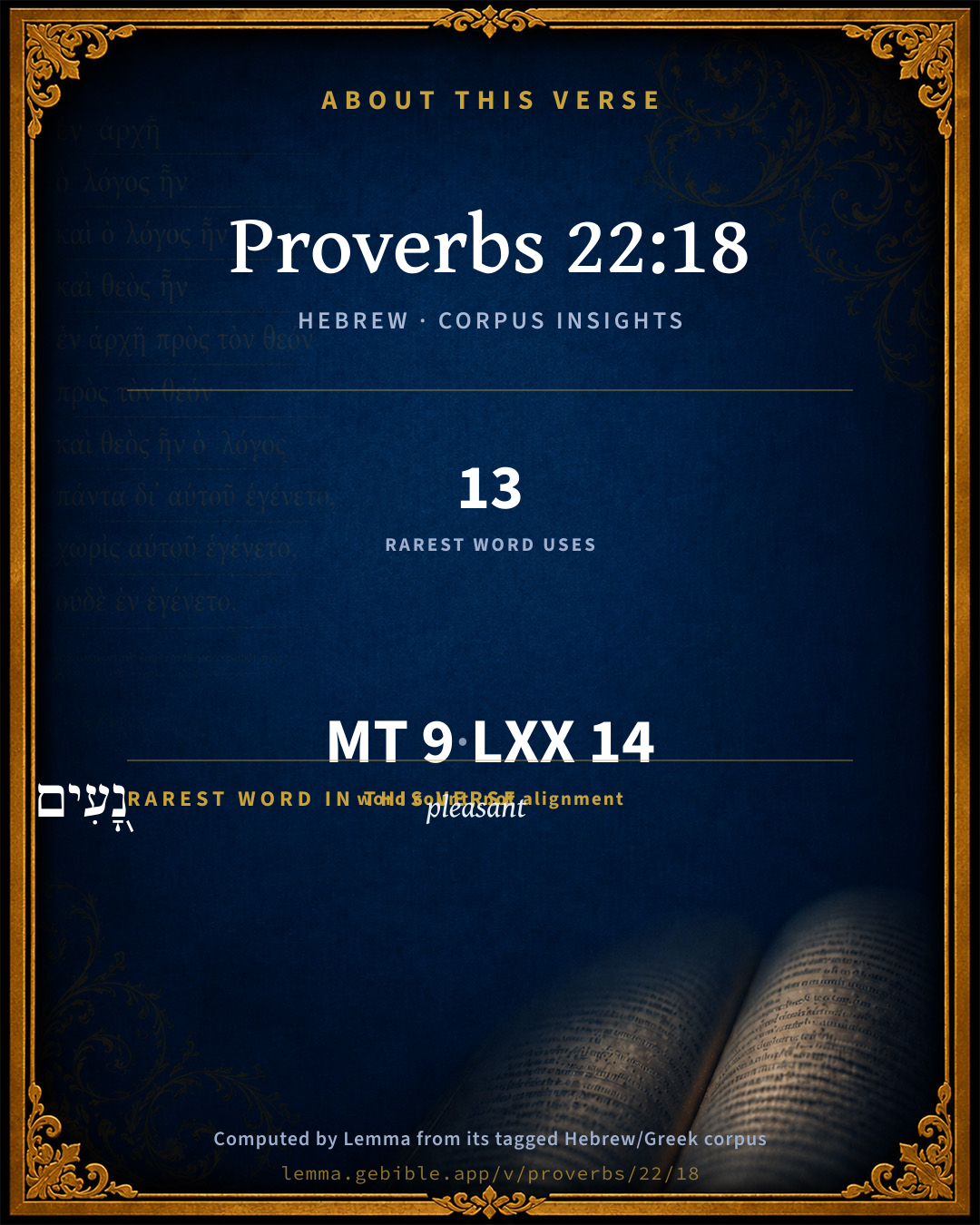
The rarest word here is נָ֭עִים pleasant H5273 — appearing just 13 times in the whole Hebrew Bible.

Shared distinctive vocabulary

נָ֭עִים pleasant H5273 occurs in 13 verses of the Hebrew Bible. Also found in:

Grammatical profile

  • 2 verbs
  • 2 nouns
  • 1 adjective
  • 1 preposition
  • 2 conjunctions
  • 1 adverb

Verb forms

  • תִשְׁמְרֵ֣ם Qal · Imperfect
  • יִכֹּ֥נוּ Niphal · Imperfect

Repetition

A word recurs within this verse — often emphatic in Hebrew:

  • כִּֽי that H3588 ×2

Hebrew & Septuagint length

In English translation the verse runs 21 words from the Hebrew and 23 from the Septuagint (LXX English) — closely comparable.

A rough comparison of the two English renderings, which tokenize alike — not a word-level alignment.

Word counts can differ between the Hebrew and the Greek without any difference in meaning — e.g. the Hebrew direct-object marker אֵת has no separate Greek word, and Greek often adds the article ὁ.

In the original languages it is 9 Hebrew tokens and 14 Greek tokens — but the two are counted differently (Hebrew bundles its prefixes and suffixes into one token; the Greek is in lemma form), so that isn’t a like-for-like length.

Cross-references

20

Topical passages linked to Proverbs 22:18 in the Treasury of Scripture Knowledge — connected by theme and wording, ordered by reader-vote popularity; previews shown in the World English Bible.

  • Jeremiah 15:16 Your words were found, and I ate them; and your words were to me a joy and the rejoicing of my heart: for I am called by your name, Yahweh, God of hosts.
  • Proverbs 2:10 For wisdom will enter into your heart. Knowledge will be pleasant to your soul.
  • Proverbs 8:6 Hear, for I will speak excellent things. The opening of my lips is for right things.
  • Psalms 119:103 How sweet are your promises to my taste, More than honey to my mouth!
  • Proverbs 10:21 The lips of the righteous feed many, But the foolish die for lack of understanding.
  • Proverbs 15:7 The lips of the wise spread knowledge; Not so with the heart of fools.
  • John 7:38 He who believes in me, as the Scripture has said, from within him will flow rivers of living water."
  • Job 32:18–19 For I am full of words. The spirit within me constrains me.
  • Psalms 19:10 More to be desired are they than gold, yes, than much fine gold; Sweeter also than honey and the extract of the honeycomb.
  • Psalms 119:13 With my lips, I have declared all the ordinances of your mouth.
  • Psalms 119:111 I have taken your testimonies as a heritage forever, For they are the joy of my heart.
  • Psalms 119:162 I rejoice at your word, As one who finds great spoil.
  • Psalms 119:171 Let my lips utter praise, For you teach me your statutes.
  • Proverbs 3:17 Her ways are ways of pleasantness. All her paths are peace.
  • Proverbs 10:13 Wisdom is found on the lips of him who has discernment, But a rod is for the back of him who is void of understanding.
  • Proverbs 16:21 The wise in heart shall be called prudent. Pleasantness of the lips promotes instruction.
  • Proverbs 24:13–14 My son, eat honey, for it is good; The droppings of the honeycomb, which are sweet to your taste:
  • Proverbs 25:11 A word fitly spoken Is like apples of gold in settings of silver.
  • Hebrews 13:15 Through him, then, let us offer up a sacrifice of praise to God continually, that is, the fruit of lips which make confession to his name.
  • Malachi 2:7 For the priest's lips should keep knowledge, and they should seek the law at his mouth; for he is the messenger of Yahweh of Hosts.

Cross-references courtesy of OpenBible.info (CC BY 4.0).

Hebrew and Greek witnesses Masoretic Hebrew ↔ Greek Septuagint

The same verse in the two great witnesses to the Old Testament, shown verse-for-verse.

These are two independent witnesses, not word-aligned to each other, and the Septuagint is shown in lemma (dictionary) form.

Hebrew Proverbs 22:18 Masoretic · Westminster Leningrad Codex

כִּֽי נָ֭עִים כִּֽי תִשְׁמְרֵ֣ם בְּבִטְנֶ֑ךָ יִכֹּ֥נוּ יַ֝חְדָּ֗ו עַל שְׂפָתֶֽיךָ

For it is a pleasant thing if you keep them within you, If all of them are ready on your lips.

World English Bible · Public Domain

Greek LXX Proverbs 22:18 Septuagint · lemma form

καί ἐάν ἐνβάλλω αὐτός εἰς ὁ καρδία σύ εὐφραίνω σύ ἅμα ἐπί σός χεῖλος

that you may know that they are good: and if you lay them to heart, they shall also gladden you on your lips.

LXX2012 (modern English Septuagint) · Public Domain

On this verse, The Pulpit Commentary discusses the Septuagint’s reading. Read the note in Commentary ↓

Hebrew: Westminster Leningrad Codex (CC BY 4.0). Greek: Septuagint (public domain); English from LXX2012 (modern English Septuagint) (Public Domain). How the Septuagint differs from the Hebrew →

Commentary

Notes on Proverbs 22:18 from classic Christian and Jewish commentators (each source and its license shown beneath its notes). The classic Christian expositions comment on the surrounding passage and are grouped to its opening verse, so a note may address several verses; the Jewish commentaries on the Tanakh (Rashi and others) are per-verse, so they appear only where the commentator wrote on this verse.

Lemma curates 59 commentaries, every one of them public domain or Creative Commons licensed, each selected and text-cleaned for this edition rather than reprinted as found. About our sources →

Trapp's Complete Commentary

John Trapp

Pro 22:18 For [it is] a pleasant thing if thou keep them within thee; they shall withal be fitted in thy lips.

Ver. 18. For it is a pleasant thing if thou keep them within thee.] Heb., In thy belly; that is, in thine inwards. Truth it is, that St John found the little book he ate - whether we understand it of the revelation only, or of the whole Bible, which Bishop Bonner’s chaplain called in scorn his little pretty God’s book, it much matters not - bitter in his belly, though sweet in his mouth, {Rev 10:10} because ministers find it grievous to be kept from making known the whole counsel of God to their people. But the word of God attentively heard, and by a later meditation well digested and incorporated into the soul, is sweeter than honey, as David felt it; and yields more pleasure than all the tasteless fooleries of this present world.

They shall withal be fitted in thy lips.] Thou shalt need no other help to discourse: thou shalt get a singular dexterity and volubility of holy language, being able to utter thy mind in pure Scripture - Loquamur verba Scripturae, saith that incomparable Peter Ramus, utamur sermone Spiritus Sancti - thou shalt "so speak and so do, as one that must be judged by that law of liberty." {Jas 2:12}

John Trapp, A Commentary or Exposition upon All the Books of the Old and New Testament (1647–1656) — public domain. Text from a community e-Sword module.

Jamieson, Fausset & Brown

Robert Jamieson, A. R. Fausset & David Brown

These lessons must be laid up in the mind, and

fitted--or better, "fixed" in the lips so as to be ever ready.

Jamieson, Fausset & Brown — Commentary Critical and Explanatory on the Whole Bible (1871) — public domain (CC PDM 1.0). Text via the HelloAO Bible API.

Adam Clarke's Commentary

Verse 18. For it is a pleasant thing if thou keep them within thee]

II. The pleasure and profit which may be derived from an attentive hearing.

1. They should be laid up in the heart - stored, treasured up within thee.

2. This will yield high satisfaction and happiness to the soul: "For it is a pleasant thing if thou keep them within thee."

3. The man who thus attends to the teachings of wisdom shall gain an experimental knowledge of them, so as to be able to speak of them suitably, pertinently and persuasively. "They shall withal be fitted in thy lips."

Adam Clarke's Commentary on the Bible (1810–1826) — public domain. Text from a community e-Sword/MySword module.

Ellicott's Commentary for English Readers

(18) They shall withal be fitted in thy lips.—Rather, if they be established (dwell constantly) upon thy lips. They are to be as a watch, and “keep the door of his lips” against sin (Psa_141:3), to teach him what to say in difficulty (Mar_13:11), how to speak without fear even before kings (Psa_119:46); by them the “praises of God” will ever be in his mouth (Psa_149:6).

A Bible Commentary for English Readers, edited by Charles John Ellicott (1878–1897) — public domain. Text from a community e-Sword module.

The Cambridge Bible for Schools and Colleges

gen. ed. J. J. S. Perowne

18. they shall withal be fitted in] Rather, if they be established together upon, R.V.; i.e. if being kept securely in thy heart they dwell constantly on thy lips.

The Cambridge Bible for Schools and Colleges (gen. ed. J. J. S. Perowne; Cambridge University Press, 1878–1918) — public domain. Text from a community e-Sword module.

John Gill's Exposition

For it is a pleasant thing if thou keep them within thee,.... Or, "in thy belly" (a). That is, in thine heart, in the inmost recesses of it; where the words or doctrines of the wise should be received in the love of them, and carefully laid up and retained; which will upon reflection yield much pleasure, like Ezekiel's roll, which was in his belly as honey for sweetness; and which also is very profitable as an antidote against sin, Psa 119:11;

they shall withal be fitted in thy lips; become them, and be suitable and graceful to them: or, "shall be ordered and disposed in" or "by thy lips" (b); being received into the heart, and digested there, they shall easily and freely go off the tongue, which shall be as the pen of a ready writer; they shall be delivered in a regular manner, with great liberty and facility; by a good digestion of Gospel truths, and a comfortable experience of them, persons become apt to teach others.

(a) "in ventre tuo", V. L. Montanus, Junius & Tremellius, Mercerus, Cocceius, Gejerus, Michaelis, Schultens. (b) "disponantur", Vatablus.

John Gill's Exposition of the Whole Bible (1746–1763) — public domain (CC PDM 1.0). Text via the HelloAO Bible API.

Albert Barnes' Notes on the Bible

What is “pleasant” in the sight of God and man is the union of two things, belief passing into profession, profession resting on belief.

Albert Barnes' Notes on the Bible (1834–1885) — public domain. Text from a community e-Sword/MySword module.

Haydock's Catholic Bible Commentary

Lips. Out of the abundance of the heart the mouth speaketh. (Haydock)

George Leo Haydock (1774–1849), Haydock's Catholic Family Bible and Commentary, 1859 edition — public domain. Excludes Psalms (Douay-Rheims chapter numbering differs from Protestant) and Deuterocanonical books (Catholic canon only).

Matthew Poole's English Annotations

If thou keep them, the words of the wise, within thee, Heb. in thy belly. i.e. in thine heart, which implies receiving them in love, and retaining them in mind and memory.

Be fitted; be fitly expressed; or, be disposed or ordered. The sense is, When thou hast got them into thine heart, thou wilt be able and ready to discourse pertinently and profitably of them.

Matthew Poole's English Annotations on the Holy Bible (1683–1685) — public domain. Text from a community e-Sword/MySword module.

Whedon's Commentary on the Bible

Daniel D. Whedon

18. For it is (better, it will be) a pleasant thing, etc. — The latter clause should probably have the conditional particle carried forward — if they shall be altogether established upon thy lips. The idea is, that they should be committed to memory, and become so familiar that the lips can readily utter them. “If they are ready, all of them, on thy lips.” — Conant.

Within thee — Literally, in thy bowels.

Daniel D. Whedon (gen. ed.), Commentary on the Old and New Testaments (1874–1909) — public domain. Text from a community e-Sword module.

The Pulpit Commentary

This verse gives the reason for the previous exhortation. It is a pleasant thing if thou keep them within thee; in thy mind and memory. (comp. Pro_18:8 Pro_20:27) Thus Psa_147:1, "It is good to sing praises unto our God; for it is pleasant, and praise is comely." They shall withal be fitted in thy lips. This rendering hardly suits the hortatory nature of the introduction. It is better to take the clause in the optative, as Delitzsch, Ewald, Nowack, and ethers: "Let them abide altogether upon thy lips;" i.e. be not ashamed to profess them openly, let them regulate thy words, teach thee wisdom and discretion. Septuagint, "And if thou admit them to thy heart, they shall likewise gladden thee on thy lips."

The Pulpit Commentary (1880–1919), ed. H.D.M. Spence-Jones & Joseph S. Exell — public domain. Text from a community e-Sword module.

John Wesley's Explanatory Notes

Fitted - Fitly expressed: thou wilt be able to discourse profitably of them.

John Wesley, Explanatory Notes Upon the Whole Bible (1754–1765) — public domain. Text via the GEBible commentary corpus.

Kretzmann's Popular Commentary

Paul E. Kretzmann

v. 18. For it is a pleasant thing if thou keep them within thee, the words of the wise serving to give true delight; they shall withal be fitted in thy lips, abiding there and exerting their authority.

Paul E. Kretzmann, Popular Commentary of the Bible (1921–1924) — public domain. Text from a community e-Sword module.

Rashi

Rabbi Shlomo Yitzchaki (Rashi)

for it is pleasant It will be [pleasant] for you at a later time if you preserve them and hide them in your innards lest you forget them. Now when will they be preserved in your heart? When they are established on your lips, when you utter them with your mouth.

Rashi on the Tanakh — English translations: “The Judaica Press complete Tanach with Rashi, translated by A. J. Rosenberg” (CC BY 4.0); “Pentateuch with Rashi's commentary by M. Rosenbaum and A.M. Silbermann, 1929-1934” (public domain); “The Metsudah Tanach series, Lakewood, N.J” (CC BY 4.0); and “The Book of Joshua, Metsudah Publications, 1997” (CC BY 4.0). Text via Sefaria.

Lesson kit

Teaching starters — assembled from the data on this page, not authored interpretation. Every prompt links to the verse data it draws on. Edit before teaching.

Proverbs, in the Wisdom, opens this verse with 9 words (8 distinct Hebrew lemmas). Its most distinctive word is nâʻîym (“pleasant”). A historical commentator’s framing appears above. Read the whole chapter for the surrounding context.

Discussion questions

  1. What does “pleasant” (nâʻîym) contribute to the verse as a whole?
  2. 2 Samuel 1:23 shares the word «pleasant» with this verse. How do the two illuminate each other?
  3. “that” occurs 2× in this one verse. What is the effect of the repetition?
  4. These translations render this verse differently; the difference is in the English rendering, not the original. What questions does that raise?
  5. The verb «תִשְׁמְרֵ֣ם» is Qal Imperfect. How does its form color the action?
  6. Reading how Trapp's Complete Commentary and Jamieson, Fausset & Brown read this verse, where do the two commentators agree and where do they part?

Things to notice

Reading settings

Reading text

Shown beneath each verse's original-language words.

Old Testament
Old Testament edition

Read the OT as the Masoretic Hebrew (MT) or the Greek Septuagint (LXX).

English shown for the Greek Septuagint (in the Hebrew ↔ Greek comparison).

Comparing translations? Open the Compare panel on any verse page to stack up to four side by side.