Ezekiel 7:14

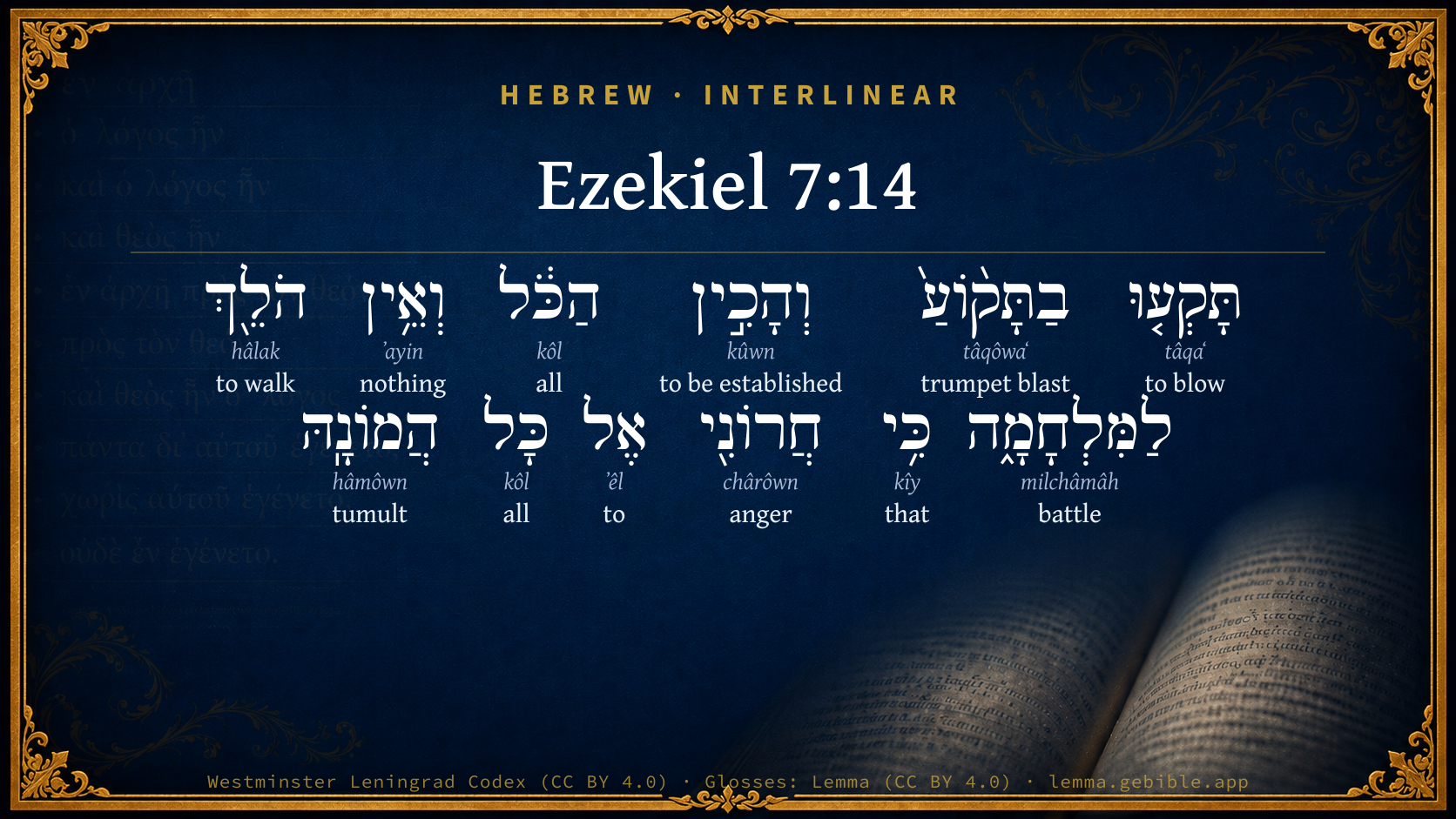
Hebrew (Westminster Leningrad Codex) Ezekiel 7:14 appears in the Hebrew Old Testament. The text above is from the Westminster Leningrad Codex. Each word links to its Strong’s number, a concise gloss, and parsing drawn from the Open Scriptures Hebrew Bible morphology. Click any word for its full Brown-Driver-Briggs (BDB) entry.
Download image
Cite this verse

Ezekiel 7:14 (World English Bible). Public Domain. Lemma interlinear Bible study tool, https://lemma.gebible.app/v/ezekiel/7/14.

Show BibTeX & RIS
BibTeX
RIS
English Translation
They have blown the trumpet, and have made all ready; but none goes to the battle; for my wrath is on all the multitude of it.
World English Bible · Public Domain
Highlights Full analysis ↓
Download a study sheet

One document with this verse’s original text, its word-by-word gloss line, the meaning frame, cross-references with their text, attributed commentary, and full source and license credits — printable, and it pastes into notes with its structure intact.

This verse Autodidact and up

Study sheet (.html) Plain text (.txt)

A passage Seminary Student

Up to 50 verses in one chapter. A passage sheet keeps up to 6 commentary sources and 12 cross-references per verse, in the order this page ranks them, and says so on the sheet whenever that leaves anything out. Ask for a single verse and you get the Autodidact verse sheet above.

Everything on this page stays free to read, with no account — the sheet is a download of what is already on screen, not access to it.

Want to remove ads? Support Godless Engineer
Compare translations 3

The same verse in 3 English versions, stacked beneath the original-language interlinear above. Click any original word for its lexicon entry.

Each is an independent rendering of the whole verse — the interlinear is not word-aligned to these translations.

Highlighted words mark where these versions differ — a whole-verse word diff, not a word-by-word alignment.

  • World English Bible Public Domain
    They have blown the trumpet, and have made all ready; but none goes to the battle; for my wrath is on all the multitude of it.
  • King James Version Public Domain
    They have blown the trumpet, even to make all ready; but none goeth to the battle: for my wrath is upon all the multitude thereof.
  • unfoldingWord Literal Text CC BY-SA 4.0
    They have blown the trumpet and made everything ready, but there is no one marching to battle; since my anger is on the entire multitude.

unfoldingWord Literal Text — © unfoldingWord, licensed CC BY-SA 4.0. Word-aligned USFM3 via Door43 (git.door43.org/unfoldingWord/en_ult).

Versions to compare (up to 4)

3 of 4 selected

Show all 18 translations

Every available English version of this verse, each an independent rendering of the whole verse.

  • World English Bible Public Domain
    They have blown the trumpet, and have made all ready; but none goes to the battle; for my wrath is on all the multitude of it.
  • Berean Standard Bible Public Domain
    They have blown the trumpet and made everything ready, but no one goes to war, for My wrath is upon the whole multitude.
  • Majority Standard Bible Public Domain
    They have blown the trumpet and made everything ready, but no one goes to war, for My wrath is upon the whole multitude.
  • King James Version Public Domain
    They have blown the trumpet, even to make all ready; but none goeth to the battle: for my wrath is upon all the multitude thereof.
  • American Standard Version (1901) Public Domain
    They have blown the trumpet, and have made all ready; but none goeth to the battle; for my wrath is upon all the multitude thereof.
  • Revised Version (1885) Public Domain
    They have blown the trumpet, and have made all ready; but none goeth to the battle: for my wrath is upon all the multitude thereof.
  • Geneva Bible (1599) Public Domain
    They haue blowen the trumpet, and prepared all, but none goeth to the battel: for my wrath is vpon all the multitude thereof.
  • Douay-Rheims (1899) Public Domain
    Blow the trumpet, let all be made ready, yet there is none to go to the battle: for my wrath shall be upon all the people thereof.
  • Young's Literal Translation Public Domain
    They have blown with a trumpet to prepare the whole, And none is going to battle, For My wrath `is' unto all its multitude.
  • Literal Standard Version CC BY-SA 4.0
    They have blown with a horn to prepare the whole, || And none is going to battle, || For My wrath [is] to all its multitude.
  • Unlocked Literal Bible CC BY-SA 4.0
    They have blown the trumpet and made everything ready, but there is no one marching to battle; since my anger is on the entire multitude.
  • unfoldingWord Literal Text CC BY-SA 4.0
    They have blown the trumpet and made everything ready, but there is no one marching to battle; since my anger is on the entire multitude.
  • Darby Bible Public Domain
    They have blown the trumpet and made all ready, but none goeth to the battle; for my fierce anger is upon all the multitude thereof.
  • World Messianic Bible Public Domain
    They have blown the shofar, and have made all ready; but no one goes to the battle, for my wrath is on all its multitude.
  • Webster's Bible Public Domain
    They have blown the trumpet, even to make all ready; but none goeth to the battle: for my wrath is upon all the multitude thereof:
  • Free Bible Version CC BY-SA 4.0
    Even though the trumpet call to arms has sounded, even though all the preparations have been made, no one is ready to fight, because I am angry with everyone.
  • Bible in Basic English Public Domain
    And he who has given a price for goods will not get them, for my wrath is on all of them.
  • JPS Tanakh (1917) Public Domain
    They have blown the horn, and have made all ready, but none goeth to the battle; for My wrath is upon all the multitude thereof.

Literal Standard Version (2020), Covenant Press — licensed CC BY-SA 4.0. Text via the HelloAO Bible API (eBible.org). Unlocked Literal Bible (unfoldingWord) — licensed CC BY-SA 4.0. Text via the HelloAO Bible API (eBible.org). unfoldingWord Literal Text — © unfoldingWord, licensed CC BY-SA 4.0. Word-aligned USFM3 via Door43 (git.door43.org/unfoldingWord/en_ult). Free Bible Version, Dr. Jonathan Gallagher — licensed CC BY-SA 4.0. Text via the HelloAO Bible API (eBible.org).

Word by word

More ways to search: Search by grammar → Find every occurrence → Compare this word →

Practice this passage: Drill this verse → Learn its vocabulary →

בַתָּק֨וֹעַ֙
tâqôwaʻ
H8619
“in/at the · trumpet blast”
Preposition, Determined + Noun, Common, Masculine, Singular, Absolute
Part of Speech
Preposition + Noun
Type
Common
Gender
Masculine
Number
Singular
State
Absolute
Full BDB Definition

Origin: from H8628 (in the musical sense)

TWOT: 2541b

a blast-(wind)-instrument, trumpet
  1. תָּקְע֤וּ tâqaʻ H8628 “to blow” Verb, Qal, Perfect, 3rd Person, Common, Plural
  2. וְהָכִ֣ין kûwn H3559 “and · to be established” Conjunction + Verb, Hiphil, Infinitive Construct
  3. הַכֹּ֔ל kôl H3605 “the · all” Particle, Definite Article + Noun, Common, Masculine, Singular, Absolute
  4. וְאֵ֥ין ʼayin H369 “and · nothing” Conjunction + Particle, Negative
  5. הֹלֵ֖ךְ hâlak H1980 “walking” Verb, Qal, Participle Active, Masculine, Singular, Absolute
  6. לַמִּלְחָמָ֑ה milchâmâh H4421 “to/for the · battle” Preposition, Determined + Noun, Common, Feminine, Singular, Absolute
  7. כִּ֥י kîy H3588 “that” Conjunction
  8. חֲרוֹנִ֖י chârôwn H2740 “anger · my” Noun, Common, Masculine, Singular, Construct + Suffix, Personal, 1st Person, Common, Singular
  9. אֶל ʼêl H413 “to” Preposition
  10. כָּל kôl H3605 “all of” Noun, Common, Masculine, Singular, Construct
  11. הֲמוֹנָֽהּ hâmôwn H1995 “tumult · her” Noun, Common, Masculine, Singular, Construct + Suffix, Personal, 3rd Person, Feminine, Singular

About this verse

These counts appear in no published source. They are computed here, from the morphology-tagged text and Lemma’s own curated glosses. What Lemma adds →

12
words
11
distinct lemmas
Prophets
section

Notable vocabulary

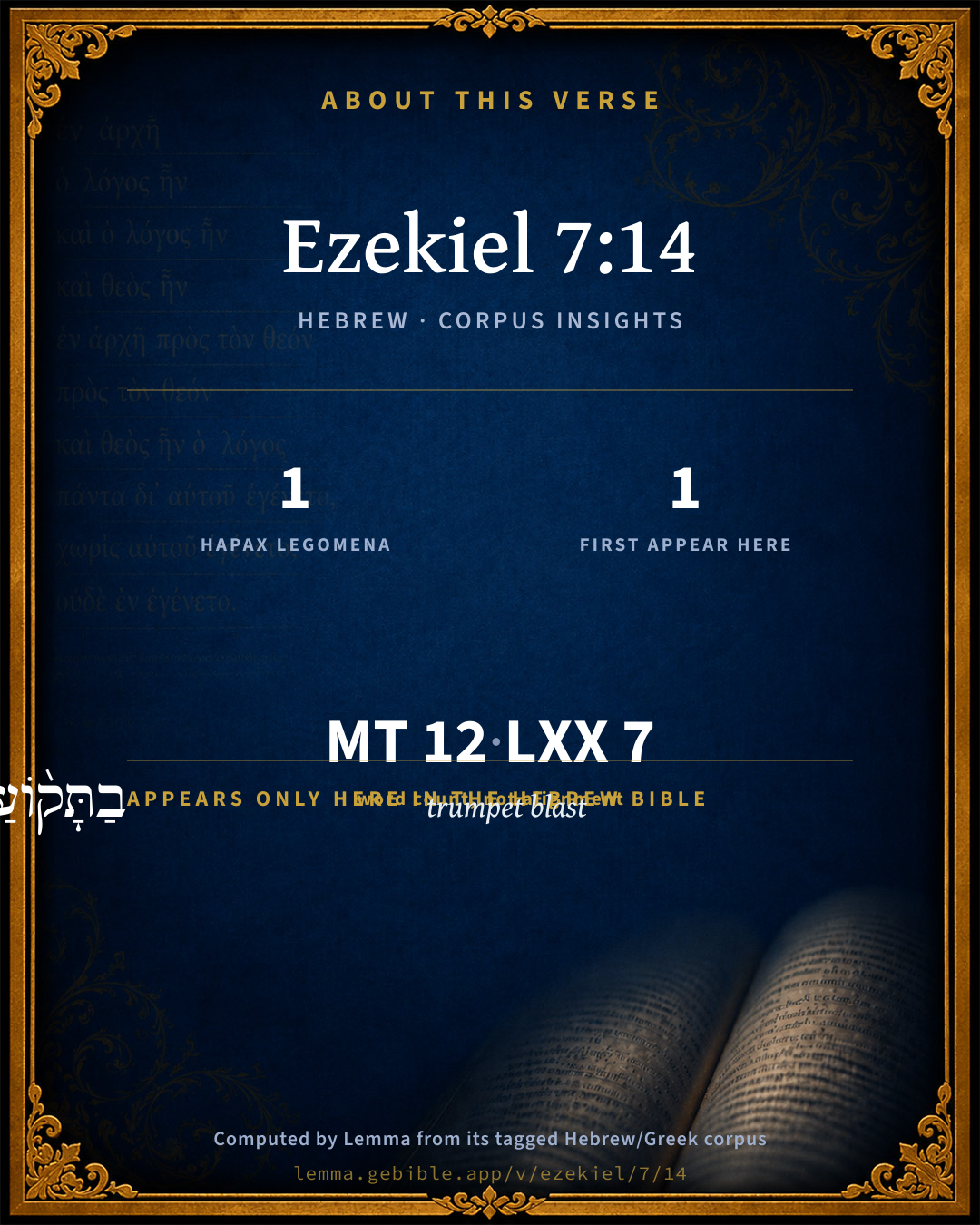
1 hapax legomenon — a word that appears only here in the entire Hebrew Bible:

  • בַתָּק֨וֹעַ֙ trumpet blast H8619

First appearance in Scripture

This word makes its first canonical appearance in the Hebrew Bible here:

  • בַתָּק֨וֹעַ֙ trumpet blast H8619

Shared distinctive vocabulary

חֲרוֹנִ֖י anger H2740 occurs in 40 verses of the Hebrew Bible. Also found in:

Grammatical profile

  • 3 verbs
  • 6 nouns
  • 1 preposition
  • 1 conjunction
  • 1 particle

Verb forms

  • תָּקְע֤וּ Qal · Perfect
  • וְהָכִ֣ין Hiphil · Infinitive Construct
  • הֹלֵ֖ךְ Qal · Participle Active

Repetition

A word recurs within this verse — often emphatic in Hebrew:

  • הַכֹּ֔ל all H3605 ×2

Hebrew & Septuagint length

In English translation the verse runs 26 words from the Hebrew and 10 from the Septuagint (LXX English) — the Septuagint runs noticeably shorter here. See the side-by-side →

A rough comparison of the two English renderings, which tokenize alike — not a word-level alignment.

Word counts can differ between the Hebrew and the Greek without any difference in meaning — e.g. the Hebrew direct-object marker אֵת has no separate Greek word, and Greek often adds the article ὁ.

In the original languages it is 12 Hebrew tokens and 7 Greek tokens — but the two are counted differently (Hebrew bundles its prefixes and suffixes into one token; the Greek is in lemma form), so that isn’t a like-for-like length.

Cross-references

8

Topical passages linked to Ezekiel 7:14 in the Treasury of Scripture Knowledge — connected by theme and wording, ordered by reader-vote popularity; previews shown in the World English Bible.

  • Jeremiah 4:5 Declare you in Judah, and publish in Jerusalem; and say, Blow you the trumpet in the land: cry aloud and say, Assemble yourselves, and let us go into the fortified cities.
  • Isaiah 24:1–7 Behold, Yahweh makes the earth empty, and makes it waste, and turns it upside down, and scatters abroad the inhabitants of it.
  • Jeremiah 6:1 Flee for safety, you children of Benjamin, out of the midst of Jerusalem, and blow the trumpet in Tekoa, and raise up a signal on Beth Haccherem; for evil looks forth from the north, and a great destruction.
  • Jeremiah 6:11 Therefore I am full of the wrath of Yahweh; I am weary with holding in: pour it out on the children in the street, and on the assembly of young men together; for even the husband with the wife shall be taken, the aged with him who is full of days.
  • Jeremiah 7:20 Therefore thus says the Lord Yahweh: Behold, my anger and my wrath shall be poured out on this place, on man, and on animal, and on the trees of the field, and on the fruit of the ground; and it shall burn, and shall not be quenched.
  • Jeremiah 12:12 Destroyers are come on all the bare heights in the wilderness; for the sword of Yahweh devours from the one end of the land even to the other end of the land: no flesh has peace.
  • Jeremiah 51:27 Set up a standard in the land, blow the trumpet among the nations, prepare the nations against her, call together against her the kingdoms of Ararat, Minni, and Ashkenaz: appoint a marshal against her; cause the horses to come up as the rough canker-worm.
  • Ezekiel 7:11–12 Violence is risen up into a rod of wickedness; none of them [shall remain], nor of their multitude, nor of their wealth: neither shall there be eminency among them.

Cross-references courtesy of OpenBible.info (CC BY 4.0).

Hebrew and Greek witnesses Masoretic Hebrew ↔ Greek Septuagint

The same verse in the two great witnesses to the Old Testament, shown verse-for-verse.

Here the Septuagint runs noticeably shorter than the Hebrew — LXX2012 (modern English Septuagint) 10 words vs World English Bible 26. A rough length comparison of the two English translations, not a word-level alignment — read both below.

These are two independent witnesses, not word-aligned to each other, and the Septuagint is shown in lemma (dictionary) form.

Hebrew Ezekiel 7:14 Masoretic · Westminster Leningrad Codex

תָּקְע֤וּ בַתָּק֨וֹעַ֙ וְהָכִ֣ין הַכֹּ֔ל וְאֵ֥ין הֹלֵ֖ךְ לַמִּלְחָמָ֑ה כִּ֥י חֲרוֹנִ֖י אֶל כָּל הֲמוֹנָֽהּ

They have blown the trumpet, and have made all ready; but none goes to the battle; for my wrath is on all the multitude of it.

World English Bible · Public Domain

Greek LXX Ezekiel 7:14 Septuagint · lemma form

σαλπίζω ἐν σάλπιγξ καί κρίνω ὁ σύμπας

Sound you⌃ the trumpet, and pass sentence on all together.

LXX2012 (modern English Septuagint) · Public Domain

Hebrew: Westminster Leningrad Codex (CC BY 4.0). Greek: Septuagint (public domain); English from LXX2012 (modern English Septuagint) (Public Domain). How the Septuagint differs from the Hebrew →

Targum (Aramaic paraphrase)

1

The Targum is the ancient Jewish Aramaic paraphrase of the Hebrew Scriptures — an interpretive translation, not the Hebrew text itself. Onkelos (literal) and Pseudo-Jonathan (expansive) render the Torah, and Jonathan the Prophets. Coverage is partial: where no permissively-licensed English translation exists for a verse, only the Aramaic is shown. This is verse-level text, not a word-by-word alignment to the Hebrew.

  1. Targum Jonathan Prophets (Joshua–Malachi)
    נַפְקִין בְּאַצְוָחַת קַרְנָא מִתַקְנִין בְּמָנֵי זְיָנָא וְלֵית דְאָזִיל לִקְרָבָא אֲרֵי רְגַז מִן קֳדָמַי עַל כָּל אִתְרְגוּשַׁתְהוֹן:

    (no public-domain English translation for this verse)

    Targum Jonathan — Aramaic: “Mikraot Gedolot” (public domain). English: “Sefaria Community Translation” (CC0 1.0 (public-domain dedication)); “London "Chaldee Paraphrase," 1871” (public domain). Text via Sefaria.

Commentary

Notes on Ezekiel 7:14 from classic Christian and Jewish commentators (each source and its license shown beneath its notes). The classic Christian expositions comment on the surrounding passage and are grouped to its opening verse, so a note may address several verses; the Jewish commentaries on the Tanakh (Rashi and others) are per-verse, so they appear only where the commentator wrote on this verse.

Lemma curates 59 commentaries, every one of them public domain or Creative Commons licensed, each selected and text-cleaned for this edition rather than reprinted as found. About our sources →

The Cambridge Bible for Schools and Colleges

gen. ed. J. J. S. Perowne

14–18. Fruitlessness of the defence

14. Preparations for the defence are made but there is no courage to face the enemy, for the wrath of God upon them predetermines their defeat.

even to make all ready] Rather: and have made (inf. abs.).

14–27. Picture of the dissolution of the state

(1) Eze_7:14-18. The trumpet shall sound the alarm, but none shall prepare himself for the battle. The sword shall devour without and famine consume within. A paralysing terror shall seize upon all.

(2) Eze_7:19-22. They shall cast their gold and silver into the streets, for it cannot buy wherewith to appease their hunger. Their wealth which was their pride and which they used to further their abominations shall become the prey of the invader.

(3) Eze_7:23-27. The city is full of violence therefore it shall be given over to the worst of the heathen. Perplexity and stupefaction shall seize king and people, priest and prophet alike. They shall know Jehovah when his judgments overtake them.

The Cambridge Bible for Schools and Colleges (gen. ed. J. J. S. Perowne; Cambridge University Press, 1878–1918) — public domain. Text from a community e-Sword module.

Trapp's Complete Commentary

John Trapp

Eze 7:14 They have blown the trumpet, even to make all ready; but none goeth to the battle: for my wrath [is] upon all the multitude thereof.

Ver. 14. They have blown the trumpet, even to make all ready.] But all to no purpose, since God hath dispirited them (as he did the old Canaanites, the Saxons and Piers in that Victoria Halleluiatica, the Germans against the Hussites in Bohemia, &c.), and struck them with a panic terror, with utter despondency, so that they were feeble and fainthearted, and the strong were become as tow. {Isa 1:31}

John Trapp, A Commentary or Exposition upon All the Books of the Old and New Testament (1647–1656) — public domain. Text from a community e-Sword module.

Tyndale Open Study Notes

Tyndale Open Resources

7:14 When Israel sounded the trumpet in holy war, the troops would not rally and the enemy would not be terrified, as in the past (see Num 10:9; Josh 6:4-20; Judg 6:34; 7:16-22; Neh 4:18-20).

Tyndale Open Study Notes — © Tyndale Open Resources, licensed CC BY-SA 4.0. Text via the HelloAO Bible API.

Geneva Bible (1599)

Geneva Bible translators

The Israelites made a brag, but their hearts failed them.

Geneva Bible (1599) marginal notes — public domain. Text via Bolls.life.

Jamieson, Fausset & Brown

Robert Jamieson, A. R. Fausset & David Brown

They have blown the trumpet--rather, "Blow the trumpet," or, "Let them blow the trumpet" to collect soldiers as they will, "to make all ready" for encountering the foe, it will be of no avail; none will have the courage to go to the battle (compare Jer 6:1), [CALVIN].

Jamieson, Fausset & Brown — Commentary Critical and Explanatory on the Whole Bible (1871) — public domain (CC PDM 1.0). Text via the HelloAO Bible API.

Adam Clarke's Commentary

Verse 14. They have blown the trumpet] Vain are all the efforts you make to collect and arm the people, and stand on your own defence; for all shall be dispirited, and none go to the battle.

Adam Clarke's Commentary on the Bible (1810–1826) — public domain. Text from a community e-Sword/MySword module.

John Calvin's Commentaries

Here the Prophet adds, although the Israelites provide themselves with every aid, and prepare all things for carrying on the war, nay, while they omit nothing for the best fortification, yet when it came to the point, their hopes would be vain, and all the supplies which they prepared for themselves of no avail. However, therefore, they may blow the trumpet, and prepare all things, he says, yet no one goes out to battle The reason must be marked, since God’s indignation was upon the whole multitude of them, that is, because God determined to destroy them all. Now it follows —

John Calvin's Commentaries (1540-1563) — public domain. Text from the Calvin Translation Society English edition (1840s-50s) via the Christian Classics Ethereal Library (ccel.org). Calvin's coverage is partial (roughly two-thirds of the Bible); uncommented books and verses are honest gaps, never fabricated. The 19th-century editor's footnotes and remarks are omitted so the notes are faithfully Calvin's own voice.

Ellicott's Commentary for English Readers

(14) None goeth to the battle.—The last thought is followed up here. The people are so enfeebled by their sins as to have no power against the enemy. Consequently (Eze_7:15) they shall all perish, directly or indirectly, at the hands of their foes.

A Bible Commentary for English Readers, edited by Charles John Ellicott (1878–1897) — public domain. Text from a community e-Sword module.

John Gill's Exposition

The sword is without,.... Without the city, where the enemy was besieging; so that those that went without, in order to make their escapes fell into their hands:

and the pestilence and the famine within; within the city; so that such who thought themselves safe in their own houses died by those judgments:

he that is in the field shall die by the sword; by the hands of the Chaldeans:

and he that is in the city, famine and pestilence shall devour him; and he shall die by the hand of God.

John Gill's Exposition of the Whole Bible (1746–1763) — public domain (CC PDM 1.0). Text via the HelloAO Bible API.

Haydock's Catholic Bible Commentary

CHAPTER VII.

Ready. He describes the vain attempts of the Jews to make resistance.

George Leo Haydock (1774–1849), Haydock's Catholic Family Bible and Commentary, 1859 edition — public domain. Excludes Psalms (Douay-Rheims chapter numbering differs from Protestant) and Deuterocanonical books (Catholic canon only).

Matthew Poole's English Annotations

The house of Israel have published their resolution for war, and summoned in all fit for arms, if the words be read as here. Or if in the imperative mood, Blow ye, &c., they are a smart irony against the preparations the Jews can possibly make for repelling the enemy, and defending their city.

To make all ready; persons fit for the war and all warlike provisions, a thing necessary in case of invasions, but in their case a vain attempt. There is not a man going to the war, (as the Hebrew,) all are backward in this danger.

My wrath; that displeasure which takes away their prudence and courage, that these men of might sleep, and none finds his hands or weapons, Isa 29:14.

Matthew Poole's English Annotations on the Holy Bible (1683–1685) — public domain. Text from a community e-Sword/MySword module.

Whedon's Commentary on the Bible

Daniel D. Whedon

14. Even to make — Literally, and made.

None goeth to the battle — Here is pictured the “collapse of Judah’s military preparations in the hour of danger.” The soldiers are struck with fear before they have struck a blow. God has deserted them, and his wrath makes cowards of brave men. (Compare Lev_26:6; Deu_28:25; Deu_32:30.)

Daniel D. Whedon (gen. ed.), Commentary on the Old and New Testaments (1874–1909) — public domain. Text from a community e-Sword module.

The Pulpit Commentary

They have blown the trumpet. The word for "trumpet" is not found elsewhere, but the corresponding verb is used continually in connection with the trumpet of war, and Ezekiel seems to have coined the corresponding substantive, not, perhaps, without a reminiscence of Jer_6:1. There may possibly be an allusion to the trumpet blowing with which the jubilee year (see ver. 13) was ushered in. The trumpet should sound, not for each man"s return to his own estate, but for the alarm of war. and even then the consciousness of guilt will hinder men from arming themselves for battle. (comp. Lev_26:36; Deu_28:25 Deu_32:30)

The Pulpit Commentary (1880–1919), ed. H.D.M. Spence-Jones & Joseph S. Exell — public domain. Text from a community e-Sword module.

John Wesley's Explanatory Notes

They - The house of Israel have summoned in all fit for arms. None - There is not a man going to the war. Wrath - That displeasure which takes away their courage.

John Wesley, Explanatory Notes Upon the Whole Bible (1754–1765) — public domain. Text via the GEBible commentary corpus.

unfoldingWord translationNotes

Door43 World Missions Community

General Information:

These are Yahweh's words about Israel.

They have blown the trumpet

"They have blown the trumpet to call people to fight against the enemy"

my anger is on the entire multitude

"I am angry with the whole multitude." See how you translated this in Ezekiel 7:12.

The sword is on the outside

The word "sword" is a metonym for soldiers who kill people using swords. AT:

the building

the city

while famine and plague will consume those in the city

The word "consume" is a metaphor for "totally destroy." AT: "and most of the people in the city will die from hunger and sickness" (See: Metaphor)

Like doves of the valleys, all of them will moan

Doves make a low-pitched noise that sounds like the sound a person makes when he is in constant pain or deep sadness. AT: "They will all be so sad that they will moan, and the sound will be as if they were a flock of doves" (See: Simile)

translationWords

trumpet

sword

plague

famine

dove

iniquity

unfoldingWord translationNotes — © Distant Shores Media and the Door43 World Missions Community, licensed CC BY-SA 4.0. Source: git.door43.org/Door43/en_tn.

Rashi

Rabbi Shlomo Yitzchaki (Rashi)

They sound the shofar When the enemy comes upon them, they prepare themselves for war, but no one will go out to fight.

Rashi on the Tanakh — English translations: “The Judaica Press complete Tanach with Rashi, translated by A. J. Rosenberg” (CC BY 4.0); “Pentateuch with Rashi's commentary by M. Rosenbaum and A.M. Silbermann, 1929-1934” (public domain); “The Metsudah Tanach series, Lakewood, N.J” (CC BY 4.0); and “The Book of Joshua, Metsudah Publications, 1997” (CC BY 4.0). Text via Sefaria.

Lesson kit

Teaching starters — assembled from the data on this page, not authored interpretation. Every prompt links to the verse data it draws on. Edit before teaching.

Ezekiel, in the Prophets, opens this verse with 12 words (11 distinct Hebrew lemmas). Its most distinctive word is tâqôwaʻ (“trumpet blast”). The Greek Septuagint runs shorter here. A historical commentator’s framing appears above. Read the whole chapter for the surrounding context.

Discussion questions

  1. How does “trumpet blast” (tâqôwaʻ) shape what this verse is saying?
  2. 1 word here appears nowhere else in the Hebrew Bible. Why might the author reach for such rare wording?
  3. This is the first place “trumpet blast” appears in Scripture (first appears here). What does its debut here establish?
  4. How does Exodus 15:7, which shares the word «anger», read alongside this verse?
  5. What does the repetition of “all” (2× in this one verse) do in this verse?
  6. The Septuagint runs shorter here than the Hebrew. What might account for the difference?
  7. These translations render this verse differently; the difference is in the English rendering, not the original. What questions does that raise?
  8. «תָּקְע֤וּ» is a Qal Perfect verb. How does that grammatical form shape the action described?

Things to notice

  • 1 word in this verse appears nowhere else in the Hebrew Bible.
  • 1 word makes its first canonical appearance in Scripture here.
  • This verse counts 12 Hebrew ↔ 7 Greek words.
  • These translations choose different wording for 17 words in this verse.
  • “all” occurs 2× in this single verse.

Reading settings

Reading text

Shown beneath each verse's original-language words.

Old Testament
Old Testament edition

Read the OT as the Masoretic Hebrew (MT) or the Greek Septuagint (LXX).

English shown for the Greek Septuagint (in the Hebrew ↔ Greek comparison).

Comparing translations? Open the Compare panel on any verse page to stack up to four side by side.