2 Chronicles 30:19

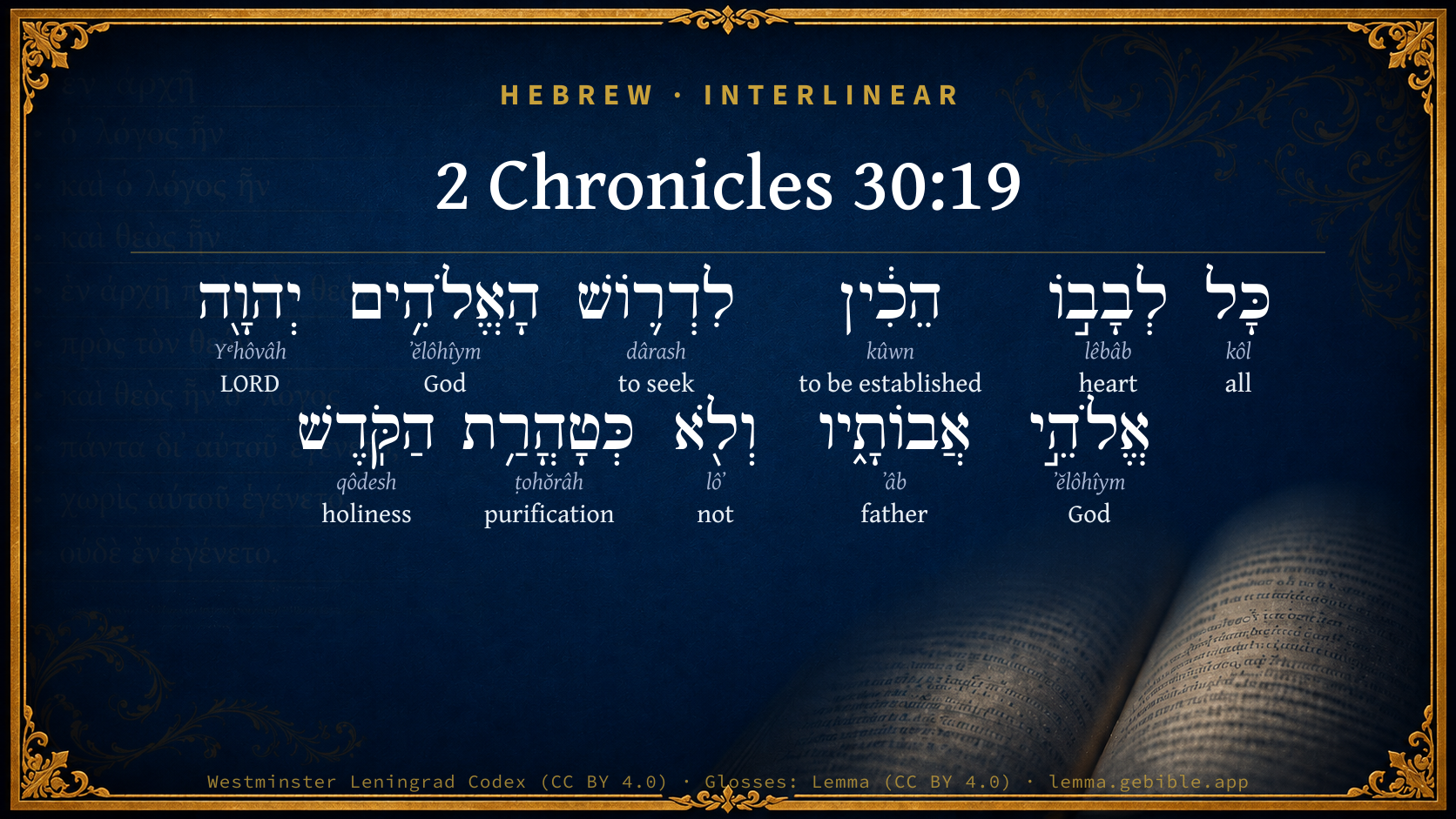
Hebrew (Westminster Leningrad Codex) 2 Chronicles 30:19 appears in the Hebrew Old Testament. The text above is from the Westminster Leningrad Codex. Each word links to its Strong’s number, a concise gloss, and parsing drawn from the Open Scriptures Hebrew Bible morphology. Click any word for its full Brown-Driver-Briggs (BDB) entry.
Download image
Cite this verse

2 Chronicles 30:19 (World English Bible). Public Domain. Lemma interlinear Bible study tool, https://lemma.gebible.app/v/2-chronicles/30/19.

Show BibTeX & RIS
BibTeX
RIS
English Translation
who sets his heart to seek God, Yahweh, the God of his fathers, though not [cleansed] according to the purification of the sanctuary.
World English Bible · Public Domain
Download a study sheet

One document with this verse’s original text, its word-by-word gloss line, the meaning frame, cross-references with their text, attributed commentary, and full source and license credits — printable, and it pastes into notes with its structure intact.

This verse Autodidact and up

Study sheet (.html) Plain text (.txt)

A passage Seminary Student

Up to 50 verses in one chapter. A passage sheet keeps up to 6 commentary sources and 12 cross-references per verse, in the order this page ranks them, and says so on the sheet whenever that leaves anything out. Ask for a single verse and you get the Autodidact verse sheet above.

Everything on this page stays free to read, with no account — the sheet is a download of what is already on screen, not access to it.

Want to remove ads? Support Godless Engineer
Compare translations 3

The same verse in 3 English versions, stacked beneath the original-language interlinear above. Click any original word for its lexicon entry.

Each is an independent rendering of the whole verse — the interlinear is not word-aligned to these translations.

Highlighted words mark where these versions differ — a whole-verse word diff, not a word-by-word alignment.

  • World English Bible Public Domain
    who sets his heart to seek God, Yahweh, the God of his fathers, though not [cleansed] according to the purification of the sanctuary.
  • King James Version Public Domain
    That prepareth his heart to seek God, the LORD God of his fathers, though he be not cleansed according to the purification of the sanctuary.
  • unfoldingWord Literal Text CC BY-SA 4.0
    everyone who prepares his heart to seek God, Yahweh, the God of his fathers, but not according to the purifying of the holy place.”

unfoldingWord Literal Text — © unfoldingWord, licensed CC BY-SA 4.0. Word-aligned USFM3 via Door43 (git.door43.org/unfoldingWord/en_ult).

Versions to compare (up to 4)

3 of 4 selected

Show all 18 translations

Every available English version of this verse, each an independent rendering of the whole verse.

  • World English Bible Public Domain
    who sets his heart to seek God, Yahweh, the God of his fathers, though not [cleansed] according to the purification of the sanctuary.
  • Berean Standard Bible Public Domain
    who sets his heart on seeking God—the LORD, the God of his fathers—even if he is not cleansed according to the purification rules of the sanctuary.”
  • Majority Standard Bible Public Domain
    who sets his heart on seeking God—the LORD, the God of his fathers—even if he is not cleansed according to the purification rules of the sanctuary.”
  • King James Version Public Domain
    That prepareth his heart to seek God, the LORD God of his fathers, though he be not cleansed according to the purification of the sanctuary.
  • American Standard Version (1901) Public Domain
    that setteth his heart to seek God, Jehovah, the God of his fathers, though `he be' not `cleansed' according to the purification of the sanctuary.
  • Revised Version (1885) Public Domain
    that setteth his heart to seek God, the LORD, the God of his fathers, though he be not cleansed according to the purification of the sanctuary.
  • Geneva Bible (1599) Public Domain
    That prepareth his whole heart to seeke the Lord God, the God of his fathers, though he be not cleansed, according to the purification of the Sanctuarie.
  • Douay-Rheims (1899) Public Domain
    For a great part of the people from Ephraim, and Manasses, and Issachar, and Zabulon, that had not been sanctified, ate the phase otherwise than it is written: and Ezechias prayed for them, saying: The Lord who is good will shew mercy,
  • Young's Literal Translation Public Domain
    who hath prepared his heart to seek God -- Jehovah, God of his fathers -- yet not according to the cleansing of the sanctuary;'
  • Literal Standard Version CC BY-SA 4.0
    who has prepared his heart to seek God—YHWH, God of his fathers—yet not according to the cleansing of the holy place”;
  • Unlocked Literal Bible CC BY-SA 4.0
    who sets his heart to seek God, Yahweh, the God of his ancestors, even though he is not purified by the purification standards of the holy place.”
  • unfoldingWord Literal Text CC BY-SA 4.0
    everyone who prepares his heart to seek God, Yahweh, the God of his fathers, but not according to the purifying of the holy place.”
  • Darby Bible Public Domain
    that has directed his heart to seek God, Jehovah the God of his fathers, although not according to the purification of the sanctuary.
  • World Messianic Bible Public Domain
    who sets his heart to seek God, the LORD, the God of his fathers, even if they aren’t clean according to the purification of the sanctuary.”
  • Webster's Bible Public Domain
    That prepareth his heart to seek God, the LORD God of his fathers, though he is not cleansed according to the purification of the sanctuary.
  • Free Bible Version CC BY-SA 4.0
    who sincerely wants to follow the Lord God, the God of their forefathers, even though they're not clean according to the sanctuary requirements.”
  • Bible in Basic English Public Domain
    Who, with all his heart, is turned to God the Lord, the God of his fathers, even if he has not been made clean after the rules of the holy place.
  • JPS Tanakh (1917) Public Domain
    every one that setteth his heart to seek God, the LORD, the God of his fathers, though he be not cleansed according to the purification that pertaineth to holy things.'

Literal Standard Version (2020), Covenant Press — licensed CC BY-SA 4.0. Text via the HelloAO Bible API (eBible.org). Unlocked Literal Bible (unfoldingWord) — licensed CC BY-SA 4.0. Text via the HelloAO Bible API (eBible.org). unfoldingWord Literal Text — © unfoldingWord, licensed CC BY-SA 4.0. Word-aligned USFM3 via Door43 (git.door43.org/unfoldingWord/en_ult). Free Bible Version, Dr. Jonathan Gallagher — licensed CC BY-SA 4.0. Text via the HelloAO Bible API (eBible.org).

Word by word

More ways to search: Search by grammar → Find every occurrence → Compare this word →

Practice this passage: Drill this verse → Learn its vocabulary →

כְּטָהֳרַ֥ת
ṭohŏrâh
H2893
“like/as · purification of”
Preposition + Noun, Common, Both, Singular, Construct
Part of Speech
Preposition + Noun
Type
Common
Gender
Both
Number
Singular
State
Construct
Full BDB Definition

Origin: from H2892

TWOT: 792c

purifying, cleansing, purification, purity, cleanness - purifying, menstruation - cleansing, purification
  1. כָּל kôl H3605 “all of” Noun, Common, Masculine, Singular, Construct
  2. לְבָב֣וֹ lêbâb H3824 “heart · his” Noun, Common, Masculine, Singular, Construct + Suffix, Personal, 3rd Person, Masculine, Singular
  3. הֵכִ֔ין kûwn H3559 “to be established” Verb, Hiphil, Perfect, 3rd Person, Masculine, Singular
  4. לִדְר֛וֹשׁ dârash H1875 “to seek” Preposition + Verb, Qal, Infinitive Construct
  5. הָאֱלֹהִ֥ים ʼĕlôhîym H430 “the · God(s)” Particle, Definite Article + Noun, Common, Masculine, Plural, Absolute
  6. יְהוָ֖ה Yᵉhôvâh H3068 “LORD” Noun, Proper
  7. אֱלֹהֵ֣י ʼĕlôhîym H430 “God(s) of” Noun, Common, Masculine, Plural, Construct
  8. אֲבוֹתָ֑יו ʼâb H1 “fathers · his” Noun, Common, Masculine, Plural, Construct + Suffix, Personal, 3rd Person, Masculine, Singular
  9. וְלֹ֖א lôʼ H3808 “and · not” Conjunction + Particle, Negative
  10. הַקֹּֽדֶשׁ qôdesh H6944 “the · holiness” Particle, Definite Article + Noun, Common, Masculine, Singular, Absolute

About this verse

These counts appear in no published source. They are computed here, from the morphology-tagged text and Lemma’s own curated glosses. What Lemma adds →

11
words
10
distinct lemmas
Historical
section

Notable vocabulary

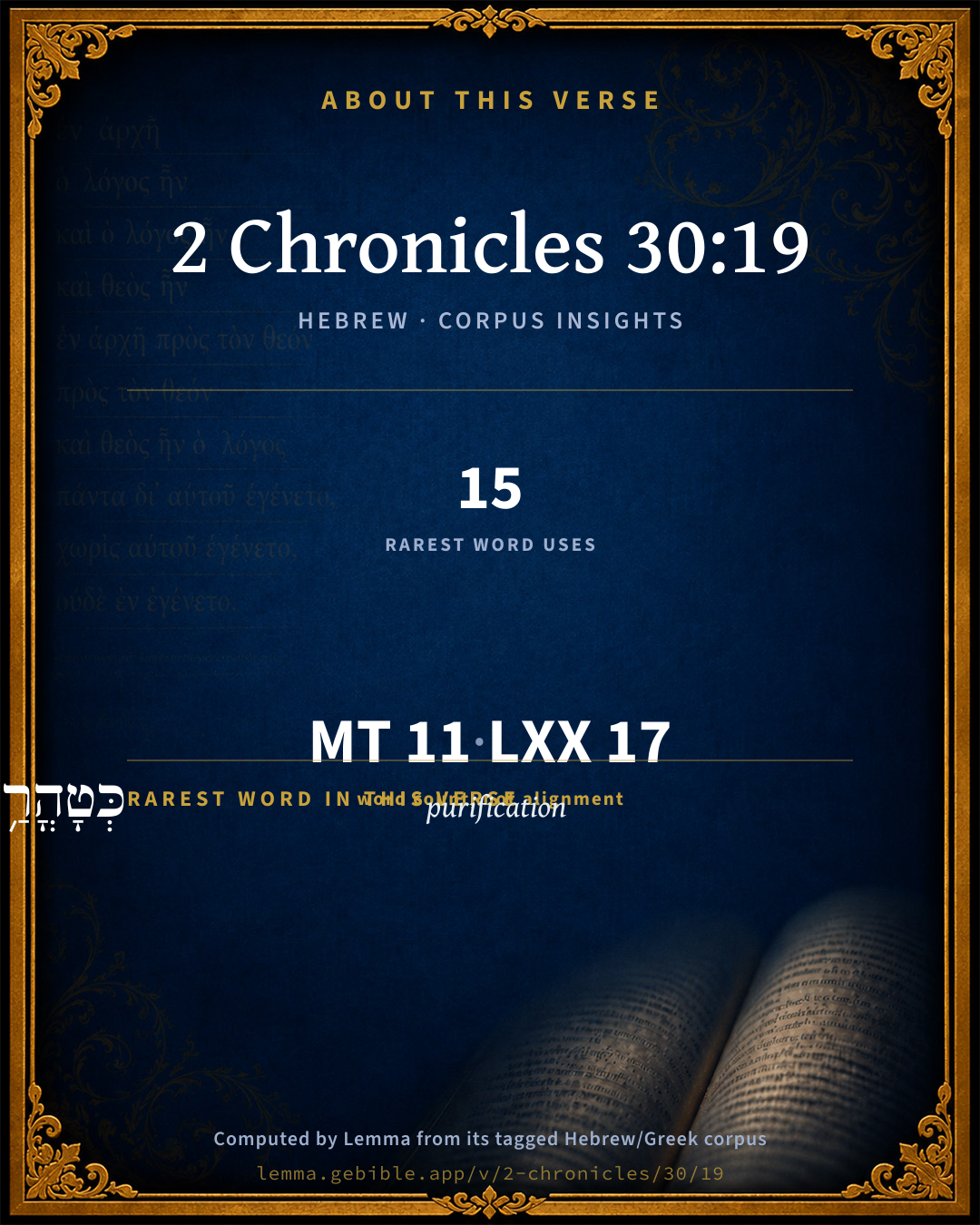
The rarest word here is כְּטָהֳרַ֥ת purification H2893 — appearing just 15 times in the whole Hebrew Bible.

Shared distinctive vocabulary

כְּטָהֳרַ֥ת purification H2893 occurs in 14 verses of the Hebrew Bible. Also found in:

Grammatical profile

  • 2 verbs
  • 8 nouns
  • 1 particle

Verb forms

  • הֵכִ֔ין Hiphil · Perfect
  • לִדְר֛וֹשׁ Qal · Infinitive Construct

Repetition

A word recurs within this verse — often emphatic in Hebrew:

  • הָאֱלֹהִ֥ים God H430 ×2

Hebrew & Septuagint length

In English translation the verse runs 23 words from the Hebrew and 30 from the Septuagint (LXX English) — closely comparable.

A rough comparison of the two English renderings, which tokenize alike — not a word-level alignment.

Word counts can differ between the Hebrew and the Greek without any difference in meaning — e.g. the Hebrew direct-object marker אֵת has no separate Greek word, and Greek often adds the article ὁ.

In the original languages it is 11 Hebrew tokens and 17 Greek tokens — but the two are counted differently (Hebrew bundles its prefixes and suffixes into one token; the Greek is in lemma form), so that isn’t a like-for-like length.

Cross-references

14

Topical passages linked to 2 Chronicles 30:19 in the Treasury of Scripture Knowledge — connected by theme and wording, ordered by reader-vote popularity; previews shown in the World English Bible.

  • 2 Chronicles 19:3 Nevertheless there are good things found in you, in that you have put away the Asheroth out of the land, and have set your heart to seek God.
  • Proverbs 23:26 My son, give me your heart; And let your eyes keep in my ways.
  • Job 11:13 "If you set your heart aright, Stretch out your hands toward him.
  • Psalms 10:17 Yahweh, you have heard the desire of the humble. You will prepare their heart. You will cause your ear to hear,
  • 1 Chronicles 29:18 Yahweh, the God of Abraham, of Isaac, and of Israel, our fathers, keep this forever in the imagination of the thoughts of the heart of your people, and prepare their heart to you;
  • 2 Chronicles 20:33 However the high places were not taken away; neither as yet had the people set their hearts to the God of their fathers.
  • Ezra 7:10 For Ezra had set his heart to seek the law of Yahweh, and to do it, and to teach in Israel statutes and ordinances.
  • Leviticus 12:4 She shall continue in the blood of purification thirty-three days. She shall not touch any holy thing, nor come into the sanctuary, until the days of her purifying are completed.
  • Leviticus 15:31–33 "'Thus you shall separate the children of Israel from their uncleanness, so they will not die in their uncleanness, when they defile my tabernacle that is in their midst.'"
  • Leviticus 21:17–23 "Say to Aaron, 'None of your seed throughout their generations who has a blemish, may approach to offer the bread of his God.
  • Leviticus 22:3–6 Tell them, 'If anyone of all your seed throughout your generations approaches the holy things, which the children of Israel make holy to Yahweh, having his uncleanness on him, that soul shall be cut off from before me. I am Yahweh.
  • Numbers 9:6 There were certain men, who were unclean because of the dead body of a man, so that they could not keep the Passover on that day, and they came before Moses and before Aaron on that day.
  • Numbers 19:13–20 Whoever touches a dead person, the body of a man who has died, and doesn't purifies himself, defiles the tent of Yahweh; and that soul shall be cut off from Israel: because the water for impurity was not sprinkled on him, he shall be unclean; his uncleanness is yet on him.
  • 1 Samuel 7:3 Samuel spoke to all the house of Israel, saying, If you do return to Yahweh with all your heart, then put away the foreign gods and the Ashtaroth from among you, and direct your hearts to Yahweh, and serve him only; and he will deliver you out of the hand of the Philistines.

Cross-references courtesy of OpenBible.info (CC BY 4.0).

Hebrew and Greek witnesses Masoretic Hebrew ↔ Greek Septuagint

The same verse in the two great witnesses to the Old Testament, shown verse-for-verse.

These are two independent witnesses, not word-aligned to each other, and the Septuagint is shown in lemma (dictionary) form.

Hebrew 2 Chronicles 30:19 Masoretic · Westminster Leningrad Codex

כָּל לְבָב֣וֹ הֵכִ֔ין לִדְר֛וֹשׁ הָאֱלֹהִ֥ים יְהוָ֖ה אֱלֹהֵ֣י אֲבוֹתָ֑יו וְלֹ֖א כְּטָהֳרַ֥ת הַקֹּֽדֶשׁ

who sets his heart to seek God, Yahweh, the God of his fathers, though not [cleansed] according to the purification of the sanctuary.

World English Bible · Public Domain

Greek LXX 2 Chronicles 30:19 Septuagint · lemma form

πᾶς καρδία καταεὐθύνω ἐκζητέω κύριος ὁ θεός ὁ πατήρ αὐτός καί οὐ κατά ὁ ἁγνεία ὁ ἅγιος

The good Lord be merciful with regard to every heart that sincerely seeks the Lord God of their fathers, and is not purified according to the purification of the sanctuary.

LXX2012 (modern English Septuagint) · Public Domain

On this verse, Ellicott's Commentary for English Readers discusses the Septuagint’s reading. Read the note in Commentary ↓

Hebrew: Westminster Leningrad Codex (CC BY 4.0). Greek: Septuagint (public domain); English from LXX2012 (modern English Septuagint) (Public Domain). How the Septuagint differs from the Hebrew →

Commentary

Notes on 2 Chronicles 30:19 from classic Christian and Jewish commentators (each source and its license shown beneath its notes). The classic Christian expositions comment on the surrounding passage and are grouped to its opening verse, so a note may address several verses; the Jewish commentaries on the Tanakh (Rashi and others) are per-verse, so they appear only where the commentator wrote on this verse.

Lemma curates 59 commentaries, every one of them public domain or Creative Commons licensed, each selected and text-cleaned for this edition rather than reprinted as found. About our sources →

Trapp's Complete Commentary

John Trapp

2Ch 30:19 [That] prepareth his heart to seek God, the LORD God of his fathers, though [he be] not [cleansed] according to the purification of the sanctuary.

Ver. 19. That prepareth his heart.] As well as he is able, though he fall far short of what he should be. The bent, frame, and tendencies of the heart show what the man is.

John Trapp, A Commentary or Exposition upon All the Books of the Old and New Testament (1647–1656) — public domain. Text from a community e-Sword module.

Joseph Benson's Commentary

2Ch 30:19. That prepareth his heart to seek God — The great thing required in our attendance on God in his ordinances is, that we prepare our hearts to seek him; that the inward man, the spirit, be engaged; that we make heart-work of our religion. All is nothing without this. Hezekiah does not pray that this might be dispensed with, or that the want of other things might be pardoned or overlooked, where this was not. For this is the one thing needful, and God is not, cannot be sought acceptably, without it. But he prays that where this was, other deficiencies and omissions, especially such as were of an external and ritual nature, might be pardoned. Though he be not cleansed according to the purification of the sanctuary — With that purification which was required of them that came into God’s sanctuary. So he calls it, to distinguish it from that internal purity which they are here acknowledged to have.

Joseph Benson's Commentary on the Old and New Testaments (1811–1818) — public domain. Text from a community e-Sword module.

Ellicott's Commentary for English Readers

(19) That prepareth.—Hath directed. The division of verses here is obviously incorrect. (The mistake was doubtless caused by the omission of the relative in the Hebrew between kol, “every one,” and lĕbâbô hçkîn, “his heart he hath directed.” The construction is parallel to that in 1Ch_15:12, “unto the place that I have prepared for it;” so LXX.) The prayer is, “Jehovah the Good atone for every one who hath directed his heart to seek the true God, even Jehovah, the God of his fathers, albeit not (literally, and not) according to the holy purifying”—i.e., although he hath not rigorously observed the law of purification.

Purification of the sanctuary.—Or, holy purification: a phrase only found here (comp. 1Ch_23:28).

The prayer evinces a preference of spiritual sincerity to mere literal observance of legal prescriptions, which is all the more remarkable as occurring in a writer whose principal aim is to foster a due reverence for the external ordinances and traditional customs of religion.

A Bible Commentary for English Readers, edited by Charles John Ellicott (1878–1897) — public domain. Text from a community e-Sword module.

John Gill's Exposition

And the Lord hearkened to Hezekiah,.... Heard his prayer, and accepted of it, and granted what he desired:

and healed his people; that is, forgave their sins, as Kimchi interprets it; forgiveness being expressed by healing, for which he refers to Psa 41:4 to which may be added Psa 103:3 and which was known either by a prophet sent to declare it, or by not punishing them for their offence.

John Gill's Exposition of the Whole Bible (1746–1763) — public domain (CC PDM 1.0). Text via the HelloAO Bible API.

Matthew Poole's English Annotations

i.e. With that ceremonial purification which was required of them that came into God’s sanctuary. So he calls it, to distinguish from that moral and internal purity which they are here acknowledged to have.

Matthew Poole's English Annotations on the Holy Bible (1683–1685) — public domain. Text from a community e-Sword/MySword module.

John Wesley's Explanatory Notes

The sanctuary - With that purification which was required of them that came in God's sanctuary. So he calls it to distinguish from that internal purity which they are here acknowledged to have. The great thing required in our attendance on God's ordinances is, that we prepare our heart to seek him; that the inward man be engaged, that we make heart work of it. All is nothing without this.

John Wesley, Explanatory Notes Upon the Whole Bible (1754–1765) — public domain. Text via the GEBible commentary corpus.

Rashi

Rabbi Shlomo Yitzchaki (Rashi)

who has set his whole heart So it is explained in the Baraitha of Rabbi Eleazar the son of Rabbi Jose the Galilean which commences: Wherever you find the words of Rabbi Eleazar the son of Rabbi Jose the Galilean in Aggadah, listen attentively, as it is said (Prov. 2:2): “To make your ear attentive to wisdom” of the thirty-two methods by which the Aggadah is expounded, and this is one of them:. If the sequence was separated, e.g. this one: The good Lord will atone for anyone who has set his whole heart to seek God to perform His Passover sacrifice, to offer up his sacrifice—even though they did not offer it with the purity of sacred things, for they had not purified themselves; the entire Judah had purified themselves because they were near Jerusalem, and they could cleanse themselves and consecrate themselves and return to Jerusalem, but many from Ephraim and Manasseh, Issachar and Zebulun were not so much to blame in the matter, because the matter was far away for them through letters, and they did not have time to wait and to delay their coming until they consecrated themselves. They therefore came and were not purified. And because it was not their fault, therefore atone for them. Similarly, (Isa. 35:1f.): “Desert and wasteland shall rejoice over them, etc.”: the sequence is separated.

Rashi on the Tanakh — English translations: “The Judaica Press complete Tanach with Rashi, translated by A. J. Rosenberg” (CC BY 4.0); “Pentateuch with Rashi's commentary by M. Rosenbaum and A.M. Silbermann, 1929-1934” (public domain); “The Metsudah Tanach series, Lakewood, N.J” (CC BY 4.0); and “The Book of Joshua, Metsudah Publications, 1997” (CC BY 4.0). Text via Sefaria.

Lesson kit

Teaching starters — assembled from the data on this page, not authored interpretation. Every prompt links to the verse data it draws on. Edit before teaching.

2 Chronicles, in the Historical, opens this verse with 11 words (10 distinct Hebrew lemmas). Its most distinctive word is ṭohŏrâh (“purification”). A historical commentator’s framing appears above. Read the whole chapter for the surrounding context.

Discussion questions

  1. What does “purification” (ṭohŏrâh) contribute to the verse as a whole?
  2. How does Leviticus 12:4, which shares the word «purification», read alongside this verse?
  3. What does the repetition of “God” (2× in this one verse) do in this verse?
  4. These translations render this verse differently. What is at stake in choosing one wording over another?
  5. «הֵכִ֔ין» is a Hiphil Perfect verb. How does that grammatical form shape the action described?
  6. Compare how Trapp's Complete Commentary and Joseph Benson's Commentary read this verse. Where do they agree or differ?

Things to notice

Reading settings

Reading text

Shown beneath each verse's original-language words.

Old Testament
Old Testament edition

Read the OT as the Masoretic Hebrew (MT) or the Greek Septuagint (LXX).

English shown for the Greek Septuagint (in the Hebrew ↔ Greek comparison).

Comparing translations? Open the Compare panel on any verse page to stack up to four side by side.