Psalms 87:5

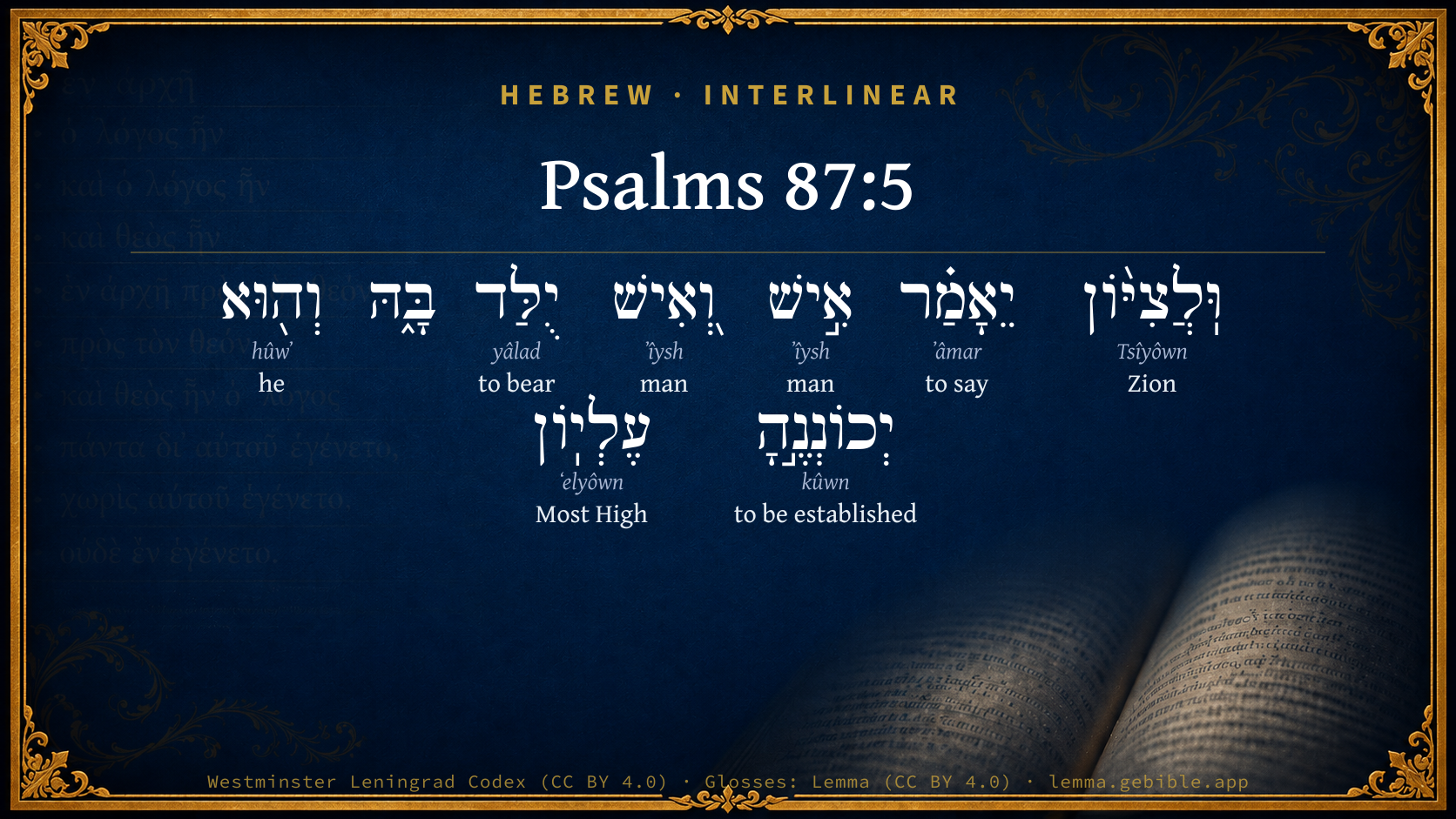
Hebrew (Westminster Leningrad Codex) Psalms 87:5 appears in the Hebrew Old Testament. The text above is from the Westminster Leningrad Codex. Each word links to its Strong’s number, a concise gloss, and parsing drawn from the Open Scriptures Hebrew Bible morphology. Click any word for its full Brown-Driver-Briggs (BDB) entry.
Download image
Cite this verse

Psalms 87:5 (World English Bible). Public Domain. Lemma interlinear Bible study tool, https://lemma.gebible.app/v/psalms/87/5.

Show BibTeX & RIS
BibTeX
RIS
English Translation
Yes, of Zion it will be said, "This one and that one was born in her;" The Most High himself will establish her.
World English Bible · Public Domain
Download a study sheet

One document with this verse’s original text, its word-by-word gloss line, the meaning frame, cross-references with their text, attributed commentary, and full source and license credits — printable, and it pastes into notes with its structure intact.

This verse Autodidact and up

Study sheet (.html) Plain text (.txt)

A passage Seminary Student

Up to 50 verses in one chapter. A passage sheet keeps up to 6 commentary sources and 12 cross-references per verse, in the order this page ranks them, and says so on the sheet whenever that leaves anything out. Ask for a single verse and you get the Autodidact verse sheet above.

Everything on this page stays free to read, with no account — the sheet is a download of what is already on screen, not access to it.

Want to remove ads? Support Godless Engineer
Compare translations 3

The same verse in 3 English versions, stacked beneath the original-language interlinear above. Click any original word for its lexicon entry.

Each is an independent rendering of the whole verse — the interlinear is not word-aligned to these translations.

Highlighted words mark where these versions differ — a whole-verse word diff, not a word-by-word alignment.

  • World English Bible Public Domain
    Yes, of Zion it will be said, "This one and that one was born in her;" The Most High himself will establish her.
  • King James Version Public Domain
    And of Zion it shall be said, This and that man was born in her: and the highest himself shall establish her.
  • unfoldingWord Literal Text CC BY-SA 4.0
    And of Zion it will be said, “Man and man was born in her, and he, he will establish her, the Most High.”

unfoldingWord Literal Text — © unfoldingWord, licensed CC BY-SA 4.0. Word-aligned USFM3 via Door43 (git.door43.org/unfoldingWord/en_ult).

Versions to compare (up to 4)

3 of 4 selected

Show all 18 translations

Every available English version of this verse, each an independent rendering of the whole verse.

  • World English Bible Public Domain
    Yes, of Zion it will be said, "This one and that one was born in her;" The Most High himself will establish her.
  • Berean Standard Bible Public Domain
    And it will be said of Zion: “This one and that one were born in her, and the Most High Himself will establish her.”
  • Majority Standard Bible Public Domain
    And it will be said of Zion: “This one and that one were born in her, and the Most High Himself will establish her.”
  • King James Version Public Domain
    And of Zion it shall be said, This and that man was born in her: and the highest himself shall establish her.
  • American Standard Version (1901) Public Domain
    Yea, of Zion it shall be said, This one and that one was born in her; And the Most High himself will establish her.
  • Revised Version (1885) Public Domain
    Yea, of Zion it shall be said, This one and that one was born in her; and the Most High himself shall establish her.
  • Geneva Bible (1599) Public Domain
    And of Zion it shall be sayde, Many are borne in her: and he, euen the most High shall stablish her.
  • Douay-Rheims (1899) Public Domain
    Shall not Sion say: This man and that man is born in her? and the Highest himself hath founded her.
  • Young's Literal Translation Public Domain
    And of Zion it is said: Each one was born in her, And He, the Most High, doth establish her.
  • Literal Standard Version CC BY-SA 4.0
    And of Zion it is said: Each one was born in her, || And He, the Most High, establishes her.
  • Unlocked Literal Bible CC BY-SA 4.0
    Of Zion it will be said, “Each of these was born in her; and the Most High himself will establish her.”
  • unfoldingWord Literal Text CC BY-SA 4.0
    And of Zion it will be said, “Man and man was born in her, and he, he will establish her, the Most High.”
  • Darby Bible Public Domain
    And of Zion it shall be said, This one and that one was born in her; and the Most High himself shall establish her.
  • World Messianic Bible Public Domain
    Yes, of Zion it will be said, “This one and that one was born in her;” the Most High himself will establish her.
  • Webster's Bible Public Domain
    And of Zion it shall be said, This and that man was born in her: and the Highest himself shall establish her.
  • Free Bible Version CC BY-SA 4.0
    It will be said concerning Jerusalem, “Everyone was born there,” and the Most High will make it secure.
  • Bible in Basic English Public Domain
    And of Zion it will be said, This or that man had his birth there; and the Most High will make her strong.
  • JPS Tanakh (1917) Public Domain
    But of Zion it shall be said: 'This man and that was born in her; and the Most High Himself doth establish her.'

Literal Standard Version (2020), Covenant Press — licensed CC BY-SA 4.0. Text via the HelloAO Bible API (eBible.org). Unlocked Literal Bible (unfoldingWord) — licensed CC BY-SA 4.0. Text via the HelloAO Bible API (eBible.org). unfoldingWord Literal Text — © unfoldingWord, licensed CC BY-SA 4.0. Word-aligned USFM3 via Door43 (git.door43.org/unfoldingWord/en_ult). Free Bible Version, Dr. Jonathan Gallagher — licensed CC BY-SA 4.0. Text via the HelloAO Bible API (eBible.org).

Word by word

More ways to search: Search by grammar → Find every occurrence → Compare this word →

Practice this passage: Drill this verse → Learn its vocabulary →

עֶלְיֽוֹן
ʻelyôwn
H5945
“Most High”
Adjective, Adjective, Masculine, Singular, Absolute
Part of Speech
Adjective
Type
Adjective
Gender
Masculine
Number
Singular
State
Absolute
Full BDB Definition

Origin: from H5927

TWOT: 1624g , 1624h

high, upper (adjective) - of Davidic king exalted above monarchs - Highest, Most High (noun masculine) - name of God - of rulers, either monarchs or angel-princes
  1. וּֽלֲצִיּ֨וֹן Tsîyôwn H6726 “and · to/for · Zion” Conjunction + Preposition + Noun, Proper
  2. יֵאָמַ֗ר ʼâmar H559 “to say” Verb, Niphal, Imperfect, 3rd Person, Masculine, Singular
  3. אִ֣ישׁ ʼîysh H376 “man” Noun, Common, Masculine, Singular, Absolute
  4. וְ֭אִישׁ ʼîysh H376 “and · man” Conjunction + Noun, Common, Masculine, Singular, Absolute
  5. יֻלַּד yâlad H3205 “to bear” Verb, Pual, Perfect, 3rd Person, Masculine, Singular
  6. וְה֖וּא hûwʼ H1931 “and · he” Conjunction + Pronoun, Personal, 3rd Person, Masculine, Singular
  7. יְכוֹנְנֶ֣הָ kûwn H3559 “to be established · her” Verb, Polel, Imperfect, 3rd Person, Masculine, Singular + Suffix, Personal, 3rd Person, Feminine, Singular

About this verse

These counts appear in no published source. They are computed here, from the morphology-tagged text and Lemma’s own curated glosses. What Lemma adds →

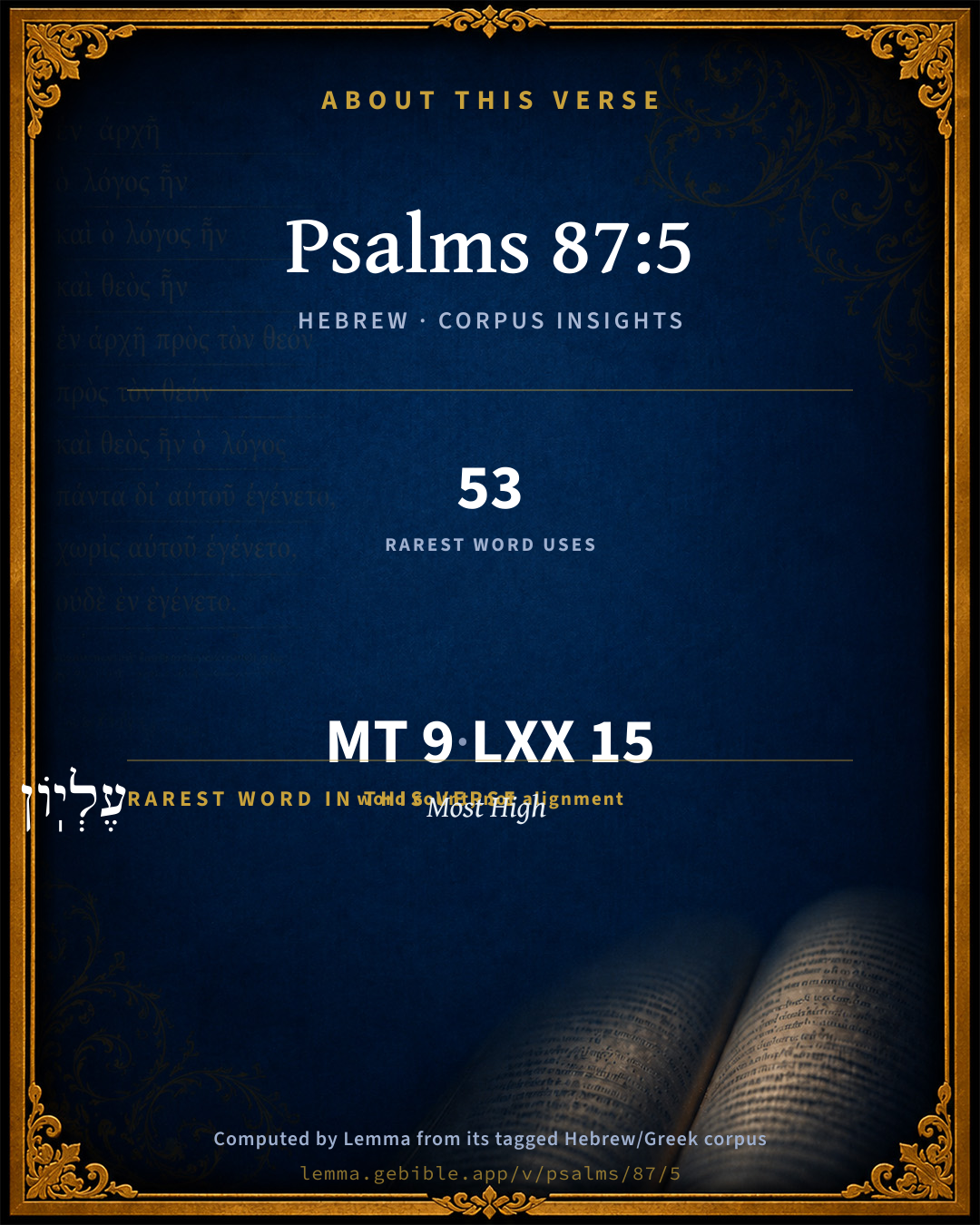
9
words
7
distinct lemmas
Wisdom
section

Shared distinctive vocabulary

עֶלְיֽוֹן Most High H5945 occurs in 53 verses of the Hebrew Bible. Also found in:

Grammatical profile

  • 3 verbs
  • 3 nouns
  • 1 adjective
  • 1 pronoun
  • 1 preposition

Verb forms

  • יֵאָמַ֗ר Niphal · Imperfect
  • יֻלַּד Pual · Perfect
  • יְכוֹנְנֶ֣הָ Polel · Imperfect

Repetition

A word recurs within this verse — often emphatic in Hebrew:

  • אִ֣ישׁ man H376 ×2

Hebrew & Septuagint length

In English translation the verse runs 23 words from the Hebrew and 23 from the Septuagint (LXX English) — the same length.

A rough comparison of the two English renderings, which tokenize alike — not a word-level alignment.

Word counts can differ between the Hebrew and the Greek without any difference in meaning — e.g. the Hebrew direct-object marker אֵת has no separate Greek word, and Greek often adds the article ὁ.

In the original languages it is 9 Hebrew tokens and 15 Greek tokens — but the two are counted differently (Hebrew bundles its prefixes and suffixes into one token; the Greek is in lemma form), so that isn’t a like-for-like length.

Cross-references

12

Topical passages linked to Psalms 87:5 in the Treasury of Scripture Knowledge — connected by theme and wording, ordered by reader-vote popularity; previews shown in the World English Bible.

  • Romans 8:31 What then shall we say about these things? If God is for us, who can be against us?
  • 1 Peter 1:23–24 having been born again, not of corruptible seed, but of incorruptible, through the word of God, which lives and remains forever.
  • Ezekiel 48:35 It shall be eighteen thousand [reeds] round about: and the name of the city from that day shall be, Yahweh is there.
  • John 1:12–14 But as many as received him, to them he gave the right to become God's children, to those who believe in his name:
  • Galatians 3:26–28 For you are all children of God, through faith in Christ Jesus.
  • Isaiah 44:4–5 and they shall spring up among the grass, as willows by the watercourses.
  • Isaiah 60:1–9 Arise, shine; for your light is come, and the glory of Yahweh is risen on you.
  • John 3:3–5 Jesus answered him, "Most assuredly, I tell you, unless one is born anew, he can't see the Kingdom of God."
  • Hebrews 11:32–12:2 What more shall I say? For the time would fail me if I told of Gideon, Barak, Samson, Jephthah, David, Samuel, and the prophets;
  • Psalms 48:8 As we have heard, so we have seen, In the city of Yahweh of Hosts, in the city of our God. God will establish it forever. Selah.
  • Matthew 16:18 I also tell you that you are Peter, and on this rock I will build my assembly, and the gates of Hades will not prevail against it.
  • Hebrews 12:22–24 But you have come to Mount Zion, and to the city of the living God, the heavenly Jerusalem, and to innumerable hosts of angels,

Cross-references courtesy of OpenBible.info (CC BY 4.0).

Hebrew and Greek witnesses Masoretic Hebrew ↔ Greek Septuagint

The same verse in the two great witnesses to the Old Testament, shown verse-for-verse.

You’re reading Greek Psalm 86 (Hebrew Psalm 87). The Septuagint counts the superscription, so verse numbers can differ from the Hebrew — chapter-level alignment, not verse-by-verse. Numbering follows Rahlfs.

These are two independent witnesses, not word-aligned to each other, and the Septuagint is shown in lemma (dictionary) form.

Hebrew Psalms 87:5 Masoretic · Westminster Leningrad Codex

וּֽלֲצִיּ֨וֹן יֵאָמַ֗ר אִ֣ישׁ וְ֭אִישׁ יֻלַּד בָּ֑הּ וְה֖וּא יְכוֹנְנֶ֣הָ עֶלְיֽוֹן

Yes, of Zion it will be said, "This one and that one was born in her;" The Most High himself will establish her.

World English Bible · Public Domain

Greek LXX Greek Psalm 86:5 Septuagint · lemma form

μήτηρ σιων εἶπον ἄνθρωπος καί ἄνθρωπος γίγνομαι ἐν αὐτός καί αὐτός θεμελιόω αὐτός ὁ ὕψιστος

A man shall say, Sion is my mother; and such a man was born in her; and the Highest himself has founded her.

LXX2012 (modern English Septuagint) · Public Domain

On this verse, The Cambridge Bible for Schools and Colleges discusses the Septuagint’s reading. Read the note in Commentary ↓

Hebrew: Westminster Leningrad Codex (CC BY 4.0). Greek: Septuagint (public domain); English from LXX2012 (modern English Septuagint) (Public Domain). How the Septuagint differs from the Hebrew →

Commentary

Notes on Psalms 87:5 from classic Christian and Jewish commentators (each source and its license shown beneath its notes). The classic Christian expositions comment on the surrounding passage and are grouped to its opening verse, so a note may address several verses; the Jewish commentaries on the Tanakh (Rashi and others) are per-verse, so they appear only where the commentator wrote on this verse.

Lemma curates 59 commentaries, every one of them public domain or Creative Commons licensed, each selected and text-cleaned for this edition rather than reprinted as found. About our sources →

Trapp's Complete Commentary

John Trapp

Psa 87:5 And of Zion it shall be said, This and that man was born in her: and the highest himself shall establish her.

Ver. 5. And of Zion it shall be said, This and that man was born in her] i.e. Converted; and so a daily accession made to the Church of Christ, as it was by Peter’s sermon, &c., and now so many nations: Behold, the world is gone after him, said these envious Pharisees, Joh 12:19; and the Papists grudge as much at the late glorious Reformation, begun by Luther, wherein so many rejoice, and shall do to all eternity. Bucholcerus blesseth God that he was born in the days and was bred under the discipline of holy Malancthon, Luther’s colleague:

Divisae his operae, sed mens fuit unica; pavit

Ore Lutherus oves, flore Melancthon apes.

Beatus Ludovicus would be called Ludovicus de Pissiaco rather than take greater titles, because there he became a Christian. He thought no birth equal to a new birth in Christ; no parentage to that of God to his Father, the Church to his mother, Christ to his elder brother, &c. Some apply this text to the places of holy men’s birth, and tell us, that he loves the very ground his servants tread on, the very air they first breathe in, their walls are continually before him, Isa 49:16, he thinks the better of the houses where they dwell.

And the highest himself shall establish her] So that the gates of hell shall not unsettle her. Other states and polities have their times and their turns, their rise and their ruin; not so the Church.

John Trapp, A Commentary or Exposition upon All the Books of the Old and New Testament (1647–1656) — public domain. Text from a community e-Sword module.

The Biblical Illustrator

Joseph S. Exell

Psa_87:5

And of Zion it shall be said, This and that man was born in her.

The Church of to-day

I. The chief work and truest dignity of the Church lies in her regeneration and saving energy. In imitation of the example of her Lord, she has reached, and is reaching now, those whom philosophers and poets, statesmen and even philanthropists, had designated the lapsed and incorrigible classes. Where schools of philosophy and codes of law have utterly and ignominiously failed to kill the virus of some moral epidemic, the religion of Christ has succeeded, the Gospel of Christ has proved an unfailing remedy.

II. The conversion of men should be the first aim of the Christian ministry.

III. This should be the great aim of all religious effort. We need more of the spirit of the sainted Alleine, who said he was insatiably greedy for the salvation of souls; or of Matthew Henry, who said he would deem it a greater happiness to gain one soul to Christ than thousands of gold and silver.

IV. The dignity and work of the Church lies with its individual members--this and that man. The Church of every age can boast of names whose loss would be a loss to mankind. Time would fail to tell of Paul, the eloquent apostle of the Gentiles; Polycarp, the faithful disciple of John; Justin Martyr, the great defender of the faith; Augustine, Luther, Wycliffe, Knox, Wesley and Whitefield, and a host of others, of whom we say with pride, this and that man, etc.

V. The true inspiration in the Church is spiritual and supernatural, I have seen an unfilled balloon lying limp and useless on the ground. I have seen the same material expanded and floating gracefully far away above the toil and sin of earth. So have I seen the Church lying limp and lifeless, an object of loathing to some and pity to others. I have seen the same Church filled by the breath of God warm and full, no longer pitied, but admired as the centre of life and hope for a weary world. (Z. T. Dowen, D. D.)

Zion a type of the Church

Contemplate Zion in regard to--

I. Her converts. They are born, as it were, into a new world. The subjects of this change have new attachments and aversions; new joys and sorrows; new fears and hopes. They are actuated by new motives; and having experienced such a change in the inward man, they will manifest it in the whole of their deportment.

II. Her perpetuity.

III. Her final triumph. We may infer this from--

1. The faithfulness of God to His promises.

2. The firm basis on which religious liberty rests in our day, and the growing intelligence of the age respecting the spiritual nature and the Scriptural means of supporting the Church of Christ.

3. The more abundant outpouring of the Holy Spirit with which we believe God will bless His Church.

4. The prayers offered and the efforts made for the religious interests of the neighbourhood. (Essex Remembrancer.)

The Churchs fruitfulness

1. In regard of the eminency of her births, she is not wholly barren; she bath her births of men, and worthy men. The carnal world hath not exceeded the Church in men of raised intellectuals; Zion hath not been a city of fools.

2. In regard to the multitude of them; this and that man, of all sorts and conditions, and multitudes of them, so that more are the children of the desolate than of the married wife. The tents were prophesied to be enlarged, the curtains of the habitations of Zion to be stretched out, and her cords to be lengthened, to receive and entertain that multitude of children that should be brought forth by her after the sacrifice of the Son of God (Isa_54:1-2); for that exhortation follows upon the description of the death and exaltation of Christ (Isa_53:1-12.). (S. Charnock.)

Fragrant memories of spiritual birth-places

There is nothing strange in the halo of dearness which, to every Christian, hangs around the scenes with which the beginning of his new life is associated. The place where two friends first met is sacred to them all through their friendship, all the more sacred as their friendship deepens and grows old. Only the last day shall tell how much of earth is hallowed ground. This is what makes the old churches holy with an accumulated sacredness which surpasses their first consecration. Who can tell how many this church of ours will find among the blessed to honour and treasure her for ever, that she may not be forgotten when the birthplaces of souls are remembered? (Bishop Phillips Brooks.)

And the Highest Himself shall establish her.

The Churchs stability

I. The explication.

1. This stability must not be meant of any particular Church in the world. Particular Churches have their beginnings, progresses, and periods. Particular Churches have been corrupted by superstition and idolatry, rent by heresies, and scattered by persecutions, Zion hath stood, though some synagogues of it have been pulled down; it hath, like the sun, kept its station in the firmament, though not without eclipses and clouds to muffle it. The Church is but one, though it be in divers countries, and named according to the places where it resides, as the Church of Ephesus, the Church of Sardis, etc. If you obstruct the light of one beam, or lop off one branch, or dam up the stream, yet the sun, root, fountain remains the same.

2. Though God unstakes the Church in one place, yet He will not only have a Church, but a professing Church in another. It is a standing law of Christianity that a belief in the heart should be attended by confession with the mouth (Rom_10:9). And the Church is a congregation of people sounding the voice of Christ, as He was preached and confessed by the apostles. While there are believers, there will be professors in society together; some ordinances settled in being during the continuance of the world, as the supper (1Co_11:6).

3. This Church or Zion shall have a numerous progeny. The spiritual Israel shall be as the sand of the sea, which cannot be measured or numbered (Hos_1:10), which was the promise made to Abraham (Gen_22:17), and renewed in the same terms to Jacob (Gen_32:12). The Church is a little flock in comparison of the carnal world, yet it is numerous in itself, though not in every place.

II. God has hitherto established Zion.

1. This is testified by its present standing, when other empires have sunk by age or violence. She bath borne up her head in the midst of earthly revolutions, and met with her preservation or resurrection where carnal interests have found their funeral.

2. No society but the Church ever subsisted in the midst of a multitude of enemies.

3. The violences against her, which have been fatal to other societies, have been useful to her. This bush hath burned without consuming, and preserved its verdure in the midst of fire; not from the nature of the bush, but the presence of Him that dwelt in it.

4. When she has seemed to be forlorn and dead, God has restored her. When Israel was at the lowest, a decree issued out in Egypt to destroy her males and root out her seed, deliverance began to dawn; and when a knife was at her throat at the Red Sea, and scarce a valiant believer found among a multitude of despairers, God turned the back of the knife to His Israel, and the edge to the throat of the enemies.

5. God never wanted instruments for His Church in the due season. If Nebuchadnezzar be the axe to hew down Jerusalem, Cyrus shall be the instrument to build her up; when His time is come, He will not want an Ezra and Nehemiah to rear her walls, nor be wanting to them to inspire them with courage and assist their labour, in spite of the adversaries that would give checkmate to the work. If Stephen be stoned by the Sews, He will call out Paul, an abettor of that murder, to be a preacher of the Gospel, and he that was all fire against it shall become as great a flame for the propagation of it: one phoenix shall arise out of the ashes of another.

III. Why it must needs be so.

1. It is necessary for the honour of God. Those societies may moulder away, and those religions grow feeble, which have drawn their birth from the wisdom of man and been settled from the force of man, but a Divine work must needs have a Divine establishment.. It is so--

(1) If you regard it as His main design in the creation of the world.

(2) As He hath been the author and builder of Zion.

(3) As He hath been the preserver and enlarger of her to this day.

(4) In regard of the cost and pains He hath been at about Zion.

(5) In regard of faithfulness, His veracity is engaged.

(6) In regard it is the seat of His glory.

(7) In regard that it is the object of His peculiar affection.

(8) In regard of the natural weakness of the Church.

2. It is for the exercise of the offices of Christ that Zion should be established. He is prophet, priest, and king, which are all titles of relation. Prophet implies some to be instructed, a priest some to offer for, and a king some to be ruled; put one relation, and you must necessarily put the other. If there were no Church preserved in the world, He would be a nominal prophet without any disciples, a king without subjects, and a priest without suppliants to be atoned by Him upon earth.

3. The foundation of Zion is sure. It is founded upon Christ, the corner stone.

IV. The use,

1. Information.

(1) If the Church hath a duration and stability, then ordinances and ministry are perpetual. Ministers may be thrust into corners, clapped up in prison, hurried to their graves, but the sepulchres of ministers are not the graves of the ministry.

(2) The doctrine of the establishment of every member of Zion is clearly established. The same blood that is the cement of Zion, the same hand that built her, the same head that influenceth her, secures every one of her true-born children. They are all in the same posture and upon the same foundation with Zion herself.

(3) How great is the folly of Zions enemies! They judge of her by the weakness of her worldly interest, and not by the almightiness of her guardian.

(4) What a ground is here for prayer! No petition can more comfortably, no petition can more confidently, be put up, than for Zions establishment. Prayers for particular persons, or for ourselves, may want success; but supplications for Zion never miscarry.

(5) What a strong ground is here for trust! Look not so much upon the condition of Zions walls as upon her foundation; not upon her present posture, as upon her promise-charte; not upon her as a weak vine, but under the hand of the Highest as the vine-dresser. Look not upon the feebleness of the flock, but upon the care of the shepherd; nor upon the fierceness of the lions, but upon the strength and affection of her guardian.

2. Comfort.

(1) In the confusions and troubles of the world.

(2) In persecutions.

(3) In the deepest designs of her enemies. If He be the Highest, and employs Himself as the Highest, there is none so high as to overtop Him, none so high as to outwit Him. Though their union be never so close, and their projects never so deep, yet Gods being with the Church is curb enough for them and comforting enough for Zion (Isa_8:9).

3. Exhortation.

(1) Take heed of apostatizing from Zion.

(2) Let us love Zion.

(3) Let us desire the establishment of Zion more than our own private establishment.

(4) Let us endeavour the establishment of Zion. (S. Charnock.)

The Biblical Illustrator, edited by Joseph S. Exell (c. 1880s–1900s) — public domain. Text from a community e-Sword module.

Joseph Benson's Commentary

Psa 87:5. Of Zion — Concerning the church of God, whether composed of Jews or Gentiles, it shall be said — It shall be mentioned by God, and acknowledged by men, as a great and wonderful work of Jehovah, that this and that man was born in her — That is, persons of this and that nation: not only a few of one nation, as formerly, but now multitudes of all sorts and conditions, without difference of nations, shall become members of the church, Gal 4:28; Col 3:11. Hebrew, אישׁ ואישׁ, ish veish, man and man, that is, every man, or, all sorts of men, without respect of persons; any man whosover that shall turn to God; so this very phrase, man and man, is rendered Lev 17:10; Lev 17:13; as, by day and day, is meant every day, or, from day to day, Est 3:4; Psa 61:8. And the Highest himself shall establish her — Uphold her to perpetuity, Mat 16:18. This shall not be a sudden and transient, but a lasting work: and the accession of proselytes, out of divers nations, shall be so far from occasioning discord and division, that it shall contribute greatly to Zion’s strength; for God himself having founded her upon a rock, whatever convulsions and revolutions there may be of states and kingdoms, and however heaven and earth may be shaken, she shall be found among the things which cannot be shaken, but must remain, Hag 2:6-7; Heb 12:27. Zion shall continue in its strength and fertility, because the almighty God is its founder and protector, and will finish the work which he hath begun; the Highest himself who can do it effectually, shall undertake to establish her.

Joseph Benson's Commentary on the Old and New Testaments (1811–1818) — public domain. Text from a community e-Sword module.

J. A. Alexander on Psalms

Joseph Addison Alexander

5. (Psa 87:5) And of Zion it shall be said, (This) man and (that) man was born in her, and He will establish her, the Highest. The strict translation of the first words is to Zion, but the subsequent use of the third person (in her) shews that the act described is that of speaking of a person in his presence, yet not directly to him, or, as we sometimes say in English, talking at him. See above, on Psa 3:2; Psa 71:10. The idiomatic phrase man and man means every one or each one severally. See the Hebrew of Est 1:8, and compare that of Lev 17:10; Lev 17:13. The clause may then be understood as asserting of individuals what had just been said of whole communities, or as repeating the latter, in a more emphatic form, for the purpose of connecting it with an additional promise, namely, that the church thus enlarged by the accession of the Gentiles, shall be permanently established and secured. The pronoun is emphatic, and is rendered more so by the epithet attached to it. He the Highest, or the Highest himself. The protector of the church is neither man nor angel, but the supreme and sovereign God. See above, on Psa 47:2; Psa 48:8.

Joseph Addison Alexander, The Psalms Translated and Explained (1850) — public domain. Text from a community e-Sword module.

Tyndale Open Study Notes

Tyndale Open Resources

87:5-6 Jerusalem becomes the international city where all God’s children are citizens.

Tyndale Open Study Notes — © Tyndale Open Resources, licensed CC BY-SA 4.0. Text via the HelloAO Bible API.

Geneva Bible (1599)

Geneva Bible translators

Out of all quarters they shall come to the Church, and be counted as citizens.

Geneva Bible (1599) marginal notes — public domain. Text via Bolls.life.

Adam Clarke's Commentary

Verse 5. This and that man was born in her] It will be an honour to any person to have been born in Zion. But how great is the honour to be born from above, and be a citizen of the Jerusalem that is from above! To be children of God, by faith in Christ Jesus! The Targum has, "David the king, and Solomon his son, were brought up here."

The Highest himself shall establish her.] The Christian Church is built on the foundation of the prophets and apostles; Jesus Christ himself being the Cornerstone.

Adam Clarke's Commentary on the Bible (1810–1826) — public domain. Text from a community e-Sword/MySword module.

John Calvin's Commentaries

5 And it shall be said of Zion, Man and man is born in her. It is asserted, in the 4th verse, That new citizens shall be gathered into the Church of God from different parts of the world; and here the same subject is prosecuted. Another figure is however employed, which is, that strangers by birth shall be accounted among the holy people, just as if they were descended from Abraham. It had been stated in the preceding verse, that the Chaldeans and Egyptians would be added to the household of the Church; and that the Ethiopians, Philistines, and Tyrians, would be enrolled among her children. Now, it is added, by way of confirmation, that the number of the new progeny shall be exceeding great, so that the city which had been for a time uninhabited, and afterwards only half filled with a few people, shall be crowded with a vast population. The prophet Isaiah describes more at length what is here promised, in a few words,

“Sing, O barren, thou that didst not bear; break forth into singing, and cry aloud, thou that didst not travail with child: for more are the children of the desolate than the children of the married wife, saith the Lord. Enlarge the place of thy tent, and let them stretch forth the curtains of thine habitations: spare not, lengthen thy cords, and strengthen thy stakes: for thou shalt break forth on the right hand and on the left; and thy seed shall inherit the Gentiles, and make the desolate cities to be inhabited.” (Isaiah 54:1)

Also,

“Lift up thine eyes round about, and see; all they gather themselves together, they come to thee: thy sons shall come from far, and thy daughters shall be nursed at thy side.” (Isaiah 60:4)

And, in the 44th chapter, at the 5th verse, we meet with almost the same language as in the passage before us, or at least what comes very near to it: “One shall say, I am the Lord’s; and another shall call himself by the name of Jacob; and another shall subscribe with his hand unto the Lord, and surname himself by the name of Israel.” Nor is the word born inappropriately employed to express the fact, that the Egyptians, Chaldeans, and such like, shall be of the flock of God’s people. Although Zion was not the place of their natural birth, but they were to be grafted into the body of the holy people by adoption; yet as the way by which we enter into the Church is a second birth, this form of expression is used with great propriety. The condition upon which Christ espouses the faithful to himself is, that they should forget their own people and their father’s house, (Psalm 45:11,) and that, being formed into new creatures, and born again of incorruptible seed, they should begin to be the children of God as well as of the Church, (Galatians 4:19.) And the ministry of the Church, and it alone, is undoubtedly the means by which we are born again to a heavenly life. By the way, we should remember the difference which the Apostle sets forth as subsisting between the earthly Jerusalem, — which, being herself a bondwoman, brings forth children also in bondage, — and the heavenly Jerusalem, which brings forth free children by the instrumentality of the Gospel.

In the second part of the verse, there is expressed the stability and enduring character of Zion. It often happens, that in proportion to the rapidity with which cities rise to distinguished eminence, is the shortness of the continuance of their prosperity. That it may not be thought that the prosperity of the Church is of such a perishable and transitory nature, it is declared, that the Most High himself will establish her It is not surprising, as if it had been said, to find other cities shaken, and subject from time to time to a variety of vicissitudes; for they are carried round with the world in its revolutions, and do not enjoy everlasting defenders. But it is the very reverse with respect to the new Jerusalem, which, being founded upon the power of God, will continue even when heaven and earth shall fall into ruins.

John Calvin's Commentaries (1540-1563) — public domain. Text from the Calvin Translation Society English edition (1840s-50s) via the Christian Classics Ethereal Library (ccel.org). Calvin's coverage is partial (roughly two-thirds of the Bible); uncommented books and verses are honest gaps, never fabricated. The 19th-century editor's footnotes and remarks are omitted so the notes are faithfully Calvin's own voice.

Ellicott's Commentary for English Readers

(5) And of Zion . . .—This verse must be taken as antithetical to the preceding. The poet claims a prouder boast for natives of Jerusalem, because it was established by the Most High. Render, But of Zion it is said, “This man and that (literally, man and man) was born in her, and her the Most High established.”

A Bible Commentary for English Readers, edited by Charles John Ellicott (1878–1897) — public domain. Text from a community e-Sword module.

The Cambridge Bible for Schools and Colleges

gen. ed. J. J. S. Perowne

5. The Psalmist speaks, echoing the divine decree from Zion’s point of view, dwelling upon the honour which will accrue to Zion by this accession of citizens.

Yea, of Zion it shall be said,

Each and every one was born in her;

And the Most High himself shall establish her.

Not merely certain specified nations but all the nations shall call Zion their mother-city. One after another comes to be reckoned among her children[49]. Grammatically it is possible to understand each and every one of individuals, but the context is decisive in favour of taking this verse to refer to nations, as Psa_87:4; Psa_87:6 do. Each nation, reckoned as a whole, receives the right of citizenship. Individuals receive it as members of their nation.

[49] The reading of the LXX, though due apparently simply to a textual error in the Greek (μήτηρ for μήτι, Vulg. numquid), catches the spirit of the Psalm too strikingly to be passed over: O Mother Sion, shall a man say.

The LXX and some other Ancient Versions render hath founded her; but shall establish her, as Psa_48:8, is certainly right. Under the protection and blessing of the Sovereign Ruler of the world she grows ever stronger and nobler as each fresh nation joins the universal kingdom of God.

The Cambridge Bible for Schools and Colleges (gen. ed. J. J. S. Perowne; Cambridge University Press, 1878–1918) — public domain. Text from a community e-Sword module.

John Gill's Exposition

And of Zion it shall be said,.... The same with the city of God, the church before commended:

this and that man was born in her; this and that great man, in opposition to a mean person, in the preceding verse: "or a man and man" (d); men of all sorts, and of different nations, Jews and Gentiles, and great numbers of them:

and the Highest himself shall establish her; the church of God, though founded by him, and laid on a sure foundation, on the Rock of ages, against which the gates of hell cannot prevail, yet is sometimes fluctuating and unsettled;

it is tossed with tempests, the persecutions of men, the errors and heresies of false teachers, and the contentions and divisions of its own members; and is not always in one place, but is removed from one place to another, and is obliged to flee into the wilderness; but in the latter day it will be established and settled; it will be a tabernacle that shall not be taken down nor removed; but shall be established for ever, Psa 89:37, and this is the work of God, the most high God, the possessor of heaven and earth, whatever instruments he may make use of, as ministers of the word, and kings of the earth; as it is his work, and his only, to establish particular believers, Co2 1:21, so it is his to establish the church in general: or it may be rendered, "he shall establish her on high" (e), which will be the case when she is established upon the top of the mountains, and exalted above the hills, Isa 2:2.

(d) "vir et vir", Pagninus, Montanus, Tigurine version, Vatablus, Gejerus, Michaelis. (e) So the Targum, and Ainsworth.

John Gill's Exposition of the Whole Bible (1746–1763) — public domain (CC PDM 1.0). Text via the HelloAO Bible API.

Albert Barnes' Notes on the Bible

And of Zion it shall be said - In respect to Zion; or, in honor of Zion. People shall regard it as a privilege to have been born in Zion. They shall speak of such a birth as a marked and honored distinction. “This and that man,” etc. Designating them, or pointing them out, as having been born there. Those in a crowd, those passing along, those brought in any way to notice, will be spoken of in reference to their birth in Zion, and will be treated with a degree of favor and esteem, arising from their birth there corresponding to what those receive who are born in Egypt, Babylon, or Tyre. They will not be shunned and avoided on account of their birth as if it were ignoble, but they will be honored for it.

And the Highest himself shall establish her - Will establish Zion, or will give it prosperity and perpetuity. This, too, is what would be “said” respecting Zion by such as should speak of those born there; and it indicates

(a) their conviction that it would be permanent; and

(b) their desire that it might be: that a place so honored and distinguished might be perpetuated.

The practical truths suggested by this verse, as applied to the church, are

(1) that it is a privilege to have been born in connection with the Christian church; to have had a Christian parentage, and to have been early dedicated to God;

(2) that the time will come when this will be a ground of commendation, or when it will be spoken of as an honor, or when it will be regarded as presumptive evidence of a claim to esteem in the eyes of the world, that one was born in the church, was early devoted to God, and was trained up under the influences of religion;

(3) that the character of those who are thus born, and who are thus trained up, will constitute, in the view of the world, evidence of the stability of the church, and proof that God regards it with favor. It has not always been deemed an honor, or a passport to favor, to have been born in the church, but the time will come when this will be universally so; and, even now, no child can fully appreciate the honor and the real advantage of having been born in a family where God is served, and of having been early consecrated to God by parental purpose, by prayer, and by Christian baptism.

Albert Barnes' Notes on the Bible (1834–1885) — public domain. Text from a community e-Sword/MySword module.

Matthew Poole's English Annotations

Of Zion, i.e. of Jerusalem, or the church of God. It shall be said; it shall be mentioned by God, as was said, Psa 87:4, and it shall be observed and acknowledged by men, as a great and wonderful work of God.

This and that man, i.e. men of this and that nation, i.e. of every nation, indifferently, Jews or Gentiles, according to that prediction, that Egypt, and Assyria, and Israel should be all joined together, and blessed and owned by God for his people, Isa 19:24,25. Heb. Man and man, i.e. every man, or all sorts of men, without difference of nations; as this very phrase man and man, Lev 17:10,13, is rendered every or whatsoever man; and as by day and day is meant every day, or from day to day, Est 1:1,4; Psa 61:8. And the Highest himself shall establish her: and this shall not be a sudden and transient, but a lasting work; Zion shall continue in its strength and fertility because the Almighty God is her Founder and Protector, and will finish the work which he hath begun.

Matthew Poole's English Annotations on the Holy Bible (1683–1685) — public domain. Text from a community e-Sword/MySword module.

The Treasury of David

Charles H. Spurgeon

Ver. 5. And of Zion it shall be said, This and that man was born in her. Not as nations only, but one by one, as individuals, the citizens of the New Jerusalem shall be counted, and their names publicly declared. Man by man will the Lord reckon them, for they are each one precious in his sight; the individual shall not be lost in the mass, but each one shall be of high account. What a patent of nobility is it, for a man to have it certified that he was born in Zion; the twice born are a royal priesthood, the true aristocracy, the imperial race of men. The original, by using the noblest word for man, intimates that many remarkable men will be born in the church, and indeed every man who is renewed in the image of Christ is an eminent personage, while there are some, who, even to the dim eyes of the world, shine forth with a lustre of character which cannot but be admitted to be unusual and admirable. The church has illustrious names of prophets, apostles, martyrs, confessors, reformers, missionaries and the like, which bear comparison with the grandest names honoured by the world, nay, in many respects far excel them. Zion has no reason to be ashamed of her sons, nor her sons of her. "Wisdom is justified of her children."

And the highest himself shall establish her the only establishment worth having. When the numbers of the faithful are increased by the new birth, the Lord proves himself to be the builder of the church. The Lord alone deserves to wear the title of Defender of the Faith; he is the sole and sufficient Patron and Protector of the true church. There is no fear for the Lord's heritage, his own arm is sufficient to maintain his rights. The Highest is higher than all those who are against us, and the good old cause shall triumph over all.

Ver. 5. This man. The word rendered "Man" is generally used for a person of eminence; and the clause "this and that man", is simply, "a Man and a Man", which some think is used as a peculiar superlative, and means, the most eminent of men, even the Lord Jesus Christ, and they suppose that He, in his divine nature, is the Highest who "shall establish the church." No doubt he is the glory of the church, and of his people Israel; but his crucifixion was the deepest disgrace imaginable to Jerusalem itself. Thomas Scott.

Ver. 5. This man. It is well to observe that the word for man, used here, is not Mda adam, the common name for man, but vya ish, which is usually employed when a name is introduced to be designated with distinction and honour. There are in Hebrew, in fact, three words to designate man, with varied signification Mda adam, the common name; vya ish, the name of excellency and honour; and vwna enosh, man in his weak and inferior character, as liable to misfortune, misery, and death. The illustrative discrimination with which these words are respectively employed, gives to many passages of the Hebrew Scriptures a force and significance which cannot be preserved in translation into a language which has but one word to represent all these meaningsor indeed has no word for man but the one answering to Adam, unless indeed our "male", in a sense of dignity and strength, answers in some measure to ish. John Kitto, in "The Pictorial Bible."

Ver. 5. The renowned men of the church of God.

1. Great warriors, who have fought with temptation.

2. Great poets, whose lives were Psalms.

3. Great heroes, who have lived and died for Jesus.

4. Great kings, who have ruled themselves, & c. Apostles, martyrs, confessors, reformers, men renowned for virtues such as only grace can produce.

Ver. 5. This and that man. The individuality of true religion.

1. Each soul sins for itself.

2. Rejects or accepts the Saviour for itself.

3. Must be judged, and

4. Saved or lost individually. The consequent need of personal piety; the temptations to neglect it; and the habits which promote it.

Ver. 5. (last clause). The Established Church of Godher Head, her protection, her power. & c.

Psalms 87:6*

Charles H. Spurgeon's The Treasury of David (1869–1885) — public domain. Psalms only. Text from a community e-Sword/MySword module.

The Pulpit Commentary

And of Zion it shall be said, This and that man was born in her. A repetition, but emphatic, and perhaps intended to assert of individuals what in the preceding verse was said of nations. And the highest himself shall establish her; literally, and he, the highest, shall establish her. (comp. Mat_16:18) The Church is "established" on a Rock, forever.

The Pulpit Commentary (1880–1919), ed. H.D.M. Spence-Jones & Joseph S. Exell — public domain. Text from a community e-Sword module.

John Wesley's Explanatory Notes

Zion - Of Jerusalem, or the church of God. Said - It shall be acknowledged. Man - Hebrew. Man and man, all sorts of men without difference of nations. Establish - And this shall not be a transient, but a lasting work; Zion shall continue in its strength and fertility because the Almighty God is her founder and protector.

John Wesley, Explanatory Notes Upon the Whole Bible (1754–1765) — public domain. Text via the GEBible commentary corpus.

Keil & Delitzsch

C. F. Keil & F. Delitzsch

Inasmuch now as the nations come thus into the church (or congregation) of the children of God and of the children of Abraham, Zion becomes by degrees a church immeasurably great. To Zion, however, or of Zion (ל of reference to), shall it be said אישׁ ואישׁ ילּד־בּהּ. Zion, the one city, stands in contrast to all the countries, the one city of God in contrast to the kingdoms of the world, and אישׁ ואישׁ in contrast to זה. This contrast, upon the correct apprehension of which depends the understanding of the whole Psalm, is missed when it is said, "whilst in relation to other countries it is always only the whole nation that comes under consideration, Zion is not reckoned up as a nation, but by persons" (Hofmann). With this rendering the ילּד retires into the background; in that case this giving of prominence to the value of the individual exceeds the ancient range of conception, and it is also an inadmissible appraisement that in Zion each individual is as important as a nation as a whole. Elsewhere אישׁ אישׁ, Lev 17:10, Lev 17:13, or אישׁ ואישׁ, Est 1:8, signifies each and every one; accordingly here אישׁ ואישׁ (individual and, or after, individual) affirms a progressus in infinitum, where one is ever added to another. Of an immeasurable multitude, and of each individual in this multitude in particular, it is said that he was born in Zion. Now, too, והוּא כוננה עליון has a significant connection with what precedes. Whilst from among foreign peoples more and more are continually acquiring the right of natives in Zion, and thus are entering into a new national alliance, so that a breach of their original national friendships is taking place, He Himself (cf. Sa1 20:9), the Most High, will uphold Zion (Psa 48:9), so that under His protection and blessing it shall become ever greater and more glorious. Psa 87:6 tells us what will be the result of such a progressive incorporation in the church of Zion of those who have hitherto been far removed, viz., Jahve will reckon when He writeth down (כּתוב as in Jos 18:8) the nations; or better - since this would more readily be expressed by בּכתבו, and the book of the living (Isa 4:3) is one already existing from time immemorial - He will reckon in the list (כתוב after the form חלום, חלו, פּקוד = כּתב, Eze 13:9) of the nations, i.e., when He goes over the nations that are written down there and chosen for the coming salvation, "this one was born there;" He will therefore acknowledge them one after another as those born in Zion. The end of all history is that Zion shall become the metropolis of all nations. When the fulness of the Gentiles is thus come in, then shall all and each one as well singing as dancing say (supply יאמרוּ): All my fountains are in thee. Among the old translators the rendering of Aquila is the best: καὶ ᾄδοντες ὡς χοροί· πᾶσαι πηγαὶ ἐν σοί, which Jerome follows, et cantores quasi in choris: omnes fontes mei in te. One would rather render cholaliym, "flute-players" (lxx ὡς ἐν αὐλοῖς); but to pipe or play the flute is חלּל (a denominative from חליל), Kg1 1:40, whereas to dance is חלל (Pilel of חוּל); it is therefore = מחוללים, like לצצים, Hos 7:5. But it must not moreover be rendered, "And singers as well as dancers (will say);" for "singers" is משׁררים, not שׁרים, which signifies cantantes, not cantores. Singing as dancing, i.e., making known their festive joy as well by the one as by the other, shall the men of all nations incorporated in Zion say: All my fountains, i.e., fountains of salvation (after Isa 12:3), are in thee (O city of God). It has also been interpreted: my looks (i.e., the object on which my eye is fixed, or the delight of my eyes), or: my thoughts (after the modern Hebrew עיּן of spiritual meditation); but both are incongruous. The conjecture, too, of Bttcher, and even before him of Schnurrer (Dissertationes, p. 150), כל־מעיני, all who take up their abode (instead of which Hupfeld conjectures מעיני, all my near-dwellers, i.e., those who dwell with me under the same roof)

(Note: Hupfeld cites Rashi as having thus explained it; but his gloss is to be rendered: my whole inmost part (after the Aramaic = מעי) is with thee, i.e., they salvation.)),

is not Hebrew, and deprives us of the thought which corresponds to the aim of the whole, that Jerusalem shall be universally regarded as the place where the water of life springs for the whole of mankind, and shall be universally praised as this place of fountains.

Keil & Delitzsch — Biblical Commentary on the Old Testament (1861–1891) — public domain (CC PDM 1.0). Text via the HelloAO Bible API. (Old Testament only.)

unfoldingWord translationNotes

Door43 World Missions Community

Of Zion it will be said

This can be stated in active form. AT: "People will say about Zion" (See: Active or Passive)

Each of these was born in her

People from other nations that worship Yahweh are spoken of as if they were born in Jerusalem. AT: "It is as though all of these people were born in Jerusalem" (See: Metaphor)

in her

It was common to refer to cities as "her." AT: "in Jerusalem" or "in Zion"

the Most High himself

The writer uses the reflexive pronoun "himself" to emphasize that it is the Most High who is doing this. (See: Reflexive Pronouns)

will establish her

"will make Jerusalem strong"

Yahweh writes in the census book of the nations

Yahweh acknowledging that the people from other nations belong to him is spoken of as if he were a king writing down the names of the people who live in his city. (See: Metaphor)

This one was born there

"This one" refers to the people from the nations that the writer mentions. Although they were not physically born in Zion, those who follow God are natives of Jerusalem spiritually. See how you translated this in Psalms 87:4. (See: Metaphor)

translationWords

Zion

Most High

Yahweh

people group

selah

unfoldingWord translationNotes — © Distant Shores Media and the Door43 World Missions Community, licensed CC BY-SA 4.0. Source: git.door43.org/Door43/en_tn.

Rashi

Rabbi Shlomo Yitzchaki (Rashi)

And to Zion it will be said, “Man after man was born in her” And when they bring them as a tribute to the Lord, it will be said to Zion concerning each one, “This is [one] of those who were exiled from you,” or “from their generations.” Another explanation: The Psalmist says, “I will mention to my people and to my beloved ones the greatness of Egypt and Babylon, whose greatness they now see. Behold Philistia and Tyre with Cush, because they are near Rahab and Babylon, all the nations exalt them [the Israelites] and say about them, ‘This one was born there,’ in Egypt or Babylon.”

And to Zion it will be said, “Man, etc.” And this praise that is now [directed] to Rahab and Babylon will be turned around to Zion, and concerning it they will say, “So-and-so and so-and-so were born in her.”

and He will establish it on high And the Holy One, blessed be He, will establish it above all the cities.

Rashi on the Tanakh — English translations: “The Judaica Press complete Tanach with Rashi, translated by A. J. Rosenberg” (CC BY 4.0); “Pentateuch with Rashi's commentary by M. Rosenbaum and A.M. Silbermann, 1929-1934” (public domain); “The Metsudah Tanach series, Lakewood, N.J” (CC BY 4.0); and “The Book of Joshua, Metsudah Publications, 1997” (CC BY 4.0). Text via Sefaria.

Lesson kit

Teaching starters — assembled from the data on this page, not authored interpretation. Every prompt links to the verse data it draws on. Edit before teaching.

Psalms, in the Wisdom, opens this verse with 9 words (7 distinct Hebrew lemmas). Its most distinctive word is ʻelyôwn (“Most High”). A historical commentator’s framing appears above. Read the whole chapter for the surrounding context.

Discussion questions

  1. What does “Most High” (ʻelyôwn) contribute to the verse as a whole?
  2. Genesis 14:18 shares the word «Most High» with this verse. How do the two illuminate each other?
  3. “man” occurs 2× in this one verse. What is the effect of the repetition?
  4. The translations on this page render this verse differently — a whole-verse word diff, not a word-by-word alignment. What might account for the different wordings?
  5. The verb «יֵאָמַ֗ר» is Niphal Imperfect. How does its form color the action?
  6. Reading how Trapp's Complete Commentary and The Biblical Illustrator read this verse, where do the two commentators agree and where do they part?

Things to notice

Reading settings

Reading text

Shown beneath each verse's original-language words.

Old Testament
Old Testament edition

Read the OT as the Masoretic Hebrew (MT) or the Greek Septuagint (LXX).

English shown for the Greek Septuagint (in the Hebrew ↔ Greek comparison).

Comparing translations? Open the Compare panel on any verse page to stack up to four side by side.