Exodus 19:11

Hebrew (Westminster Leningrad Codex) Exodus 19:11 appears in the Hebrew Old Testament. The text above is from the Westminster Leningrad Codex. Each word links to its Strong’s number, a concise gloss, and parsing drawn from the Open Scriptures Hebrew Bible morphology. Click any word for its full Brown-Driver-Briggs (BDB) entry.
Download image
Cite this verse

Exodus 19:11 (World English Bible). Public Domain. Lemma interlinear Bible study tool, https://lemma.gebible.app/v/exodus/19/11.

Show BibTeX & RIS
BibTeX
RIS
English Translation
and be ready against the third day; for on the third day Yahweh will come down in the sight of all the people on Mount Sinai.
World English Bible · Public Domain
Download a study sheet

One document with this verse’s original text, its word-by-word gloss line, the meaning frame, cross-references with their text, attributed commentary, and full source and license credits — printable, and it pastes into notes with its structure intact.

This verse Autodidact and up

Study sheet (.html) Plain text (.txt)

A passage Seminary Student

Up to 50 verses in one chapter. A passage sheet keeps up to 6 commentary sources and 12 cross-references per verse, in the order this page ranks them, and says so on the sheet whenever that leaves anything out. Ask for a single verse and you get the Autodidact verse sheet above.

Everything on this page stays free to read, with no account — the sheet is a download of what is already on screen, not access to it.

Want to remove ads? Support Godless Engineer
Compare translations 3

The same verse in 3 English versions, stacked beneath the original-language interlinear above. Click any original word for its lexicon entry.

Each is an independent rendering of the whole verse — the interlinear is not word-aligned to these translations.

Highlighted words mark where these versions differ — a whole-verse word diff, not a word-by-word alignment.

  • World English Bible Public Domain
    and be ready against the third day; for on the third day Yahweh will come down in the sight of all the people on Mount Sinai.
  • King James Version Public Domain
    And be ready against the third day: for the third day the LORD will come down in the sight of all the people upon mount Sinai.
  • unfoldingWord Literal Text CC BY-SA 4.0
    and they will be prepared for the third day; for on the third day Yahweh will come down to Mount Sinai before the eyes of all the people.

unfoldingWord Literal Text — © unfoldingWord, licensed CC BY-SA 4.0. Word-aligned USFM3 via Door43 (git.door43.org/unfoldingWord/en_ult).

Versions to compare (up to 4)

3 of 4 selected

Show all 18 translations

Every available English version of this verse, each an independent rendering of the whole verse.

  • World English Bible Public Domain
    and be ready against the third day; for on the third day Yahweh will come down in the sight of all the people on Mount Sinai.
  • Berean Standard Bible Public Domain
    and be prepared by the third day, for on the third day the LORD will come down on Mount Sinai in the sight of all the people.
  • Majority Standard Bible Public Domain
    and be prepared by the third day, for on the third day the LORD will come down on Mount Sinai in the sight of all the people.
  • King James Version Public Domain
    And be ready against the third day: for the third day the LORD will come down in the sight of all the people upon mount Sinai.
  • American Standard Version (1901) Public Domain
    and be ready against the third day; for the third day Jehovah will come down in the sight of all the people upon mount Sinai.
  • Revised Version (1885) Public Domain
    and be ready against the third day: for the third day the LORD will come down in the sight of all the people upon mount Sinai.
  • Geneva Bible (1599) Public Domain
    And let them be ready on the third day: for the thirde day the Lord will come downe in the sight of all the people vpon mount Sinai:
  • Douay-Rheims (1899) Public Domain
    And let them be ready against the third day: for on the third day the Lord will come down in the sight of all the people upon mount Sinai.
  • Young's Literal Translation Public Domain
    and have been prepared for the third day; for on the third day doth Jehovah come down before the eyes of all the people, on mount Sinai.
  • Literal Standard Version CC BY-SA 4.0
    and have been prepared for the third day; for on the third day YHWH comes down on Mount Sinai before the eyes of all the people.
  • Unlocked Literal Bible CC BY-SA 4.0
    Be ready for the third day, for on the third day Yahweh will come down to Mount Sinai.
  • unfoldingWord Literal Text CC BY-SA 4.0
    and they will be prepared for the third day; for on the third day Yahweh will come down to Mount Sinai before the eyes of all the people.
  • Darby Bible Public Domain
    and let them be ready for the third day; for on the third day Jehovah will come down before the eyes of all the people on mount Sinai.
  • World Messianic Bible Public Domain
    and be ready for the third day; for on the third day the LORD will come down in the sight of all the people on Mount Sinai.
  • Webster's Bible Public Domain
    And be ready against the third day: for on the third day the LORD will come down in the sight of all the people upon mount Sinai.
  • Free Bible Version CC BY-SA 4.0
    and be ready on the third day because that is when the Lord will descend upon Mount Sinai in the full view of everyone.
  • Bible in Basic English Public Domain
    And by the third day let them be ready: for on the third day the Lord will come down on Mount Sinai, before the eyes of all the people.
  • JPS Tanakh (1917) Public Domain
    and be ready against the third day; for the third day the LORD will come down in the sight of all the people upon mount Sinai.

Literal Standard Version (2020), Covenant Press — licensed CC BY-SA 4.0. Text via the HelloAO Bible API (eBible.org). Unlocked Literal Bible (unfoldingWord) — licensed CC BY-SA 4.0. Text via the HelloAO Bible API (eBible.org). unfoldingWord Literal Text — © unfoldingWord, licensed CC BY-SA 4.0. Word-aligned USFM3 via Door43 (git.door43.org/unfoldingWord/en_ult). Free Bible Version, Dr. Jonathan Gallagher — licensed CC BY-SA 4.0. Text via the HelloAO Bible API (eBible.org).

Word by word

More ways to search: Search by grammar → Find every occurrence → Compare this word →

Practice this passage: Drill this verse → Learn its vocabulary →

סִינָֽי
Çîynay
H5514
“Sinai”
Noun, Proper
Part of Speech
Noun
Type
Proper
Full BDB Definition

Origin: of uncertain derivation

TWOT: 1488

Sinai = "thorny" - the mountain where Moses received the Law from Jehovah; located at the southern end of the Sinai peninsula between the horns of the Red Sea; exact site unknown
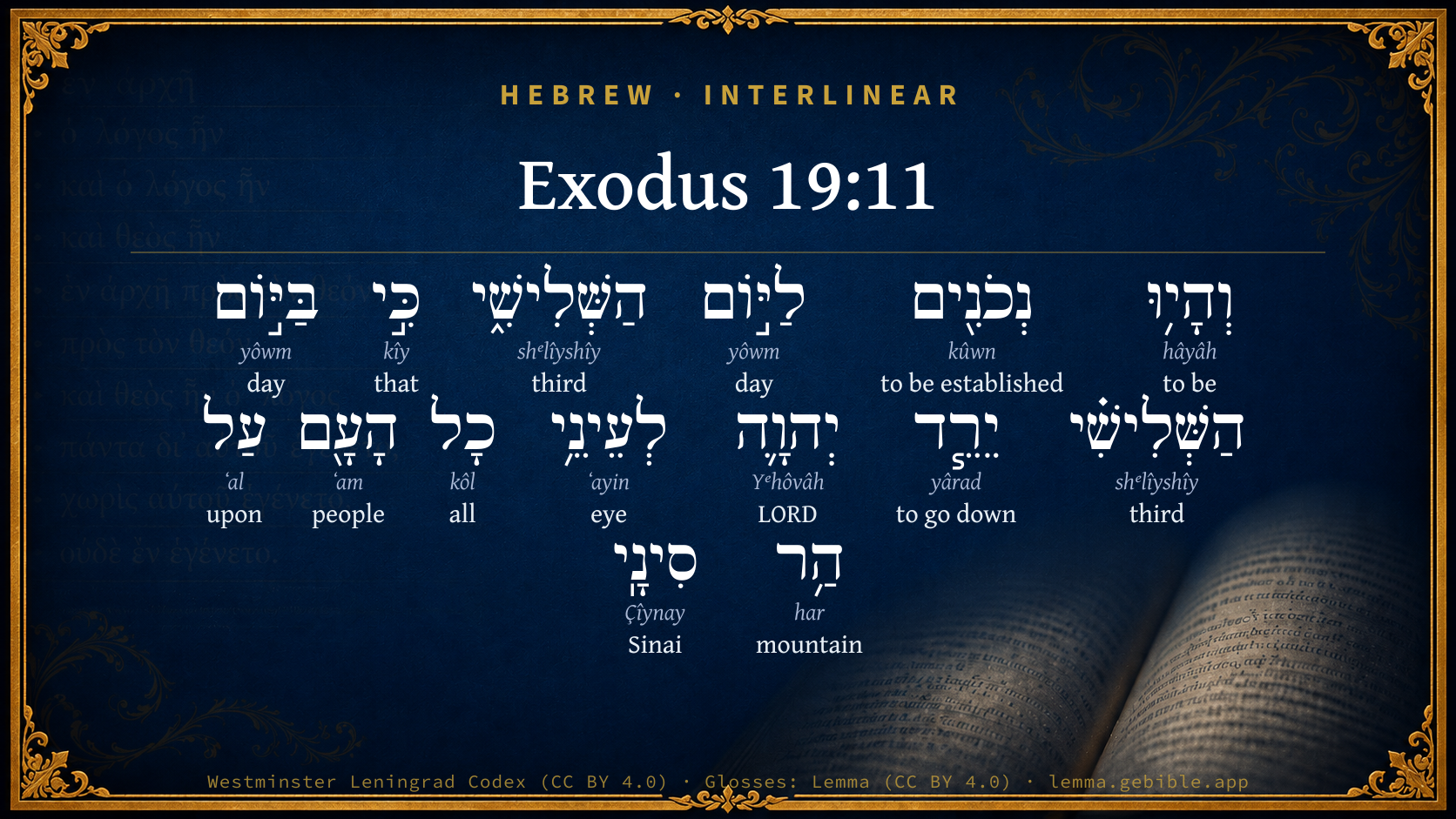
  1. וְהָי֥וּ hâyâh H1961 “and · to be” Conjunction + Verb, Qal, Sequential Perfect, 3rd Person, Common, Plural
  2. נְכֹנִ֖ים kûwn H3559 “being established” Verb, Niphal, Participle Active, Masculine, Plural, Absolute
  3. לַיּ֣וֹם yôwm H3117 “to/for the · day” Preposition, Determined + Noun, Common, Masculine, Singular, Absolute
  4. הַשְּׁלִישִׁ֑י shᵉlîyshîy H7992 “the · third” Particle, Definite Article + Adjective, Ordinal number, Masculine, Singular, Absolute
  5. כִּ֣י kîy H3588 “that” Conjunction
  6. בַּיּ֣וֹם yôwm H3117 “in/at the · day” Preposition, Determined + Noun, Common, Masculine, Singular, Absolute
  7. הַשְּׁלִישִׁ֗י shᵉlîyshîy H7992 “the · third” Particle, Definite Article + Adjective, Ordinal number, Masculine, Singular, Absolute
  8. יֵרֵ֧ד yârad H3381 “to go down” Verb, Qal, Imperfect, 3rd Person, Masculine, Singular
  9. יְהוָ֛ה Yᵉhôvâh H3068 “LORD” Noun, Proper
  10. לְעֵינֵ֥י ʻayin H5869 “to/for · eyes of” Preposition + Noun, Common, Both, Dual, Construct
  11. כָל kôl H3605 “all of” Noun, Common, Masculine, Singular, Construct
  12. הָעָ֖ם ʻam H5971 “the · people” Particle, Definite Article + Noun, Common, Masculine, Singular, Absolute
  13. עַל ʻal H5921 “upon” Preposition
  14. הַ֥ר har H2022 “mountain of” Noun, Common, Masculine, Singular, Construct

About this verse

These counts appear in no published source. They are computed here, from the morphology-tagged text and Lemma’s own curated glosses. What Lemma adds →

15
words
13
distinct lemmas
Pentateuch
section

Shared distinctive vocabulary

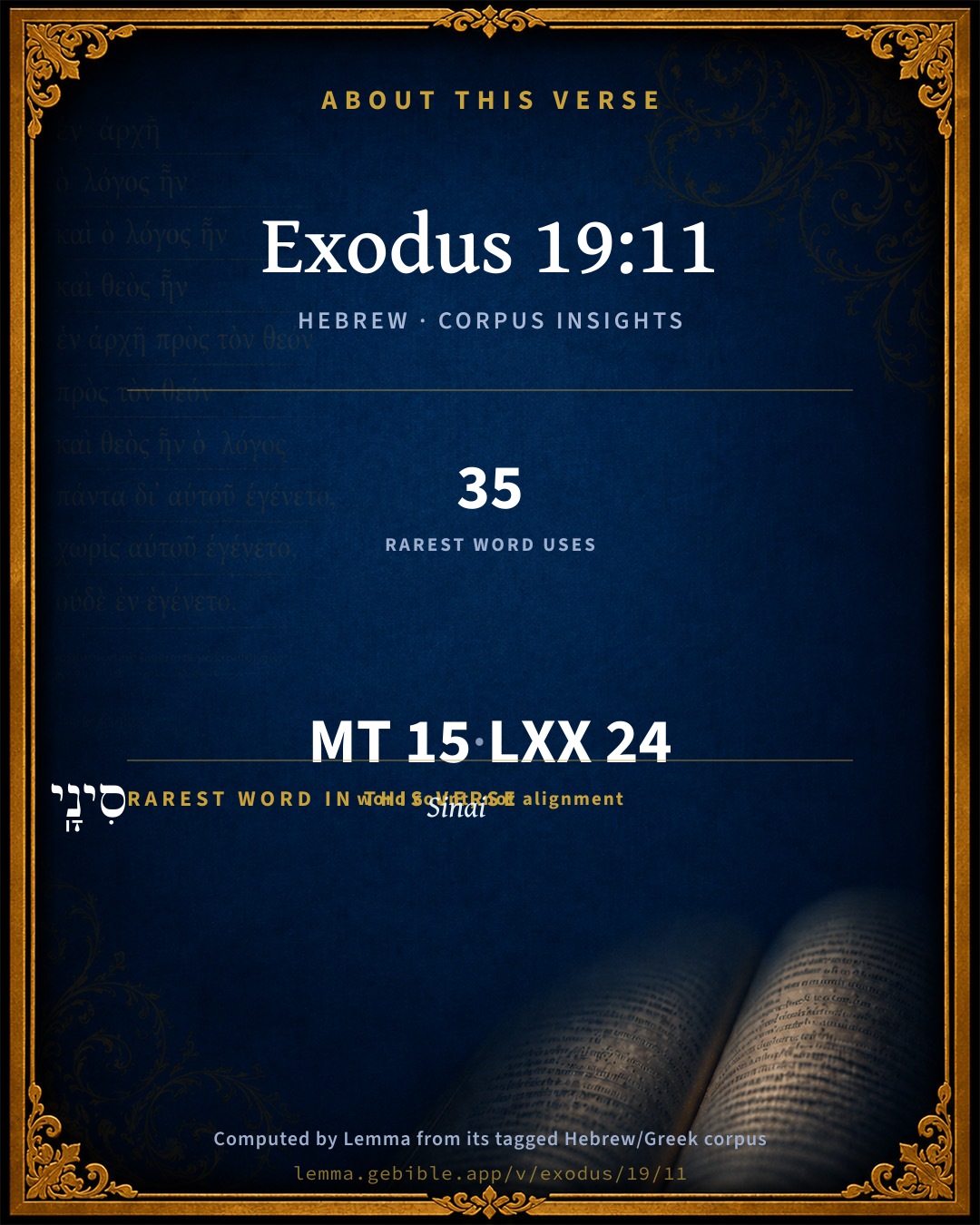
סִינָֽי Sinai H5514 occurs in 34 verses of the Hebrew Bible. Also found in:

Grammatical profile

  • 3 verbs
  • 8 nouns
  • 2 adjectives
  • 1 preposition
  • 1 conjunction

Verb forms

  • וְהָי֥וּ Qal · Sequential Perfect
  • נְכֹנִ֖ים Niphal · Participle Active
  • יֵרֵ֧ד Qal · Imperfect

Repetition

Words recur within this verse — often emphatic in Hebrew:

  • לַיּ֣וֹם day H3117 ×2
  • הַשְּׁלִישִׁ֑י third H7992 ×2

Hebrew & Septuagint length

In English translation the verse runs 26 words from the Hebrew and 25 from the Septuagint (LXX English) — closely comparable.

A rough comparison of the two English renderings, which tokenize alike — not a word-level alignment.

Word counts can differ between the Hebrew and the Greek without any difference in meaning — e.g. the Hebrew direct-object marker אֵת has no separate Greek word, and Greek often adds the article ὁ.

In the original languages it is 15 Hebrew tokens and 24 Greek tokens — but the two are counted differently (Hebrew bundles its prefixes and suffixes into one token; the Greek is in lemma form), so that isn’t a like-for-like length.

Cross-references

13

Topical passages linked to Exodus 19:11 in the Treasury of Scripture Knowledge — connected by theme and wording, ordered by reader-vote popularity; previews shown in the World English Bible.

  • Exodus 19:16 It happened on the third day, when it was morning, that there were thunders and lightnings, and a thick cloud on the mountain, and the sound of an exceedingly loud trumpet; and all the people who were in the camp trembled.
  • Exodus 34:5 Yahweh descended in the cloud, and stood with him there, and proclaimed the name of Yahweh.
  • Deuteronomy 33:2 He said, Yahweh came from Sinai, Rose from Seir to them; He shined forth from Mount Paran, He came from the ten thousands of holy ones: At his right hand was a fiery law for them.
  • John 3:13 No one has ascended into heaven, but he who descended out of heaven, the Son of Man, who is in heaven.
  • Exodus 3:8 I have come down to deliver them out of the hand of the Egyptians, and to bring them up out of that land to a good and large land, to a land flowing with milk and honey; to the place of the Canaanite, the Hittite, the Amorite, the Perizzite, the Hivite, and the Jebusite.
  • Exodus 19:18 Mount Sinai, the whole of it, smoked, because Yahweh descended on it in fire; and its smoke ascended like the smoke of a furnace, and the whole mountain quaked greatly.
  • Exodus 19:20 Yahweh came down on Mount Sinai, to the top of the mountain. Yahweh called Moses to the top of the mountain, and Moses went up.
  • Numbers 11:17 I will come down and talk with you there: and I will take of the Spirit which is on you, and will put it on them; and they shall bear the burden of the people with you, that you not bear it yourself alone.
  • Psalms 18:9 He bowed the heavens also, and came down. Thick darkness was under his feet.
  • Psalms 144:5 Part your heavens, Yahweh, and come down. Touch the mountains, and they will smoke.
  • Isaiah 64:1–2 Oh that you would tear the heavens, that you would come down, that the mountains might quake at your presence,
  • Habakkuk 3:3–6 God came from Teman, The Holy One from Mount Paran. Selah. His glory covered the heavens, And his praise filled the earth.
  • John 6:38 For I have come down from heaven, not to do my own will, but the will of him who sent me.

Cross-references courtesy of OpenBible.info (CC BY 4.0).

Hebrew and Greek witnesses Masoretic Hebrew ↔ Greek Septuagint

The same verse in the two great witnesses to the Old Testament, shown verse-for-verse.

These are two independent witnesses, not word-aligned to each other, and the Septuagint is shown in lemma (dictionary) form.

Hebrew Exodus 19:11 Masoretic · Westminster Leningrad Codex

וְהָי֥וּ נְכֹנִ֖ים לַיּ֣וֹם הַשְּׁלִישִׁ֑י כִּ֣י בַּיּ֣וֹם הַשְּׁלִישִׁ֗י יֵרֵ֧ד יְהוָ֛ה לְעֵינֵ֥י כָל הָעָ֖ם עַל הַ֥ר סִינָֽי

and be ready against the third day; for on the third day Yahweh will come down in the sight of all the people on Mount Sinai.

World English Bible · Public Domain

Greek LXX Exodus 19:11 Septuagint · lemma form

καί εἰμί ἕτοιμος εἰς ὁ ἡμέρα ὁ τρίτος ὁ γάρ ἡμέρα ὁ τρίτος καταβαίνω κύριος ἐπί ὁ ὄρος ὁ σινα ἐναντίον πᾶς ὁ λαός

And let them be ready against the third day, for on the third day the Lord will descend upon mount Sina before all the people.

LXX2012 (modern English Septuagint) · Public Domain

Hebrew: Westminster Leningrad Codex (CC BY 4.0). Greek: Septuagint (public domain); English from LXX2012 (modern English Septuagint) (Public Domain). How the Septuagint differs from the Hebrew →

Targum (Aramaic paraphrase)

2

The Targum is the ancient Jewish Aramaic paraphrase of the Hebrew Scriptures — an interpretive translation, not the Hebrew text itself. Onkelos (literal) and Pseudo-Jonathan (expansive) render the Torah, and Jonathan the Prophets. Coverage is partial: where no permissively-licensed English translation exists for a verse, only the Aramaic is shown. This is verse-level text, not a word-by-word alignment to the Hebrew.

  1. Targum Onkelos Torah (Genesis–Deuteronomy)
    וִיהוֹן זְמִינִין לְיוֹמָא תְלִיתָאָה אֲרֵי בְּיוֹמָא תְלִיתָאָה יִתְגְלִי יְיָ לְעֵינֵי כָל עַמָא עַל טוּרָא דְסִינָי:

    (no public-domain English translation for this verse)

    Targum Onkelos — Aramaic: “Onkelos Genesis” (public domain); “Onkelos Exodus” (public domain); “Onkelos Leviticus” (public domain); “Onkelos Numbers” (public domain); “Onkelos Deuteronomy” (public domain). English: “Sefaria Community Translation” (CC0 1.0 (public-domain dedication)); “J.W. Etheridge. The Targums of Onkelos and Jonathan Ben Uzziel on the Pentateuch. London: Longmans, Green, 1862” (public domain). Text via Sefaria.

  2. Targum Pseudo-Jonathan Torah (Genesis–Deuteronomy)
    וִיהוֹן זְמִינִין לְיוֹמָא תְּלִיתָאָה אֲרוּם בְּיוֹמָא תְּלִיתָאָה יִתְגְּלֵי יְיָ לְעֵינֵי כָל עַמָּא עַל טוּרָא דְסִינָי

    and be prepared On the third day; for on the third day the Lord will reveal Himself to the eyes of all the people, upon the Mount of Sinai.

    Targum Pseudo-Jonathan — Aramaic: “Targum Jonathan on Genesis” (public domain); “Targum Jonathan on Exodus” (public domain); “Targum Jonathan on Leviticus” (public domain); “Targum Jonathan on Numbers” (public domain); “Targum Jonathan on Deuteronomy” (public domain). English: “The Targum of Jonathan ben Uzziel, trans. J. W. Etheridge, London, 1862” (public domain). Text via Sefaria.

Commentary

Notes on Exodus 19:11 from classic Christian and Jewish commentators (each source and its license shown beneath its notes). The classic Christian expositions comment on the surrounding passage and are grouped to its opening verse, so a note may address several verses; the Jewish commentaries on the Tanakh (Rashi and others) are per-verse, so they appear only where the commentator wrote on this verse.

Lemma curates 59 commentaries, every one of them public domain or Creative Commons licensed, each selected and text-cleaned for this edition rather than reprinted as found. About our sources →

Trapp's Complete Commentary

John Trapp

Exo 19:11 And be ready against the third day: for the third day the LORD will come down in the sight of all the people upon mount Sinai.

Ver. 11. Against the third day.] That is, three days hence, on the day of Pentecost.

John Trapp, A Commentary or Exposition upon All the Books of the Old and New Testament (1647–1656) — public domain. Text from a community e-Sword module.

Joseph Benson's Commentary

Exo 19:11. In the sight of all the people — Though they should see no manner of similitude, yet they should see so much as would convince them, that God was among them of a truth. And so high was the top of mount Sinai, that it is supposed not only the camp of Israel, but even the countries about might discern some extraordinary appearance of glory upon it.

Joseph Benson's Commentary on the Old and New Testaments (1811–1818) — public domain. Text from a community e-Sword module.

Ellicott's Commentary for English Readers

(11) Against the third day.—There is no special “significance” in this mention of “the third day.” The important point is, that the purification was to continue through two entire days—one day not being sufficient. This taught the lesson that man’s defilement is, in the sight of God, very great.

The Lord will come down in the sight of all the people.—See the comment on Exo_19:9.

A Bible Commentary for English Readers, edited by Charles John Ellicott (1878–1897) — public domain. Text from a community e-Sword module.

John Gill's Exposition

And be ready against the third day,.... Not the third day of the month, but the third day from hence, this being the fourth, and the morrow the fifth, and the third day, the day following that, the sixth, on which day it is generally agreed by the Jews that the law was given; see Gill on Exo 19:16.

for the third day the Lord will come down in the sight of all the people upon Mount Sinai; which must be understood, consistent with his omnipresence, and is only expressive of some visible display of his power, and of some sensible token of his presence to the people; he was now upon it in the pillar of cloud, but then he would appear in another manner, and descend in a thick cloud and fire, which all the people would see, though they could not see the similitude of anything in it.

John Gill's Exposition of the Whole Bible (1746–1763) — public domain (CC PDM 1.0). Text via the HelloAO Bible API.

Matthew Poole's English Annotations

For the third day from this time, and the fiftieth day from the passover, as was noted before,

the Lord will come down in a visible and glorious manifestation of his presence.

Matthew Poole's English Annotations on the Holy Bible (1683–1685) — public domain. Text from a community e-Sword/MySword module.

Whedon's Commentary on the Bible

Daniel D. Whedon

11. Be ready against the third day — Ceremonial purifications, made with expectations of some sublime theophany about to take place, prepared the hearts of the people to receive the deepest possible impressions from the scene. While the messages given through Moses to Israel were generally received alone in the mountain, this grand revelation was to be in the sight of all the people. Object-teaching was especially necessary at that stage of Israel’s history.

Daniel D. Whedon (gen. ed.), Commentary on the Old and New Testaments (1874–1909) — public domain. Text from a community e-Sword module.

The Pulpit Commentary

The Lord win come down. Jehovah is regarded as dwelling in the heaven above, not exclusively, (Psa_139:7-10) but especially and therefore, when he appears on earth, he "comes down". (Gen_11:5-7 Gen_18:21; Exo_3:8; etc.) In the sight of all the people. That a visible manifestation of the Divine presence is intended appears, unmistakably, from verses 16 and 18.

The Pulpit Commentary (1880–1919), ed. H.D.M. Spence-Jones & Joseph S. Exell — public domain. Text from a community e-Sword module.

John Wesley's Explanatory Notes

In the sight of all the people - Though they should see no manner of similitude, yet they should see so much as would convince them, that God was among them of a truth. And so high was the top of Mount Sinai, that it is supposed not only the camp of Israel, but even the countries about might discern some extraordinary appearance of glory upon it.

John Wesley, Explanatory Notes Upon the Whole Bible (1754–1765) — public domain. Text via the GEBible commentary corpus.

Rashi

Rabbi Shlomo Yitzchaki (Rashi)

והיו נכנים AND LET THEM BE PREPARED — separated from their wives (Mekhilta; cf. Rashi on Shabbat 87a).

ליום השלישי AGAINST THE THIRD DAY, which is the sixth of the month. On the fifth Moses built the altar under the mountain and the twelve monuments — the whole narrative as is stated later on in the Sidra ואלה המשפטים (Exodus 24:4), for there is neither “earlier” nor “later” (there is no chronological order) in the Torah (Mekhilta-2).

לעיני כל העם BEFORE THE EYES (in the sight) OF ALL THE PEOPLE — This tells us that there was not a blind person amongst them — that they had all been healed of their blindness (Mekhilta).

Rashi on the Tanakh — English translations: “The Judaica Press complete Tanach with Rashi, translated by A. J. Rosenberg” (CC BY 4.0); “Pentateuch with Rashi's commentary by M. Rosenbaum and A.M. Silbermann, 1929-1934” (public domain); “The Metsudah Tanach series, Lakewood, N.J” (CC BY 4.0); and “The Book of Joshua, Metsudah Publications, 1997” (CC BY 4.0). Text via Sefaria.

Ramban (Nachmanides)

Rabbi Moshe ben Nachman (Ramban / Nachmanides)

THE ETERNAL WILL COME DOWN IN THE SIGHT OF ALL THE PEOPLE. I.e., so that all the people will behold His coming down, meaning that they will see the appearance of the Glory of the Eternal like devouring fire on the top of the mount, but they will not see G-d, for it is written, for man shall not see Me and live., 33:20.

Ramban (Nachmanides) on the Tanakh — English translation: “Commentary on the Torah by Ramban (Nachmanides). Translated and annotated by Charles B. Chavel. New York, Shilo Pub. House, 1971-1976” (CC BY 4.0). Text via Sefaria.

Lesson kit

Teaching starters — assembled from the data on this page, not authored interpretation. Every prompt links to the verse data it draws on. Edit before teaching.

Exodus, in the Pentateuch, opens this verse with 15 words (13 distinct Hebrew lemmas). Its most distinctive word is Çîynay (“Sinai”). A historical commentator’s framing appears above. Read the whole chapter for the surrounding context.

Discussion questions

  1. The word Çîynay carries the sense “Sinai.” How does it shape the verse?
  2. Exodus 16:1 shares the word «Sinai» with this verse. How do the two illuminate each other?
  3. “day” occurs 2× in this one verse. What is the effect of the repetition?
  4. These translations render this verse differently. What is at stake in choosing one wording over another?
  5. The verb «וְהָי֥וּ» is Qal Sequential Perfect. How does its form color the action?
  6. Reading how Trapp's Complete Commentary and Joseph Benson's Commentary read this verse, where do the two commentators agree and where do they part?

Things to notice

Reading settings

Reading text

Shown beneath each verse's original-language words.

Old Testament
Old Testament edition

Read the OT as the Masoretic Hebrew (MT) or the Greek Septuagint (LXX).

English shown for the Greek Septuagint (in the Hebrew ↔ Greek comparison).

Comparing translations? Open the Compare panel on any verse page to stack up to four side by side.