
Psalms 119:133

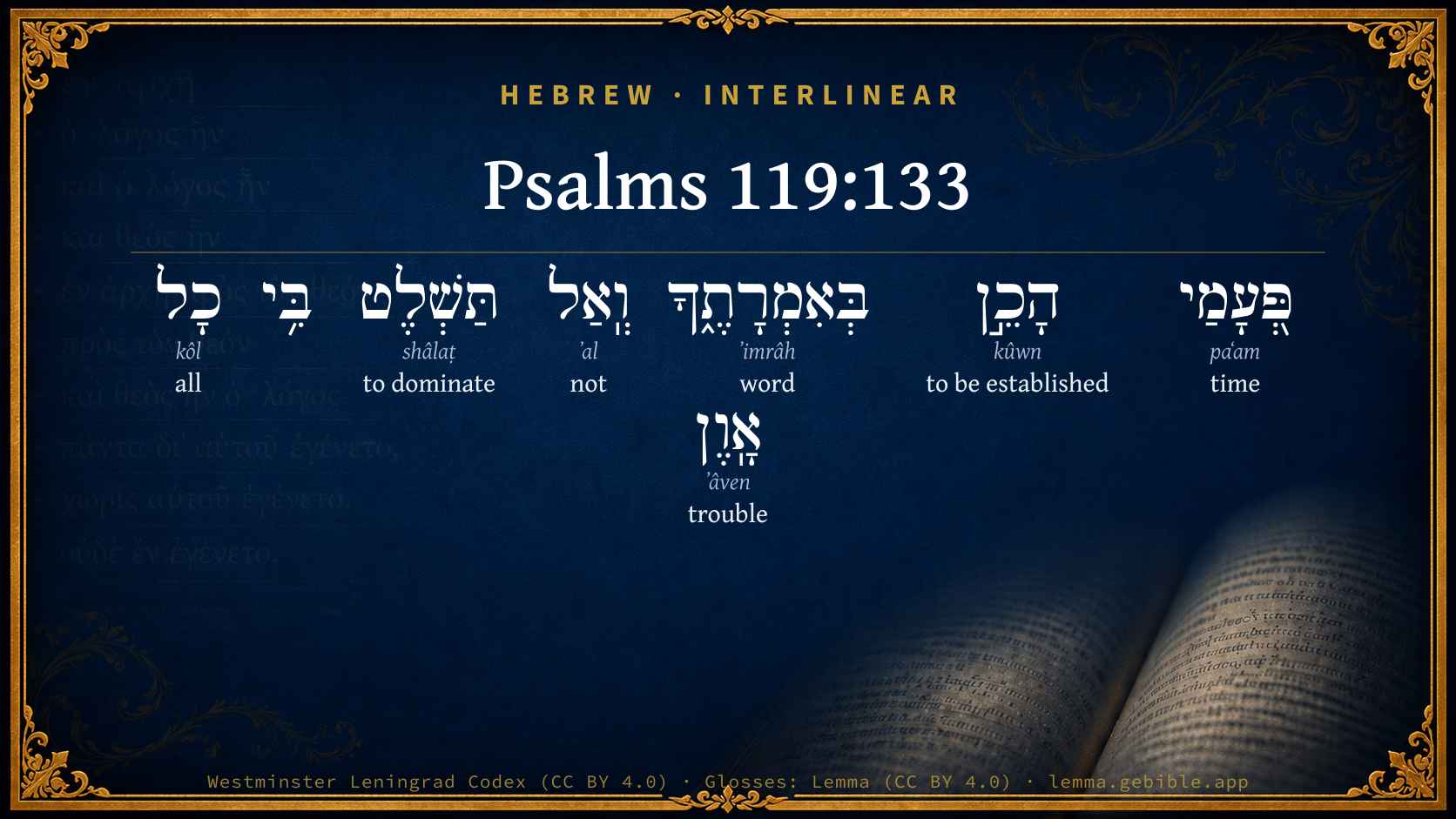
Hebrew (Westminster Leningrad Codex) Psalms 119:133 appears in the Hebrew Old Testament. The text above is from the Westminster Leningrad Codex. Each word links to its Strong’s number, a concise gloss, and parsing drawn from the Open Scriptures Hebrew Bible morphology. Click any word for its full Brown-Driver-Briggs (BDB) entry.
Download image
Cite this verse

Psalms 119:133 (World English Bible). Public Domain. Lemma interlinear Bible study tool, https://lemma.gebible.app/v/psalms/119/133.

Show BibTeX & RIS
BibTeX
RIS
English Translation
Establish my footsteps in your word. Don't let any iniquity have dominion over me.
World English Bible · Public Domain
Download a study sheet

One document with this verse’s original text, its word-by-word gloss line, the meaning frame, cross-references with their text, attributed commentary, and full source and license credits — printable, and it pastes into notes with its structure intact.

This verse Autodidact and up

Study sheet (.html) Plain text (.txt)

A passage Seminary Student

Up to 50 verses in one chapter. A passage sheet keeps up to 6 commentary sources and 12 cross-references per verse, in the order this page ranks them, and says so on the sheet whenever that leaves anything out. Ask for a single verse and you get the Autodidact verse sheet above.

Everything on this page stays free to read, with no account — the sheet is a download of what is already on screen, not access to it.

Want to remove ads? Support Godless Engineer
Compare translations 3

The same verse in 3 English versions, stacked beneath the original-language interlinear above. Click any original word for its lexicon entry.

Each is an independent rendering of the whole verse — the interlinear is not word-aligned to these translations.

Highlighted words mark where these versions differ — a whole-verse word diff, not a word-by-word alignment.

  • World English Bible Public Domain
    Establish my footsteps in your word. Don't let any iniquity have dominion over me.
  • King James Version Public Domain
    Order my steps in thy word: and let not any iniquity have dominion over me.
  • unfoldingWord Literal Text CC BY-SA 4.0
    Establish my steps in your word, and do not let any iniquity rule over me.

unfoldingWord Literal Text — © unfoldingWord, licensed CC BY-SA 4.0. Word-aligned USFM3 via Door43 (git.door43.org/unfoldingWord/en_ult).

Versions to compare (up to 4)

3 of 4 selected

Show all 17 translations

Every available English version of this verse, each an independent rendering of the whole verse.

  • World English Bible Public Domain
    Establish my footsteps in your word. Don't let any iniquity have dominion over me.
  • Berean Standard Bible Public Domain
    Order my steps in Your word; let no sin rule over me.
  • Majority Standard Bible Public Domain
    Order my steps in Your word; let no sin rule over me.
  • King James Version Public Domain
    Order my steps in thy word: and let not any iniquity have dominion over me.
  • American Standard Version (1901) Public Domain
    Establish my footsteps in thy word; And let not any iniquity have dominion over me.
  • Revised Version (1885) Public Domain
    Order my footsteps in thy word; and let not any iniquity have dominion over me.
  • Geneva Bible (1599) Public Domain
    Direct my steppes in thy worde, and let none iniquitie haue dominion ouer me.
  • Young's Literal Translation Public Domain
    My steps establish by Thy saying, And any iniquity doth not rule over me.
  • Literal Standard Version CC BY-SA 4.0
    Establish my steps by Your saying, || And any iniquity does not rule over me.
  • Unlocked Literal Bible CC BY-SA 4.0
    Direct my footsteps by your word; do not let any sin rule me.
  • unfoldingWord Literal Text CC BY-SA 4.0
    Establish my steps in your word, and do not let any iniquity rule over me.
  • Darby Bible Public Domain
    Establish my steps in thy ùword; and let not any iniquity have dominion over me.
  • World Messianic Bible Public Domain
    Establish my footsteps in your word. Don’t let any iniquity have dominion over me.
  • Webster's Bible Public Domain
    Order my steps in thy word: and let not any iniquity have dominion over me.
  • Free Bible Version CC BY-SA 4.0
    Tell me by your word the way I should go, and don't let any kind of evil control me.
  • Bible in Basic English Public Domain
    Let my steps be guided by your word; and let not sin have control over me.
  • JPS Tanakh (1917) Public Domain
    Order my footsteps by Thy word; and let not any iniquity have dominion over me.

Literal Standard Version (2020), Covenant Press — licensed CC BY-SA 4.0. Text via the HelloAO Bible API (eBible.org). Unlocked Literal Bible (unfoldingWord) — licensed CC BY-SA 4.0. Text via the HelloAO Bible API (eBible.org). unfoldingWord Literal Text — © unfoldingWord, licensed CC BY-SA 4.0. Word-aligned USFM3 via Door43 (git.door43.org/unfoldingWord/en_ult). Free Bible Version, Dr. Jonathan Gallagher — licensed CC BY-SA 4.0. Text via the HelloAO Bible API (eBible.org).

Word by word

More ways to search: Search by grammar → Find every occurrence → Compare this word →

Practice this passage: Drill this verse → Learn its vocabulary →

תַּשְׁלֶט
shâlaṭ
H7980
“to dominate”
Verb, Hiphil, Jussive, 3rd Person, Feminine, Singular
Part of Speech
Verb
Stem
Hiphil
Form
Jussive
Person
3rd Person
Gender
Feminine
Number
Singular
Full BDB Definition

Origin: a primitive root

TWOT: 2396

to domineer, exercise power over, dominate, have mastery, be master, lord it over - (Qal) to domineer, lord it over, become master - (Hiphil) - to give power of - to get mastery of
  1. פְּ֭עָמַי paʻam H6471 “times · my” Noun, Common, Feminine, Plural, Construct + Suffix, Personal, 1st Person, Common, Singular
  2. הָכֵ֣ן kûwn H3559 “be established” Verb, Hiphil, Imperative, 2nd Person, Masculine, Singular
  3. בְּאִמְרָתֶ֑ךָ ʼimrâh H565 “in/at · word · your” Preposition + Noun, Common, Feminine, Singular, Construct + Suffix, Personal, 2nd Person, Masculine, Singular
  4. וְֽאַל ʼal H408 “and · not” Conjunction + Particle, Negative
  5. כָל kôl H3605 “all of” Noun, Common, Masculine, Singular, Construct
  6. אָֽוֶן ʼâven H205 “trouble” Noun, Common, Masculine, Singular, Absolute

About this verse

These counts appear in no published source. They are computed here, from the morphology-tagged text and Lemma’s own curated glosses. What Lemma adds →

8
words
7
distinct lemmas
Wisdom
section

Notable vocabulary

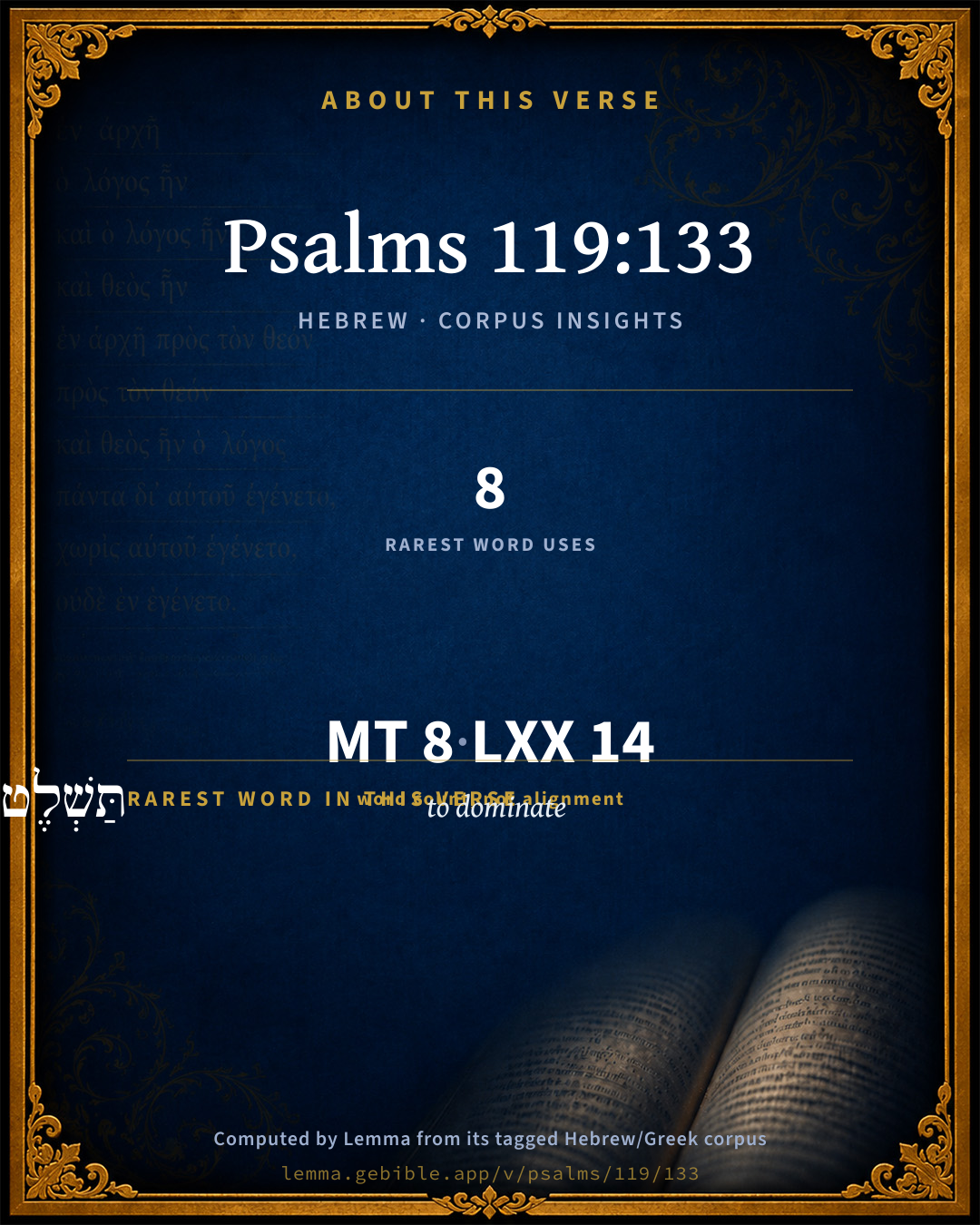
The rarest word here is תַּשְׁלֶט to dominate H7980 — appearing just 8 times in the whole Hebrew Bible.

Shared distinctive vocabulary

תַּשְׁלֶט to dominate H7980 occurs in 7 verses of the Hebrew Bible. Also found in:

Grammatical profile

  • 2 verbs
  • 4 nouns
  • 1 preposition
  • 1 particle

Verb forms

  • הָכֵ֣ן Hiphil · Imperative
  • תַּשְׁלֶט Hiphil · Jussive

Hebrew & Septuagint length

In English translation the verse runs 14 words from the Hebrew and 16 from the Septuagint (LXX English) — closely comparable.

A rough comparison of the two English renderings, which tokenize alike — not a word-level alignment.

Word counts can differ between the Hebrew and the Greek without any difference in meaning — e.g. the Hebrew direct-object marker אֵת has no separate Greek word, and Greek often adds the article ὁ.

In the original languages it is 8 Hebrew tokens and 14 Greek tokens — but the two are counted differently (Hebrew bundles its prefixes and suffixes into one token; the Greek is in lemma form), so that isn’t a like-for-like length.

Cross-references

8

Topical passages linked to Psalms 119:133 in the Treasury of Scripture Knowledge — connected by theme and wording, ordered by reader-vote popularity; previews shown in the World English Bible.

  • Psalms 17:5 My steps have held fast to your paths, My feet have not slipped.
  • Psalms 19:13 Keep back your servant also from presumptuous sins. Let them not have dominion over me. Then I will be upright, I will be blameless and innocent of great transgression.
  • Psalms 119:116 Uphold me according to your word, that I may live. Let me not be ashamed of my hope.
  • Psalms 32:8 I will instruct you and teach you in the way which you shall go. I will counsel you with my eye on you.
  • Romans 6:12–14 Therefore don't let sin reign in your mortal body, that you should obey it in its lusts.
  • 1 Samuel 2:9 He will keep the feet of his holy ones; But the wicked shall be put to silence in darkness; For by strength shall no man prevail.
  • Psalms 121:3 He will not allow your foot to be moved. He who keeps you will not slumber.
  • Romans 7:23–24 but I see a different law in my members, warring against the law of my mind, and bringing me into captivity under the law of sin which is in my members.

Cross-references courtesy of OpenBible.info (CC BY 4.0).

Hebrew and Greek witnesses Masoretic Hebrew ↔ Greek Septuagint

The same verse in the two great witnesses to the Old Testament, shown verse-for-verse.

You’re reading Greek Psalm 118 (Hebrew Psalm 119). The Septuagint counts the superscription, so verse numbers can differ from the Hebrew — chapter-level alignment, not verse-by-verse. Numbering follows Rahlfs.

These are two independent witnesses, not word-aligned to each other, and the Septuagint is shown in lemma (dictionary) form.

Hebrew Psalms 119:133 Masoretic · Westminster Leningrad Codex

פְּ֭עָמַי הָכֵ֣ן בְּאִמְרָתֶ֑ךָ וְֽאַל תַּשְׁלֶט בִּ֥י כָל אָֽוֶן

Establish my footsteps in your word. Don't let any iniquity have dominion over me.

World English Bible · Public Domain

Greek LXX Greek Psalm 118:133 Septuagint · lemma form

ὁ διάβημα ἐγώ καταεὐθύνω κατά ὁ λόγιον σύ καί μή κατακυριεύω ἐγώ πᾶς ἀνομία

Order my steps according to your word: and let not any iniquity have dominion over me.

LXX2012 (modern English Septuagint) · Public Domain

Hebrew: Westminster Leningrad Codex (CC BY 4.0). Greek: Septuagint (public domain); English from LXX2012 (modern English Septuagint) (Public Domain). How the Septuagint differs from the Hebrew →

Commentary

Notes on Psalms 119:133 from classic Christian and Jewish commentators (each source and its license shown beneath its notes). The classic Christian expositions comment on the surrounding passage and are grouped to its opening verse, so a note may address several verses; the Jewish commentaries on the Tanakh (Rashi and others) are per-verse, so they appear only where the commentator wrote on this verse.

Lemma curates 59 commentaries, every one of them public domain or Creative Commons licensed, each selected and text-cleaned for this edition rather than reprinted as found. About our sources →

Trapp's Complete Commentary

John Trapp

Psa 119:133 Order my steps in thy word: and let not any iniquity have dominion over me.

Ver. 133. Order my steps in thy word] Let me walk as in a frame, walk by rule exactly, accurately, Eph 5:15. Here he prayeth that he may keep the affirmative precepts, saith Aben Ezra; as in the next words, the negative.

And let not any iniquity have dominion over me] Let it not reign, though it doth rebel; let it be like those beasts in Daniel, whose dominion was taken away, yet their lives were prolonged for a season and a time, Psa 7:12.

John Trapp, A Commentary or Exposition upon All the Books of the Old and New Testament (1647–1656) — public domain. Text from a community e-Sword module.

The Biblical Illustrator

Joseph S. Exell

Psa_119:133

Order my steps in Thy Word: and let not any iniquity have dominion over me.

Ordered steps

I. Complete subservience to the will of God.

1. Order. He is a man who wishes to be under orders, he is willing to obey the Lords commands, and he is anxious to receive them, and to be made to carry them out.

2. Order my steps in Thy Word. Once we lived without any order, or plan, or method; but the grace of God makes us methodists in the highest possible sense. It makes us live according to Gods method; and our prayer is, that we may never be disorderly, but that in all things, just as the universe is arranged by God, and all the stars keep their appointed courses, so we may be made to take our proper places, and may be kept in them, joyfully obedient to the will of the Most High.

3. In Thy Word. He was perfectly satisfied with Gods revelation; he had not so much of it as we have, but there was room enough in it for all his steps. He wanted no greater liberty than the Bible gave him.

II. Careful watchfulness.

1. He does not say merely, Order my life, but, Order my steps. Godly men desire to be kept right by God even in the little things of life.

2. That prayer means, Order my ordinary dally life. Do not many think that religion is only something for Sundays?

3. Let us especially pray about all our advances. It is by steps that we go forward.

III. Comprehensive obedience. It has two clauses, the positive and the negative. Order my steps in Thy Word; that is, Lord, make me positively to do the right thing! Then, let not any iniquity have dominion over me; that is, Lord, preserve me from any thought, or word, or deed which would be contrary to Thy mind and will! He is the right sort of believer who is an all-round Christian, one who is positive for doing the right, but who is equally determined not to do the wrong.

IV. Cautious apprehensiveness. He means, Lord, I am afraid to take a single step without Thine orders, I am afraid to put one foot before another for fear I should go wrong! Happy is the man that feareth alway. He that was too bold was never too wise. He that leaped before he looked, looked very sadly after he had leaped. He shall go right who knows where he is going, is careful about the road, and afraid lest he should go astray. He is the man who prays, Order my steps in Thy Word. (C. H. Spurgeon.)

A soul conscious of its dependence on God

I. For guidance. Order my steps. The human spirit is destined to move on and on for ever. It needs a guide; it cannot guide itself, nor can any finite creature do so.

1. There is but one safe Guide. If He order our steps, two evils will be avoided.

(1) Moral stumblings. Souls are everywhere stumbling on the path of life, they fall, and often receive fatal injuries, Hold Thou me up and I shall be safe. The other evil avoided will be--

(2) Unhappy destination. The path of life, whilst it may have no real end, but run on through ages interminable, has one awful crisis that decides the ultimate fate of the traveller, and that crisis is death.

2. If He order the steps of the soul, the crisis will be the constant brightening and beautifying of the path.

II. For emancipation. Let not any iniquity have dominion over me.

1. This is the worst of despotisms.

(1) It is the most criminal. There are despotisms social and political that are calamities, not crimes: the poor victim cannot avoid them. Not so the despotism of sin. A despotism which, in the first place, he never ought to have allowed; but having allowed, he should break away from and become heroic and free.

(2) It is the most powerful. A man might become such a victim of worldly despotism as to be imprisoned in a dungeon and cut off from all fellowship with living men. Still his soul may be free. Paul and Silas. But sin manacles the soul, shuts out its light, and binds its faculties in chains mightier than adamant.

(3) It is the most enduring. Death will put an end to all worldly despotisms; in the grave the slave is free from his tyrant. But death has no power to put an end to this slavery of the soul.

2. This is the most prevalent of despotisms--co-extensive with the world of unregenerate humanity. (Homilist.)

A well-ordered life

This is not the prayer of an unconverted man, or the cry of an awakened sinner thinking to find salvation in good works; it is the prayer of one who is saved, and who knows it. Note each word of the text. Order. David looking abroad saw order ruling everywhere; he would have his life in harmony with the universe. My steps: he is anxious as to details. He would have each single step ordered in holiness. In Thy Word. Not by Thy Word, nor according to Thy Word. The sentence means that, but it means far more. Not by Thy Word, as though it were a law hanging up upon the columns in the market-place; but in, as though it were engraven in my heart and encompassed all my ways. And let not any iniquity, etc. This expression is weaker than the first, pitched upon a lower key: as if he would say, If, O Lord, my steps cannot be so ordered as that I shall be altogether without sin, yet let not any iniquity gain the mastery of my spirit. O, my Lord, suffer no iniquity to sit down on the throne of my heart and make me its serf and vassal. But now, keeping to the first sentence only, we note--

I. That a holy life is a masterpiece of order. Holiness rejoices in symmetry, proportion, harmony, order. That--

1. Of conformity to rule. We have the rule given us in living characters in the incarnate Word. I fear me there are hundreds of Christians who do not scruple to do things without once pausing to use the plumb-line of Christs example to see whether their actions are upright. But the truly Christian heart will ever seek to proceed according to the Divine mind.

2. That which is arithmetical. Things are never in order when the second is before the first, and order in life consists very much in seeking first the kingdom of God. Oh, it is well with the Christian when he has learned his notation table well, and gives the first thing the first place.

3. That which is geometrical. There should be progress in Christian life, and if the advance be by a constant multiple, how greatly will a man increase. He who did a little for Christ when but a babe in grace should do more as a young man, and most of all as a father.

4. The order proportional. All Christians should endeavour so to balance their lives that there shall not be an excess of one virtue and a deficiency in another. Courage some will have till they are rude. Modesty in otters will sink into cowardice. It is only in the life of Jesus that you see this order most of all: it shall perplex you to discover what virtues shine with purest radiance.

5. That of relation. We stand not alone; we are all the centres of circles, and innumerable lines intersect each other in the region of our hearts. Now, we should seek for right relationship with God and with all men and things: with the Church and our own families.

6. There is an order of period: the order of the celestial Almanack: duties done at due time. Holiness consists not in the rushing of intense resolve, which, like Kishen, sweeps everything before it, and then subsides, but in the constant flow of Silvahs still waters, which perpetually make glad the city of God. The tree that God commendeth bringeth forth its fruit in its season. It is the fault of numbers that their virtues are always too late.

7. The order of suitability. What would be right enough for one man is not so for another. What is suitable to She worldling is not She measure of the Christians service. What do ye more than others? is a very pertinent question to all of us.

II. The rule of this order. In Thy Word, not according to my wishes, which would be mere self-will. Nor according to profit of this world: nor according to the rule of pleasure: nor according to impressions, but in Thy Word.

III. The director whom David had chosen. God Himself. Much will depend upon the model that a man takes, and the captain under whom a man serves. A commanding officer, last week at Aldershot, was obeyed by his soldiers with that prompt discipline which is peculiar to the British soldier; but through some mistake he managed to dash together two parties of dragoons, so that one or two were injured and one man killed outright. When God orders us no harm can come then. Davids prayer is for a loving heart, an illumined mind, guidance of the Spirit, to have the love of holiness; to be not tempted above what he is able--this prayer means all these things. Christians, seek holiness would you extend the Churchs power; would you enjoy peace in your own souls. And you whose steps are not ordered in Gods words--some of you are halting. Decide now. Others of you are hypocrites. How will you bear the judgment of God? Trust in Jesus now. (C. H. Spurgeon.)

The gate to the drill-ground

I. The psalmist recognizes and accepts his obligation to be subject to moral order. He prays that his daily life, not only in its large outlines, but in its details, its steps, may be ordered. We need a rule of life, and we need also to become established in a habit of loyalty to that rule. The prayer, Order my steps, is a prayer for habitual subjection to Divine order. A religion which does not regulate a mans life is no religion at all. It contradicts its own name; for, according to its derivation, religion is something which binds together God and man, and therefore puts the whole of mans life in contact with God. All spiritual influences, however high they are lodged, gravitate inevitably to mens ordinary level of life. As he thinketh in his heart so is he.

II. The psalmist recognizes the source and centre of all moral order. God is its centre and Gods Word its manual, and to God he addresses himself in prayer that he may be drawn and kept within the sphere of His heavenly order. The Bible brings to bear upon a man a variety of influences, all tending to the ordering of his steps.

1. It centres him. Whatever the Bible is, it is, first of all, a revelation of God. It keeps God before him continually. All its own movement centres in God, all its sanctions are Gods. There is no detail but is referred to God. There is no escape from God.

2. It regulates him. The statutes of the Lord are right, and are meant, as some one has quaintly said, to set us to rights. It does not make itself superfluous. It does not bring man into the sphere of Gods order, and leave him there, but it leads him along in that order, ordering every step until he steps from earth to heaven.

3. It restrains him. There is no order without restraint. Restraint is implied in guidance. Yonder planet which fulfils its appointed course in its orbit, and century by century traverses the same unvarying track, moves, indeed, under a power which propels it from the centre, but it moves also under a power which holds it to the centre. And nothing in the Bible is more striking than this union of impulse and restraint.

4. It establishes him. The Bible brings the element of fixedness more and more into our lives.

III. Having acknowledged the obligation to be under moral order, having recognized the source and centre of that order, having prayed that he might be introduced to that Divine order and kept in it, the psalmist naturally prays to be delivered from the consequence of moral lawlessness: and that consequence is expressed in a word--subjection. In his prayer that iniquity may not have dominion over him, he utters the truth that sin is servitude; the truth which Paul expressed in (Rom_6:16). (M. R. Vincent, D. D.)

Life a series of steps

He who travels over a continent must go inch by inch. He who writes a book must do it sentence by sentence. Life is made up of little things--little courtesies, little kindnesses, pleasant words, genial smiles, a friendly letter, good wishes, and good deeds. One in a million, once in a lifetime, may do an heroic action. But the little things that make up our life come every day and every hour. If we make the little events of life beautiful and good, then is the whole full of beauty and goodness. (Christian Weekly.)

The Bible a chart

The Bible is a chart. It teaches men how to steer where the sandbank of temptation is, where that rock of danger is, where that whirling vortex of passion is. The Bible is a chart of salvation; and if a man only knows his course by this, he will go through life with all its storms and come safely into the port of heaven. (H. W. Beecher.)

Symmetry in Christian character

Some mens lives are out of perspective. Do you remember Hogarths caricature of a picture without perspective, wherein a man appears to be fishing in a river, but is really standing far away from it; a sparrow in a tree looks like a huge eagle, and a man on the top of a hill is borrowing a light from a candle held out of the window of a house down below on the other side of a river. Without perspective good drawing is impossible, and without proportion a complete life is impossible. A man may be, in many points, a good man, and yet he may have so much of one virtue that it may become a vice, and he may have so little of another virtue that it may be a grave defect. We can never attain to the right proportion of the virtues unless the Lord Himself arranges them in order for us. O Lord, help us. Order our steps. (C. H. Spurgeon.)

The Biblical Illustrator, edited by Joseph S. Exell (c. 1880s–1900s) — public domain. Text from a community e-Sword module.

J. A. Alexander on Psalms

Joseph Addison Alexander

133. (Psa 119:133) My steps establish by thy word, and let not any iniquity rule over me. Establish, i.e. make firm, cause me to walk safely. See above, on Psa 40:2. By thy word or saying, what thou hast said, i.e. by the fulfilment of thy promise. The last clause might seem to be a prayer against the power of his own corruption; but the frequent use of the Hebrew noun to denote the mutual injustice of men, together with the language of the next verse, seems to shew that this too is a prayer against oppression. The verb in this clause is applied by Nehemiah (Neh 5:15), to the oppression suffered by the restored Jews. The Arabic verb of the same form is the root of the royal title Sultan.

Joseph Addison Alexander, The Psalms Translated and Explained (1850) — public domain. Text from a community e-Sword module.

Matthew Henry's Commentary

Here David prays for two great spiritual blessings, and is, in this verse, as earnest for the good work of God in him as, in the verse before, for the good-will of God towards him. He prays, 1. For direction in the paths of duty: "Order my steps in thy word; having led me into the right way, let every step I take in that way be under the guidance of thy grace." We ought to walk by rule; all the motions of the soul must not only be kept within the bounds prescribed by the word, so as not to transgress them, but carried out in the paths prescribed by the word, so as not to trifle in them. And therefore we must beg of God that by his good Spirit he would order our steps accordingly. 2. For deliverance from the power of sin: "Let no iniquity have dominion over me, so as to gain my consent to it, and that I should be led captive by it." The dominion of sin is to be dreaded and deprecated by every one of us; and, if in sincerity we pray against it, we may receive that promise as an answer to the prayer (Rom 6:14), Sin shall not have dominion over you.

Matthew Henry's Commentary on the Whole Bible (1708–1710) — public domain (CC PDM 1.0). Text via the HelloAO Bible API.

Adam Clarke's Commentary

Verse 133. Order my steps] הכן hachen, make them firm; let me not walk with a halting or unsteady step.

Have dominion over me.] בי bi, IN me. Let me have no governor but God; let the throne of my heart be filled by him, and none other.

Adam Clarke's Commentary on the Bible (1810–1826) — public domain. Text from a community e-Sword/MySword module.

John Calvin's Commentaries

133. Direct my steps according to thy word. By these words he shows, as he has often done before in other places, that the only rule of living well is for men to regulate themselves wholly by the law of God. We have already repeatedly seen in this Psalm, that so long as men allow there-selves to wander after their own inventions, God rejects whatever they do, however laborious the efforts they may put forth. But as the Prophet declares that men’s lives are then only framed aright when they yield themselves wholly to the obeying of God, so, on the other hand, he confesses that to do this is not within their own will or power. God’s law, it is evident, will not make us better by merely prescribing to us what is right. Hence the outward preaching of it is compared to a dead letter. David, then, well instructed in the law, prays for an obedient heart being given him, that he may walk in the way set before him. Here two points are particularly deserving of our notice — first, that God deals bountifully with men, when he invites them to himself by his word and doctrine; and, secondly, that still all this is lifeless and unprofitable, until he govern by his Spirit those whom he has already taught by his word. As the Psalmist desires not simply to have his steps directed, but to have them directed to God’s word, we may learn that he did not hunt after secret revelations, and set the word at nought, as many fanatics do, but connected the external doctrine with the inward grace of the Holy Spirit; and herein consists the completeness of the faithful, in that God engraves on their hearts what he shows by his word to be right. Nothing, therefore, is more foolish than the fancy of those who say, that in enjoining upon men what he would have them to do, God estimates the strength which they have to perform it. In vain does divine truth sound in our ears, if the Spirit of God does not effectually pierce into our hearts. The Prophet confesses that it is to no purpose for him to read or hear the law of God, unless his life is regulated by the secret influence of the Holy Spirit, that he may thus be enabled to walk in that righteousness which the law enjoins. In the second clause he reminds us how necessary it is for us to be continually presenting this prayer at the throne of grace, acknowledging that he is the bond-slave of sin until God stretch forth his hand to deliver him. direct me, says he, that iniquity may not have dominion in me. בי, bi, IN me. Let me have no governor but God; let the throne of my heart be filled by him, and none other. — Dr. Adam Clark

John Calvin's Commentaries (1540-1563) — public domain. Text from the Calvin Translation Society English edition (1840s-50s) via the Christian Classics Ethereal Library (ccel.org). Calvin's coverage is partial (roughly two-thirds of the Bible); uncommented books and verses are honest gaps, never fabricated. The 19th-century editor's footnotes and remarks are omitted so the notes are faithfully Calvin's own voice.

Ellicott's Commentary for English Readers

(133) Have dominion.—Or, get the mastery. The Arabic root cognate with the Hebrew of the word appears in the title sultan.

A Bible Commentary for English Readers, edited by Charles John Ellicott (1878–1897) — public domain. Text from a community e-Sword module.

The Cambridge Bible for Schools and Colleges

gen. ed. J. J. S. Perowne

133. Direct my footsteps, or, make my footsteps firm, in or by thy word, and so let no iniquity have dominion over me, through stress either of temptation from within, or of trial from without. Iniquity or vanity is a comprehensive term for sin as moral worthlessness or antagonism to God; it is the very opposite of that law which is truth.

The Cambridge Bible for Schools and Colleges (gen. ed. J. J. S. Perowne; Cambridge University Press, 1878–1918) — public domain. Text from a community e-Sword module.

John Gill's Exposition

TZADDI.--The Eighteenth Part.

TZADDI. Righteous art thou, O Lord,.... Essentially, originally, and of himself; naturally, immutably, and universally, in all his ways and works of nature and grace; in his thoughts, purposes, counsels, and decrees; in all the dispensations of his providence; in redemption, in the justification of a sinner, in the pardon of sin, and in the gift of eternal life through Christ;

and upright are thy judgments; they are according to the rules of justice and equity; the precepts of the word, the doctrines of the Gospel, as well as the judgments of God inflicted on wicked men, and all the providential dealings of God with his people, and also the final judgment.

John Gill's Exposition of the Whole Bible (1746–1763) — public domain (CC PDM 1.0). Text via the HelloAO Bible API.

Albert Barnes' Notes on the Bible

Order my steps in thy word - My goings, or, my conduct and life - by thy word; according to thy requirements. Let me be wholly obedient to thy will.

And let not any iniquity have dominion over me - See the notes at Psa 19:13. The prayer is, that no form of sin, that no wicked passion or propensity, might be allowed to rule over him. He who is willing that any one sin should rule in his heart, though he should be free from all other forms of sin, cannot be a pious man. See the notes at Jam 2:10.

Albert Barnes' Notes on the Bible (1834–1885) — public domain. Text from a community e-Sword/MySword module.

Matthew Poole's English Annotations

Order my steps; by thy grace direct and govern all my motions and actions.

In thy word; in the way prescribed in thy word; or, by thy word. Let thy Spirit accompany thy word, and ingraft it within me, so that I may be guided and ruled by it. And although I have evil inclinations and affections within me, let them not bear sway in me, nor withdraw me from the course of obedience.

Matthew Poole's English Annotations on the Holy Bible (1683–1685) — public domain. Text from a community e-Sword/MySword module.

The Treasury of David

Charles H. Spurgeon

Ver. 133. Order my steps in thy word. This is one of the Lord's customary mercies to his chosen, "He keepeth the feet of his saints." By his grace he enables us to put our feet step by step in the very place which his word ordains. This prayer seeks a very choice favour, namely, that every distinct act, every step, might be arranged and governed by the will of God. This does not stop short of perfect holiness, neither will the believer's desires be satisfied with anything beneath that blessed consummation.

And let not any iniquity have dominion over me. This is the negative side of the blessing. We ask to do all that is right, and to fall under the power of nothing that is wrong. God is our sovereign, and we would have every thought in subjection to his sway. Believers have no choice, darling sins to which they would be willing to bow. They pant for perfect liberty from the power of evil, and being conscious that they cannot obtain it of themselves, they cry unto God for it.

Ver. 133. Order my steps in thy word. As before he sought mercy, so now he seekers grace. There are many that seek mercy to forgive sin, who seek not grace to deliver them from the power of sin: this is to abuse God's mercy, and turn his grace into wantonness. He that prayeth for mercy to forgive the guilt of sin only, seeks not that by sin he should not offend God; but that he may sin and not hurt himself: but he who craves deliverance also from the commanding power and deceit of sin, seeks not only a benefit to himself, but grace also to please and serve the Lord his God. The first is but a lover of himself; the second is a lover of God, more than of himself. And truly he never knew what it was to seek mercy for sin past, who with it also earnestly sought not grace to keep him from sin in time to come. These benefits cannot be divided: he who hath not the second whosoever he flatter himself may be assured that he hath not gotten the first. William Cowper.

Ver. 133. Order my steps in thy word. It is written of Boleslaus, one of the kings of Poland, that he still carries about him the picture of his father, and when he was to do any great work or set upon any design extraordinary, he would look on the picture and pray that he might do nothing unworthy of such a father's name. Thus it is that the Scriptures are the picture of God's will, therein drawn out to the very life. Before a man enter upon or engage himself in any business whatsoever, let him look there, and read there what is to be done; what to be undone; and what God commands, let that be done; what he forbids, let that be undone; let the balance of the sanctuary weigh all, the oracles of God decide all, the rule of God's word be the square of all, and his glory the ultimate of all intendments whatsoever. From Spencer's "Things New and Old."

Ver. 133. Order my steps. Nbh hachen, make them firm;let me not walk with a halting or unsteady step. Adam Clarke.

Ver. 133. Order my steps, etc. The people of God would not only have their path right, but their steps ordered; as not their general course wrong (as those who walk in the way of everlasting perdition), so not a step awry; they would not miss the way to heaven, either in whole or in part. Thomas Manton.

Ver. 133. My steps. Speaking of the steps of the Temple, Bunyan says, "These steps, whether cedar, gold, or stone, yet that which added to their adornment, was the wonderment of a Queen. And whatever they were made of, to be sure, they were a shadow of those steps, which we should take to, and in the house of God. Steps of God, Ps 75:13. Steps ordered by him, Ps 37:23 Steps ordered in his word, Ps 64:133. Steps of faith, Ro 4:12. Steps of the spirit, 2Co 7:18. Steps of truth, 3Jo 1:4. Steps washed with butter, Job 29:6. Steps taken before, or in the presence of God. Steps butted and bounded by a divine rule. These are steps indeed." John Bunyan, in "Solomon's Temple Spiritualized."

Ver. 133. Let not any iniquity, etc. True obedience to God is inconsistent with the dominion of any one lust, or corrupt affection. I say, though a man out of some slender and insufficient touch of religion upon his heart, may go right for a while, and do many things gladly; yet that corruption which is indulged, and under the power of which a man lieth, will at length draw him off from God; and therefore no one sin shall have dominion over us. When doth sin reign, or have dominion over us? When we do not endeavour to mortify it, and to cut off the provisions that may feed that lust. Chrysostom's observation is, the apostle does not say, let it not tyrannize over you, but, let it not reign over you; that is, when you suffer it to have a quiet reign in your hearts. Thomas Manton.

Ver. 133. Let not any iniquity have dominion over me. I had rather be a prisoner to man all my life than be a bondage to sin one day. He says not, Let not this and the other man rule over me; but "let not sin have dominion over mo." Well said! There is hope in such a man's condition as long as it is so. Michael Bruce, 1666.

Ver. 133.

1. A holy life is no work of chance, it is a masterpiece of order the order of conformity to the prescribed rule; there is arithmetical and geometrical order; the proportional order; the order of relation; an order of period: holiness, as to its order, is seasonable, suitable.

2. The rule of this order: "in thy word."

3. The director chosen. See "Spurgeon's Sermons, "No. 878: "A Well ordered Life."

Ver. 133.

1. Order in outward life desired.

2. Order according to the divine idea.

3. Order in the government within.

Ver. 133.

1. Help needed.

(a) To avoid sin.

(b) To be holy.

2. Help sought.

(a) From below: "thy word."

(b) From above: "order, "etc., and "let not, "etc. G.R.

Ver. 133. Sin's sway in the soul.

1. Fervently deprecated.

(a) Realization of the horrors of its rule.

(b) Recognition of the better power.

(c) Thorough exclusion sought.

2. Wisely combated.

(a) Practicalness as well as prayerfulness.

(b) Regard had to little "steps."

3. Steps to be governed by divine rule.

4. System not trusted apart from God. W.B.H.

Ver. 133. Notice,

1. The right path for human feet: "In thy word."

2. The needed help to control the steps: "Order my steps."

3. The perverting power of a dominant sin: "Let not any, "etc. J.F.

Psalms 119:134*

Charles H. Spurgeon's The Treasury of David (1869–1885) — public domain. Psalms only. Text from a community e-Sword/MySword module.

The Pulpit Commentary

Order my steps in thy Word; perhaps rather, establish my steps by thy Word. (comp. Psa_40:2) And let not any iniquity (i.e. any wicked persons) have dominion over me. The prayer is not for deliverance from internal corruption, but from the external oppression of enemies (see the next verse).

God practically applying his own Word.

"Order my steps in thy Word." It would seem as if the psalmist were asking God to do what he ought to do for himself. Ordering footsteps, shaping conduct, is a man"s own business. But that is to miss the point of the psalmist. He knew well enough that God only works with a man; and that God will order no man"s footsteps unless the man is ordering his own. It is not extravagant to see in the psalmist"s plea an anticipation of the higher truth of Christianity, that God, as the living God, is actually in his Word, and working its work. God was in Christ, using for the redemption of man his human manifestation. Christ, risen, living, spiritual, is actually in his gospel, as it is proclaimed to men, using it for the carrying out of his redemptive mission. In this we have but the unfolding, the development, of what has been the truth concerning God"s Word through all the ages. In whatever form it has come to men, it has been inseparable from God. God has been in it. We are always wrong when we try to make two things God"s Word, and God. The Word is a living thing, and its life is God. Then when the psalmist is most anxiously seeking the counsels of the Word for the guidance of his conduct, with the most resolute intention to shape his conduct by what he discovers to be God"s will, he can most sincerely pray the prayer of this text, for God is in the Word, prepared to make all due applications of it, in the life that is freely and fully opened to him. When the genuine man takes God"s Word into his mind and heart, he takes God in, and he therefore has not knowledge only, but knowledge and power. He knows what he ought to do; he feels what he wants to do; but beyond and above this, he realizes what he can do. God is no distant Being communicating a rule for his guidance. God is with him, and in him, prepared to order his footsteps, to help him in ordering his footsteps by the rule. R.T.

The Pulpit Commentary (1880–1919), ed. H.D.M. Spence-Jones & Joseph S. Exell — public domain. Text from a community e-Sword module.

John Wesley's Explanatory Notes

Steps - My motions and actions.

John Wesley, Explanatory Notes Upon the Whole Bible (1754–1765) — public domain. Text via the GEBible commentary corpus.

unfoldingWord translationNotes

Door43 World Missions Community

Direct my footsteps

Here the word "footsteps" represents the writer as he is walking. He speaks of the way he lives, or his conduct, as if he were walking on a path. AT: "Direct me" or "Teach me how to live" (See: Synecdoche and Metaphor)

do not let any sin rule me

The writer speaks of sin as if it were a person who has authority over him. Possible meanings are 1) "do not let me habitually commit any sin" or 2) "do not let sinful men rule me" (See: Personification)

Redeem me from human oppression

The word "oppression" can be translated as a verb. AT: "Save me from people who oppress others" (See: Abstract Nouns)

translationWords

word of God

sin

redeem

oppress

instruct

unfoldingWord translationNotes — © Distant Shores Media and the Door43 World Missions Community, licensed CC BY-SA 4.0. Source: git.door43.org/Door43/en_tn.

Lesson kit

Teaching starters — assembled from the data on this page, not authored interpretation. Every prompt links to the verse data it draws on. Edit before teaching.

Psalms, in the Wisdom, opens this verse with 8 words (7 distinct Hebrew lemmas). Its most distinctive word is shâlaṭ (“to dominate”). A historical commentator’s framing appears above. Read the whole chapter for the surrounding context.

Discussion questions

  1. The word shâlaṭ carries the sense “to dominate.” How does it shape the verse?
  2. Nehemiah 5:15 shares the word «to dominate» with this verse. How do the two illuminate each other?
  3. These translations render this verse differently; the difference is in the English rendering, not the original. What questions does that raise?
  4. The verb «הָכֵ֣ן» is Hiphil Imperative. How does its form color the action?
  5. Reading how Trapp's Complete Commentary and The Biblical Illustrator read this verse, where do the two commentators agree and where do they part?

Things to notice

Reading settings

Reading text

Shown beneath each verse's original-language words.

Old Testament
Old Testament edition

Read the OT as the Masoretic Hebrew (MT) or the Greek Septuagint (LXX).

English shown for the Greek Septuagint (in the Hebrew ↔ Greek comparison).

Comparing translations? Open the Compare panel on any verse page to stack up to four side by side.