Esther 7:10

Hebrew (Westminster Leningrad Codex) Esther 7:10 appears in the Hebrew Old Testament. The text above is from the Westminster Leningrad Codex. Each word links to its Strong’s number, a concise gloss, and parsing drawn from the Open Scriptures Hebrew Bible morphology. Click any word for its full Brown-Driver-Briggs (BDB) entry.
Download image
Cite this verse

Esther 7:10 (World English Bible). Public Domain. Lemma interlinear Bible study tool, https://lemma.gebible.app/v/esther/7/10.

Show BibTeX & RIS
BibTeX
RIS
English Translation
So they hanged Haman on the gallows that he had prepared for Mordecai. Then was the king's wrath pacified.
World English Bible · Public Domain
Download a study sheet

One document with this verse’s original text, its word-by-word gloss line, the meaning frame, cross-references with their text, attributed commentary, and full source and license credits — printable, and it pastes into notes with its structure intact.

This verse Autodidact and up

Study sheet (.html) Plain text (.txt)

A passage Seminary Student

Up to 50 verses in one chapter. A passage sheet keeps up to 6 commentary sources and 12 cross-references per verse, in the order this page ranks them, and says so on the sheet whenever that leaves anything out. Ask for a single verse and you get the Autodidact verse sheet above.

Everything on this page stays free to read, with no account — the sheet is a download of what is already on screen, not access to it.

Want to remove ads? Support Godless Engineer
Compare translations 3

The same verse in 3 English versions, stacked beneath the original-language interlinear above. Click any original word for its lexicon entry.

Each is an independent rendering of the whole verse — the interlinear is not word-aligned to these translations.

Highlighted words mark where these versions differ — a whole-verse word diff, not a word-by-word alignment.

  • World English Bible Public Domain
    So they hanged Haman on the gallows that he had prepared for Mordecai. Then was the king's wrath pacified.
  • King James Version Public Domain
    So they hanged Haman on the gallows that he had prepared for Mordecai. Then was the king's wrath pacified.
  • unfoldingWord Literal Text CC BY-SA 4.0
    And they hanged Haman on the pole that he had prepared for Mordecai, and the rage of the king subsided.

unfoldingWord Literal Text — © unfoldingWord, licensed CC BY-SA 4.0. Word-aligned USFM3 via Door43 (git.door43.org/unfoldingWord/en_ult).

Versions to compare (up to 4)

3 of 4 selected

Show all 18 translations

Every available English version of this verse, each an independent rendering of the whole verse.

  • World English Bible Public Domain
    So they hanged Haman on the gallows that he had prepared for Mordecai. Then was the king's wrath pacified.
  • Berean Standard Bible Public Domain
    So they hanged Haman on the gallows he had prepared for Mordecai. Then the fury of the king subsided.
  • Majority Standard Bible Public Domain
    So they hanged Haman on the gallows he had prepared for Mordecai. Then the fury of the king subsided.
  • King James Version Public Domain
    So they hanged Haman on the gallows that he had prepared for Mordecai. Then was the king's wrath pacified.
  • American Standard Version (1901) Public Domain
    So they hanged Haman on the gallows that he had prepared for Mordecai. Then was the king's wrath pacified.
  • Revised Version (1885) Public Domain
    So they hanged Haman on the gallows that he had prepared for Mordecai. Then was the king’s wrath pacified.
  • Geneva Bible (1599) Public Domain
    So they hanged Haman on the tree, that he had prepared for Mordecai: then was the Kings wrath pacified.
  • Douay-Rheims (1899) Public Domain
    So Aman was hanged on the gibbet, which he had prepared for Mardochai: and the king's wrath ceased.
  • Young's Literal Translation Public Domain
    And they hang Haman upon the tree that he had prepared for Mordecai, and the fury of the king hath lain down.
  • Literal Standard Version CC BY-SA 4.0
    And they hang Haman on the tree that he had prepared for Mordecai, and the fury of the king has lain down.
  • Unlocked Literal Bible CC BY-SA 4.0
    So they hanged Haman on the gallows that he had prepared for Mordecai. Then the king's rage died down.
  • unfoldingWord Literal Text CC BY-SA 4.0
    And they hanged Haman on the pole that he had prepared for Mordecai, and the rage of the king subsided.
  • Darby Bible Public Domain
    So they hanged Haman on the gallows that he had prepared for Mordecai. And the king's wrath was appeased.
  • World Messianic Bible Public Domain
    So they hanged Haman on the gallows that he had prepared for Mordecai. Then the king’s wrath was pacified.
  • Webster's Bible Public Domain
    So they hanged Haman on the gallows that he had prepared for Mordecai. Then was the king's wrath pacified.
  • Free Bible Version CC BY-SA 4.0
    So they impaled Haman on the pole that he had set up for Mordecai. Then the anger of the king died down.
  • Bible in Basic English Public Domain
    So Haman was put to death by hanging him on the pillar he had made for Mordecai. Then the king's wrath became less.
  • JPS Tanakh (1917) Public Domain
    So they hanged Haman on the gallows that he had prepared for Mordecai. Then was the king's wrath assuaged.

Literal Standard Version (2020), Covenant Press — licensed CC BY-SA 4.0. Text via the HelloAO Bible API (eBible.org). Unlocked Literal Bible (unfoldingWord) — licensed CC BY-SA 4.0. Text via the HelloAO Bible API (eBible.org). unfoldingWord Literal Text — © unfoldingWord, licensed CC BY-SA 4.0. Word-aligned USFM3 via Door43 (git.door43.org/unfoldingWord/en_ult). Free Bible Version, Dr. Jonathan Gallagher — licensed CC BY-SA 4.0. Text via the HelloAO Bible API (eBible.org).

Word by word

More ways to search: Search by grammar → Find every occurrence → Compare this word →

Practice this passage: Drill this verse → Learn its vocabulary →

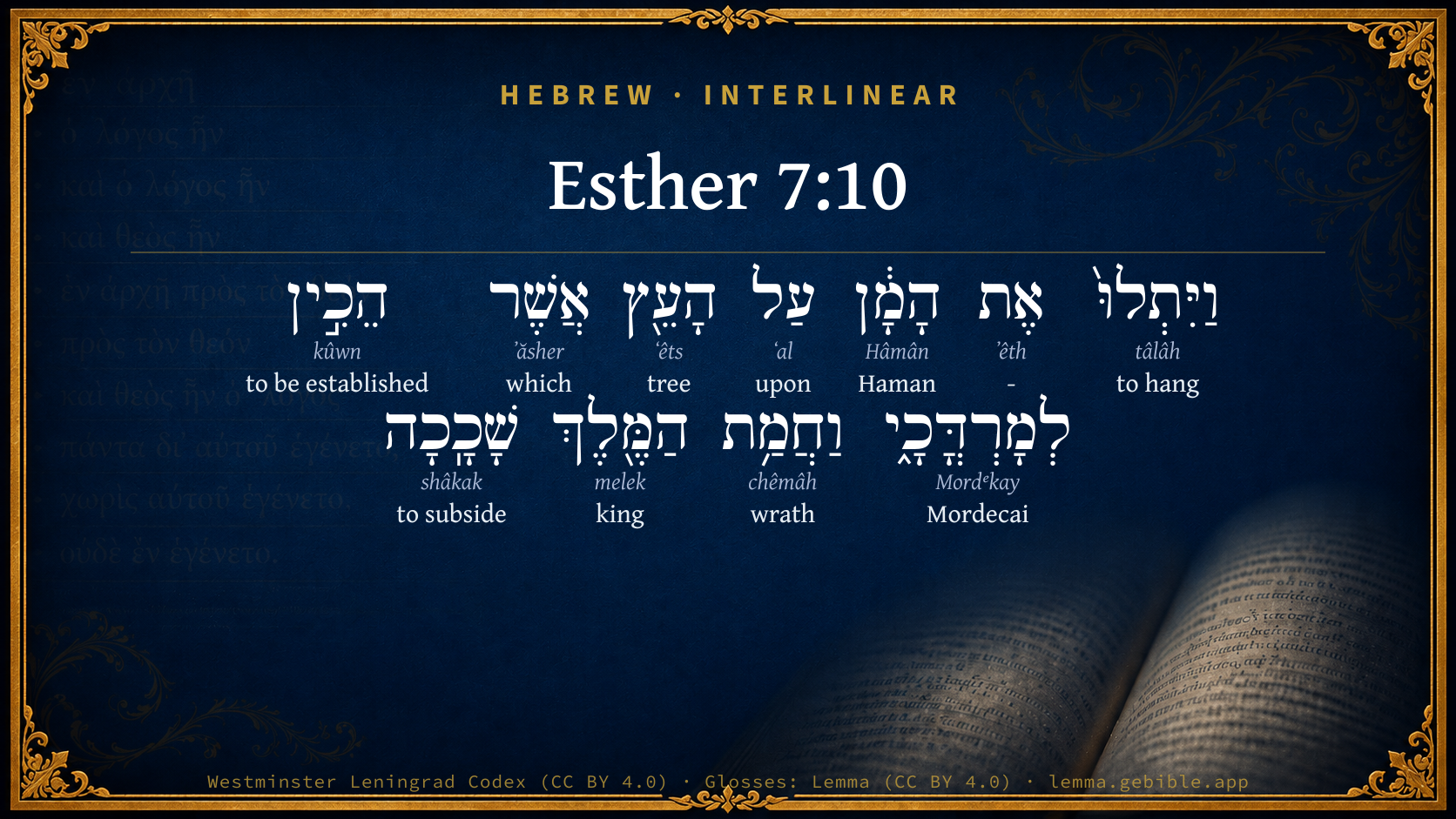
שָׁכָֽכָה
shâkak
H7918
“to subside”
Verb, Qal, Perfect, 3rd Person, Feminine, Singular
Part of Speech
Verb
Stem
Qal
Form
Perfect
Person
3rd Person
Gender
Feminine
Number
Singular
Full BDB Definition

Origin: a primitive root

TWOT: 2384

to subside, abate, decrease - (Qal) to abate - (Hiphil) to allay
  1. וַיִּתְלוּ֙ tâlâh H8518 “and · to hang” Conjunction + Verb, Qal, Sequential Imperfect, 3rd Person, Masculine, Plural
  2. אֶת ʼêth H853 “-” Particle, Direct Object
  3. הָמָ֔ן Hâmân H2001 “Haman” Noun, Proper
  4. עַל ʻal H5921 “upon” Preposition
  5. הָעֵ֖ץ ʻêts H6086 “the · tree” Particle, Definite Article + Noun, Common, Masculine, Singular, Absolute
  6. אֲשֶׁר ʼăsher H834 “which” Particle, Relative
  7. הֵכִ֣ין kûwn H3559 “to be established” Verb, Hiphil, Perfect, 3rd Person, Masculine, Singular
  8. לְמָרְדֳּכָ֑י Mordᵉkay H4782 “to/for · Mordecai” Preposition + Noun, Proper
  9. וַחֲמַ֥ת chêmâh H2534 “and · wrath of” Conjunction + Noun, Common, Feminine, Singular, Construct
  10. הַמֶּ֖לֶךְ melek H4428 “the · king” Particle, Definite Article + Noun, Common, Masculine, Singular, Absolute

About this verse

These counts appear in no published source. They are computed here, from the morphology-tagged text and Lemma’s own curated glosses. What Lemma adds →

11
words
11
distinct lemmas
Historical
section

Notable vocabulary

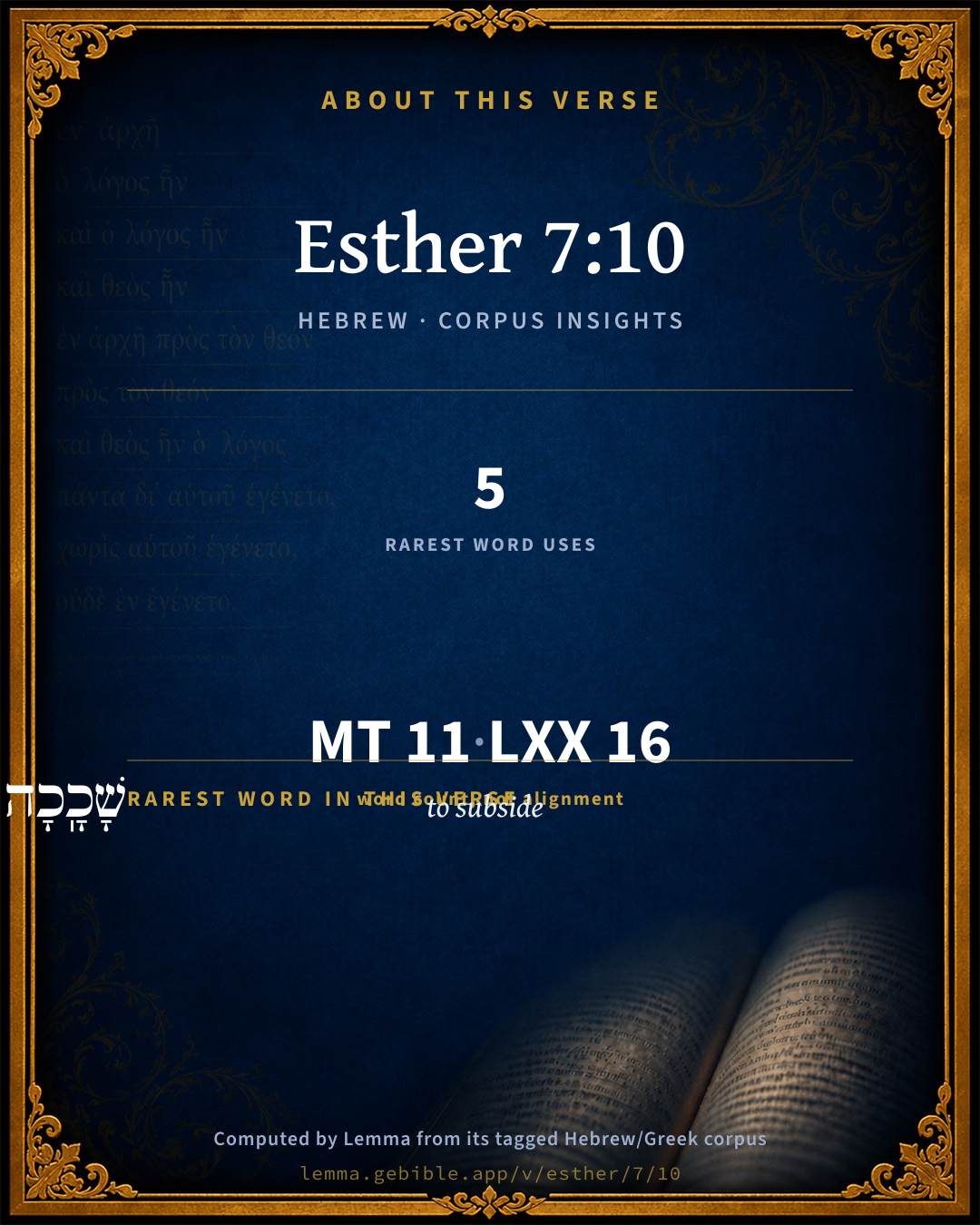
The rarest word here is שָׁכָֽכָה to subside H7918 — appearing just 5 times in the whole Hebrew Bible.

Shared distinctive vocabulary

שָׁכָֽכָה to subside H7918 occurs in 5 verses of the Hebrew Bible. Also found in:

Grammatical profile

  • 3 verbs
  • 5 nouns
  • 1 preposition
  • 2 particles

Verb forms

  • וַיִּתְלוּ֙ Qal · Sequential Imperfect
  • הֵכִ֣ין Hiphil · Perfect
  • שָׁכָֽכָה Qal · Perfect

Hebrew & Septuagint length

In English translation the verse runs 19 words from the Hebrew and 20 from the Septuagint (LXX English) — closely comparable.

A rough comparison of the two English renderings, which tokenize alike — not a word-level alignment.

Word counts can differ between the Hebrew and the Greek without any difference in meaning — e.g. the Hebrew direct-object marker אֵת has no separate Greek word, and Greek often adds the article ὁ.

In the original languages it is 11 Hebrew tokens and 16 Greek tokens — but the two are counted differently (Hebrew bundles its prefixes and suffixes into one token; the Greek is in lemma form), so that isn’t a like-for-like length.

Cross-references

6

Topical passages linked to Esther 7:10 in the Treasury of Scripture Knowledge — connected by theme and wording, ordered by reader-vote popularity; previews shown in the World English Bible.

  • Psalms 7:16 The trouble he causes shall return to his own head. His violence shall come down on the crown of his own head.
  • Daniel 6:24 The king commanded, and they brought those men who had accused Daniel, and they cast them into the den of lions, them, their children, and their wives; and the lions had the mastery of them, and broke all their bones in pieces, before they came to the bottom of the den.
  • Judges 15:7 Samson said to them, If you do after this manner, surely I will be avenged of you, and after that I will cease.
  • Ezekiel 5:13 Thus shall my anger be accomplished, and I will cause my wrath toward them to rest, and I shall be comforted; and they shall know that I, Yahweh, have spoken in my zeal, when I have accomplished my wrath on them.
  • Esther 2:1 After these things, when the wrath of king Ahasuerus was pacified, he remembered Vashti, and what she had done, and what was decreed against her.
  • Zechariah 6:8 Then he called to me, and spoke to me, saying, "Behold, those who go toward the north country have quieted my spirit in the north country."

Cross-references courtesy of OpenBible.info (CC BY 4.0).

Hebrew and Greek witnesses Masoretic Hebrew ↔ Greek Septuagint

The same verse in the two great witnesses to the Old Testament, shown verse-for-verse.

These are two independent witnesses, not word-aligned to each other, and the Septuagint is shown in lemma (dictionary) form.

Hebrew Esther 7:10 Masoretic · Westminster Leningrad Codex

וַיִּתְלוּ֙ אֶת הָמָ֔ן עַל הָעֵ֖ץ אֲשֶׁר הֵכִ֣ין לְמָרְדֳּכָ֑י וַחֲמַ֥ת הַמֶּ֖לֶךְ שָׁכָֽכָה

So they hanged Haman on the gallows that he had prepared for Mordecai. Then was the king's wrath pacified.

World English Bible · Public Domain

Greek LXX Esther 7:10 Septuagint · lemma form

καί κρεμάζω αμαν ἐπί ὁ ξύλον ὅς ἑτοιμάζω μαρδοχαῖος καί τότε ὁ βασιλεύς κοπάζω ὁ θυμός

So Aman was hanged on the gallows that had been prepared for Mardochaeus: and then the king's wrath was appeased.

LXX2012 (modern English Septuagint) · Public Domain

On this verse, Trapp's Complete Commentary discusses the Septuagint’s reading. Read the note in Commentary ↓

Hebrew: Westminster Leningrad Codex (CC BY 4.0). Greek: Septuagint (public domain); English from LXX2012 (modern English Septuagint) (Public Domain). How the Septuagint differs from the Hebrew →

Commentary

Notes on Esther 7:10 from classic Christian and Jewish commentators (each source and its license shown beneath its notes). The classic Christian expositions comment on the surrounding passage and are grouped to its opening verse, so a note may address several verses; the Jewish commentaries on the Tanakh (Rashi and others) are per-verse, so they appear only where the commentator wrote on this verse.

Lemma curates 59 commentaries, every one of them public domain or Creative Commons licensed, each selected and text-cleaned for this edition rather than reprinted as found. About our sources →

Trapp's Complete Commentary

John Trapp

Est 7:10 So they hanged Haman on the gallows that he had prepared for Mordecai. Then was the king’s wrath pacified.

10. So they hanged Haman on the gallows] Heb. tree. Neither hanged they him only to death; but crucified or nailed his dead body to the tree, for greater ignominy. So some gather from Est 8:5. The Septuagint also render it, So they crucified him. And here hanged the greatness of Haman, who now is fallen from the palace to the gallows, from the highest stage of honour to the lowest stair of disgrace, and lies wrapped up in the sheet of perpetual infamy. "So let all thine enemies perish, O Lord," &c. A like end befell Bonosus, the drunken emperor; Amasis, that insolent king of Egypt; Joan, that libidinous queen of Naples; our Roger Mortimer, that troubler of the realm, hanged at Tyburn; Oliver, that proud prefect, advanced to highest honours and offices by Louis, king of France, but hanged up by his son and successor upon a new and large gallows, set up for the purpose, and not without his desert. High places are not more uneasy than slippery. Even height itself maketh men’s brains to swim, and when they fall they come down with a poise.

That he had prepared for Mordecai] Josephus hath here a very good note: Undo mihi contigit mirari nomen Dei, et sapientiam et iustitiam eius agnoscere, &c., I cannot but admire the Lord’s wisdom, and acknowledge his justice, in that he not only punished him for his malice to the Church, but by turning his own mischief upon himself, hath made him an example to all posterity, hanging him up in gibbets, that others may take warning. The like the Lord did by Adonibezek, Pharaoh, Goliath, Ahithophel, Absalom, Sennacherib, Maxentius, Valerianus, &c.

Quam bene dispositum terris, ut dignus iniqui

Fructus consilii primis authoribus instet, &c.

See those sacred similes to the same sense, Ecc 10:8-9 Pro 26:27 Psa 7:16, &c., and beware of making a match with mischief, lest ye have your belly full thereof, ος εν αυτω κακα τευχει ανηρ αλλω κακα τευχων (Hesiod). He that conceiveth with guile, shall (though he grow never so big) bring forth nothing but vanity and worse, Job 15:35. As he hath sown the wind, so he shall reap the whirlwind, Hos 8:6. {See Trapp on "Hos 8:6"} Diaboli servus et satelles praecipuus erat Haman, Haman was a servant of the devil and an accomplice in particular, saith Rupertus. Haman was a main stickler for the devil, who had paid him accordingly: the wages of sin is death, and it may well be feared that Haman was killed with death, as Jezebel’s children were, Rev 2:23. Fuit enim homo dinae feritatis planeque αθεος, for he was a most cruel wretch, and a plain atheist. I shall shut up the story of his life as Ambrose doth that of Ahab and Jezebel’s fearful end: Fuge ergo, dives eiusmodi exitum, &c. Tremble at such ends, and be careful to avoid them. Such ends ye shall easily avoid if ye carefully flee such like foul and flagitious practices.

Then was the king’s wrath pacified] Harbonah had helped to kindle it, Est 7:9, and by executing Haman, whom he had accused, he now helpeth to quench it. For it was not unusual of old, that men of greatest rank and quality should execute malefactors; as Gideon did Zeba and Zalmunnah; as Samuel did Agag; as Benaiah did Adonijah, Joab, and Shimei, by the command of Solomon, Sententiam ocyus dicto exequuntur oculici (Merl.). The holy angels delight in such an office, as at Sodom, and in Sennacherib’s army; and how active shall they be at the last day, but chiefly against such as walk after the flesh in the lust of uncleanness, and despise government, 2Pe 2:10. So shall God’s wrath be pacified, as once it was at the time when Phineas, the high priest, had done execution upon that unclean couple. The saints have another way of pacifying him, of preventing his judgments, and disarming his indignation; and that is by remembering their sins, and being confounded in his presence, never opening their mouths any more, Eze 16:63, unless it be in a humble confession, which is the Christian’s best apology, as the apostle calleth it, 2Co 7:11. This will quiet God’s Spirit (as the phrase is, Zec 6:8), and cause him to say, as Job 33:24, I have found a reconciliation. Surely, if we judge ourselves, he will not judge us, 1Co 11:31. God shall be prevented, and the accuser of the brethren put out of office; our Hamans also shall be hanged up before the sun, our sturdy corruptions crucified, and the Lord shall as little repent him of any good he hath done us as Ahasuerus did of gratifying his wife Esther, and kinsman Mordecai; who were now all the doers, seeking the wealth of Israel, and speaking peace to that whole people, as appeareth in the following chapters. As for the king, he never so much as once lamented the loss of Haman, nor said se properantius quam prudentius egisse, that he had been more hasty than wise in doing him to death; but was very well pleased with what he had done; his wrath rested, saith the text, as the sea doth in a calm; it lay and slept, as the word signifieth; for anger is an eager desire of revenge, and rendereth a man restless till that be done, Ira est libido puniendi eius qui videtur laesisse iniuria (Cicero).

John Trapp, A Commentary or Exposition upon All the Books of the Old and New Testament (1647–1656) — public domain. Text from a community e-Sword module.

Joseph Benson's Commentary

Est 7:10. So they hanged Haman on the gallows that he had prepared for Mordecai — As the sentence was short, so the execution was speedy, and he that expected every one to do him reverence is now made an ignominious spectacle to the world on a gallows fifty cubits high: and himself is sacrificed to justice, who disdained that less than a whole nation should be sacrificed to his revenge. Thus does God resist the proud, and those whom he resists will find him irresistible! Thus did mischief return on the person that contrived it, and the wicked was snared in the work of his own hands. If he had not set up that gallows, the king probably would not have thought of ordering him to be hanged; but as he had unjustly prepared it for a good man, he was justly condemned to suffer on it himself. The enemies of God’s church have often been thus taken in their own craftiness. In the morning, Haman designed himself for the robes, and Mordecai for the gallows: but the tables are now turned, and Mordecai has the crown and Haman the cross. The Lord is known by the judgments which he executeth. “I cannot pass over this wonderful harmony of providence,” says Josephus, (Antiq., 50:2, c. 6,) “without a remark upon the almighty power, and admirable justice of the wisdom of God; not only in bringing Haman to his deserved punishment, but in trapping him in the very snare which he had laid for another, and turning a malicious invention upon the head of the inventor.” Bishop Patrick observes, on this wonderful deliverance of the Jewish nation, that “though, in the whole, there was no extraordinary manifestation of God’s power; no particular cause, or agent, which was in its working advanced above the ordinary pitch of nature; yet the contrivance, and suiting these ordinary agents appointed by God, is in itself more admirable than if the same end had been effected by means which were truly miraculous. That a king should not sleep, is no unusual thing, nor that he should solace his waking thoughts by hearing the annals of his own kingdom, or the journals of his own reign, read to him: but that he should be awake at that time, especially when Haman was watching to destroy the Jews, and that, in the chronicles of the kingdom, they should light on that place where Mordecai’s unrewarded services were recorded; that the king should resolve, thereupon, forthwith to do him honour; that Haman should come in at the very moment when he was so disposed; should ignorantly determine what honour should be done him, and be himself appointed to that ungrateful office: all this, no doubt, was from the Keeper of Israel, who neither slumbereth nor sleepeth, and was truly marvellous in his people’s eyes.” — See Dodd.

Joseph Benson's Commentary on the Old and New Testaments (1811–1818) — public domain. Text from a community e-Sword module.

Jamieson, Fausset & Brown

Robert Jamieson, A. R. Fausset & David Brown

So they hanged Haman on the gallows that he had prepared for Mordecai--He has not been the only plotter of mischief whose feet have been taken in the net which they hid (Psa 9:15). But never was condemnation more just, and retribution more merited, than the execution of that gigantic criminal.

Next: Esther Chapter 8

Jamieson, Fausset & Brown — Commentary Critical and Explanatory on the Whole Bible (1871) — public domain (CC PDM 1.0). Text via the HelloAO Bible API.

John Gill's Exposition

So they hanged Haman on the gallows that he had prepared for Mordecai,.... Not within his house, Est 7:9, but more probably in his courtyard, in the sight of his family and friends; or, it may be, the gallows was taken from thence, and set up without the city, where he was hanged: for so it is said in the additions of the book of Esther,"For he that was the worker of these things, is hanged at the gates of Susa with all his family: God, who ruleth all things, speedily rendering vengeance to him according to his deserts.'' (Esther 16:18)that he was hanged without the gates of Shushan; see Psa 7:15,

then was the king's wrath pacified; having inflicted punishment on such a wicked counsellor of his, and the contriver of such mischief.

Next: Esther Chapter 8

John Gill's Exposition of the Whole Bible (1746–1763) — public domain (CC PDM 1.0). Text via the HelloAO Bible API.

Matthew Poole's English Annotations

The gallows that he had prepared; which stood in his own house, as was now said, and made the punishment more grievous and ignominious.

Then was the king’s wrath pacified; judgment being now most justly executed upon this abominable criminal.

Matthew Poole's English Annotations on the Holy Bible (1683–1685) — public domain. Text from a community e-Sword/MySword module.

The Pulpit Commentary

Wrath pacified.

Ahasuerus, unlike Jonah, "did well to be angry." Haman had plotted against the life of his favourite queen, and one of his most serviceable friends, and against an unoffending community. And he had all but usurped the royal authority in causing the gallows to be reared on which be intended that Mordecai should be put to death. A righteous anger led to what would have been deemed in him, an arbitrary sovereign, a just act of retribution. And only when the judicial sentence was carried out against the offender was "the king"s wrath pacified.

I HUMAN ANGER.

1. This is sometimes righteous. "Be ye angry and sin not." Indignationagainst wrong and wrath with the oppressor are virtues, without which man is scarcely human.

2. Anger is always to be treated with suspicion. We are all prone, likeAhasuerus, to be angry with what hurts ourselves, and our sense of our rights and dignity, rather than with what is evil in the sight of the Lord. Let us ask ourselves whether our anger is justifiable is sympathy with the Divine righteousness, or is mere selfish passion.

3. Anger should not be confounded with personal revenge. Wrath may bepacified by malevolent action, and then "sin lieth at the door.

II DIVINE ANGER.

1. God is angry with the wicked every day. The Scriptures representhim as regarding the evil-doing of men with displeasure and with wrath.

2. In the midst of wrath God remembers mercy. This is the message of thegospel, which does not conceal God"s indignation at sin or his displeasure with the sinner; but shows that he is just, and the Justifier of the believer in Christ. He condemns the sin in pardoning the sinner. "Thou wast angry; but thine anger is turned away, and thou comfortedst us.

Lessons:

1. Rejoice that God is pacified and reconciled.

2. Accept his offers of mercy.

3. Seek to share his placable and forgiving spirit.

HOMILIES BY D. ROWLANDS Ver. 10.

The terrible consummation of a wicked life.

Our first impulse on reading these words is to praise Ahasuerus for his faithful administration of justice; for if ever a man deserved summary vengeance at the hands of the law, it was Haman. But a little reflection must correct our judgment. The whole transaction reveals the fickle, passionate, unscrupulous disposition of the tyrant. Without any apparent reason, or at least without any regard to his merits, he had made a special favourite of Haman, and had lavished upon him all the honours at his command; and now, in a fit of uncontrollable rage, he hurries him, without any pretence of a trial, to a felon"s death. Flatterers are the most unreliable of men. Those who lick the dust at your feet in prosperity are the most likely to tread upon your neck in adversity. There is but one step between "Hosanna to the Son of David," and "Away with him! crucify him!" The king"s servants, who vied with each other in their obsequiousness to Haman while he enjoyed their master"s favour, were now so eager to execute him that they could scarcely wait for the sentence. The text is in many respects one of the most striking in the whole Bible, and is fraught with weighty and permanent lessons. Note

I THE TERRIBLE CONSUMMATION OF A WICKED CAREER. It sometimes happens that the ungodly flourish in the world to such an extent that our faith in eternal righteousness is staggered. We could point to men whose road to power was paved with injustice, treachery, and bloodshed. Many an upright heart, crushed for its very uprightness, has poured forth, in contemplating such men, the despairing complaint of the Psalmist, "Verily! have cleansed my heart in vain, and washed my hands in innocency." But a careful observation of facts would doubtless show that even in this world excessive wickedness frequently brings about its own requital. Pharaoh perished in the Red Sea; the dogs licked the blood of Ahab in Samaria; Herod was eaten of worms upon his throne. There are circumstances about the case of Haman which separate it from all others, but in its essential features it is but one among thousands. Three elements in Haman"s character may be mentioned which, while they contributed to his temporary success, led to his final ruin.

1. Boundless ambition.

2. Boundless pride.

3. Boundless cruelty.

II THE IGNOMINIOUS EXTINCTION OF AN INFAMOUS RACE. Some think that Haman was an Amalekite; and we are told that the Amalekites, for their hostility to the Israelites, had been singled out for retribution. The Lord said to Moses, "I will utterly put out the remembrance of Amalek from under heaven." The threat was not carried out at once; for ages the footsteps of justice seemed to linger, and the delay had only intensified their malignity. But here the last of the race dies upon the gallows, for after this they disappear altogether from history. Piety runs in families, and so does wickedness. God"s blessing rests upon families, and so does his curse. This is not due to haphazard, caprice, or favouritism; but there is always a definite cause for it. Think of the Stuarts of England, and the Bourbons of France. By trampling upon the rights of the people, and seeking self-aggrandisement at the expense of righteousness, they sinned no less against Heaven than against humanity. But, as if pursued by an inexorable fate, they were hurled from the summit of power to the ignoble obscurity which they so richly deserved. Let us beware of committing "presumptuous sins," lest they should taint our families, and doom them as well as ourselves to eternal disgrace.

III THE SIGNAL DEFEAT OF A HEARTLESS PURPOSE. The incident before us is one of those incidents which cannot be accounted for except on the supposition of an overruling Providence. We perceive cunning baffled, crime punished, impiousness abashed in such a wonderful way, that to attribute the whole affair to mere chance would be the height of folly.

1. Haman was degraded just when he thought of reaching the goal of his ambition. The highest dignities of the kingdom, next to those enjoyed by the king, were his already. His vanity, his love of authority, his fondness for display had nothing to desire. And now the only annoyance that disturbed him was about to be removed & Ntilde; the people which he hated was about to be annihilated and he was about to become absolute master of the situation. Henceforth he would be admired, courted, envied by all the world. But, alas, it was not to be. "There are many devices in a man"s heart; nevertheless the counsel of the Lord, that shall stand." Haman had left that counsel out of his calculation; hence, when he thought of attaining the climax of honour, he was plunged into the abyss of shame. Prosperity is the worst thing that can happen to the wicked man. Adversity may mellow his heart, and produce reflection, repentance, and reformation; but a course of unbroken triumph only hardens his heart, and hastens the inevitable catastrophe. "For when they shall say, Peace and safety; then sudden destruction cometh upon them, as travail upon a woman with child; and they shall not escape.

2. Haman perished on the very gallows that he had erected for another. This was probably the bitterest ingredient in his cup of woe. Imagine his chagrin, his confusion, his despair, when he found that the huge instrument of death which he had set up at such great expense to punish his unbending antagonist was to be employed for no other purpose than his own execution! And who knows but that Mordecai himself was among the crowd who witnessed the scene? There was an awful fitness about the punishment. After-ages have with one consent pronounced it just. No utterance commends itself to universal approval with greater force than this: "Whoso diggeth a pit shall fall therein; and he that rolleth a stone, it will return upon him." We are reminded here that as virtue is its own reward, so sin is its own punishment, Haman died on a gallows of his own construction; so shall every impenitent sinner perish through his own waywardness. "Thine own wickedness shall correct thee, and thy backslidings shall reprove thee. R.

The Pulpit Commentary (1880–1919), ed. H.D.M. Spence-Jones & Joseph S. Exell — public domain. Text from a community e-Sword module.

Lesson kit

Teaching starters — assembled from the data on this page, not authored interpretation. Every prompt links to the verse data it draws on. Edit before teaching.

Esther, in the Historical, opens this verse with 11 words (11 distinct Hebrew lemmas). Its most distinctive word is shâkak (“to subside”). A historical commentator’s framing appears above. Read the whole chapter for the surrounding context.

Discussion questions

  1. What does “to subside” (shâkak) contribute to the verse as a whole?
  2. How does Genesis 8:1, which shares the word «to subside», read alongside this verse?
  3. These translations render this verse differently. What is at stake in choosing one wording over another?
  4. «וַיִּתְלוּ֙» is a Qal Sequential Imperfect verb. How does that grammatical form shape the action described?
  5. Compare how Trapp's Complete Commentary and Joseph Benson's Commentary read this verse. Where do they agree or differ?

Things to notice

Reading settings

Reading text

Shown beneath each verse's original-language words.

Old Testament
Old Testament edition

Read the OT as the Masoretic Hebrew (MT) or the Greek Septuagint (LXX).

English shown for the Greek Septuagint (in the Hebrew ↔ Greek comparison).

Comparing translations? Open the Compare panel on any verse page to stack up to four side by side.