
Proverbs 16:9

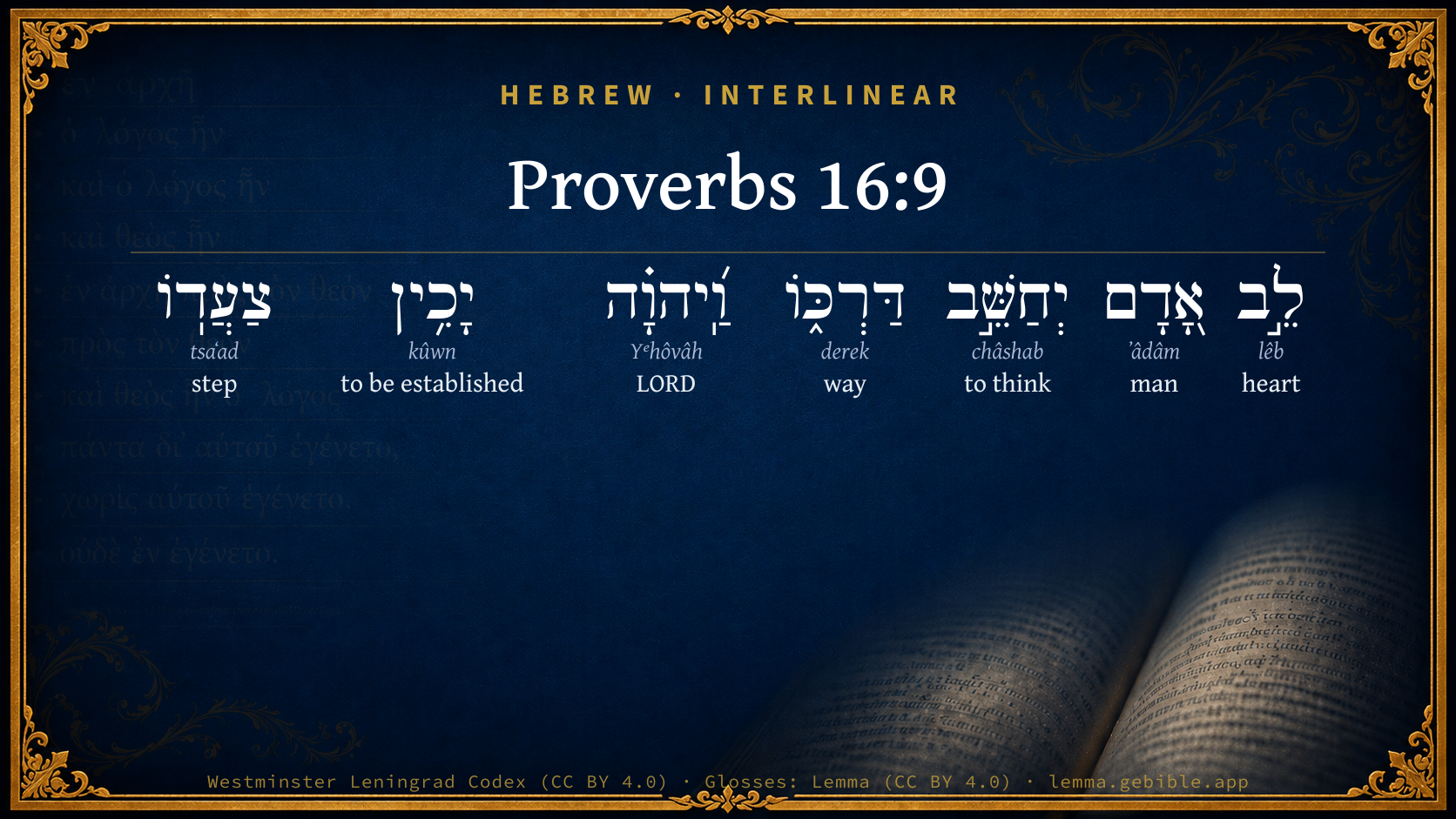
Hebrew (Westminster Leningrad Codex) Proverbs 16:9 appears in the Hebrew Old Testament. The text above is from the Westminster Leningrad Codex. Each word links to its Strong’s number, a concise gloss, and parsing drawn from the Open Scriptures Hebrew Bible morphology. Click any word for its full Brown-Driver-Briggs (BDB) entry.
Download image
Cite this verse

Proverbs 16:9 (World English Bible). Public Domain. Lemma interlinear Bible study tool, https://lemma.gebible.app/v/proverbs/16/9.

Show BibTeX & RIS
BibTeX
RIS
English Translation
A man's heart plans his course, But Yahweh directs his steps.
World English Bible · Public Domain
Download a study sheet

One document with this verse’s original text, its word-by-word gloss line, the meaning frame, cross-references with their text, attributed commentary, and full source and license credits — printable, and it pastes into notes with its structure intact.

This verse Autodidact and up

Study sheet (.html) Plain text (.txt)

A passage Seminary Student

Up to 50 verses in one chapter. A passage sheet keeps up to 6 commentary sources and 12 cross-references per verse, in the order this page ranks them, and says so on the sheet whenever that leaves anything out. Ask for a single verse and you get the Autodidact verse sheet above.

Everything on this page stays free to read, with no account — the sheet is a download of what is already on screen, not access to it.

Want to remove ads? Support Godless Engineer
Compare translations 3

The same verse in 3 English versions, stacked beneath the original-language interlinear above. Click any original word for its lexicon entry.

Each is an independent rendering of the whole verse — the interlinear is not word-aligned to these translations.

Highlighted words mark where these versions differ — a whole-verse word diff, not a word-by-word alignment.

  • World English Bible Public Domain
    A man's heart plans his course, But Yahweh directs his steps.
  • King James Version Public Domain
    A man's heart deviseth his way: but the LORD directeth his steps.
  • unfoldingWord Literal Text CC BY-SA 4.0
    The heart of a man plans his way, but Yahweh establishes his step.

unfoldingWord Literal Text — © unfoldingWord, licensed CC BY-SA 4.0. Word-aligned USFM3 via Door43 (git.door43.org/unfoldingWord/en_ult).

Versions to compare (up to 4)

3 of 4 selected

Show all 18 translations

Every available English version of this verse, each an independent rendering of the whole verse.

  • World English Bible Public Domain
    A man's heart plans his course, But Yahweh directs his steps.
  • Berean Standard Bible Public Domain
    A man’s heart plans his course, but the LORD determines his steps.
  • Majority Standard Bible Public Domain
    A man’s heart plans his course, but the LORD determines his steps.
  • King James Version Public Domain
    A man's heart deviseth his way: but the LORD directeth his steps.
  • American Standard Version (1901) Public Domain
    A man's heart deviseth his way; But Jehovah directeth his steps.
  • Revised Version (1885) Public Domain
    A man’s heart deviseth his way: but the LORD directeth his steps.
  • Geneva Bible (1599) Public Domain
    The heart of man purposeth his way: but the Lord doeth direct his steppes.
  • Douay-Rheims (1899) Public Domain
    The heart of man disposeth his way: but the Lord must direct his steps.
  • Young's Literal Translation Public Domain
    The heart of man deviseth his way, And Jehovah establisheth his step.
  • Literal Standard Version CC BY-SA 4.0
    The heart of man devises his way, || And YHWH establishes his step.
  • Unlocked Literal Bible CC BY-SA 4.0
    In his heart a person plans out his way, but Yahweh directs his steps.
  • unfoldingWord Literal Text CC BY-SA 4.0
    The heart of a man plans his way, but Yahweh establishes his step.
  • Darby Bible Public Domain
    The heart of man deviseth his way, but Jehovah directeth his steps.
  • World Messianic Bible Public Domain
    A man’s heart plans his course, but the LORD directs his steps.
  • Webster's Bible Public Domain
    A man's heart deviseth his way: but the LORD directeth his steps.
  • Free Bible Version CC BY-SA 4.0
    You can plan in your mind what to do, but the Lord will guide you.
  • Bible in Basic English Public Domain
    A man may make designs for his way, but the Lord is the guide of his steps.
  • JPS Tanakh (1917) Public Domain
    A man's heart deviseth his way; but the LORD directeth his steps.

Literal Standard Version (2020), Covenant Press — licensed CC BY-SA 4.0. Text via the HelloAO Bible API (eBible.org). Unlocked Literal Bible (unfoldingWord) — licensed CC BY-SA 4.0. Text via the HelloAO Bible API (eBible.org). unfoldingWord Literal Text — © unfoldingWord, licensed CC BY-SA 4.0. Word-aligned USFM3 via Door43 (git.door43.org/unfoldingWord/en_ult). Free Bible Version, Dr. Jonathan Gallagher — licensed CC BY-SA 4.0. Text via the HelloAO Bible API (eBible.org).

Word by word

More ways to search: Search by grammar → Find every occurrence → Compare this word →

Practice this passage: Drill this verse → Learn its vocabulary →

About this verse

These counts appear in no published source. They are computed here, from the morphology-tagged text and Lemma’s own curated glosses. What Lemma adds →

7
words
7
distinct lemmas
Wisdom
section

Notable vocabulary

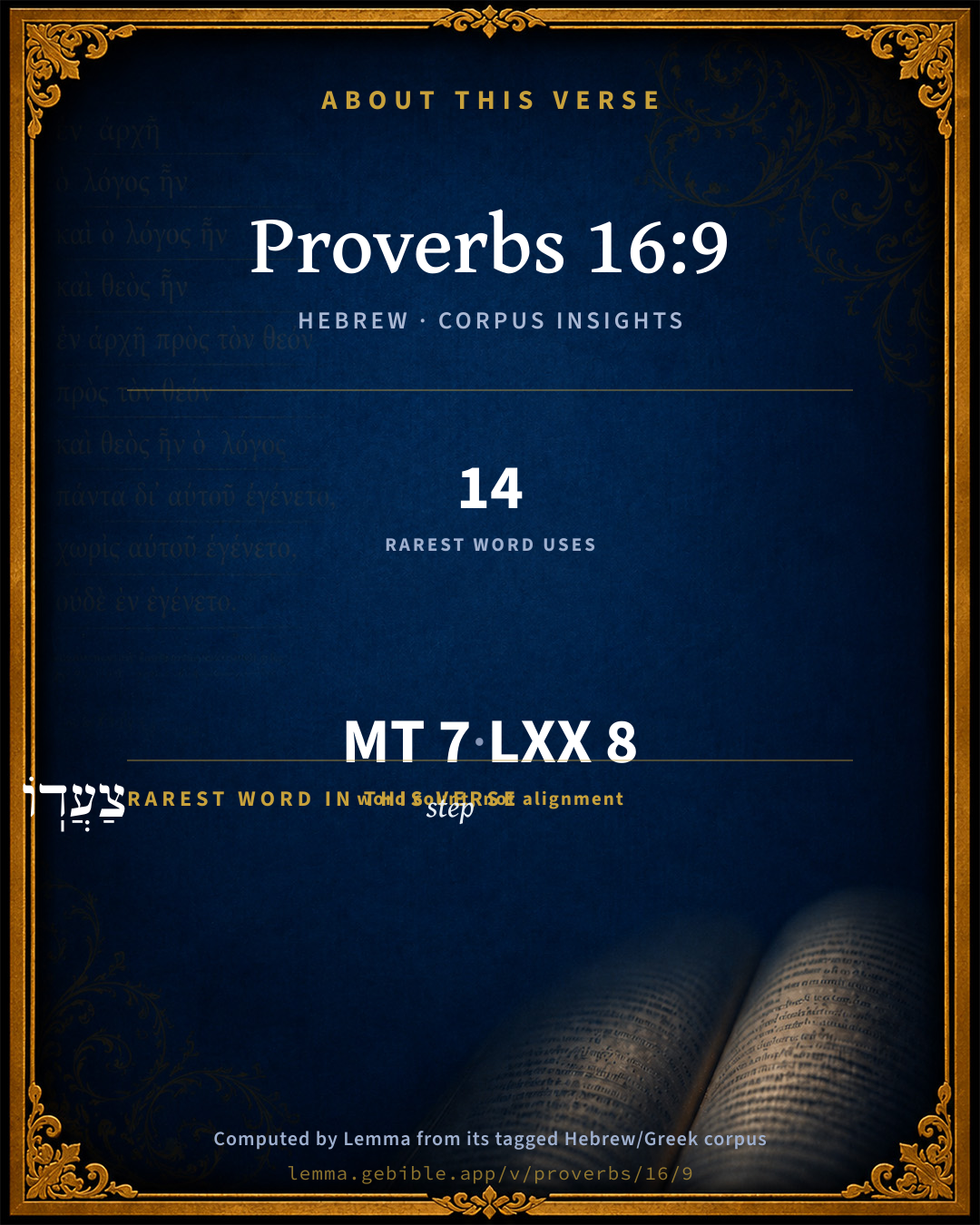
The rarest word here is צַעֲדֽוֹ step H6806 — appearing just 14 times in the whole Hebrew Bible.

Shared distinctive vocabulary

צַעֲדֽוֹ step H6806 occurs in 14 verses of the Hebrew Bible. Also found in:

Grammatical profile

  • 2 verbs
  • 5 nouns

Verb forms

  • יְחַשֵּׁ֣ב Piel · Imperfect
  • יָכִ֥ין Hiphil · Imperfect

Hebrew & Septuagint length

In the original languages it is 7 Hebrew tokens and 8 Greek tokens — but the two are counted differently (Hebrew bundles its prefixes and suffixes into one token; the Greek is in lemma form), so that isn’t a like-for-like length.

Cross-references

7

Topical passages linked to Proverbs 16:9 in the Treasury of Scripture Knowledge — connected by theme and wording, ordered by reader-vote popularity; previews shown in the World English Bible.

  • Proverbs 19:21 There are many plans in a man's heart, But Yahweh's counsel will prevail.
  • Psalms 37:23 A man's goings are established by Yahweh. He delights in his way.
  • Proverbs 16:1 The plans of the heart belong to man, But the answer of the tongue is from Yahweh.
  • Proverbs 20:24 A man's steps are from Yahweh; How then can man understand his way?
  • Jeremiah 10:23 Yahweh, I know that the way of man is not in himself: it is not in man who walks to direct his steps.
  • Proverbs 21:30 There is no wisdom nor understanding Nor counsel against Yahweh.
  • Isaiah 46:10 declaring the end from the beginning, and from ancient times things that are not [yet] done; saying, My counsel shall stand, and I will do all my pleasure;

Cross-references courtesy of OpenBible.info (CC BY 4.0).

Hebrew and Greek witnesses Masoretic Hebrew ↔ Greek Septuagint

The same verse in the two great witnesses to the Old Testament, shown verse-for-verse.

These are two independent witnesses, not word-aligned to each other, and the Septuagint is shown in lemma (dictionary) form.

Hebrew Proverbs 16:9 Masoretic · Westminster Leningrad Codex

לֵ֣ב אָ֭דָם יְחַשֵּׁ֣ב דַּרְכּ֑וֹ וַֽ֝יהוָ֗ה יָכִ֥ין צַעֲדֽוֹ

A man's heart plans his course, But Yahweh directs his steps.

World English Bible · Public Domain

Greek LXX Proverbs 16:9 Septuagint · lemma form

δεκτός βασιλεύς χεῖλος δίκαιος λόγος δέ ὀρθός ἀγαπάω

No English rendering of this Greek verse — the small residue in the structurally divergent books.

On this verse, The Pulpit Commentary discusses the Septuagint’s reading. Read the note in Commentary ↓

Hebrew: Westminster Leningrad Codex (CC BY 4.0). Greek: Septuagint (public domain); English from a public-domain English Septuagint. How the Septuagint differs from the Hebrew →

Commentary

Notes on Proverbs 16:9 from classic Christian and Jewish commentators (each source and its license shown beneath its notes). The classic Christian expositions comment on the surrounding passage and are grouped to its opening verse, so a note may address several verses; the Jewish commentaries on the Tanakh (Rashi and others) are per-verse, so they appear only where the commentator wrote on this verse.

Lemma curates 59 commentaries, every one of them public domain or Creative Commons licensed, each selected and text-cleaned for this edition rather than reprinted as found. About our sources →

Trapp's Complete Commentary

John Trapp

Pro 16:9 A man’s heart deviseth his way: but the LORD directeth his steps.

Ver. 9. A man’s heart deviseth his way, but God directeth his steps.] Man purposeth, God disposeth of all. {Pro 19:21} Events many times cross expectation, "neither is it in man to order his own ways." {Jer 10:23} This the heathen saw, and were much troubled at, {a} as were the Athenians when their good General Nicias lost himself and his army in Sicily. So the Romans when Pompey, Cato, and others, worthy patriots, were worsted by Julius Caesar. Brutus, a wise and valiant man overthrown by Antony, cries out, ω πλημων αρετη, &c., O miserable virtue, thou art a mere slave to fortune! Christians have learned better language, and can set down themselves with sounder reason if crossed of their designs or desires. They know "it is the Lord"; they are "dumb, because it is his doing," and they are "punished less than their deserts." {Ezr 9:13} Pompey, that seeing all to go on Caesar’s side, said there was a great deal of mist over the eye of Providence, did no better than blame the sun, because of his sore eyes. {b}

{a} Aνδρα ορωντες θεοφιλη ουδενος επιεικεστερα τυχη χρηθαι των κακιστων. - Thucyd.

{b} Dio.

John Trapp, A Commentary or Exposition upon All the Books of the Old and New Testament (1647–1656) — public domain. Text from a community e-Sword module.

The Biblical Illustrator

Joseph S. Exell

Pro_16:9

A mans heart deviseth his way, but the Lord directeth his steps.

On the government of human affairs by providence

The efforts of our activity, how great soever they may be, are subject to the control of a superior, invisible power. Higher counsels than ours are concerned in the issues of human conduct. The line is let out to allow us to run a certain length, but by that line we are all the while invisibly held, and are recalled and checked at the pleasure of Heaven. Among all who admit the existence of a Deity it has been a general belief that He exercises some government over human affairs. In what manner providence interposes in human affairs, by what means it influences the thoughts and counsels of men, and, notwithstanding the influence which it exerts, leaves to them the freedom of will and choice, are subjects of a dark and mysterious nature. The secret power with which God controls sun, moon, and stars is equally inexplicable. Throughout the sacred writings God is represented as, on every occasion, by various dispensations of His providence, rewarding the righteous or chastening them according as His wisdom requires, and punishing the wicked. The experience of every one bears testimony to a particular providence. Accident and chance and fortune are words without meaning. In Gods universe nothing comes to pass causelessly or in vain. Every event has its own determined direction. But this doctrine of a particular providence has no tendency to supersede counsel, design, or a proper exertion of the active powers of man. Man, devising his own way, and carrying on his own plans, has a place in the order of means which providence employs. The doctrine of the text is to be improved--

1. For correcting anxious and immoderate care about the future events of our life. The folly of such anxiety is aggravated by this consideration, that all events are under a much better and wiser direction than we could place them. To the unavoidable evils of life do not add this evil of thine own procuring, a tormenting anxiety about the success of thy designs. The great rule both of religion and duty is--Do thy duty and leave the issue to Heaven.

2. The doctrine of the text is calculated to enforce moderation of mind in every state; it humbles the pride of prosperity and prevents that despair which is incident to adversity.

3. This doctrine places the vanity and folly of all sinful plans in a very strong light. All sin, in every view of it, must be attended with danger.

4. It concerns us to perform those duties which a proper regard to providence requires, and to obtain protection from that power which directeth and disposeth all. An interest in Gods favour is far more important than all the wisdom and ability of man. Without His favour the wisest will be disappointed and baffled; under His protection and guidance the simple are led in a plain and sure path. (Hugh Blair, D.D.)

The infallible Director of man

The doctrine of the text is matter of uniform experience. Little indeed does any one know what lies before him.

I. The guidance of God may be traced in the dispensations of His providence. No natural causes can explain the wonderful events that occurred from the call of Abraham to the time of the Redeemer. In every scene, not only the miraculous, but the ordinary, the hand of the Deity is visible. We can often see clearly the traces of that hand when its work is done.

II. The sentiment of the text receives its fullest exemplification in the dispensation of grace. In a way the most improbable, and at a time the least expected, the God of all grace has laid hold upon the soul. Illustrate from the woman of Samaria, and from Zaccheus. The means, no less than the time and occasion, are of God. Some striking providence, some simple truth repeated for the thousandth time, some whispered admonition of a Christian friend, awakes attention, excites to immediate consideration, and bows down the soul in true contrition and prayer. The teaching of the text is also illustrated in the removal of the fear of death when the death-time comes. (W. E. Schenck.)

Man proposing, God disposing

We cherish hopes, we make plans; but there is a higher power that directs our steps. The ideas of fate and chance have been entertained by men in all ages of the world to account for these experiences. Scripture knows nothing of fate or chance. It is the Lord who is directing our steps. Look at this directing work of God overruling our purposes--

1. In the success or failure of our daily business. Man uses what discretion and judgment he has, but when he has done all much is left to circumstances over which he has no control. Generally it may be said that the diligent and persevering are the most successful, but there are many cases in which the rule will not apply. Success will sometimes come to the careless. Failure will sometimes come to the most diligent. Perhaps almost the last place in which we should look to find the hand of God is the business of the world.

2. In the choice of our occupations in life. What an amount of selecting and rejecting goes on in the mind of many a boy! He little thinks his choice will rest at last with One who knows better far than he knows for what he is adapted. There are few who, in choosing their occupations in life, have not had wishes of their own, and there are few who, in looking back, do not find that those wishes have been overruled. God is working out some kind and wise purpose by putting us where we are.

3. In the choice of our friendships. An unexpected meeting with a person may alter our whole career. God is as certainly working in the minor as He is in the greater events of our lives. (S. G. Matthews, B.A.)

The plan of man, and the plan of God, in human life

I. Mans own plan. A mans heart deviseth his way. Every man forms a programme of his daily life. When he moves rationally, he does not move by blind impulse. That mans history is self-originated and self-arranged is manifested from three things.

1. Society holds every man responsible for his actions.

2. The Bible appeals to every man as having a personal sovereignty.

3. Every mans conscience attests his freedom of action. If the sinner felt himself the mere creature of forces he could not control, he could experience no remorse. Man feels that his life is fashioned by his own plan, that he is the undisputed monarch of his own inner world.

II. Gods own plan. The Lord directeth his steps. God has a plan concerning every mans life--a plan which, though it compasses and controls every activity, leaves the man in undisturbed freedom. This is the great problem of the worlds history, mans freedom, and Gods control. Experience, says Mr. Bridges, gives a demonstrable stamp of evidence even in all the minutiae of circumstances which form the parts and pieces of the Divine plan. A matter Of common business, the indulgence of curiosity, the supply of necessary want, a journey from home, all are connected with infinitely important results. And often when our purpose seemed as clearly fixed, and as sure of accomplishment as a journey to London, this way of our own devising has been blocked up by unexpected difficulties, and unexpected facilities have opened an opposite way, with the ultimate acknowledgment, He led me forth in the right way (Psa_112:7; Isa_42:16). After all, however, we need much discipline to wean us from our own devices, that we may seek the Lords direction in the first place. The fruit of this discipline will be a dread of being left to our own devices, as before we were eager to follow them (Psa_143:10). So truly do we find our happiness and security in yielding up our will to our heavenly Guide! He knows the whole way, every step of the way: The end from the beginning. And never shall we miss either the way or the end, if only we resign ourselves with unreserved confidence to His keeping, and the direction of our steps. (Homilist.)

The folly of self-confidence

A mans heart, that is, his mind, his inward powers of reflection, anticipation, skill, prudence, deviseth his way--a term implying the application of all possible consideration, invention, and precaution--but the Lord directeth his steps. The words express and expose the folly and presumption, on mans part, of self-confidence--of his thus assuring himself of success, as if he had the future under his eye, and at his bidding; regardless of that hidden but ever-present, ever- busy superintending power that has all under complete command; that can at once arrest his progress in the very midst and at the very height of his boasting, and turn to foolishness all his devices. The sacred oracles are full of this sentiment, and of the most striking exemplifications of its truth. And what is the sentiment of revelation cannot fail to command the concurrence of enlightened reason. It must be so. If there is a God at all it cannot be otherwise. It were the height of irrationality as well as impiety for a moment to question it--to imagine the contrary possible. How otherwise could God govern the world? Were not all human schemes under supreme and irresistible control, what would become of the certainty of the Divine? All must of necessity fulfil the plans of Infinite Wisdom in the administration of Gods universal government. God will work, and who shall let it? (R. Wardlaw, D.D.)

Orderings of providence

Young Clive is shipped off, to get rid of him, in the East India Company, and he becomes the founder of Englands empire in India. The Duke of Wellington seeks of Lord Camden in early life a place at the Treasury Board, and becomes the military hero of Europe. There are many to-day occupying positions very different to those which they set before themselves in early life. Some are preaching the gospel who were destined to practise at the English bar. Some are lawyers who started to be physicians. Some are business men who started to be artists or musicians. David Livingstone starts as a hand in a Glasgow factory, and he becomes the pioneer of missionary work in Africa. William Carey makes shoes and he becomes the most successful missionary in India. Looking back on life, we say it was this or that event which impelled us on another course. We are apt to forget that the event was no chance accident, but a distinct factor in Gods government of our lives.

The Biblical Illustrator, edited by Joseph S. Exell (c. 1880s–1900s) — public domain. Text from a community e-Sword module.

Joseph Benson's Commentary

Pro 16:9. A man’s heart deviseth his way — Considers and proposes to himself what he will do; designs an end, and contrives by what means he may attain it; but the Lord directeth his steps — Ruleth and disposeth all his intentions and actions as he pleases, determining what the event shall be, and ordering his motions, perhaps, to such an issue as never came into his thoughts.

Joseph Benson's Commentary on the Old and New Testaments (1811–1818) — public domain. Text from a community e-Sword module.

The Preacher's Complete Homiletical Commentary

Joseph S. Exell (gen. ed.)

CRITICAL NOTES.—

Pro_16:9. Deviseth. The form of the verb denotes anxious consideration.

MAIN HOMILETICS OF Pro_16:9

MAN PROPOSES, GOD DISPOSES

I. This is a fact of national and individual history. In both inspired and uninspired records we meet with abundant confirmations of this truth. There is no more striking illustration of it than in the life of Joseph. He leaves his father’s house, as he supposes, for a few days, little dreaming that he is traversing a path by which he will never return. He only purposes to find his brethren, and “see if it is well with them, and bring his father word again.” But God is then directing his steps into a far-off land—into slavery, to a prison, and through both to a throne. So the shepherd boy of Bethlehem sets out with the unambitious intention of carrying supplies to his brethren, and of seeing how the battle is likely to go, and becomes himself the central figure in the camp, and the hero of his nation. And David’s predecessor goes in search of his father’s asses, and finds a crown and a kingdom at the end of his journey. Cromwell, despairing of enjoying liberty in England, planned to make a home in America, and, it is said, actually went on board a vessel which was about to sail. But God, using as an instrument the man to whose throne he was to succeed, directed his steps in another direction, and being forbidden to quit the country, he becomes not only England’s deliverer, but a great and powerful ruler, whose influence was felt throughout Europe. Clive went out to India as a clerk, because he had no prospects of getting a living at home, and lays the foundation of our Indian empire. And there is hardly a man living who, if he reflects upon his past life, cannot remember passages in his own history which confirm the truth of the text. He makes certain plans, and purposes to accomplish certain designs, and the result of his doings is quite different from his intentions, or leads him to a place, or a position, or into relationships which were entirely out of his calculation when he “devised his way.”

II. This is a law which must be in operation till the end of time. Unexpected events must be the outcome of man’s plans and purpose, because he is finite and very short-sighted, and there is an Infinite and Omniscient Ruler of the universe, who comprehends in His plan of the universe all the plans of His creatures, and in His plan concerning every man all that man’s devices and deeds. “God professes in His word,” says Dr. Bushnell, “to have purposes pre-arranged for all events; to govern by a plan which is from eternity even, and which, in some proper sense, comprehends everything. And what is this but another way of conceiving that God has a definite place and plan adjusted for every human being? And without such a plan, He could not even govern the world intelligently, or make a proper universe of the created system; for it becomes a universe only in the grand unity of reason which includes it, otherwise it were only a jumble of fortuities without counsel, end, or law.” This being so, a man can rejoice in the truth that “The Lord directs his steps”—that the events of his life are not the outcome of chance, but are all under the control of a supremely wise and benevolent King and Father. Not that God’s foreknowledge is the cause of man’s actions, but that seeing He must know what shall come to pass nothing takes Him by surprise, and therefore nothing finds Him unprepared to arrange all a man’s affairs after the counsel of His own will. Nothing happens without His permission; no good thing comes to a man’s life without His instigation and co-operation, and, if a man is willing to yield himself to His guidance, He will not only direct his steps, but direct them so as to further that man’s true wellbeing—will make “all things work together for good” to him (Rom_8:28). The fact here declared will redound to a man’s eternal gain or loss according to the attitude which he takes towards God. “There is then, I conclude, a definite and proper end, or issue, for every man’s existence; an end which to the heart of God is the good intended for him, or for which he was intended; that which he is privileged to become; called to become, ought to become; that which God will assist him to become, save by his own fault. Every human soul has a complete and perfect plan cherished for it in the heart of God—a Divine biography marked out which it enters into life to live. This life, rightly unfolded, will be a complete and beautiful whole, an experience led on by God and unfolded by his secret nurture, as the trees and the flowers, by the secret nurture of the world; a drama cast in the mould of a perfect art, with no part wanting; a Divine study for the man himself, and for others; a study that shall for ever unfold, in wondrous beauty, the love and faithfulness of God; great in its conception, great in the Divine skill by which it is shaped; above all, great in the momentous and glorious issues it prepares. What a thought is this for every human being to cherish! What dignity does it add to life! What support does it bring to the trials of life! What instigations does it add to send us onward in everything that constitutes our excellence! We live in the Divine thought. We fill a place in the great everlasting plan of God’s intelligence. We never sink below His care—never drop out of His counsel. But there is, I must add, a single and very important qualification. Things all serve their uses, and never break out of their place. They have no power to do it. Not so with us. We are able, as free beings, to refuse the place and the duties God appoints; which, if we do, then we sink into something lower and less worthy of us. That highest and best condition for which God designed us is no more possible.… And yet, as that was the best thing possible for us in the reach of God’s original counsel, so there is a place designed for us now, which is the next best possible. God calls us now to the best thing left, and will do so till all good possibility is narrowed down and spent. And then, when He cannot use us any more for our own good, He will use us for the good of others—an example of the misery and horrible desperation to which any soul must come when all the good ends, and all the holy callings of God’s friendly and fatherly purpose are exhausted. Or it may be now, that, remitting all other plans and purposes in our behalf, He will henceforth use us—wholly against our will—to be the demonstration of His justice and avenging power before the eyes of mankind, saying over us, as He did over Pharaoh in the day of His judgments, “Even for this same purpose have I raised thee up, that I might show My power in thee, and that My name might be declared throughout all the earth.” Doubtless He had other and more general plans to serve in this bad man, if only he could have accepted such; but, knowing his certain rejection of these, God turned His mighty counsel in him wholly on the use to be made of him as a reprobate. How many Pharaohs in common life refuse every other use God will make of them, choosing only to figure, in their small way, as reprobates, and descending, in that manner, to a fate that painfully mimics his”—(Bushnell).

OUTLINES AND SUGGESTIVE COMMENTS

The thought of the first verse, coming to be repeated, this versatile sentencemaker calls it back with different scenery. “The answer” or “decree of a tongue” (Pro_16:1) is one pregnant act, the “step” of a foot is another. Both may make a man or ruin him, for this world, or that which is to come. The critical thing, in either case, is controlled by the Almighty.… “Heart,” more intellectual than the English heart. “Devises” too intellectual for our emotional nature. It means studies, or deeply meditates. The sinner really reflects upon his future! wisdoms. Alas! they are too future! And when the future come, he “plants,” “sets firm, his step” quite differently from what he had decreed.—Miller.

The doctrine of Providence is not like the doctrine of the Trinity—to be received by faith. Experience gives a demonstrable stamp of evidence—even in all the minutiæ of circumstances, which form the parts and pieces of the Divine plan.—Bridges.

It must be so. If there is a God at all it cannot be otherwise. It were the height of irrationality as well as impiety for a moment to question it—to imagine the contrary possible. How otherwise could God govern the world? Were not all human schemes under supreme and irresistible control, what would become of the certainty of the Divine?—Wardlaw.

When it is said that a man’s heart deviseth his way but the Lord directeth his steps, we must not think that the purpose of the creature is condemned as an impertinence. It is an essential element of the plan. Neither human purposes, the material on which God exercises His sovereign control, nor the control which He exercises on that material could be wanted. If there were no room for the devices of men’s hearts, providence would disappear, and grim hate, the leaden creed that crushes Eastern nations in the dust, would come in its stead. If, on the other hand, these devices are left to fight against each other for their objects without being subjected all to the will of a Living One, faith flees from the earth and the reign of Atheism begins. The desires of human hearts, and the efforts of human hands, do go into the processes of providence, and constitute the material upon which the Almighty works. When God made man in His own image, a new era was inaugurated and a new work begun. Hitherto, in the government of this world, the Creator had no other elements to deal with than matter and the instincts of brutes; but the moment that man took his place on creation, a new and higher element was introduced into its government. The sphere was enlarged and the principle elevated. There was more room for the display of wisdom and power. The will of intelligent moral beings being left free, and yet as completely controlled as matter and laws, makes the Divine government much more glorious than the mere management of a material universe. For God’s glory man was created, and that purpose will stand; a glory to God man will be, willing or unwilling, fallen or restored, throughout the course of time, and at its close. The doctrine of Scripture regarding Providence neither degrades man, nor inflates him. It does not make him a mere thing on the one hand, nor a god on the other. It neither takes from him the attributes of humanity, nor ascribes to him the attributes of Deity. It permits him freely to propose, but leaves the ultimate disposal in a mightier hand.—Arnot.

The doctrine of the text—I. Should correct immoderate care about the future events of our life. What means this mighty bustle and stir—this restless perturbation of thought and care—as if all the issues of futurity rested wholly on thy conduct? Something depends upon thyself, and there is reason, therefore, for acting thy part with prudence and attention. But upon a hand unseen it depends, either to overturn thy projects, or to crown them with success, therefore thine attention should never run into immoderate care. II. Should enforce moderation of mind in every state. How little ground the real situation of the most prosperous man affords for the vain elation of mind, for he is dependent every moment on the pleasure of a superior. III. Places the vanity and folly of sinful plans in a very strong light. The sinner has against him, first, the general uncertainty which belongs to all the designs of men. And he hath also engaged against himself one certain and formidable enemy. IV. That an interest in God’s favour is far more important than all the wisdom and ability of man. In a world so full of uncertainty, let us take pains to secure to ourselves one resting place, one habitation that cannot be moved.—Blair.

God having made man lord of the earth, He hath made him lord also of the ways of the earth. He is not tied to this way or that way, but as his heart deviseth, so he may go. And herein is the dignity of a man above a beast. For that way must a beast go which he is driven: but man, not driven by fate, or constellation, or any other necessity, as master of himself, chooseth his own courses wherein to walk. Notwithstanding, man is not without an overseer, a ruler, by whom his steps are directed. The wicked chooseth an evil way, but God directeth it to a good end. The good chooseth a good way, but it is by God brought to a good issue.—Jermin.

The Preacher's Complete Homiletical Commentary (gen. ed. Joseph S. Exell; Funk & Wagnalls, c. 1892) — public domain (pre-1929). A full-Bible homiletical/sermon-outline anthology covering 65 of 66 books (2 John is absent from the source module). Text from a community e-Sword module.

Geneva Bible (1599)

Geneva Bible translators

He showeth the folly of man, which thinketh that his ways are in his own hand, and yet it is able to remove one foot except God give force.

Geneva Bible (1599) marginal notes — public domain. Text via Bolls.life.

Matthew Henry's Commentary

Man is here represented to us, 1. As a reasonable creature, that has the faculty of contriving for himself: His heart devises his way, designs an end, and projects ways and means leading to that end, which the inferior creatures, who are governed by sense and natural instinct, cannot do. The more shame for him if he do not devise the way how to please God and provide for his everlasting state. 2. But as a depending creature, that is subject to the direction and dominion of his Maker. If men devise their way, so as to make God's glory their end and his will their rule, they may expect that he will direct their steps by his Spirit and grace, so that they shall not miss their way nor come short of their end. But let men devise their worldly affairs ever so politely, and with ever so great a probability of success, yet God has the ordering of the event, and sometimes directs their steps to that which they least intended. The design of this is to teach us to say, If the Lord will, we shall live and do this or that (Jam 4:14, Jam 4:15), and to have our eye to God, not only in the great turns of our lives, but in every step we take. Lord, direct my way, Th1 3:11.

Matthew Henry's Commentary on the Whole Bible (1708–1710) — public domain (CC PDM 1.0). Text via the HelloAO Bible API.

Jamieson, Fausset & Brown

Robert Jamieson, A. R. Fausset & David Brown

(Compare Pro 16:3).

directeth--establisheth.

Jamieson, Fausset & Brown — Commentary Critical and Explanatory on the Whole Bible (1871) — public domain (CC PDM 1.0). Text via the HelloAO Bible API.

Adam Clarke's Commentary

Verse 9. A man's heart deviseth his way] This is precisely the same sentiment as that contained in the first verse, on the true meaning of which so much has been already said.

Adam Clarke's Commentary on the Bible (1810–1826) — public domain. Text from a community e-Sword/MySword module.

Ellicott's Commentary for English Readers

(9) A man’s heart deviseth his way . . .—“Man proposeth, God disposeth.” (See below on Pro_20:24.)

A Bible Commentary for English Readers, edited by Charles John Ellicott (1878–1897) — public domain. Text from a community e-Sword module.

The Cambridge Bible for Schools and Colleges

gen. ed. J. J. S. Perowne

9. Comp. Pro_16:1 of this chapter.

The Cambridge Bible for Schools and Colleges (gen. ed. J. J. S. Perowne; Cambridge University Press, 1878–1918) — public domain. Text from a community e-Sword module.

John Gill's Exposition

A man's heart deviseth his way,.... This is to be understood, not of a wicked man, in whose heart is frowardness, and who devises mischief and evil imaginations continually, Pro 6:14; for such are an abomination to the Lord; nor will he direct their goings, or prosper and succeed them in their ways: but of a good man, or righteous man, as Aben Ezra; who thinks of the way in which he should go, and desires to walk in a right way, as Jarchi; and who is influenced by the Spirit and grace of God to think and act in this manner; for otherwise the way of man is not in himself; it is not of his own devising and finding out; nor is his disposition to walk in it of himself; and it is only such a man, a good man, whose steps are ordered by the Lord, as follows; see Jer 10:23;

but the Lord directeth his steps: to go right on, and not turn to the right hand or the left; and to walk safely and surely, through a variety of troubles and difficulties, to his kingdom and glory.

John Gill's Exposition of the Whole Bible (1746–1763) — public domain (CC PDM 1.0). Text via the HelloAO Bible API.

Albert Barnes' Notes on the Bible

Deviseth his way - i. e., Thinks it out with anxious care; yet it is the Lord and He only who directs the steps. Compare Pro 16:1.

Albert Barnes' Notes on the Bible (1834–1885) — public domain. Text from a community e-Sword/MySword module.

Matthew Poole's English Annotations

Deviseth his way; considers and proposeth to himself what he will do.

Directeth his steps; overruleth and disposeth all their designs and actions as he pleaseth, and not as they list.

Matthew Poole's English Annotations on the Holy Bible (1683–1685) — public domain. Text from a community e-Sword/MySword module.

Whedon's Commentary on the Bible

Daniel D. Whedon

9. Directeth — Or, makes firm, sure. This proverb contains substantially the same sentiments as Pro_16:1, which see. Compare Pro_20:24; Psa_37:23; Jer_10:23.

Daniel D. Whedon (gen. ed.), Commentary on the Old and New Testaments (1874–1909) — public domain. Text from a community e-Sword module.

The Pulpit Commentary

A man"s heart deviseth his way: but the Lord directeth his steps (ver. 1). "Man proposes, God disposes" or, as the Germans say, "Der Mensch denkt, Gott lenkt". (comp. Pro_20:24) The word rendered "deviseth" implies, by its spectra, intensity of thought and care. Man meditates and prepares his plans with the utmost solicitude, hut it rests with God whether he shall carry them to completion or not, and whether, if they are to be accomplished, it be done with ease or with painful labour. (comp. Gen_24:12, etc.) We all remember Shakespeare"s words in "Hamlet"There"s a divinity that shapes our ends, Rough-hew them how we will.

Septuagint, "Let the heart of man consider what is just, that his steps may be by God directed might". (comp. Jer_10:23)

The Pulpit Commentary (1880–1919), ed. H.D.M. Spence-Jones & Joseph S. Exell — public domain. Text from a community e-Sword module.

John Wesley's Explanatory Notes

Deviseth - Proposes what he will do. Directeth - Over-rules and disposes all his designs and actions.

John Wesley, Explanatory Notes Upon the Whole Bible (1754–1765) — public domain. Text via the GEBible commentary corpus.

Keil & Delitzsch

C. F. Keil & F. Delitzsch

9 The heart of man deviseth his way;

But Jahve directeth his steps.

Similar to this is the German proverb: "Der Mensch denkt, Gott lenkt" [= our "man proposes, God disposes"], and the Arabic el-‛abd (העבד = man) judebbir wallah juḳaddir; Latin, homo proponit, Deus disponit; for, as Hitzig rightly remarks, 9b means, not that God maketh his steps firm (Venet., Luther, Umbreit, Bertheau, Elster), but that He gives direction to him (Jerome, dirigere). Man deliberates here and there (חשּׁב, intens. of חשׁב, to calculate, reflect) how he will begin and carry on this or that; but his short-sightedness leaves much out of view which God sees; his calculation does not comprehend many contingencies which God disposes of and man cannot foresee. The result and issue are thus of God, and the best is, that in all his deliberations one should give himself up without self-confidence and arrogance to the guidance of God, that one should do his duty and leave the rest, with humility and confidence, to God.

Keil & Delitzsch — Biblical Commentary on the Old Testament (1861–1891) — public domain (CC PDM 1.0). Text via the HelloAO Bible API. (Old Testament only.)

Bridges on Proverbs

Charles Bridges

A fine description of the Sovereign government of God! Inscrutable indeed is the mystery, how he accomplishes his fixed purpose by free-willed agents. Man without his free will is a machine. God without his unchangeable purpose ceases to be God. (Mal 3:6 .) As rational agents we think, consult, act freely. As dependent agents, the LORD exercises his own power in permitting, overruling, or furthering our acts.†1 Thus man proposes; God disposes. Man devises; the LORD directeth. He orders our will, without infringing our liberty, or disturbing our responsibility. For while we act as we please, we must be answerable.

We observe this supremacy, in directing, not only an important end, but every step towards it; not only the great events, but every turn;†2 not only in his own people,†3 but in every child of man.†4 How little did Joseph’s brethren contemplate the overruling direction to their evil devisings!†5 When Saul’s heart was devising "slaughter against the disciples of the Lord;"†6 when the renegade slave was running in his own path,†7 little did they think of that gracious direction of their steps, to the salvation of their souls. When David simply went at his father’s bidding, little did he know the grand crisis, to which the LORD was directing his steps.†8 As little did the captive girl calculate upon the weighty results from her banishment from her country.†9 Often also hath the path of the Lord’s people been encouraged by the counteracting of their enemies’ devising, and the backward direction of their steps, at the moment when they were ready to grasp their prey! (1Sa 23:27 ; Isa 37:7-8 .) In fact - as Bp. Hall remarks - ’Every creature walks blindfold. Only he that dwells in light, sees whither they go.’ (2Ki 5:2-3 .)

This doctrine of Providence is not like the doctrine of the Trinity - to be received by faith. Experience gives a demonstrable stamp of evidence - even in all the minutiae of circumstances which form the parts and pieces of the Divine plan. A matter of common business;†10 the indulgence of curiosity;†11 the supply of necessary want;†12 a journey from home†13 - all are connected with infinitely important results. And often, when our purpose seemed as clearly fixed, and as sure of accomplishment, as a journey to London, this way of our own devising has been blocked up by unexpected difficulties, and unexpected facilities have opened an opposite way, with the ultimate acknowledgment - "He led me forth in the right way." (Psa 107:7 . Isa 42:16 .) The Divine control of the Apostle’s movements, apparently thwarting their present usefulness, "turned out rather to the furtherance of the gospel." Philip was transferred from an important sphere in Samaria, from preaching to thousands, into a desert. But the Ethiopian Eunuch was his noble convert, and through him the gospel was doubtless widely circulated. (Act 8:37-39 .) Paul was turned aside from a wide field of labor to a more contracted ministry. A few women, and a family, were his only Church. Yet how did these small beginnings issue in the planting of flourishing Churches!†14 After all, however, we need much discipline to wean us from our own devices, that we may seek the Lord’s direction in the first place. The fruit of this discipline will be a dread of being left to our own devices; as before we were eager to follow them. (Psa 143:10 .) So truly do we find our happiness and security in yielding up our will to our Heavenly Guide! He knows the whole way - every step of the way - "the end from the beginning." And never shall we miss either the way or the end, if only we resign ourselves with unreserved confidence to his keeping and direction of our steps.

Footnotes:

†1 Pro 19:21; Pro 21:30 . Psa 33:11 . Isa 46:10 . Lam 3:37 .

†2 What vast results hung upon the sleepless night of the Eastern autocrat! Est 6:1 .

†3 Psa 37:23.

†4 Pro 20:24. Jer 10:23

†5 Gen 37:26-28; Gen 45:5 .

†6 Act 9:1-6.

†7 Epistle to Phm 1:1-25 .

†8 1Sa 17:17-18, 1Sa 17:23, 1Sa 17:58 .

†9 2Ki 5:2-3 .

†10 1Sa 9:3, 1Sa 9:15-16.

†11 Luk 19:4, Luk 19:6, Luk 19:9 .

†12 Joh 4:7.

†13 Acts 16:14.

†14 Acts 16:6-15, Act 16:34, with Php 1:1 . 1Th 1:1

Charles Bridges, An Exposition of the Book of Proverbs (1846) — public domain. Text from a community e-Sword module.

Kretzmann's Popular Commentary

Paul E. Kretzmann

v. 9. A man’s heart deviseth his way, reflecting most carefully on his conduct, considering as best he can what might be best for him to do; but the Lord directeth his steps, the result and the end are the Lord’s, and the best suggestion is that a Christian from the beginning place himself under God’s guidance; for "man proposes, but God disposes. "

Paul E. Kretzmann, Popular Commentary of the Bible (1921–1924) — public domain. Text from a community e-Sword module.

unfoldingWord translationNotes

Door43 World Missions Community

In his heart a person plans out his way

Here the word "heart" represents the mind and thoughts. The writer speaks of a person's actions as if the person were walking on a path. AT: "A person plans in his mind what he will do" (See: Metonymy and Metaphor)

Yahweh directs his steps

The writer speaks of Yahweh determining the outcome of a person's plans as if Yahweh were telling that person where to walk. (See: Metaphor)

Insightful decisions are on the lips of a king

Here the word "lips" is a metonym for what the king says. AT: "What a king says are insightful decisions" (See: Metonymy)

his mouth should not betray justice

The word "mouth" represents the king himself. AT: "he should not speak deceitfully when he judges" (See: Synecdoche)

translationWords

heart

Yahweh

king

unfoldingWord translationNotes — © Distant Shores Media and the Door43 World Missions Community, licensed CC BY-SA 4.0. Source: git.door43.org/Door43/en_tn.

Rashi

Rabbi Shlomo Yitzchaki (Rashi)

A man’s heart plans his way to walk on the straight way.

but the Lord prepares his step as we learned: He who comes to purify himself is granted assistance.

Rashi on the Tanakh — English translations: “The Judaica Press complete Tanach with Rashi, translated by A. J. Rosenberg” (CC BY 4.0); “Pentateuch with Rashi's commentary by M. Rosenbaum and A.M. Silbermann, 1929-1934” (public domain); “The Metsudah Tanach series, Lakewood, N.J” (CC BY 4.0); and “The Book of Joshua, Metsudah Publications, 1997” (CC BY 4.0). Text via Sefaria.

Lesson kit

Teaching starters — assembled from the data on this page, not authored interpretation. Every prompt links to the verse data it draws on. Edit before teaching.

Proverbs, in the Wisdom, opens this verse with 7 words (7 distinct Hebrew lemmas). Its most distinctive word is tsaʻad (“step”). A historical commentator’s framing appears above. Read the whole chapter for the surrounding context.

Discussion questions

  1. What does “step” (tsaʻad) contribute to the verse as a whole?
  2. How does 2 Samuel 6:13, which shares the word «step», read alongside this verse?
  3. These translations render this verse differently. What is at stake in choosing one wording over another?
  4. «יְחַשֵּׁ֣ב» is a Piel Imperfect verb. How does that grammatical form shape the action described?
  5. Compare how Trapp's Complete Commentary and The Biblical Illustrator read this verse. Where do they agree or differ?

Things to notice

Reading settings

Reading text

Shown beneath each verse's original-language words.

Old Testament
Old Testament edition

Read the OT as the Masoretic Hebrew (MT) or the Greek Septuagint (LXX).

English shown for the Greek Septuagint (in the Hebrew ↔ Greek comparison).

Comparing translations? Open the Compare panel on any verse page to stack up to four side by side.