
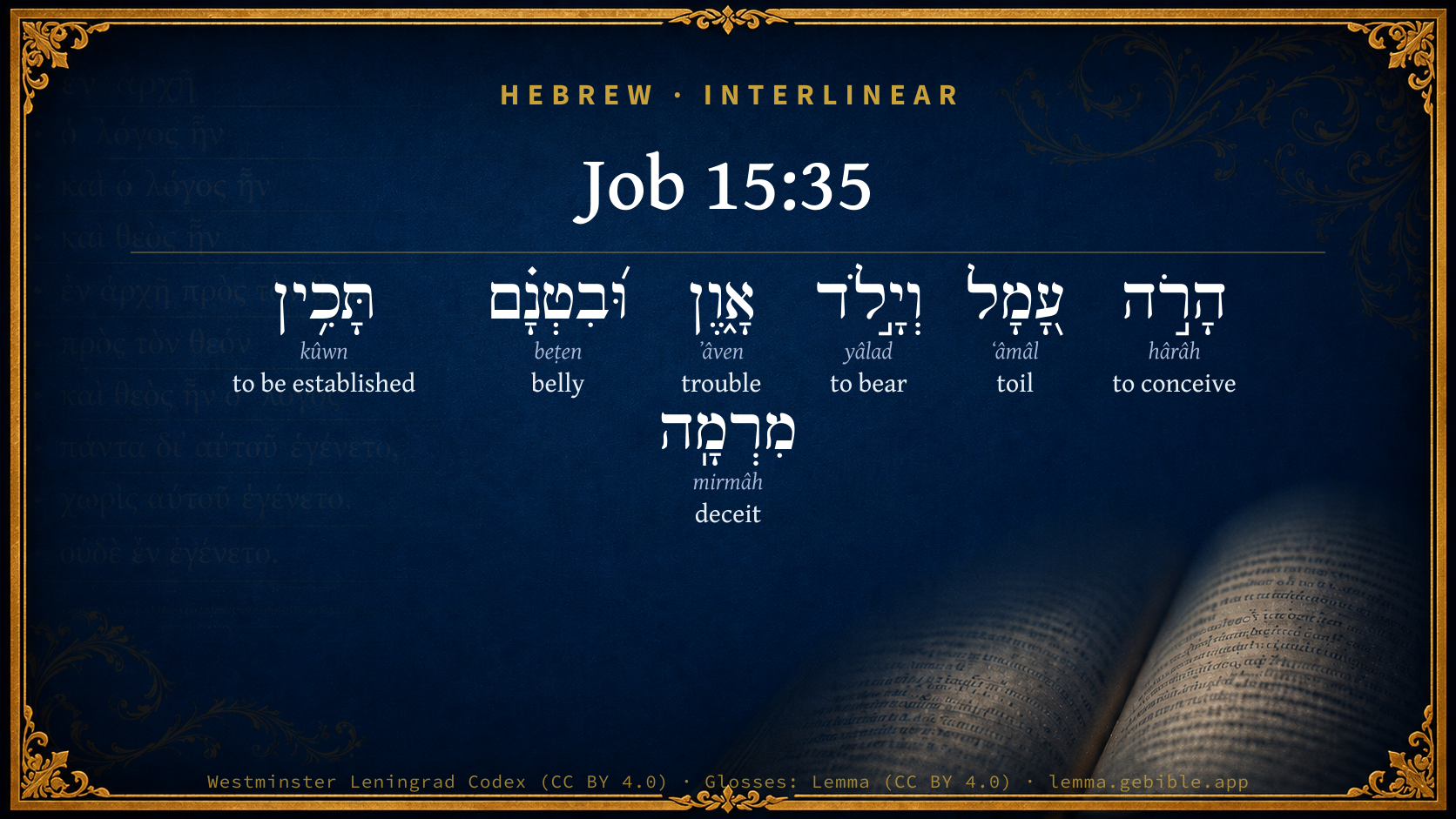
Job 15:35

Hebrew (Westminster Leningrad Codex) Job 15:35 appears in the Hebrew Old Testament. The text above is from the Westminster Leningrad Codex. Each word links to its Strong’s number, a concise gloss, and parsing drawn from the Open Scriptures Hebrew Bible morphology. Click any word for its full Brown-Driver-Briggs (BDB) entry.
Download image
Cite this verse

Job 15:35 (World English Bible). Public Domain. Lemma interlinear Bible study tool, https://lemma.gebible.app/v/job/15/35.

Show BibTeX & RIS
BibTeX
RIS
English Translation
They conceive mischief, and bring forth iniquity. Their heart prepares deceit."
World English Bible · Public Domain
Download a study sheet

One document with this verse’s original text, its word-by-word gloss line, the meaning frame, cross-references with their text, attributed commentary, and full source and license credits — printable, and it pastes into notes with its structure intact.

This verse Autodidact and up

Study sheet (.html) Plain text (.txt)

A passage Seminary Student

Up to 50 verses in one chapter. A passage sheet keeps up to 6 commentary sources and 12 cross-references per verse, in the order this page ranks them, and says so on the sheet whenever that leaves anything out. Ask for a single verse and you get the Autodidact verse sheet above.

Everything on this page stays free to read, with no account — the sheet is a download of what is already on screen, not access to it.

Want to remove ads? Support Godless Engineer
Compare translations 3

The same verse in 3 English versions, stacked beneath the original-language interlinear above. Click any original word for its lexicon entry.

Each is an independent rendering of the whole verse — the interlinear is not word-aligned to these translations.

Highlighted words mark where these versions differ — a whole-verse word diff, not a word-by-word alignment.

  • World English Bible Public Domain
    They conceive mischief, and bring forth iniquity. Their heart prepares deceit."
  • King James Version Public Domain
    They conceive mischief, and bring forth vanity, and their belly prepareth deceit.
  • unfoldingWord Literal Text CC BY-SA 4.0
    They conceive trouble and bear iniquity, and their womb fashions deceit.”

unfoldingWord Literal Text — © unfoldingWord, licensed CC BY-SA 4.0. Word-aligned USFM3 via Door43 (git.door43.org/unfoldingWord/en_ult).

Versions to compare (up to 4)

3 of 4 selected

Show all 18 translations

Every available English version of this verse, each an independent rendering of the whole verse.

  • World English Bible Public Domain
    They conceive mischief, and bring forth iniquity. Their heart prepares deceit."
  • Berean Standard Bible Public Domain
    They conceive trouble and give birth to evil; their womb is pregnant with deceit.”
  • Majority Standard Bible Public Domain
    They conceive trouble and give birth to evil; their womb is pregnant with deceit.”
  • King James Version Public Domain
    They conceive mischief, and bring forth vanity, and their belly prepareth deceit.
  • American Standard Version (1901) Public Domain
    They conceive mischief, and bring forth iniquity, And their heart prepareth deceit.
  • Revised Version (1885) Public Domain
    They conceive mischief, and bring forth iniquity, and their belly prepareth deceit.
  • Geneva Bible (1599) Public Domain
    For they conceiue mischiefe and bring foorth vanitie, and their bellie hath prepared deceite.
  • Douay-Rheims (1899) Public Domain
    He hath conceived sorrow, and hath brought forth iniquity, and his womb prepareth deceits.
  • Young's Literal Translation Public Domain
    To conceive misery, and to bear iniquity, Even their heart doth prepare deceit.
  • Literal Standard Version CC BY-SA 4.0
    To conceive misery, and to bear iniquity, || Even their heart prepares deceit.”
  • Unlocked Literal Bible CC BY-SA 4.0
    They conceive mischief and give birth to iniquity; their womb conceives deceit.”
  • unfoldingWord Literal Text CC BY-SA 4.0
    They conceive trouble and bear iniquity, and their womb fashions deceit.”
  • Darby Bible Public Domain
    They conceive mischief, and bring forth iniquity, and their belly prepareth deceit.
  • World Messianic Bible Public Domain
    They conceive mischief and produce iniquity. Their heart prepares deceit.”
  • Webster's Bible Public Domain
    They conceive mischief, and bring forth vanity, and their belly prepareth deceit.
  • Free Bible Version CC BY-SA 4.0
    They plan trouble and produce evil, giving birth to deception.”
  • Bible in Basic English Public Domain
    Evil has made them with child, and they give birth to trouble; and the fruit of their body is shame for themselves.
  • JPS Tanakh (1917) Public Domain
    They conceive mischief, and bring forth iniquity, and their belly prepareth deceit.

Literal Standard Version (2020), Covenant Press — licensed CC BY-SA 4.0. Text via the HelloAO Bible API (eBible.org). Unlocked Literal Bible (unfoldingWord) — licensed CC BY-SA 4.0. Text via the HelloAO Bible API (eBible.org). unfoldingWord Literal Text — © unfoldingWord, licensed CC BY-SA 4.0. Word-aligned USFM3 via Door43 (git.door43.org/unfoldingWord/en_ult). Free Bible Version, Dr. Jonathan Gallagher — licensed CC BY-SA 4.0. Text via the HelloAO Bible API (eBible.org).

Word by word

More ways to search: Search by grammar → Find every occurrence → Compare this word →

Practice this passage: Drill this verse → Learn its vocabulary →

About this verse

These counts appear in no published source. They are computed here, from the morphology-tagged text and Lemma’s own curated glosses. What Lemma adds →

7
words
7
distinct lemmas
Wisdom
section

Shared distinctive vocabulary

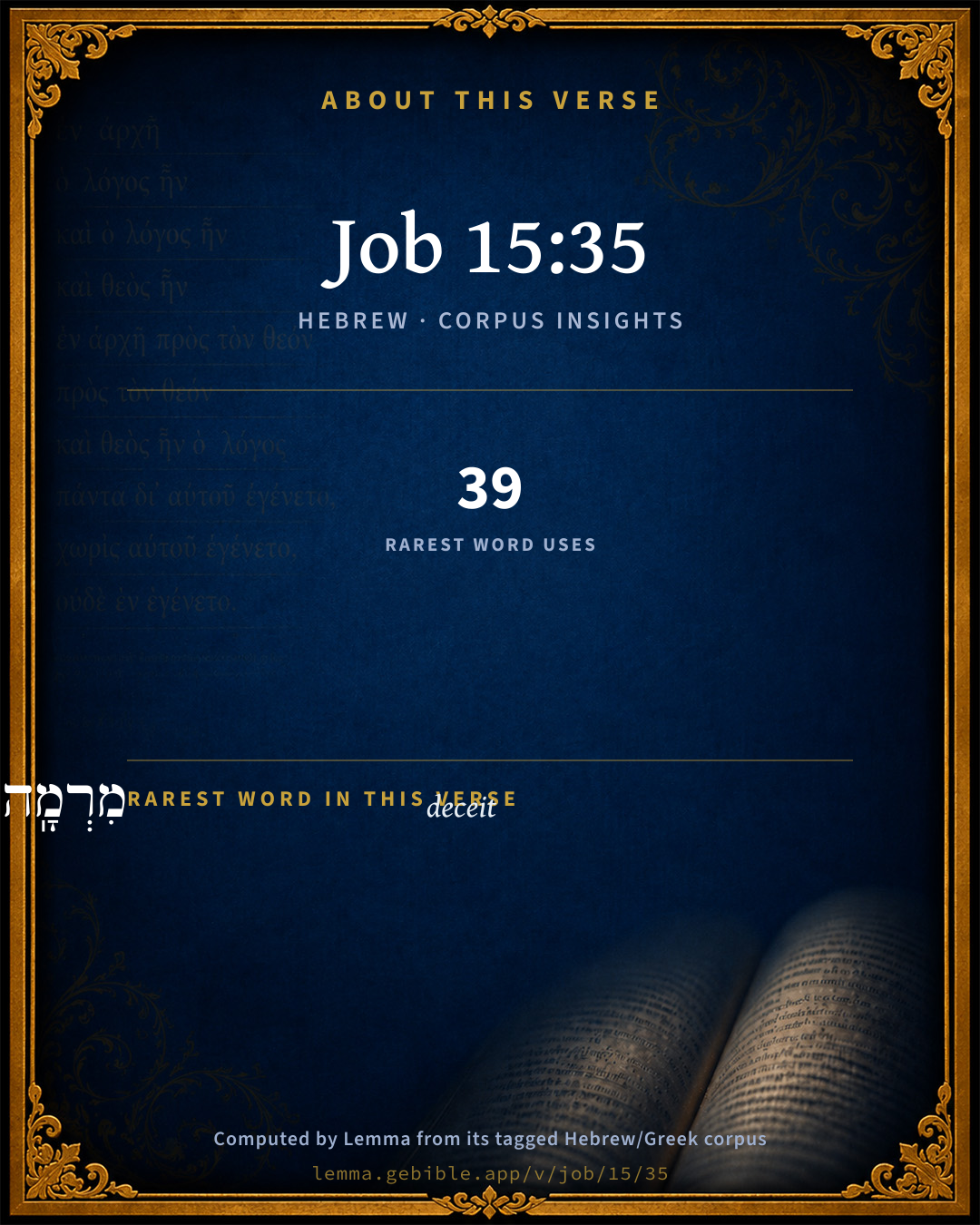
מִרְמָֽה deceit H4820 occurs in 38 verses of the Hebrew Bible. Also found in:

Grammatical profile

  • 3 verbs
  • 4 nouns

Verb forms

  • הָרֹ֣ה Qal · Infinitive Absolute
  • וְיָ֣לֹד Qal · Infinitive Absolute
  • תָּכִ֥ין Hiphil · Imperfect

Hebrew & Septuagint length

In English translation the verse runs 11 words from the Hebrew and 17 from the Septuagint (LXX English) — the Septuagint runs noticeably longer here. See the side-by-side →

A rough comparison of the two English renderings, which tokenize alike — not a word-level alignment.

Word counts can differ between the Hebrew and the Greek without any difference in meaning — e.g. the Hebrew direct-object marker אֵת has no separate Greek word, and Greek often adds the article ὁ.

Cross-references

5

Topical passages linked to Job 15:35 in the Treasury of Scripture Knowledge — connected by theme and wording, ordered by reader-vote popularity; previews shown in the World English Bible.

  • Psalms 7:14 Behold, he travails with iniquity; Yes, he has conceived mischief, And brought forth falsehood.
  • Hosea 10:13 You have plowed wickedness. You have reaped iniquity. You have eaten the fruit of lies, For you trusted in your way, in the multitude of your mighty men.
  • Isaiah 59:4–5 None sues in righteousness, and none pleads in truth: they trust in vanity, and speak lies; they conceive mischief, and bring forth iniquity.
  • James 1:15 Then the lust, when it has conceived, bears sin; and the sin, when it is full grown, brings forth death.
  • Galatians 6:7–8 Don't be deceived. God is not mocked, for whatever a man sows, that will he also reap.

Cross-references courtesy of OpenBible.info (CC BY 4.0).

Hebrew and Greek witnesses Masoretic Hebrew ↔ Greek Septuagint

The same verse in the two great witnesses to the Old Testament, shown verse-for-verse.

Here the Septuagint runs noticeably longer than the Hebrew — LXX2012 (modern English Septuagint) 17 words vs World English Bible 11. A rough length comparison of the two English translations, not a word-level alignment — read both below.

These are two independent witnesses, not word-aligned to each other, and the Septuagint is shown in lemma (dictionary) form.

Hebrew Job 15:35 Masoretic · Westminster Leningrad Codex

הָרֹ֣ה עָ֭מָל וְיָ֣לֹד אָ֑וֶן וּ֝בִטְנָ֗ם תָּכִ֥ין מִרְמָֽה

They conceive mischief, and bring forth iniquity. Their heart prepares deceit."

World English Bible · Public Domain

Greek LXX Job 15:35 Septuagint · lemma form

ἐν γαστήρ δέ λαμβάνω ὀδύνη ἀποβαίνω δέ αὐτός κενός ὁ δέ κοιλία αὐτός ὑποφέρω δόλος

And he shall conceive sorrows, and his end shall be vanity, and his belly shall bear deceit.

LXX2012 (modern English Septuagint) · Public Domain

Hebrew: Westminster Leningrad Codex (CC BY 4.0). Greek: Septuagint (public domain); English from LXX2012 (modern English Septuagint) (Public Domain). How the Septuagint differs from the Hebrew →

Commentary

Notes on Job 15:35 from classic Christian and Jewish commentators (each source and its license shown beneath its notes). The classic Christian expositions comment on the surrounding passage and are grouped to its opening verse, so a note may address several verses; the Jewish commentaries on the Tanakh (Rashi and others) are per-verse, so they appear only where the commentator wrote on this verse.

Lemma curates 59 commentaries, every one of them public domain or Creative Commons licensed, each selected and text-cleaned for this edition rather than reprinted as found. About our sources →

Trapp's Complete Commentary

John Trapp

Job 15:35 They conceive mischief, and bring forth vanity, and their belly prepareth deceit.

Ver. 35. They conceive mischief, and bring forth vanity] Here Elipbaz for a close, by an elegant and usual metaphor taken from child bearing, showeth that all such as conceive with guile or wrong to others, by that time they have reckoned their months aright, though they grow never so big, shall bring forth nothing but wind and vanity. Like as a woman that thinks she hath conceived and is deceived, pleaseth herself with the thoughts of a child, but brings forth nothing but wind, water, or some dead mass. Brentius exemplifieth this by the Papists, devising tot modos et formas confitendi et missandi, so many ways and forms of confessing and massing. Poor souls, when stung by the friars’ sermons, or otherwise troubled in mind, run to those practices for help, but all in vain; for though stilled for a while, yet conscience recoileth upon them, and, making them miserable, leaveth them desperate, as Popery is a doctrine of desperation. Meanwhile, till they are confuted by the event, wicked men please themselves not a little in their sinful conceptions; they have a kind of a sensus veneris (which Scaliger will have to be the sixth sense, besides those five commonly counted of), a sensual delight in their sinful projects, In male agendo voluptatem quaesierunt (Merlin). As one, speaking of the Council of Trent, saith, That it was carried on by the pope with such infinite guile and craft, as that themselves will even smile in the triumphs of their own wits, when they hear it but mentioned, as at a master stratagem (Spec. Europ.). These heathens (so they are called, Rev 6:2) consider not, that while they thus tumultuate they do but imagine a vain thing, Psa 2:1, and that the child’s name is vanity, as here.

And their belly prepareth deceit] Not their head, but their belly, prepareth (accurately and strongly prepareth, so the word signifieth) deceit, self deceit (so some sense it), or rather to deceive and undo others whom they cannot overcome by might, to overcome by sleight. And in these guileful projects they delight and take a contemplative kind of pleasure, as the voluptuous person doth in his lust, Psa 52:1-2.

John Trapp, A Commentary or Exposition upon All the Books of the Old and New Testament (1647–1656) — public domain. Text from a community e-Sword module.

Geneva Bible (1599)

Geneva Bible translators

And therefore all their vain devises shall turn to their own destruction.

Geneva Bible (1599) marginal notes — public domain. Text via Bolls.life.

Jamieson, Fausset & Brown

Robert Jamieson, A. R. Fausset & David Brown

Bitter irony, illustrating the "unfruitfulness" (Job 15:34) of the wicked. Their conceptions and birthgivings consist solely in mischief, &c. (Isa 33:11).

prepareth--hatcheth.

Next: Job Chapter 16

Jamieson, Fausset & Brown — Commentary Critical and Explanatory on the Whole Bible (1871) — public domain (CC PDM 1.0). Text via the HelloAO Bible API.

Adam Clarke's Commentary

Verse 35. They conceive mischief] The figure here is both elegant and impressive. The wicked conceive mischief, from the seed which Satan sows in their hearts; in producing which they travail with many pangs, (for sin is a sore labour,) and at last their womb produces fraud or deception. This is an accursed birth, from an iniquitous conception. St. James gives the figure at full length, most beautifully touched in all its parts: When lust hath conceived it bringeth forth sin; and sin, when it is finished, bringeth forth death; Jas 1:15, where see the note.

Poor Job! what a fight of affliction had he to contend with! His body wasted and tortured with sore disease; his mind harassed by Satan; and his heart wrung with the unkindness, and false accusations of his friends. No wonder he was greatly agitated, often distracted, and sometimes even thrown off his guard. However, all his enemies were chained; and beyond that chain they could not go. God was his unseen Protector, and did not suffer his faithful servant to be greatly moved.

Adam Clarke's Commentary on the Bible (1810–1826) — public domain. Text from a community e-Sword/MySword module.

The Cambridge Bible for Schools and Colleges

gen. ed. J. J. S. Perowne

35. Finally Eliphaz condenses into an expressive figure the general doctrine both of this and his former discourse, namely, that suffering and disaster follow, as by a law of nature, doing evil and wrong. In Job_4:8, “They that sow wickedness reap the same”; in this verse, “They that conceive mischief bring forth trouble”. The word rendered “vanity” here is “affliction” in Job_5:6; see notes there and on Job_4:8. Comp. Psa_7:14; Isa_33:11; Isa_59:4.

The Cambridge Bible for Schools and Colleges (gen. ed. J. J. S. Perowne; Cambridge University Press, 1878–1918) — public domain. Text from a community e-Sword module.

Albert Barnes' Notes on the Bible

They conceive mischief - The meaning of this verse is, that they form and execute plans of evil. It is the characteristic of such men that they form such plans and live to execute them, and they must abide the consequences. All this was evidently meant for Job; and few things could be more trying to a man’s patience than to sit and hear those ancient apothegms, designed to describe the wicked, applied so unfeelingly to himself.

Albert Barnes' Notes on the Bible (1834–1885) — public domain. Text from a community e-Sword/MySword module.

Haydock's Catholic Bible Commentary

Sorrow. Hebrew, "mischief." (Haydock) See Psalm vii. 15., and Isaias xlix. 4. --- The tree is known by its fruit. Eliphaz sufficiently insinuates, that he is speaking of Job. (Calmet) --- His, or "its," the congregation’s womb, ver. 34. Protestants, "their belly." (Haydock)

George Leo Haydock (1774–1849), Haydock's Catholic Family Bible and Commentary, 1859 edition — public domain. Excludes Psalms (Douay-Rheims chapter numbering differs from Protestant) and Deuterocanonical books (Catholic canon only).

Matthew Poole's English Annotations

They conceive mischief, i.e. they devise and contrive injurious and pernicious enterprises against others.

Vanity, or iniquity, or injury, or trouble; either,

1. To others; they execute what they had contrived. Or,

2. To themselves; the mischief they designed for others falleth upon their own heads, and they reap what they sowed. And their belly, i.e. their inward parts, their hearts and minds. See Poole "Job 15:2".

Prepareth deceit; either,

1. For others, whom they design to cheat; or,

2. For themselves, who whilst they seek to deceive others, shall find that they themselves are most deceived, as being deprived of all their desires and hopes wherewith they fed themselves, and cast into all those calamities which they thought to prevent by these artifices.

Matthew Poole's English Annotations on the Holy Bible (1683–1685) — public domain. Text from a community e-Sword/MySword module.

Whedon's Commentary on the Bible

Daniel D. Whedon

35. Deceit — This word is but the refrain of the entire address of Eliphaz — Job is self-deceived.

Daniel D. Whedon (gen. ed.), Commentary on the Old and New Testaments (1874–1909) — public domain. Text from a community e-Sword module.

The Pulpit Commentary

They conceive mischief, and bring forth vanity; rather, as in the margin, iniquity. And their belly prepareth deceit. Internally, i.e. in their inner nature in their heart, as we should any they make ready deceits. "The viscera," as Professor Lee observes, "are often made by the Hebrews the seat of thought."

The Pulpit Commentary (1880–1919), ed. H.D.M. Spence-Jones & Joseph S. Exell — public domain. Text from a community e-Sword module.

Rashi

Rabbi Shlomo Yitzchaki (Rashi)

They conceive trouble and bear iniquity They commit evil and are recompensed. The recompense of the birth is in accordance with the conception.

prepares makes ready.

deceit Their desire shall be converted for them into deceit.

Rashi on the Tanakh — English translations: “The Judaica Press complete Tanach with Rashi, translated by A. J. Rosenberg” (CC BY 4.0); “Pentateuch with Rashi's commentary by M. Rosenbaum and A.M. Silbermann, 1929-1934” (public domain); “The Metsudah Tanach series, Lakewood, N.J” (CC BY 4.0); and “The Book of Joshua, Metsudah Publications, 1997” (CC BY 4.0). Text via Sefaria.

Lesson kit

Teaching starters — assembled from the data on this page, not authored interpretation. Every prompt links to the verse data it draws on. Edit before teaching.

Job, in the Wisdom, opens this verse with 7 words (7 distinct Hebrew lemmas). Its most distinctive word is mirmâh (“deceit”). The Greek Septuagint runs longer here. A historical commentator’s framing appears above. Read the whole chapter for the surrounding context.

Discussion questions

  1. The word mirmâh carries the sense “deceit.” How does it shape the verse?
  2. How does Genesis 27:35, which shares the word «deceit», read alongside this verse?
  3. The Septuagint runs longer here than the Hebrew. What might account for the difference?
  4. The translations on this page render this verse differently — a whole-verse word diff, not a word-by-word alignment. What might account for the different wordings?
  5. «הָרֹ֣ה» is a Qal Infinitive Absolute verb. How does that grammatical form shape the action described?
  6. Compare how Trapp's Complete Commentary and Geneva Bible (1599) read this verse. Where do they agree or differ?

Things to notice

Reading settings

Reading text

Shown beneath each verse's original-language words.

Old Testament
Old Testament edition

Read the OT as the Masoretic Hebrew (MT) or the Greek Septuagint (LXX).

English shown for the Greek Septuagint (in the Hebrew ↔ Greek comparison).

Comparing translations? Open the Compare panel on any verse page to stack up to four side by side.