
Proverbs 8:27

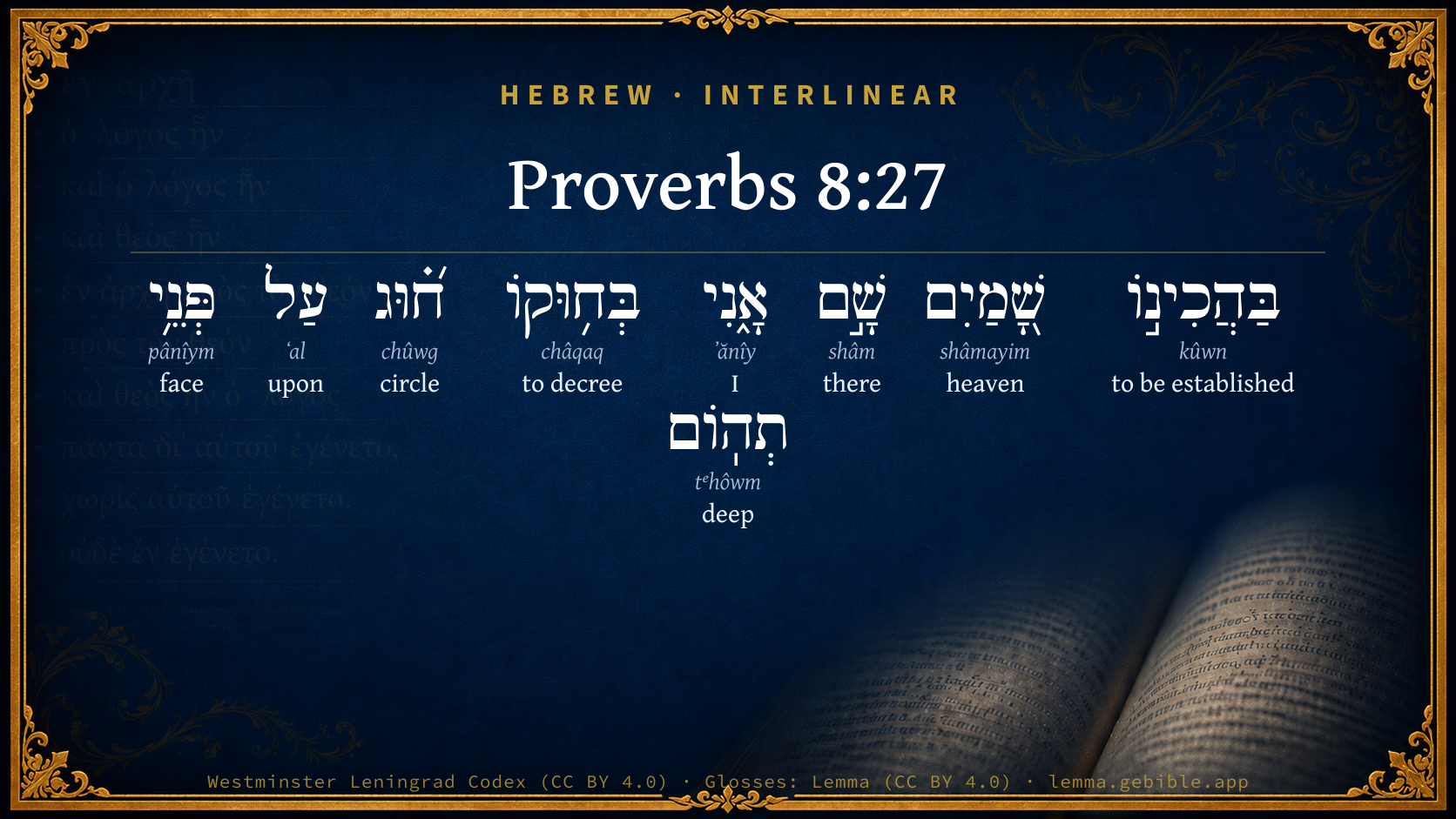
Hebrew (Westminster Leningrad Codex) Proverbs 8:27 appears in the Hebrew Old Testament. The text above is from the Westminster Leningrad Codex. Each word links to its Strong’s number, a concise gloss, and parsing drawn from the Open Scriptures Hebrew Bible morphology. Click any word for its full Brown-Driver-Briggs (BDB) entry.
Download image
Cite this verse

Proverbs 8:27 (World English Bible). Public Domain. Lemma interlinear Bible study tool, https://lemma.gebible.app/v/proverbs/8/27.

Show BibTeX & RIS
BibTeX
RIS
English Translation
When he established the heavens, I was there; When he set a circle on the surface of the deep,
World English Bible · Public Domain
Download a study sheet

One document with this verse’s original text, its word-by-word gloss line, the meaning frame, cross-references with their text, attributed commentary, and full source and license credits — printable, and it pastes into notes with its structure intact.

This verse Autodidact and up

Study sheet (.html) Plain text (.txt)

A passage Seminary Student

Up to 50 verses in one chapter. A passage sheet keeps up to 6 commentary sources and 12 cross-references per verse, in the order this page ranks them, and says so on the sheet whenever that leaves anything out. Ask for a single verse and you get the Autodidact verse sheet above.

Everything on this page stays free to read, with no account — the sheet is a download of what is already on screen, not access to it.

Want to remove ads? Support Godless Engineer
Compare translations 3

The same verse in 3 English versions, stacked beneath the original-language interlinear above. Click any original word for its lexicon entry.

Each is an independent rendering of the whole verse — the interlinear is not word-aligned to these translations.

Highlighted words mark where these versions differ — a whole-verse word diff, not a word-by-word alignment.

  • World English Bible Public Domain
    When he established the heavens, I was there; When he set a circle on the surface of the deep,
  • King James Version Public Domain
    When he prepared the heavens, I was there: when he set a compass upon the face of the depth:
  • unfoldingWord Literal Text CC BY-SA 4.0
    When he established the heavens, I there, when he inscribed a circle over the face of the watery deep,

unfoldingWord Literal Text — © unfoldingWord, licensed CC BY-SA 4.0. Word-aligned USFM3 via Door43 (git.door43.org/unfoldingWord/en_ult).

Versions to compare (up to 4)

3 of 4 selected

Show all 18 translations

Every available English version of this verse, each an independent rendering of the whole verse.

  • World English Bible Public Domain
    When he established the heavens, I was there; When he set a circle on the surface of the deep,
  • Berean Standard Bible Public Domain
    I was there when He established the heavens, when He inscribed a circle on the face of the deep,
  • Majority Standard Bible Public Domain
    I was there when He established the heavens, when He inscribed a circle on the face of the deep,
  • King James Version Public Domain
    When he prepared the heavens, I was there: when he set a compass upon the face of the depth:
  • American Standard Version (1901) Public Domain
    When he established the heavens, I was there: When he set a circle upon the face of the deep,
  • Revised Version (1885) Public Domain
    When he established the heavens, I was there: when he set a circle upon the face of the deep:
  • Geneva Bible (1599) Public Domain
    When hee prepared the heauens, I was there, when he set the compasse vpon the deepe.
  • Douay-Rheims (1899) Public Domain
    When he prepared the heavens, I was present: when with a certain law and compass he enclosed the depths:
  • Young's Literal Translation Public Domain
    In His preparing the heavens I `am' there, In His decreeing a circle on the face of the deep,
  • Literal Standard Version CC BY-SA 4.0
    In His preparing the heavens I [am] there, || In His decreeing a circle on the face of the deep,
  • Unlocked Literal Bible CC BY-SA 4.0
    I was there when he established the heavens, when he drew a circle on the surface of the deep.
  • unfoldingWord Literal Text CC BY-SA 4.0
    When he established the heavens, I there, when he inscribed a circle over the face of the watery deep,
  • Darby Bible Public Domain
    When he prepared the heavens I was there; when he ordained the circle upon the face of the deep;
  • World Messianic Bible Public Domain
    When he established the heavens, I was there. When he set a circle on the surface of the deep,
  • Webster's Bible Public Domain
    When he prepared the heavens, I was there: when he set a compass upon the face of the depth:
  • Free Bible Version CC BY-SA 4.0
    I was there when he placed the heavens in position, when he drew the horizon over the ocean,
  • Bible in Basic English Public Domain
    When he made ready the heavens I was there: when he put an arch over the face of the deep:
  • JPS Tanakh (1917) Public Domain
    When He established the heavens, I was there; when He set a circle upon the face of the deep,

Literal Standard Version (2020), Covenant Press — licensed CC BY-SA 4.0. Text via the HelloAO Bible API (eBible.org). Unlocked Literal Bible (unfoldingWord) — licensed CC BY-SA 4.0. Text via the HelloAO Bible API (eBible.org). unfoldingWord Literal Text — © unfoldingWord, licensed CC BY-SA 4.0. Word-aligned USFM3 via Door43 (git.door43.org/unfoldingWord/en_ult). Free Bible Version, Dr. Jonathan Gallagher — licensed CC BY-SA 4.0. Text via the HelloAO Bible API (eBible.org).

Word by word

More ways to search: Search by grammar → Find every occurrence → Compare this word →

Practice this passage: Drill this verse → Learn its vocabulary →

About this verse

These counts appear in no published source. They are computed here, from the morphology-tagged text and Lemma’s own curated glosses. What Lemma adds →

9
words
9
distinct lemmas
Wisdom
section

Notable vocabulary

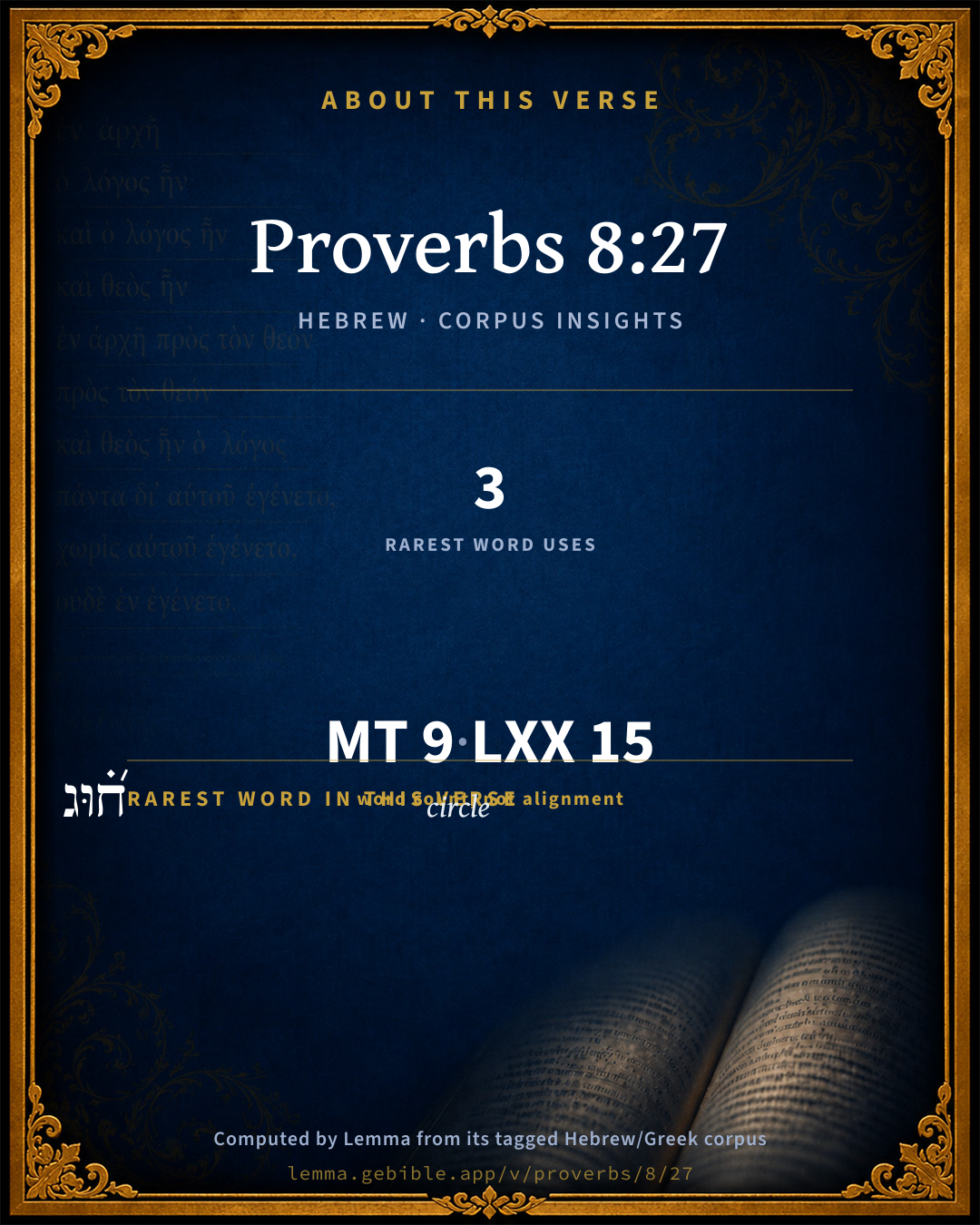
The rarest word here is ח֝֗וּג circle H2329 — appearing just 3 times in the whole Hebrew Bible.

Shared distinctive vocabulary

ח֝֗וּג circle H2329 occurs in 3 verses of the Hebrew Bible. Also found in:

Grammatical profile

  • 2 verbs
  • 4 nouns
  • 1 pronoun
  • 1 preposition
  • 1 adverb

Verb forms

  • בַּהֲכִינ֣וֹ Hiphil · Infinitive Construct
  • בְּח֥וּקוֹ Qal · Infinitive Construct

Hebrew & Septuagint length

In English translation the verse runs 19 words from the Hebrew and 19 from the Septuagint (LXX English) — the same length.

A rough comparison of the two English renderings, which tokenize alike — not a word-level alignment.

Word counts can differ between the Hebrew and the Greek without any difference in meaning — e.g. the Hebrew direct-object marker אֵת has no separate Greek word, and Greek often adds the article ὁ.

In the original languages it is 9 Hebrew tokens and 15 Greek tokens — but the two are counted differently (Hebrew bundles its prefixes and suffixes into one token; the Greek is in lemma form), so that isn’t a like-for-like length.

Cross-references

10

Topical passages linked to Proverbs 8:27 in the Treasury of Scripture Knowledge — connected by theme and wording, ordered by reader-vote popularity; previews shown in the World English Bible.

  • Job 26:10 He has described a boundary on the surface of the waters, And to the confines of light and darkness.
  • Isaiah 40:22 [It is] he who sits above the circle of the earth, and the inhabitants of it are as grasshoppers; who stretches out the heavens as a curtain, and spreads them out as a tent to dwell in;
  • Proverbs 3:19 By wisdom Yahweh founded the earth. By understanding, he established the heavens.
  • Psalms 136:5 To him who by understanding made the heavens; For his loving kindness endures forever:
  • Colossians 1:16 For by him were all things created, in the heavens and on the earth, things visible and things invisible, whether thrones or dominions or principalities or powers; all things have been created through him, and for him.
  • Isaiah 40:11 He will feed his flock like a shepherd, he will gather the lambs in his arm, and carry them in his bosom, [and] will gently lead those who have their young.
  • Jeremiah 10:12 He has made the earth by his power, he has established the world by his wisdom, and by his understanding has he stretched out the heavens:
  • Psalms 33:6 By Yahweh's word the heavens were made; All their host by the breath of his mouth.
  • Hebrews 1:2 has at the end of these days spoken to us by his Son, whom he appointed heir of all things, through whom also he made the worlds.
  • Psalms 103:19 Yahweh has established his throne in the heavens. His kingdom rules over all.

Cross-references courtesy of OpenBible.info (CC BY 4.0).

Hebrew and Greek witnesses Masoretic Hebrew ↔ Greek Septuagint

The same verse in the two great witnesses to the Old Testament, shown verse-for-verse.

These are two independent witnesses, not word-aligned to each other, and the Septuagint is shown in lemma (dictionary) form.

Hebrew Proverbs 8:27 Masoretic · Westminster Leningrad Codex

בַּהֲכִינ֣וֹ שָׁ֭מַיִם שָׁ֣ם אָ֑נִי בְּח֥וּקוֹ ח֝֗וּג עַל פְּנֵ֥י תְהֽוֹם

When he established the heavens, I was there; When he set a circle on the surface of the deep,

World English Bible · Public Domain

Greek LXX Proverbs 8:27 Septuagint · lemma form

ἡνίκα ἑτοιμάζω ὁ οὐρανός συν παραεἰμί αὐτός καί ὅτε ἀποὁρίζω ὁ ἑαυτοῦ θρόνος ἐπί ἄνεμος

When he prepared the heaven, I was present with him; and when he prepared his throne upon the winds:

LXX2012 (modern English Septuagint) · Public Domain

On this verse, The Pulpit Commentary discusses the Septuagint’s reading. Read the note in Commentary ↓

Hebrew: Westminster Leningrad Codex (CC BY 4.0). Greek: Septuagint (public domain); English from LXX2012 (modern English Septuagint) (Public Domain). How the Septuagint differs from the Hebrew →

Commentary

Notes on Proverbs 8:27 from classic Christian and Jewish commentators (each source and its license shown beneath its notes). The classic Christian expositions comment on the surrounding passage and are grouped to its opening verse, so a note may address several verses; the Jewish commentaries on the Tanakh (Rashi and others) are per-verse, so they appear only where the commentator wrote on this verse.

Lemma curates 59 commentaries, every one of them public domain or Creative Commons licensed, each selected and text-cleaned for this edition rather than reprinted as found. About our sources →

Trapp's Complete Commentary

John Trapp

Pro 8:27 When he prepared the heavens, I [was] there: when he set a compass upon the face of the depth:

Ver. 27. When he prepared the heavens.] Or, Caused them to be prepared, took order to have it done, viz., by me, who was with him, and "by whom he made the worlds." {Heb 1:1-14 : 3Jn 1:3 Col 1:16} "For the Father loveth the Son, and hath put all things into his hand." {Joh 3:35}

When he set a compass.] Or, Drew a circle round about the earth, meaning the outspread firmament of heaven. {Gen 1:6} Howbeit the Hebrews understand it of the world of angels, called by them the third world, or the third heaven; whereunto St Paul also seems to allude in 2Co 12:2.

John Trapp, A Commentary or Exposition upon All the Books of the Old and New Testament (1647–1656) — public domain. Text from a community e-Sword module.

Joseph Benson's Commentary

Pro 8:27-29. When he prepared the heavens I was there — Not as an idle spectator, but as a co-worker with my Father. When he set a compass upon the face of the depth — Of that great abyss of water and earth, mixed together, which is called both earth, and water, and the deep, (Gen 1:2,) when he made this lower world in the form of a globe. When he established the clouds above — Hebrew, strengthened them, by his word and decree, which alone upholds the clouds in the air, which otherwise would quickly be dissolved or dispersed. When he strengthened the fountains — When he shut up the several fountains in the cavities of the earth, and kept them there, as it were, by a strong hand, for the use of man and beast; of the deep — Which fountains have their originals from the deep, either from the sea, or from the abyss of waters, in the bowels of the earth. When he gave to the sea his decree — Its bounds or limits, namely, by those parts of the earth which border upon it; that the waters should not pass his commandment — Should not overflow the earth; when he appointed — Or fixed; the foundations of the earth — Hung the earth, self- balanced, upon its centre, or gave the earth its firm standing upon its foundations, notwithstanding all the assaults which the waters of the sea, or those in the bowels of the earth make against it.

Joseph Benson's Commentary on the Old and New Testaments (1811–1818) — public domain. Text from a community e-Sword module.

Tyndale Open Study Notes

Tyndale Open Resources

8:27-29 God used his wisdom to establish the created order, so wisdom can tell us how the world works and testifies to God’s greatness.

Tyndale Open Study Notes — © Tyndale Open Resources, licensed CC BY-SA 4.0. Text via the HelloAO Bible API.

Jamieson, Fausset & Brown

Robert Jamieson, A. R. Fausset & David Brown

when he set . . . depth--marked out the circle, according to the popular idea of the earth, as circular, surrounded by depths on which the visible concave heavens rested.

Jamieson, Fausset & Brown — Commentary Critical and Explanatory on the Whole Bible (1871) — public domain (CC PDM 1.0). Text via the HelloAO Bible API.

Adam Clarke's Commentary

Verse 27. When he prepared the heavens, I was there] For there is no part of the creation of God in which wisdom, skill, contrivance, are more manifest, than in the construction of the visible heavens.

When he set a compass upon the face of the depth] Does not this refer to the establishment of the law of gravitation? by which all the particles of matter, tending to a common centre, would produce in all bodies the orbicular form, which we see them have; so that even the waters are not only retained within their boundaries, but are subjected to the circular form, in their great aggregate of seas, as other parts of matter are. This is called here making a compass, בחקו חוג bechukko chug, sweeping a circle; and even this on the face of the deep, to bring the chaotic mass into form, regularity, and order.

Adam Clarke's Commentary on the Bible (1810–1826) — public domain. Text from a community e-Sword/MySword module.

Ellicott's Commentary for English Readers

(27) When he set a compass upon the face of the depth—i.e., when He stretched the vault of heaven over it: the same expression is used in Job_22:14. It is also interpreted of the circle of the horizon.

A Bible Commentary for English Readers, edited by Charles John Ellicott (1878–1897) — public domain. Text from a community e-Sword module.

The Cambridge Bible for Schools and Colleges

gen. ed. J. J. S. Perowne

27. compass] Rather, circle, R.V. text, A.V. marg. The reference is to the heavens, just mentioned, which seem to stand like a vault or dome upon the sea, marked out by the circle of the horizon on its surface. Comp. Job_22:14.

The Cambridge Bible for Schools and Colleges (gen. ed. J. J. S. Perowne; Cambridge University Press, 1878–1918) — public domain. Text from a community e-Sword module.

John Gill's Exposition

When he prepared the heavens, I was there,.... Made, beautified, and adorned them; when he gave them their form, figure, magnitude, and motion; when he garnished them with the sun, moon, and stars; then was Christ present, not as a mere spectator, but as a co-worker; see Heb 1:10; and even the third heaven, the place and state of glorified saints, prepared for them from the foundation of the world, Mat 25:34;

when he set a compass upon the face of the depth: or "compassed the waters with bounds", as Job says, Pro 26:10; or made the earth with the sea globular, which make one terraqueous globe: or "made a circle" (p); all around it, called the circle of the earth, on which he sits, Isa 40:22; this compass may design the vast expanse or firmament of heaven, which is stretched and drawn around the terraqueous globe as a canopy or curtain. Christ was with his Father on the first day's creation of the heavens; and on the second day, when the firmament was made, and was before them both.

(p) "describendo circulum", Montanus, Mercerus, Cocceius, Michaelis, Schultens.

John Gill's Exposition of the Whole Bible (1746–1763) — public domain (CC PDM 1.0). Text via the HelloAO Bible API.

Albert Barnes' Notes on the Bible

A compass - Better as in the margin and Job 22:14 (see the note), i. e., the great vault of heaven stretched over the deep seas.

Albert Barnes' Notes on the Bible (1834–1885) — public domain. Text from a community e-Sword/MySword module.

Haydock's Catholic Bible Commentary

CHAPTER VIII.

George Leo Haydock (1774–1849), Haydock's Catholic Family Bible and Commentary, 1859 edition — public domain. Excludes Psalms (Douay-Rheims chapter numbering differs from Protestant) and Deuterocanonical books (Catholic canon only).

Matthew Poole's English Annotations

I was there, not as an idle spectator, but as a co-worker with my Father.

Of the depth, i.e. of that great and deep abyss of water and earth mixed together, which is called both earth and water, and the deep, Gen 1:2. When he made this lower world round, or in the form of a globe, agreeable to the form of the upper world.

Matthew Poole's English Annotations on the Holy Bible (1683–1685) — public domain. Text from a community e-Sword/MySword module.

Whedon's Commentary on the Bible

Daniel D. Whedon

27. The teacher now ascends to the visible heavens, (the region of the atmosphere,) as they appear to the eye.

When he prepared — בהכינו, prepared, disposed, adjusted, according to their established order or laws.

The heavens — The רקיע, (rakia’h,) or expanse of Gen_1:6.

When he set a compass — In his defining the circle, or sphere: when he described a circle upon the face of the depth, תהום, (tehom,) the abyss, of the atmosphere; more probably of the apparent resting of the concave heavens, the atmosphere — the sphere of air over the abyss beneath; a poetic description in accordance with the appearance.

I was there — Hebrews, emphatic — There was I. Comp. Isa_40:22; Job_26:10. Translation, according to the sense: When he disposed the heavens there was I — when he swept (his) circle upon the face of the (great) abyss.

There is in this and the following verses a change in the form of the predicate concerning wisdom. When the antemundane period is spoken of, the ‘holam — eternity — “the beginning,” she belonged to Jehovah — she existed as the attribute of the eternal Mind. She was produced, originated, (a poetical conception of the period of actual exertion or manifestation,) when she began to act, as in the work of creation. She was there, was with him.

Daniel D. Whedon (gen. ed.), Commentary on the Old and New Testaments (1874–1909) — public domain. Text from a community e-Sword module.

The Pulpit Commentary

After asserting the pre-existence of Wisdom, the writer tells her part in the work of creation. When he prepared the heavens, I was there. When God made the firmament, and divided the waters above it and below, (Gen_1:7) Wisdom cooperated. When he set a compass upon the face of the depth. gWj (chug), "circle," or "circuit", (as Job_22:14) means the vault of heaven, conceived of as resting on the ocean which surrounds the earth, in partial accordance with the notion in Homer, who speaks of the streams of ocean flowing back into itself (aqorroov ), "Iliad," 18:399; "Odyssey," 10:508, etc. That the reference is not to the marking out a limit for the waters is plain from the consideration that this interpretation would make the verse identical with ver. 29. Thus in Isa_40:22 we have, "It is he that sitteth above the circle (chug) of the earth;" i.e. the vault of heaven that encircles the earth. Septuagint, "When he marked out (afwrize ) his throne upon the winds." The translators have referred tchom, "depth," to the waters above.

The Pulpit Commentary (1880–1919), ed. H.D.M. Spence-Jones & Joseph S. Exell — public domain. Text from a community e-Sword module.

John Wesley's Explanatory Notes

I was there - As co-worker with my Father. Depth - Of that great abyss of water and earth mixed together, which is called both earth and water and the deep, Gen. i, 2, when he made this lower world in the form of a globe.

John Wesley, Explanatory Notes Upon the Whole Bible (1754–1765) — public domain. Text via the GEBible commentary corpus.

Keil & Delitzsch

C. F. Keil & F. Delitzsch

But not only did her existence precede the laying of the foundation of the world; she was also actively taking part in the creative work:

"When He prepared the heavens, I was there,

When He measured out a circle for the mirror of the multitude of waters."

Again a sentence clothed with two designations of time. The adv. of place שׁם is used, chiefly poetically, for אז, eo tempore (Arab. thumm, in contradistinction to thamm, eo loco); but here it has the signification of place, which includes that of time: Wisdom was there when God created the world, and had then already long before that come into existence, like as the servant of Jahve, Isa 48:16, with just such a שׁם אני, says that He is there from the time that the history of nations received a new direction, beginning with Cyrus. הכין signifies to give a firm position or a definite direction. Thus Job 28:27 of Wisdom, whom the Creator places before Himself as a pattern (ideal); here, as Jer 10:12; Psa 65:7, of the setting up, restoring throughout the whole world. In the parallel member, חוּג, corresponding to שׁמים, appears necessarily to designate the circle or the vault of the heavens (Job 22:14), which, according to the idea of the Hebrews, as in Homer, rests as a half-globe on the outermost ends of the disc of the earth surrounded with water, and thus lies on the waters. Vid., Hupfeld under Psa 24:2. This idea of the ocean girdling the earth is introduced into the O.T. without its being sanctioned by it. The lxx (καὶ ὅτε ἀφώριζε τὸν ἑαυτοῦ θρόνον ἐπ ̓ ἀνέμων) appears to understand תהום of the waters above; but תהום never has this meaning, ים (Job 9:8; Job 36:30) might rather be interpreted of the ocean of the heavens. The passage in accordance with which this before us is to be expounded is Job 26:10 : He has set a limit for the surface of the waters, i.e., describing over them a circle setting bounds to their region. So here, with the exchange of the functions of the two words; when He marked out a circle over the surface of the multitude of waters, viz., to appoint a fixed region (מקוה, Gen 1:10) for them, i.e., the seas, fountains, rivers, in which the waters under the heavens spread over the earth. חקק signifies incidere, figere, to prescribe, to measure off, to consign, and directly to mark out, which is done by means of firm impressions of the graver's tools. But here this verb is without the Dagesh, to distinguish between the infinitive and the substantive חקּו (his statute or limit); for correct texts have בּחקו (Michlol 147a); and although a monosyllable follows, yet there is no throwing back of the tone, after the rule that words terminating in o in this case maintain their ultima accentuation (e.g., משׂמו אל, Num 24:23). Fleischer also finally decides for the explanation: quum delinearet circulum super abysso, when He marked out the region of the sea as with the circle.

Keil & Delitzsch — Biblical Commentary on the Old Testament (1861–1891) — public domain (CC PDM 1.0). Text via the HelloAO Bible API. (Old Testament only.)

Rashi

Rabbi Shlomo Yitzchaki (Rashi)

when He drew a circle over the face of the deep When He drew the circle of the earth over the water, to draw a boundary that it may not pass.

חוג is an expression of encircling, as in (Isa. 44: 13): “and with a compass (ובמחוגה) he rounds it.” (Compas in French, zirkel in German, as in Gen. 29: 17, Isa. 5:22, 44:13, and Job 22: 14.)

Rashi on the Tanakh — English translations: “The Judaica Press complete Tanach with Rashi, translated by A. J. Rosenberg” (CC BY 4.0); “Pentateuch with Rashi's commentary by M. Rosenbaum and A.M. Silbermann, 1929-1934” (public domain); “The Metsudah Tanach series, Lakewood, N.J” (CC BY 4.0); and “The Book of Joshua, Metsudah Publications, 1997” (CC BY 4.0). Text via Sefaria.

Lesson kit

Teaching starters — assembled from the data on this page, not authored interpretation. Every prompt links to the verse data it draws on. Edit before teaching.

Proverbs, in the Wisdom, opens this verse with 9 words (9 distinct Hebrew lemmas). Its most distinctive word is chûwg (“circle”). A historical commentator’s framing appears above. Read the whole chapter for the surrounding context.

Discussion questions

  1. How does “circle” (chûwg) shape what this verse is saying?
  2. Job 22:14 shares the word «circle» with this verse. How do the two illuminate each other?
  3. These translations render this verse differently; the difference is in the English rendering, not the original. What questions does that raise?
  4. The verb «בַּהֲכִינ֣וֹ» is Hiphil Infinitive Construct. How does its form color the action?
  5. Reading how Trapp's Complete Commentary and Joseph Benson's Commentary read this verse, where do the two commentators agree and where do they part?

Things to notice

Reading settings

Reading text

Shown beneath each verse's original-language words.

Old Testament
Old Testament edition

Read the OT as the Masoretic Hebrew (MT) or the Greek Septuagint (LXX).

English shown for the Greek Septuagint (in the Hebrew ↔ Greek comparison).

Comparing translations? Open the Compare panel on any verse page to stack up to four side by side.