
Psalms 119:73

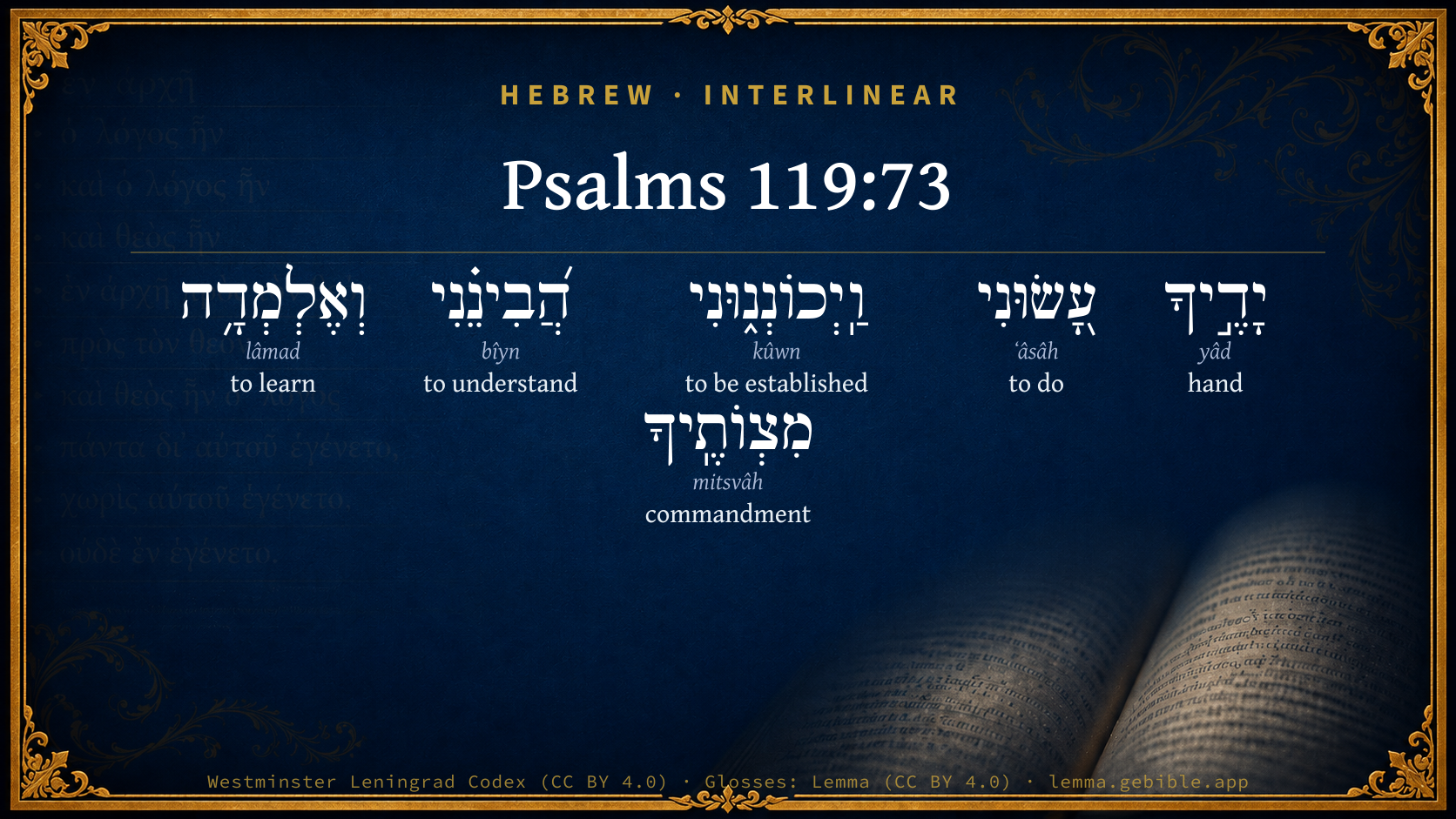
Hebrew (Westminster Leningrad Codex) Psalms 119:73 appears in the Hebrew Old Testament. The text above is from the Westminster Leningrad Codex. Each word links to its Strong’s number, a concise gloss, and parsing drawn from the Open Scriptures Hebrew Bible morphology. Click any word for its full Brown-Driver-Briggs (BDB) entry.
Download image
Cite this verse

Psalms 119:73 (World English Bible). Public Domain. Lemma interlinear Bible study tool, https://lemma.gebible.app/v/psalms/119/73.

Show BibTeX & RIS
BibTeX
RIS
English Translation
Your hands have made me and formed me. Give me understanding, that I may learn your commandments.
World English Bible · Public Domain
Download a study sheet

One document with this verse’s original text, its word-by-word gloss line, the meaning frame, cross-references with their text, attributed commentary, and full source and license credits — printable, and it pastes into notes with its structure intact.

This verse Autodidact and up

Study sheet (.html) Plain text (.txt)

A passage Seminary Student

Up to 50 verses in one chapter. A passage sheet keeps up to 6 commentary sources and 12 cross-references per verse, in the order this page ranks them, and says so on the sheet whenever that leaves anything out. Ask for a single verse and you get the Autodidact verse sheet above.

Everything on this page stays free to read, with no account — the sheet is a download of what is already on screen, not access to it.

Want to remove ads? Support Godless Engineer
Compare translations 3

The same verse in 3 English versions, stacked beneath the original-language interlinear above. Click any original word for its lexicon entry.

Each is an independent rendering of the whole verse — the interlinear is not word-aligned to these translations.

Highlighted words mark where these versions differ — a whole-verse word diff, not a word-by-word alignment.

  • World English Bible Public Domain
    Your hands have made me and formed me. Give me understanding, that I may learn your commandments.
  • King James Version Public Domain
    Thy hands have made me and fashioned me: give me understanding, that I may learn thy commandments.
  • unfoldingWord Literal Text CC BY-SA 4.0
    Your hands have made me and established me; give me understanding so that I may learn your commandments.

unfoldingWord Literal Text — © unfoldingWord, licensed CC BY-SA 4.0. Word-aligned USFM3 via Door43 (git.door43.org/unfoldingWord/en_ult).

Versions to compare (up to 4)

3 of 4 selected

Show all 17 translations

Every available English version of this verse, each an independent rendering of the whole verse.

  • World English Bible Public Domain
    Your hands have made me and formed me. Give me understanding, that I may learn your commandments.
  • Berean Standard Bible Public Domain
    Your hands have made me and fashioned me; give me understanding to learn Your commandments.
  • Majority Standard Bible Public Domain
    Your hands have made me and fashioned me; give me understanding to learn Your commandments.
  • King James Version Public Domain
    Thy hands have made me and fashioned me: give me understanding, that I may learn thy commandments.
  • American Standard Version (1901) Public Domain
    YODH. Thy hands have made me and fashioned me: Give me understanding, that I may learn thy commandments.
  • Revised Version (1885) Public Domain
    Thy hands have made me and fashioned me: give me understanding, that I may learn thy commandments.
  • Geneva Bible (1599) Public Domain
    IOD. Thine hands haue made me and fashioned me: giue mee vnderstanding therefore, that I may learne thy commandements.
  • Young's Literal Translation Public Domain
    `Yod.' Thy hands made me and establish me, Cause me to understand, and I learn Thy commands.
  • Literal Standard Version CC BY-SA 4.0
    [YOD] Your hands made me and establish me, || Cause me to understand, and I learn Your commands.
  • Unlocked Literal Bible CC BY-SA 4.0
    Your hands have made and fashioned me; give me understanding so that I may learn your commandments.
  • unfoldingWord Literal Text CC BY-SA 4.0
    Your hands have made me and established me; give me understanding so that I may learn your commandments.
  • Darby Bible Public Domain
    YOD. Thy hands have made me and fashioned me: give me understanding, and I will learn thy commandments.
  • World Messianic Bible Public Domain
    Your hands have made me and formed me. Give me understanding, that I may learn your commandments.
  • Webster's Bible Public Domain
    JOD. Thy hands have made me and fashioned me: give me understanding, that I may learn thy commandments.
  • Free Bible Version CC BY-SA 4.0
    You created me and made me what I am; help me to learn and better understand your commandments.
  • Bible in Basic English Public Domain
    JOD Your hands have made me, and given me form: give me wisdom, so that I may have knowledge of your teaching.
  • JPS Tanakh (1917) Public Domain
    JOD. Thy hands have made me and fashioned me; give me understanding, that I may learn Thy commandments.

Literal Standard Version (2020), Covenant Press — licensed CC BY-SA 4.0. Text via the HelloAO Bible API (eBible.org). Unlocked Literal Bible (unfoldingWord) — licensed CC BY-SA 4.0. Text via the HelloAO Bible API (eBible.org). unfoldingWord Literal Text — © unfoldingWord, licensed CC BY-SA 4.0. Word-aligned USFM3 via Door43 (git.door43.org/unfoldingWord/en_ult). Free Bible Version, Dr. Jonathan Gallagher — licensed CC BY-SA 4.0. Text via the HelloAO Bible API (eBible.org).

Word by word

More ways to search: Search by grammar → Find every occurrence → Compare this word →

Practice this passage: Drill this verse → Learn its vocabulary →

וְאֶלְמְדָ֥ה
lâmad
H3925
“and · to learn”
Conjunction + Verb, Qal, Cohortative, 1st Person, Common, Singular
Part of Speech
Conjunction + Verb
Stem
Qal
Form
Cohortative
Person
1st Person
Gender
Common
Number
Singular
Full BDB Definition

Origin: a primitive root

TWOT: 1116

to learn. teach, exercise in - (Qal) to learn - (Piel) to teach - (Pual) to be taught, be trained
  1. יָדֶ֣יךָ yâd H3027 “hands · your” Noun, Common, Both, Dual, Construct + Suffix, Personal, 2nd Person, Masculine, Singular
  2. עָ֭שׂוּנִי ʻâsâh H6213 “to do · me” Verb, Qal, Perfect, 3rd Person, Common, Plural + Suffix, Personal, 1st Person, Common, Singular
  3. וַֽיְכוֹנְנ֑וּנִי kûwn H3559 “and · to be established · me” Conjunction + Verb, Polel, Imperfect, 3rd Person, Masculine, Plural + Suffix, Personal, 1st Person, Common, Singular
  4. הֲ֝בִינֵ֗נִי bîyn H995 “understand · me” Verb, Hiphil, Imperative, 2nd Person, Masculine, Singular + Suffix, Personal, 1st Person, Common, Singular
  5. מִצְוֺתֶֽיךָ mitsvâh H4687 “commandments · your” Noun, Common, Feminine, Plural, Construct + Suffix, Personal, 2nd Person, Masculine, Singular

About this verse

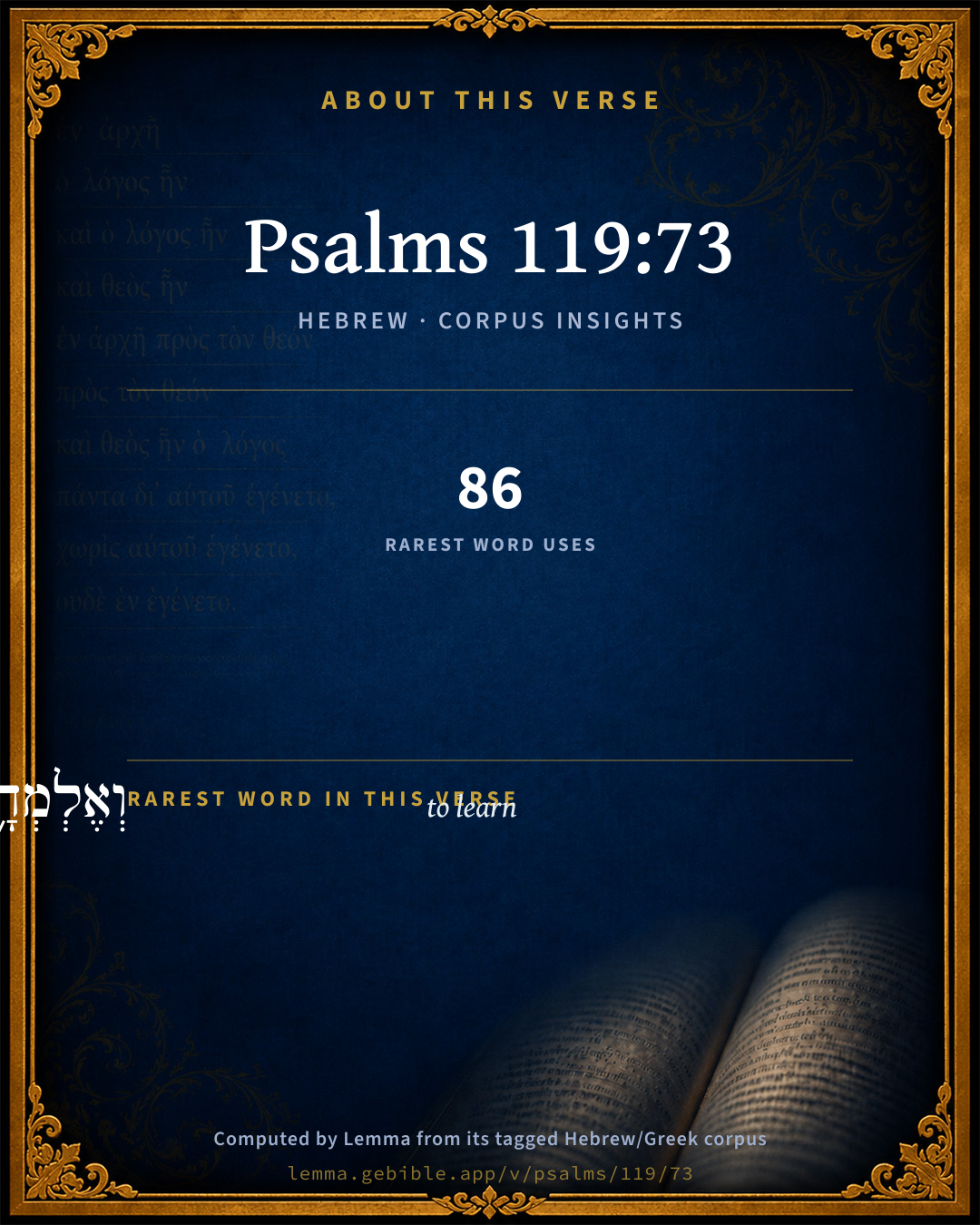
These counts appear in no published source. They are computed here, from the morphology-tagged text and Lemma’s own curated glosses. What Lemma adds →

6
words
6
distinct lemmas
Wisdom
section

Grammatical profile

  • 4 verbs
  • 2 nouns

Verb forms

  • עָ֭שׂוּנִי Qal · Perfect
  • וַֽיְכוֹנְנ֑וּנִי Polel · Imperfect
  • הֲ֝בִינֵ֗נִי Hiphil · Imperative
  • וְאֶלְמְדָ֥ה Qal · Cohortative

Hebrew & Septuagint length

In English translation the verse runs 17 words from the Hebrew and 16 from the Septuagint (LXX English) — closely comparable.

A rough comparison of the two English renderings, which tokenize alike — not a word-level alignment.

Word counts can differ between the Hebrew and the Greek without any difference in meaning — e.g. the Hebrew direct-object marker אֵת has no separate Greek word, and Greek often adds the article ὁ.

Cross-references

16

Topical passages linked to Psalms 119:73 in the Treasury of Scripture Knowledge — connected by theme and wording, ordered by reader-vote popularity; previews shown in the World English Bible.

  • Psalms 139:14–16 I will give thanks to you, For I am fearfully and wonderfully made. Your works are wonderful. My soul knows that very well.
  • Job 31:15 Didn't he who made me in the womb make him? Didn't one fashion us in the womb?
  • Psalms 138:8 Yahweh will fulfill that which concerns me; Your loving kindness, Yahweh, endures forever. Don't forsake the works of your own hands.
  • Psalms 111:10 The fear of Yahweh is the beginning of wisdom. All those who do his work have a good understanding. His praise endures forever!
  • 2 Timothy 2:7 Consider what I say, and may the Lord give you understanding in all things.
  • Job 32:8 But there is a spirit in man, And the breath of the Almighty gives them understanding.
  • Psalms 119:125 I am your servant. Give me understanding, That I may know your testimonies.
  • 1 John 5:20 We know that the Son of God has come, and has given us an understanding, that we know him who is true, and we are in him who is true, in his Son Jesus Christ. This is the true God, and eternal life.
  • Psalms 100:3 Know that Yahweh, he is God. It is he who has made us, and we are his. We are his people, and the sheep of his pasture.
  • Psalms 119:34 Give me understanding, and I will keep your law. Yes, I will obey it with my whole heart.
  • 2 Chronicles 2:12 Huram said moreover, Blessed be Yahweh, the God of Israel, that made heaven and earth, who has given to David the king a wise son, endowed with discretion and understanding, that should build a house for Yahweh, and a house for his kingdom.
  • Psalms 119:169 Let my cry come before you, Yahweh. Give me understanding according to your word.
  • James 3:18 Now the fruit of righteousness is sown in peace by those who make peace.
  • 1 Chronicles 22:12 May Yahweh give you discretion and understanding, and put you in charge of Israel; that so you may keep the law of Yahweh your God.
  • Job 10:8–11 'Your hands have framed me and fashioned me altogether; Yet you destroy me.
  • Psalms 119:144 Your testimonies are righteous forever. Give me understanding, that I may live.

Cross-references courtesy of OpenBible.info (CC BY 4.0).

Hebrew and Greek witnesses Masoretic Hebrew ↔ Greek Septuagint

The same verse in the two great witnesses to the Old Testament, shown verse-for-verse.

You’re reading Greek Psalm 118 (Hebrew Psalm 119). The Septuagint counts the superscription, so verse numbers can differ from the Hebrew — chapter-level alignment, not verse-by-verse. Numbering follows Rahlfs.

These are two independent witnesses, not word-aligned to each other, and the Septuagint is shown in lemma (dictionary) form.

Hebrew Psalms 119:73 Masoretic · Westminster Leningrad Codex

יָדֶ֣יךָ עָ֭שׂוּנִי וַֽיְכוֹנְנ֑וּנִי הֲ֝בִינֵ֗נִי וְאֶלְמְדָ֥ה מִצְוֺתֶֽיךָ

Your hands have made me and formed me. Give me understanding, that I may learn your commandments.

World English Bible · Public Domain

Greek LXX Greek Psalm 118:73 Septuagint · lemma form

ιωθ ὁ χείρ σύ ποιέω ἐγώ καί πλάσσω ἐγώ συνέτιζω ἐγώ καί μανθάνω ὁ ἐντολή σύ

Your hands have made me, and fashioned me: instruct me, that I may learn your commandments.

LXX2012 (modern English Septuagint) · Public Domain

Hebrew: Westminster Leningrad Codex (CC BY 4.0). Greek: Septuagint (public domain); English from LXX2012 (modern English Septuagint) (Public Domain). How the Septuagint differs from the Hebrew →

Commentary

Notes on Psalms 119:73 from classic Christian and Jewish commentators (each source and its license shown beneath its notes). The classic Christian expositions comment on the surrounding passage and are grouped to its opening verse, so a note may address several verses; the Jewish commentaries on the Tanakh (Rashi and others) are per-verse, so they appear only where the commentator wrote on this verse.

Lemma curates 59 commentaries, every one of them public domain or Creative Commons licensed, each selected and text-cleaned for this edition rather than reprinted as found. About our sources →

Trapp's Complete Commentary

John Trapp

Psa 119:73 JOD. Thy hands have made me and fashioned me: give me understanding, that I may learn thy commandments.

Ver. 73. Thy hands have made me and fashioned me] Plasmaverunt, which Basil interpreteth of the body curiously wrought by God, Psa 139:15-16 as "made" of the soul; q.d. Thou art my Maker, I would thou shouldest be my Master ( Formaverunt, firmaverunt). A body hast thou fitted me, Heb 10:5, a reasonable soul also hast thou given me, capable of salvation; I am an understanding creature still; neither have I lost my passive capacity of thy renewing grace.

Give me understanding] And thereunto add sincere affection, Psa 119:80, that these may run parallel in my heart, and mutually transfuse life and vigour into one another.

John Trapp, A Commentary or Exposition upon All the Books of the Old and New Testament (1647–1656) — public domain. Text from a community e-Sword module.

The Biblical Illustrator

Joseph S. Exell

Psa_119:73

Thy hands have made me and fashioned me: give me understanding.

The right attitude of man in relation to God

I. Recognizing God as the author of his existence. Thy hands. I am not the creature of chance or of necessity, the product of the blind forces of nature. I recognize Thy hands, the hands of infinite skill and goodness. He made us.

1. Then, to study our constitutions is to study Him.

2. Then His claims upon our activities are absolute. No one has a right to us but Himself. We are His.

II. Looking to God as the educator of his spirit. Thou hast commandments concerning us--laws that should rule all the powers with which Thou hast endowed us. I am ignorant of them, enlighten me, I beseech Thee. Lord, what wilt Thou have me to do? Thou hast given me a capacity for moral knowledge; but that knowledge I have not. I am in the dark. Kindle within me that light that will enable me to go the way Thou wouldst have me go. I have a wonderful nature that I know not how to use. Give me understanding.

III. Imploring God as the perfecter of his being. He knew that God made him for the purpose, and that that purpose could only be realized by correct moral information, a practical obedience to His will. And hence he prays, Give me understanding.

1. This plea is rational. It is from the less to the greater. Thou hast made me for Thyself. I want to be Thine by my own willing and devoted service. Thou madest me without my choice or consent. I entreat Thee to give me that, to make my being a blessing to myself and an honour to Thee.

2. It is a powerful plea. It is the cry of a child in distress to a tender parent. It is more than this--it is the cry of a frail, ignorant, dying creature to the loving and almighty Author of its being. I should not have been, had it not been for Thee. Oh, grant me what I ask, and make my being blessed.

3. It is a loyal plea. What I ask for is, not the gratification of my own selfish wishes, but that; I may learn Thy commandments--learn them--practically learn them. (Homilist.)

The Creator-Guide

Long ago a laconic moralist gave this summary of wisdom, Live as you were meant to live. This sentence recognizes the fact that there is a purpose the discovery of which is mans first anxiety and the accomplishment of which is mans supreme aim. Now, our Bible tells us that we have to do Gods will, to serve God, to glorify God, to do good, to do right, to find and to keep in the truth. I think the significance of these phrases will appear if we consider some workmanship of man in relation to its makers purpose. At South Kensington there is a clock made above 500 years ago under the hammer of a Glastonbury monk. It has measured out the moments of fifteen generations of men That piece of mechanism has done and is still doing its makers will. It has served its makers purpose. It fulfils his praiseworthy intention and so praises him. Every stroke of its pendulum is to the glory of the Glastonbury smith. It keeps (so to say) its makers commandments. What he meant it to do it has done well and truly. Think of this clockwork of the brain, this delicate mechanism of thought and feeling. Year in, year out, the restless wheels of desire and feeling, of thought and passion, play into one another and mark results on the solemn dial of life. Matters may be so mismanaged as to put the machinery into a whirl of wild confusion. It is, on the other hand, possible to secure such inward adjustment, such balance, such regulative control, such true impulse, as to make the soul a splendid harmony and the life a utility which men acknowledge with reverence and benediction. With Gods work, as with mans, the essential thing is to be true to the Makers purpose. There is a commandment--a Divine intention to which every one must be true. Thy hands have made me, and fashioned me; give me understanding of Thy will and commandment. Somewhere, at the outset of human story, God did give this knowledge to His creatures. Along the line of the Jewish people that knowledge came in a pure stream--pure compared with its deep pollution as it ran through other histories. Mans necessary life-knowledge has two branches. If for the general understanding of religion it is essential to throw the soul directly upon God, much more is that necessary for particular understanding of our individual perplexities. Take the case of the captain of a ship. Education and experience have given him general knowledge of the capabilities of ships, of the ways of sailors, of navigation, of coast-lines, storms and signals. These are the mariners alphabet, and correspond to the Christians general knowledge of God and life of the Saviour and the soul. But imagine the ships captain on a voyage to a new port, in a new ship, with a fresh sort of cargo and a strange crew. His ship gets into storms, or among icebergs. There are break-downs and accidents to ship and tackling. Besides his general sailor lore the captain obviously requires presence of mind, tact, resource, the gift to see what needs to be done, and what can be done in every new emergency. Such readiness for the event corresponds to the Christians application of religious truth to the perplexities of his personal career. About the generalities of religion we are fairly informed. We know what is right and what is wrong. We understand the perils of temptation and we know the grace of God. We know the ways of the world, and we know the truths of Holy Scripture. All this is our miscellaneous sailing-lore. But every day we make a new voyage and venture, in which sudden accidents may happen. Storm or collision may come. We may find ourselves confronted by new circumstances, and we want the quickly-acting instinct of Christian temper so as to be able to say none of these things move me. Can we meet difficulty with patience? Can we take failure with hopefulness? Can we be meek and yet strong, pleasant and yet good, gentle and yet firm? Can we so pass through things temporal as to fail not of things that are eternal? For all this we need more than general knowledge of Divine truth; we require that the power of Christ shall rest upon us. Give me understanding, that for each act and for each step I may know Thy commandment. Nor is this the end of the matter. There are emergencies and perplexities which form a class by themselves. We come to places when it is hard to know which is right--the way on the right hand or the way on the left hand. Infallibility does not belong even to the man whose soul is nearest to God. Insurance against ever making a wrong decision, or taking a wrong step is not gained by the most Christian sincerity and faith. Through all his campaigns the Duke of Wellington never made a serious mistake. Sometimes good men show similar wisdom in the conduct of lifes stern warfare, but there is no guarantee for this clear and precise practical judgment. Often you must Do the sum to prove it. Do it carefully. Do it honestly. Do it for the most part on your knees. The rest is with God. They cry unto the Lord in their trouble and He delivereth them out of all their distresses. If any man lack wisdom let him ask of God. Keep near to the source of light and direction, not merely in the acts and offices of devotion but in all the sincere aims of daily conduct. (S. Gregory.)

God our Maker

Thomas Carlyle was once present when a conversation was started between some friends on the subject of evolution. Having quietly listened for a time, the Chelsea sage seized the opportunity of a pause to remark, with considerable solemnity and emphasis, Gentlemen, you seem well pleased to trace your descent from a tadpole, and an ape, but I would say with David, Lord, Thou hast made me a little lower than the angels. (J. H. Hitchens, D. D.)

The Biblical Illustrator, edited by Joseph S. Exell (c. 1880s–1900s) — public domain. Text from a community e-Sword module.

The Treasury of David

Charles H. Spurgeon

Ver. 73. Thy hands have made me and fashioned me. It is profitable to remember our creation, it is pleasant to see that the divine hand has had much to do with us, for it never moves apart from the divine thought. It excites reverence, gratitude, and affection towards God when we view him as our Maker, putting forth the careful skill and power of his hands in our forming and fashioning. He took a personal interest in us, making us with his own hands; he was doubly thoughtful, for he is represented both as making and moulding us. In both giving existence and arranging existence he manifested love and wisdom; and therefore we find reasons for praise, confidence, and expectation in our being and well being.

Give me understanding, that I may learn thy commandments. As thou hast made me, teach me. Here is the vessel which thou hast fashioned; Lord, fill it. Thou hast given me both soul and body; grant me now thy grace that my soul may know thy will, and my body may join in the performance of it. The plea is very forcible; it is an enlargement of the cry, "Forsake not the work of thine own hands." Without understanding the divine law and rendering obedience to it we are imperfect and useless; but we may reasonably hope that the great Potter will complete his work and give the finishing touch to it by imparting to it sacred knowledge and holy practice. If God had roughly made us, and had not also elaborately fashioned us, this argument would lose much of its force; but surely from the delicate art and marvellous skill which the Lord has shown in the formation of the human body, we may infer that he is prepared to take equal pains with the soul till it shall perfectly bear his image.

A man without a mind is an idiot, the mere mockery of a man; and a mind without grace is wicked, the sad perversion of a mind. We pray that we may not be left without a spiritual judgment: for this the Psalmist prayed in verse 66, and he here pleads for it again; there is no true knowing and keeping of the commandments without it. Fools can sin; but only those who are taught of God can be holy. We often speak of gifted men; but he has the best gifts to whom God has given a sanctified understanding wherewith to know and prize the ways of the Lord. Note well that David's prayer for understanding is not for the sake of speculative knowledge, and the gratification of his curiosity: he desires an enlightened judgment that he may learn God's commandments, and so become obedient and holy. This is the best of learning. A man may abide in the College where this science is taught all his days, and yet cry out for ability to learn more. The commandment of God is exceeding broad, and so it affords scope for the most vigorous and instructed mind: in fact, no man has by nature an understanding capable of compassing so wide a field, and hence the prayer, "give me understanding"; as much as to say I can learn other things with the mind I have, but thy law is so pure, so perfect, spiritual and sublime, that I need to have my mind enlarged before I can become proficient in it. He appeals to his Maker to do this, as if he felt that no power short of that which made him could make him wise unto holiness. We need a new creation, and who can grant us that but the Creator himself? He who made us to live must make us to learn; he who gave us power to stand must give us grace to understand. Let us each one breathe to heaven the prayer of this verse ere we advance a step further, for we shall be lost even in these petitions unless we pray our way through them, and cry to God for understanding.

In this section each verse begins with the Hebrew letter Jori, or i, the smallest letter in the Hebrew alphabet, called in Mt 5:18, jot; one jot or tittle shall in no wise pass from the law. Albert Barnes.

Ver. 73-80. The usual account of this section, as given by the medieval theologians, is that it is the prayer of man to be restored to his state of original innocence and wisdom by being conformed to the image of Christ. And this squares with the obvious meaning, which is partly a petition for divine grace and partly an assertion that the example of piety and resignation in trouble is attractive enough to draw men's hearts on towards God, a truth set forth at once by the Passion, and by the lives of all those saints who have tried to follow it. Neale and Littledale.

Ver. 73. Thy hands have made me and fashioned me, etc. This verse hath a petition for understanding, and a reason with it: I am the workmanship of thine hands, therefore give me understanding. There is no man but favours the works of his hands. And shall not the. Lord much more love his creatures, especially man, his most excellent creature? Whom, if ye consider according to the fashion of his body, ye shall find nothing on earth more precious than he; but in that which is not seen, namely, his soul, he is much more beautiful. So you see, David's reasoning is very effectual; all one as if he should say as he doth elsewhere, "Forsake not, O Lord, the work of thine hands"; thou art my author and maker; thine help I seek, and the help of none other.

No man can rightly seek good things from God, if he consider not what good the Lord hath already done to him. But many are in this point so ignorant, that they know not how wonderfully God did make them; and therefore can neither bless him, nor seek from him, as from their Creator and Conserver. But this argument, drawn from our first creation, no man can rightly use, but he who is through grace partaker of the second creation; for all the privileges of our first creation we have lost by our fall. So that now by nature it is no comfort to us, nor matter of our hope, that God did make us; but rather matter of our fear and distrust, that we have mismade ourselves, have lost his image, and are not now like unto that which God created us in the beginning. William Cowper.

Ver. 73. Thy hands have made me and fashioned me, etc. Mark here two things: first, that in making his prayer for holy understanding, he justly accuseth himself and all others of blindness, which proceeded not from the Creator, but from man corrupted. Secondly, that even from his creation he conceived hope that God would continue his work begun in him, because God leaveth not his work, and therefore he begs God to bestow new grace upon him, and to finish that which he had begun in him. Thomas Wilcocks, 1586.

Ver. 73. Hugo ingeniously notices in the different verbs of this verse the particular vices to be shunned: ingratitude, when it is said, "Thy hands have made me"; pride, "and fashioned me"; confidence in his own judgment, "give me understanding"; prying inquisitiveness, "that I may learn thy commandments."

Ver. 73. Thy hands. Hilary and Ambrose think that by the plural "hands" is intimated that there is a more exact and perfect workmanship in man, and as if it were with greater labour and skill he had been formed by God, because after the image and likeness to God: and that it is not written that any other thing but man was made by God with both hands, for he saith in Isaiah, "Mine hand also hath laid the foundation of the earth": Isa 48:13. John Lorinus, 1569-1634.

This, however, is an error, as Augustine notes; for it is written, "The heavens are the work of thine hands." Ps 102:25. C.H.S.

Ver. 73. Thy hands. Oh, look upon the wounds of thine hands, and forget not the work of thine hands: so Queen Elizabeth prayed. John Trapp.

Ver. 73. Some refer the verb hyhn, "made, "to the soul, yhns, "fashioned, "to the body. D.H. Mollerus.

Ver. 73. Made me and fashioned me: give me understanding. The greatness of God is no hindrance to his intercourse with us, for one special part of the divine greatness is to be able to condescend to the littleness of created beings, seeing that creaturehood must, from its very name, have this littleness; inasmuch as God must ever be God, and man must ever be man: the ocean must ever be the ocean, the drop must ever be the drop. The greatness of God compassing our littleness about, as the heavens the earth, and fitting into it on every side, as the air into all parts of the earth, is that which makes the intercourse so complete and blessed: "In his hand is the soul of every living thing, and the breath of all mankind" (Job 12:10). Such is his nearness to, such is his intimacy with, the works of his hands. It is nearness, not distance, that the name Creator implies; and the simple fact of his having made us is the assurance of his desire to bless us and to hold intercourse with us. Communication between the thing made and its maker is involved in the very idea of creation. "Thy hands have made me and fashioned me: give we understanding, that I may learn thy commandments." "Faithful Creator" is his name (1Pe 4:19), and as such we appeal to him, "Forsake not the work of thine own hands" (Ps 138:8). Horatius Bonar, in "The Rent Veil", 1875.

Ver. 73. Give we understanding, etc. The book of God is like the apothecary's shop, there is no wound but therein is a remedy; but if a stranger come unto the apothecary's shop, though all these things be there, vet he cannot tell where they are, but the apothecary himself knoweth; so in the Scriptures, there are cures for any infirmities; there is comfort against any sorrows, and by conferring chapter with chapter, we shall understand them. The Scriptures are not wanting to us, but we to ourselves; let us be conversant in them, and we shall understand them, when great clerks who are negligent remain in darkness. Richard Stock.

Ver. 73. Give me understanding. Let us pray unto God that he would open our understandings, that as he hath given us consciences to guide us, so also he would give eyes to these guides that they may be able to direct us aright. The truth is, it is God only that can soundly enlighten our consciences; and therefore let us pray unto him to do it. All our studying, and hearing, and reading, and conferring will never be able to do it; it is only in the power of him who made us to do it. He who made our consciences, he only can give them this heavenly light of true knowledge and right understanding; and therefore let us seek earnestly to him for it. William Fenner, 1600-1640.

Ver. 73. That I may learn thy commandments. That he might learn them so as to know the sense and meaning of them, their purity and spirituality; and so as to do them from a principle of love, in faith, and to the glory of God: for it is not a bare learning of them by heart or committing them to memory, nor a mere theory of them, but the practice of them in faith and love, which is here meant. John Gill.

Ver. 73-74. From these verses, learn,

1. Albeit nothing can satisfy unbelief, yet true faith will make use of the most common benefit of creation to strengthen itself: "Thine hands have made me and fashioned me."

2. It is a good way of reasoning with God, to ask another gift, because we have received one; and because he hath given common benefits, to ask that he would give us also saving graces: "Thy hands have made me and fashioned me: give me understanding, that I may learn thy commandments."

3. Seeing that God is our Creator, and that the end of our creation is to serve God, we may confidently ask whatsoever grace may enable us to serve him, as the Psalmist's example doth teach us...

4. It should be the joy of all believers to see one of their number sustained and borne up in his sufferings; for in the proof and example of one sufferer a pawn is given to all the rest, that God will help them in like case: "They that fear thee will be glad when they see me." David Dickson.

Outlines Upon Keywords of the Psalm, By Pastor C. A. Davis.

Ver. 73-80. Natural and spiritual creation. The Psalmist prays to the Creator for spiritual life or "understanding" (Ps 119:73), he will then be welcomed by the spiritual (Ps 119:74). He submissively receives affliction for spiritual training (Ps 119:75-77), deprecates the hostility of the proud (Ps 119:78), craves the company of the spiritual (Ps 119:79), and prays for heart soundness (Ps 119:80).

Ver. 73.

1. Consider the Lord's great care in our creation.

2. See in it a reason for his perfecting the new creation within us.

3. Observe the method of this perfecting.

Psalms 119:74*

Charles H. Spurgeon's The Treasury of David (1869–1885) — public domain. Psalms only. Text from a community e-Sword/MySword module.

Joseph Benson's Commentary

JOD.

Psa 119:73. Thy hands have made me, &c. — Desert not then thy own workmanship, that neither has nor hopes for any thing but from thy almighty power. Being thy creature, I know that, as such, I am obliged to serve and obey thee with all my might: which that I may do aright, give me the understanding and aid of which I stand in need.

Joseph Benson's Commentary on the Old and New Testaments (1811–1818) — public domain. Text from a community e-Sword module.

Keil & Delitzsch

C. F. Keil & F. Delitzsch

The eightfold Jod. God humbles, but He also exalts again according to His word; for this the poet prays in order that he may be a consolatory example to the God-fearing, to the confusion of his enemies. It is impossible that God should forsake man, who is His creature, and deny to him that which makes him truly happy, viz., the understanding and knowledge of His word. For this spiritual gift the poet prays in Psa 119:73 (cf. on 73a, Deu 32:6; Job 10:8; Job 31:15); and he wishes in Psa 119:74 that all who fear God may see in him with joy an example of the way in which trust in the word of God is rewarded (cf. Psa 34:3; Psa 35:27; Psa 69:33; Psa 107:42, and other passages). He knows that God's acts of judgment are pure righteousness, i.e., regulated by God's holiness, out of which they spring, and by the salvation of men, at which they aim; and he knows that God has humbled him אמוּנה (accus. adverb. for בּאמוּנה), being faithful in His intentions towards him; for it is just in the school of affliction that one first learns rightly to estimate the worth of His word, and comes to feel its power. But trouble, though sweetened by an insight into God's salutary design, is nevertheless always bitter; hence the well-justified prayer of Psa 119:76, that God's mercy may notwithstanding be bestowed upon him for his consolation, in accordance with the promise which is become his (ל as in Psa 119:49), His servant's. עוּת, Psa 119:78, instead of being construed with the accusative of the right, or of the cause, that is perverted, is construed with the accusative of the person upon whom such perversion of right, such oppression by means of misrepresentation, is inflicted, as in Job 19:6; Lam 3:36. Chajug' reads עוּדוּני as in Psa 119:61. The wish expressed in Psa 119:79 is to be understood according to Psa 73:10; Jer 15:19, cf. Pro 9:4, Pro 9:16. If instead of וידעי (which is favoured by Psa 119:63), we read according to the Chethb וידעוּ (cf. Psa 119:125), then what is meant by ישׁוּבוּ לּי is a turning towards him for the purpose of learning: may their knowledge be enriched from his experience. For himself, however, in Psa 119:80 he desires unreserved, faultless, unwavering adherence to God's word, for only thus is he secure against being ignominiously undeceived.

Keil & Delitzsch — Biblical Commentary on the Old Testament (1861–1891) — public domain (CC PDM 1.0). Text via the HelloAO Bible API. (Old Testament only.)

J. A. Alexander on Psalms

Joseph Addison Alexander

73. (Psa 119:73) Thy hands made me and fashioned me; make me understand and let me learn thy commandments. As I owe my existence to thy power, so too I rely upon thy grace for spiritual illumination. Compere Deu 32:6. Fashioned, literally fixed, established, i.e. framed my constitution as it is.

Joseph Addison Alexander, The Psalms Translated and Explained (1850) — public domain. Text from a community e-Sword module.

Tyndale Open Study Notes

Tyndale Open Resources

119:73-80 Yodh (י): In this prayer for comfort and compassion, the psalmist commits himself to his Creator, who has afflicted him. He wants God to pay back his enemies for the wrongs they have done. He also prays to receive the gift of life. He not only prays for himself but also considers the whole community of the godly, asking that God’s answers to prayer would encourage them.

119:73-76 As God’s child, the psalmist asks for divine wisdom.

Tyndale Open Study Notes — © Tyndale Open Resources, licensed CC BY-SA 4.0. Text via the HelloAO Bible API.

Geneva Bible (1599)

Geneva Bible translators

Because God leaveth not his work that he hath begun, he desireth a new grace: that is, that he would continue his mercies.

Geneva Bible (1599) marginal notes — public domain. Text via Bolls.life.

Matthew Henry's Commentary

Here, 1. David adores God as the God of nature and the author of his being: Thy hands have made me and fashioned me, Job 10:8. Every man is as truly the work of God's hands as the first man was, Psa 139:15, Psa 139:16. "Thy hands have not only made me, and given me a being, otherwise I should never have been, but fashioned me, and given me this being, this noble and excellent being, endued with these powers and faculties;" and we must own that we are fearfully and wonderfully made. 2. He addresses himself to God as the God of grace, and begs he will be the author of his new and better being. God made us to serve him and enjoy him; but by sin we have made ourselves unable for his service and indisposed for the enjoyment of him; and we must have a new and divine nature, otherwise we had the human nature in vain; therefore David prays, "Lord, since thou hast made me by thy power for thy glory, make me anew by thy grace, that I may answer the ends of my creation and live to some purpose: Give me understanding, that I may learn thy commandments." The way in which God recovers and secures his interest in men is by giving them an understanding; for by that door he enters into the soul and gains possession of it.

Matthew Henry's Commentary on the Whole Bible (1708–1710) — public domain (CC PDM 1.0). Text via the HelloAO Bible API.

Adam Clarke's Commentary

LETTER י YOD. - Tenth Division

Verse 73. Thy hands have made me] Thou hast formed the mass out of which I was made; and fashioned me - thou hast given me that particular form that distinguishes me from all thy other creatures.

Give me understanding] As thou hast raised me above the beasts that perish in my form and mode of life, teach me that I may live for a higher and nobler end, in loving, serving, and enjoying thee for ever. Show me that I was made for heaven, not for earth.

Adam Clarke's Commentary on the Bible (1810–1826) — public domain. Text from a community e-Sword/MySword module.

John Calvin's Commentaries

73. Thy hands have made and fashioned me. The avowal of the prophet, that he had been created by the hand of God, greatly contributed to inspire him with the hope of obtaining the favor which he supplicates. As we are the creatures and the workmanship of God, and as he has not only bestowed upon us vital motion, in common with the lower animals, but has, in addition thereto, given us the light of understanding and reasons — this encourages us to pray that he would direct us to the obedience of his law. And yet the prophet does not call upon God, as if He were under any obligations to him; but, knowing that God never forsakes the work which he has begun, he simply asks for new grace, by which God may carry on to perfection what he has commenced. We have need of the assistance of the law, since all that is sound in our understandings is corrupted; so that we cannot perceive what is right, unless we are taught from some other source. But our blindness and stupidity are still more strikingly manifest, from the fact that teaching will avail us nothing, until our souls are renewed by Divine grace. What I have previously said must be borne in mind.. That whenever the prophet prays for understanding being imparted to him, in order to his learning the Divine commandments, he condemns both himself and all mankind as in a state of blindness; for which the only remedy is the illumination of the Holy Spirit.

John Calvin's Commentaries (1540-1563) — public domain. Text from the Calvin Translation Society English edition (1840s-50s) via the Christian Classics Ethereal Library (ccel.org). Calvin's coverage is partial (roughly two-thirds of the Bible); uncommented books and verses are honest gaps, never fabricated. The 19th-century editor's footnotes and remarks are omitted so the notes are faithfully Calvin's own voice.

Ellicott's Commentary for English Readers

JOD.

(73) Fashioned.—Literally, fixed, established.

A Bible Commentary for English Readers, edited by Charles John Ellicott (1878–1897) — public domain. Text from a community e-Sword module.

The Cambridge Bible for Schools and Colleges

gen. ed. J. J. S. Perowne

73. fashioned] Or, established. Cp. Job_10:8; Deu_32:6.

give me understanding &c.] Complete Thy work: Thou hast made my bodily frame, perfect my spirit.

73–80. Yôd. God has afflicted him in faithfulness: yet now O that He would comfort him, for the encouragement of the godly and the confusion of the proud.

The Cambridge Bible for Schools and Colleges (gen. ed. J. J. S. Perowne; Cambridge University Press, 1878–1918) — public domain. Text from a community e-Sword module.

John Gill's Exposition

Let thy tender mercies come unto me,.... See Gill on Psa 119:41;

that I may live; not merely corporeally; though corporeal life is a grant and favour, and the continuance of it; it is owing to the tender mercies of God that men are not consumed: but spiritually; the first principle of spiritual life is from the rich mercy and great love of God; his time of love is a time of life. Here it seems to design the lively exercise of grace, which is influenced, animated, and quickened by the love of God, as faith, hope, and love; or a living comfortably: without the love of God, and a view of it, saints look upon themselves as dead men, forgotten as they are, free among the dead, that are remembered no more; but in the favour of God is life; let but that be shown, let the tender mercies of God come in full flow into the soul, and it will be revived, and live comfortably; and such also shall live eternally, as the fruit and effect of the same love and favour;

for thy law is my delight; or "delights" (u); what he exceedingly delighted in, after the inward man, and yet could not live by it, without the mercy, love, and grace of God; see Psa 119:24.

(u) "deliciae meae", Montanus, Tigurine versions Cocceius; "oblectationes meae", Gejerus; so Michaelis.

John Gill's Exposition of the Whole Bible (1746–1763) — public domain (CC PDM 1.0). Text via the HelloAO Bible API.

Albert Barnes' Notes on the Bible

Thy hands have made me - This commences a new division of the psalm, in which each verse begins with the Hebrew letter Jod (י y) - or “i” - the smallest letter in the Hebrew alphabet, called in Mat 5:18, “jot;” “one jot or tittle shall in no wise pass from the law.” The words “thy hands have made me” are expressive of the idea that he had been formed or moulded by God - as the “hands” are the instruments by which we do anything. See the notes at Job 10:8; compare Psa 100:3.

And fashioned me - Fitted me; shaped me, formed me as I am. He had received alike his existence and the particular form of his existence from God - as a man makes a statue or image. Compare Psa 139:13-16.

Give me understanding ... - As I have derived my being from thee, so I am wholly dependent on thee to carry out the purpose for which I have been made. My Maker alone can give me understanding. I have no resources in myself. See Psa 119:34.

Albert Barnes' Notes on the Bible (1834–1885) — public domain. Text from a community e-Sword/MySword module.

Matthew Poole's English Annotations

JOD

I am thy creature, and therefore obliged to serve and obey thee with all my might; which that I may do aright I beg thy instruction or assistance. Or, thou hast made me once, make me a second time, and renew thy decayed image in me, that I may know and serve thee better; and that as I was made by thee, so I may be guided by thy grace to serve and glorify my Creator.

Matthew Poole's English Annotations on the Holy Bible (1683–1685) — public domain. Text from a community e-Sword/MySword module.

Whedon's Commentary on the Bible

Daniel D. Whedon

י, Jod.

73-80. I may learn thy commandments—The psalmist considers the value of broad and truthful experiences in the word as related to his influence upon others. He implores strength and exemption from affliction for this purpose. He feels that he has something to say that he has learned in his previous troubles; and, if his heart be but kept sound in God’s statutes, he believes that he will see candid men turning and listening with advantage. “My soul is full of sermons; I long to recover so as to utter them.” Many a sick preacher has repeated the groanful prayer.

Daniel D. Whedon (gen. ed.), Commentary on the Old and New Testaments (1874–1909) — public domain. Text from a community e-Sword module.

The Pulpit Commentary

yYOD.

Thy hands have made me and fashioned me. (comp. Psa_100:3 Psa_138:8 Psa_139:14) The "fundamental passage" is Deu_32:6; but the present psalmist seems to follow Job_10:8. Give me understanding, that I may learn thy commandments. If thou hast done so much for me, wilt thou not do more? Without "understanding" this body that thou hast given me is nothing worth (comp. ver. 34).

Vers. 73-96. Human need and the Divine sufficiency.

These verses bring out

I THE GREATNESS OF OUR HUMAN NEED. The psalmist lingers over:

1. The evils which we suffer from persecution. The proud "deal perversely with us" (ver. 78); "they had almost consumed me" (ver. 87); "they persecute me wrongly" (ver. 86). The expressions cover all kinds of cruelty and injustice, as well as that which we understand by "persecutor," making us to suffer for our religious convictions. Man is the chief enemy of man, everywhere and always.

2. He indicates the extremity to which we may be reduced; his soul "faints for God"s salvation" (ver. 81); he wonders at the long delay (ver. 82); his very life is endangered (ver. 77); he is ready to perish (ver. 92).

3. He is concerned lest he be put to shame, lest he fall into sin or into despair, and cause the enemy to triumph (ver. 80).

4. He finds that even the best prove to be in some respects unworthy (ver. 96). Our need is great, but we turn to

II THE SUFFICIENCY WHICH IS IN GOD.

1. His perfect knowledge of us, and his power over us. He who made us must know our nature and its needs, must be able to minister to us. (ver. 73; see Psa_94:9, Psa_94:10) He "knows what is in man.

2. His promised help (vers. 76, 81; see preceding homily).

3. His succor granted through his people (ver. 79). Let the troubled servants of God turn to one and another who are known to honor him, and they will not seek a brother"s sympathy in vain. If man is our enemy, man also is our friend. "A man shall be a covert". (Isa_32:2)

(1) His faithfulness (vers. 75, 86). God is not forgetful of us; he is not indifferent to our distress; he is not unmindful of our service (ver. 94); he does not overlook the fact that we are his own children, closely related to him in his Son (ver. 94); but he is seeking our highest good; he is caring for our spiritual advancement; he is purifying us from all dross; he is preparing us for higher service in a nobler sphere. He is redeeming his Word at the very time when, and by the very treatment in which, he seems to be breaking it (vers. 128, 138).

4. The unchangeableness of his Word (vers. 89-91). We may quote for our own and others" support any word of encouragement God has ever spoken at any time; for "the counsel of the Lord standeth forever, the thoughts of his heart to all generations". (Psa_33:11) What be was to our fathers in distant days, and has been to all those who came before us, he will be to us. (see Psa_90:1 Heb_13:8 Jam_1:17)

5. The breadth of his Law (ver. 96). While the fact that his Law covers the entire range of human thought and action thus brings us into condemnation, on the other hand, the fullness and amplitude of his promises cover all our possible errors and wrong-doings, and leave the gateway into the kingdom wide open to all who approach it in the spirit of penitence and faith.

Vers. 73-80. The sustaining power of the Word of God.

The psalmist has just come forth from some heavy affliction; but all through it God"s Word has been his stay; and some of the results of such God-sustained affliction are shown in this section. They may be classed under the three heads of

I CONVICTION. This relates:

1. To the fact that his life has been ordered of God. (Ver. 73) "Thy hands have," etc. He is speaking not merely of his body, that God created that, but rather he speaks of that as proof that all else concerning him had been made and fashioned of God his life was according to the settled purpose and plan of God. "He knoweth the way that I take." Blessed is it when we come to recognize this truth; for then shall we know that we are not the sport of mere caprice or blind chance, but are under the control of God, who cannot err, and who, "like as a father, pitieth his children.

2. That in righteousness and faithfulness God had afflicted him. (Ver. 75) Men find it very hard to say this now; they never do say it of themselves; but God"s grace can enable a man to say it, as here and hereafter in heaven we shall say it. But it is good to be able to say it now.

II ASSURANCE (ver. 74) that his trust in God under his affliction would win for him the glad welcome of those who feared God. The warm welcome of the people of God is one of the many recompenses with which those who for Christ"s sake suffer will be met. (Mat_19:29)

III PRAYERFULNESS. Note his petitions:

1. For understanding, so that he might learn, etc. (Ver. 73) This is a petition he is perpetually offering (see vers. 34, 125, 144, 169, 27, 100, etc.). It implies that if men did but understand, their hearts would turn to God. (Psa_14:2 Psa_82:5 Isa_6:10) And, undoubtedly, it would be so. The failure is not in the intellect, but in the heart.

2. For more knowledge of Gods promised mercy (vers. 76, 77); so that he may be comforted thereby, and that he might live (ver. 77). Life without the realization of God"s tender mercies would not be worth having.

3. For the bringing of the proud to shame, if so be God"s will; if it were not, then he would not be without help, for he would meditate in, etc. (ver. 78).

4. For the friendship of the good. How blessed to have this (ver. 79)!

5. For soundness of heart in Gods statutes. The heart is the all-important thing. S.C.

The Pulpit Commentary (1880–1919), ed. H.D.M. Spence-Jones & Joseph S. Exell — public domain. Text from a community e-Sword module.

Kretzmann's Popular Commentary

Paul E. Kretzmann

Jod. The Consolation of God’s Providence and Government. —

v. 73. Thy hands have made me and fashioned me, the special creation of man being referred to here, and the implication being that God will not destroy His noblest creature. Give me understanding, leading the believer back to the original knowledge of the heavenly Father, that I may learn Thy commandments, for the renewal of the image of God in the heart of the believers works in them righteousness and true holiness, so that their entire conduct agrees with the directions given in His Word.

v. 74. They that fear Thee will be glad when they see me, rejoicing at the prosperity of the faithful. as they consider his cause their cause and glorify God for the revelation of His mercy, because I have hoped in Thy Word, for this hope never disappoints the believer.

v. 75. I know, O Lord, that Thy judgments, His decisions of condemnation as well as of approval, are right, they served for his benefit, for his salvation, and that Thou in faithfulness hast afflicted me, dealing with him as a faithful Friend and Father, the chastisement which was laid upon him being just the right thing to turn him away from sin and from the allurements of this world.

v. 76. Let, I pray Thee, Thy merciful kindness be for my comfort, to sustain him in the trials which his weak and sinful nature found so hard to endure, according to Thy Word unto Thy servant, another reminder of God’s faithful promises, upon which he relies absolutely.

v. 77. Let Thy tender mercies come unto me, the believer being unable, of his own reason and strength, to come to them or to earn them, that I may live, for the mercy of God is the source of all true life in man; for Thy Law is my delight, the Word of God’s mercy sustains him. For this reason the psalmist now asks God to frustrate the plans of the enemies.

v. 78. Let the proud, the arrogant mockers, be ashamed; for they dealt perversely with me without a cause, both by intimating that his sufferings were an evidence of his rejection by God and by trying to discredit him everywhere; but I will meditate in Thy precepts, continuing to fashion his conduct in accordance with the Word of God.

v. 79. Let those that fear Thee turn unto me, realizing that the charges of his enemies are untrue, that God is not making him an example by punishing him in anger, and those that have known Thy testimonies, for all true believers will rally to his side in this emergency.

v. 80. Let my heart be sound, perfect and sincere, in Thy statutes, making the Word his one rule of doctrine and life, that I be not ashamed, disgraced before the enemies on account of his trust and disappointed in his hope of salvation.

Paul E. Kretzmann, Popular Commentary of the Bible (1921–1924) — public domain. Text from a community e-Sword module.

unfoldingWord translationNotes

Door43 World Missions Community

YOD

This is the name of the tenth letter of the Hebrew alphabet. In the Hebrew language, each line of verses 73-80 begins with this letter.

Your hands have made and fashioned me

God creating a person is spoken of as if God used his hands to shape the person the way someone may shape clay into an object. (See: Metaphor)

Your hands

Here "hands" represents God's power or action. AT: "You" (See: Metonymy)

because I find hope in your word

"because I trust what you say" or "I confidently believe what you say"

translationWords

hand

understand

command

honor

hope

word of God

unfoldingWord translationNotes — © Distant Shores Media and the Door43 World Missions Community, licensed CC BY-SA 4.0. Source: git.door43.org/Door43/en_tn.

Lesson kit

Teaching starters — assembled from the data on this page, not authored interpretation. Every prompt links to the verse data it draws on. Edit before teaching.

Psalms, in the Wisdom, opens this verse with 6 words (6 distinct Hebrew lemmas). Its most distinctive word is lâmad (“to learn”). A historical commentator’s framing appears above. Read the whole chapter for the surrounding context.

Discussion questions

  1. How does “to learn” (lâmad) shape what this verse is saying?
  2. How does Psalms 139:14–16, which shares this passage’s theme, read alongside this verse?
  3. These translations render this verse differently; the difference is in the English rendering, not the original. What questions does that raise?
  4. «עָ֭שׂוּנִי» is a Qal Perfect verb. How does that grammatical form shape the action described?
  5. Compare how Trapp's Complete Commentary and The Biblical Illustrator read this verse. Where do they agree or differ?

Things to notice

Reading settings

Reading text

Shown beneath each verse's original-language words.

Old Testament
Old Testament edition

Read the OT as the Masoretic Hebrew (MT) or the Greek Septuagint (LXX).

English shown for the Greek Septuagint (in the Hebrew ↔ Greek comparison).

Comparing translations? Open the Compare panel on any verse page to stack up to four side by side.