
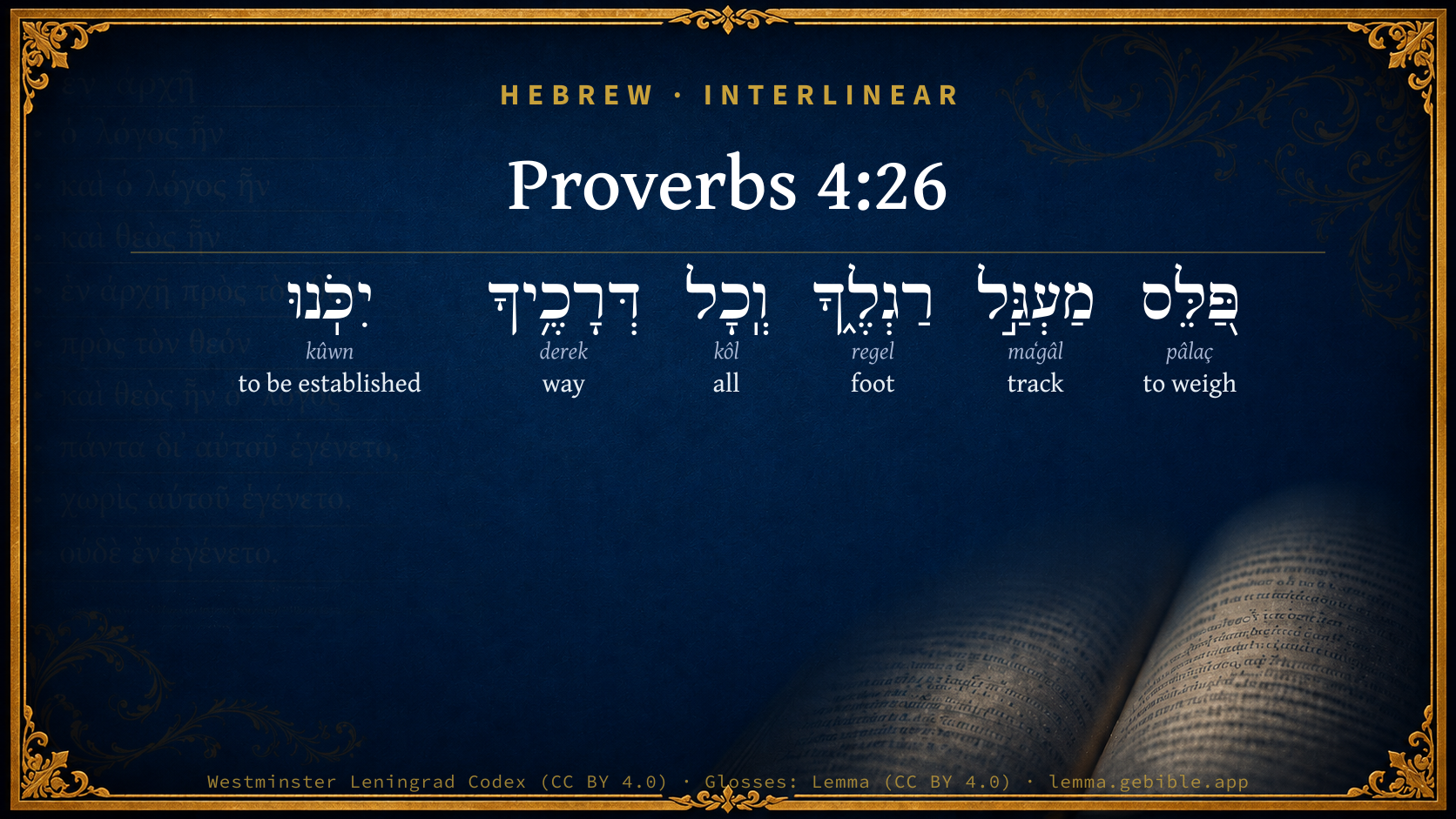
Proverbs 4:26

Hebrew (Westminster Leningrad Codex) Proverbs 4:26 appears in the Hebrew Old Testament. The text above is from the Westminster Leningrad Codex. Each word links to its Strong’s number, a concise gloss, and parsing drawn from the Open Scriptures Hebrew Bible morphology. Click any word for its full Brown-Driver-Briggs (BDB) entry.
Download image
Cite this verse

Proverbs 4:26 (World English Bible). Public Domain. Lemma interlinear Bible study tool, https://lemma.gebible.app/v/proverbs/4/26.

Show BibTeX & RIS
BibTeX
RIS
English Translation
Make the path of your feet level. Let all of your ways be established.
World English Bible · Public Domain
Download a study sheet

One document with this verse’s original text, its word-by-word gloss line, the meaning frame, cross-references with their text, attributed commentary, and full source and license credits — printable, and it pastes into notes with its structure intact.

This verse Autodidact and up

Study sheet (.html) Plain text (.txt)

A passage Seminary Student

Up to 50 verses in one chapter. A passage sheet keeps up to 6 commentary sources and 12 cross-references per verse, in the order this page ranks them, and says so on the sheet whenever that leaves anything out. Ask for a single verse and you get the Autodidact verse sheet above.

Everything on this page stays free to read, with no account — the sheet is a download of what is already on screen, not access to it.

Want to remove ads? Support Godless Engineer
Compare translations 3

The same verse in 3 English versions, stacked beneath the original-language interlinear above. Click any original word for its lexicon entry.

Each is an independent rendering of the whole verse — the interlinear is not word-aligned to these translations.

Highlighted words mark where these versions differ — a whole-verse word diff, not a word-by-word alignment.

  • World English Bible Public Domain
    Make the path of your feet level. Let all of your ways be established.
  • King James Version Public Domain
    Ponder the path of thy feet, and let all thy ways be established.
  • unfoldingWord Literal Text CC BY-SA 4.0
    Make level the track of your foot and all your ways will be firm.

unfoldingWord Literal Text — © unfoldingWord, licensed CC BY-SA 4.0. Word-aligned USFM3 via Door43 (git.door43.org/unfoldingWord/en_ult).

Versions to compare (up to 4)

3 of 4 selected

Show all 18 translations

Every available English version of this verse, each an independent rendering of the whole verse.

  • World English Bible Public Domain
    Make the path of your feet level. Let all of your ways be established.
  • Berean Standard Bible Public Domain
    Make a level path for your feet, and all your ways will be sure.
  • Majority Standard Bible Public Domain
    Make a level path for your feet, and all your ways will be sure.
  • King James Version Public Domain
    Ponder the path of thy feet, and let all thy ways be established.
  • American Standard Version (1901) Public Domain
    Make level the path of thy feet, And let all thy ways be established.
  • Revised Version (1885) Public Domain
    Make level the path of thy feet, and let all thy ways be established.
  • Geneva Bible (1599) Public Domain
    Ponder the path of thy feete, and let all thy waies be ordred aright.
  • Douay-Rheims (1899) Public Domain
    Make straight the path for thy feet, and all thy ways shall be established.
  • Young's Literal Translation Public Domain
    Ponder thou the path of thy feet, And all thy ways `are' established.
  • Literal Standard Version CC BY-SA 4.0
    Ponder the path of your feet, || And all your ways [are] established.
  • Unlocked Literal Bible CC BY-SA 4.0
    Make a level path for your foot; then all your ways will be secure.
  • unfoldingWord Literal Text CC BY-SA 4.0
    Make level the track of your foot and all your ways will be firm.
  • Darby Bible Public Domain
    Ponder the path of thy feet, and let all thy ways be well-ordered.
  • World Messianic Bible Public Domain
    Make the path of your feet level. Let all of your ways be established.
  • Webster's Bible Public Domain
    Ponder the path of thy feet, and let all thy ways be established.
  • Free Bible Version CC BY-SA 4.0
    Pay attention to the path you decide to follow, and you'll be safe wherever you go.
  • Bible in Basic English Public Domain
    Keep a watch on your behaviour; let all your ways be rightly ordered.
  • JPS Tanakh (1917) Public Domain
    Make plain the path of thy feet, and let all thy ways be established.

Literal Standard Version (2020), Covenant Press — licensed CC BY-SA 4.0. Text via the HelloAO Bible API (eBible.org). Unlocked Literal Bible (unfoldingWord) — licensed CC BY-SA 4.0. Text via the HelloAO Bible API (eBible.org). unfoldingWord Literal Text — © unfoldingWord, licensed CC BY-SA 4.0. Word-aligned USFM3 via Door43 (git.door43.org/unfoldingWord/en_ult). Free Bible Version, Dr. Jonathan Gallagher — licensed CC BY-SA 4.0. Text via the HelloAO Bible API (eBible.org).

Word by word

More ways to search: Search by grammar → Find every occurrence → Compare this word →

Practice this passage: Drill this verse → Learn its vocabulary →

About this verse

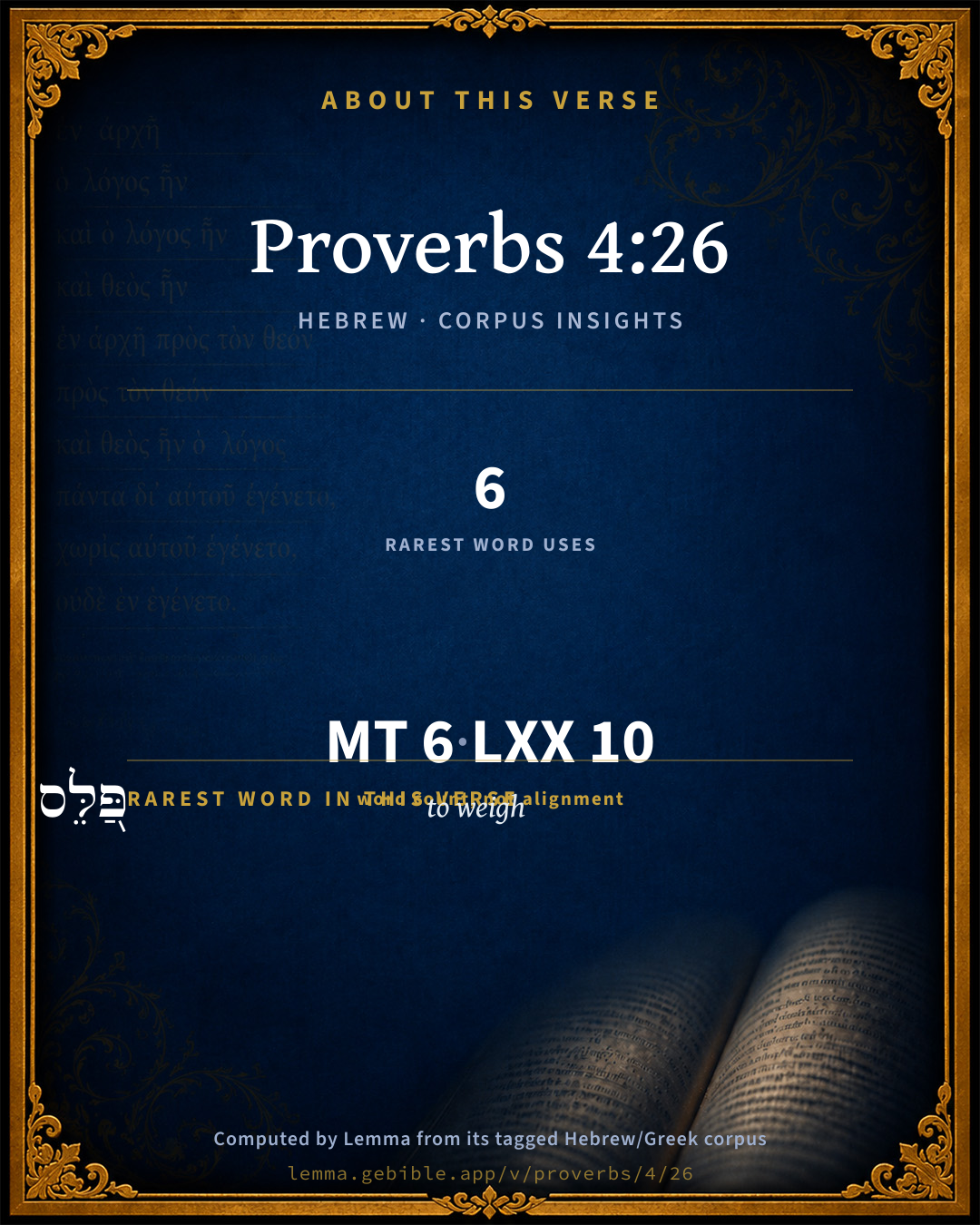
These counts appear in no published source. They are computed here, from the morphology-tagged text and Lemma’s own curated glosses. What Lemma adds →

6
words
6
distinct lemmas
Wisdom
section

Notable vocabulary

The rarest word here is פַּ֭לֵּס to weigh H6424 — appearing just 6 times in the whole Hebrew Bible.

Shared distinctive vocabulary

פַּ֭לֵּס to weigh H6424 occurs in 6 verses of the Hebrew Bible. Also found in:

Grammatical profile

  • 2 verbs
  • 4 nouns

Verb forms

  • פַּ֭לֵּס Piel · Imperative
  • יִכֹּֽנוּ Niphal · Imperfect

Hebrew & Septuagint length

In English translation the verse runs 14 words from the Hebrew and 11 from the Septuagint (LXX English) — closely comparable.

A rough comparison of the two English renderings, which tokenize alike — not a word-level alignment.

Word counts can differ between the Hebrew and the Greek without any difference in meaning — e.g. the Hebrew direct-object marker אֵת has no separate Greek word, and Greek often adds the article ὁ.

In the original languages it is 6 Hebrew tokens and 10 Greek tokens — but the two are counted differently (Hebrew bundles its prefixes and suffixes into one token; the Greek is in lemma form), so that isn’t a like-for-like length.

Cross-references

15

Topical passages linked to Proverbs 4:26 in the Treasury of Scripture Knowledge — connected by theme and wording, ordered by reader-vote popularity; previews shown in the World English Bible.

  • Psalms 37:23 A man's goings are established by Yahweh. He delights in his way.
  • Hebrews 12:13 and make straight paths for your feet, so that which is lame may not be dislocated, but rather be healed.
  • Psalms 119:5 Oh that my ways were steadfast To obey your statutes!
  • Haggai 1:5 Now therefore this is what Yahweh of Hosts says: Consider your ways.
  • 2 Thessalonians 3:3 But the Lord is faithful, who will establish you, and guard you from the evil one.
  • Haggai 1:7 This is what Yahweh of Hosts says: "Consider your ways.
  • Proverbs 5:21 For the ways of man are before the eyes of Yahweh. He examines all his paths.
  • Psalms 119:59 I considered my ways, And turned my steps to your statutes.
  • Ezekiel 18:28 Because he considers, and turns away from all his transgressions that he has committed, he shall surely live, he shall not die.
  • Psalms 40:2 He brought me up also out of a horrible pit, Out of the miry clay. He set my feet on a rock, And gave me a firm place to stand.
  • Ephesians 5:15 Therefore watch carefully how you walk, not as unwise, but as wise;
  • Proverbs 5:6 She gives no thought to the way of life. Her ways are crooked, and she doesn't know it.
  • Ephesians 5:17 Therefore don't be foolish, but understand what the will of the Lord is.
  • 1 Thessalonians 3:13 to the end he may establish your hearts blameless in holiness before our God and Father, at the coming of our Lord Jesus with all his saints.
  • 1 Peter 5:10 But may the God of all grace, who called you to his eternal glory by Christ Jesus, after you have suffered a little while, perfect, establish, strengthen, and settle you.

Cross-references courtesy of OpenBible.info (CC BY 4.0).

Hebrew and Greek witnesses Masoretic Hebrew ↔ Greek Septuagint

The same verse in the two great witnesses to the Old Testament, shown verse-for-verse.

These are two independent witnesses, not word-aligned to each other, and the Septuagint is shown in lemma (dictionary) form.

Hebrew Proverbs 4:26 Masoretic · Westminster Leningrad Codex

פַּ֭לֵּס מַעְגַּ֣ל רַגְלֶ֑ךָ וְֽכָל דְּרָכֶ֥יךָ יִכֹּֽנוּ

Make the path of your feet level. Let all of your ways be established.

World English Bible · Public Domain

Greek LXX Proverbs 4:26 Septuagint · lemma form

ὀρθός τροχιά ποιέω σός πούς καί ὁ ὁδός σύ καταεὐθύνω

Make straight paths for your feet, and order your ways aright.

LXX2012 (modern English Septuagint) · Public Domain

On this verse, The Cambridge Bible for Schools and Colleges discusses the Septuagint’s reading. Read the note in Commentary ↓

Hebrew: Westminster Leningrad Codex (CC BY 4.0). Greek: Septuagint (public domain); English from LXX2012 (modern English Septuagint) (Public Domain). How the Septuagint differs from the Hebrew →

Commentary

Notes on Proverbs 4:26 from classic Christian and Jewish commentators (each source and its license shown beneath its notes). The classic Christian expositions comment on the surrounding passage and are grouped to its opening verse, so a note may address several verses; the Jewish commentaries on the Tanakh (Rashi and others) are per-verse, so they appear only where the commentator wrote on this verse.

Lemma curates 59 commentaries, every one of them public domain or Creative Commons licensed, each selected and text-cleaned for this edition rather than reprinted as found. About our sources →

Trapp's Complete Commentary

John Trapp

Pro 4:26 Ponder the path of thy feet, and let all thy ways be established.

Ver. 26. Ponder the path of thy feet.] Viz., By the weights of the word. Look to thine affections, for by these maids Satan woes the mistress. Take heed where you set gunpowder, since fire is in your hearts. Augustine thanks God that his heart and the temptation did not meet together. Walk accurately, tread right, ακριβως ορθοποδειν; {Gal 2:14} step warily; lift not up one foot till you find firm footing for another, as those in Psa 35:6. The way of this world is like the vale of Siddim, slimy and slippery: Cavete. Beware, We have an Eve, a tempter (each one) within us, our own flesh, saith Bernard. And Nemo sibi de suo palpet: quisque sibi Satan est, saith another father. We have enough to watch for our halting; the devil also casts his club at us that we "may stumble and fall, and be broken, and snared, and taken." {Isa 8:15}

John Trapp, A Commentary or Exposition upon All the Books of the Old and New Testament (1647–1656) — public domain. Text from a community e-Sword module.

The Biblical Illustrator

Joseph S. Exell

Pro_4:26

Ponder the path of thy feet, and let all thy ways be established.

Pondering the path

Mystery surrounds me. I find myself a resident of the illimitable realm of the unknown. The commonest objects touching me on every side start unanswerable questions. But amidst these enveloping mysteries, like a rock in the central ocean, emerges this certainty--I am. That means, I know I am. I am dowered with self-consciousness. There is a chasm wide and awful between myself and everything which is not myself; the me is other than the not-me; I am a separate, solitary soul. Amid all the mystery surrounding me, there emerges this other certainty--I ought. That means, I have the power of referring what I am to the judgment of the moral sense. There is, and must be, an irreversible distinction between what I ought and what I ought not. There is both a standard and an ability of discrimination. There is a law of right and wrong of which the moral sense takes cognisance. Amid the mystery there arises another certainty--I can. That means, I dwell in the sphere of moral freedom; the helm of my being is in the hand of an unenslaved volition; I possess a self-determining and sovereign will. I am not a thrall, a thing; I am a power. There emerges this other certainty--I will. That means, I exercise my power in this direction or in that. I will to do the thing I ought not, or the thing I ought. Man is a moral being, capable of choice, and actually choosing. You should ponder the path of your feet--

I. Because your feet are pressing toward an end by which your whole previous path in life is to find final test. Thomas Carlyle says, It is the conclusion that crowns the work; much more the irreversible conclusion wherein all is concluded; thus is there no life so mean but a death will make it memorable. As you are going now what will that final test of the end declare?

II. Because this moment you are choosing your path. You should ask yourself whether it be the right one.

III. Because the longer you walk in the wrong path the harder it will Be to get out of it into the right, The awful law of habit; the binding power of bad companionships, etc. (Homiletic Magazine.)

Spiritual anatomy the feet

I. Their natural course.

1. Found in the way of evil

2. Which has diverse paths.

3. These paths fatal in their termination.

II. Transition of the feet to the way of righteousness.

1. Consideration.

2. Arrestment.

3. Abandonment of evil way.

4. Prayer.

5. Decision.

III. The feet consecrated to divine service.

1. They stand on a rock.

2. Enjoy liberty.

3. Established by the Lord.

4. Guided in the way to life eternal. (J. Burns, D.D.)

Life a path

1. Unique, difficult, momentous.

2. This path, this journey, will be travelled but once--there is never a retracing of our steps.

3. A false guide, a false step, may prove eternally fatal.

4. The path is intricate, and nothing short of the utmost care, and constant watchfulness, and thorough discipline of heart and life can carry one safely through it. (Homiletic Monthly.)

Feet and eyes joined

The wise man joins the feet unto the eyes, intimating that our actions should be weighed, as well as our thoughts, words, and looks.

I. We must beforehand order all well that we go about.

1. Lest we show our folly to all men by our indiscreet actions.

2. Lest we run ourselves into danger.

3. Because our actions are dangerous as well as our thoughts, looks, and words; and these were all to be ordered. Bring all your actions to the touchstone before you do them. Weigh them in a just balance.

II. The meanest members of the body must be well-ordered. The foot is lowest, yet must not be left at liberty to go where it will.

1. Because the meanest members are of necessary use.

2. Because they, being disordered, bring much hurt.

III. Endeavour to act surely in what you do. Show your wisdom by your sure and just acting according to Gods Word, and it will stand. (Francis Taylor, B.D.)

Self-examination explained and recommended

It is our wisdom to look into our own hearts, to inquire seriously and impartially into the state of religion in our minds; that we may form a true judgment of our real character in the sight of God, and may be better able to regulate our future conduct.

I. Explain the precept of the text: Ponder the path of thy feet. This includes--

1. A serious inquiry--into our past conduct, i.e., of the general tenor of our conduct; whether it has been agreeable to our character as men and as Christians, agreeable to the dictates of right reason, and the precepts of the gospel.

2. A diligent examination of the motives of our conduct, and the principal ends we have pursued in life; whether they are those which religion points out, or those which are recommended by the example of the world around us. Let us particularly attend to the state of our mind. Our chief motive is to be the glory of God. This motive is of all others the most extensive, and where it has its due place in the mind, will prove the most effectual means of regulating the conduct.

3. Considering attentively what our ruling passion is, and what influence it has had in determining our conduct. Every man has something peculiar in the make or constitution of his mind, which inclines him more strongly to some pursuits than to others, and which consequently lays him more open to temptation from that quarter than from any other.

4. A diligent inquiry into the present temper and state of our minds; the settled purpose and resolution of the mind, the prevailing bent of the will and affections. In what light does sin appear to us? What are our sentiments of the law of God? How do we stand affected towards the great objects of faith?

5. The examination recommended in the text must be accompanied with a sincere resolution and a correspondent endeavour by Divine assistance to reform the errors of our past life, and to make continual advances in virtue and goodness.

II. The advantages that will attend the practice of it. Steadiness and uniformity of conduct is the result of habitual consideration and reflection.

1. This will be a probable means of securing us from all fatal errors and miscarriages, or of restoring us to the path of duty, if we have wandered from it.

2. The habit of reflection will confirm and strengthen the mind, and enable us to make continual advances in holiness.

III. Some directions that may assist us in the performance of what has been recommended.

1. Set yourself as in the presence of God.

2. Implore the Divine direction and assistance.

3. Be upon your guard against the deceitfulness of your own hearts, while you are conversing with them.

4. Fear not to know the worst of your case.

5. Pursue the inquiry till you have brought it to some conclusion, and faithfully observe and comply with the admonitions which conscience may give you.

6. Frequently renew the exercise of self-examination according to the directions laid down. Improvement--

1. See the great end we should propose to ourselves by this self-inquiry.

2. The great importance of self-examination to the Christian life. (R. Clark.)

Salutary counsel

I. Ponder that portion of our path which we have already trodden.

1. Has it been the way of evil?

2. Have we visited Calvary?

3. Has it been a path of usefulness?

II. Ponder the portion of the path which we are now treading.

1. Is it lawful ground?

2. Are we following the footprints of Jesus? These are found, and found only, in heavenly paths.

3. Is there a light shining upon the road? The way of the wicked is as darkness, because it is their own evil, dismal, unhappy, and dangerous way; but the path of the justified is that of increasing holiness and joy.

III. Ponder that portion of our path which we have yet to tread.

1. It is beset with snares and dangers.

2. It passes through the valley and shadow of death. There is now no other way to immortality.

3. It leads either to heaven or to hell. (The Congregational Pulpit.)

Christian casuistry

I. We ought to ponder our steps in regard to the principle from which they proceed. An action good in itself may become criminal if it proceed from a bad principle. The little attention we pay to this maxim is one principal cause of the false judgments we make of ourselves. Would you always take right steps? Never take one without first examining the motive which engages you to take it.

II. We ought to ponder our steps in regard to the circumstances which accompany them. An action, good or innocent in itself, may become criminal in certain circumstances. This maxim is a clue to many cases of conscience in which we choose to blind ourselves. We obstinately consider our actions in a certain abstracted light, and do not attend to circumstances which change the nature of the action.

III. We ought to examine the manners that accompany our ways. Actions, good in themselves, become criminal when they are not performed with proper dispositions.

II. An action, good in itself, may become criminal by being extended beyond its proper limits. Be not righteous overmuch, neither make thyself overwise.

1. In regard to the mysteries of religion.

2. In regard to charity.

3. In regard to closet devotion; in regard to distrusting yourselves and fearing the judgments of God.

V. An action, good when it is performed by a man arrived at a certain degree of holiness, becomes criminal when it is done by him who hath only an inferior degree. If we wish our ways to be established, let us weigh them with the different judgments which we ourselves form concerning them. Set the judgment which we shall one day form of them against that which we now form. In order to obey the precept of the wise man, we should collect our thoughts every morning, and never begin a day without a cool examination of the whole business of it. (James Saurin.)

The Biblical Illustrator, edited by Joseph S. Exell (c. 1880s–1900s) — public domain. Text from a community e-Sword module.

Geneva Bible (1599)

Geneva Bible translators

Keep a measure in all thy doings.

Geneva Bible (1599) marginal notes — public domain. Text via Bolls.life.

Jamieson, Fausset & Brown

Robert Jamieson, A. R. Fausset & David Brown

Ponder--Consider well; a wise course results from wise forethought.

Jamieson, Fausset & Brown — Commentary Critical and Explanatory on the Whole Bible (1871) — public domain (CC PDM 1.0). Text via the HelloAO Bible API.

Adam Clarke's Commentary

Verse 26. Ponder the path of thy feet] Weigh well the part thou shouldst act in life. See that thou contract no bad habits.

Adam Clarke's Commentary on the Bible (1810–1826) — public domain. Text from a community e-Sword/MySword module.

Ellicott's Commentary for English Readers

(26) Ponder the path of thy feet.—Rather, make it smooth, level: take all obstacles out of it which may prevent thy going in the way God is leading thee. Comp. the directions to cut off even the hand or the foot that offends (Mat_18:8). This verse is quoted in Heb_12:13.

Let all thy ways be established.—Or, directed aright; see that they lead straight to the end (Psa_119:5).

A Bible Commentary for English Readers, edited by Charles John Ellicott (1878–1897) — public domain. Text from a community e-Sword module.

The Cambridge Bible for Schools and Colleges

gen. ed. J. J. S. Perowne

26. ponder] So R.V. marg., weigh carefully; but R.V. text has make level, &c., with which agrees LXX. ὀρθὰς τροχιὰς ποίει σοῖς ποσίν: “make straight paths for thy feet.” So Heb_12:13. See Pro_5:21.

established] Or, ordered aright, R.V. marg.

The Cambridge Bible for Schools and Colleges (gen. ed. J. J. S. Perowne; Cambridge University Press, 1878–1918) — public domain. Text from a community e-Sword module.

John Gill's Exposition

Ponder the path of thy feet,.... Consider well what path it is, whether right or wrong; or weigh it in the balances of thought, as Aben Ezra; or rather in the balances of the word, and see whether it agrees with that or not. The Septuagint version is, "make straight paths for thy feet"; to which the author of the epistle to the Hebrews seems to have respect, Heb 12:13;

and let all thy walls be established; so as to walk on steadily, constantly, uniformly, and not be easily moved out of the ways of religion and truth. Or, "let all thy ways be prepared", or "directed", or "disposed" (c); according to the rule of the divine word. Some render it as a promise, "and all thy ways shall be established" (d); when care is taken to look well into them; see Ch2 20:20.

(c) "dirigantur", Tigurine version, Mercerus; "recte apparentur aut disponantur", Vatablus. (d) "Stabilientur", V. L. Pagninus, Montanus; "constabilientur", Schultens.

John Gill's Exposition of the Whole Bible (1746–1763) — public domain (CC PDM 1.0). Text via the HelloAO Bible API.

Haydock's Catholic Bible Commentary

Straight. Hebrew, "ponder." Examine what thou takest in hand, and walk not at random, Hebrews xii. 13.

George Leo Haydock (1774–1849), Haydock's Catholic Family Bible and Commentary, 1859 edition — public domain. Excludes Psalms (Douay-Rheims chapter numbering differs from Protestant) and Deuterocanonical books (Catholic canon only).

Matthew Poole's English Annotations

Ponder the path of thy feet; consider thine actions before thou doest them, and see that they agree with the rule.

Let all thy ways be established; let thine actions be uniformly and constantly good in spite of all temptations to the contrary. Or, let thy ways be directed or disposed aright, as this Hebrew word signifies. Or, thy ways shall be established. So this is a promise to confirm the foregoing precept. If thou dost ponder them, thou mayst expect God’s blessing and good success in them.

Matthew Poole's English Annotations on the Holy Bible (1683–1685) — public domain. Text from a community e-Sword/MySword module.

Whedon's Commentary on the Bible

Daniel D. Whedon

26. Ponder — The word means, first, to make level; secondly, to weigh; and then, metaphorically, to consider, deliberate. Some render, Make smooth or straight the path, etc. The sense is, Consider well thy undertakings; examine thoroughly beforehand, whether they are right and proper; so shalt thou have confidence in the rectitude of thy conduct and in the providential ordering of the result. Compare Psa_119:133; Heb_12:13.

Daniel D. Whedon (gen. ed.), Commentary on the Old and New Testaments (1874–1909) — public domain. Text from a community e-Sword module.

The Pulpit Commentary

Ponder the path of thy feet; properly, make straight or level the path of thy feet. The command carries on the idea of the previous verse. Simplicity of aim in the moral life is to be accompanied by attention to the moral conduct. The sense is, remove every obstacle which may impede or render insecure the way of moral life, and thus avoid every false step. The meaning "to ponder," i.e. "to weigh," seems to be given to the verb palles, piel of the unused palas here used only in Psa_58:3 and possibly in Pro_5:21. Its ordinary signification is "to make level, or even," as in Isa_26:7 Isa_40:12; and Pro_5:6. The LXX keeps this in view in rendering, "Make straight paths for thy feet". (cf. Heb_12:13) The Authorized Version would mean, "Weigh your conduct as in a balance; before acting, consider the consequences and nature of the act." The second clause, and let all thy ways be established, is in effect only a repetition of the preceding thought, since it signifies, "See that thy conduct is correct; let all thy ways be definite and fixed." The marginal reading. "And all thy ways shall be ordered aright." gives the literal rendering to the tense; yikkonu being the future hiph. of kun, "to be established," "to stand firm." This would express the result of giving heed to one"s conduct.

The Pulpit Commentary (1880–1919), ed. H.D.M. Spence-Jones & Joseph S. Exell — public domain. Text from a community e-Sword module.

John Wesley's Explanatory Notes

Ponder - Consider thine actions before thou dost them, and see that they agree with the rule. And - Let thine actions be uniformly and constantly good in spite of all temptations.

John Wesley, Explanatory Notes Upon the Whole Bible (1754–1765) — public domain. Text via the GEBible commentary corpus.

unfoldingWord translationNotes

Door43 World Missions Community

Make a level path for your foot

Here the word "foot" represents the person who is walking. The writer speaks of a person's actions as if he were walking along a path, and of planning those actions carefully as if it were making that path level. AT: "Make a level path to walk on" or "Prepare well what you want to do" (See: Synecdoche and Metaphor)

a level path

"a smooth path" or "an even path"

then all your ways will be secure

The writer speaks of a person's actions as if the person were walking along a path and of those actions being successful as if the path were safe and secure. AT: "then everything that you do will be right" (See: Metaphor)

Do not turn aside to the right or to the left

The directions "right" and "left" form a merism, meaning that the person is not to leave the level path in any direction. AT: "Walk straight ahead and do not leave the level path" (See: Merism)

turn your foot away from evil

Here the word "foot" represents the person who walks. The writer speaks of not committing evil actions as if the person were walking away from evil. AT: "turn away from evil" or "stay away from evil" (See: Synecdoche and Metaphor)

translationWords

turn

evil

unfoldingWord translationNotes — © Distant Shores Media and the Door43 World Missions Community, licensed CC BY-SA 4.0. Source: git.door43.org/Door43/en_tn.

Rashi

Rabbi Shlomo Yitzchaki (Rashi)

Weigh the path of your feet Weigh your way: the loss of a commandment against its reward and the reward of a sin against its loss, and then all your ways will be established.

Rashi on the Tanakh — English translations: “The Judaica Press complete Tanach with Rashi, translated by A. J. Rosenberg” (CC BY 4.0); “Pentateuch with Rashi's commentary by M. Rosenbaum and A.M. Silbermann, 1929-1934” (public domain); “The Metsudah Tanach series, Lakewood, N.J” (CC BY 4.0); and “The Book of Joshua, Metsudah Publications, 1997” (CC BY 4.0). Text via Sefaria.

Lesson kit

Teaching starters — assembled from the data on this page, not authored interpretation. Every prompt links to the verse data it draws on. Edit before teaching.

Proverbs, in the Wisdom, opens this verse with 6 words (6 distinct Hebrew lemmas). Its most distinctive word is pâlaç (“to weigh”). A historical commentator’s framing appears above. Read the whole chapter for the surrounding context.

Discussion questions

  1. The word pâlaç carries the sense “to weigh.” How does it shape the verse?
  2. How does Psalms 58:2, which shares the word «to weigh», read alongside this verse?
  3. These translations render this verse differently; the difference is in the English rendering, not the original. What questions does that raise?
  4. «פַּ֭לֵּס» is a Piel Imperative verb. How does that grammatical form shape the action described?
  5. Compare how Trapp's Complete Commentary and The Biblical Illustrator read this verse. Where do they agree or differ?

Things to notice

Reading settings

Reading text

Shown beneath each verse's original-language words.

Old Testament
Old Testament edition

Read the OT as the Masoretic Hebrew (MT) or the Greek Septuagint (LXX).

English shown for the Greek Septuagint (in the Hebrew ↔ Greek comparison).

Comparing translations? Open the Compare panel on any verse page to stack up to four side by side.