
Deuteronomy 19:3

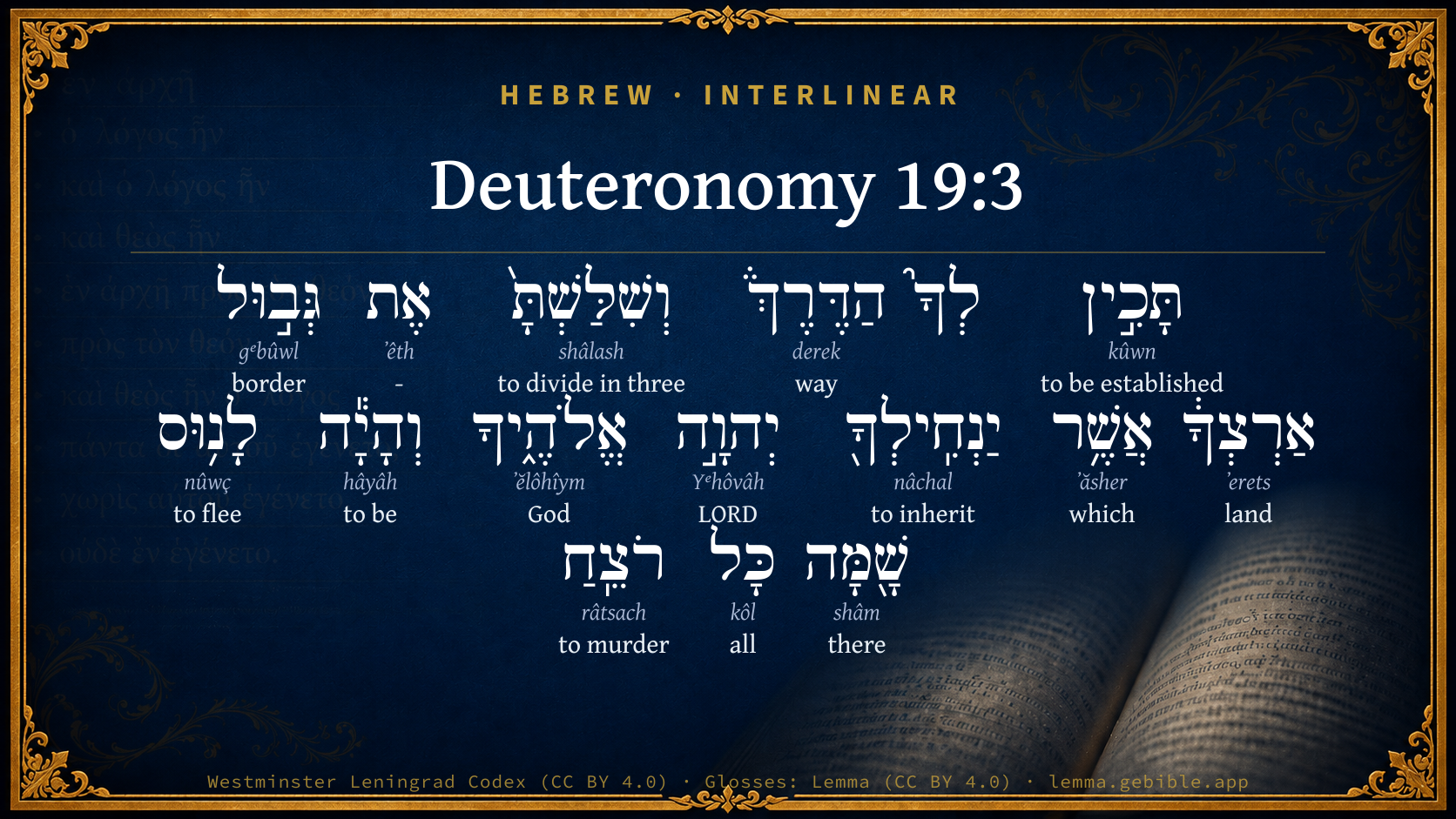
Hebrew (Westminster Leningrad Codex) Deuteronomy 19:3 appears in the Hebrew Old Testament. The text above is from the Westminster Leningrad Codex. Each word links to its Strong’s number, a concise gloss, and parsing drawn from the Open Scriptures Hebrew Bible morphology. Click any word for its full Brown-Driver-Briggs (BDB) entry.
Download image
Cite this verse

Deuteronomy 19:3 (World English Bible). Public Domain. Lemma interlinear Bible study tool, https://lemma.gebible.app/v/deuteronomy/19/3.

Show BibTeX & RIS
BibTeX
RIS
English Translation
You shall prepare you the way, and divide the borders of your land, which Yahweh your God causes you to inherit, into three parts, that every manslayer may flee there.
World English Bible · Public Domain
Download a study sheet

One document with this verse’s original text, its word-by-word gloss line, the meaning frame, cross-references with their text, attributed commentary, and full source and license credits — printable, and it pastes into notes with its structure intact.

This verse Autodidact and up

Study sheet (.html) Plain text (.txt)

A passage Seminary Student

Up to 50 verses in one chapter. A passage sheet keeps up to 6 commentary sources and 12 cross-references per verse, in the order this page ranks them, and says so on the sheet whenever that leaves anything out. Ask for a single verse and you get the Autodidact verse sheet above.

Everything on this page stays free to read, with no account — the sheet is a download of what is already on screen, not access to it.

Want to remove ads? Support Godless Engineer
Compare translations 3

The same verse in 3 English versions, stacked beneath the original-language interlinear above. Click any original word for its lexicon entry.

Each is an independent rendering of the whole verse — the interlinear is not word-aligned to these translations.

Highlighted words mark where these versions differ — a whole-verse word diff, not a word-by-word alignment.

  • World English Bible Public Domain
    You shall prepare you the way, and divide the borders of your land, which Yahweh your God causes you to inherit, into three parts, that every manslayer may flee there.
  • King James Version Public Domain
    Thou shalt prepare thee a way, and divide the coasts of thy land, which the LORD thy God giveth thee to inherit, into three parts, that every slayer may flee thither.
  • unfoldingWord Literal Text CC BY-SA 4.0
    You shall prepare for yourself a road and make the borders of your land three, which Yahweh your God is causing you to inherit, and it will be, everyone who murders shall flee there.

unfoldingWord Literal Text — © unfoldingWord, licensed CC BY-SA 4.0. Word-aligned USFM3 via Door43 (git.door43.org/unfoldingWord/en_ult).

Versions to compare (up to 4)

3 of 4 selected

Show all 18 translations

Every available English version of this verse, each an independent rendering of the whole verse.

  • World English Bible Public Domain
    You shall prepare you the way, and divide the borders of your land, which Yahweh your God causes you to inherit, into three parts, that every manslayer may flee there.
  • Berean Standard Bible Public Domain
    You are to build roads for yourselves and divide into three regions the land that the LORD your God is giving you as an inheritance, so that any manslayer can flee to these cities.
  • Majority Standard Bible Public Domain
    You are to build roads for yourselves and divide into three regions the land that the LORD your God is giving you as an inheritance, so that any manslayer can flee to these cities.
  • King James Version Public Domain
    Thou shalt prepare thee a way, and divide the coasts of thy land, which the LORD thy God giveth thee to inherit, into three parts, that every slayer may flee thither.
  • American Standard Version (1901) Public Domain
    Thou shalt prepare thee the way, and divide the borders of thy land, which Jehovah thy God causeth thee to inherit, into three parts, that every manslayer may flee thither.
  • Revised Version (1885) Public Domain
    Thou shalt prepare thee the way, and divide the borders of thy land, which the LORD thy God causeth thee to inherit, into three parts, that every manslayer may flee thither.
  • Geneva Bible (1599) Public Domain
    Thou shalt prepare thee the way, and deuide the coastes of the land, which the Lord thy God giueth thee to inherite, into three parts, that euery manslayer may flee thither.
  • Douay-Rheims (1899) Public Domain
    Paving diligently the way: and thou shalt divide the whole province of thy land equally into three parts: that he who is forced to flee for manslaughter, may have near at hand whither to escape.
  • Young's Literal Translation Public Domain
    Thou dost prepare for thee the way, and hast divided into three parts the border of thy land which Jehovah thy God doth cause thee to inherit, and it hath been for the fleeing thither of every man-slayer.
  • Literal Standard Version CC BY-SA 4.0
    You prepare the way for yourself, and have divided into three parts the border of your land which your God YHWH causes you to inherit, and it has been for the fleeing there of every manslayer.
  • Unlocked Literal Bible CC BY-SA 4.0
    You must build a road and divide the borders of your land into three parts, the land that Yahweh your God is causing you to inherit, so that everyone who kills another person may flee there.
  • unfoldingWord Literal Text CC BY-SA 4.0
    You shall prepare for yourself a road and make the borders of your land three, which Yahweh your God is causing you to inherit, and it will be, everyone who murders shall flee there.
  • Darby Bible Public Domain
    Thou shalt prepare thee the way, and divide the territory of thy land, which Jehovah thy God giveth thee to inherit, into three parts, so that every slayer may flee thither.
  • World Messianic Bible Public Domain
    You shall prepare the way, and divide the borders of your land which the LORD your God causes you to inherit into three parts, that every man slayer may flee there.
  • Webster's Bible Public Domain
    Thou shalt prepare thee a way, and divide the limits of thy land which the LORD thy God giveth thee to inherit, into three parts, that every slayer may flee thither.
  • Free Bible Version CC BY-SA 4.0
    You are to build roads to these towns. Divide the country the Lord is giving you into three sections. This way anyone who kills someone else can easily run to these towns for protection.
  • Bible in Basic English Public Domain
    You are to make ready a way, and see that the land which the Lord your God is giving you for your heritage, is marked out into three parts, to which any taker of life may go in flight.
  • JPS Tanakh (1917) Public Domain
    Thou shalt prepare thee the way, and divide the borders of thy land, which the LORD thy God causeth thee to inherit, into three parts, that every manslayer may flee thither.

Literal Standard Version (2020), Covenant Press — licensed CC BY-SA 4.0. Text via the HelloAO Bible API (eBible.org). Unlocked Literal Bible (unfoldingWord) — licensed CC BY-SA 4.0. Text via the HelloAO Bible API (eBible.org). unfoldingWord Literal Text — © unfoldingWord, licensed CC BY-SA 4.0. Word-aligned USFM3 via Door43 (git.door43.org/unfoldingWord/en_ult). Free Bible Version, Dr. Jonathan Gallagher — licensed CC BY-SA 4.0. Text via the HelloAO Bible API (eBible.org).

Word by word

More ways to search: Search by grammar → Find every occurrence → Compare this word →

Practice this passage: Drill this verse → Learn its vocabulary →

וְשִׁלַּשְׁתָּ֙
shâlash
H8027
“and · to divide in three”
Conjunction + Verb, Piel, Sequential Perfect, 2nd Person, Masculine, Singular
Part of Speech
Conjunction + Verb
Stem
Piel
Form
Sequential Perfect
Person
2nd Person
Gender
Masculine
Number
Singular
Full BDB Definition

Origin: a primitive root perhaps originally to intensify, i.e. treble

TWOT: TWOT - 2403

to do a third time, do three times, divide in three parts - (Piel) to do a third time, divide into three parts - (Pual) to be three years of age, be threefold
  1. תָּכִ֣ין kûwn H3559 “to be established” Verb, Hiphil, Imperfect, 2nd Person, Masculine, Singular
  2. הַדֶּרֶךְ֒ derek H1870 “the · way” Particle, Definite Article + Noun, Common, Both, Singular, Absolute
  3. אֶת ʼêth H853 “-” Particle, Direct Object
  4. גְּב֣וּל gᵉbûwl H1366 “border of” Noun, Common, Masculine, Singular, Construct
  5. אַרְצְךָ֔ ʼerets H776 “land · your” Noun, Common, Both, Singular, Construct + Suffix, Personal, 2nd Person, Masculine, Singular
  6. אֲשֶׁ֥ר ʼăsher H834 “which” Particle, Relative
  7. יַנְחִֽילְךָ֖ nâchal H5157 “to inherit · you” Verb, Hiphil, Imperfect, 3rd Person, Masculine, Singular + Suffix, Personal, 2nd Person, Masculine, Singular
  8. יְהוָ֣ה Yᵉhôvâh H3068 “LORD” Noun, Proper
  9. אֱלֹהֶ֑יךָ ʼĕlôhîym H430 “God(s) · your” Noun, Common, Masculine, Plural, Construct + Suffix, Personal, 2nd Person, Masculine, Singular
  10. וְהָיָ֕ה hâyâh H1961 “and · to be” Conjunction + Verb, Qal, Sequential Perfect, 3rd Person, Masculine, Singular
  11. לָנ֥וּס nûwç H5127 “to flee” Preposition + Verb, Qal, Infinitive Construct
  12. שָׁ֖מָּה shâm H8033 “there · toward” Adverb + Suffix, Demonstrative
  13. כָּל kôl H3605 “all of” Noun, Common, Masculine, Singular, Construct
  14. רֹצֵֽחַ râtsach H7523 “murdering” Verb, Qal, Participle Active, Masculine, Singular, Absolute

About this verse

These counts appear in no published source. They are computed here, from the morphology-tagged text and Lemma’s own curated glosses. What Lemma adds →

16
words
15
distinct lemmas
Pentateuch
section

Notable vocabulary

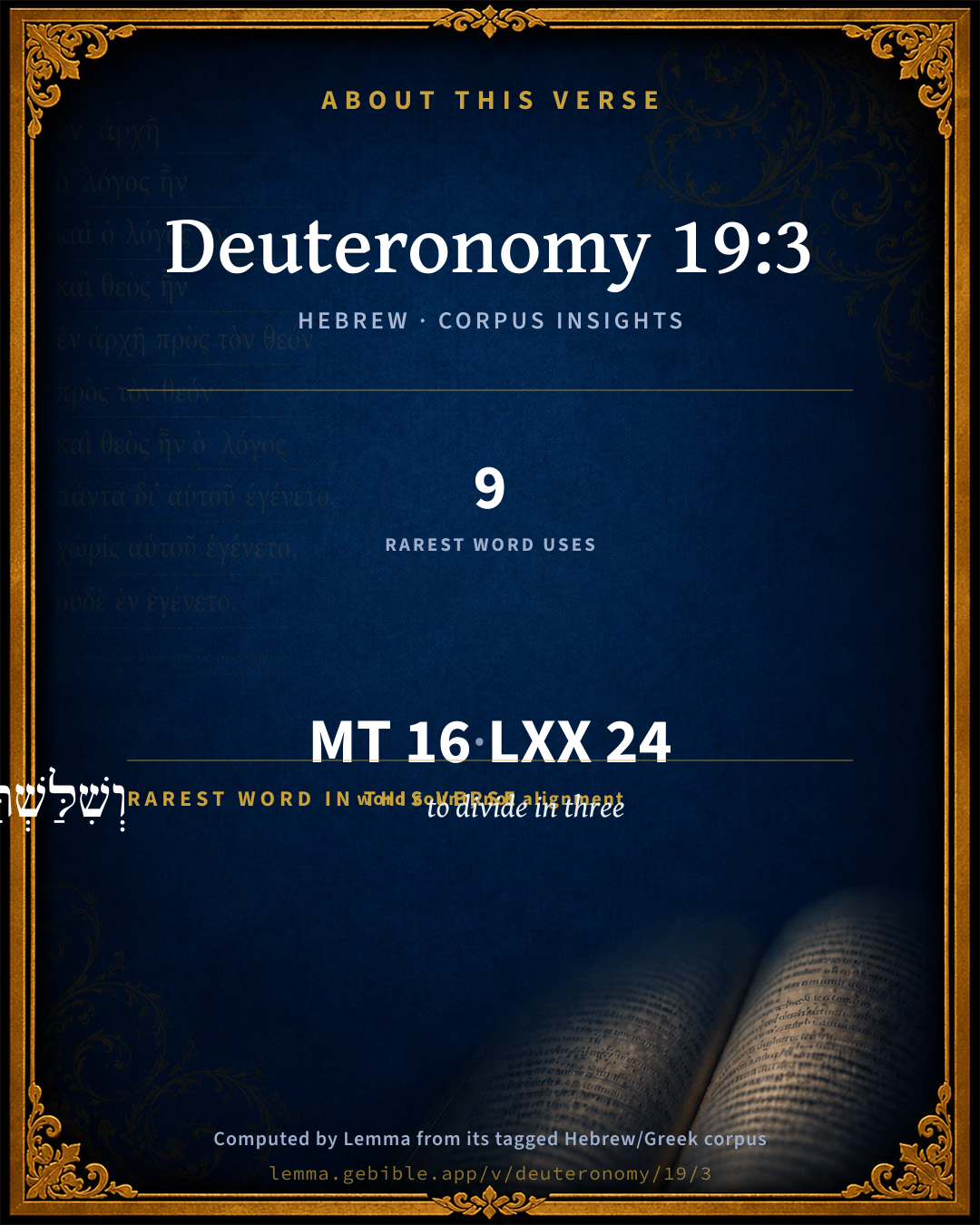
The rarest word here is וְשִׁלַּשְׁתָּ֙ to divide in three H8027 — appearing just 9 times in the whole Hebrew Bible.

Shared distinctive vocabulary

וְשִׁלַּשְׁתָּ֙ to divide in three H8027 occurs in 6 verses of the Hebrew Bible. Also found in:

Grammatical profile

  • 6 verbs
  • 6 nouns
  • 1 preposition
  • 1 adverb
  • 2 particles

Verb forms

  • תָּכִ֣ין Hiphil · Imperfect
  • וְשִׁלַּשְׁתָּ֙ Piel · Sequential Perfect
  • יַנְחִֽילְךָ֖ Hiphil · Imperfect
  • וְהָיָ֕ה Qal · Sequential Perfect
  • לָנ֥וּס Qal · Infinitive Construct
  • רֹצֵֽחַ Qal · Participle Active

Hebrew & Septuagint length

In English translation the verse runs 30 words from the Hebrew and 36 from the Septuagint (LXX English) — closely comparable.

A rough comparison of the two English renderings, which tokenize alike — not a word-level alignment.

Word counts can differ between the Hebrew and the Greek without any difference in meaning — e.g. the Hebrew direct-object marker אֵת has no separate Greek word, and Greek often adds the article ὁ.

In the original languages it is 16 Hebrew tokens and 24 Greek tokens — but the two are counted differently (Hebrew bundles its prefixes and suffixes into one token; the Greek is in lemma form), so that isn’t a like-for-like length.

Cross-references

4

Topical passages linked to Deuteronomy 19:3 in the Treasury of Scripture Knowledge — connected by theme and wording, ordered by reader-vote popularity; previews shown in the World English Bible.

  • Isaiah 57:14 He will say, Cast up, cast up, prepare the way, take up the stumbling-block out of the way of my people.
  • Isaiah 35:8 A highway shall be there, and a way, and it shall be called The way of holiness. The unclean shall not pass over it, but is shall be for for him who walks in the Way. Wicked fools will not go there.
  • Isaiah 62:10 Go through, go through the gates; prepare you the way of the people; cast up, cast up the highway; gather out the stones; lift up an ensign for the peoples.
  • Hebrews 12:13 and make straight paths for your feet, so that which is lame may not be dislocated, but rather be healed.

Cross-references courtesy of OpenBible.info (CC BY 4.0).

Hebrew and Greek witnesses Masoretic Hebrew ↔ Greek Septuagint

The same verse in the two great witnesses to the Old Testament, shown verse-for-verse.

These are two independent witnesses, not word-aligned to each other, and the Septuagint is shown in lemma (dictionary) form.

Hebrew Deuteronomy 19:3 Masoretic · Westminster Leningrad Codex

תָּכִ֣ין לְךָ֮ הַדֶּרֶךְ֒ וְשִׁלַּשְׁתָּ֙ אֶת גְּב֣וּל אַרְצְךָ֔ אֲשֶׁ֥ר יַנְחִֽילְךָ֖ יְהוָ֣ה אֱלֹהֶ֑יךָ וְהָיָ֕ה לָנ֥וּס שָׁ֖מָּה כָּל רֹצֵֽחַ

You shall prepare you the way, and divide the borders of your land, which Yahweh your God causes you to inherit, into three parts, that every manslayer may flee there.

World English Bible · Public Domain

Greek LXX Deuteronomy 19:3 Septuagint · lemma form

στοχάζω σύ ὁ ὁδός καί τριμερίζω ὁ ὅριον ὁ γῆ σύ ὅς καταμερίζω σύ κύριος ὁ θεός σύ καί εἰμί καταφυγή ἐκεῖ πᾶς φονευτής

Take a survey of your way, and you shall divide the coasts of your land, which the Lord your God apportions to you, into three parts, and there shall be there a refuge for every manslayer.

LXX2012 (modern English Septuagint) · Public Domain

On this verse, The Cambridge Bible for Schools and Colleges discusses the Septuagint’s reading. Read the note in Commentary ↓

Hebrew: Westminster Leningrad Codex (CC BY 4.0). Greek: Septuagint (public domain); English from LXX2012 (modern English Septuagint) (Public Domain). How the Septuagint differs from the Hebrew →

Targum (Aramaic paraphrase)

2

The Targum is the ancient Jewish Aramaic paraphrase of the Hebrew Scriptures — an interpretive translation, not the Hebrew text itself. Onkelos (literal) and Pseudo-Jonathan (expansive) render the Torah, and Jonathan the Prophets. Coverage is partial: where no permissively-licensed English translation exists for a verse, only the Aramaic is shown. This is verse-level text, not a word-by-word alignment to the Hebrew.

  1. Targum Onkelos Torah (Genesis–Deuteronomy)
    תְּתַקֵן לָךְ אָרְחָא וּתְתַלַת יָת תְּחוּם אַרְעָךְ דִי יַחְסְנִנָךְ יְיָ אֱלָהָךְ וִיהֵי לְמֵעִירוֹק תַּמָן כָּל קָטוֹלָא

    (no public-domain English translation for this verse)

    Targum Onkelos — Aramaic: “Onkelos Genesis” (public domain); “Onkelos Exodus” (public domain); “Onkelos Leviticus” (public domain); “Onkelos Numbers” (public domain); “Onkelos Deuteronomy” (public domain). English: “Sefaria Community Translation” (CC0 1.0 (public-domain dedication)); “J.W. Etheridge. The Targums of Onkelos and Jonathan Ben Uzziel on the Pentateuch. London: Longmans, Green, 1862” (public domain). Text via Sefaria.

  2. Targum Pseudo-Jonathan Torah (Genesis–Deuteronomy)
    תְּכַוְונוּן לְכוֹן אָרְחָא וּתְתַלְתוּן יַת תְּחוּם אַרְעֲכוֹן דִּיחַסְנְכוֹן יְיָ אֱלָהָכוֹן וִיהֵי לְמַעֲרוֹק לְתַמָּן כָּל קָטוֹלָא

    You shall prepare a high road, and divide your limit which the Lord your God bestoweth upon you, that any manslayer may flee thither.

    Targum Pseudo-Jonathan — Aramaic: “Targum Jonathan on Genesis” (public domain); “Targum Jonathan on Exodus” (public domain); “Targum Jonathan on Leviticus” (public domain); “Targum Jonathan on Numbers” (public domain); “Targum Jonathan on Deuteronomy” (public domain). English: “The Targum of Jonathan ben Uzziel, trans. J. W. Etheridge, London, 1862” (public domain). Text via Sefaria.

Commentary

Notes on Deuteronomy 19:3 from classic Christian and Jewish commentators (each source and its license shown beneath its notes). The classic Christian expositions comment on the surrounding passage and are grouped to its opening verse, so a note may address several verses; the Jewish commentaries on the Tanakh (Rashi and others) are per-verse, so they appear only where the commentator wrote on this verse.

Lemma curates 59 commentaries, every one of them public domain or Creative Commons licensed, each selected and text-cleaned for this edition rather than reprinted as found. About our sources →

Trapp's Complete Commentary

John Trapp

Deu 19:3 Thou shalt prepare thee a way, and divide the coasts of thy land, which the LORD thy God giveth thee to inherit, into three parts, that every slayer may flee thither.

Ver. 3. Thou shalt prepare thee a way.] A direct, plain, fair highway: such a way must ministers prepare and pave for their people to Christ, the true asylum, by giving them "the knowledge of salvation by the remission of their sins." {Luk 1:76-77}

John Trapp, A Commentary or Exposition upon All the Books of the Old and New Testament (1647–1656) — public domain. Text from a community e-Sword module.

Joseph Benson's Commentary

Deu 19:3. Thou shalt prepare thee a way — Make a plain road to them, keep it in good repair, and distinguish it by evident marks, to prevent delays and mistakes, that the manslayer might meet with no difficulty in escaping to the nearest city. And divide the coasts of thy land — Thy possessions on the west of Jordan into three equal parts, and in the central part of each open a place of refuge, which being nearly at an equal distance with respect to the inhabitants of that district, all might have the same benefit by it.

Joseph Benson's Commentary on the Old and New Testaments (1811–1818) — public domain. Text from a community e-Sword module.

Geneva Bible (1599)

Geneva Bible translators

Make an open and ready way.

Which killeth against his will, and bare no hatred in his heart.

Geneva Bible (1599) marginal notes — public domain. Text via Bolls.life.

Jamieson, Fausset & Brown

Robert Jamieson, A. R. Fausset & David Brown

Thou shalt prepare thee a way--The roads leading to them were to be kept in good condition and the brooks or rivers to be spanned by good bridges; the width of the roads was to be thirty-two cubits; and at all the crossroads signposts were to be erected with the words, Mekeleth, Mekeleth, "refuge, refuge," painted on them.

divide the coasts of thy land . . . into three parts--the whole extent of the country from the south to the north. The three cities on each side of Jordan were opposite to each other, "as two rows of vines in a vineyard" (see on Jos 20:7).

Jamieson, Fausset & Brown — Commentary Critical and Explanatory on the Whole Bible (1871) — public domain (CC PDM 1.0). Text via the HelloAO Bible API.

Adam Clarke's Commentary

Verse 3. Thou shalt prepare thee a way] The Jews inform us that the roads to the cities of refuge were made very broad, thirty-two cubits; and even, so that there should be no impediments in the way; and were constantly kept in good repair.

Adam Clarke's Commentary on the Bible (1810–1826) — public domain. Text from a community e-Sword/MySword module.

The Cambridge Bible for Schools and Colleges

gen. ed. J. J. S. Perowne

3. prepare thee the way] Usually taken as making the road open and firm. But (though Steuern.’s objection to this meaning, that such preparation would give equal advantage to the pursuer with the pursued, is hypercritical) this has no relevance to the rest of the v., as the older translators already saw and gave it another sense: LXX στόχασαί σοι, ‘reckon,’ or ‘guess,’ O.L. aestimare. Steuern. renders measure the distance. Better fix, or make sure of, the direction (in which the cities lie), and divide the area of thy land into three.

every manslayer] The general term, Deu_4:42.

The Cambridge Bible for Schools and Colleges (gen. ed. J. J. S. Perowne; Cambridge University Press, 1878–1918) — public domain. Text from a community e-Sword module.

John Gill's Exposition

Thou shalt prepare thee a way,.... A road, an highway to those cities: on the first of Adar, or February, the magistrates used to meet, and proclaimed, or ordered to be proclaimed, that the ways be repaired (r), particularly those leading to the cities of refuge; which was done by making them smooth and plain, so that there was not an hill or dale to be seen; and by building bridges over rivers and brooks, that he might escape who had killed anyone through mistake, and not be hindered, lest the avenger of blood should overtake him and kill him (s); and therefore every obstruction was removed out of the way, that there might be a clear course for him; and at the parting of ways, or where two or more ways met, that he might not be at a loss one moment which way to take, "refuge" was written, as Jarchi and other writers observe, upon posts or pillars erected for that purpose: See Gill on Num 35:6,

and divide the coasts of thy land, which the Lord thy God giveth thee to inherit, in three parts; in each of which was to be a city of refuge, and those at an equal distance: so Jarchi observes, that this was done that there might be from the beginning of the border (of the land) unto the first city of the cities of refuge, according to the measure of a journey, that there is from that to the second, and so from the second to the third, and so from the third to the other border of the land of Israel: of the situation of these cities, so as to answer to those on the other side Jordan; see Gill on Num 35:14,

that every slayer may flee thither; to that which is nearest and most convenient for him, that is, who had slain a man unawares, as follows.

(r) Misn. Shekalim, c. 1. sect. 1. (s) Maimon. & Bartenora in ib.

John Gill's Exposition of the Whole Bible (1746–1763) — public domain (CC PDM 1.0). Text via the HelloAO Bible API.

Haydock's Catholic Bible Commentary

Way, and keeping all in good repair, with guide-posts at the crossroads, on which Oleaster says moklot, "escape," was written. See Numbers xxxv.

George Leo Haydock (1774–1849), Haydock's Catholic Family Bible and Commentary, 1859 edition — public domain. Excludes Psalms (Douay-Rheims chapter numbering differs from Protestant) and Deuterocanonical books (Catholic canon only).

Matthew Poole's English Annotations

Thou shalt prepare thee a way; distinguish it by evident marks, and make it plain and convenient, to prevent mistakes and delays.

Into three parts; not into more, because it was fit that these places should, as far as it was possible, be at some considerable distance from the friends of the slain person, lest the sight of the manslayer might have provoked their passion, and occasioned his ruin.

Matthew Poole's English Annotations on the Holy Bible (1683–1685) — public domain. Text from a community e-Sword/MySword module.

Whedon's Commentary on the Bible

Daniel D. Whedon

3. Thou shalt prepare thee a way — The sentence might read, prepare the road. This was understood to be a direction to have the roads leading to the cities of refuge kept in order. The hills were to be levelled; the streams were to be bridged; the road was to be thirty-two cubits broad.

Daniel D. Whedon (gen. ed.), Commentary on the Old and New Testaments (1874–1909) — public domain. Text from a community e-Sword module.

The Pulpit Commentary

Thou shalt prepare thee a way. In the East, the roads were for the most part mere tracks made by the feet of animals used as beasts of burden or for traveling; and this continues to be the case in Palestine and many other parts of the East even at the present day. That roads, however, properly so called, were not unknown to the Hebrews, even in early times, is evident, not only from this passage, but also from Lev_26:22; Num_20:17 Num_21:22; Deu_2:27; 1Sa_6:12. The design of the injunction here was that every facility should be afforded to the fugitive to escape to the place of refuge. In later times, it was enacted that the roads leading to these cities should be repaired every year in the month Adar, and every obstruction removed.

The Pulpit Commentary (1880–1919), ed. H.D.M. Spence-Jones & Joseph S. Exell — public domain. Text from a community e-Sword module.

John Wesley's Explanatory Notes

Prepare thee a way - Distinguish it by evident marks, and make it plain and convenient, to prevent mistakes and delays.

John Wesley, Explanatory Notes Upon the Whole Bible (1754–1765) — public domain. Text via the GEBible commentary corpus.

Rashi

Rabbi Shlomo Yitzchaki (Rashi)

תכין לך הדרך THOU SHALT PREPARE THEE A WAY — “Refuge!” "Refuge!" was inscribed at each crossroad (to point the way to the nearest city of refuge) (Makkot 10b).

ושלשת את גבול ארצך AND THOU SHALT DIVIDE THE TERRITORY OF THY LAND … INTO THREE PARTS — so that from the point where the boundary begins unto the first city of refuge there should be the same length of journey as there is from it to the second city; and that there should be the same distance from the second to the third and from the third to the other (opposite) boundary of the Land of Israel (Makkot 9b).

Rashi on the Tanakh — English translations: “The Judaica Press complete Tanach with Rashi, translated by A. J. Rosenberg” (CC BY 4.0); “Pentateuch with Rashi's commentary by M. Rosenbaum and A.M. Silbermann, 1929-1934” (public domain); “The Metsudah Tanach series, Lakewood, N.J” (CC BY 4.0); and “The Book of Joshua, Metsudah Publications, 1997” (CC BY 4.0). Text via Sefaria.

Lesson kit

Teaching starters — assembled from the data on this page, not authored interpretation. Every prompt links to the verse data it draws on. Edit before teaching.

Deuteronomy, in the Pentateuch, opens this verse with 16 words (15 distinct Hebrew lemmas). Its most distinctive word is shâlash (“to divide in three”). A historical commentator’s framing appears above. Read the whole chapter for the surrounding context.

Discussion questions

  1. What does “to divide in three” (shâlash) contribute to the verse as a whole?
  2. Genesis 15:9 shares the word «to divide in three» with this verse. How do the two illuminate each other?
  3. The translations on this page render this verse differently — a whole-verse word diff, not a word-by-word alignment. What might account for the different wordings?
  4. The verb «תָּכִ֣ין» is Hiphil Imperfect. How does its form color the action?
  5. Reading how Trapp's Complete Commentary and Joseph Benson's Commentary read this verse, where do the two commentators agree and where do they part?

Things to notice

Reading settings

Reading text

Shown beneath each verse's original-language words.

Old Testament
Old Testament edition

Read the OT as the Masoretic Hebrew (MT) or the Greek Septuagint (LXX).

English shown for the Greek Septuagint (in the Hebrew ↔ Greek comparison).

Comparing translations? Open the Compare panel on any verse page to stack up to four side by side.