
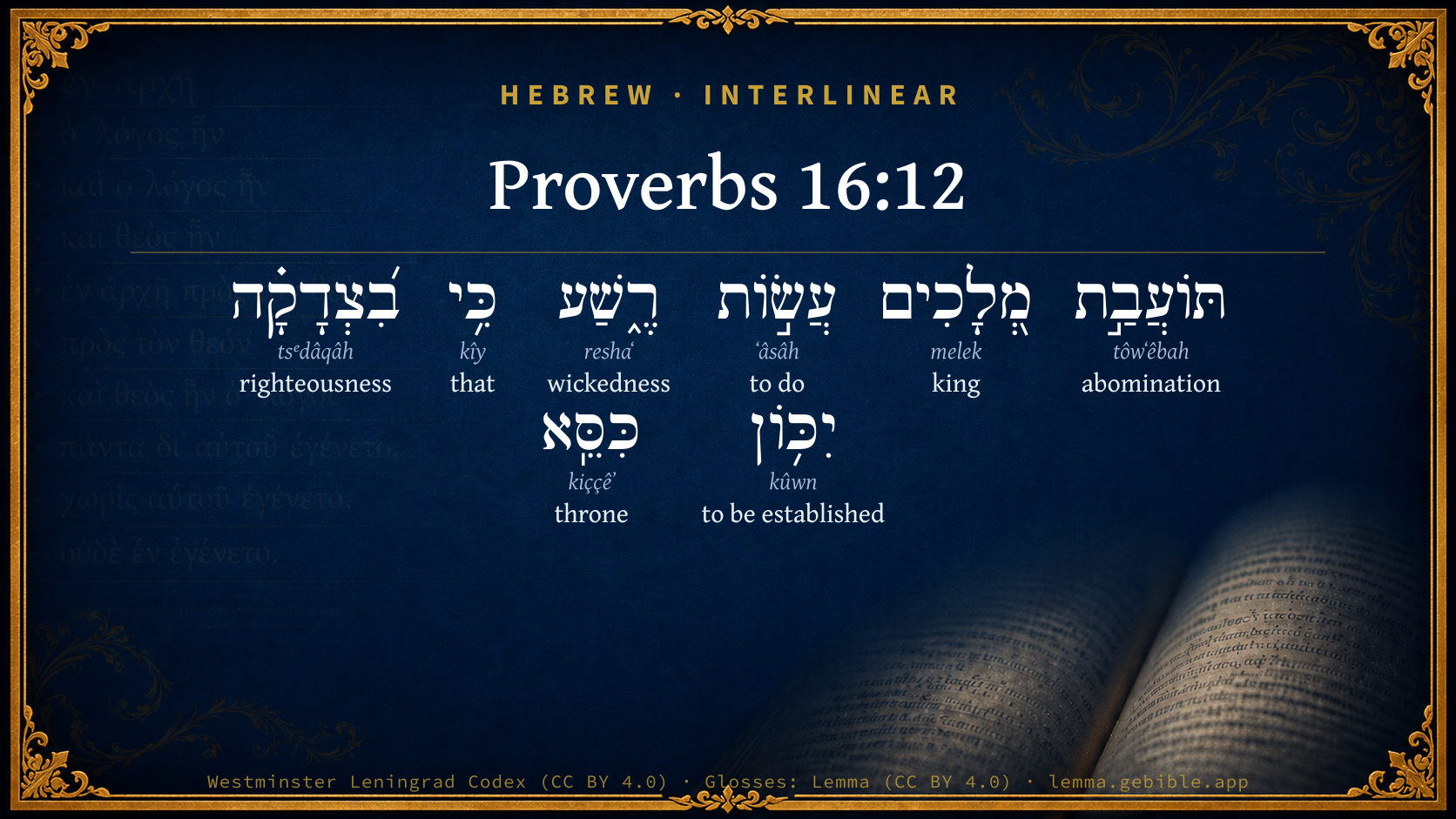
Proverbs 16:12

Hebrew (Westminster Leningrad Codex) Proverbs 16:12 appears in the Hebrew Old Testament. The text above is from the Westminster Leningrad Codex. Each word links to its Strong’s number, a concise gloss, and parsing drawn from the Open Scriptures Hebrew Bible morphology. Click any word for its full Brown-Driver-Briggs (BDB) entry.
Download image
Cite this verse

Proverbs 16:12 (World English Bible). Public Domain. Lemma interlinear Bible study tool, https://lemma.gebible.app/v/proverbs/16/12.

Show BibTeX & RIS
BibTeX
RIS
English Translation
It is an abomination for kings to do wrong, For the throne is established by righteousness.
World English Bible · Public Domain
Download a study sheet

One document with this verse’s original text, its word-by-word gloss line, the meaning frame, cross-references with their text, attributed commentary, and full source and license credits — printable, and it pastes into notes with its structure intact.

This verse Autodidact and up

Study sheet (.html) Plain text (.txt)

A passage Seminary Student

Up to 50 verses in one chapter. A passage sheet keeps up to 6 commentary sources and 12 cross-references per verse, in the order this page ranks them, and says so on the sheet whenever that leaves anything out. Ask for a single verse and you get the Autodidact verse sheet above.

Everything on this page stays free to read, with no account — the sheet is a download of what is already on screen, not access to it.

Want to remove ads? Support Godless Engineer
Compare translations 3

The same verse in 3 English versions, stacked beneath the original-language interlinear above. Click any original word for its lexicon entry.

Each is an independent rendering of the whole verse — the interlinear is not word-aligned to these translations.

Highlighted words mark where these versions differ — a whole-verse word diff, not a word-by-word alignment.

  • World English Bible Public Domain
    It is an abomination for kings to do wrong, For the throne is established by righteousness.
  • King James Version Public Domain
    It is an abomination to kings to commit wickedness: for the throne is established by righteousness.
  • unfoldingWord Literal Text CC BY-SA 4.0
    An abomination of kings doing wickedness, for by righteousness is a throne established.

unfoldingWord Literal Text — © unfoldingWord, licensed CC BY-SA 4.0. Word-aligned USFM3 via Door43 (git.door43.org/unfoldingWord/en_ult).

Versions to compare (up to 4)

3 of 4 selected

Show all 18 translations

Every available English version of this verse, each an independent rendering of the whole verse.

  • World English Bible Public Domain
    It is an abomination for kings to do wrong, For the throne is established by righteousness.
  • Berean Standard Bible Public Domain
    Wicked behavior is detestable to kings, for a throne is established through righteousness.
  • Majority Standard Bible Public Domain
    Wicked behavior is detestable for kings, for a throne is established through righteousness.
  • King James Version Public Domain
    It is an abomination to kings to commit wickedness: for the throne is established by righteousness.
  • American Standard Version (1901) Public Domain
    It is an abomination to kings to commit wickedness; For the throne is established by righteousness.
  • Revised Version (1885) Public Domain
    It is an abomination to kings to commit wickedness: for the throne is established by righteousness.
  • Geneva Bible (1599) Public Domain
    It is an abomination to Kings to commit wickednes: for the throne is stablished by iustice.
  • Douay-Rheims (1899) Public Domain
    They that act wickedly are abominable to the king: for the throne is established by justice.
  • Young's Literal Translation Public Domain
    An abomination to kings `is' doing wickedness, For by righteousness is a throne established.
  • Literal Standard Version CC BY-SA 4.0
    Doing wickedness [is] an abomination to kings, || For a throne is established by righteousness.
  • Unlocked Literal Bible CC BY-SA 4.0
    When kings do wicked things, that is something to be despised, for a throne is established by doing what is right.
  • unfoldingWord Literal Text CC BY-SA 4.0
    An abomination of kings doing wickedness, for by righteousness is a throne established.
  • Darby Bible Public Domain
    It is an abomination to kings to commit wickedness; for the throne is established by righteousness.
  • World Messianic Bible Public Domain
    It is an abomination for kings to do wrong, for the throne is established by righteousness.
  • Webster's Bible Public Domain
    It is an abomination to kings to commit wickedness: for the throne is established by righteousness.
  • Free Bible Version CC BY-SA 4.0
    It's a terrible thing for a king to do evil, for his throne is based on doing right.
  • Bible in Basic English Public Domain
    Evil-doing is disgusting to kings: for the seat of the ruler is based on righteousness.
  • JPS Tanakh (1917) Public Domain
    It is an abomination to kings to commit wickedness; for the throne is established by righteousness.

Literal Standard Version (2020), Covenant Press — licensed CC BY-SA 4.0. Text via the HelloAO Bible API (eBible.org). Unlocked Literal Bible (unfoldingWord) — licensed CC BY-SA 4.0. Text via the HelloAO Bible API (eBible.org). unfoldingWord Literal Text — © unfoldingWord, licensed CC BY-SA 4.0. Word-aligned USFM3 via Door43 (git.door43.org/unfoldingWord/en_ult). Free Bible Version, Dr. Jonathan Gallagher — licensed CC BY-SA 4.0. Text via the HelloAO Bible API (eBible.org).

Word by word

More ways to search: Search by grammar → Find every occurrence → Compare this word →

Practice this passage: Drill this verse → Learn its vocabulary →

About this verse

These counts appear in no published source. They are computed here, from the morphology-tagged text and Lemma’s own curated glosses. What Lemma adds →

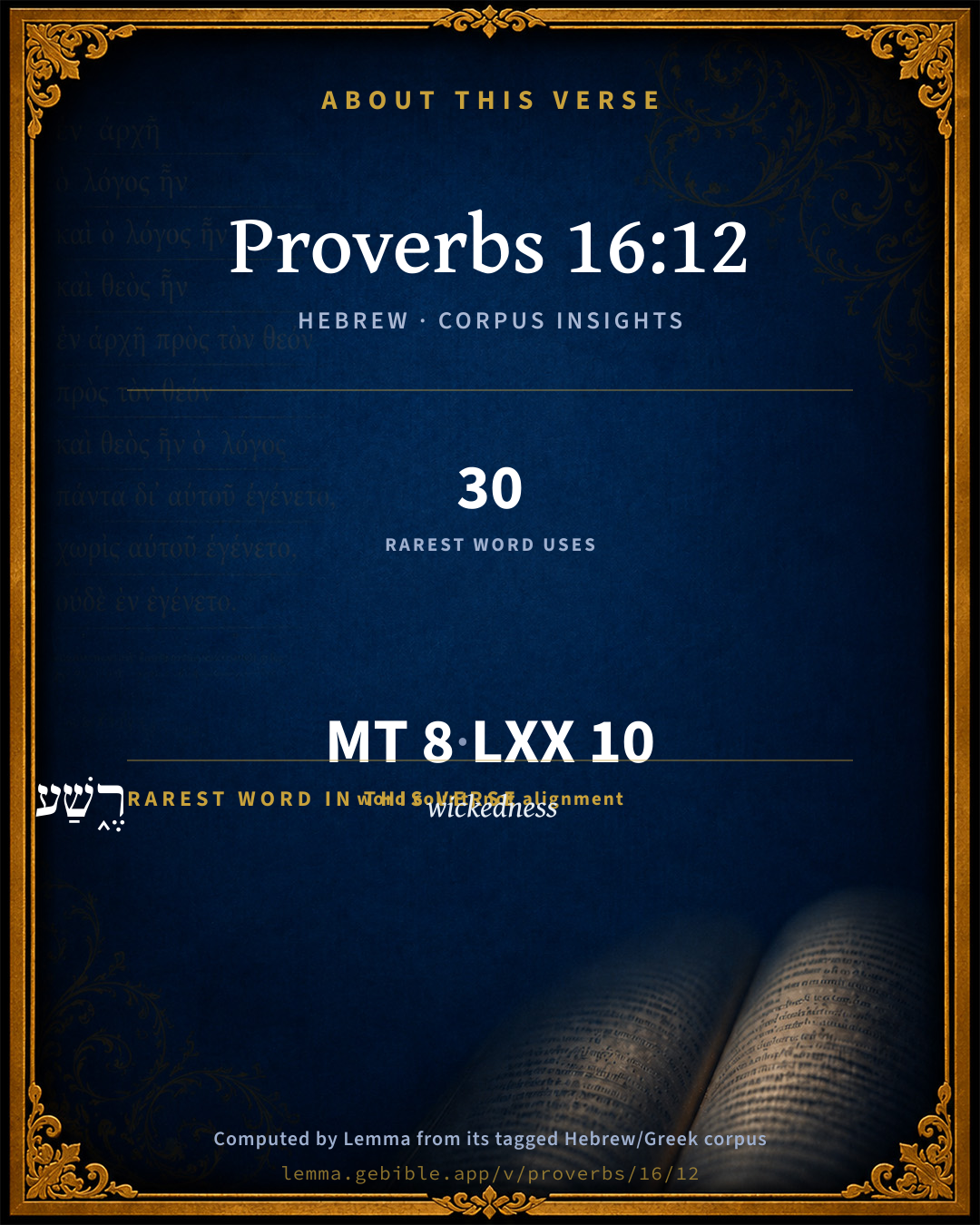
8
words
8
distinct lemmas
Wisdom
section

Shared distinctive vocabulary

רֶ֑שַׁע wickedness H7562 occurs in 29 verses of the Hebrew Bible. Also found in:

Grammatical profile

  • 2 verbs
  • 5 nouns
  • 1 conjunction

Verb forms

  • עֲשׂ֣וֹת Qal · Infinitive Construct
  • יִכּ֥וֹן Niphal · Imperfect

Hebrew & Septuagint length

In English translation the verse runs 16 words from the Hebrew and 17 from the Septuagint (LXX English) — closely comparable.

A rough comparison of the two English renderings, which tokenize alike — not a word-level alignment.

Word counts can differ between the Hebrew and the Greek without any difference in meaning — e.g. the Hebrew direct-object marker אֵת has no separate Greek word, and Greek often adds the article ὁ.

In the original languages it is 8 Hebrew tokens and 10 Greek tokens — but the two are counted differently (Hebrew bundles its prefixes and suffixes into one token; the Greek is in lemma form), so that isn’t a like-for-like length.

Cross-references

8

Topical passages linked to Proverbs 16:12 in the Treasury of Scripture Knowledge — connected by theme and wording, ordered by reader-vote popularity; previews shown in the World English Bible.

  • Proverbs 25:5 Take away the wicked from the king's presence, And his throne will be established in righteousness.
  • Proverbs 29:14 The king who fairly judges the poor, His throne shall be established forever.
  • Proverbs 28:9 He who turns away his ear from hearing the law, Even his prayer is an abomination.
  • Luke 12:48 but he who didn't know, and did things worthy of stripes, will be beaten with few stripes. To whoever much is given, of him will much be required; and to whom much was entrusted, of him more will be asked.
  • Deuteronomy 25:16 For all who do such things, [even] all who do unrighteously, are an abomination to Yahweh your God.
  • Psalms 99:4 The King's strength also loves justice. You do establish equity. You execute justice and righteousness in Jacob.
  • Proverbs 20:18 Plans are established by advice; By wise guidance you wage war!
  • Revelation 19:11 I saw the heaven opened, and behold, a white horse, and he who sat on it is called Faithful and True. In righteousness he judges and makes war.

Cross-references courtesy of OpenBible.info (CC BY 4.0).

Hebrew and Greek witnesses Masoretic Hebrew ↔ Greek Septuagint

The same verse in the two great witnesses to the Old Testament, shown verse-for-verse.

These are two independent witnesses, not word-aligned to each other, and the Septuagint is shown in lemma (dictionary) form.

Hebrew Proverbs 16:12 Masoretic · Westminster Leningrad Codex

תּוֹעֲבַ֣ת מְ֭לָכִים עֲשׂ֣וֹת רֶ֑שַׁע כִּ֥י בִ֝צְדָקָ֗ה יִכּ֥וֹן כִּסֵּֽא

It is an abomination for kings to do wrong, For the throne is established by righteousness.

World English Bible · Public Domain

Greek LXX Proverbs 16:12 Septuagint · lemma form

νοσσιά σοφία αἱρετός χρυσίον νοσσιά δέ φρόνησις αἱρετός ὑπέρ ἀργύριον

An evil-doer is an abomination to a king; for the throne of rule is established by righteousness.

LXX2012 (modern English Septuagint) · Public Domain

On this verse, The Pulpit Commentary discusses the Septuagint’s reading. Read the note in Commentary ↓

Hebrew: Westminster Leningrad Codex (CC BY 4.0). Greek: Septuagint (public domain); English from LXX2012 (modern English Septuagint) (Public Domain). How the Septuagint differs from the Hebrew →

Commentary

Notes on Proverbs 16:12 from classic Christian and Jewish commentators (each source and its license shown beneath its notes). The classic Christian expositions comment on the surrounding passage and are grouped to its opening verse, so a note may address several verses; the Jewish commentaries on the Tanakh (Rashi and others) are per-verse, so they appear only where the commentator wrote on this verse.

Lemma curates 59 commentaries, every one of them public domain or Creative Commons licensed, each selected and text-cleaned for this edition rather than reprinted as found. About our sources →

Trapp's Complete Commentary

John Trapp

Pro 16:12 [It is] an abomination to kings to commit wickedness: for the throne is established by righteousness.

Ver. 12. It is an abomination for kings to commit wickedness.] It is so for any man, but especially for great men. Peter Martyr told Queen Elizabeth in an epistle, that princes were doubly obliged to God: first, as men; secondly, as chief men. When I was born into the world, said Henry IV of France, there were thousands of others born besides myself; what have I done to God more than they? It is his mere grace and mercy which doth bind me more unto his justice; for the faults of great men are never small. {a} Thus he. It is reported of Tamberlane, {b} that warlike Scythian, that having overcome Bajazet the great Turk, he asked him whether ever he had given God thanks for making him so great an emperor? who confessed ingenuously he never thought of it. To whom Tamberlane replied, that it was no wonder so ungrateful a man should be made a spectacle of misery. For you, saith he, being blind of one eye, and I lame of a leg, was there any worth in us, why God should set us over two great empires of Turks and Tartars, to command many more worthy than ourselves? Good turns aggravate unkindnesses; and men’s offences are increased by their obligations.

For the throne is established by righteousness.] Politicians give many directions for the upholding and conserving of kingdoms; but this of Solomon is far beyond them all. See it exemplified in Jer 22:15-20, "Shalt thou reign, because thou closest thyself in cedar? Did not thy father eat and drink, and do judgment and justice, and then it was well with him?" &c.

{a} French Chron.

{b} Leunclav, Annal. Turci.

John Trapp, A Commentary or Exposition upon All the Books of the Old and New Testament (1647–1656) — public domain. Text from a community e-Sword module.

The Biblical Illustrator

Joseph S. Exell

Pro_16:12

For the throne is estaabished by righteousness.

Religious principles the best support of government

I. Righteousness most effectually answers the end and design of government. Religion consists in an acknowledgment of God as Governor of the world. Though the power be lodged in earthen vessels, there is no power but of God. This religious sense of a providential government will incline the subject to pay due reverence to the prince, because it reaches farther than his own person, and is ultimately referred to that Divine Original, whose image and representative he is. Religion fixes our duty to our sovereign upon a certain basis and derives our obedience from the noblest motives, not from a slavish fear, not from an occasional humour, not from a mercenary regard to temporal interest, but from a filial love and respect to the Lord of glory. An awful regard to God and a prevailing sense of religion possesses the subject with that justice and fidelity which cannot be shaken by any temptation, but stands unmoved against the assaults of danger and the allurements of interest. The fear of God is so powerful a principle of action that it necessarily produces happy effects, and is so mighty a restraint from sin that it almost supersedes the necessity of any other restraint.

II. Guard against those pernicious principles that subvert the throne and are destructive of government.

1. Those that remove the foundations of religion and deny the being of a God. Could these opinions prevail, fidelity and justice would cease and the distinction between right and wrong would be lost in confusion. It is the interest of every prince and people to put a stop to these fatal principles, and not only to discourage atheism itself, but every approach towards it.

2. A scornful neglect of God the Son, and an avowed denial of His divinity, may produce as dreadful effects as even the denial of God the Father. If we renounce the authority of Jesus Christ, the authority of revealed religion is absolutely cancelled.

3. Those republican doctrines which derive all power from the people.

4. The principle that makes an absolute allowance to the sincerity of every mans persuasion and places the whole of religion and the great affair of eternal salvation upon the authority of every private judgment. This is contradictory to an article of our creed; it is fruitful of erroneous sects and impious heresies, and it has a pernicious influence upon the State. If the sincerity of mens present persuasions will justify them in all their consequences, the more strongly they are persuaded so much the more abundantly will they be justified. And if they are hurried on to the commission of any evil action the strength of the impulse will sanctify the crime. Let us, then, show our regard to government by discharging our duty to God. (T. Newlin, M.A.)

The Biblical Illustrator, edited by Joseph S. Exell (c. 1880s–1900s) — public domain. Text from a community e-Sword module.

Joseph Benson's Commentary

Pro 16:12. It is an abomination to kings to commit wickedness — They should not only abstain from all wicked practices, but abhor them, both in their own persons, and in all their servants and subjects. It is too plain that he speaks not of the common practice, but of the duty of kings, as in Pro 16:10. A good king not only does justice, but it is an abomination to him to do otherwise: he hates the thought of doing wrong, and perverting justice: he not only abhors the wickedness done by others, but abhors to do any himself, though, having power, he might easily and safely do it. For the throne is established by righteousness — He that makes conscience of using his power aright, shall find that to be the best security of his government; both as it will oblige people, and keep them true to his interests, and as it will bring down upon him and his government the blessing of God, which will be a firm basis to his throne, and a strong guard about it.

Joseph Benson's Commentary on the Old and New Testaments (1811–1818) — public domain. Text from a community e-Sword module.

Tyndale Open Study Notes

Tyndale Open Resources

16:12-13 These proverbs presuppose a wise, godly king (see Isa 9:6-7). Many of Israel’s kings loved wrongdoing and hated truth (e.g., Ahab in 1 Kgs 21).

Tyndale Open Study Notes — © Tyndale Open Resources, licensed CC BY-SA 4.0. Text via the HelloAO Bible API.

Geneva Bible (1599)

Geneva Bible translators

They are appointed by God to rule according to equity and justice.

Geneva Bible (1599) marginal notes — public domain. Text via Bolls.life.

Matthew Henry's Commentary

Here is, 1. The character of a good king, which Solomon intended not for his own praise, but for instruction to his successors, his neighbours, and the viceroys under him. A good king not only does justice, but it is an abomination to him to do otherwise. He hates the thought of doing wrong and perverting justice; he not only abhors the wickedness done by others, but abhors the wickedness done by others, but abhors to do any himself, though, having power, he might easily and safety do it. 2. The comfort of a good king: His throne is established by righteousness. He that makes conscience of using his power aright shall find that to be the best security of his government, both as it will oblige people, make them easy, and keep them in the interest of it, and as it will obtain the blessing of God, which will be a firm basis to the throne and a strong guard about it.

Matthew Henry's Commentary on the Whole Bible (1708–1710) — public domain (CC PDM 1.0). Text via the HelloAO Bible API.

Jamieson, Fausset & Brown

Robert Jamieson, A. R. Fausset & David Brown

Rulers are rightly expected, by their position, to hate evil; for their power is sustained by righteousness.

Jamieson, Fausset & Brown — Commentary Critical and Explanatory on the Whole Bible (1871) — public domain (CC PDM 1.0). Text via the HelloAO Bible API.

Adam Clarke's Commentary

Verse 12. It is an abomination to kings, &c.] In all these verses the wise man refers to monarchical government rightly administered. And the proverbs on this subject are all plain.

Adam Clarke's Commentary on the Bible (1810–1826) — public domain. Text from a community e-Sword/MySword module.

Ellicott's Commentary for English Readers

(12) It is an abomination to kings. . . .—This and the following verse are, like Pro_16:10, descriptive of the ideal king who, above all things, loves truth and justice. Psalms 72 works out the thought more fully. How feebly the character was fulfilled by Solomon or the best of his successors the history of Israel shews. It was too high a conception for man to carry out, and was fulfilled only in the person of David’s Son, who is “King of kings, and Lord of lords” (Rev_19:16).

A Bible Commentary for English Readers, edited by Charles John Ellicott (1878–1897) — public domain. Text from a community e-Sword module.

John Gill's Exposition

It is an abomination to kings to commit wickedness,.... The Targum is,

"the abomination of kings are they that work wickedness.''

It should be an abomination to kings to commit wickedness themselves, and those that do it should be abhorred by them, or they should show their resentment at it by removing them from their presence, or by punishing them: and though there have been such kings as David, Psa 101:4; yet there are but few such; this is not true of kings in common; and therefore rather expresses what they should be than what they are; but is perfectly applicable to Christ, who loves righteousness and hates iniquity, Psa 45:7;

for the throne is established by righteousness; this is the support, strength, and security of every kingdom, and of the thrones of kings; and it is with judgment and righteousness that the throne of Christ is established; yea, justice and judgment are the habitation of his throne, Isa 9:7.

John Gill's Exposition of the Whole Bible (1746–1763) — public domain (CC PDM 1.0). Text via the HelloAO Bible API.

Matthew Poole's English Annotations

It is an abomination to kings to commit wickedness; they should not only abstain from all wicked practices, but abhor them both in their own persons, and in all their servants and subjects. It is too plain that he speaks not of the common practice, but of the duty of kings, as on Pro 16:10. And such affirmative expressions are oft used in Scripture to express men’s duty only, as 1Co 6:19, your body is (i.e. should be) the temple, &c.; and 1Co 7:32, careth, &c. i.e. ought to care.

The throne is established by righteousness; and (which is implied) weakened, and sometimes overthrown by unrighteousness; and therefore this is necessary for their own security and happiness.

Matthew Poole's English Annotations on the Holy Bible (1683–1685) — public domain. Text from a community e-Sword/MySword module.

Whedon's Commentary on the Bible

Daniel D. Whedon

12. This verse may be understood in two ways — either that the abomination consists in the wickedness which the king commits, or in that which is committed by others. Some understand it of both; they must neither do evil themselves nor permit others to do it.

For the throne is established by righteousness — In the king and in his subjects. Comp. Pro_16:5. The second sense above is generally preferred. The doing of wickedness by others is an abomination to good rulers. Compare Pro_16:10; Pro_25:5.

Daniel D. Whedon (gen. ed.), Commentary on the Old and New Testaments (1874–1909) — public domain. Text from a community e-Sword module.

The Pulpit Commentary

It is an abomination to kings to commit wickedness. This and the following verse give the ideal view of the monarch that which he ought to be rather than what be is. (comp. Ps 72) Certainly neither Solomon nor many of his successors exhibited this high character. The Septuagint, followed by some modern commentators, translates, "He who doeth wickedness is an abomination to kings;" but as the "righteousness" in the second clause (the throne is established by righteousness) undoubtedly refers to the king, so it is more natural to take the "wickedness" in the first member as being his own, not his subjects". When a ruler acts justly and wisely, punishes the unruly, rewards the virtuous, acts as God"s vicegerent, and himself sets the example of the character which becomes so high a position, he wins the affection of his people, they willingly obey him. and are ready to die for him and his family. (comp. Pro_25:5 Isa_16:5) Lawmakers should not be lawbreakers. Seneca, "Thyest.," 215"Ubi non est pudor, Nec cura juris, sanctitas, pietas, fides, Instabile regnum est.

The Pulpit Commentary (1880–1919), ed. H.D.M. Spence-Jones & Joseph S. Exell — public domain. Text from a community e-Sword module.

Keil & Delitzsch

C. F. Keil & F. Delitzsch

12 It is an abomination to kings to commit wickedness,

For by righteousness the throne is established.

As 10b uttered a warning to the king, grounded on the fact of 10a, so 12a indirectly contains a warning, which is confirmed by the fact 12b. It is a fact that the throne is established by righteousness (יכּון as expressive of a rule, like הוּכן, Isa 16:5, as expressive of an event); on this account it is an abomination to kings immediately or mediately to commit wickedness, i.e., to place themselves in despotic self-will above the law. Such wicked conduct shall be, and ought to be, an abhorrence to them, because they know that they thereby endanger the stability of their throne. This is generally the case, but especially was it so in Israel, where the royal power was never absolutistic; where the king as well as the people were placed under God's law; where the existence of the community was based on the understood equality of right; and the word of the people, as well as the word of the prophets, was free. Another condition of the stability of the throne is, after Pro 25:5, the removal of godless men from nearness to the king. Rehoboam lost the greater part of his kingdom by this, that he listened to the counsel of the young men who were hated by the people.

Keil & Delitzsch — Biblical Commentary on the Old Testament (1861–1891) — public domain (CC PDM 1.0). Text via the HelloAO Bible API. (Old Testament only.)

Kretzmann's Popular Commentary

Paul E. Kretzmann

v. 12. It is an abomination to kings, it makes them objects of loathing and contempt, to commit wickedness, the setting aside of right and justice causes both God and men to despise them; for the throne is established by righteousness, regal power is sustained by righteousness in its constant application, not by the arbitrariness of the despot.

Paul E. Kretzmann, Popular Commentary of the Bible (1921–1924) — public domain. Text from a community e-Sword module.

Rashi

Rabbi Shlomo Yitzchaki (Rashi)

It is an abomination to kings to commit wickedness It is an abominable thing for judges, and it is not proper for them to commit wickedness.

Rashi on the Tanakh — English translations: “The Judaica Press complete Tanach with Rashi, translated by A. J. Rosenberg” (CC BY 4.0); “Pentateuch with Rashi's commentary by M. Rosenbaum and A.M. Silbermann, 1929-1934” (public domain); “The Metsudah Tanach series, Lakewood, N.J” (CC BY 4.0); and “The Book of Joshua, Metsudah Publications, 1997” (CC BY 4.0). Text via Sefaria.

Lesson kit

Teaching starters — assembled from the data on this page, not authored interpretation. Every prompt links to the verse data it draws on. Edit before teaching.

Proverbs, in the Wisdom, opens this verse with 8 words (8 distinct Hebrew lemmas). Its most distinctive word is reshaʻ (“wickedness”). A historical commentator’s framing appears above. Read the whole chapter for the surrounding context.

Discussion questions

  1. How does “wickedness” (reshaʻ) shape what this verse is saying?
  2. How does Deuteronomy 9:27, which shares the word «wickedness», read alongside this verse?
  3. These translations render this verse differently; the difference is in the English rendering, not the original. What questions does that raise?
  4. «עֲשׂ֣וֹת» is a Qal Infinitive Construct verb. How does that grammatical form shape the action described?
  5. Compare how Trapp's Complete Commentary and The Biblical Illustrator read this verse. Where do they agree or differ?

Things to notice

Reading settings

Reading text

Shown beneath each verse's original-language words.

Old Testament
Old Testament edition

Read the OT as the Masoretic Hebrew (MT) or the Greek Septuagint (LXX).

English shown for the Greek Septuagint (in the Hebrew ↔ Greek comparison).

Comparing translations? Open the Compare panel on any verse page to stack up to four side by side.