
Psalms 68:9

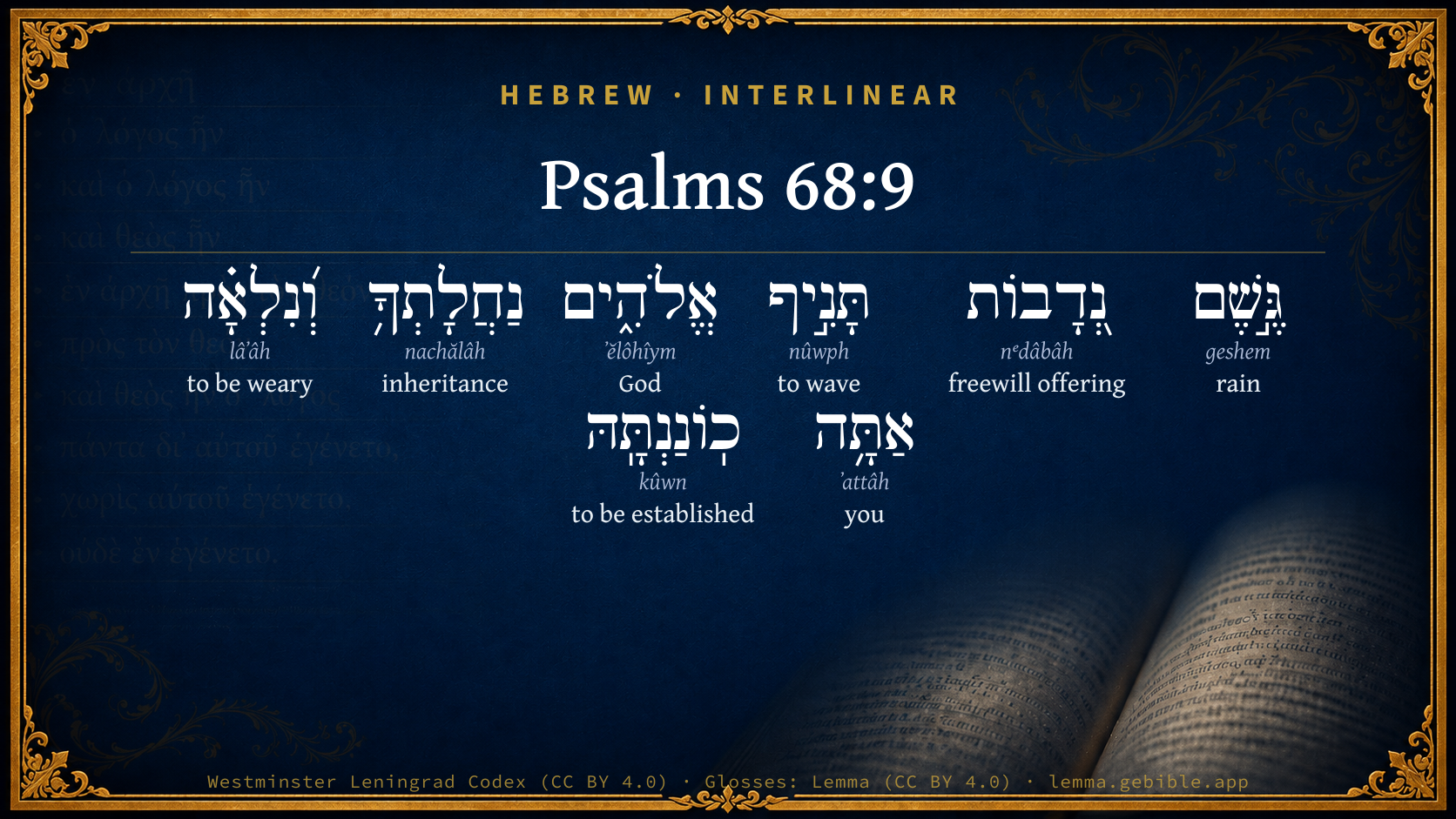
Hebrew (Westminster Leningrad Codex) Psalms 68:9 appears in the Hebrew Old Testament. The text above is from the Westminster Leningrad Codex. Each word links to its Strong’s number, a concise gloss, and parsing drawn from the Open Scriptures Hebrew Bible morphology. Click any word for its full Brown-Driver-Briggs (BDB) entry.
Download image
Cite this verse

Psalms 68:9 (World English Bible). Public Domain. Lemma interlinear Bible study tool, https://lemma.gebible.app/v/psalms/68/9.

Show BibTeX & RIS
BibTeX
RIS
English Translation
You, God, sent a plentiful rain. You confirmed your inheritance, when it was weary.
World English Bible · Public Domain
Download a study sheet

One document with this verse’s original text, its word-by-word gloss line, the meaning frame, cross-references with their text, attributed commentary, and full source and license credits — printable, and it pastes into notes with its structure intact.

This verse Autodidact and up

Study sheet (.html) Plain text (.txt)

A passage Seminary Student

Up to 50 verses in one chapter. A passage sheet keeps up to 6 commentary sources and 12 cross-references per verse, in the order this page ranks them, and says so on the sheet whenever that leaves anything out. Ask for a single verse and you get the Autodidact verse sheet above.

Everything on this page stays free to read, with no account — the sheet is a download of what is already on screen, not access to it.

Want to remove ads? Support Godless Engineer
Compare translations 3

The same verse in 3 English versions, stacked beneath the original-language interlinear above. Click any original word for its lexicon entry.

Each is an independent rendering of the whole verse — the interlinear is not word-aligned to these translations.

Highlighted words mark where these versions differ — a whole-verse word diff, not a word-by-word alignment.

  • World English Bible Public Domain
    You, God, sent a plentiful rain. You confirmed your inheritance, when it was weary.
  • King James Version Public Domain
    Thou, O God, didst send a plentiful rain, whereby thou didst confirm thine inheritance, when it was weary.
  • unfoldingWord Literal Text CC BY-SA 4.0
    A rain of generosities you shook out, God; your inheritance, when it was wearied, you, you established it.

unfoldingWord Literal Text — © unfoldingWord, licensed CC BY-SA 4.0. Word-aligned USFM3 via Door43 (git.door43.org/unfoldingWord/en_ult).

Versions to compare (up to 4)

3 of 4 selected

Show all 18 translations

Every available English version of this verse, each an independent rendering of the whole verse.

  • World English Bible Public Domain
    You, God, sent a plentiful rain. You confirmed your inheritance, when it was weary.
  • Berean Standard Bible Public Domain
    You sent abundant rain, O God; You refreshed Your weary inheritance.
  • Majority Standard Bible Public Domain
    You sent abundant rain, O God; You refreshed Your weary inheritance.
  • King James Version Public Domain
    Thou, O God, didst send a plentiful rain, whereby thou didst confirm thine inheritance, when it was weary.
  • American Standard Version (1901) Public Domain
    Thou, O God, didst send a plentiful rain, Thou didst confirm thine inheritance, when it was weary.
  • Revised Version (1885) Public Domain
    Thou, O God, didst send a plentiful rain, thou didst confirm thine inheritance, when it was weary.
  • Geneva Bible (1599) Public Domain
    Thou, O God, sendest a gracious raine vpon thine inheritance, and thou didest refresh it when it was wearie.
  • Douay-Rheims (1899) Public Domain
    The earth was moved, and the heavens dropped at the presence of the God of Sina, at the presence of the God of Israel.
  • Young's Literal Translation Public Domain
    A shower of free-will gifts thou shakest out, O God. Thine inheritance, when it hath been weary, Thou hast established it.
  • Literal Standard Version CC BY-SA 4.0
    You shake out a shower of free-will gifts, O God. Your inheritance, when it has been weary, || You have established it.
  • Unlocked Literal Bible CC BY-SA 4.0
    You, God, sent a plentiful rain; you strengthened your inheritance when it was weary.
  • unfoldingWord Literal Text CC BY-SA 4.0
    A rain of generosities you shook out, God; your inheritance, when it was wearied, you, you established it.
  • Darby Bible Public Domain
    Thou, O God, didst pour a plentiful rain upon thine inheritance, and when it was weary thou strengthenedst it.
  • World Messianic Bible Public Domain
    You, God, sent a plentiful rain. You confirmed your inheritance when it was weary.
  • Webster's Bible Public Domain
    \\68:8\\The earth shook, the heavens also dropped at the presence of God: even Sinai itself was moved at the presence of God, the God of Israel.
  • Free Bible Version CC BY-SA 4.0
    You sent plenty of rain to water the promised land; refreshing it when it was dry.
  • Bible in Basic English Public Domain
    You, O God, did freely send the rain, giving strength to the weariness of your heritage.
  • JPS Tanakh (1917) Public Domain
    (68-10) A bounteous rain didst Thou pour down, O God; when Thine inheritance was weary, Thou didst confirm it.

Literal Standard Version (2020), Covenant Press — licensed CC BY-SA 4.0. Text via the HelloAO Bible API (eBible.org). Unlocked Literal Bible (unfoldingWord) — licensed CC BY-SA 4.0. Text via the HelloAO Bible API (eBible.org). unfoldingWord Literal Text — © unfoldingWord, licensed CC BY-SA 4.0. Word-aligned USFM3 via Door43 (git.door43.org/unfoldingWord/en_ult). Free Bible Version, Dr. Jonathan Gallagher — licensed CC BY-SA 4.0. Text via the HelloAO Bible API (eBible.org).

Word by word

More ways to search: Search by grammar → Find every occurrence → Compare this word →

Practice this passage: Drill this verse → Learn its vocabulary →

וְ֝נִלְאָ֗ה
lâʼâh
H3811
“and · being weary”
Conjunction + Verb, Niphal, Participle Active, Feminine, Singular, Absolute
Part of Speech
Conjunction + Verb
Stem
Niphal
Form
Participle Active
Gender
Feminine
Number
Singular
State
Absolute
Full BDB Definition

Origin: a primitive root

TWOT: 1066

to be weary, be impatient, be grieved, be offended - (Qal) to be weary, be impatient - (Niphal) to be tired of something, weary oneself - (Hiphil) to weary, make weary, exhaust
  1. גֶּ֣שֶׁם geshem H1653 “rain of” Noun, Common, Masculine, Singular, Construct
  2. נְ֭דָבוֹת nᵉdâbâh H5071 “freewill offerings” Noun, Common, Feminine, Plural, Absolute
  3. תָּנִ֣יף nûwph H5130 “to wave” Verb, Hiphil, Imperfect, 2nd Person, Masculine, Singular
  4. אֱלֹהִ֑ים ʼĕlôhîym H430 “God(s)” Noun, Common, Masculine, Plural, Absolute
  5. נַחֲלָתְךָ֥ nachălâh H5159 “inheritance · your” Noun, Common, Feminine, Singular, Construct + Suffix, Personal, 2nd Person, Masculine, Singular
  6. אַתָּ֥ה ʼattâh H859 “you” Pronoun, Personal, 2nd Person, Masculine, Singular
  7. כֽוֹנַנְתָּֽהּ kûwn H3559 “to be established · her” Verb, Polel, Perfect, 2nd Person, Masculine, Singular + Suffix, Personal, 3rd Person, Feminine, Singular

About this verse

These counts appear in no published source. They are computed here, from the morphology-tagged text and Lemma’s own curated glosses. What Lemma adds →

8
words
8
distinct lemmas
Wisdom
section

Notable vocabulary

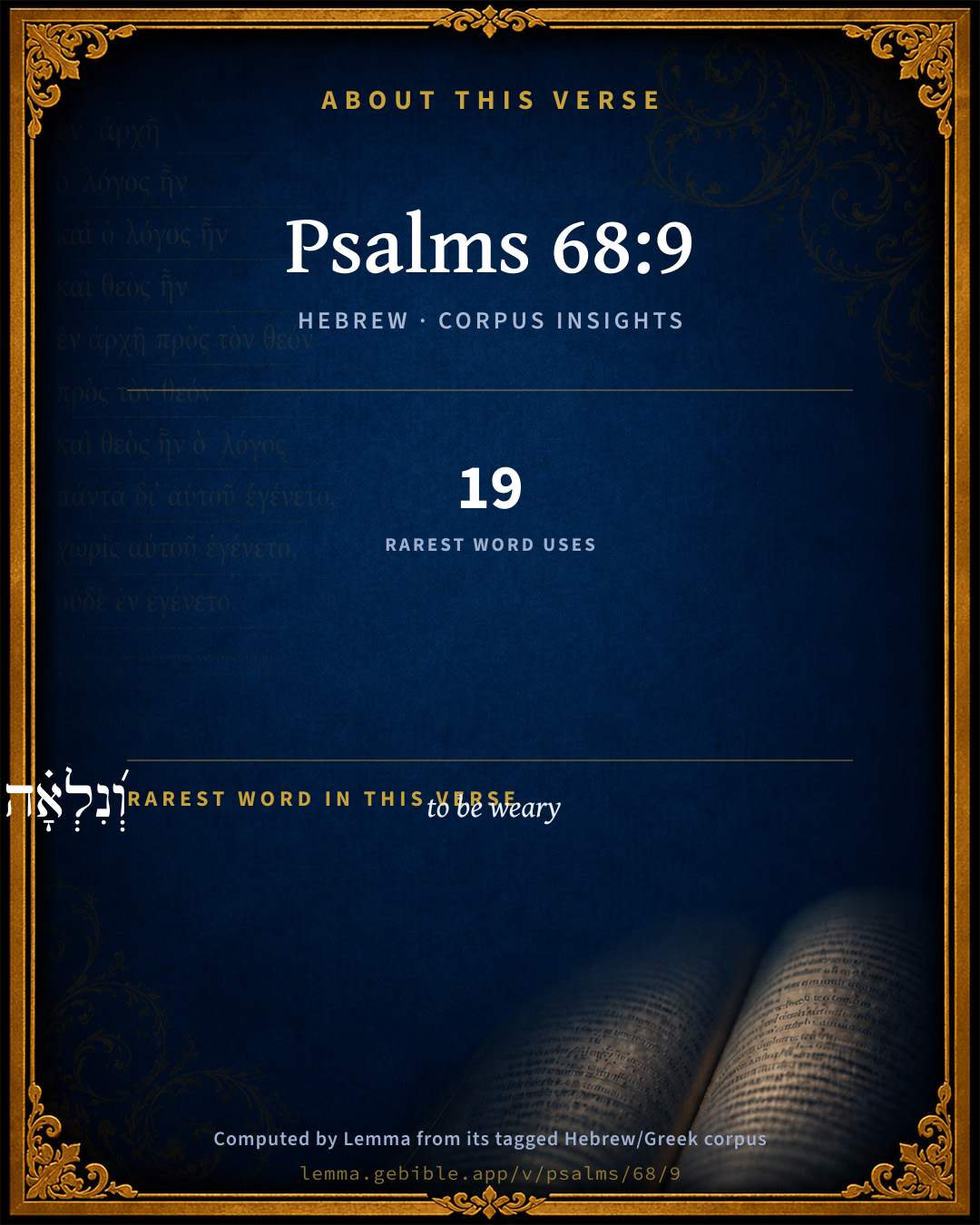
The rarest word here is וְ֝נִלְאָ֗ה to be weary H3811 — appearing just 19 times in the whole Hebrew Bible.

Shared distinctive vocabulary

וְ֝נִלְאָ֗ה to be weary H3811 occurs in 18 verses of the Hebrew Bible. Also found in:

Grammatical profile

  • 3 verbs
  • 4 nouns
  • 1 pronoun

Verb forms

  • תָּנִ֣יף Hiphil · Imperfect
  • וְ֝נִלְאָ֗ה Niphal · Participle Active
  • כֽוֹנַנְתָּֽהּ Polel · Perfect

Hebrew & Septuagint length

In English translation the verse runs 14 words from the Hebrew and 20 from the Septuagint (LXX English) — closely comparable.

A rough comparison of the two English renderings, which tokenize alike — not a word-level alignment.

Word counts can differ between the Hebrew and the Greek without any difference in meaning — e.g. the Hebrew direct-object marker אֵת has no separate Greek word, and Greek often adds the article ὁ.

Cross-references

6

Topical passages linked to Psalms 68:9 in the Treasury of Scripture Knowledge — connected by theme and wording, ordered by reader-vote popularity; previews shown in the World English Bible.

  • Deuteronomy 11:14 that I will give the rain of your land in its season, the former rain and the latter rain, that you may gather in your grain, and your new wine, and your oil.
  • Ezekiel 34:26 I will make them and the places round about my hill a blessing; and I will cause the shower to come down in its season; there shall be showers of blessing.
  • Psalms 65:9–13 You visit the earth, and water it. You greatly enrich it. The river of God is full of water. You provide them grain, for so you have ordained it.
  • Psalms 78:24–27 He rained down manna on them to eat, And gave them food from the sky.
  • Deuteronomy 11:10–12 For the land, where you go in to possess it, isn't as the land of Egypt, from whence you came out, where you sowed your seed, and watered it with your foot, as a garden of herbs;
  • Psalms 77:16–17 The waters saw you, God. The waters saw you, and they writhed. The depths also convulsed.

Cross-references courtesy of OpenBible.info (CC BY 4.0).

Hebrew and Greek witnesses Masoretic Hebrew ↔ Greek Septuagint

The same verse in the two great witnesses to the Old Testament, shown verse-for-verse.

You’re reading Greek Psalm 67 (Hebrew Psalm 68). The Septuagint counts the superscription, so verse numbers can differ from the Hebrew — chapter-level alignment, not verse-by-verse. Numbering follows Rahlfs.

These are two independent witnesses, not word-aligned to each other, and the Septuagint is shown in lemma (dictionary) form.

Hebrew Psalms 68:9 Masoretic · Westminster Leningrad Codex

גֶּ֣שֶׁם נְ֭דָבוֹת תָּנִ֣יף אֱלֹהִ֑ים נַחֲלָתְךָ֥ וְ֝נִלְאָ֗ה אַתָּ֥ה כֽוֹנַנְתָּֽהּ

You, God, sent a plentiful rain. You confirmed your inheritance, when it was weary.

World English Bible · Public Domain

Greek LXX Greek Psalm 67:9 Septuagint · lemma form

γῆ σείω καί γάρ ὁ οὐρανός στάζω ἀπό πρόσωπον ὁ θεός οὗτος σινα ἀπό πρόσωπον ὁ θεός ἰσραήλ

O God, you will grant to your inheritance a gracious rain; for it was weary, but you did refresh it.

LXX2012 (modern English Septuagint) · Public Domain

On this verse, The Cambridge Bible for Schools and Colleges discusses the Septuagint’s reading. Read the note in Commentary ↓

Hebrew: Westminster Leningrad Codex (CC BY 4.0). Greek: Septuagint (public domain); English from LXX2012 (modern English Septuagint) (Public Domain). How the Septuagint differs from the Hebrew →

Commentary

Notes on Psalms 68:9 from classic Christian and Jewish commentators (each source and its license shown beneath its notes). The classic Christian expositions comment on the surrounding passage and are grouped to its opening verse, so a note may address several verses; the Jewish commentaries on the Tanakh (Rashi and others) are per-verse, so they appear only where the commentator wrote on this verse.

Lemma curates 59 commentaries, every one of them public domain or Creative Commons licensed, each selected and text-cleaned for this edition rather than reprinted as found. About our sources →

Ellicott's Commentary for English Readers

(9, 10) Thou, O God . . .—The text of these two verses literally runs, A rain of gifts thou shakest out, O God, on thine inheritance, and when exhausted didst refresh it. Thy living creatures dwell therein; thou makest provision of thy goodness for the afflicted, O God. The rain of gifts has been variously explained as actual showers, blessings of prosperity, outpourings of the Holy Spirit. Both the latter might no doubt be implied in the expression, but some particular material blessing seems indicated, and in connection with the desert wanderings the rain of manna suggests itself. By thine inheritance we understand God’s people, as in Deu_4:20; Psa_28:9, &c. The “living creatures” in the next verse will then probably be the quails; and a slight emendation, lately suggested, carries conviction along with it. It consists in bringing “thy living creatures” into Psa_68:9, and, by the insertion of a letter, to read instead of “they dwell therein”—they are satisfied with it (comp. Psa_78:24-25). This gives the rendering, and when it was exhausted thou didst refresh it with thy living creatures; they are satisfied therewith. (Burgess.)

A Bible Commentary for English Readers, edited by Charles John Ellicott (1878–1897) — public domain. Text from a community e-Sword module.

The Cambridge Bible for Schools and Colleges

gen. ed. J. J. S. Perowne

9. Thou, O God, didst send &c.] Or, dost send, a general truth, illustrated by God’s dealings with Israel. The verse is explained by, many to refer to the manna and the quails which God ‘rained down’ upon the Israelites (Exo_16:4; Psa_78:24; Psa_78:27); or generally, to all the gifts and blessings which He bestowed upon them in the wilderness. But ‘dwelt’ in Psa_68:10 (though the word is sometimes used of the temporary sojourn in the wilderness, e.g. Num_25:1; Deu_1:46) is most naturally understood of the settlement in Canaan, and the antecedent to ‘therein’ must be ‘thine inheritance,’ i.e. the promised land, which is called God’s inheritance in Exo_15:17; Jer_2:7; Psa_79:1; 2Ma_2:4, “The mount which Moses ascended and viewed the inheritance of God.” Psa_68:9 will thus refer to the gracious preparation of the land of Canaan to be the home of Israel. In contrast to the land of Egypt from which they had come, and the wilderness through which they had passed, it was a land of abundant rain (Deu_11:10-12; Psa_65:9): though it too had known what it was to be ‘weary’ with drought (Gen_47:13). But a plentiful rain, lit. rain of bounteousnesses, is not perhaps to be limited to the literal meaning, but may include all blessings which God pours out upon His people of His gracious liberality.

whereby thou didst confirm] Omit whereby, which is not in the Heb. Confirm may mean stablish as in Exo_15:17; Psa_48:8; or prepare, LXX κατηρτίσω.

weary] Cp., though the word is different, Psa_63:1.

The Cambridge Bible for Schools and Colleges (gen. ed. J. J. S. Perowne; Cambridge University Press, 1878–1918) — public domain. Text from a community e-Sword module.

Trapp's Complete Commentary

John Trapp

Psa 68:9 Thou, O God, didst send a plentiful rain, whereby thou didst confirm thine inheritance, when it was weary.

Ver. 9. Thou, O God, didst send a plentiful rain] Heb. Thou didst speak out a rain of liberalities. Spiritually this meaneth the doctrine of the gospel, Deu 32:2 Isa 45:8 Hos 14:6, and the gifts of the Holy Ghost, bestowed freely and plentifully.

John Trapp, A Commentary or Exposition upon All the Books of the Old and New Testament (1647–1656) — public domain. Text from a community e-Sword module.

The Biblical Illustrator

Joseph S. Exell

Psa_68:9

Thou, O God, didst send a plentiful rain, whereby Thou didst confirm Thine inheritance when it was weary.

Refreshing showers

The language is figurative. There is no mention of any rain in Israels history. It was a rain of gifts. He rained down manna upon them, etc. I will pour water upon him that is thirsty, and floods, etc. Now, the resemblance to the rain holds good--

I. In their abundance. It is a plentiful rain. So is it with Gods grace

II. In their refreshing, reviving nature. See it in the fields; so is it in human hearts.

III. In their seasonableness--when Gods inheritance was weary. They have been weary times which have preceded the outpouring of the grace of God. See this in history; in homes and Churches; in individual hearts. (E. W. Shalders, B. A.)

Blessing for a weary heritage

I. God has a possession in this world which may be pre-eminently called His own. Thine inheritance. The Church is His--

1. By special choice.

2. By right of conquest.

3. By voluntary self-surrender of His believing people.

II. This heritage upon earth is often exposed to the exhausting influence of trial and discouragement.

1. The length of the way.

2. Open enemies.

3. False friends.

4. Delay of harvest, and fear of final loss.

III. God is at no loss for means and instruments to refresh and replenish His church in critical seasons.

1. These promised influences are timely and seasonable.

2. They are copious and abundant

3. They are fertilizing and vitally influential. (Homiletic Magazine.)

A gracious rain refreshes Gods inheritance when weary

I. The people of God are His inheritance. This implies that He peculiarly loves, delights in, and cultivates His inheritance; and receives from them, in return, those fruits of righteousness, of worship, and of praise, in which the revenue of His glory consists.

II. This inheritance, from a variety of causes, is sometimes weary, By too much intercourse with the world; by too close an attention to business; by too free an indulgence in the enjoyments of life; the people of God become barren and unfruitful. And when they are brought to a sense of their condition, no land parched with drought ever thirsted more for the refreshing rain of heaven than they long for the renewing grace of God.

III. When it is weary, God, in great compassion, sends a gracious rain upon his inheritance, and refreshes it. There is not a more perceptible effect produced upon the face of nature, by the rain which descends from heaven, than in the soul of man, by the rain of heavenly grace. What a verdure; what a freshness, in the one case; and in the other, what a serenity of soul; what a kindness of temper; what a humbleness of mind; what a sanctity of heart; what a blessed hope; what an unspeakable peace; what a reviving like the corn; what a growing like the lily; what a casting forth of roots as Lebanon; what a spreading of the branches of the tree of life; what an olive-like beauty--are the fruits of this gracious rain, this heavenly refreshing! The refreshing of which we speak does not produce feelings and affections merely grateful. The beauty which is imparted is the beauty of holiness. It is a beautifying of the meek with salvation. Ask yourselves, then, this question: Am I refreshed by the Word of God? Does it come to me not in word only, but in power, in the Holy Ghost, and in much assurance? (M. Jackson.)

Refreshing influences

Trace the analogy between the effects of rain on the earth and the influence of the Holy Spirit on the Church.

I. Cleansing. No rain in March, no rain in April, and no rain till the middle of May; the grass, the flower, the shrub, the bush, and the tree were covered with malarial excrescences, parasites, blight and dust. How long would it take the women of England, with brush and duster in hand, to dust the hedges, the gardens, the forests and the fields? They sadly needed it--months without a wash, their beauty was gone. But the rain came, washed away the dust, drowned the parasites, and removed all hindrances to growth. This is the present need of the Church of God: showers of blessings; the washing of regeneration. Conformity to the habits of society, worldliness, talebearing, scandalizing, pride, selfishness, envy, strife, hypocrisy, uncharitableness, assumption of holiness--these are the dust, the excrescences, the parasites, which mar the beauty and retard the growth of the Church of Christ in our day. We need a downpour of the Holy Ghost to wash all away.

II. Fertilizing (Psa_72:6). The mown field suggests the condition of those who are exhausting themselves in the service of Christ, or, at least, those who are throwing off crop after crop of work and experience for the benefit of others. These Christians are the pillars of the truth; towards them our hearts go forth. They are so busy at work that they cannot find fault with others; and so sensible are they of their own unworthiness that they never sit in judgment upon their fellow-Christians. Their motto is, To spend and be spent for Christ. But human energy is inexhaustible, and it needs replenishing--rain upon the mown grass. The rain fills the fibres of the tree, and penetrates the ground to water the roots, so does the influence of prayer water the soul.

III. Ripening. You see the husbandman looking at the cornfield when about ripe. A good shower ripens and fills the grain. The ripeness of the soul is like a shock of corn. God is looking out, and pours His Spirit upon it. (T. Davies, D. D.)

The Biblical Illustrator, edited by Joseph S. Exell (c. 1880s–1900s) — public domain. Text from a community e-Sword module.

Joseph Benson's Commentary

Psa 68:9. Thou, O God, didst send a plentiful rain, &c. — Hebrew, נדבות, גשׁם, geshem nedaboth, a rain of spontaneousness, or liberality. The Seventy render it, βροχην εκουσιον, a spontaneous, voluntary, or free rain. As we do not read of any showers of rain that fell during the continuance of the Israelites in the wilderness, except that before mentioned on Sinai, the people being supplied with water, partly from wells which they found, and partly by miracle from rocks, Dr. Chandler thinks the plentiful rain here mentioned “relates to the manna and the quails, which were rained down on them from heaven.” Thus God promised, I will rain bread from heaven for you, Exo 16:4; and the psalmist observes, Psa 68:23-24; Psa 68:27, He opened the doors of heaven, and rained down manna upon them to eat, and gave them of the corn of heaven. He rained flesh also upon them as dust, and feathered fowls as the sand of the sea. “This,” he thinks, “may truly be called a kind of spontaneous shower; as both the manna and the quails offered themselves to their hands without any pains or labour in the people to procure them. By this shower, says the sacred writer, thou didst confirm thine inheritance, (see Deu 32:9;) that is, didst recruit and refresh thy people; for they greatly needed it, as they were weary; that is, tired, and almost worn out with hunger, the hardships of which they bore with great impatience and murmuring.” There is, however, one great objection to this interpretation of the passage. It does not seem to comport with the next verse, which speaks of the congregation of Israel as dwelling in the inheritance refreshed by this rain, which inheritance was certainly the land of Canaan. In this they had dwelt for many ages when David wrote this Psalm, and though they had sometimes been chastised with drought, yet they had often witnessed the descent of abundant rains upon their country, which were the more necessary and desirable, because it was hilly and of a dry soil, and not watered, like Egypt, by the overflowings of a great river. See Deu 11:10-11.

Joseph Benson's Commentary on the Old and New Testaments (1811–1818) — public domain. Text from a community e-Sword module.

J. A. Alexander on Psalms

Joseph Addison Alexander

10. (Psa 68:9). A rain of free gifts thou pourest down, O God; thine inheritance and (that) exhausted, thou dost confirm (or strengthen) it. The first clause probably refers to the abundant and refreshing gifts (of which rain is a natural and common emblem) bestowed upon the people in the wilderness, including manna, quails, and water. The future tense is like those in Psa 18:6). Pour down, literally shake or shake out. Thine inheritance, thy people. The construction is that of an absolute nominative, (as to) thine inheritance. The next clause heightens the description by suggesting that the gift came precisely when it was most needed.

Joseph Addison Alexander, The Psalms Translated and Explained (1850) — public domain. Text from a community e-Sword module.

Jamieson, Fausset & Brown

Robert Jamieson, A. R. Fausset & David Brown

a plentiful rain--a rain of gifts, as manna and quails.

Jamieson, Fausset & Brown — Commentary Critical and Explanatory on the Whole Bible (1871) — public domain (CC PDM 1.0). Text via the HelloAO Bible API.

Adam Clarke's Commentary

Verse 9. Didst send a plentiful rain] גשם נדבות geshem nedaboth, a shower of liberality. I believe this to refer to the manna by which God refreshed and preserved alive the weary and hungry Israelites.

Adam Clarke's Commentary on the Bible (1810–1826) — public domain. Text from a community e-Sword/MySword module.

John Calvin's Commentaries

9. Thou, O God! shalt make a liberal rain to fall upon thine inheritance Mention is made here of the continued course of favor which had been extended to the people from the time when they first entered the promised land. It is called the inheritance of God, as having been assigned over to his own children. Others understand by the inheritance spoken of in the verse, the Church, but this is not correct, for it is afterwards stated as being the place where the Church dwelt. The title is appropriately given to the land of Canaan, which God made over to them by right of inheritance. David takes notice of the fact, that, from the first settlement of the seed of Abraham in it, God had never ceased to make the kindest fatherly provision for them, sending his rain in due season to prepare their food. The words translated a liberal rain, read literally in the Hebrew a rain of freenesses, and I agree with interpreters in thinking that he alludes to the blessing as having come in the exercise of free favor, and to God, as having of his own unprompted goodness provided for all the wants of his people. Some read a desirable rain; others, a rain flowing without violence, or gentle; but neither of these renderings seems eligible. Others read a copious or plentiful rain; but I have already stated what appears to me to be the preferable sense. It was a proof, then, of his Divine liberality, that God watered the land seasonably with showers. There is clearly a reference to the site of Judea, which owed its fertility to dews and the rains of heaven. In allusion to the same circumstance, he speaks of its being refreshed when weary. The reason is assigned — because it had been given to his chosen people to dwell in. On no other account was it blessed, than as being the habitation of God’s Church and people. The more to impress upon the minds of the Jews their obligations to Divine goodness, he represents them as pensioners depending upon God for their daily food. He fed them upon the finest of the wheat, giving them wine, and honey, and oil in abundance — still he proportioned the communication of his kindness so as to keep them always dependent in expectation upon himself. Some, instead of reading, Thou wilt prepare with thy goodness, etc., render it, Thou wilt prepare with rich food; but, without absolutely objecting to this translation, I rather think that he adverts to the circumstance of God’s being led to provide for his people entirely by his own good pleasure.

John Calvin's Commentaries (1540-1563) — public domain. Text from the Calvin Translation Society English edition (1840s-50s) via the Christian Classics Ethereal Library (ccel.org). Calvin's coverage is partial (roughly two-thirds of the Bible); uncommented books and verses are honest gaps, never fabricated. The 19th-century editor's footnotes and remarks are omitted so the notes are faithfully Calvin's own voice.

John Gill's Exposition

Thou, O God, didst send a plentiful rain,.... Not of water literally taken, as when the Israelites passed through the sea, Psa 77:17; or when the thunderings and lightnings were on Mount Sinai, at the giving of the law, which are commonly attended with rain, Exo 19:16; or in the land of Canaan, which was the land that drank in the water of the rain of heaven, Deu 11:11; nor the rain of manna and of quails, as Arama, Exo 16:4; but either the effusion of the Holy Spirit, ordinary or extraordinary; that, on the day of Pentecost, in consequence of Christ's ascension, prophesied of in this psalm, was a "plentiful" one indeed; when the disciples were filled with the Holy Ghost, and baptized with it: yea, the ordinary measure of the Spirit's grace in conversion is abundant, and exceeding abundant; it is shed abundantly through Christ, and superabounds sin, and may be called, as the words here signify, "a rain of liberalities" (s), or a free and liberal rain; for it comes from the free grace of God, and makes those on whom it descends a willing people in their obedience. The Spirit of God is a free Spirit; and, where he is, there is liberty, in the exercise of grace, and in the discharge of duty. Or else the ministration of the Gospel (t) is meant; which is compared to rain, Deu 32:2. This, especially in the first times of the Gospel, was a very large and plentiful one; it being sent all over the world, and brought forth fruit in every place: this was also a "liberal" one, flowed from the free grace of God; the subject of it is free grace; and the tendency and effect of it are, to make men free from the bondage of the law, and the spirit of bondage which that induces. The Targum is,

"thou hast let down the dews of quickening, and the rains of good pleasure;''

grace, or free favour;

whereby thou didst confirm thine inheritance when it was weary; that is, the church, as the Targum explains it; the inheritance of Christ, which he has chosen, the Father has given him, and he possesses: the people of God, "weary" with the burdensome rites and ceremonies of the law; with their own sins and corruptions, a burden too heavy for them to bear; with the sins of others, among whom they dwell; with the temptations of Satan, with which they are annoyed; with the persecutions of the men of the world, which make them weary sometimes, and faint in their minds; and with the common afflictions of life, which often make them weary of life itself. Now, by the plentiful ministration of the doctrines of the Gospel, accompanied with the Spirit and grace of God, the hearts of the Lord's people are refreshed, as the weary, dry, and thirsty land, is with a comfortable shower of rain; and by it weary souls have rest, or at least are directed by it to Christ, where they find it: and as the earth is "prepared" (u), as the word used signifies, by rain, for the nourishment of plants; so is the church by the Gospel, whose plants are an orchard of pomegranates, for the reviving and fructifying of those who are planted in it; whereby they appear to be trees of righteousness, and the planting of the Lord; and so are confirmed, settled, and established in the house of God, and in the truths of the Gospel.

(s) "pluviam munificentiarum", Montanus; "vel liberalitatum", Vatablus, Gejerus, Michaelis; so Ainsworth; to the same purpose the Tigurine version, Cocceius, Junius & Tremellius. (t) "Dicitur de pluvia", Psal. lxviii. 10. "quae effusionem Spiritus sancti, et praeconium evangelii designat". Stockius, p. 660. (u) "parasti eam", Michaelis; "praeparas", Gejerus.

John Gill's Exposition of the Whole Bible (1746–1763) — public domain (CC PDM 1.0). Text via the HelloAO Bible API.

Albert Barnes' Notes on the Bible

Thou, O God, didst send a plentiful rain - Margin, shake out. Prof. Alexander, “a rain of free gifts.” The Septuagint and the Vulgate render it, “a voluntary or willing rain.” The Syriac, “the rain of a vow.” The Hebrew word translated “plentiful” means free, voluntary, of its own accord - נדבה nedâbâh - (See the notes at Psa 51:12, where it is rendered free); then it means that which is given freely; and hence, abundantly. It means, therefore, in this place, plentiful, abundant. The reference, however, is to the manna, with which the people were supplied from day to day, and which seemed to be showered upon them in abundance. The word rendered “didst send” means properly to shake out, as if God shook the clouds or the heavens, and the abundant supplies for their needs were thus shaken out.

Whereby thou didst confirm thine inheritance, when it was weary - Thou didst strengthen thy people when they were exhausted, or were in danger of fainting. In other words, God sent a supply of food - manna, quails, etc. - when they were in the pathless wilderness, and when they were ready to perish.

Albert Barnes' Notes on the Bible (1834–1885) — public domain. Text from a community e-Sword/MySword module.

Matthew Poole's English Annotations

Send a plentiful rain; either,

1. In the wilderness; where they oft wanted water, and were by God’s extraordinary care supplied with it. Or rather,

2. In the land of Canaan, which he calls God’s inheritance in the next words; as also Exo 15:17, and in many other places of Scripture; in which God’s people are said to dwell in the next verse, of which, and the things done in it, lie speaks in the following verses, and which, being destitute of those constant supplies from the overflowings of a great river which Egypt enjoyed, God took a special care to supply with rain as occasion required; of which see Deu 11:10,11.

Confirm; or, stablish, or support, or sustain.

Thine inheritance; either thy people; or rather thy land, as was now said. Weary; dry and thirsty, and parched with excessive heat, and ready to faint for want of rain: compare Psa 63:1.

Matthew Poole's English Annotations on the Holy Bible (1683–1685) — public domain. Text from a community e-Sword/MySword module.

The Treasury of David

Charles H. Spurgeon

Ver. 9. Thou, O God, didst send a plentiful rain. The march of God was not signalized solely by displays of terror, for goodness and bounty were also made conspicuous. Such rain as never fell before dropped on the desert sand, bread from heaven and winged fowl fell all around the host; good gifts were poured upon them, rivers leaped forth from rocks. The earth shook with fear, and in reply, the Lord, as from a cornucopia, shook out blessings upon it; so the original may be rendered.

Whereby thou didst confirm thine inheritance, when it was weary. As at the end of each stage, when they halted, weary with the march, they found such showers of good things awaiting them that they were speedily refreshed. Their foot did not swell all those forty years. When they were exhausted, God was not. When they were weary, He was not. They were his chosen heritage, and, therefore, although for their good he allowed them to be weary, yet he watchfully tended them and tenderly considered their distresses. In like manner, to this day, the elect of God in this wilderness state are apt to become tired and faint, but their ever loving Jehovah comes in with timely succours, cheers the faint, strengthens the weak, and refreshes the hungry; so that once again, when the silver trumpets sound, the church militant advances with bold and firm step towards "the rest which remaineth." By this faithfulness, the faith of God's people is confirmed, and their hearts established; if fatigue and want made them waver, the timely supply of grace stays them again upon the eternal foundations.

Ver. 9. The Thou in the Hebrew is emphatic: Thine inheritance, even when it was wearied (i.e., worn out) thou didst confirm; or, "fortify it." Thou who alone couldest strengthen one worn out, didst so for thy people. A. R. Fausset.

Ver. 9. A liberal rain. The words translated a liberal rain, read literally in the Hebrew a rain of freenesses; and I agree with interpreters in thinking that he alludes to the blessing as having come in the exercise of free favour, and to God, as having of his own unprompted goodness provided for all the wants of his people. Some read, a desirable rain; others a rain flowing without violence, or gentle; but neither of these renderings seems eligible. Others read, a copious or plentiful rain; but I have already stated what appears to me to be the preferable sense. John Calvin.

Ver. 9. A gracious rain; that is, of manna. Edmund Law (1703-1787), quoted by Richard Warner in loc., 1828.

Ver. 9. Rain. One fountain, says Cyril, waters thy paradise, and the rain that falls upon all the world is the same; it is white in the bloom of the hawthorn, red in the rose, purple in the hyacinth, and diverse kinds, and all in all; yet it itself is the same and of the same kind...

So also the Holy Spirit, though he is one and the same and not divisible, yet to every one he divideth grace according as he wills. Thomas Le Blanc.

Ver. 9. A plentiful rain. Thy love has been as a shower! The returns, but a dew drop, and that dew drop stained with sin. James Harrington Evans, 1785-1849.

Ver. 9.

I. God's mercy compared to a shower.

1. It is direct from heaven; not through priests.

2. It is pure and unmixed.

3. No one has a monopoly of it.

4. There is no substitute for it.

5. It is sovereignly dispensed, as to (1) time; (2) place; (3) manner; and (4) measure.

6. It works efficiently. Isa 55:10.

7. Prayer can get it.

II. There are seasons when these showers fall.

1. In the house of God.

2. In the means of grace.

3. In prayer.

4. In affliction.

5. When saints are weary (1) through working; (2) through sickness; (3) through non success.

6. By the Holy Spirit refreshing the heart.

III. These showers are meant to "confirm God's people."

IV. They are wanted now.

Ver. 9.

I. The church is God's inheritance.

1. Chosen.

2. Purchased.

3. Acquired. II. Though his inheritance, at times it may be weary. III. When weary, it will be refreshed by him. G. R.

Psalms 68:10*

Charles H. Spurgeon's The Treasury of David (1869–1885) — public domain. Psalms only. Text from a community e-Sword/MySword module.

Whedon's Commentary on the Bible

Daniel D. Whedon

9. Confirm thine inheritance, when it was weary—Literally, Thine inheritance, when it was faint, thou hast established. The privations of the desert naturally induced impatience, doubts, and murmurings, but from time to time the people were re-established in faith and constancy by those opportune supplies. Thus, God tempers the trial. 1Co_10:13.“Inheritance” is a term of endearment, and points to the intimate relation of Israel to God as Father, Proprietor, and Lord. Deu_32:9

Daniel D. Whedon (gen. ed.), Commentary on the Old and New Testaments (1874–1909) — public domain. Text from a community e-Sword module.

The Pulpit Commentary

Thou, O God, didst send a plentiful rain. Not a literal rain, but a shower of blessings manna, quails, water out of the rock, protection against enemies, victories, etc. Whereby thou didst confirm (or, establish) thine inheritance. (see 2Sa_7:13) When it was weary. The wandering in the wilderness must have been inexpressibly dull and wearisome, especially to those who had left Egypt with the hope of a quick march through the waste, and a speedy entrance into "a land flowing with milk and honey". (Exo_3:17) The "establishment" in Palestine under Joshua was a blessing that could not but be highly valued after well nigh a century of cruel bondage in Egypt, and forty years of aimless wandering in the Sinaitic peninsula.

"A plentiful rain.

Closely rendered, "A rain of free bounty didst thou shed forth, O God! Thine inheritance, when weary, thou strengthenedst it." In the poetic Hebrew phrase, the land suffering from drought is said to be "weary;" as if exhausted and thirsting for the rain. If the reference here (as commonly supposed) be to the manna and other blessings, even including spiritual blessings, bestowed by God on Israel; yet the image is drawn from nature. Nothing is more delightful to every sense than an abundant rain after scorching drought. None of God"s works is more full of usefulness, beauty, or spiritual symbolism than the rain. Take some of its lessons.

I THE RICHES OF GOD"S BOUNTY. As its uncounted millions of drops fall from the sky, they vividly remind us that "every good gift is from above." All life, of man and lower creatures, hangs on those tiny drops. In wells, springs, storage reservoirs, they furnish the life-giving draught; which lacking, intolerable torments of thirst would presently end in death. At the roots of grass, corn, trees, plants of divers kinds they are food for man and beast; and not food only, but clothing, habitation, fuel, inexhaustible material of industry. Gathered in streams and rivers, or vanishing again in steam, they are motive power, slaves of traffic, builders of homesteads and of cities. Truly does another psalm say, "Thou greatly enrichest it." Our wealth and luxury, as well as food and drink, descend in the "plentiful rain.

II THE GENTLENESS OF DIVINE POWER. The silent softness with which the raindrops fall conceals the tremendous strength stored up in them. Now and then waterspouts, floods, hailstorms, show how easily the rain may become the minister of ruin and death, instead of nourishment and growth. God"s gentleness makes us great. A drop of rain from a mile high will not hurt a child"s hand. An ounce of ice from the same height would kill a giant.

III GOD"S FAR-WORKING POWER AND ALL-EMBRACING WISDOM. The provision for rain in the seas and oceans covering so large a proportion of our globe; in the heat which raises the vapour, the winds which bear the clouds, the forces by which the rain drops are formed and fail presents a network of contrivance encompassing the whole globe; one of the most wonderful and beautiful examples of creative design. No wonder the references in the Bible are so numerous: St. Paul, to the idolaters of Lystra; (Act_14:17) Amo_5:8 Jer_14:22; our Saviour. (Mat_5:45) The general laws according to which this prime necessary of life is supplied are simple and uniform, and there are regions in which they work with monotonous regularity; but in the countries chosen for the principal education of the human race there is a wide margin of mystery and apparent irregularity, which seems specially intended to give scope for the discipline of providence and for prayer. (Amo_4:7, 8 Jam_5:17, Jam_5:18)

IV THE RAIN IS THE IMAGE OF SPIRITUAL BLESSINGS, ESPECIALLY OF DIVINE TRUTH AND OF THE HOLY SPIRIT. (Isa_44:3, 4 Eze_36:25, Eze_36:26) And as the rain falls in vain on the sea and on the sandy waste, so the truth and grace of God are offered in vain to thankless, unbelieving hearts. (Heb_6:7, 8 2Co_6:1)

These words may be taken as symbolizing God"s love gifts to his people.

What he did to Israel in the wilderness, he will do to his Church to the end of the world. He is the great Sender, the Giver of every good and perfect gift, and evermore the thought of his love awakens gratitude and praise. His gifts are characterized by

I SWEETNESS. They are sweet in themselves as the "rain," but they are sweeter still as sent from God. They have the impress of his hand. They are the tokens of his love. (Act_14:17 Deu_32:2)

II COPIOUSNESS. Rain may be slight, partial, or temporary. Here it is "plentiful." It is like that which came on Carmel at the prophet"s call of rain". (1Ki_18:41) It is a "rain of gifts large, generous, widespread, meeting the needs of all, reaching to the furthest part of the dry and parched land.

III TIMELINESS. God does nothing in an arbitrary way. It is when his people are "weary" that he visits them with "times of refreshing." They are "weary" from toil, or conflict, or suffering, or long and anxious waiting; and their hearts are like the "parched ground" crying for "rain." God hears. When "rain" is most needed it is best appreciated. God promises "to pour water on the thirsty". (Isa_44:3)

IV REFRESHMENT. "Confirm." This implies renewal of strength, invigoration of faith and hope and love. As the "rain" quickens and calls forth the life in the earth, so that the grass flourisheth and the corn ripens, so it is with God"s people when he visits them with the outpouring of the Spirit. It is as if Pentecost were come again. Let us pray and wait. Let us turn new vigour to right use. "As torrents in summer, half dried in their channels, Suddenly rise though the sky is still cloudless, For rain has been falling far off at their fountains; So hearts that are fainting grow full to o"erflowing, And they that behold, it marvel and know not That God at their fountains far off has been raining. (Longfellow) W.F.

The Pulpit Commentary (1880–1919), ed. H.D.M. Spence-Jones & Joseph S. Exell — public domain. Text from a community e-Sword module.

John Wesley's Explanatory Notes

Weary - Dry and thirsty, and parched with excessive heat, and ready to faint for want of rain, chap. lxiii, 1.

John Wesley, Explanatory Notes Upon the Whole Bible (1754–1765) — public domain. Text via the GEBible commentary corpus.

unfoldingWord translationNotes

Door43 World Missions Community

you strengthened your inheritance when it was weary

The land of Israel is spoken of as if it was a person who could be weary, or could gain strength. AT: "you caused the land to produce good crops" (See: Metaphor)

your inheritance

The land that God gave to the Israelites is spoken of as if it was an inheritance that a father passed on to his children. AT: "the land that you gave to us Israelites" (See: Metaphor)

the poor

This refers to poor people in general. AT: "poor people" (See: Nominal Adjectives)

translationWords

inherit

unfoldingWord translationNotes — © Distant Shores Media and the Door43 World Missions Community, licensed CC BY-SA 4.0. Source: git.door43.org/Door43/en_tn.

Rashi

Rabbi Shlomo Yitzchaki (Rashi)

this is Sinai That too quaked because of the Lord God of Israel.

Rashi on the Tanakh — English translations: “The Judaica Press complete Tanach with Rashi, translated by A. J. Rosenberg” (CC BY 4.0); “Pentateuch with Rashi's commentary by M. Rosenbaum and A.M. Silbermann, 1929-1934” (public domain); “The Metsudah Tanach series, Lakewood, N.J” (CC BY 4.0); and “The Book of Joshua, Metsudah Publications, 1997” (CC BY 4.0). Text via Sefaria.

Lesson kit

Teaching starters — assembled from the data on this page, not authored interpretation. Every prompt links to the verse data it draws on. Edit before teaching.

Psalms, in the Wisdom, opens this verse with 8 words (8 distinct Hebrew lemmas). Its most distinctive word is lâʼâh (“to be weary”). A historical commentator’s framing appears above. Read the whole chapter for the surrounding context.

Discussion questions

  1. The word lâʼâh carries the sense “to be weary.” How does it shape the verse?
  2. How does Genesis 19:11, which shares the word «to be weary», read alongside this verse?
  3. These translations render this verse differently; the difference is in the English rendering, not the original. What questions does that raise?
  4. «תָּנִ֣יף» is a Hiphil Imperfect verb. How does that grammatical form shape the action described?
  5. Compare how Ellicott's Commentary for English Readers and The Cambridge Bible for Schools and Colleges read this verse. Where do they agree or differ?

Things to notice

Reading settings

Reading text

Shown beneath each verse's original-language words.

Old Testament
Old Testament edition

Read the OT as the Masoretic Hebrew (MT) or the Greek Septuagint (LXX).

English shown for the Greek Septuagint (in the Hebrew ↔ Greek comparison).

Comparing translations? Open the Compare panel on any verse page to stack up to four side by side.