
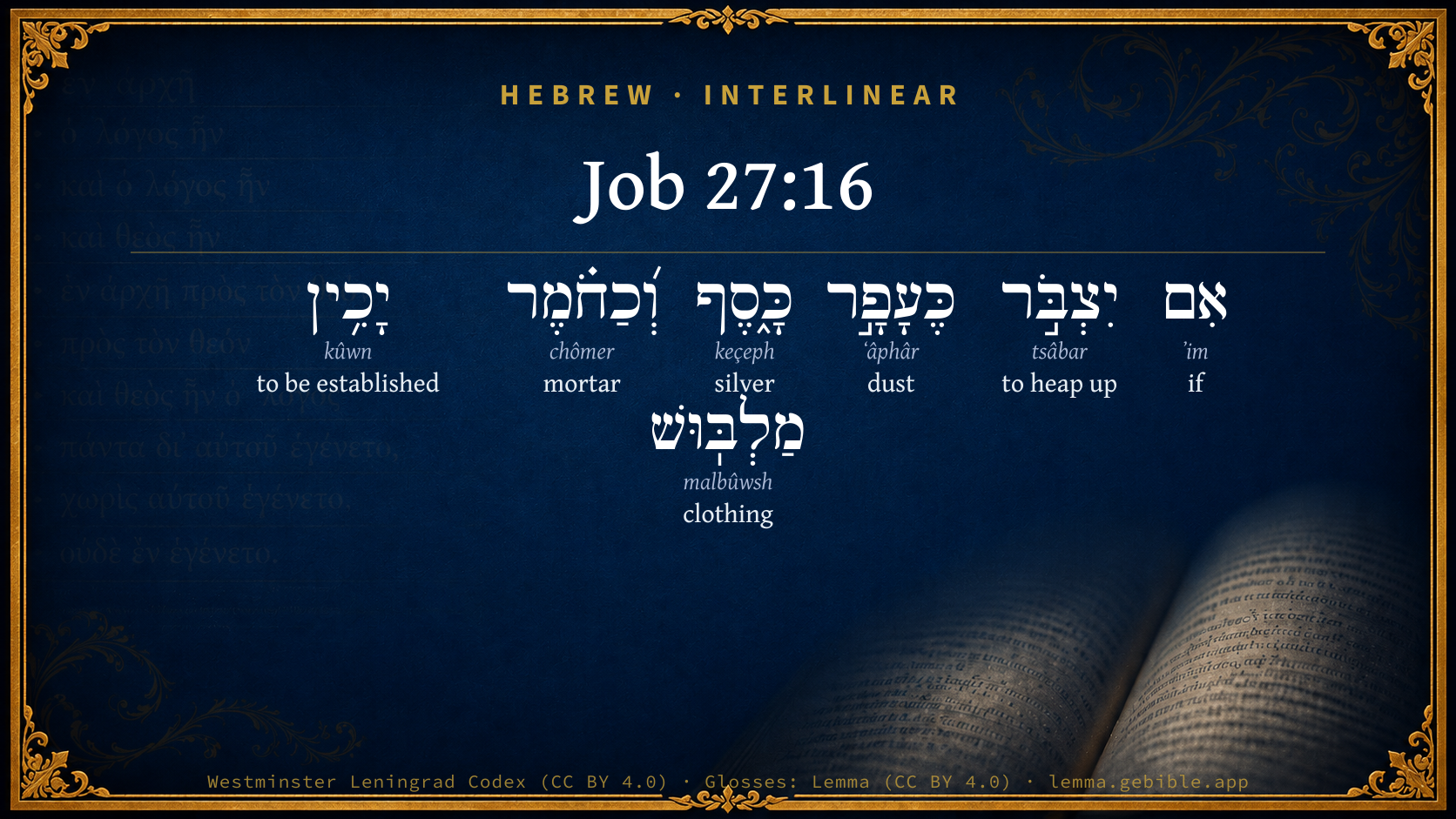
Job 27:16

Hebrew (Westminster Leningrad Codex) Job 27:16 appears in the Hebrew Old Testament. The text above is from the Westminster Leningrad Codex. Each word links to its Strong’s number, a concise gloss, and parsing drawn from the Open Scriptures Hebrew Bible morphology. Click any word for its full Brown-Driver-Briggs (BDB) entry.
Download image
Cite this verse

Job 27:16 (World English Bible). Public Domain. Lemma interlinear Bible study tool, https://lemma.gebible.app/v/job/27/16.

Show BibTeX & RIS
BibTeX
RIS
English Translation
Though he heap up silver as the dust, And prepare clothing as the clay;
World English Bible · Public Domain
Download a study sheet

One document with this verse’s original text, its word-by-word gloss line, the meaning frame, cross-references with their text, attributed commentary, and full source and license credits — printable, and it pastes into notes with its structure intact.

This verse Autodidact and up

Study sheet (.html) Plain text (.txt)

A passage Seminary Student

Up to 50 verses in one chapter. A passage sheet keeps up to 6 commentary sources and 12 cross-references per verse, in the order this page ranks them, and says so on the sheet whenever that leaves anything out. Ask for a single verse and you get the Autodidact verse sheet above.

Everything on this page stays free to read, with no account — the sheet is a download of what is already on screen, not access to it.

Want to remove ads? Support Godless Engineer
Compare translations 3

The same verse in 3 English versions, stacked beneath the original-language interlinear above. Click any original word for its lexicon entry.

Each is an independent rendering of the whole verse — the interlinear is not word-aligned to these translations.

Highlighted words mark where these versions differ — a whole-verse word diff, not a word-by-word alignment.

  • World English Bible Public Domain
    Though he heap up silver as the dust, And prepare clothing as the clay;
  • King James Version Public Domain
    Though he heap up silver as the dust, and prepare raiment as the clay;
  • unfoldingWord Literal Text CC BY-SA 4.0
    If he heaps up silver like the dust and he piles up clothing like clay mounds,

unfoldingWord Literal Text — © unfoldingWord, licensed CC BY-SA 4.0. Word-aligned USFM3 via Door43 (git.door43.org/unfoldingWord/en_ult).

Versions to compare (up to 4)

3 of 4 selected

Show all 18 translations

Every available English version of this verse, each an independent rendering of the whole verse.

  • World English Bible Public Domain
    Though he heap up silver as the dust, And prepare clothing as the clay;
  • Berean Standard Bible Public Domain
    Though he heaps up silver like dust and piles up a wardrobe like clay,
  • Majority Standard Bible Public Domain
    Though he heaps up silver like dust and piles up a wardrobe like clay,
  • King James Version Public Domain
    Though he heap up silver as the dust, and prepare raiment as the clay;
  • American Standard Version (1901) Public Domain
    Though he heap up silver as the dust, And prepare raiment as the clay;
  • Revised Version (1885) Public Domain
    Though he heap up silver as the dust, and prepare raiment as the clay;
  • Geneva Bible (1599) Public Domain
    Though he shoulde heape vp siluer as the dust, and prepare rayment as the clay,
  • Douay-Rheims (1899) Public Domain
    If he shall heap together silver as earth, and prepare raiment as clay,
  • Young's Literal Translation Public Domain
    If he heap up as dust silver, And as clay prepare clothing,
  • Literal Standard Version CC BY-SA 4.0
    If he heaps up silver as dust, || And prepares clothing as clay,
  • Unlocked Literal Bible CC BY-SA 4.0
    Though the wicked man heaps up silver like the dust, and heaps up clothing like clay,
  • unfoldingWord Literal Text CC BY-SA 4.0
    If he heaps up silver like the dust and he piles up clothing like clay mounds,
  • Darby Bible Public Domain
    Though he heap up silver as the dust, and prepare clothing as the clay;
  • World Messianic Bible Public Domain
    Though he heap up silver as the dust, and prepare clothing as the clay;
  • Webster's Bible Public Domain
    Though he should heap up silver as the dust, and prepare raiment as the clay?
  • Free Bible Version CC BY-SA 4.0
    Even though they pile up silver like dust, and clothes like heaps of clay,
  • Bible in Basic English Public Domain
    Though he may get silver together like dust, and make ready great stores of clothing;
  • JPS Tanakh (1917) Public Domain
    Though he heap up silver as the dust, and prepare raiment as the clay;

Literal Standard Version (2020), Covenant Press — licensed CC BY-SA 4.0. Text via the HelloAO Bible API (eBible.org). Unlocked Literal Bible (unfoldingWord) — licensed CC BY-SA 4.0. Text via the HelloAO Bible API (eBible.org). unfoldingWord Literal Text — © unfoldingWord, licensed CC BY-SA 4.0. Word-aligned USFM3 via Door43 (git.door43.org/unfoldingWord/en_ult). Free Bible Version, Dr. Jonathan Gallagher — licensed CC BY-SA 4.0. Text via the HelloAO Bible API (eBible.org).

Word by word

More ways to search: Search by grammar → Find every occurrence → Compare this word →

Practice this passage: Drill this verse → Learn its vocabulary →

About this verse

These counts appear in no published source. They are computed here, from the morphology-tagged text and Lemma’s own curated glosses. What Lemma adds →

7
words
7
distinct lemmas
Wisdom
section

Notable vocabulary

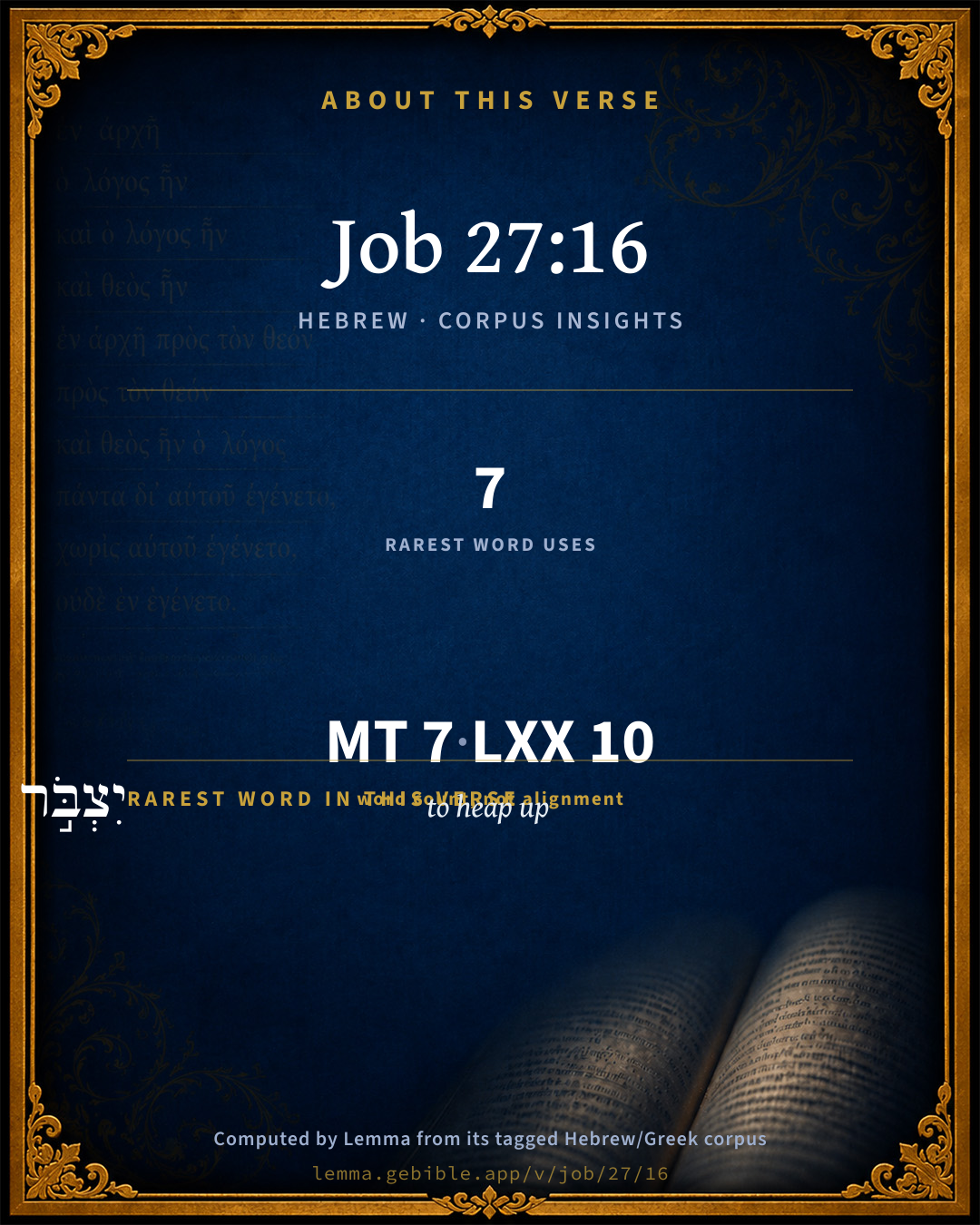
The rarest word here is יִצְבֹּ֣ר to heap up H6651 — appearing just 7 times in the whole Hebrew Bible.

Shared distinctive vocabulary

יִצְבֹּ֣ר to heap up H6651 occurs in 7 verses of the Hebrew Bible. Also found in:

Grammatical profile

  • 2 verbs
  • 4 nouns
  • 1 conjunction

Verb forms

  • יִצְבֹּ֣ר Qal · Imperfect
  • יָכִ֥ין Hiphil · Imperfect

Hebrew & Septuagint length

In English translation the verse runs 14 words from the Hebrew and 13 from the Septuagint (LXX English) — closely comparable.

A rough comparison of the two English renderings, which tokenize alike — not a word-level alignment.

Word counts can differ between the Hebrew and the Greek without any difference in meaning — e.g. the Hebrew direct-object marker אֵת has no separate Greek word, and Greek often adds the article ὁ.

In the original languages it is 7 Hebrew tokens and 10 Greek tokens — but the two are counted differently (Hebrew bundles its prefixes and suffixes into one token; the Greek is in lemma form), so that isn’t a like-for-like length.

Cross-references

6

Topical passages linked to Job 27:16 in the Treasury of Scripture Knowledge — connected by theme and wording, ordered by reader-vote popularity; previews shown in the World English Bible.

  • Zechariah 9:3 Tyre built herself a stronghold, And heaped up silver like the dust, And fine gold like the mire of the streets.
  • Matthew 6:19 "Don't lay up treasures for yourselves on the earth, where moth and rust consume, and where thieves break through and steal;
  • 1 Kings 10:27 The king made silver to be in Jerusalem as stones, and cedars made he to be as the sycamore trees that are in the lowland, for abundance.
  • Job 22:24 Lay your treasure in the dust, The gold of Ophir among the stones of the brooks.
  • Habakkuk 2:6 Won't all these take up a parable against him, and a taunting proverb against him, and say, 'Woe to him who increases that which is not his, and who enriches himself by extortion! How long?'
  • James 5:2 Your riches are corrupted and your garments are moth-eaten.

Cross-references courtesy of OpenBible.info (CC BY 4.0).

Hebrew and Greek witnesses Masoretic Hebrew ↔ Greek Septuagint

The same verse in the two great witnesses to the Old Testament, shown verse-for-verse.

These are two independent witnesses, not word-aligned to each other, and the Septuagint is shown in lemma (dictionary) form.

Hebrew Job 27:16 Masoretic · Westminster Leningrad Codex

אִם יִצְבֹּ֣ר כֶּעָפָ֣ר כָּ֑סֶף וְ֝כַחֹ֗מֶר יָכִ֥ין מַלְבּֽוּשׁ

Though he heap up silver as the dust, And prepare clothing as the clay;

World English Bible · Public Domain

Greek LXX Job 27:16 Septuagint · lemma form

ἐάν συνἄγω ὥσπερ γῆ ἀργύριον ἴσος δέ πηλός ἑτοιμάζω χρυσίον

Even if he should gather silver as earth, and prepare gold as clay;

LXX2012 (modern English Septuagint) · Public Domain

Hebrew: Westminster Leningrad Codex (CC BY 4.0). Greek: Septuagint (public domain); English from LXX2012 (modern English Septuagint) (Public Domain). How the Septuagint differs from the Hebrew →

Commentary

Notes on Job 27:16 from classic Christian and Jewish commentators (each source and its license shown beneath its notes). The classic Christian expositions comment on the surrounding passage and are grouped to its opening verse, so a note may address several verses; the Jewish commentaries on the Tanakh (Rashi and others) are per-verse, so they appear only where the commentator wrote on this verse.

Lemma curates 59 commentaries, every one of them public domain or Creative Commons licensed, each selected and text-cleaned for this edition rather than reprinted as found. About our sources →

Trapp's Complete Commentary

John Trapp

Job 27:16 Though he heap up silver as the dust, and prepare raiment as the clay;

Ver. 16. Though he heap up silver as the dust] Silver and gold, what are they else but white and red earth, the guts and garbage of the earth, as one saith? Yet how greedy of them and gripple after them are many muck worms, heaping up riches, and not knowing who shall gather them, Psa 39:6; laying up, as if their lives were riveted upon eternity; or were sure to leave it to their children, who yet shall never enjoy it. This is a great vanity, saith Solomon; and yet such dust heaps as these are to be found in every corner.

And prepare raiment as the clay] Tantum vestium quantum est luti, saith Vatablus, that he have as great store of suits in his wardrobe as he hath dirt in his ditches.

John Trapp, A Commentary or Exposition upon All the Books of the Old and New Testament (1647–1656) — public domain. Text from a community e-Sword module.

The Biblical Illustrator

Joseph S. Exell

Job_27:16-17

Though he heap up silver as the dust.

Hoarding

I. The wicked hoarding their wealth. They heap up silver as the dust. As a rule, this is the grand work of wicked men on the earth. On it they concentrate all their energies; to it they devote all their time.

II. The hoarded wealth of the wicked coming into the hands of the good. The just shall put it on, and the innocent shall divide the silver.

1. This is partially taking place now every day. Wicked worldlings die, and the righteous get possession of their wealth.

2. This will be the case universally, one day. All the wealth amassed by wicked men shall fall into the hands of the Christly. If the wicked man is blessed with children, punishment may come from that quarter. The sword and famine may deprive him of them; and so desolate will he become that all his sorrowing friends shall be buried. If wicked men are blessed with great riches, their wealth shall fall into the hands of the good. He may prepare it, but the just shall put it on. That if the wicked man is blessed with houses they will not stand. (Homilist.)

The Biblical Illustrator, edited by Joseph S. Exell (c. 1880s–1900s) — public domain. Text from a community e-Sword module.

Joseph Benson's Commentary

Job 27:16-18. Prepare raiment as the clay — In great abundance. But the just shall put it on — Either because it shall be given to him by the magistrate, to recompense him for those injuries which he had received from the oppressor; or because the right of it is, in some other way, transferred upon him by divine providence. He buildeth his house as a moth — Which settleth itself in a garment, but is quickly and unexpectedly dispossessed of its dwelling, and crushed to death. And as a booth, &c. — Which the keeper of a garden or vineyard suddenly rears up in fruit-time, and as quickly pulls down again.

Joseph Benson's Commentary on the Old and New Testaments (1811–1818) — public domain. Text from a community e-Sword module.

Jamieson, Fausset & Brown

Robert Jamieson, A. R. Fausset & David Brown

dust . . . clay--images of multitudes (Zac 9:3). Many changes of raiment are a chief constituent of wealth in the East.

Jamieson, Fausset & Brown — Commentary Critical and Explanatory on the Whole Bible (1871) — public domain (CC PDM 1.0). Text via the HelloAO Bible API.

Adam Clarke's Commentary

Verse 16. Though he heap up silver] Though he amass riches in the greatest abundance, he shall not enjoy them. Unsanctified wealth is a curse to its possessor. Money, of all earthly possessions, is the most dangerous, as it is the readiest agent to do good or evil. He that perverts it is doubly cursed, because it affords him the most immediate means of sinful gratification; and he can sin more in an hour through this, than he can in a day or week by any other kind of property. On the other hand, they who use it aright have it in their power to do the most prompt and immediate good. Almost every kind of want may be speedily relieved by it. Hence, he who uses it as he ought is doubly blessed; while he who abuses it is doubly cursed.

Adam Clarke's Commentary on the Bible (1810–1826) — public domain. Text from a community e-Sword/MySword module.

The Cambridge Bible for Schools and Colleges

gen. ed. J. J. S. Perowne

16. The “dust” and “clay” or mire are images that express extreme abundance, Zec_9:3, 1Ki_10:27. Great wardrobes of costly garments are a usual element of Oriental wealth, Gen_24:53, Jos_7:21, 2Ki_7:8, Mat_6:19.

The Cambridge Bible for Schools and Colleges (gen. ed. J. J. S. Perowne; Cambridge University Press, 1878–1918) — public domain. Text from a community e-Sword module.

John Gill's Exposition

He may prepare it,.... Raiment; beginning with that first which was mentioned last, which is frequent in the Hebrew and eastern languages; such things may be done, and often are, by wicked men:

but the just shall put it on; the wicked man will either have no heart, or have no time, to wear it, at least to wear it out, and so a just man shall have it, as the Israelites put on the raiment of the Egyptians, which they begged or borrowed, and spoiled them of, Exo 12:35; and oftentimes so it is in Providence, that the wealth of wicked men is by one means or another transferred into the families of good men, who enjoy it, and make a better use of it, Pro 13:22;

and the innocent shall divide the silver; have a part of it at least, or divide the whole between his children, or give a part of it to the poor; so money that is ill gotten, or ill used, is taken away, and put into the hands of one that will have mercy on the poor, and liberally distribute it to them, Pro 28:8.

John Gill's Exposition of the Whole Bible (1746–1763) — public domain (CC PDM 1.0). Text via the HelloAO Bible API.

Albert Barnes' Notes on the Bible

Though he heap up silver as the dust - That is, in great quantities - as plenty as dust; compare 1Ki 10:27, “And the king made silver to be in Jerusalem as stones.”

And prepare raiment - Oriental wealth consisted much in changes of raiment. Sir John Chardin says that in the East it is common to gather together immense quantities of furniture and clothes. According to D’Herbelot, Bokteri, an illustrious poet; of Cufah in the ninth century, had so many presents made him in the course of his life, that when he died he was found possessed of an hundred complete suits of clothes, two hundred shirts, and five hundred turbans. compare Ezr 2:69, and Neh 7:70 see Bochart IIieroz. P. II. Lib. iv. c. xxv. p. 617. This species of treasure is mentioned by Virgil;

Dives equom, dives pictai vestis et auri.

Aeneid ix. 26.

The reason why wealth consisted so much in changes of raiment, is to be found in the fondness for display in Oriental countries, and in the fact that as fashions never change there, such treasures are valuable until they are worn out. In the ever-varying fashions of the West such treasures are comparatively of much less value.

As the clay - As the dust of the streets; or as abundant as mire.

Albert Barnes' Notes on the Bible (1834–1885) — public domain. Text from a community e-Sword/MySword module.

Matthew Poole's English Annotations

i.e. In great abundance.

Matthew Poole's English Annotations on the Holy Bible (1683–1685) — public domain. Text from a community e-Sword/MySword module.

Whedon's Commentary on the Bible

Daniel D. Whedon

16. Raiment as the clay — As with Elizabeth, queen of England, the wardrobe of the rich in the East represented often untold sums of wealth.

Daniel D. Whedon (gen. ed.), Commentary on the Old and New Testaments (1874–1909) — public domain. Text from a community e-Sword module.

The Pulpit Commentary

Though he heap up silver as the dust. The city of Tyro, we are told by Zechariah, "heaped up silver as the dust", (Zec_9:3) i.e. in vast quantities, beyond count. So might the wicked man do. He might also prepare raiment as the clay; i.e. fill his house with rich dresses, partly for his own wear, partly to be given as robes of honour to his friends and boon companions. (Gen_45:22 2Ki_5:22 2Ki_10:22,mt 2Ki_6:19 Jam_5:2) Robes of honour are still kept in store by Eastern monarchs, and presented as marks of favour to visitors of importance,

The Pulpit Commentary (1880–1919), ed. H.D.M. Spence-Jones & Joseph S. Exell — public domain. Text from a community e-Sword module.

John Wesley's Explanatory Notes

As clay - In great abundance.

John Wesley, Explanatory Notes Upon the Whole Bible (1754–1765) — public domain. Text via the GEBible commentary corpus.

Lesson kit

Teaching starters — assembled from the data on this page, not authored interpretation. Every prompt links to the verse data it draws on. Edit before teaching.

Job, in the Wisdom, opens this verse with 7 words (7 distinct Hebrew lemmas). Its most distinctive word is tsâbar (“to heap up”). A historical commentator’s framing appears above. Read the whole chapter for the surrounding context.

Discussion questions

  1. The word tsâbar carries the sense “to heap up.” How does it shape the verse?
  2. How does Genesis 41:35, which shares the word «to heap up», read alongside this verse?
  3. The translations on this page render this verse differently — a whole-verse word diff, not a word-by-word alignment. What might account for the different wordings?
  4. «יִצְבֹּ֣ר» is a Qal Imperfect verb. How does that grammatical form shape the action described?
  5. Compare how Trapp's Complete Commentary and The Biblical Illustrator read this verse. Where do they agree or differ?

Things to notice

Reading settings

Reading text

Shown beneath each verse's original-language words.

Old Testament
Old Testament edition

Read the OT as the Masoretic Hebrew (MT) or the Greek Septuagint (LXX).

English shown for the Greek Septuagint (in the Hebrew ↔ Greek comparison).

Comparing translations? Open the Compare panel on any verse page to stack up to four side by side.