
Psalms 102:28

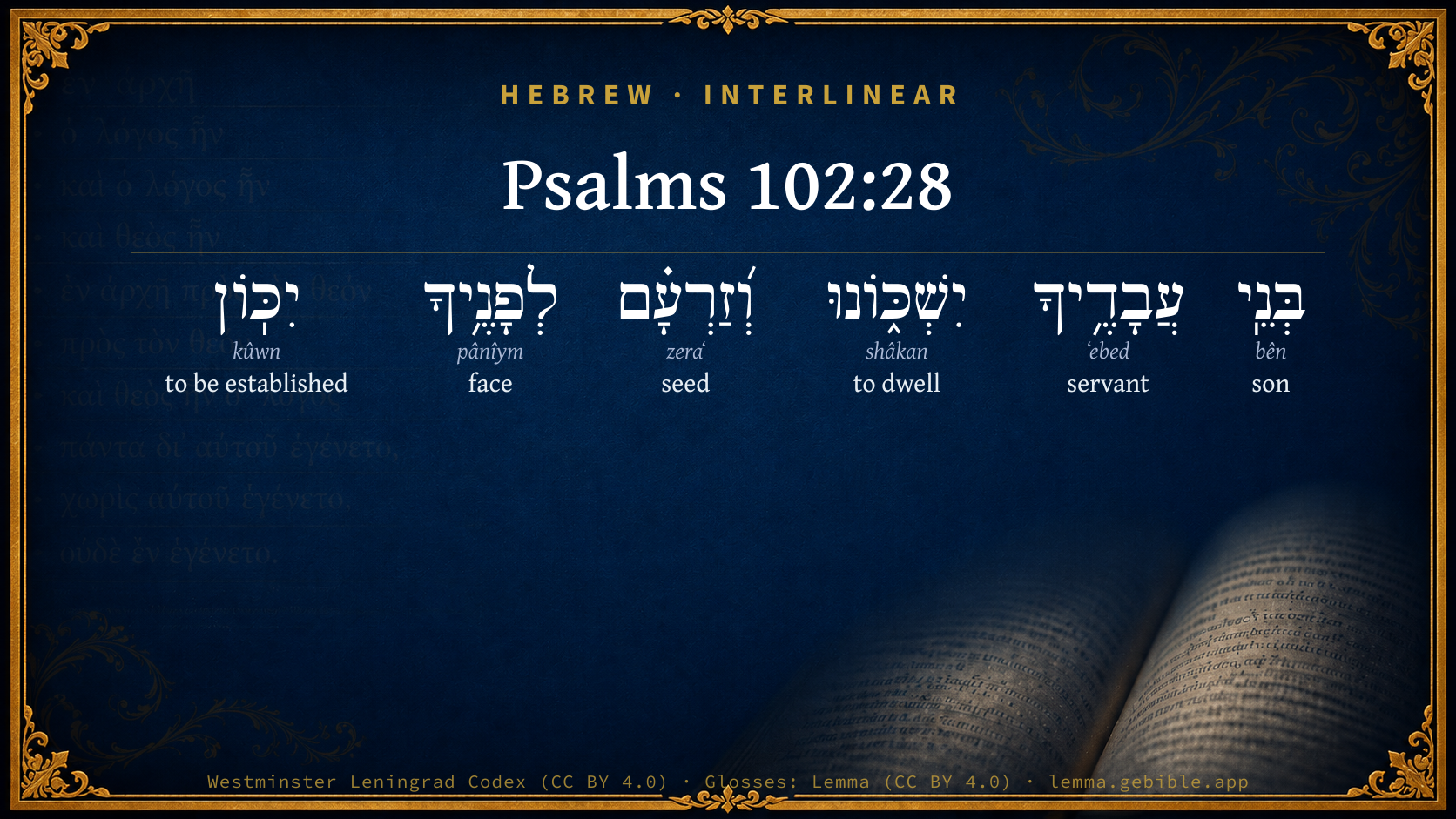
Hebrew (Westminster Leningrad Codex) Psalms 102:28 appears in the Hebrew Old Testament. The text above is from the Westminster Leningrad Codex. Each word links to its Strong’s number, a concise gloss, and parsing drawn from the Open Scriptures Hebrew Bible morphology. Click any word for its full Brown-Driver-Briggs (BDB) entry.
Download image
Cite this verse

Psalms 102:28 (World English Bible). Public Domain. Lemma interlinear Bible study tool, https://lemma.gebible.app/v/psalms/102/28.

Show BibTeX & RIS
BibTeX
RIS
English Translation
The children of your servants will continue. Their seed will be established before you."
World English Bible · Public Domain
Download a study sheet

One document with this verse’s original text, its word-by-word gloss line, the meaning frame, cross-references with their text, attributed commentary, and full source and license credits — printable, and it pastes into notes with its structure intact.

This verse Autodidact and up

Study sheet (.html) Plain text (.txt)

A passage Seminary Student

Up to 50 verses in one chapter. A passage sheet keeps up to 6 commentary sources and 12 cross-references per verse, in the order this page ranks them, and says so on the sheet whenever that leaves anything out. Ask for a single verse and you get the Autodidact verse sheet above.

Everything on this page stays free to read, with no account — the sheet is a download of what is already on screen, not access to it.

Want to remove ads? Support Godless Engineer
Compare translations 3

The same verse in 3 English versions, stacked beneath the original-language interlinear above. Click any original word for its lexicon entry.

Each is an independent rendering of the whole verse — the interlinear is not word-aligned to these translations.

Highlighted words mark where these versions differ — a whole-verse word diff, not a word-by-word alignment.

  • World English Bible Public Domain
    The children of your servants will continue. Their seed will be established before you."
  • King James Version Public Domain
    The children of thy servants shall continue, and their seed shall be established before thee.
  • unfoldingWord Literal Text CC BY-SA 4.0
    The sons of your servants will abide, and their seed will be established to your face.”

unfoldingWord Literal Text — © unfoldingWord, licensed CC BY-SA 4.0. Word-aligned USFM3 via Door43 (git.door43.org/unfoldingWord/en_ult).

Versions to compare (up to 4)

3 of 4 selected

Show all 18 translations

Every available English version of this verse, each an independent rendering of the whole verse.

  • World English Bible Public Domain
    The children of your servants will continue. Their seed will be established before you."
  • Berean Standard Bible Public Domain
    The children of Your servants will dwell securely, and their descendants will be established before You.”
  • Majority Standard Bible Public Domain
    The children of Your servants will dwell securely, and their descendants will be established before You.”
  • King James Version Public Domain
    The children of thy servants shall continue, and their seed shall be established before thee.
  • American Standard Version (1901) Public Domain
    The children of thy servants shall continue, And their seed shall be established before thee. Psalm 103 `A Psalm' of David.
  • Revised Version (1885) Public Domain
    The children of thy servants shall continue, and their seed shall be established before thee.
  • Geneva Bible (1599) Public Domain
    The children of thy seruants shall continue, and their seede shall stand fast in thy sight.
  • Douay-Rheims (1899) Public Domain
    But thou art always the selfsame, and thy years shall not fail.
  • Young's Literal Translation Public Domain
    The sons of Thy servants do continue, And their seed before Thee is established!
  • Literal Standard Version CC BY-SA 4.0
    The sons of Your servants continue, || And their seed is established before You!
  • Unlocked Literal Bible CC BY-SA 4.0
    The children of your servants will live on, and their descendants will live in your presence.”
  • unfoldingWord Literal Text CC BY-SA 4.0
    The sons of your servants will abide, and their seed will be established to your face.”
  • Darby Bible Public Domain
    The children of thy servants shall abide, and their seed shall be established before thee.
  • World Messianic Bible Public Domain
    The children of your servants will continue. Their offspring will be established before you.”
  • Webster's Bible Public Domain
    \\102:27\\But thou art the same, and thy years will have no end.
  • Free Bible Version CC BY-SA 4.0
    Our children will live with you, and our children's children will grow in your presence.”
  • Bible in Basic English Public Domain
    The children of your servants will have a safe resting-place, and their seed will be ever before you.
  • JPS Tanakh (1917) Public Domain
    (102-29) The children of Thy servants shall dwell securely, and their seed shall be established before Thee.'

Literal Standard Version (2020), Covenant Press — licensed CC BY-SA 4.0. Text via the HelloAO Bible API (eBible.org). Unlocked Literal Bible (unfoldingWord) — licensed CC BY-SA 4.0. Text via the HelloAO Bible API (eBible.org). unfoldingWord Literal Text — © unfoldingWord, licensed CC BY-SA 4.0. Word-aligned USFM3 via Door43 (git.door43.org/unfoldingWord/en_ult). Free Bible Version, Dr. Jonathan Gallagher — licensed CC BY-SA 4.0. Text via the HelloAO Bible API (eBible.org).

Word by word

More ways to search: Search by grammar → Find every occurrence → Compare this word →

Practice this passage: Drill this verse → Learn its vocabulary →

יִשְׁכּ֑וֹנוּ
shâkan
H7931
“to dwell”
Verb, Qal, Imperfect, 3rd Person, Masculine, Plural
Part of Speech
Verb
Stem
Qal
Form
Imperfect
Person
3rd Person
Gender
Masculine
Number
Plural
Full BDB Definition

Origin: a primitive root [apparently akin (by transmission) to H7901 through the idea of lodging]

TWOT: 2387

to settle down, abide, dwell, tabernacle, reside - (Qal) - to settle down to abide - to abide, dwell, reside - (Piel) - to make settle down, establish - to make or cause to dwell - (Hiphil) - to lay, place, set, establish, settle, fix - to cause to dwell or abide
  1. בְּנֵֽי bên H1121 “sons of” Noun, Common, Masculine, Plural, Construct
  2. עֲבָדֶ֥יךָ ʻebed H5650 “servants · your” Noun, Common, Masculine, Plural, Construct + Suffix, Personal, 2nd Person, Masculine, Singular
  3. וְ֝זַרְעָ֗ם zeraʻ H2233 “and · seed · their” Conjunction + Noun, Common, Masculine, Singular, Construct + Suffix, Personal, 3rd Person, Masculine, Plural
  4. לְפָנֶ֥יךָ pânîym H6440 “to/for · face(s) · your” Preposition + Noun, Common, Both, Plural, Construct + Suffix, Personal, 2nd Person, Masculine, Singular
  5. יִכּֽוֹן kûwn H3559 “to be established” Verb, Niphal, Imperfect, 3rd Person, Masculine, Singular

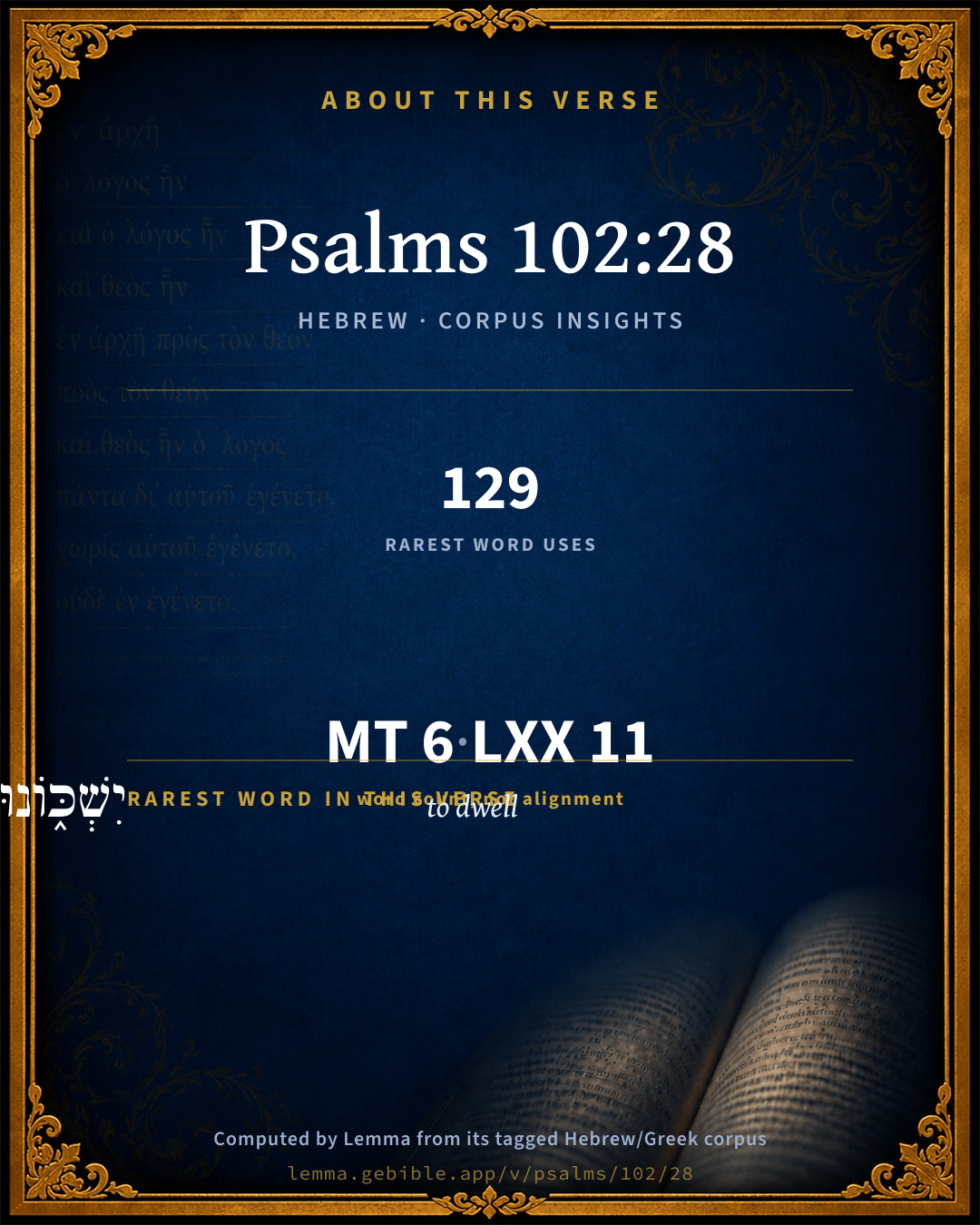
About this verse

These counts appear in no published source. They are computed here, from the morphology-tagged text and Lemma’s own curated glosses. What Lemma adds →

6
words
6
distinct lemmas
Wisdom
section

Grammatical profile

  • 2 verbs
  • 4 nouns

Verb forms

  • יִשְׁכּ֑וֹנוּ Qal · Imperfect
  • יִכּֽוֹן Niphal · Imperfect

Hebrew & Septuagint length

In English translation the verse runs 14 words from the Hebrew and 15 from the Septuagint (LXX English) — closely comparable.

A rough comparison of the two English renderings, which tokenize alike — not a word-level alignment.

Word counts can differ between the Hebrew and the Greek without any difference in meaning — e.g. the Hebrew direct-object marker אֵת has no separate Greek word, and Greek often adds the article ὁ.

In the original languages it is 6 Hebrew tokens and 11 Greek tokens — but the two are counted differently (Hebrew bundles its prefixes and suffixes into one token; the Greek is in lemma form), so that isn’t a like-for-like length.

Cross-references

9

Topical passages linked to Psalms 102:28 in the Treasury of Scripture Knowledge — connected by theme and wording, ordered by reader-vote popularity; previews shown in the World English Bible.

  • Psalms 69:35–36 For God will save Zion, and build the cities of Judah. They shall settle there, and own it.
  • Psalms 45:16–17 Your sons will take the place of your fathers. You shall make them princes in all the earth.
  • Psalms 22:30–31 Posterity shall serve him. Future generations shall be told about the Lord.
  • Psalms 89:4 'I will establish your seed forever, And build up your throne to all generations.'" Selah.
  • Psalms 90:16–17 Let your work appear to your servants; Your glory to their children.
  • Isaiah 53:10 Yet it pleased Yahweh to bruise him; he has put him to grief: when you shall make his soul an offering for sin, he shall see [his] seed, he shall prolong his days, and the pleasure of Yahweh shall prosper in his hand.
  • Isaiah 59:20–21 A Redeemer will come to Zion, and to those who turn from disobedience in Jacob, says Yahweh.
  • Isaiah 65:22 They shall not build, and another inhabit; they shall not plant, and another eat: for as the days of a tree shall be the days of my people, and my chosen shall long enjoy the work of their hands.
  • Isaiah 66:22 For as the new heavens and the new earth, which I will make, shall remain before me, says Yahweh, so shall your seed and your name remain.

Cross-references courtesy of OpenBible.info (CC BY 4.0).

Hebrew and Greek witnesses Masoretic Hebrew ↔ Greek Septuagint

The same verse in the two great witnesses to the Old Testament, shown verse-for-verse.

You’re reading Greek Psalm 101 (Hebrew Psalm 102). The Septuagint counts the superscription, so verse numbers can differ from the Hebrew — chapter-level alignment, not verse-by-verse. Numbering follows Rahlfs.

These are two independent witnesses, not word-aligned to each other, and the Septuagint is shown in lemma (dictionary) form.

Hebrew Psalms 102:28 Masoretic · Westminster Leningrad Codex

בְּנֵֽי עֲבָדֶ֥יךָ יִשְׁכּ֑וֹנוּ וְ֝זַרְעָ֗ם לְפָנֶ֥יךָ יִכּֽוֹן

The children of your servants will continue. Their seed will be established before you."

World English Bible · Public Domain

Greek LXX Greek Psalm 101:28 Septuagint · lemma form

σύ δέ ὁ αὐτός εἰμί καί ὁ ἔτος σύ οὐ ἐκλείπω

The children of your servants shall dwell securely, and their seed shall prosper for ever.

LXX2012 (modern English Septuagint) · Public Domain

Hebrew: Westminster Leningrad Codex (CC BY 4.0). Greek: Septuagint (public domain); English from LXX2012 (modern English Septuagint) (Public Domain). How the Septuagint differs from the Hebrew →

Commentary

Notes on Psalms 102:28 from classic Christian and Jewish commentators (each source and its license shown beneath its notes). The classic Christian expositions comment on the surrounding passage and are grouped to its opening verse, so a note may address several verses; the Jewish commentaries on the Tanakh (Rashi and others) are per-verse, so they appear only where the commentator wrote on this verse.

Lemma curates 59 commentaries, every one of them public domain or Creative Commons licensed, each selected and text-cleaned for this edition rather than reprinted as found. About our sources →

Trapp's Complete Commentary

John Trapp

Psa 102:28 The children of thy servants shall continue, and their seed shall be established before thee.

Ver. 28. The children of thy servants shall continue] By virtue of the covenant, and that union with thee which is the ground of communion. If it could be said of Caesar, that he held nothing to be his own that he did not communicate to his friends, how much more of Christ! Propterea bene semper sperandum, etiamsi omnia ruant. The Church is immortal and immutable.

John Trapp, A Commentary or Exposition upon All the Books of the Old and New Testament (1647–1656) — public domain. Text from a community e-Sword module.

The Biblical Illustrator

Joseph S. Exell

Psa_102:28

The children of Thy servants shall continue, and their seed shall be established before Thee.

Gods care for the posterity of His servants

I. How far a blessing cometh on the posterity of Gods servants.

1. Good men do convey many temporal mercies to their relations; that is the least. God cannot satisfy Himself with doing good to the persons of His children, but He must do good to their relations; all about them fare the better for their sakes. A land fareth the better for them (2Ki_2:12).

2. Where the parent is in visible covenant, the children also are in visible covenant with him as soon as born.

3. If they die in infancy, we need not trouble ourselves about their salvation. God is their God (Gen_17:1); and that is all the best of us has to show for his right to heaven.

4. If they live, and betray the corruption of their natures, there is more hope of them than of others. The grace of the covenant runneth most kindly in the channel of the covenant (Rom_11:24).

5. Among them salvation is most ordinary, though God leaveth himself a liberty to take men of an evil stock. A rose may grow upon a thorn; a slip of an ill stock may be grafted into the tree of life.

6. They are not cast off till they do even wrest themselves out of the arms of mercy. Cain excommunicated himself (Gen_4:16).

II. The reasons.

1. That He may show the riches of His grace, which reacheth not only to the persons, but to the families of those that love Him and serve Him. Grace, like a mighty river, will be pent within no banks, but overfloweth all that a man hath, all his relations.

2. Out of an indulgence to natural affection. God hath a son of His own, and He knoweth how He loveth Him, and is acquainted with the heart of a father, and he hath planted an affection in parents to their children. Love, like a river, is descensive.

III. How can we reconcile the promise with experience, since the children of the servants of the Lord are reduced to great extremities, and are as naught and bad as others? I answer, The blessing is invisible for a great measure, and we want faith to interpret this privilege, as well as any other mentioned in the covenant. Sometimes their outward portion may be small, but, however, they are a holy seed unto God. We see the providence of God by pieces; for the present they may be in their natural condition, and the blessing doth not as yet break out in effects of grace, as it doth afterwards. We must leave the Lord to His own seasons.

IV. To whom the promise will re most eminently fulfilled. There are some qualifications mentioned. All Gods servants have their blessings, but these especially; as, namely--

1. The strict, and such as dare not offend Him (Psa_103:17).

2. The just and upright. They abridge themselves of many advantages of gain which others hunt after. It is not lost (Psa_112:2).

3. The merciful and charitable (Psa_37:26). When we are urged to giving, you may object, What shall wife and children do? l answer, Give the rather; do something the more for every child, that the blessing may be entailed upon them; it is lent to the Lord, and it will be paid to your posterity: your children will not have a whit the less.

4. Those that are tender of Gods institutions: the second commandment, that provideth for Gods instituted worship, the sanction of it speaketh of blessings and punishments in the posterity, and deservedly. (T. Manton, D.D.)

The perpetuity and establishment of Gods servants

How blessed the assurance contained in this text; and if it might be understood literally, what encouragement would it afford to godly parents. But, alas! it is a lamentable fact that not a few of Gods servants have to mourn, as Abraham once did, Oh! that Ishmael might live before God. Those who are children of God by a second birth, and consequently the posterity of Zion, shall continue for ever, and their seed be established before God.

I. The births in succession. There is no real religion in existence but that which commences with the new birth. These births, which are in constant succession, conduct to grace privileges and to a glorious inheritance.

II. The establishment of which the text speaks. The first thing which I would press upon your attention here is, that the true Church of God must continue on earth, despite all the rage. We pass on just to remark of this establishment and perpetuity that the holy seed cannot die. Observe, further, that the experience of these established ones, and their establishment too, is supernatural. Shall be established before Thee. Now, I wish to bring my own establishment,--for I claim to be an established Christian--to this test. Will it bear being brought before God? (J. Irons.)

.

Psa_103:1-22

The Biblical Illustrator, edited by Joseph S. Exell (c. 1880s–1900s) — public domain. Text from a community e-Sword module.

Joseph Benson's Commentary

Psa 102:28. The children of thy servants shall continue — Though the heavens and the earth perish, and though we, thy servants, pine away in our iniquities, according to thy righteous sentence and threatening, Lev 26:39, and die in captivity; yet, by virtue of thy eternal and unchangeable nature, and thy promises made to Abraham and his seed, we rest assured that our children, and their children after them, shall enjoy the promised mercies, even a happy restoration to and settlement in their own land, and the presence of our and their Messiah. And their seed shall be established before thee — In the place of thy gracious presence, either here in thy church, or hereafter in heaven. Perhaps this expression, before thee, might be intended further to intimate, that their happiness did not consist in the enjoyment of the outward blessings of the land of Canaan, but in the presence and fruition of God there, which he mentions as the consummation of their desires and felicities.

Joseph Benson's Commentary on the Old and New Testaments (1811–1818) — public domain. Text from a community e-Sword module.

J. A. Alexander on Psalms

Joseph Addison Alexander

29. (Psa 102:28) The sons of thy servants shall abide, and their seed before thee shall be established. This might also be translated as a prayer, let the sons of thy servants continue, which is really included even in the prediction. Before thee, as in Gen 17:1, Psa 89:36. Be established, as in Psa 89:37; Psa 101:7. With this conclusion of the whole psalm compare Psa 69:35-36; Psa 90:16-17.

Joseph Addison Alexander, The Psalms Translated and Explained (1850) — public domain. Text from a community e-Sword module.

Tyndale Open Study Notes

Tyndale Open Resources

102:28 The Lord’s presence provides the basis for the security and happiness of his people (23:6).

Tyndale Open Study Notes — © Tyndale Open Resources, licensed CC BY-SA 4.0. Text via the HelloAO Bible API.

Geneva Bible (1599)

Geneva Bible translators

Seeing thou hast chosen thy Church out of the world, and joined it to thee, it cannot but continue forever: for thou art everlasting.

Geneva Bible (1599) marginal notes — public domain. Text via Bolls.life.

Adam Clarke's Commentary

Verse 28. The children of thy servants shall continue] Thy Church shall be permanent, because founded on thee; it shall live throughout all the revolutions of time. And as thy followers are made partakers of the Divine nature, they shall live in union with God in the other world, deriving eternal duration from the inexhaustible Fountain of being. Nothing can be permanent but by God's supporting and renewing influence.

ANALYSIS OF THE ONE HUNDRED AND SECOND PSALM

There are two general parts in this Psalm: -

I. A description of the calamities of the Church, under the person of an afflicted man, Ps 102:1-11.

II. The consolation afforded in these calamities, and the ground of it, Ps 102:12-28.

I. The description, c., is formed into a prayer proposed in the two first verses: -

1. "Hear my prayer."

2. "Hide not thy face."

In this prayer he complains, and shows his wretched state by various metaphors or figures.

1. A consumption of strength: "My days are consumed."

2. From continual weeping: "My bones cleave to my skin."

3. From his solitude: "Like a pelican in the wilderness."

4. From his continual watching: "I watch, and am like a sparrow," c.

5. From the reproach of his enemies. "Mine enemies reproach me."

6. From his sadness: "I have eaten ashes like bread."

All these increased, from a sense of God's displeasure.

1. "Because of thine indignation."

2. Because of his sufferings: "Thou hast lifted me up, and hast cast me down."

3. And the effect produced: "My days are as a shadow."

II. He comforts himself in the promises of God: -

1. "I am withered like grass: but thou shalt endure for ever."

2. I shall soon be forgotten "but thy remembrance is unto all generations."

3. Thou seemest to take no heed: but "thou wilt arise."

He was the more confident, -

1. Because the set time to favour Zion was come.

2. This he saw more clearly from the concern with which God had filled the hearts of the people: "Thy servants take pleasure in her stones."

3. He consoled himself in the prospect of the conversion of the heathen themselves: "So the heathen shall fear thy name."

4. For this he gives a particular reason: Because "the Lord shall build up Zion."

5. And he will do this, because of the prayers of the people: "He will regard the prayer," c.

This should be done in such a manner, that, -

1. Record should be made of it: "This shall be written."

2. And it should be a blessing to those that were unborn: "The people which shall be created shall praise the Lord."

And for this he assigns the proper reasons.

1. "The Lord looked down from heaven."

2. "He heard the groans of the prisoners."

These mercies call for gratitude and obedience: -

1. They should "declare the name of the Lord."

2. And this will take place "when the people are gathered together," &c.

The psalmist fears that he shall not live to see this deliverance: -

1. "For he weakened my strength in the way, - he shortened my days."

2. Yet he earnestly desires to see it: "Take me not away."

To strengthen this petition, he pleads God's unchangeableness and he proves God to be eternal, because he is immutable.

1. Not so the earth, for it had a beginning: "Of old thou hast laid," c.

2. Not so the heavens for they are "the work of thy hands."

3. Neither shall they continue: "They shall perish," c.

But God is always the same. Every thing that is mutable acquires by its change some property, quality, form or accident, which it had not before: but God, being an infinite Spirit, and infinitely perfect, can suffer no loss, can have no addition. For as he wants nothing, nothing can be added to him as he inhabits eternity, nothing can be taken from him. In him, therefore, there is no possibility of change and, consequently, none of decay or perishing.

From these considerations the psalmist draws this comfortable conclusion: -

1. His Church and servants shall continue also: "The children of thy servants," - the apostles, with the patriarchs, shall dwell in thy kingdom - in the new Jerusalem.

2. "And their seed;" as many as are begotten by the Gospel, if they remain in the faith that works by love, "shall be established," - persevere, remain, continue before thee - live in thy presence for ever. As thou art eternal, so thou wilt unite them to thyself and make them eternally happy.

Adam Clarke's Commentary on the Bible (1810–1826) — public domain. Text from a community e-Sword/MySword module.

John Calvin's Commentaries

28. The children of thy servants shall dwell. By these words the prophet intimates that he does not ask the preservation of the Church, because it is a part of the human race, but because God has raised it above the revolutions of the world. And undoubtedly, when He adopted us as his children, his design was to cherish us as it were in his own bosom. The inference of the inspired bard is not, therefore, far-fetched, when, amidst innumerable storms, each of which might carry us away, he hopes that the Church will have a permanent existence. It is true, that when through our own fault we become estranged from God, we are also as it were cut off from the fountain of life; but no sooner are we reconciled to Him than he begins again to pour down his blessings upon us. Whence it follows that true believers, as they are regenerated by the incorruptible seed, shall continue to live after death, because God continues unchangeably the same. By the word dwell, is to be understood an abiding and everlasting inheritance.

When it is said that the seed of God’s servants shall be established before his face, the meaning is, that it is not after the manner of the world, or according to the way in which the heavens and the earth are established, that the salvation of true believers is made steadfast, but because of the holy union which exists between them and God. By the seed and children of the godly, is to be understood not all their descendants without exception — for many who spring from them according to the flesh become degenerate — but those who do not turn aside from the faith of their parents. Successive generations are expressly pointed out, because the covenant extends even to future ages, as we shall again find in the subsequent psalm. If we firmly keep the treasure of life intrusted to us, let us not hesitate, although we may be environed with innumerable deaths, to cast the anchor of our faith in heaven, that the stability of our welfare may rest in God.

John Calvin's Commentaries (1540-1563) — public domain. Text from the Calvin Translation Society English edition (1840s-50s) via the Christian Classics Ethereal Library (ccel.org). Calvin's coverage is partial (roughly two-thirds of the Bible); uncommented books and verses are honest gaps, never fabricated. The 19th-century editor's footnotes and remarks are omitted so the notes are faithfully Calvin's own voice.

Ellicott's Commentary for English Readers

(28) Continue.—Rather, dwell, i.e., in the land of Canaan. (Comp. Psa_37:22; Psa_69:36.)

A Bible Commentary for English Readers, edited by Charles John Ellicott (1878–1897) — public domain. Text from a community e-Sword module.

The Cambridge Bible for Schools and Colleges

gen. ed. J. J. S. Perowne

28. The eternity of God is the pledge for the permanence of His people. Even if the Psalmist and his contemporaries do not live to see the restoration of Israel, their descendants will have part in it. The verse is an echo of Isa_65:9; Isa_66:22 : cp. Psa_69:35-36.

shall continue] Lit. shall dwell, in the land once more (Isa_65:9; Psa_69:36).

before thee] Or, in thy presence. ‘Banish them from my presence’ was the sentence pronounced upon Judah as upon Israel (Jer_7:15; Jer_15:1, &c.); but they shall be readmitted to Jehovah’s presence and restored to His favour. The prophecy of Jer_30:20 will be fulfilled.

The Cambridge Bible for Schools and Colleges (gen. ed. J. J. S. Perowne; Cambridge University Press, 1878–1918) — public domain. Text from a community e-Sword module.

Albert Barnes' Notes on the Bible

The children of thy servants shall continue - The descendants of those that serve and obey thee. This represents the confident expectation of the psalmist that, as God was unchangeable, all his promises toward his people would be fulfilled, even though the heavens and the earth should pass away. God was the same. His word would not fail. His promises were sure. Compare Mat 5:18; Mat 24:35. The word rendered “continue,” means to dwell, as in a habitation; then, to abide. It stands opposed to a wandering, nomadic life, and indicates permanency.

And their seed shall be established before thee - The word used here means properly to stand erect; then to set up, to erect, to place, to found, to make firm, as a city, Psa 107:36; the earth, Psa 24:2; the heavens, Pro 3:19. It means here that they would be firmly and permanently established: that is, the church of God would be permanent in the earth. It would not be like the generations of people that pass away. It would not be like the nomadic tribes of the desert that have no fixed habitation, and that wander from place to place. It would not be even like the heavens that might put on new forms, or wholly pass away: it would be as enduring and changeless as God himself; it would, in its proper form, endure forever. As God is eternal and unchangeable, so would the safety and welfare of his people be.

Albert Barnes' Notes on the Bible (1834–1885) — public domain. Text from a community e-Sword/MySword module.

Matthew Poole's English Annotations

Though the heavens and the earth perish, and though we thy servants pine away in our iniquities, according to thy righteous sentence and threatening, Lev 26:39, and die in captivity; yet by virtue of thy eternal and unchangeable nature and covenant, we rest assured that our children, and their children after them, shall enjoy the promised mercies, a happy restitution to and settlement in their own land, and the presence of our and their Messias, whom, being not to come till after four hundred and ninety years, we shall not live to see. The expression here used is general, not without design, partly to show that this promised blessing belongs to the Jews not upon the account of any carnal relation to Abraham, but as they are and continue to be God’s servants, from whom, if they revolt, they lose this and all their other privileges; and partly to imply that it belongs to all God’s faithful servants, and to their children, whether they be Jews or Gentiles, of whose conversion he spoke, Psa 102:22.

Before thee; in the place of thy gracious presence; either here in thy church, or hereafter in heaven, from which we are now banished. And this phrase further intimates that their happiness did not consist in the enjoyment of the outward blessings of the land of Canaan, but in the presence and fruition of God there, which he mentions as the top and upshot of all his desires and their felicities.

Matthew Poole's English Annotations on the Holy Bible (1683–1685) — public domain. Text from a community e-Sword/MySword module.

The Treasury of David

Charles H. Spurgeon

Ver. 28. The children of thy servants shall continue. The Psalmist had early in the psalm looked forward to a future generation, and here he speaks with confidence that such a race would arise and be preserved and blessed of God. Some read it as a prayer, "let the sons of thy servants abide." Any way, it is full of good cheer to us; we may plead for the Lord's favour to our seed, and we may expect that the cause of God and truth will revive in future generations. Let us hope that those who are to succeed us will not be so stubborn, unbelieving and erring as we have been. If the church has been minished and brought low by the lukewarmness of the present race, let us entreat the Lord to raise up a better order of men, whose zeal and obedience shall win and hold a long prosperity. May our own dear ones be among the better generation who shall continue in the Lord's ways, obedient to the end.

And their seed shall be established before thee. God does not neglect the children of his servants. It is the rule that Abraham's Isaac should be the Lord's, that Isaac's Jacob should be beloved of the Most High, and that Jacob's Joseph should find favour in the sight of God. Grace is not hereditary, yet God loves to be served by the same family time out of mind, even as many great landowners feel a pleasure in having the same families as tenants upon their estates from generation to generation. Here is Zion's hope, her sons will build her up, her offspring will restore her former glories. We may, therefore, not only for our own sakes, but also out of love to the church of God, daily pray that our sons and daughters may be saved, and kept by divine grace even unto the end, established before the Lord.

We have thus passed through the cloud, and in the next psalm we shall bask in the sunshine. Such is the chequered experience of the believer. Paul in the seventh of Romans cries and groans, and then in the eighth rejoices and leaps for joy; and so, from the moaning of the hundred and second psalm, we now advance to the songs and dancing of the hundred and third, blessing the Lord that, "though weeping may endure for a night, joy cometh in the morning."

Ver. 28. The children of thy servants shall continue. In what sense is "children" taken? Either the children of their flesh, or of their faith. Some say the children of the same faith with the godly teachers and servants of the Lord, begotten by them to God, as noting the perpetuity of the church, who shall in every age bring forth children to God. It is the comfort of God's people to see a young brood growing up to continue his remembrance in the world, that when they die religion shall not die with them, nor the succession of the church be interrupted. This sense is not altogether incongruous; but rather I think the children of their body are here intended; it being a blessing often promised: see Ps 103:17. "The mercy of the LORD is from everlasting to everlasting upon them that fear him, and his righteousness unto children's children." "Shall continue; ""shall be established." In what sense is it spoken? Some think only pro more faederis, according to the fashion of that covenant which the people of God were then under, when eternity was but more darkly revealed and shadowed out, either by long life, or the continuance of their name in their posterity, which was a kind of literal immortality. Clearly such a kind of regard is had, as appeareth by that which you find in Ps 37:28. "The LORD loveth judgment, and forsaketh not his saints; they are preserved for ever." How? since they die as others do: mark the antithesis, and that will explain it. "They are preserved for ever: but the seed of the wicked shall be cut off." They are preserved in their posterity. Children are but the parents multiplied, and the parent continued, it is nodosa aeternitas;when the father's life is run out to the last, there is a knot tied, and the line is still continued by the child. I confess, temporal blessings, such as long life, and the promise of a happy posterity, are more visible in the eye of that dispensation of the covenant; but yet God still taketh care for the children of his people, and many promises run that way that belong to the gospel-administration, and still God's service is the surest way to establish a family, as sin is the ready way to root it out. And if it doth not always fall out accordingly, yet for the most part it doth; and we are no competent judges of God's dispensations in this kind, because we see Providence by pieces, and have not the skill to set them together; but at the day of judgment, when the whole contexture of God's dealings is laid before us we shall clearly understand how the children of his servants continue, and their seed is established. Thomas Manton.

Ver. 28. O the folly of the world, that seeks to make perpetuities to their houses by devises in the law, which may perhaps reach to continue their estates, but can it reach to continue their seed? It may entail lands to their heirs, but can it entail heirs to their lands? No, God knows! This is a perpetuity of only God's making, a privilege of only God's servants: for The children of his servants shall continue, and theiv seed shall be established before him; but that any others shall continue is no part of David's warrant. Sir R. Baker.

Ver. 28. The true apostolical succession.

1. There always will be saints.

2. They will frequently be the seed of the saints after the flesh.

3. They will always be the spiritual seed of the godly, for God converts one by means of another.

4. We should order our efforts with an eye to the church's future.

BISHOP FISHER'S Treatise on the Penitential Psalms. (See "Treasury of David, "Vol. II., pg 114.) There is an edition in 12mo., printed in the year MDCCXIV., besides those referred to as above.

In "Meditations on Twenty select Psalms, by Sir SIR ANTHONY COPE, Chamberlain to Queen Katherine Parr. Reprinted from the edition of 1547; ...By WILLIAM H. COPE. M.A. 1848, "there is a Meditation on this Psalm.

Meditations and Disquisitions upon the Seven Psalms of David, commonly called the Penitentiall Psalmes, By Sir RICHARD BAKER, Knight. 1639. pg 139-180.

Zion's Joy in her King Coming in his Glory. Wherein the estate of the Poore distressed Church of the Gentiles (travailing in the Wildernesse towards the new Jerusalem of the Jewes) in her utmost extremities, and height of her Joyes, is lively delineated; In some Meditations upon that Propheticall Psalme 102, wherein the sense is opened, and many difficult places of Scripture inlightned by a harmony, and consent of the Scriptures. Delightfull and profitable to be read in these times of the Churches troubles, and much longed for restauration and deliverance. By FINIENS CANUS VOVE. Compiled in Exile, and lately now revised and somewhat augmented as the weight of the Subject and the revolution of the times required... 1643. 4to.

In "Sermons on the Seven Penitential Psalms, Preached during Lent, 1838, "by the Rev. CHARLES OXENDON, there is an Exposition of this Psalm.

Charles H. Spurgeon's The Treasury of David (1869–1885) — public domain. Psalms only. Text from a community e-Sword/MySword module.

Whedon's Commentary on the Bible

Daniel D. Whedon

28. The children of thy servants shall continue—Faith has thus reached the conclusion, “Because he lives, we shall live also.” The beginning and closing of this psalm exhibit the contrast between the contemplation of affliction from the human side, and from that of faith.

Continue—Hebrew, dwell, that is, in the full expression, “dwell in the land,” as Psa_37:29; Psa_69:36.The application to Christ of Psa_102:25-27, in the first chapter of the epistle to the Hebrews, is, as above stated, according to a common practice, or law, in Messianic quotations, whereby what is said of Jehovah in the Old Testament is sometimes applied to Christ in the New. See on Psa_102:25.

Daniel D. Whedon (gen. ed.), Commentary on the Old and New Testaments (1874–1909) — public domain. Text from a community e-Sword module.

The Pulpit Commentary

The children of thy servants shall continue. "The nation descended from those who served thee of old shall continue," or, "abide i.e. not only continue to exist, but have a permanent abiding-place. (comp. Psa_37:39 Psa_69:36) And their seed shall be established before thee. (comp. Jer_30:20)

The Pulpit Commentary (1880–1919), ed. H.D.M. Spence-Jones & Joseph S. Exell — public domain. Text from a community e-Sword module.

John Wesley's Explanatory Notes

Continue - Though the heavens and earth perish, yet we rest assured that our children, and their children after them, shall enjoy an happy restitution to, and settlement in their own land.

John Wesley, Explanatory Notes Upon the Whole Bible (1754–1765) — public domain. Text via the GEBible commentary corpus.

unfoldingWord translationNotes

Door43 World Missions Community

will live on

"will continue to live"

live in your presence

Here David describes the descendants being protected by Yahweh as being in his presence. AT: "be protected as they live in your presence" (See: Metaphor)

translationWords

children

servant

descend

unfoldingWord translationNotes — © Distant Shores Media and the Door43 World Missions Community, licensed CC BY-SA 4.0. Source: git.door43.org/Door43/en_tn.

Rashi

Rabbi Shlomo Yitzchaki (Rashi)

But You are He Who stands and exists.

Rashi on the Tanakh — English translations: “The Judaica Press complete Tanach with Rashi, translated by A. J. Rosenberg” (CC BY 4.0); “Pentateuch with Rashi's commentary by M. Rosenbaum and A.M. Silbermann, 1929-1934” (public domain); “The Metsudah Tanach series, Lakewood, N.J” (CC BY 4.0); and “The Book of Joshua, Metsudah Publications, 1997” (CC BY 4.0). Text via Sefaria.

Lesson kit

Teaching starters — assembled from the data on this page, not authored interpretation. Every prompt links to the verse data it draws on. Edit before teaching.

Psalms, in the Wisdom, opens this verse with 6 words (6 distinct Hebrew lemmas). Its most distinctive word is shâkan (“to dwell”). A historical commentator’s framing appears above. Read the whole chapter for the surrounding context.

Discussion questions

  1. The word shâkan carries the sense “to dwell.” How does it shape the verse?
  2. How does Psalms 69:35–36, which shares this passage’s theme, read alongside this verse?
  3. These translations render this verse differently. What is at stake in choosing one wording over another?
  4. «יִשְׁכּ֑וֹנוּ» is a Qal Imperfect verb. How does that grammatical form shape the action described?
  5. Compare how Trapp's Complete Commentary and The Biblical Illustrator read this verse. Where do they agree or differ?

Things to notice

Reading settings

Reading text

Shown beneath each verse's original-language words.

Old Testament
Old Testament edition

Read the OT as the Masoretic Hebrew (MT) or the Greek Septuagint (LXX).

English shown for the Greek Septuagint (in the Hebrew ↔ Greek comparison).

Comparing translations? Open the Compare panel on any verse page to stack up to four side by side.