
2 Samuel 7:13

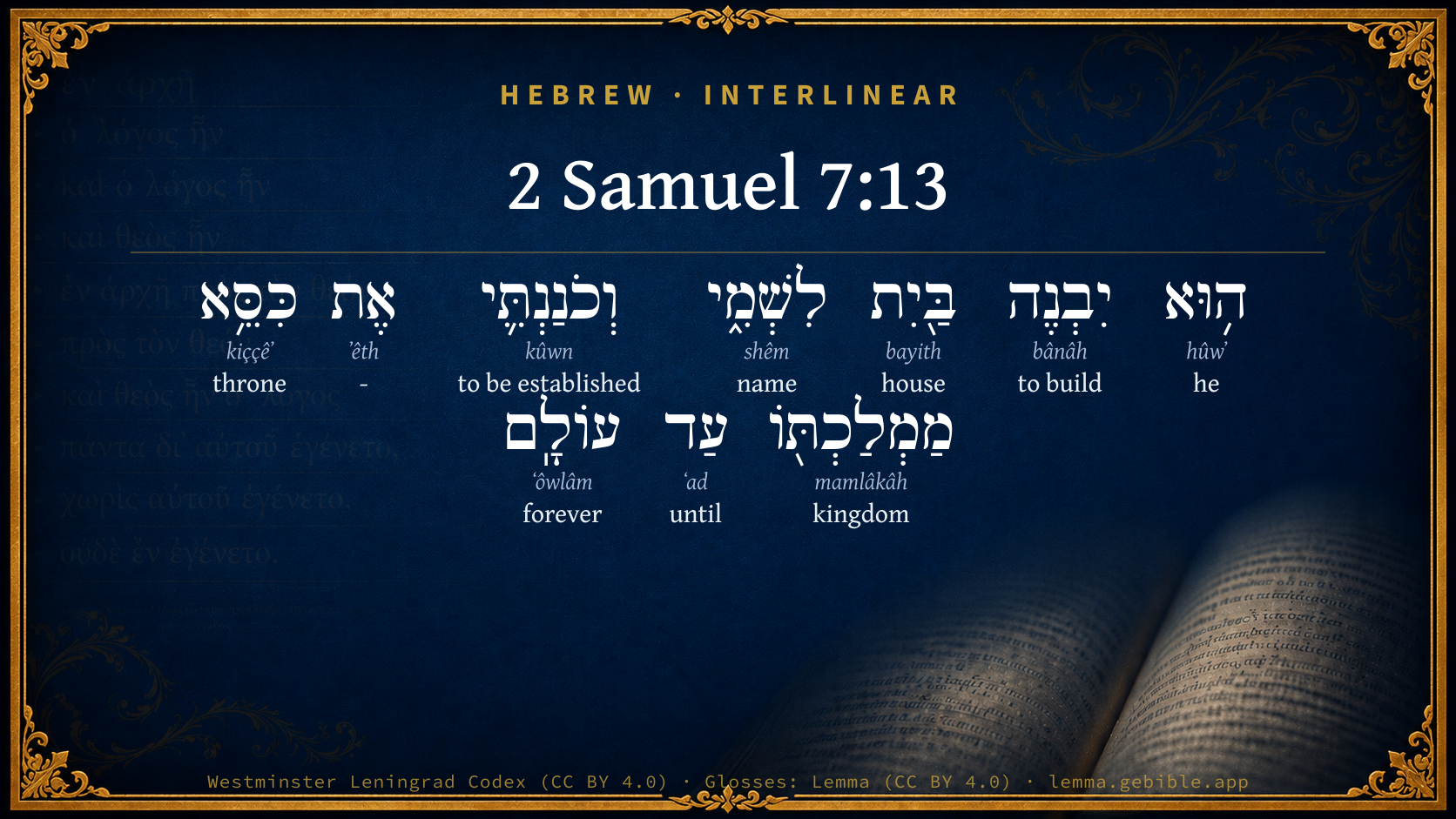
Hebrew (Westminster Leningrad Codex) 2 Samuel 7:13 appears in the Hebrew Old Testament. The text above is from the Westminster Leningrad Codex. Each word links to its Strong’s number, a concise gloss, and parsing drawn from the Open Scriptures Hebrew Bible morphology. Click any word for its full Brown-Driver-Briggs (BDB) entry.
Download image
Cite this verse

2 Samuel 7:13 (World English Bible). Public Domain. Lemma interlinear Bible study tool, https://lemma.gebible.app/v/2-samuel/7/13.

Show BibTeX & RIS
BibTeX
RIS
English Translation
He shall build a house for my name, and I will establish the throne of his kingdom forever.
World English Bible · Public Domain
Download a study sheet

One document with this verse’s original text, its word-by-word gloss line, the meaning frame, cross-references with their text, attributed commentary, and full source and license credits — printable, and it pastes into notes with its structure intact.

This verse Autodidact and up

Study sheet (.html) Plain text (.txt)

A passage Seminary Student

Up to 50 verses in one chapter. A passage sheet keeps up to 6 commentary sources and 12 cross-references per verse, in the order this page ranks them, and says so on the sheet whenever that leaves anything out. Ask for a single verse and you get the Autodidact verse sheet above.

Everything on this page stays free to read, with no account — the sheet is a download of what is already on screen, not access to it.

Want to remove ads? Support Godless Engineer
Compare translations 3

The same verse in 3 English versions, stacked beneath the original-language interlinear above. Click any original word for its lexicon entry.

Each is an independent rendering of the whole verse — the interlinear is not word-aligned to these translations.

Highlighted words mark where these versions differ — a whole-verse word diff, not a word-by-word alignment.

  • World English Bible Public Domain
    He shall build a house for my name, and I will establish the throne of his kingdom forever.
  • King James Version Public Domain
    He shall build an house for my name, and I will stablish the throne of his kingdom for ever.
  • unfoldingWord Literal Text CC BY-SA 4.0
    He, he will build a house for my name, and I will establish the throne of his kingdom to forever!

unfoldingWord Literal Text — © unfoldingWord, licensed CC BY-SA 4.0. Word-aligned USFM3 via Door43 (git.door43.org/unfoldingWord/en_ult).

Versions to compare (up to 4)

3 of 4 selected

Show all 18 translations

Every available English version of this verse, each an independent rendering of the whole verse.

  • World English Bible Public Domain
    He shall build a house for my name, and I will establish the throne of his kingdom forever.
  • Berean Standard Bible Public Domain
    He will build a house for My Name, and I will establish the throne of his kingdom forever.
  • Majority Standard Bible Public Domain
    He will build a house for My Name, and I will establish the throne of his kingdom forever.
  • King James Version Public Domain
    He shall build an house for my name, and I will stablish the throne of his kingdom for ever.
  • American Standard Version (1901) Public Domain
    He shall build a house for my name, and I will establish the throne of his kingdom for ever.
  • Revised Version (1885) Public Domain
    He shall build an house for my name, and I will establish the throne of his kingdom for ever.
  • Geneva Bible (1599) Public Domain
    He shall buyld an house for my Name, and I will stablish ye throne of his kingdome for euer.
  • Douay-Rheims (1899) Public Domain
    He shall build a house to my name, and I will establish the throne of his kingdom for ever.
  • Young's Literal Translation Public Domain
    He doth build a house for My Name, and I have established the throne of his kingdom unto the age.
  • Literal Standard Version CC BY-SA 4.0
    he builds a house for My Name, and I have established the throne of his kingdom for all time.
  • Unlocked Literal Bible CC BY-SA 4.0
    He will build a house for my name, and I will establish the throne of his kingdom forever.
  • unfoldingWord Literal Text CC BY-SA 4.0
    He, he will build a house for my name, and I will establish the throne of his kingdom to forever!
  • Darby Bible Public Domain
    It is he who shall build a house for my name, and I will establish the throne of his kingdom for ever.
  • World Messianic Bible Public Domain
    He will build a house for my name, and I will establish the throne of his kingdom forever.
  • Webster's Bible Public Domain
    He shall build a house for my name, and I will establish the throne of his kingdom for ever.
  • Free Bible Version CC BY-SA 4.0
    He will be the one to build me a house, and I will make sure his kingdom lasts forever.
  • Bible in Basic English Public Domain
    He will be the builder of a house for my name, and I will make the seat of his authority certain for ever.
  • JPS Tanakh (1917) Public Domain
    He shall build a house for My name, and I will establish the throne of his kingdom for ever.

Literal Standard Version (2020), Covenant Press — licensed CC BY-SA 4.0. Text via the HelloAO Bible API (eBible.org). Unlocked Literal Bible (unfoldingWord) — licensed CC BY-SA 4.0. Text via the HelloAO Bible API (eBible.org). unfoldingWord Literal Text — © unfoldingWord, licensed CC BY-SA 4.0. Word-aligned USFM3 via Door43 (git.door43.org/unfoldingWord/en_ult). Free Bible Version, Dr. Jonathan Gallagher — licensed CC BY-SA 4.0. Text via the HelloAO Bible API (eBible.org).

Word by word

More ways to search: Search by grammar → Find every occurrence → Compare this word →

Practice this passage: Drill this verse → Learn its vocabulary →

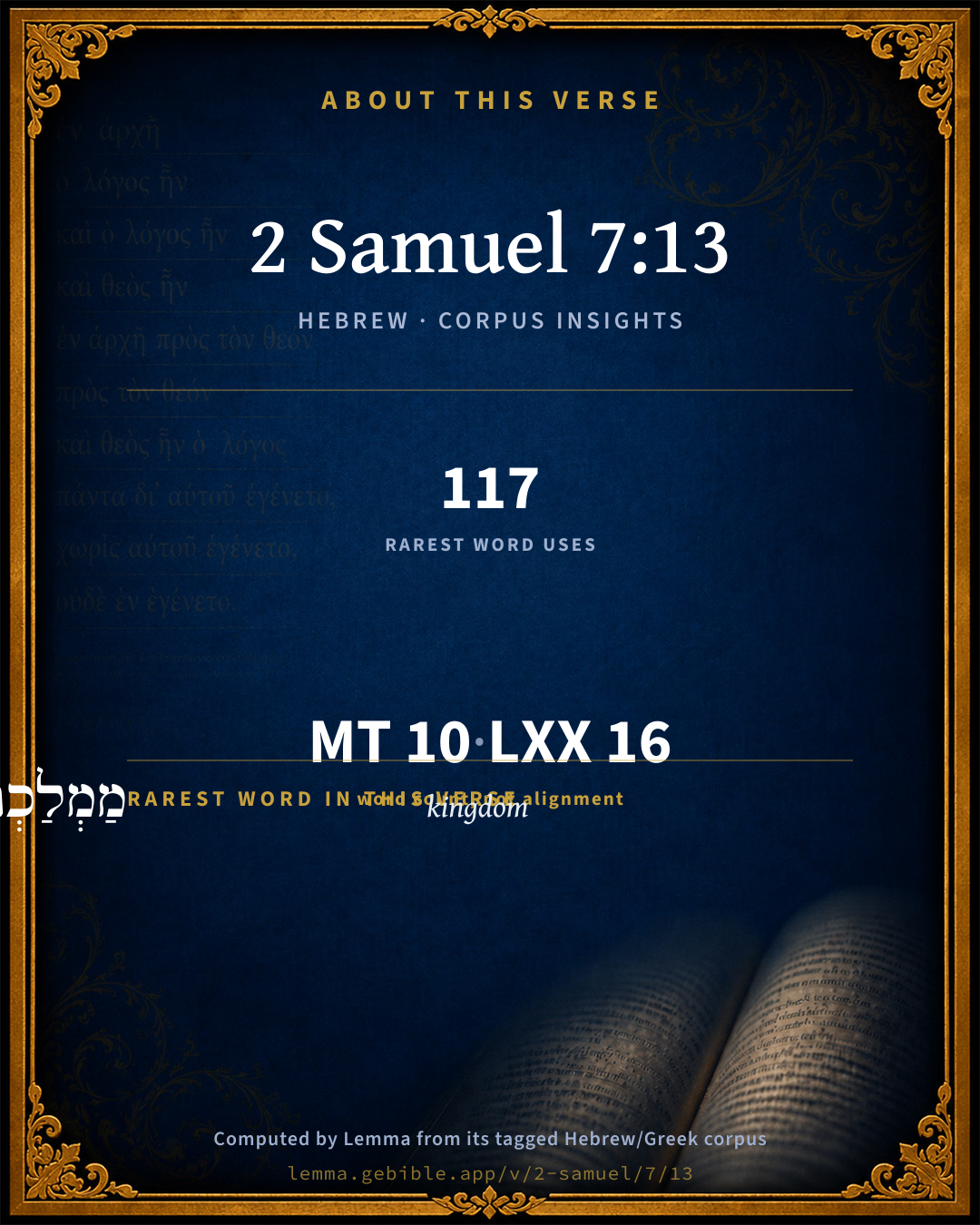
מַמְלַכְתּ֖וֹ
mamlâkâh
H4467
“kingdom · his”
Noun, Common, Feminine, Singular, Construct + Suffix, Personal, 3rd Person, Masculine, Singular
Part of Speech
Noun
Type
Common
Gender
Feminine
Number
Singular
State
Construct
Full BDB Definition

Origin: from H4427

TWOT: 1199f

kingdom, dominion, reign, sovereignty - kingdom, realm - sovereignty, dominion - reign
  1. ה֥וּא hûwʼ H1931 “he” Pronoun, Personal, 3rd Person, Masculine, Singular
  2. יִבְנֶה bânâh H1129 “to build” Verb, Qal, Imperfect, 3rd Person, Masculine, Singular
  3. בַּ֖יִת bayith H1004 “house” Noun, Common, Masculine, Singular, Absolute
  4. לִשְׁמִ֑י shêm H8034 “to/for · name · my” Preposition + Noun, Common, Masculine, Singular, Construct + Suffix, Personal, 1st Person, Common, Singular
  5. וְכֹנַנְתִּ֛י kûwn H3559 “and · to be established” Conjunction + Verb, Polel, Sequential Perfect, 1st Person, Common, Singular
  6. אֶת ʼêth H853 “-” Particle, Direct Object
  7. כִּסֵּ֥א kiççêʼ H3678 “throne of” Noun, Common, Masculine, Singular, Construct
  8. עַד ʻad H5704 “until” Preposition
  9. עוֹלָֽם ʻôwlâm H5769 “forever” Noun, Common, Masculine, Singular, Absolute

About this verse

These counts appear in no published source. They are computed here, from the morphology-tagged text and Lemma’s own curated glosses. What Lemma adds →

10
words
10
distinct lemmas
Historical
section

Grammatical profile

  • 2 verbs
  • 5 nouns
  • 1 pronoun
  • 1 preposition
  • 1 particle

Verb forms

  • יִבְנֶה Qal · Imperfect
  • וְכֹנַנְתִּ֛י Polel · Sequential Perfect

Hebrew & Septuagint length

In English translation the verse runs 18 words from the Hebrew and 20 from the Septuagint (LXX English) — closely comparable.

A rough comparison of the two English renderings, which tokenize alike — not a word-level alignment.

Word counts can differ between the Hebrew and the Greek without any difference in meaning — e.g. the Hebrew direct-object marker אֵת has no separate Greek word, and Greek often adds the article ὁ.

In the original languages it is 10 Hebrew tokens and 16 Greek tokens — but the two are counted differently (Hebrew bundles its prefixes and suffixes into one token; the Greek is in lemma form), so that isn’t a like-for-like length.

Cross-references

19

Topical passages linked to 2 Samuel 7:13 in the Treasury of Scripture Knowledge — connected by theme and wording, ordered by reader-vote popularity; previews shown in the World English Bible.

  • Luke 1:31–33 Behold, you will conceive in your womb, and bring forth a son, and will call his name 'Jesus.'
  • 1 Kings 8:19 nevertheless you shall not build the house; but your son who shall come forth out of your loins, he shall build the house for my name.
  • 2 Samuel 7:16 Your house and your kingdom shall be made sure for ever before you: your throne shall be established forever.
  • 1 Kings 5:5 Behold, I purpose to build a house for the name of Yahweh my God, as Yahweh spoke to David my father, saying, Your son, whom I will set on your throne in your room, he shall build the house for my name.
  • 1 Chronicles 22:9–10 Behold, a son shall be born to you, who shall be a man of rest; and I will give him rest from all his enemies round about; for his name shall be Solomon, and I will give peace and quietness to Israel in his days:
  • Psalms 89:4 'I will establish your seed forever, And build up your throne to all generations.'" Selah.
  • Isaiah 9:7 Of the increase of his government and of peace there shall be no end, on the throne of David, and on his kingdom, to establish it, and to uphold it with justice and with righteousness from henceforth even forever. The zeal of Yahweh of Hosts will perform this.
  • 1 Kings 6:12 Concerning this house which you are building, if you will walk in my statutes, and execute my ordinances, and keep all my commandments to walk in them; then will I establish my word with you, which I spoke to David your father.
  • Psalms 89:36–37 His seed will endure forever, His throne like the sun before me.
  • 1 Chronicles 17:11–12 It shall happen, when your days are fulfilled that you must go to be with your fathers, that I will set up your seed after you, who shall be of your sons; and I will establish his kingdom.
  • Psalms 89:29 I will also make his seed endure forever, And his throne as the days of heaven.
  • Zechariah 6:13 even he shall build the temple of Yahweh; and he shall bear the glory, and shall sit and rule on his throne; and he shall be a priest on his throne; and the counsel of peace shall be between them both.
  • Hebrews 3:3 For he has been counted worthy of more glory than Moses, inasmuch as he who built the house has more honor than the house.
  • 1 Peter 2:5 You also, as living stones, are built up as a spiritual house, to be a holy priesthood, to offer up spiritual sacrifices, acceptable to God through Jesus Christ.
  • 1 Chronicles 28:6–7 He said to me, Solomon your son, he shall build my house and my courts; for I have chosen him to be my son, and I will be his father.
  • 1 Chronicles 28:10 Take heed now; for Yahweh has chosen you to build a house for the sanctuary: be strong, and do it.
  • Isaiah 49:8 Thus says Yahweh, In an acceptable time have I answered you, and in a day of salvation have I helped you; and I will preserve you, and give you for a covenant of the people, to raise up the land, to make them inherit the desolate heritage:
  • Psalms 89:21 With whom my hand shall be established. My arm will also strengthen him.
  • Matthew 16:18 I also tell you that you are Peter, and on this rock I will build my assembly, and the gates of Hades will not prevail against it.

Cross-references courtesy of OpenBible.info (CC BY 4.0).

Hebrew and Greek witnesses Masoretic Hebrew ↔ Greek Septuagint

The same verse in the two great witnesses to the Old Testament, shown verse-for-verse.

These are two independent witnesses, not word-aligned to each other, and the Septuagint is shown in lemma (dictionary) form.

Hebrew 2 Samuel 7:13 Masoretic · Westminster Leningrad Codex

ה֥וּא יִבְנֶה בַּ֖יִת לִשְׁמִ֑י וְכֹנַנְתִּ֛י אֶת כִּסֵּ֥א מַמְלַכְתּ֖וֹ עַד עוֹלָֽם

He shall build a house for my name, and I will establish the throne of his kingdom forever.

World English Bible · Public Domain

Greek LXX 2 Samuel 7:13 Septuagint · lemma form

αὐτός οἰκοδομέω ἐγώ οἶκος ὁ ὄνομα ἐγώ καί ἀναὀρθόω ὁ θρόνος αὐτός ἕως εἰς ὁ αἰών

He shall build for me a house to my name, and I will set up his throne even for ever.

LXX2012 (modern English Septuagint) · Public Domain

Hebrew: Westminster Leningrad Codex (CC BY 4.0). Greek: Septuagint (public domain); English from LXX2012 (modern English Septuagint) (Public Domain). How the Septuagint differs from the Hebrew →

Targum (Aramaic paraphrase)

1

The Targum is the ancient Jewish Aramaic paraphrase of the Hebrew Scriptures — an interpretive translation, not the Hebrew text itself. Onkelos (literal) and Pseudo-Jonathan (expansive) render the Torah, and Jonathan the Prophets. Coverage is partial: where no permissively-licensed English translation exists for a verse, only the Aramaic is shown. This is verse-level text, not a word-by-word alignment to the Hebrew.

  1. Targum Jonathan Prophets (Joshua–Malachi)
    הוּא יִבְנֵי בֵיתָא לִשְׁמִי וְאַתְקִין יַת כּוּרְסֵי מַלְכוּתֵיהּ עַד עָלְמָא:

    (no public-domain English translation for this verse)

    Targum Jonathan — Aramaic: “Mikraot Gedolot” (public domain). English: “Sefaria Community Translation” (CC0 1.0 (public-domain dedication)); “London "Chaldee Paraphrase," 1871” (public domain). Text via Sefaria.

Commentary

Notes on 2 Samuel 7:13 from classic Christian and Jewish commentators (each source and its license shown beneath its notes). The classic Christian expositions comment on the surrounding passage and are grouped to its opening verse, so a note may address several verses; the Jewish commentaries on the Tanakh (Rashi and others) are per-verse, so they appear only where the commentator wrote on this verse.

Lemma curates 59 commentaries, every one of them public domain or Creative Commons licensed, each selected and text-cleaned for this edition rather than reprinted as found. About our sources →

Trapp's Complete Commentary

John Trapp

2Sa 7:13 He shall build an house for my name, and I will stablish the throne of his kingdom for ever.

Ver. 13. He shall build an house for my name.] Solomon, a material temple; Christ, a mystical - that is, the Church, which is the house of God. {1Ti 3:15} The Jews say that the Messiah is to build a temple, but then it must be a material one: and therefore in their daily prayers they call hard for his coming, and they cry altogether to God, Templum tuum brevi, valde cito, valde cito in diebus nostris, citissime nunc aedefica templum tuum brevi, {a} &c. Build thy temple, Lord, quickly, quickly, quickly, even in our days, &c. Oh that we would be as earnest for the building up of the mystical temple, and the speedy doing of it, that the topstone were once laid! &c.

{a} Buxtorf, De Synag., cap. 13.

John Trapp, A Commentary or Exposition upon All the Books of the Old and New Testament (1647–1656) — public domain. Text from a community e-Sword module.

Albert Barnes' Notes on the Bible

He shall build an house ... - For the fulfillment of this in the person of Solomon, see 1Ki 8:16-20. For its application to Christ, see Joh 1:12; Eph 1:20-22; 1Ti 3:15; Heb 3:6; etc.; and Zec 6:12-13.

I will stablish the throne of his kingdom forever - The words forever, emphatically twice repeated in 2Sa 7:16, show very distinctly that this prophecy looks beyond the succession of the kings of Judah of the house of David, and embraces the throne of Christ according to the Angel’s interpretation given in Luk 1:31-33, where the reference to this passage cannot be mistaken. This is also brought out fully in Psa 89:29, Psa 89:36-37. See also Dan 7:13-14; Isa 9:6-7; Jer 23:5-6; Jer 33:14-21; Eze 34:24; Zec 12:7-8; Hos 3:5, etc.

Albert Barnes' Notes on the Bible (1834–1885) — public domain. Text from a community e-Sword/MySword module.

Joseph Benson's Commentary

2Sa 7:13. He shall build a house for my name — This is meant literally of Solomon, who alone did build the material house or temple; but ultimately of Christ, who is the builder of God’s spiritual house or temple. For my name — That is, for my service and glory. For ever — This is not meant of Solomon, for his kingdom was not for ever. But it is to be understood of David’s posterity in general, and with special respect to Christ, in whose person the kingdom was to be lodged for ever.

Joseph Benson's Commentary on the Old and New Testaments (1811–1818) — public domain. Text from a community e-Sword module.

Jamieson, Fausset & Brown

Robert Jamieson, A. R. Fausset & David Brown

He shall build an house for my name, and I will establish the throne of his kingdom for ever--This declaration referred, in its primary application, to Solomon, and to the temporal kingdom of David's family. But in a larger and sublimer sense, it was meant of David's Son of another nature (Heb 1:8). [See on Ch1 17:14.]

Jamieson, Fausset & Brown — Commentary Critical and Explanatory on the Whole Bible (1871) — public domain (CC PDM 1.0). Text via the HelloAO Bible API.

Adam Clarke's Commentary

Verse 13. He shall build] That is, Solomon shall build my temple, not thou, because thou hast shed blood abundantly, and hast made great wars. See 1Ch 22:8; and see also the observations at the end. 2Sa 7:25.

The throne of his kingdom for ever.] This is a reference to the government of the spiritual kingdom, the kingdom of the Messiah, agreeably to the predictions of the prophet long after, and by which this passage is illustrated: "Of the increase of his government and peace there shall be no end, upon the throne of David, and upon his kingdom, to order it, and to establish it, with judgment and with justice, from henceforth even FOR EVER." Isa 9:7.

Adam Clarke's Commentary on the Bible (1810–1826) — public domain. Text from a community e-Sword/MySword module.

The Cambridge Bible for Schools and Colleges

gen. ed. J. J. S. Perowne

13. for my name] The Name of God signifies God Himself so far as He has revealed and manifested Himself to men. His promise concerning the Temple was that He would “put His name there,” that is, that He would be present and reveal Himself there in an especial manner. See 1Ki_8:29; 1Ki_9:3.

stablish] A shorter form of establish, both words being derived from Lat. stabilire. Cp. special and especial from species, state and estate from status.

The Cambridge Bible for Schools and Colleges (gen. ed. J. J. S. Perowne; Cambridge University Press, 1878–1918) — public domain. Text from a community e-Sword module.

John Gill's Exposition

He shall build an house for my name,.... For the honour of it, for the worship and service of God, as it is well known Solomon did; and so his antitype the Messiah, Zac 6:12,

and I will stablish the throne of his kingdom for ever; that is, for a long time. Solomon's reign was forty years, and the kingdom of Judah continued in his posterity until the Babylonish captivity, and a prince that descended from him was the ruler of the people when they returned: this has its fulfilment more eminently in Christ, who was of his seed, to whom God has given "the throne of his father David", and who "shall reign over the house of Jacob for ever", Luk 1:32.

John Gill's Exposition of the Whole Bible (1746–1763) — public domain (CC PDM 1.0). Text via the HelloAO Bible API.

Matthew Poole's English Annotations

He shall build an house: this is meant literally and immediately of Solomon, who alone did build the material house or temple; but mystically and ultimately of Christ, who is the builder of God’s spiritual house or temple, Heb 3:3,6; 1Pe 2:5.

For my name, i. e. for my service, and worship, and glory.

I will stablish the throne of his kingdom: this is not meant of Solomon, for his kingdom was not for ever. And though the phrase for ever is sometimes used of the time of a man’s life, yet it cannot be so understood here, because the mercy here promised to David’s son is of another nature, and of far longer continuance, than that which was given to Saul, 2Sa 7:15, who yet enjoyed the kingdom as long as he lived. But it is to be understood of David’s posterity in general, but with special respect to Christ in whose person the kingdom was to be lodged for ever, Isa 9:7; Dan 2:44; Luk 1:32,33.

Matthew Poole's English Annotations on the Holy Bible (1683–1685) — public domain. Text from a community e-Sword/MySword module.

Whedon's Commentary on the Bible

Daniel D. Whedon

13. He shall build a house — Here, again, the subject is primarily Solomon, for so Solomon himself explained it. 1Ki_5:5; but the for ever with which the verse ends points unmistakably to a greater than Solomon. The house which Solomon built continued till the time of the Babylonish exile, when it was burned by Nebuchadnezzar, (2Ki_25:8;) but it was rebuilt at the close of the exile, (Ezr_6:15,) and of it then the prophet Haggai said, (Hag_2:9 :) “The glory of this latter house shall be greater than that of the former;” for this second temple was the connecting link between the Jews of Haggai’s time and the Messiah, who said, “Destroy this temple, and in three days I will raise it up.” He spake of the temple of his body, (Joh_2:19,) and by the resurrection from the dead he became, in his own sacred person, the foundation of a far more glorious building — a spiritual house, built up of living stones, for a habitation of God through the Spirit. Eph_2:22; 1Pe_2:5.

Daniel D. Whedon (gen. ed.), Commentary on the Old and New Testaments (1874–1909) — public domain. Text from a community e-Sword module.

The Pulpit Commentary

I will establish the throne of his kingdom forever. The temple which Solomon was to build was the symbol of the new development of Israel, and naturally these words suggest a meaning not unworthy of so great an advance in the accomplishment of the nation"s mission. Had we, indeed, only this passage, we might be content to take it in a popular sense, as signifying that, whereas Saul"s throne (and subsequently that of the many usurpers in Samaria) had but a brief existence, Solomon"s descendants should hold for many centuries undisputed possession of the kingdom of Jerusalem. But in Psa_89:29 we read, "His (David"s) seed will I make to endure forever, and histhrone as the days of heaven." And again in vers. 36, 37 a continuance is assured to it as lasting as that of the sun and moon. We can scarcely, therefore, be wrong in the conviction that these promises pointed onwards to the establishment of Christ"s kingdom, and that the great importance attached to the building of the temple finds its explanation in its relation to him. This full establishment after so long a delay of the Mosaic typical ritual, the addition to it of psalmody, giving it a spiritual side, and making the worship that of the heart, the bestowal of empire, and the rapid development of the people under David and Solomon, were all steps in that wonderful series of special providences which made the Jews fit to be the progeniters of the Messiah, which surrounded him during his ministry with companions capable of understanding and recording his teaching, and provided for him, after his death, missionaries, not merely with zeal enough, but with intellectual gifts sufficient to enable them to persuade both Greece and Rome to listen to tidings so wonderful and mysterious as that God for our salvation had become man. Keil also well points out that the temple was a symbol of Christ"s incarnation; for it meant the dwelling of God on earth. "I have surely," says Solomon, "built thee a house of habitation, a place for thee to dwell in forever". (1Ki_8:13) The same thought was in St. John"s mind when he said, "The Word became flesh, and dwelt as in a tabernacle among us". (Joh_1:14) For the verb used by him, literally "tabernacled," is a comparison between Christ"s life on earth, and the dwelling of God in "the tent of meeting." But there is more than this. Christ himself calls his body "the temple". (Joh_2:19, Joh_2:21) At the Resurrection he raised up again the temple of his body which the Jews had destroyed, and at the Ascension it was removed from the earth, to be reserved in heaven until his second advent. His reign now is spiritual, and his temple is not a building made with hands, but is the heart of the renewed believer. (1Co_6:19) And this indwelling of Christ in the heart will continue unto the end of the present dispensation. For Christ"s indwelling is that also of the Holy Spirit; (1Co_3:16) and the gift of the Spirit continues unto the end of the world. "The Father shall give you another Comforter, that he may abide with you forever". (Joh_14:16)

The Pulpit Commentary (1880–1919), ed. H.D.M. Spence-Jones & Joseph S. Exell — public domain. Text from a community e-Sword module.

John Wesley's Explanatory Notes

He shall - This is meant literally of Solomon, who alone did build the material house or temple; but ultimately of Christ, who is the builder of God's spiritual house or temple. For my name - That is, for my service, and glory. For ever - This is not meant of Solomon, for his kingdom was not forever. But it is to be understood of David's posterity, in general, and with special respect to Christ, in whose person the kingdom was to be lodged forever. 14. His father - I will carry myself towards him as a father, with all affection, and I will own him as my son. This is intended both of Solomon, as a type of Christ; and of Christ himself as is evident from Heb. i, 5. If he commit - This agrees only to Solomon and some others of David's posterity; but not to Christ, who never committed iniquity, as Solomon did, who therein was no type of Christ, and therefore this branch is terminated in Solomon; whereas in those things wherein Solomon was a type of Christ, the sense passes through Solomon to Christ. Rod of men - With such rods as are gentle and moderate, and suited to man's weakness.

John Wesley, Explanatory Notes Upon the Whole Bible (1754–1765) — public domain. Text via the GEBible commentary corpus.

Lesson kit

Teaching starters — assembled from the data on this page, not authored interpretation. Every prompt links to the verse data it draws on. Edit before teaching.

2 Samuel, in the Historical, opens this verse with 10 words (10 distinct Hebrew lemmas). Its most distinctive word is mamlâkâh (“kingdom”). A historical commentator’s framing appears above. Read the whole chapter for the surrounding context.

Discussion questions

  1. What does “kingdom” (mamlâkâh) contribute to the verse as a whole?
  2. Luke 1:31–33 shares this passage’s theme. How do the two illuminate each other?
  3. These translations render this verse differently. What is at stake in choosing one wording over another?
  4. The verb «יִבְנֶה» is Qal Imperfect. How does its form color the action?
  5. Reading how Trapp's Complete Commentary and Albert Barnes' Notes on the Bible read this verse, where do the two commentators agree and where do they part?

Things to notice

Reading settings

Reading text

Shown beneath each verse's original-language words.

Old Testament
Old Testament edition

Read the OT as the Masoretic Hebrew (MT) or the Greek Septuagint (LXX).

English shown for the Greek Septuagint (in the Hebrew ↔ Greek comparison).

Comparing translations? Open the Compare panel on any verse page to stack up to four side by side.