
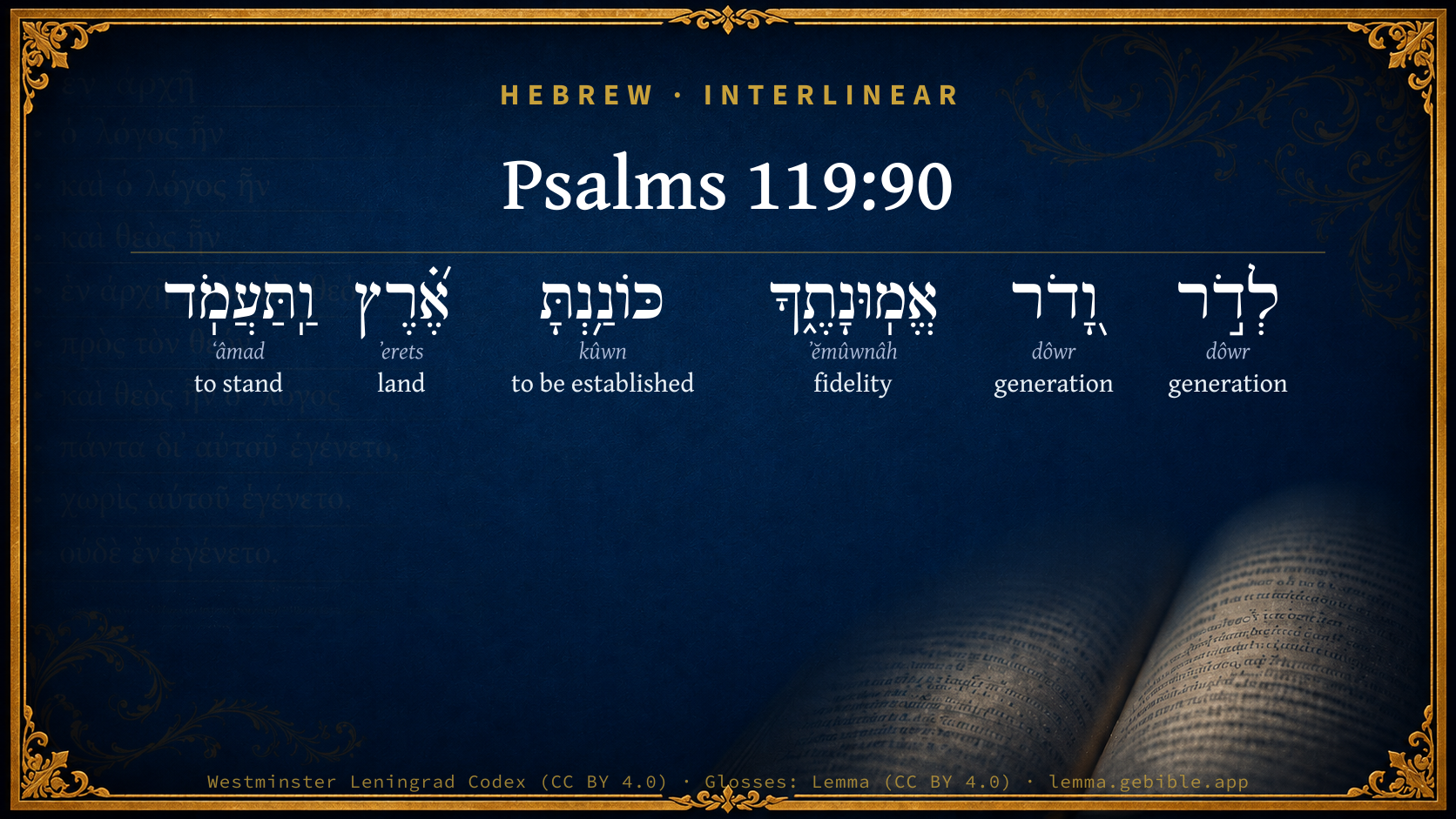
Psalms 119:90

Hebrew (Westminster Leningrad Codex) Psalms 119:90 appears in the Hebrew Old Testament. The text above is from the Westminster Leningrad Codex. Each word links to its Strong’s number, a concise gloss, and parsing drawn from the Open Scriptures Hebrew Bible morphology. Click any word for its full Brown-Driver-Briggs (BDB) entry.
Download image
Cite this verse

Psalms 119:90 (World English Bible). Public Domain. Lemma interlinear Bible study tool, https://lemma.gebible.app/v/psalms/119/90.

Show BibTeX & RIS
BibTeX
RIS
English Translation
Your faithfulness is to all generations. You have established the earth, and it remains.
World English Bible · Public Domain
Download a study sheet

One document with this verse’s original text, its word-by-word gloss line, the meaning frame, cross-references with their text, attributed commentary, and full source and license credits — printable, and it pastes into notes with its structure intact.

This verse Autodidact and up

Study sheet (.html) Plain text (.txt)

A passage Seminary Student

Up to 50 verses in one chapter. A passage sheet keeps up to 6 commentary sources and 12 cross-references per verse, in the order this page ranks them, and says so on the sheet whenever that leaves anything out. Ask for a single verse and you get the Autodidact verse sheet above.

Everything on this page stays free to read, with no account — the sheet is a download of what is already on screen, not access to it.

Want to remove ads? Support Godless Engineer
Compare translations 3

The same verse in 3 English versions, stacked beneath the original-language interlinear above. Click any original word for its lexicon entry.

Each is an independent rendering of the whole verse — the interlinear is not word-aligned to these translations.

Highlighted words mark where these versions differ — a whole-verse word diff, not a word-by-word alignment.

  • World English Bible Public Domain
    Your faithfulness is to all generations. You have established the earth, and it remains.
  • King James Version Public Domain
    Thy faithfulness is unto all generations: thou hast established the earth, and it abideth.
  • unfoldingWord Literal Text CC BY-SA 4.0
    Your faithfulness to generation and generation; you have established the earth, and it stands.

unfoldingWord Literal Text — © unfoldingWord, licensed CC BY-SA 4.0. Word-aligned USFM3 via Door43 (git.door43.org/unfoldingWord/en_ult).

Versions to compare (up to 4)

3 of 4 selected

Show all 17 translations

Every available English version of this verse, each an independent rendering of the whole verse.

  • World English Bible Public Domain
    Your faithfulness is to all generations. You have established the earth, and it remains.
  • Berean Standard Bible Public Domain
    Your faithfulness continues through all generations; You established the earth, and it endures.
  • Majority Standard Bible Public Domain
    Your faithfulness continues through all generations; You established the earth, and it endures.
  • King James Version Public Domain
    Thy faithfulness is unto all generations: thou hast established the earth, and it abideth.
  • American Standard Version (1901) Public Domain
    Thy faithfulness is unto all generations: Thou hast established the earth, and it abideth.
  • Revised Version (1885) Public Domain
    Thy faithfulness is unto all generations: thou hast established the earth, and it abideth.
  • Geneva Bible (1599) Public Domain
    Thy trueth is from generation to generation: thou hast layed the foundation of the earth, and it abideth.
  • Young's Literal Translation Public Domain
    To all generations Thy faithfulness, Thou didst establish earth, and it standeth.
  • Literal Standard Version CC BY-SA 4.0
    Your faithfulness from generation to generation, || You established earth, and it stands.
  • Unlocked Literal Bible CC BY-SA 4.0
    Your faithfulness lasts for all generations; you have established the earth, and it remains.
  • unfoldingWord Literal Text CC BY-SA 4.0
    Your faithfulness to generation and generation; you have established the earth, and it stands.
  • Darby Bible Public Domain
    Thy faithfulness is from generation to generation: thou hast established the earth, and it standeth.
  • World Messianic Bible Public Domain
    Your faithfulness is to all generations. You have established the earth, and it remains.
  • Webster's Bible Public Domain
    Thy faithfulness is to all generations: thou hast established the earth, and it abideth.
  • Free Bible Version CC BY-SA 4.0
    Your faithfulness lasts for all generations, as permanent as the earth you created.
  • Bible in Basic English Public Domain
    Your faith is unchanging from generation to generation: you have put the earth in its place, and it is not moved.
  • JPS Tanakh (1917) Public Domain
    Thy faithfulness is unto all generations; Thou hast established the earth, and it standeth.

Literal Standard Version (2020), Covenant Press — licensed CC BY-SA 4.0. Text via the HelloAO Bible API (eBible.org). Unlocked Literal Bible (unfoldingWord) — licensed CC BY-SA 4.0. Text via the HelloAO Bible API (eBible.org). unfoldingWord Literal Text — © unfoldingWord, licensed CC BY-SA 4.0. Word-aligned USFM3 via Door43 (git.door43.org/unfoldingWord/en_ult). Free Bible Version, Dr. Jonathan Gallagher — licensed CC BY-SA 4.0. Text via the HelloAO Bible API (eBible.org).

Word by word

More ways to search: Search by grammar → Find every occurrence → Compare this word →

Practice this passage: Drill this verse → Learn its vocabulary →

About this verse

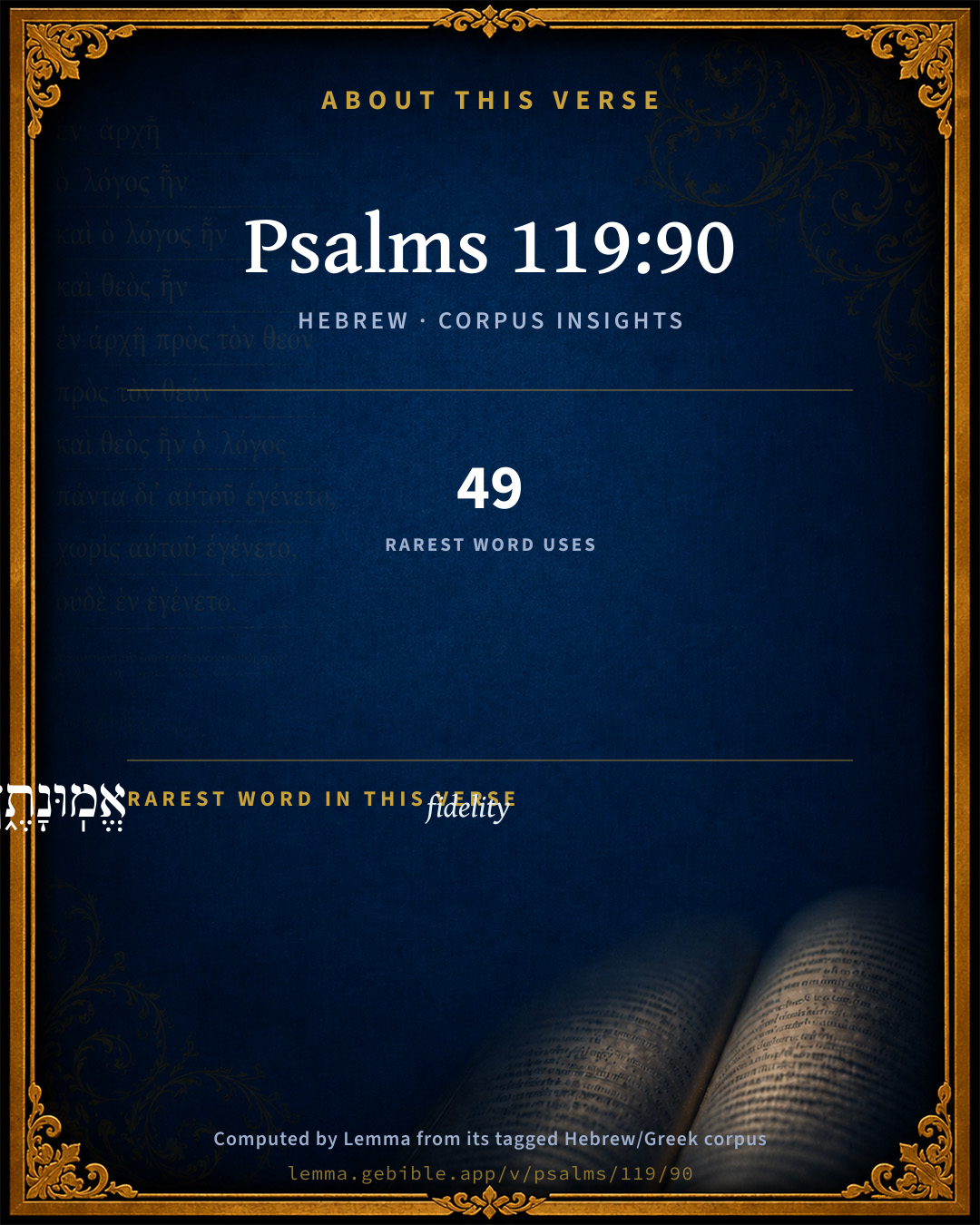
These counts appear in no published source. They are computed here, from the morphology-tagged text and Lemma’s own curated glosses. What Lemma adds →

6
words
5
distinct lemmas
Wisdom
section

Shared distinctive vocabulary

אֱמֽוּנָתֶ֑ךָ fidelity H530 occurs in 49 verses of the Hebrew Bible. Also found in:

Grammatical profile

  • 2 verbs
  • 4 nouns

Verb forms

  • כּוֹנַ֥נְתָּ Polel · Perfect
  • וַֽתַּעֲמֹֽד Qal · Sequential Imperfect

Repetition

A word recurs within this verse — often emphatic in Hebrew:

  • לְדֹ֣ר generation H1755 ×2

Hebrew & Septuagint length

In English translation the verse runs 14 words from the Hebrew and 14 from the Septuagint (LXX English) — the same length.

A rough comparison of the two English renderings, which tokenize alike — not a word-level alignment.

Word counts can differ between the Hebrew and the Greek without any difference in meaning — e.g. the Hebrew direct-object marker אֵת has no separate Greek word, and Greek often adds the article ὁ.

Cross-references

12

Topical passages linked to Psalms 119:90 in the Treasury of Scripture Knowledge — connected by theme and wording, ordered by reader-vote popularity; previews shown in the World English Bible.

  • Psalms 100:5 For Yahweh is good. His loving kindness endures forever, His faithfulness to all generations.
  • Psalms 36:5 Your loving kindness, Yahweh, is in the heavens. Your faithfulness reaches to the skies.
  • Psalms 93:1 Yahweh reigns! He is clothed with majesty! Yahweh is armed with strength. The world also is established. It can't be moved.
  • Psalms 148:6 He has also established them forever and ever. He has made a decree which will not pass away.
  • Micah 7:20 You will give truth to Jacob, and mercy to Abraham, As you have sworn to our fathers from the days of old.
  • Psalms 89:1–2 I will sing of the loving kindness of Yahweh forever. With my mouth, I will make known your faithfulness to all generations.
  • Deuteronomy 7:9 Know therefore that Yahweh your God, he is God, the faithful God, who keeps covenant and loving kindness with them who love him and keep his commandments to a thousand generations,
  • Psalms 89:11 The heavens are yours. The earth also is yours; The world and its fullness. You have founded them.
  • Psalms 104:5 He laid the foundations of the earth, That it should not be moved forever.
  • 2 Peter 3:5–7 For this they willfully forget, that there were heavens from of old, and an earth formed out of water and amid water, by the word of God;
  • Job 38:4–7 "Where were you when I laid the foundations of the earth? Declare, if you have understanding.
  • Ecclesiastes 1:4 One generation goes, and another generation comes; but the earth remains forever.

Cross-references courtesy of OpenBible.info (CC BY 4.0).

Hebrew and Greek witnesses Masoretic Hebrew ↔ Greek Septuagint

The same verse in the two great witnesses to the Old Testament, shown verse-for-verse.

You’re reading Greek Psalm 118 (Hebrew Psalm 119). The Septuagint counts the superscription, so verse numbers can differ from the Hebrew — chapter-level alignment, not verse-by-verse. Numbering follows Rahlfs.

These are two independent witnesses, not word-aligned to each other, and the Septuagint is shown in lemma (dictionary) form.

Hebrew Psalms 119:90 Masoretic · Westminster Leningrad Codex

לְדֹ֣ר וָ֭דֹר אֱמֽוּנָתֶ֑ךָ כּוֹנַ֥נְתָּ אֶ֝֗רֶץ וַֽתַּעֲמֹֽד

Your faithfulness is to all generations. You have established the earth, and it remains.

World English Bible · Public Domain

Greek LXX Greek Psalm 118:90 Septuagint · lemma form

εἰς γενεά καί γενεά ὁ ἀλήθεια σύ θεμελιόω ὁ γῆ καί διαμένω

Your truth endures to all generations; you have founded the earth, and it abides.

LXX2012 (modern English Septuagint) · Public Domain

Hebrew: Westminster Leningrad Codex (CC BY 4.0). Greek: Septuagint (public domain); English from LXX2012 (modern English Septuagint) (Public Domain). How the Septuagint differs from the Hebrew →

Commentary

Notes on Psalms 119:90 from classic Christian and Jewish commentators (each source and its license shown beneath its notes). The classic Christian expositions comment on the surrounding passage and are grouped to its opening verse, so a note may address several verses; the Jewish commentaries on the Tanakh (Rashi and others) are per-verse, so they appear only where the commentator wrote on this verse.

Lemma curates 59 commentaries, every one of them public domain or Creative Commons licensed, each selected and text-cleaned for this edition rather than reprinted as found. About our sources →

Trapp's Complete Commentary

John Trapp

Psa 119:90 Thy faithfulness [is] unto all generations: thou hast established the earth, and it abideth.

Ver. 90. Thy faithfulness is unto all generations] He singles out God’s word of promise, and showes it to be immutable and unmoveable as the earth is in the middle of heaven, by the word of God’s power. See Jer 33:25.

Thou hast established] See Job 26:7. {See Trapp on "Job 26:7"}

John Trapp, A Commentary or Exposition upon All the Books of the Old and New Testament (1647–1656) — public domain. Text from a community e-Sword module.

J. A. Alexander on Psalms

Joseph Addison Alexander

90. (Psa 119:90) To generation and generation (is) thy faithfulness; thou hast fixed the earth and it stands. Resolved into our idiom, the meaning of this verse is, that the truth of God's promises, or his fidelity to his engagements, is secured by the same divine perfection, which brought the world at first into existence, and has ever since preserved it. The verb translated fixed is not the one employed in Psa 119:89, but that used in Psa 7:9; Psa 9:7; Psa 40:2; Psa 48:8; Psa 68:9; Psa 90:17; Psa 99:4; Psa 107:36. The sense prepared is rare and doubtful, and too feeble for this context.

Joseph Addison Alexander, The Psalms Translated and Explained (1850) — public domain. Text from a community e-Sword module.

Adam Clarke's Commentary

Verse 90. Thy faithfulness] That which binds thee to accomplish the promise made. And this shall be, not for an age merely, but from generation to generation; for thy promises refer to the whole duration of time.

Thou hast established the earth] Thou hast given it its appointed place in the system, and there it abideth.

Adam Clarke's Commentary on the Bible (1810–1826) — public domain. Text from a community e-Sword/MySword module.

John Calvin's Commentaries

90. Thy truth is from generation to generation In this verse the Psalmist repeats and confirms the same sentiment. He expressly teaches, that although the faithful live for a short time as strangers upon earth, and soon pass away, yet their life is not perishable, since they are begotten again of an incorruptible seed. He, however, proceeds still farther. He had before enjoined us to pierce by faith into heaven, because we will find nothing in the world on which we can assuredly rest; and now he again teaches us, by experience, that though the world is subject to revolutions, yet in it bright and signal testimonies to the truth of God shine forth, so that the steadfastness of his word is not exclusively confined to heaven, but comes down even to us who dwell upon the earth. For this reason, it is added, that the earth continues steadfast, even as it was established by God at the beginning. Lord, as if it had been said, even in the earth we see thy truth reflected as it were in a mirror; for though it is suspended in the midst of the sea, yet it continues to remain in the same state. These two things, then, are quite consistent; first, that the steadfastness of God’s word is not to be judged of according to the condition of the world, which is always fluctuating, and fades away as a shadow; and, secondly, that yet men are ungrateful if they do not acknowledge the constancy which in many respects marks the frame. work of the world; for the earth, which otherwise could not occupy the position it does for a single moment, abides notwithstanding steadfast, because God’s word is the foundation on which it rests. Farther, no person has any ground for objecting, that it is a hard thing to go beyond this world in quest of the evidences of God’s truth, since, in that case, it would be too remote from the apprehension of men. The prophet meets the objection by affirming, that although it dwells in heaven, yet we may see at our very feet conspicuous proofs of it, which may gradually advance us to as perfect knowledge of it as our limited capacity will permit. Thus the prophet, on the one hand, exhorts us to rise above the whole world by faith, so that the word of God may be found by experience to be adequate, as it really is adequate, to sustain our faith; and, on the other hand, he warns us that we have no excuse, if, by the very sight of the earth, we do not discover the truth of God, since legible traces of it are to be found at our feet. In the first clause, men are called back from the vanity of their own understanding; and, in the other; their weakness is relieved, that they may have a foretaste upon earth of what is to be found more fully in heaven.

John Calvin's Commentaries (1540-1563) — public domain. Text from the Calvin Translation Society English edition (1840s-50s) via the Christian Classics Ethereal Library (ccel.org). Calvin's coverage is partial (roughly two-thirds of the Bible); uncommented books and verses are honest gaps, never fabricated. The 19th-century editor's footnotes and remarks are omitted so the notes are faithfully Calvin's own voice.

The Cambridge Bible for Schools and Colleges

gen. ed. J. J. S. Perowne

90. The permanence of the earth which God has created is an emblem and guarantee of the permanence of His faithfulness. Cp. Psa_78:69. Kay refers to a sermon by Chalmers on “The Constancy of God in His Works an argument for the Faithfulness of God in His Word.”

The Cambridge Bible for Schools and Colleges (gen. ed. J. J. S. Perowne; Cambridge University Press, 1878–1918) — public domain. Text from a community e-Sword module.

John Gill's Exposition

I am thine, save me,.... From all troubles and afflictions; from all enemies, temporal and spiritual; from Satan, and his principalities and powers, from sin, and all the wretched consequences of it; from hell wrath, and damnations: salvation from all which is by Christ. And this is a prayer of faith with respect to him, founded upon his interest and property in him; whose he was by choice, by covenant, by gift, by purchase, and by grace: and this is a plea for salvation; thou hast an interest in me, I am one of thine, therefore let me not be lost or perish;

for I have sought thy precepts; to understand them better, and observe them more constantly; and which sense of interest and relation, and of salvation, will influence unto.

John Gill's Exposition of the Whole Bible (1746–1763) — public domain (CC PDM 1.0). Text via the HelloAO Bible API.

Albert Barnes' Notes on the Bible

Thy faithfulness - The accomplishment of thy promises.

Is unto all generations - Margin, “to generation and generation.” From one generation to another. The generations of people change and pass away, but thy promises do not change. They are as applicable to one generation as to another; they meet every generation alike. The people of no one age can lay any exclusive claim to them, or feel that they were made only for them. They are as universal - as much adapted to the new generations that come upon the earth - as the light of the sun, ever-enduring, is; or as the fountains and streams, which flow from age to age.

Thou hast established the earth, and it abideth - Margin, “Standeth.” It is firm. The earth thus established or made firm, is an illustration of thy faithfulness, and of the stability and permanence of thy promises. It is the same from generation to generation, with its rivers, streams, and fountains; with its fruits and flowers; with its balmy air and its sweet prospects; with its riches of gold and silver; with its pearls and diamonds; with its treasures of land and ocean. So is the word of God - so are the gracious promises which he has addressed to people - the same in every age.

Albert Barnes' Notes on the Bible (1834–1885) — public domain. Text from a community e-Sword/MySword module.

Matthew Poole's English Annotations

Every age gives fresh proofs of the truth of thy word.

The earth abideth in that place and state in which thou didst establish it. See Ecc 1:4.

Matthew Poole's English Annotations on the Holy Bible (1683–1685) — public domain. Text from a community e-Sword/MySword module.

The Treasury of David

Charles H. Spurgeon

Ver. 90. Thy faithfulness is unto all generations. This is an additional glory: God is not affected by the lapse of ages; he is not only faithful to one man throughout his lifetime, but to his children's children after him, yea, and to all generations so long as they keep his covenant and remember his commandments to do them. The promises are ancient things, yet they are not worn out by centuries of use, for the divine faithfulness endureth for ever. He who succoured his servants thousands of years ago still shows himself strong on the behalf of all them that trust in him. "Thou hast established the earth, and it abideth." Nature is governed by fixed laws; the globe keeps its course by the divine command, and displays no erratic movements: the seasons observe their predestined order, the sea obeys the rule of ebb and flow, and all things else are marshalled in their appointed order. There is an analogy between the word of God and the works of God, and specially in this, that they are both of them constant, fixed, and unchangeable. God's word which established the world is the same as that which he has embodied in the Scriptures; by the word of the Lord were the heavens made, and specially by him who is emphatically THE WORD. When we see the world keeping its place and all its laws abiding the same, we have herein assurance that the Lord will be faithful to his covenant, and will not allow the faith of his people to be put to shame. If the earth abideth the spiritual creation will abide; if God's word suffices to establish the world surely it is enough for the establishment of the individual believer.

Ver. 90. Thy faithfulness is unto all generations. As he gathered, the certainty of God's word from the endurance of heaven, so now he confirms it by considering the foundation of the earth. Since the foundation of the earth, made by the word of God, abides sure, shall we not think that the foundation of our salvation laid in Jesus Christ, is much more sure? Though the creatures cannot teach us the way of our salvation (for that we must learn by the word), yet do they confirm that which the word saith, "Thus saith the LORD, which giveth the sun for a light by day, and the ordinances of the moon and of the stars for a light by night, which divideth the sea when the waves thereof roar; the LORD of hosts is his name: If those ordinances depart from before me, saith the LORD, then the seed of Israel also shall cease from being a nation before me for ever:" Jer 31:85, 36. As there Jeremy gathers the stability of the church from the stability of the creatures; so here David confirms the certainty of our salvation by the most certain and unchangeable course of creation; and both of them are amplified by Christ Jesus: "Heaven and earth may pass away, but one jot of God's word shall not fall to the ground." Let us therefore be strengthened in faith and give glory to God. William Cowper.

Ver. 90. Thou hast established the earth, and it abideth. Every time we set foot on the ground, we may remember the stability of God's promises, and it is also a confirmation of faith. Thus,

1. The stability of the earth is the effect of God's word; this is the true pillar upon which the earth standeth; for he upholdeth all things by the word of his power; "For he spake, and it was done; he commanded, and it stood fast": Ps 33:9. Now, his word of power helpeth us to depend upon his word of promise.

2. Nothing appeareth whereon the globe of the earth should lean and rest: "He stretcheth out the north over the empty place, and hangeth the earth upon nothing:" Job 26:7. Now, that this vast and ponderous body should lean upon the fluid air as upon a firm foundation, is matter of wonder; the question is put in the book of Job: "Whereupon are the foundations thereof fastened? or who laid the cornerstone thereof?" Job 38:6. Yet firm it is, though it hang as a ball in the air...Now, since his word beareth up such a weight, and all the church's weight, and our own burden leaneth on the promise of God, he can, by the power of his word, bear up all without visible means. Therefore his people may trust his providence; he is able to support them in any distresses, when no way of help appeareth.

3. The firmness and stability offereth itself to our thoughts. The earth abideth in the same seat and condition wherein God left it, as long as the present course and order of nature is to continue: Ps 104:5. God's truth is as immovable as the earth: Ps 117:2. Surely if the foundation of the earth abideth sure, the foundation of our salvation, laid by Jesus Christ, is much more sure.

4. The stability remains in the midst of changes: Ec 1:4. All things in the world are subject to many revolutions, but God's truth is one and the same.

5. In upholding the frame of the world, all those attributes are seen, which are a firm stay to a believer's heart, such as wisdom, power, and goodness. The covenant of grace is as sure as the covenant made after the deluge. We cannot look upon this earth without seeing therein a display of those same attributes which confirm our faith, in waiting upon God till his promises be fulfilled to us. Condensed from T. Manton.

Ver. 90. It abideth. Creation is as the mother, and Providence the nurse which preserveth all the works of God. God is not like man; for man, when he hath made a work, cannot maintain it: he buildeth a ship, and cannot save it from shipwreck; he edifies a house, but cannot keep it from decay. It is otherwise with God; we daily see his conserving power, upholding his creatures; which should confirm us that he will not cast us off, nor suffer us to perish (since we are the works of his hands) if we so depend upon him, and give him glory as our Creator, Conserver, and Redeemer. William Cowper.

Ver. 90. The stability of the earth a present picture of everlasting faithfulness.

Ver. 90-91. Consider,

1. The steadfastness of nature as dependent upon the divine decree: "according to thy ordinances."

2. The subserviency of nature to the divine will: "for all are thy servants."

3. The fixedness of nature's laws, together with their subserviency to God's purposes, as a confirmation of the Christian's faith in the written word, in the care of a divine providence, and in the sureness of spiritual and heavenly things. "Thy faithfulness is, "etc. J.F.

Psalms 119:91*

Charles H. Spurgeon's The Treasury of David (1869–1885) — public domain. Psalms only. Text from a community e-Sword/MySword module.

The Pulpit Commentary

Thy faithfulness is unto all generations. God "keepeth his promise forever". (Psa_146:6, Prayer-book Version) If his "Word" generally is unchanging, so especially must be his promises. Thou hast established the earth, and it abideth. Even God"s physical laws have a character of perpetuity about them. "The constancy of God in his works is an argument for the faithfulness of God in his Word" (Chalmers).

The Pulpit Commentary (1880–1919), ed. H.D.M. Spence-Jones & Joseph S. Exell — public domain. Text from a community e-Sword module.

Lesson kit

Teaching starters — assembled from the data on this page, not authored interpretation. Every prompt links to the verse data it draws on. Edit before teaching.

Psalms, in the Wisdom, opens this verse with 6 words (5 distinct Hebrew lemmas). Its most distinctive word is ʼĕmûwnâh (“fidelity”). A historical commentator’s framing appears above. Read the whole chapter for the surrounding context.

Discussion questions

  1. The word ʼĕmûwnâh carries the sense “fidelity.” How does it shape the verse?
  2. Exodus 17:12 shares the word «fidelity» with this verse. How do the two illuminate each other?
  3. “generation” occurs 2× in this one verse. What is the effect of the repetition?
  4. These translations render this verse differently; the difference is in the English rendering, not the original. What questions does that raise?
  5. The verb «כּוֹנַ֥נְתָּ» is Polel Perfect. How does its form color the action?
  6. Reading how Trapp's Complete Commentary and J. A. Alexander on Psalms read this verse, where do the two commentators agree and where do they part?

Things to notice

  • These translations choose different wording for 8 words in this verse.
  • “generation” occurs 2× in this single verse.
  • 5 distinct Hebrew lemmas span 6 words in this verse.

Reading settings

Reading text

Shown beneath each verse's original-language words.

Old Testament
Old Testament edition

Read the OT as the Masoretic Hebrew (MT) or the Greek Septuagint (LXX).

English shown for the Greek Septuagint (in the Hebrew ↔ Greek comparison).

Comparing translations? Open the Compare panel on any verse page to stack up to four side by side.