
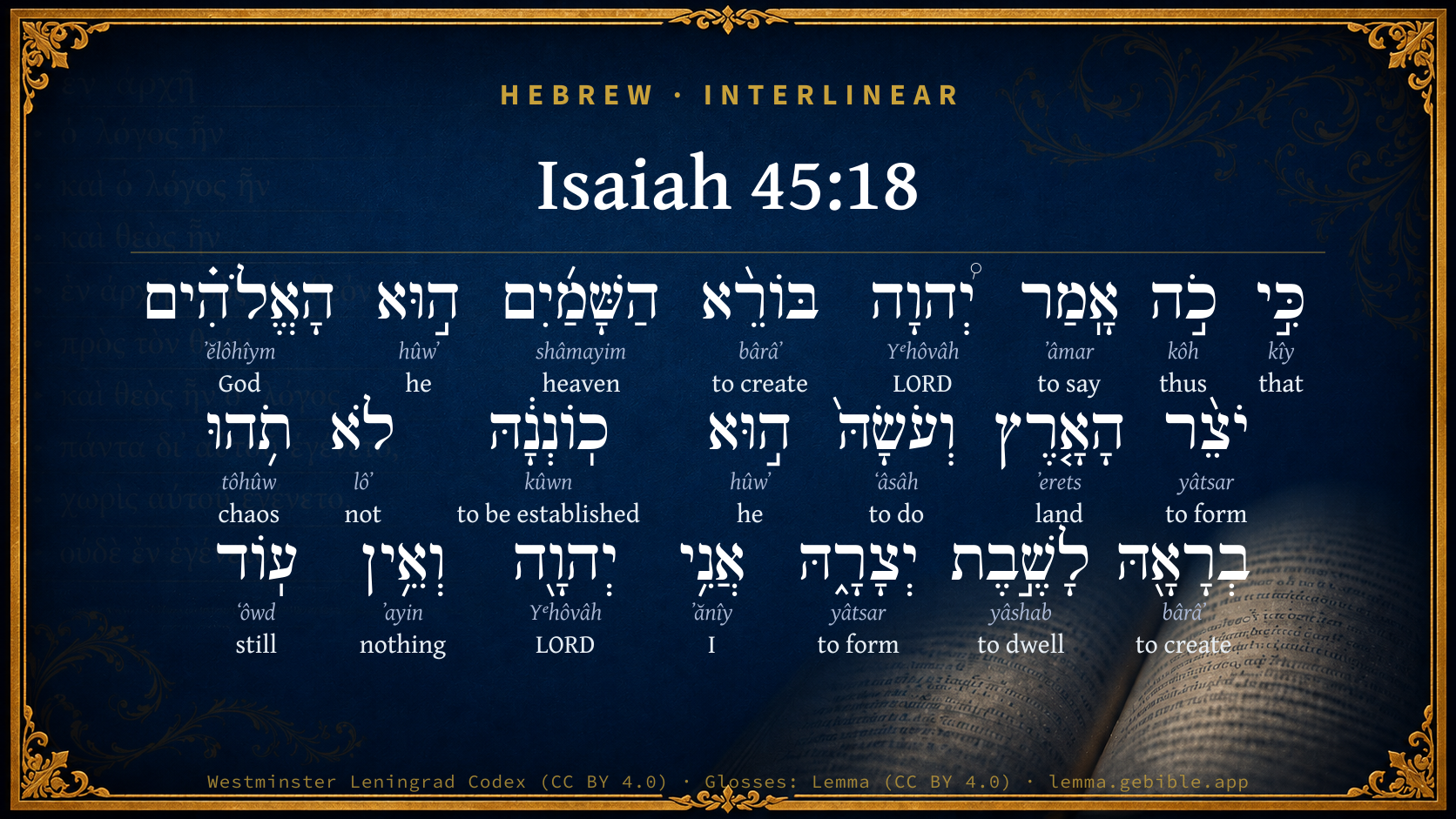
Isaiah 45:18

Hebrew (Westminster Leningrad Codex) Isaiah 45:18 appears in the Hebrew Old Testament. The text above is from the Westminster Leningrad Codex. Each word links to its Strong’s number, a concise gloss, and parsing drawn from the Open Scriptures Hebrew Bible morphology. Click any word for its full Brown-Driver-Briggs (BDB) entry.
Download image
Cite this verse

Isaiah 45:18 (World English Bible). Public Domain. Lemma interlinear Bible study tool, https://lemma.gebible.app/v/isaiah/45/18.

Show BibTeX & RIS
BibTeX
RIS
English Translation
For thus says Yahweh who created the heavens, the God who formed the earth and made it, who established it and didn't create it a waste, who formed it to be inhabited: I am Yahweh; and there is no one else.
World English Bible · Public Domain
Download a study sheet

One document with this verse’s original text, its word-by-word gloss line, the meaning frame, cross-references with their text, attributed commentary, and full source and license credits — printable, and it pastes into notes with its structure intact.

This verse Autodidact and up

Study sheet (.html) Plain text (.txt)

A passage Seminary Student

Up to 50 verses in one chapter. A passage sheet keeps up to 6 commentary sources and 12 cross-references per verse, in the order this page ranks them, and says so on the sheet whenever that leaves anything out. Ask for a single verse and you get the Autodidact verse sheet above.

Everything on this page stays free to read, with no account — the sheet is a download of what is already on screen, not access to it.

Want to remove ads? Support Godless Engineer
Compare translations 3

The same verse in 3 English versions, stacked beneath the original-language interlinear above. Click any original word for its lexicon entry.

Each is an independent rendering of the whole verse — the interlinear is not word-aligned to these translations.

Highlighted words mark where these versions differ — a whole-verse word diff, not a word-by-word alignment.

  • World English Bible Public Domain
    For thus says Yahweh who created the heavens, the God who formed the earth and made it, who established it and didn't create it a waste, who formed it to be inhabited: I am Yahweh; and there is no one else.
  • King James Version Public Domain
    For thus saith the LORD that created the heavens; God himself that formed the earth and made it; he hath established it, he created it not in vain, he formed it to be inhabited: I am the LORD; and there is none else.
  • unfoldingWord Literal Text CC BY-SA 4.0
    For thus says Yahweh, the creator of the heavens—he God— the fashioner of the earth and its maker, he, he established it; he did not create it emptiness, he formed it for dwelling: “I Yahweh, and there is no other.

unfoldingWord Literal Text — © unfoldingWord, licensed CC BY-SA 4.0. Word-aligned USFM3 via Door43 (git.door43.org/unfoldingWord/en_ult).

Versions to compare (up to 4)

3 of 4 selected

Show all 18 translations

Every available English version of this verse, each an independent rendering of the whole verse.

  • World English Bible Public Domain
    For thus says Yahweh who created the heavens, the God who formed the earth and made it, who established it and didn't create it a waste, who formed it to be inhabited: I am Yahweh; and there is no one else.
  • Berean Standard Bible Public Domain
    For thus says the LORD, who created the heavens—He is God; He formed the earth and fashioned it; He established it; He did not create it to be empty, but formed it to be inhabited: “I am the LORD, and there is no other.
  • Majority Standard Bible Public Domain
    For thus says the LORD, who created the heavens—He is God; He formed the earth and fashioned it; He established it; He did not create it to be empty, but formed it to be inhabited: “I am the LORD, and there is no other.
  • King James Version Public Domain
    For thus saith the LORD that created the heavens; God himself that formed the earth and made it; he hath established it, he created it not in vain, he formed it to be inhabited: I am the LORD; and there is none else.
  • American Standard Version (1901) Public Domain
    For thus saith Jehovah that created the heavens, the God that formed the earth and made it, that established it and created it not a waste, that formed it to be inhabited: I am Jehovah; and there is none else.
  • Revised Version (1885) Public Domain
    For thus saith the LORD that created the heavens; he is God; that formed the earth and made it; he established it, he created it not a waste, he formed it to be inhabited: I am the LORD; and there is none else.
  • Geneva Bible (1599) Public Domain
    For thus saith the Lord (that created heauen, God himselfe, that formed the earth, and made it: he that prepared it, he created it not in vaine: he formed it to be inhabited) I am the Lord, and there is none other.
  • Douay-Rheims (1899) Public Domain
    For thus saith the Lord that created the heavens, God himself that formed the earth, and made it, the very maker thereof: he did not create it in vain: he formed it to be inhabited. I am the Lord, and there is no other.
  • Young's Literal Translation Public Domain
    For thus said Jehovah, Creator of heaven, He is God, Former of earth, and its Maker, He established it -- not empty He prepared it, For inhabiting He formed it: `I `am' Jehovah, and there is none else.
  • Literal Standard Version CC BY-SA 4.0
    For thus said YHWH, Creator of the heavens, || He is God, || Former of earth, and its Maker, || He established it—He did not create it empty, || For He formed it to be inhabited: “I [am] YHWH, and there is none else.
  • Unlocked Literal Bible CC BY-SA 4.0
    This is what Yahweh says, who created the heavens, the true God who created the earth and made it, who established it. He created it, not as a waste, but designed it to be inhabited: “I am Yahweh, and there is no other.
  • unfoldingWord Literal Text CC BY-SA 4.0
    For thus says Yahweh, the creator of the heavens—he God— the fashioner of the earth and its maker, he, he established it; he did not create it emptiness, he formed it for dwelling: “I Yahweh, and there is no other.
  • Darby Bible Public Domain
    For thus saith Jehovah who created the heavens, God himself who formed the earth and made it, he who established it, -- not as waste did he create it: he formed it to be inhabited: -- I [am] Jehovah, and there is none else.
  • World Messianic Bible Public Domain
    For the LORD who created the heavens, the God who formed the earth and made it, who established it and didn’t create it a waste, who formed it to be inhabited says: “I am the LORD. There is no other.
  • Webster's Bible Public Domain
    For thus saith the LORD that created the heavens; God himself that formed the earth and made it; he hath established it, he created it not in vain, he formed it to be inhabited: I am the LORD; and there is none else.
  • Free Bible Version CC BY-SA 4.0
    For this is what the Lord says, the God who created the heavens, who formed and made the earth, he founded it. He didn't make it to be left empty, but formed it to be inhabited. He is the one who says, I am the Lord, and there is no God apart from me.
  • Bible in Basic English Public Domain
    For this is the word of the Lord who made the heavens; he is God; the maker and designer of the earth; who made it not to be a waste, but as a living-place for man: I am the Lord, and there is no other.
  • JPS Tanakh (1917) Public Domain
    For thus saith the LORD that created the heavens, He is God; that formed the earth and made it, He established it, He created it not a waste, He formed it to be inhabited: I am the LORD, and there is none else.

Literal Standard Version (2020), Covenant Press — licensed CC BY-SA 4.0. Text via the HelloAO Bible API (eBible.org). Unlocked Literal Bible (unfoldingWord) — licensed CC BY-SA 4.0. Text via the HelloAO Bible API (eBible.org). unfoldingWord Literal Text — © unfoldingWord, licensed CC BY-SA 4.0. Word-aligned USFM3 via Door43 (git.door43.org/unfoldingWord/en_ult). Free Bible Version, Dr. Jonathan Gallagher — licensed CC BY-SA 4.0. Text via the HelloAO Bible API (eBible.org).

Word by word

More ways to search: Search by grammar → Find every occurrence → Compare this word →

Practice this passage: Drill this verse → Learn its vocabulary →

תֹ֥הוּ
tôhûw
H8414
“chaos”
Noun, Common, Masculine, Singular, Absolute
Part of Speech
Noun
Type
Common
Gender
Masculine
Number
Singular
State
Absolute
Full BDB Definition

Origin: from an unused root meaning to lie waste

TWOT: 2494a

formlessness, confusion, unreality, emptiness - formlessness (of primeval earth) - nothingness, empty space - that which is empty or unreal (of idols) (figuratively) - wasteland, wilderness (of solitary places) - place of chaos - vanity
  1. כִּ֣י kîy H3588 “that” Conjunction
  2. כֹ֣ה kôh H3541 “thus” Adverb
  3. אָֽמַר ʼâmar H559 “to say” Verb, Qal, Perfect, 3rd Person, Masculine, Singular
  4. יְ֠הוָה Yᵉhôvâh H3068 “LORD” Noun, Proper
  5. בּוֹרֵ֨א bârâʼ H1254 “creating” Verb, Qal, Participle Active, Masculine, Singular, Absolute
  6. הַשָּׁמַ֜יִם shâmayim H8064 “the · heaven(s)” Particle, Definite Article + Noun, Common, Masculine, Plural, Absolute
  7. ה֣וּא hûwʼ H1931 “he” Pronoun, Personal, 3rd Person, Masculine, Singular
  8. הָאֱלֹהִ֗ים ʼĕlôhîym H430 “the · God(s)” Particle, Definite Article + Noun, Common, Masculine, Plural, Absolute
  9. יֹצֵ֨ר yâtsar H3335 “forming” Verb, Qal, Participle Active, Masculine, Singular, Absolute
  10. הָאָ֤רֶץ ʼerets H776 “the · land” Particle, Definite Article + Noun, Common, Both, Singular, Absolute
  11. וְעֹשָׂהּ֙ ʻâsâh H6213 “and · doing · her” Conjunction + Verb, Qal, Participle Active, Masculine, Singular, Construct + Suffix, Personal, 3rd Person, Feminine, Singular
  12. ה֣וּא hûwʼ H1931 “he” Pronoun, Personal, 3rd Person, Masculine, Singular
  13. כֽוֹנְנָ֔הּ kûwn H3559 “to be established · her” Verb, Polel, Perfect, 3rd Person, Masculine, Singular + Suffix, Personal, 3rd Person, Feminine, Singular
  14. לֹא lôʼ H3808 “not” Particle, Negative
  15. בְרָאָ֖הּ bârâʼ H1254 “to create · her” Verb, Qal, Perfect, 3rd Person, Masculine, Singular + Suffix, Personal, 3rd Person, Feminine, Singular
  16. לָשֶׁ֣בֶת yâshab H3427 “to dwell” Preposition + Verb, Qal, Infinitive Construct
  17. יְצָרָ֑הּ yâtsar H3335 “to form · her” Verb, Qal, Perfect, 3rd Person, Masculine, Singular + Suffix, Personal, 3rd Person, Feminine, Singular
  18. אֲנִ֥י ʼănîy H589 “I” Pronoun, Personal, 1st Person, Common, Singular
  19. יְהוָ֖ה Yᵉhôvâh H3068 “LORD” Noun, Proper
  20. וְאֵ֥ין ʼayin H369 “and · nothing” Conjunction + Particle, Negative
  21. עֽוֹד ʻôwd H5750 “still” Adverb

About this verse

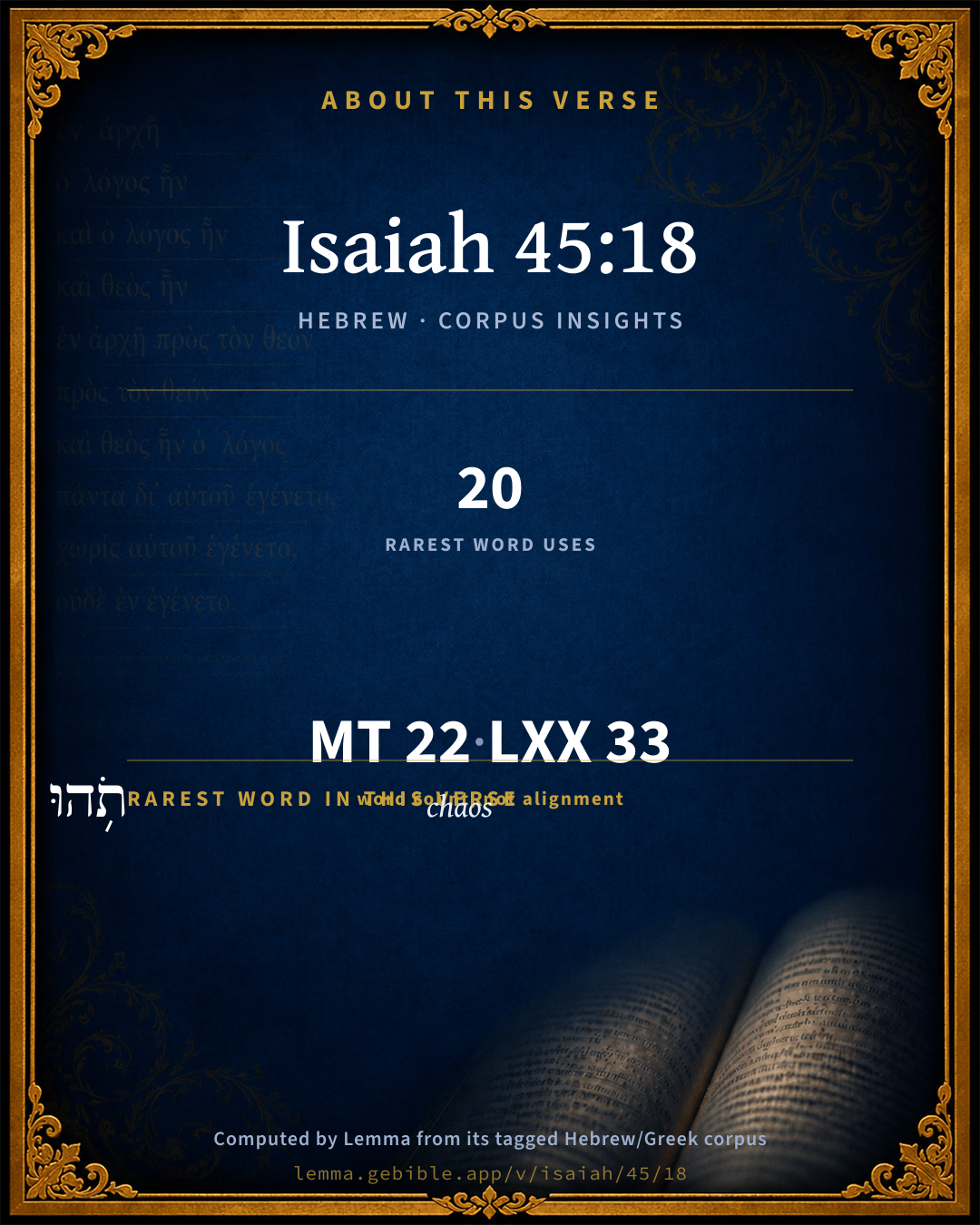
These counts appear in no published source. They are computed here, from the morphology-tagged text and Lemma’s own curated glosses. What Lemma adds →

22
words
18
distinct lemmas
Prophets
section

Notable vocabulary

The rarest word here is תֹ֥הוּ chaos H8414 — appearing just 20 times in the whole Hebrew Bible.

Shared distinctive vocabulary

תֹ֥הוּ chaos H8414 occurs in 19 verses of the Hebrew Bible. Also found in:

Grammatical profile

  • 8 verbs
  • 6 nouns
  • 3 pronouns
  • 1 conjunction
  • 2 adverbs
  • 2 particles

Verb forms

  • אָֽמַר Qal · Perfect
  • בּוֹרֵ֨א Qal · Participle Active
  • יֹצֵ֨ר Qal · Participle Active
  • וְעֹשָׂהּ֙ Qal · Participle Active
  • כֽוֹנְנָ֔הּ Polel · Perfect
  • בְרָאָ֖הּ Qal · Perfect
  • לָשֶׁ֣בֶת Qal · Infinitive Construct
  • יְצָרָ֑הּ Qal · Perfect

Repetition

Words recur within this verse — often emphatic in Hebrew:

  • יְ֠הוָה LORD H3068 ×2
  • בּוֹרֵ֨א to create H1254 ×2
  • יֹצֵ֨ר to form H3335 ×2
  • ה֣וּא he H1931 ×2

Hebrew & Septuagint length

In English translation the verse runs 41 words from the Hebrew and 42 from the Septuagint (LXX English) — closely comparable.

A rough comparison of the two English renderings, which tokenize alike — not a word-level alignment.

Word counts can differ between the Hebrew and the Greek without any difference in meaning — e.g. the Hebrew direct-object marker אֵת has no separate Greek word, and Greek often adds the article ὁ.

In the original languages it is 22 Hebrew tokens and 33 Greek tokens — but the two are counted differently (Hebrew bundles its prefixes and suffixes into one token; the Greek is in lemma form), so that isn’t a like-for-like length.

Cross-references

11

Topical passages linked to Isaiah 45:18 in the Treasury of Scripture Knowledge — connected by theme and wording, ordered by reader-vote popularity; previews shown in the World English Bible.

  • Psalms 115:16 The heavens are the heavens of Yahweh; But the earth has he given to the children of men.
  • Jeremiah 10:12 He has made the earth by his power, he has established the world by his wisdom, and by his understanding has he stretched out the heavens:
  • Isaiah 42:5 Thus says God Yahweh, he who created the heavens, and stretched them forth; he who spread abroad the earth and that which comes out of it; he who gives breath to the people on it, and spirit to those who walk therein:
  • Isaiah 45:12 I have made the earth, and created man on it: I, even my hands, have stretched out the heavens; and all their host have I commanded.
  • Genesis 1:2 Now the earth was formless and empty. Darkness was on the surface of the deep. God's Spirit was hovering over the surface of the waters.
  • Ezekiel 36:10–12 and I will multiply men on you, all the house of Israel, even all of it; and the cities shall be inhabited, and the waste places shall be built;
  • Genesis 1:26 God said, "Let us make man in our image, after our likeness: and let them have dominion over the fish of the sea, and over the birds of the sky, and over the cattle, and over all the earth, and over every creeping thing that creeps on the earth."
  • Genesis 1:28 God blessed them. God said to them, "Be fruitful, multiply, fill the earth, and subdue it. Have dominion over the fish of the sea, over the birds of the sky, and over every living thing that moves on the earth."
  • Genesis 9:1 God blessed Noah and his sons, and said to them, "Be fruitful, and multiply, and replenish the earth.
  • Isaiah 45:5–6 I am Yahweh, and there is none else; besides me there is no God. I will gird you, though you have not known me;
  • Jeremiah 51:15 He has made the earth by his power, he has established the world by his wisdom, and by his understanding has he stretched out the heavens:

Cross-references courtesy of OpenBible.info (CC BY 4.0).

Hebrew and Greek witnesses Masoretic Hebrew ↔ Greek Septuagint

The same verse in the two great witnesses to the Old Testament, shown verse-for-verse.

These are two independent witnesses, not word-aligned to each other, and the Septuagint is shown in lemma (dictionary) form.

Hebrew Isaiah 45:18 Masoretic · Westminster Leningrad Codex

כִּ֣י כֹ֣ה אָֽמַר יְ֠הוָה בּוֹרֵ֨א הַשָּׁמַ֜יִם ה֣וּא הָאֱלֹהִ֗ים יֹצֵ֨ר הָאָ֤רֶץ וְעֹשָׂהּ֙ ה֣וּא כֽוֹנְנָ֔הּ לֹא תֹ֥הוּ בְרָאָ֖הּ לָשֶׁ֣בֶת יְצָרָ֑הּ אֲנִ֥י יְהוָ֖ה וְאֵ֥ין עֽוֹד

For thus says Yahweh who created the heavens, the God who formed the earth and made it, who established it and didn't create it a waste, who formed it to be inhabited: I am Yahweh; and there is no one else.

World English Bible · Public Domain

Greek LXX Isaiah 45:18 Septuagint · lemma form

οὕτως λέγω κύριος ὁ ποιέω ὁ οὐρανός οὗτος ὁ θεός ὁ καταδεικνύω ὁ γῆ καί ποιέω αὐτός αὐτός διαὁρίζω αὐτός οὐ εἰς κενός ποιέω αὐτός ἀλλά καταοἰκέω ἐγώ εἰμί καί οὐ εἰμί ἔτι

Thus says the Lord that made the heaven, this God that created the earth, and made it; he marked it out, he made it not in vain, but formed it to be inhabited: I am the Lord, and there is none beside.

LXX2012 (modern English Septuagint) · Public Domain

On this verse, Keil & Delitzsch discusses the Septuagint’s reading. Read the note in Commentary ↓

Hebrew: Westminster Leningrad Codex (CC BY 4.0). Greek: Septuagint (public domain); English from LXX2012 (modern English Septuagint) (Public Domain). How the Septuagint differs from the Hebrew →

Targum (Aramaic paraphrase)

1

The Targum is the ancient Jewish Aramaic paraphrase of the Hebrew Scriptures — an interpretive translation, not the Hebrew text itself. Onkelos (literal) and Pseudo-Jonathan (expansive) render the Torah, and Jonathan the Prophets. Coverage is partial: where no permissively-licensed English translation exists for a verse, only the Aramaic is shown. This is verse-level text, not a word-by-word alignment to the Hebrew.

  1. Targum Jonathan Prophets (Joshua–Malachi)
    אֲרֵי כִדְנַן אֲמַר יְיָ דִי בְרָא שְׁמַיָא הוּא אֱלֹהִים דְשַׁכְלִיל אַרְעָא וְעָבְדָהּ הוּא אַתְקְנָהּ לָא לְרֵיקָנוּ בְרָהּ אֱלָהֵין לְאַסְגָאָה עֲלָהּ בְּנֵי אֱנָשָׁא אַתְקְנָא אֲנָא יְיָ וְלֵית עוֹד:

    For thus saith the Lord that created the heavens; He who laid the foundation of the earth and made it, is God; He formed it, He created it not in vain; but He formed it, that the sons of man should multiply upon it. I am the Lord, and there is none else.

    Targum Jonathan — Aramaic: “Mikraot Gedolot” (public domain). English: “Sefaria Community Translation” (CC0 1.0 (public-domain dedication)); “London "Chaldee Paraphrase," 1871” (public domain). Text via Sefaria.

Commentary

Notes on Isaiah 45:18 from classic Christian and Jewish commentators (each source and its license shown beneath its notes). The classic Christian expositions comment on the surrounding passage and are grouped to its opening verse, so a note may address several verses; the Jewish commentaries on the Tanakh (Rashi and others) are per-verse, so they appear only where the commentator wrote on this verse.

Lemma curates 59 commentaries, every one of them public domain or Creative Commons licensed, each selected and text-cleaned for this edition rather than reprinted as found. About our sources →

The Cambridge Bible for Schools and Colleges

gen. ed. J. J. S. Perowne

18. The words God himself form a sort of parenthesis, and should be rendered as in R.V., he is God (or the God). Cf. 1Ki_18:39.

he created it not in vain] lit. not a chaos (tôhû). The significance of the expression is seen from the contrast which immediately follows.

he formed it to be inhabited] and therefore the end of His ways cannot be the destruction of the race for whose existence He has prepared the earth. Jehovah’s final purpose must be salvation.

18–25. The long passage on the mission of Cyrus closes here with the announcement of a salvation as universal as it is eternal (Isa_45:17). A purpose of universal salvation is in harmony with the character of the God who made the world for man to dwell in (Isa_45:18) and whose revelation of Himself to Israel bears the signature of absolute veracity (Isa_45:19).

The Cambridge Bible for Schools and Colleges (gen. ed. J. J. S. Perowne; Cambridge University Press, 1878–1918) — public domain. Text from a community e-Sword module.

Trapp's Complete Commentary

John Trapp

Isa 45:18 For thus saith the LORD that created the heavens; God himself that formed the earth and made it; he hath established it, he created it not in vain, he formed it to be inhabited: I [am] the LORD; and [there is] none else.

Ver. 18. He created it not in vain.] Therefore never think that he will forsake it, or not take care of his Church therein, for whose sake he made it at first, and still upholdeth it "by the word of his power." {Heb 1:3} Now, if God created not the earth in vain, much less the heavens - wherein he hath showed his greater skill {Heb 11:10} {See Trapp on "Heb 11:10"} - but that his people might there inhabit for ever. And here it is that they shall be "saved in the Lord with an everlasting salvation"; yea, they "shall not be ashamed or confounded, world without end." {Isa 45:17}

John Trapp, A Commentary or Exposition upon All the Books of the Old and New Testament (1647–1656) — public domain. Text from a community e-Sword module.

The Biblical Illustrator

Joseph S. Exell

Isa_45:18-25

For thus saith the Lord that created the heavens.

How God reveals Himself

The main current of the section may be thus expressed--

I. GODS REVELATION OF HIMSELF IS OPEN AND TRUTHFUL. He has not spoken in secret; and He has not bid men seek Him in vain.

II. GODS REVELATION OF HIMSELF IS IN REFERENCE TO THE HIGHEST PRACTICAL OBJECTS. Seek ye My face; look unto Me, and be ye saved; He is a just God and a Saviour.

III. GODS REVELATION OF HIMSELF IS TO ISSUE IN THE SALVATION OF THE WHOLE EARTH. Every knee shall bow, and every tongue shall confess to Him. (C. Short, M. A.)

The reasonableness of Gods procedure

We have here the repetition of that deep, strong note which Isaiah himself so often sounded to the comfort of men in perplexity or despair, that God is at least reasonable, not working for nothing, nor beginning only to leave off, nor creating in order to destroy. The same God, says our prophet, who formed the earth in order to see it inhabited, must surely be believed to be consistent enough to carry to the end also His spiritual work among men. Our prophets idea of Gods righteousness, therefore, includes the idea of reasonableness; implies rational, as well as moral consistency, practical sense as well as good faith; the conscience of a reasonable plan, and, perhaps, also the power to carry it through. (Prof. G. A. Smith, D. D.)

The Biblical Illustrator, edited by Joseph S. Exell (c. 1880s–1900s) — public domain. Text from a community e-Sword module.

Joseph Benson's Commentary

Isa 45:18. Thus saith the Lord — Hebrew, Jehovah; that created the heavens, &c. — This description of God is here added, 1st, To detect the vanity of idols, by asserting that none was to be owned as the true God, besides that one Jehovah who made the heavens and the earth, and the inhabitants thereof. 2d, To demonstrate God’s sufficiency to fulfil all these glorious promises made to his church, because he created the world, and upholds it by the word of his power. And, 3d, To manifest his goodness to mankind, inasmuch as he did not create the earth in vain, but for the use and comfort of men, that it might be a fit habitation for them: whence it was easy to infer that he would much more be gracious to his own people.

Joseph Benson's Commentary on the Old and New Testaments (1811–1818) — public domain. Text from a community e-Sword module.

The Preacher's Complete Homiletical Commentary

Joseph S. Exell (gen. ed.)

HOW GOD REVEALS HIMSELF

Isa_45:18-25 For thus saith the Lord that created the heavens, &c.

In Isa_45:17, the promise is made that “Israel shall be saved in the Lord with an everlasting salvation.” This gives the drift of the whole passage, Isa_45:18-25. In Isa_45:18-19, the words of Jehovah begin with the assertion that He is the absolute One; and from this two thoughts branch off—

1. That the prophecy is a revelation of light, no black art.

2. That the love of Jehovah, displayed in creation, attests itself in relation to Israel. Isa_45:20-21 declare that the salvation of Israel becomes the salvation of the heathen world. In accordance with this holy and benevolent will, the cry is uttered, “Look unto Me,” &c. (Isa_45:22); Jehovah will not rest till His object has been accomplished (Isa_45:23); but this bending of the knee will not be forced (Isa_45:24); the reference of Isa_45:25 is to the Israel of God out of all the human race. There are three leading ideas that are to be gathered out of the passage.

I. God’s revelation of Himself is open and truthful (Isa_45:19). In Isa_45:15 we read, “Verily Thou art a God that hidest Thyself,” and Isa_45:19 seems to answer the exclamation. Both declarations are true; God cannot wholly conceal nor wholly reveal Himself. A man even is always greater than his greatest work.

1. God’s speech in nature is in no secret place. The sun is a mighty word of God; but it can tell us only by feeble suggestion of the Sun of Righteousness; and yet the pure mind can see and hear far more of God in nature than the keenest scientific analyst (P. D. 485, 1526, 2545).

2. God spoke in no secret place when He spoke amid the peaks of Sinai, and on the heights of Calvary. The laws proclaimed to Moses, and shown to be honourable and glorious in the death of Christ, are the offspring of the Eternal Mind; Calvary is the Divine commentary upon Sinai.

And all really Divine revelation is truthful. The command, “Seek ye my face,” accounts for the religious nature of man. Not in the grandest of God’s works can we rest content, and realise the joy for which we have been created. Seek ye my face in righteousness of life; this is the Divine law of seeking; and all who thus seek after God shall as surely find Him as the new-born child finds the nutriment of its mother’s bosom.

II. God’s revelation of Himself is in reference to the highest practical objects.—“Look unto Me, and be ye saved;” He is “a just God and a Saviour.” God gives us such a knowledge of Himself as avails for the great practical ends of life, but not such as to satisfy speculation (H. E. I. 2229–2244).

We know far more of what electricity can do than of what it is. We do not know what God is absolutely; but we know what He can do for us; He is “a just God and a Saviour;” i.e., there is nothing incompatible in this. As a just Being, He is a God of law; but as a Saviour, He does not cease to be a God of law; by law He condemns, and by law also He saves. Grace is the work of a mightier law than even condemnation.

Note the two elements of the faith which is essential to salvation.

1. “Look unto Me;” lift up your eyes to the Infinite Strength which is reaching down to help you; that is the active element. “And be ye saved;” accept the Divine method of salvation; that is the passive, trustful element.

III. God’s revelation of Himself is to issue in the salvation of the whole earth (Isa_45:23).—This has been the inspired assurance of prophets and apostles even in the darkest ages of the world (Php_2:9-11; Rev_15:3-4). The ruling idea of these and like passages is not merely that evil shall be conquered at the last and goodness triumphant; but that this final issue of things shall come about through men coming to know God in Christ, coming to worship and love Him as the supreme goodness and beauty. The worship of the gods of this world, now so fervent, will be gradually abolished; and life, as it reaches towards the higher developments in this world, will not only be a higher morality, but a clearer knowledge, and a more passionate and enraptured sense of God.—Charles Short, M.A., Christian World Pulpit, vol. xv. pp. 120–122.

The Preacher's Complete Homiletical Commentary (gen. ed. Joseph S. Exell; Funk & Wagnalls, c. 1892) — public domain (pre-1929). A full-Bible homiletical/sermon-outline anthology covering 65 of 66 books (2 John is absent from the source module). Text from a community e-Sword module.

Keil & Delitzsch

C. F. Keil & F. Delitzsch

The second and last strophe of this prophecy commences with Isa 45:18. By the fulfilment of the promise thus openly proclaimed, those of the heathen who have been saved from the judgment will recognise Jehovah as the only God; and the irresistible will of Jehovah, that all mankind should worship Him, be carried out. The promise cannot remain unfulfilled. "For thus saith Jehovah, the creator of the heavens (He is the Deity), the former of the earth, and its finisher; He has established it (He has not created it a desert, He has formed it to be inhabited): I am Jehovah, and there is none else. I have not spoken in secret, in a place of the land of darkness; I did not say to the seed of Jacob, Into the desert seek ye me! I Jehovah am speaking righteousness, proclaiming upright things." The athnach properly divides Isa 45:18 in half. Isa 45:18 describes the speaker, and what He says commences in Isa 45:18. The first parenthesis affirms that Jehovah is God in the fullest and most exclusive sense; the second that He has created the earth for man's sake, not "as a desert" (tōhū: the lxx, Targum, and Jerome render this with less accuracy, non in vanum), i.e., not to be and continue to be a desert, but to be inhabited. Even in Gen 1:2, chaos is not described as of God's creation, because (whatever may be men's opinions concerning it in other respects) the creative activity of God merely made use of this as a starting-point, and because, although it did not come into existence without God, it was at any rate not desired by God for its own sake. The words of Jehovah commence, then, with the assertion that Jehovah is the absolute One; and from this two thoughts branch off: (1.) The first is, that the prophecy which emanates from Him is an affair of light, no black art, but essentially different from heathen soothsaying. By "a dark place of the earth" we are to understand, according to Psa 139:15, the interior of the earth, and according to Job 10:21, Hades; the intention being to point out the contrast between the prophecies of Jehovah and the heathen cave-oracles and spirit-voices of the necromancists, which seemed to rise up from the interior of the earth (see Isa 65:4; Isa 8:19; Isa 29:4). (2.) The second thought is, that the very same love of Jehovah, which has already been displayed in the creation, attests itself in His relation to Israel, which He has not directed to Himself "into the desert" (tōhū), just as He did not create the earth a tōhū. Meier and Knobel suppose that baqshūnı̄, which is written here, according to a well-supported reading, with Koph raphatum (whereas in other cases the dagesh is generally retained, particularly in the imperative of biqqēsh), refers to seeking for disclosures as to the future; but the word דרשׁוּני would be used for this, as in Isa 8:19. He has not said, "Seek ye me (as in Zep 2:3) into the desert," i.e., without the prospect of meeting with any return for your pains. On the contrary, He has attached promises to the seeking of Himself, which cannot remain unfulfilled, for He is "one speaking righteousness, declaring things that are right;" i.e., when He promises, He follows out the rule of His purpose and of His plan of salvation, and the impulse of sincere desire for their good, and love which is ever true to itself. The present word of prophecy points to the fulfilment of these promises.

Keil & Delitzsch — Biblical Commentary on the Old Testament (1861–1891) — public domain (CC PDM 1.0). Text via the HelloAO Bible API. (Old Testament only.)

Tyndale Open Study Notes

Tyndale Open Resources

45:18-25 Salvation is from the Lord alone. He is the creator, the revealer, and the executor of his will in human history. He promised to establish a new era of salvation and righteousness (see 45:8). Every human being will submit to God, either willingly or unwillingly (45:23-24).

45:18 Ancient pagan people viewed the world as a place of empty chaos. However, God’s purposes are good, and he made the world from the beginning as a place to be lived in with him in harmony.

Tyndale Open Study Notes — © Tyndale Open Resources, licensed CC BY-SA 4.0. Text via the HelloAO Bible API.

Geneva Bible (1599)

Geneva Bible translators

To wit, of men, but chiefly of his Church.

Geneva Bible (1599) marginal notes — public domain. Text via Bolls.life.

Jamieson, Fausset & Brown

Robert Jamieson, A. R. Fausset & David Brown

(See on Isa 45:12).

not in vain, he formed it to be inhabited--Therefore, Judah, lying waste during the Babylonish captivity, shall be peopled again by the exiles. The Jews, from this passage, infer that, after the resurrection, the earth shall be inhabited, for there can be no reason why the earth should then exist in vain any more than now (Pe2 3:13).

Jamieson, Fausset & Brown — Commentary Critical and Explanatory on the Whole Bible (1871) — public domain (CC PDM 1.0). Text via the HelloAO Bible API.

Adam Clarke's Commentary

Verse 18. He formed it to be inhabited - "For he formed it to be inhabited"] An ancient MS. has כי ki before לשבת lashebeth; and so the ancient Versions.

Adam Clarke's Commentary on the Bible (1810–1826) — public domain. Text from a community e-Sword/MySword module.

Ellicott's Commentary for English Readers

(18) He hath established it . . .—i.e., prepared it (see Deu_32:6; Gen_42:16) for human habitation. It was not a tohu or chaos (Gen_1:2; Isa_24:10), but the scene of human action. We note the grandeur of the prophet’s thoughts of creation.

A Bible Commentary for English Readers, edited by Charles John Ellicott (1878–1897) — public domain. Text from a community e-Sword module.

John Gill's Exposition

For thus saith the Lord, that created the heavens,.... These words, and what follow, are the words of the Son of God, of the Lord the Saviour, in whom Israel is saved with an everlasting salvation; and this is said to assure them of it, as well as to distinguish himself from the gods of the Gentiles, who made not the heavens and the earth, as he had done; for by the Word of the Lord, the essential Word of God, were the heavens made in the beginning; see Psa 33:6,

God himself, that formed the earth, and made it, he hath established it; the Saviour is God himself, truly and properly God, who has all the perfections of deity in him; and this appears as from his creation of the heavens, so from his forming, making and establishing the earth; he made the chaos of the earth out of nothing; he formed that chaos he made into a beautiful order, and prepared, as the last word (c) signifies, fitted, and furnished it with everything convenient for man and beast:

he created it not in vain, he formed it to be inhabited; the earth indeed was "tohu" when it was first created, Gen 1:2, which word is used of the chaos of the earth first made, here rendered "in vain"; but then it was not created to continue so, nor did it continue so; for though it was first without form, it was soon formed in a beautiful manner, and fitted for the habitation of men and beasts, and especially the former; and more especially for the habitation of the saints, those sons of men, with whom the delights of Christ were from eternity, and whom he foresaw would dwell in the habitable parts of the earth, which was a pleasure to him; and for the sake of them was it made to be inhabited, and not by them with the wicked promiscuously only as now, but when purified, and refined by fire, to be the habitation of the righteous, with Christ at the head of them; as will be the case in the thousand years' reign:

I am the Lord, there is none else; the one Jehovah with the Father and the Spirit, and there is no other that is the Creator of the heavens and the earth.

(c) "parsvit eam", Musculus; "aptavit, instruit", Gataker; "exaptavit", Cocceius, Vitringa,

John Gill's Exposition of the Whole Bible (1746–1763) — public domain (CC PDM 1.0). Text via the HelloAO Bible API.

Albert Barnes' Notes on the Bible

For thus saith the Lord - This verse is designed to induce them to put uuwavering confidence in the true God. For this purpose, the prophet enumerates the great things which God had done in proof that he alone was A mighty, and was worthy of trust.

He hath established it - That is, the earth. The language here is derived from the supposition that the earth is laid upon a foundation, and is made firm. The Septuagint renders this, ‘God who displayed the earth to view, and who, having made it, divided it (διώρισεν αὐτὴν diōrisen autēn) that is, parcelled it out to be inhabited. This accords well with the scope of the passage.

He created it not in vain - He did not form it to remain a vast desert without inhabitants.

He formed it to be inhabited - By man, and the various tribes of animals. He makes it a convenient habitation for them; adapts its climates, its soil, and its productions, to their nature; and makes it yield abundance for their support. The main idea, I think, in the statement of this general truth, is, that God designed that the earth at large should be inhabited; and that, therefore, he intended that Judea - thru lying waste while the captives were in Babylon - should be re-populated, and again become the happy abode of the returning exiles. So Grotius interprets it. The Jews, from this passage, infer, that the earth shall be inhabited after the resurrection - an idea which has every probability, since there will not be fewer reasons why the earth shall be inhabited then than there are now; nor can there be any reasons why the earth should then exist in vain anymore than now.

And there is none else - (See the note at Isa 45:6).

Albert Barnes' Notes on the Bible (1834–1885) — public domain. Text from a community e-Sword/MySword module.

Haydock's Catholic Bible Commentary

In vain. Hebrew, "to be a chaos," Genesis viii. 2.

George Leo Haydock (1774–1849), Haydock's Catholic Family Bible and Commentary, 1859 edition — public domain. Excludes Psalms (Douay-Rheims chapter numbering differs from Protestant) and Deuterocanonical books (Catholic canon only).

Matthew Poole's English Annotations

This description of God is here added, either,

1. To detect the vanity of idols, by asserting that none was to be owned as the true God besides that one God who made the heavens and the earth, and the inhabitants thereof. Or,

2. To demonstrate God’s sufficiency to fulfil all these glorious promises made to his church, because he made the world of nothing, and upholds it by the word of his power; and withal to discover God’s goodness to mankind, inasmuch as he did not create the earth in vain, but for the use and comfort of men, that it might be a fit habitation for them; whence it was easy to infer that God would much more be gracious to his own people.

Matthew Poole's English Annotations on the Holy Bible (1683–1685) — public domain. Text from a community e-Sword/MySword module.

Whedon's Commentary on the Bible

Daniel D. Whedon

18, 19. In substance, God repeats the great things he has done to encourage the true Israel, and all who become such, to trust him and forget forever the absurd idol system they countenanced.

I am the Lord… there is none else — Still rings, as it were, the never-ending refrain. From this oft-recurring idea there branch two others. (1) Prophecy coming from God is a thing of light — true knowledge; no black art, no voice from the secret, dark place, so necessary to idol prophets. (2) God’s love, shown in creating all things and ruling all affairs, attests itself also toward all his true people. Obeying God’s order to seek unto him, Israel has not to seek in vain, nor long to seek, as do idolaters. God is a real Being, not nonentity, like base, dumb idols.

Daniel D. Whedon (gen. ed.), Commentary on the Old and New Testaments (1874–1909) — public domain. Text from a community e-Sword module.

The Pulpit Commentary

Thus saith the Lord, etc. Translate, Thus saith the Lord that created the heavens he is God that formed the earth and made it; he established it; he created it not a chaos, but formed it to be inhabited : I am the Lord, and there is none else. As God had not formed the earth to be a material chaos, but had introduced into it order and arrangement, so he willed his spiritual creation to be recovered out of the confusion into which it had fallen, and to be established in righteousness.

Vers. 18-25. God, Israel, and the world.

Again, with solemn iteration, Jehovah declares that he is Creator and God alone. The earth was framed and fitted to be the habitation of man, and the theatre of providential manifestations.

I THE REALITY OF THE ETERNAL. The truth is open, and may be published to all; it is no thing of mystery, secrecy, like heathen esoteric rites or knowledge. "Jehovah"s Law is not to be obtained by any occult arts from the under-world." He has not been a wilderness unto Israel or a land of darkness. (Jer_2:31; cf. Jer_2:6) The seeking of his people after him is not to end in chaos. Here, again, may be an allusion to the dark sayings of the heathen oracles ambiguous, oblique, or fallacious. His speech is direct, upright, and true. Let those who have escaped from the judgment upon the nations bear witness. How foolish they who carry the wooden image in processions, and pray to it! (cf. Isa_46:1 Jer_10:5 Amo_5:26) What argument can be produced for the divinity of idols? Which of them can pretend to the prophetic and predictive power of Jehovah? God is the only Reality, the only Truth, the only faithful Principle in a world of idolatrous unrealities, pretences, and shams.

II CALL TO SALVATION. In him who is real and true, alone can men find deliverance from temporal and spiritual ills. Not Israel alone, but mankind, is destined to look to him as the Universal Saviour. Jehovah swears by himself the strongest form of assurance the accompanying revelation is specially grand, or specially hard to believe." "The abolition of the last vestige of nationalism in the true religion is announced." The word is gone forth, and shall not miss its aim; the truth has sped like an arrow to the mark. Every knee shall bow in homage, every tongue shall swear allegiance. Submission shall be without reserve and absolute. "Only in Jehovah are righteousness and strength." While confusion shall be the portion of his enemies, his servants shall be accepted, and be placed by him on the footing of the justified and righteous. "He, then, that trembles at the name of an offended Creator, let him comfort himself in the title of a reconciled Father. Though we have cause to dread the tribunal of his justice, let us come confidently to the throne of his mercy. Let us come freely, and spread all our wants before him, lay open all our complaints, tell him all the distresses and secret anguishes of our burdened consciences. Believe it, we cannot be more ready to tell them than he is to hear them; nor he to hear them than to relieve them. Let us anchor our hopes, our trust, our confidence, on his goodness; for although as our Creator he will not save us, yet as our Redeemer he will. J.

Vers. 18-25. Jehovah: his nature and purposes.

I HIS SOLE DEITY. He is the Creator, and to say this is to say that his is "the Godhead." This truth is repeated "line upon line," and "precept upon precept." Simple truths have an emphasis peculiar to them. They need to be iterated, because the memories of men are unfaithful, their imaginations vagrant, their affections prone to wander from their true and central Object. It was so in ancient times; it is so still. Then men were tempted to think that other national gods had some power; now they are disposed to turn to some "ideal substitute" for God. We should learn, not to share out our reverence among God and various ideals of the true, wise, beautiful, and good, but to conceive of him as the sum total of them all. The enduringly good, and the permanently true and spiritually and essentially fair, all enter into the conception of "the Eternal, beside whom there is none.

II HIS PURPOSE IN THE CREATION. It was to be, "not as a chaos," but a scene of order, a kosmos, as the Greek said. It was "formed, finished, and arranged, that it might be inhabited like "a lodging for a friend." God "rejoices in the habitable parts of the earth; and his delights are with the children of men." His thought was above all for the social kosmos the spiritual system, the beauty of the regenerate state of souls; his mind to be reflected in the human creation; the human creation to illustrate the glory of his mind. If science brings to light the wonders of the natural order, true theology brings to light the greater wonders of the spiritual order. It is a discovery of the law to which the passions and forces of human nature must render obedience in order to happiness.

III THE OPENNESS OF HIS REVELATIONS. Not in darkness and secrecy, like the heathen mysteries; nor in obscure and symbolic phrases, like theirs. Nor is it a matter of occult art and divination. It is the "light of Jehovah". (cf. Deu_30:11-14 Jer_2:31) Luminous in themselves, his words lead us on to tracts of light and felicity. They are direct, and opposed to the crooked and enigmatic deliverances of the heathen oracles. Let human experience decide between Jehovah and the heathen gods. They only dare to make such an appeal who are conscious that it cannot be resisted. That religion cannot stand which will not endure satire; for ridicule is the test of truth. How can they endure it who "without knowledge carry the word of their image, and pray unto a god that cannot save"? What argument can they produce? What covenant can there be between the soul and an idol? what ability in wood or stone to save? The result remains as before. As there is but one Creator, so is there but one Moral Governor one righteous, faithful, covenant-keeping God.

IV CALL TO SALVATION AND TO ADORATION. "Be saved!" That is, ye shall be saved in turning unto me. If he is the only God, obedience to him must be the only salvation. And upon this end God has set his heart this end, he swears, as God is God, shall be accomplished. The true Israel shall expand, the barriers of naturalism shall be broken down; there shall be universal, voluntary, unrestrained submission. Shame at error, and triumphant, boastful gladness in the new-found truth, shall go together. Such a communion of spirits in God and with one another is the object of faith, of aspiration now, and shall be a glorious realization hereafter. J.

The Pulpit Commentary (1880–1919), ed. H.D.M. Spence-Jones & Joseph S. Exell — public domain. Text from a community e-Sword module.

J. A. Alexander on Isaiah

Joseph Addison Alexander

“For thus saith Jehovah, the creator of the heavens, He is God, the former of the earth and its maker, He established it. Not in vain (or not to be empty) did He create it, to dwell in (or to be inhabited) He formed it. I am Jehovah, and there is none besides.” This verse assigns a reason for believing in the threatening and the promise of the two preceding verses, viz. that He Who uttered them not only made the heavens and the earth, but made them for a certain purpose, which must be accomplished. The only difficulty of construction is the question where Jehovah’s words begin, and this admits of several different answers. We may read, Thus saith Jehovah, The creator of the heavens is God; in which case the divine address begins with a formal statement of the argument derived from the creation. Again, we may read, Thus saith Jehovah, The creator of the heavens is the God who formed the earth. But most interpreters suppose the beginning of Jehovah’s own words to be marked by the introduction of the pronoun of the first person, I am Jehovah and there is no other. All that precedes is then to be regarded as a description of the speaker, including two parenthetical propositions, each beginning with the pronoun He: the creator of the heavens (He is God), the former of the earth and its maker (He established it). The common version of the next clause, He created it not in vain, is admissible, but less expressive than the more specific rendering, He created it not (to be) a waste (or empty). In the last clause Jehovah is employed as a descriptive title, and is substantially equivalent to is, which the Prophet uses in a similar connection in v. 22 below.

Joseph Addison Alexander, The Prophecies of Isaiah (1846–1847; New York: Scribner, 1870–1878) — public domain. Text from a community e-Sword module.

unfoldingWord translationNotes

Door43 World Missions Community

not as a waste

"not to be empty." Here the word "waste" refers to an empty, barren place.

but designed it to be inhabited

This can be stated in active form. AT: "but he designed it so people could live on it" (See: Active or Passive)

translationWords

Yahweh

create

heaven

true

God

earth

waste

Yahweh

unfoldingWord translationNotes — © Distant Shores Media and the Door43 World Missions Community, licensed CC BY-SA 4.0. Source: git.door43.org/Door43/en_tn.

Rashi

Rabbi Shlomo Yitzchaki (Rashi)

He did not create it for a waste but He formed it to be inhabited.

Rashi on the Tanakh — English translations: “The Judaica Press complete Tanach with Rashi, translated by A. J. Rosenberg” (CC BY 4.0); “Pentateuch with Rashi's commentary by M. Rosenbaum and A.M. Silbermann, 1929-1934” (public domain); “The Metsudah Tanach series, Lakewood, N.J” (CC BY 4.0); and “The Book of Joshua, Metsudah Publications, 1997” (CC BY 4.0). Text via Sefaria.

Ibn Ezra

Rabbi Abraham ibn Ezra

He hath established it, as the habitation for men and beasts.

תהו In vain.

Ibn Ezra on the Tanakh — English translations: “Sefaria Community Translation” (CC0 1.0 (public-domain dedication)); “Yalkut, Sifsei Chachomim Chumash, Metsudah Publications, 2009” (CC BY 4.0); and “Commentary of Ibn Ezra on Isaiah - trans. by M. Friedlander, 1873” (public domain). Text via Sefaria.

Lesson kit

Teaching starters — assembled from the data on this page, not authored interpretation. Every prompt links to the verse data it draws on. Edit before teaching.

Isaiah, in the Prophets, opens this verse with 22 words (18 distinct Hebrew lemmas). Its most distinctive word is tôhûw (“chaos”). A historical commentator’s framing appears above. Read the whole chapter for the surrounding context.

Discussion questions

  1. What does “chaos” (tôhûw) contribute to the verse as a whole?
  2. How does Genesis 1:2, which shares the word «chaos», read alongside this verse?
  3. What does the repetition of “LORD” (2× in this one verse) do in this verse?
  4. The translations on this page render this verse differently — a whole-verse word diff, not a word-by-word alignment. What might account for the different wordings?
  5. «אָֽמַר» is a Qal Perfect verb. How does that grammatical form shape the action described?
  6. Compare how The Cambridge Bible for Schools and Colleges and Trapp's Complete Commentary read this verse. Where do they agree or differ?

Things to notice

Reading settings

Reading text

Shown beneath each verse's original-language words.

Old Testament
Old Testament edition

Read the OT as the Masoretic Hebrew (MT) or the Greek Septuagint (LXX).

English shown for the Greek Septuagint (in the Hebrew ↔ Greek comparison).

Comparing translations? Open the Compare panel on any verse page to stack up to four side by side.