2 Chronicles 2:9

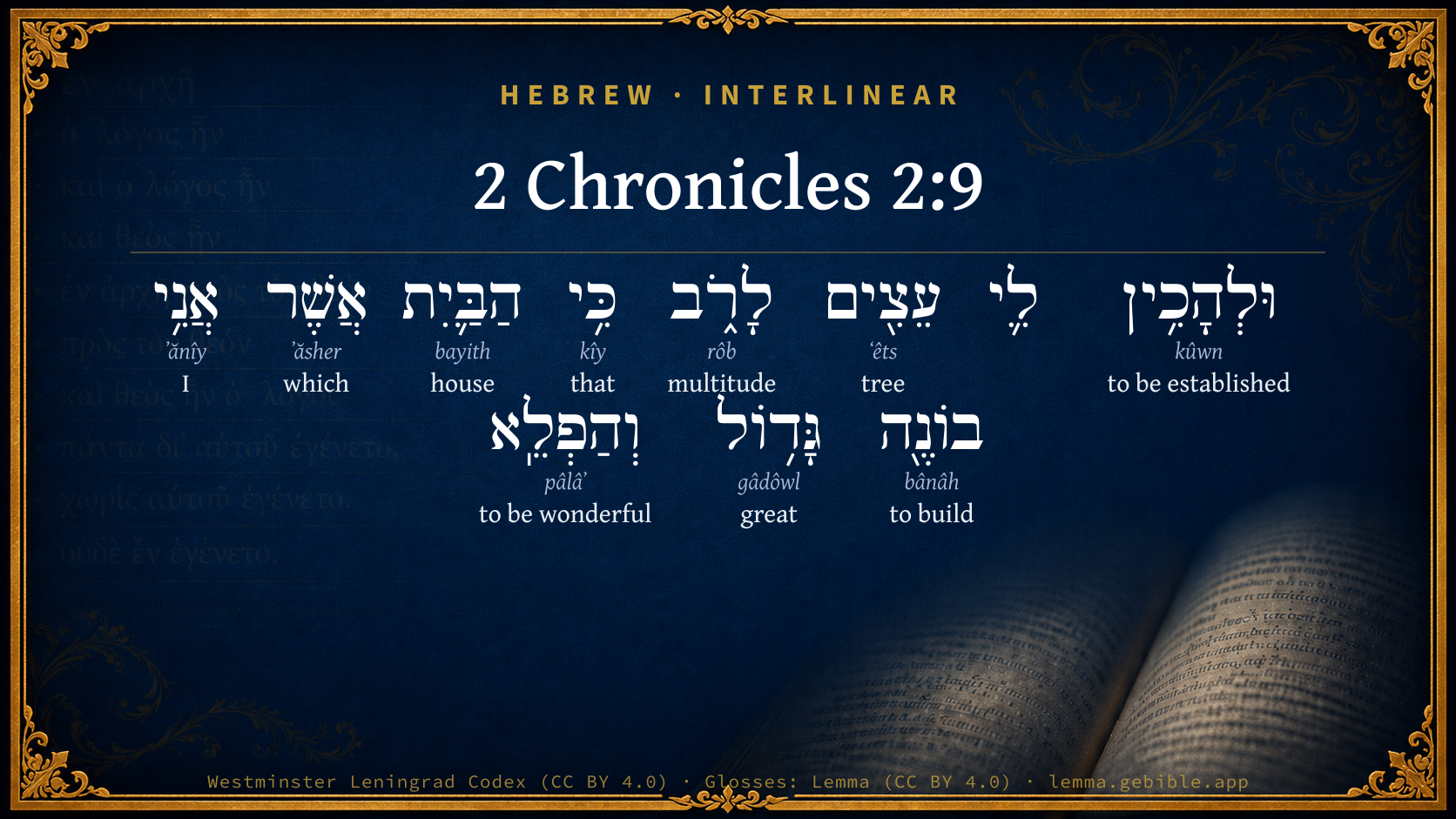
Hebrew (Westminster Leningrad Codex) 2 Chronicles 2:9 appears in the Hebrew Old Testament. The text above is from the Westminster Leningrad Codex. Each word links to its Strong’s number, a concise gloss, and parsing drawn from the Open Scriptures Hebrew Bible morphology. Click any word for its full Brown-Driver-Briggs (BDB) entry.
Download image
Cite this verse

2 Chronicles 2:9 (World English Bible). Public Domain. Lemma interlinear Bible study tool, https://lemma.gebible.app/v/2-chronicles/2/9.

Show BibTeX & RIS
BibTeX
RIS
English Translation
even to prepare me timber in abundance; for the house which I am about to build shall be great and wonderful.
World English Bible · Public Domain
Download a study sheet

One document with this verse’s original text, its word-by-word gloss line, the meaning frame, cross-references with their text, attributed commentary, and full source and license credits — printable, and it pastes into notes with its structure intact.

This verse Autodidact and up

Study sheet (.html) Plain text (.txt)

A passage Seminary Student

Up to 50 verses in one chapter. A passage sheet keeps up to 6 commentary sources and 12 cross-references per verse, in the order this page ranks them, and says so on the sheet whenever that leaves anything out. Ask for a single verse and you get the Autodidact verse sheet above.

Everything on this page stays free to read, with no account — the sheet is a download of what is already on screen, not access to it.

Want to remove ads? Support Godless Engineer
Compare translations 3

The same verse in 3 English versions, stacked beneath the original-language interlinear above. Click any original word for its lexicon entry.

Each is an independent rendering of the whole verse — the interlinear is not word-aligned to these translations.

Highlighted words mark where these versions differ — a whole-verse word diff, not a word-by-word alignment.

  • World English Bible Public Domain
    even to prepare me timber in abundance; for the house which I am about to build shall be great and wonderful.
  • King James Version Public Domain
    Even to prepare me timber in abundance: for the house which I am about to build shall be wonderful great.
  • unfoldingWord Literal Text CC BY-SA 4.0
    in order to prepare for me trees in abundance, for the house which I am building will be great and marvelous.

unfoldingWord Literal Text — © unfoldingWord, licensed CC BY-SA 4.0. Word-aligned USFM3 via Door43 (git.door43.org/unfoldingWord/en_ult).

Versions to compare (up to 4)

3 of 4 selected

Show all 18 translations

Every available English version of this verse, each an independent rendering of the whole verse.

  • World English Bible Public Domain
    even to prepare me timber in abundance; for the house which I am about to build shall be great and wonderful.
  • Berean Standard Bible Public Domain
    to prepare for me timber in abundance, because the temple I am building will be great and wonderful.
  • Majority Standard Bible Public Domain
    to prepare for me timber in abundance, because the temple I am building will be great and wonderful.
  • King James Version Public Domain
    Even to prepare me timber in abundance: for the house which I am about to build shall be wonderful great.
  • American Standard Version (1901) Public Domain
    even to prepare me timber in abundance; for the house which I am about to build shall be great and wonderful.
  • Revised Version (1885) Public Domain
    even to prepare me timber in abundance: for the house which I am about to build shall be wonderful great.
  • Geneva Bible (1599) Public Domain
    That they may prepare me timber in abundance: for the house which I doe buylde, is great and wonderfull.
  • Douay-Rheims (1899) Public Domain
    To provide me timber in abundance. For the house which I desire to build, is to be exceeding great, and glorious.
  • Young's Literal Translation Public Domain
    even to prepare for me trees in abundance, for the house that I am building `is' great and wonderful.
  • Literal Standard Version CC BY-SA 4.0
    even to prepare trees in abundance for me, for the house that I am building [is] great and wonderful.
  • Unlocked Literal Bible CC BY-SA 4.0
    in order to prepare for me timber in abundance, for the house which I am about to build will be great and marvelous.
  • unfoldingWord Literal Text CC BY-SA 4.0
    in order to prepare for me trees in abundance, for the house which I am building will be great and marvelous.
  • Darby Bible Public Domain
    even to prepare me timber in abundance: for the house that I build shall be great and wonderful.
  • World Messianic Bible Public Domain
    even to prepare me timber in abundance; for the house which I am about to build will be great and wonderful.
  • Webster's Bible Public Domain
    Even to prepare me timber in abundance: for the house which I am about to build shall be wonderfully great.
  • Free Bible Version CC BY-SA 4.0
    to produce a large quantity of timber because the Temple I'm building will be really large and very impressive.
  • Bible in Basic English Public Domain
    To get trees for me in great numbers, for the house which I am building is to be great and a wonder.
  • JPS Tanakh (1917) Public Domain
    (2-8) even to prepare me timber in abundance; for the house which I am about to build shall be great and wonderful.

Literal Standard Version (2020), Covenant Press — licensed CC BY-SA 4.0. Text via the HelloAO Bible API (eBible.org). Unlocked Literal Bible (unfoldingWord) — licensed CC BY-SA 4.0. Text via the HelloAO Bible API (eBible.org). unfoldingWord Literal Text — © unfoldingWord, licensed CC BY-SA 4.0. Word-aligned USFM3 via Door43 (git.door43.org/unfoldingWord/en_ult). Free Bible Version, Dr. Jonathan Gallagher — licensed CC BY-SA 4.0. Text via the HelloAO Bible API (eBible.org).

Word by word

More ways to search: Search by grammar → Find every occurrence → Compare this word →

Practice this passage: Drill this verse → Learn its vocabulary →

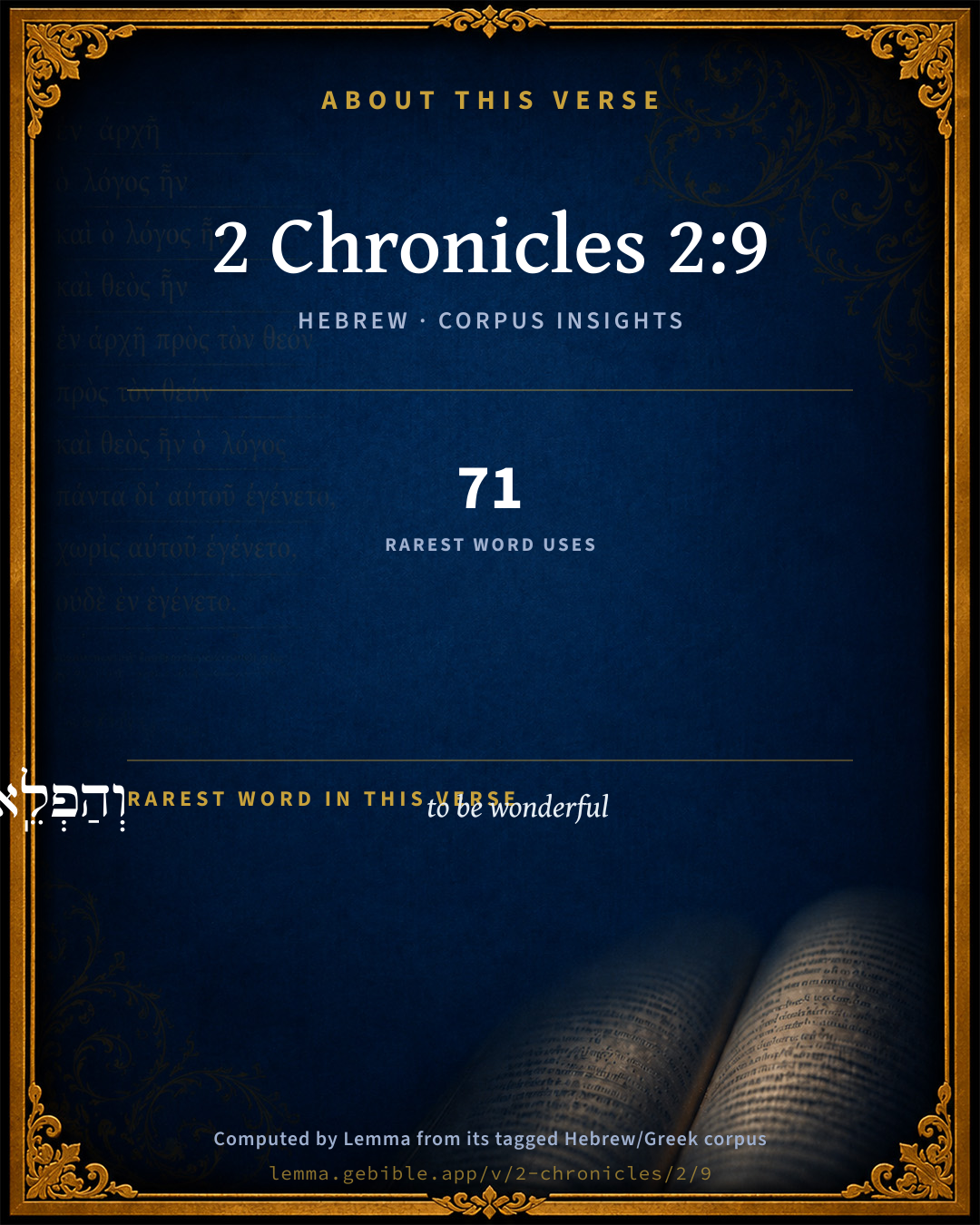
וְהַפְלֵֽא
pâlâʼ
H6381
“and · to be wonderful”
Conjunction + Verb, Hiphil, Infinitive Absolute
Part of Speech
Conjunction + Verb
Stem
Hiphil
Form
Infinitive Absolute
Full BDB Definition

Origin: a primitive root

TWOT: 1768

to be marvellous, be wonderful, be surpassing, be extraordinary, separate by distinguishing action - (Niphal) - to be beyond one's power, be difficult to do - to be difficult to understand - to be wonderful, be extraordinary - marvellous (participle) - (Piel) to separate (an offering) - (Hiphil) - to do extraordinary or hard or difficult thing - to make wonderful, do wondrously - (Hithpael) to show oneself wonderful or marvellous
  1. וּלְהָכִ֥ין kûwn H3559 “and · to be established” Conjunction + Preposition + Verb, Hiphil, Infinitive Construct
  2. עֵצִ֖ים ʻêts H6086 “trees” Noun, Common, Masculine, Plural, Absolute
  3. לָרֹ֑ב rôb H7230 “to/for · multitude” Preposition + Noun, Common, Both, Singular, Absolute
  4. כִּ֥י kîy H3588 “that” Conjunction
  5. הַבַּ֛יִת bayith H1004 “the · house” Particle, Definite Article + Noun, Common, Masculine, Singular, Absolute
  6. אֲשֶׁר ʼăsher H834 “which” Particle, Relative
  7. אֲנִ֥י ʼănîy H589 “I” Pronoun, Personal, 1st Person, Common, Singular
  8. בוֹנֶ֖ה bânâh H1129 “building” Verb, Qal, Participle Active, Masculine, Singular, Absolute
  9. גָּד֥וֹל gâdôwl H1419 “great” Adjective, Adjective, Masculine, Singular, Absolute

About this verse

These counts appear in no published source. They are computed here, from the morphology-tagged text and Lemma’s own curated glosses. What Lemma adds →

11
words
10
distinct lemmas
Historical
section

Grammatical profile

  • 3 verbs
  • 3 nouns
  • 1 adjective
  • 1 pronoun
  • 1 preposition
  • 1 conjunction
  • 1 particle

Verb forms

  • וּלְהָכִ֥ין Hiphil · Infinitive Construct
  • בוֹנֶ֖ה Qal · Participle Active
  • וְהַפְלֵֽא Hiphil · Infinitive Absolute

Hebrew & Septuagint length

In English translation the verse runs 21 words from the Hebrew and 19 from the Septuagint (LXX English) — closely comparable.

A rough comparison of the two English renderings, which tokenize alike — not a word-level alignment.

Word counts can differ between the Hebrew and the Greek without any difference in meaning — e.g. the Hebrew direct-object marker אֵת has no separate Greek word, and Greek often adds the article ὁ.

Cross-references

3

Topical passages linked to 2 Chronicles 2:9 in the Treasury of Scripture Knowledge — connected by theme and wording, ordered by reader-vote popularity; previews shown in the World English Bible.

  • 1 Kings 9:8 Though this house is so high, yet shall everyone who passes by it be astonished, and shall hiss; and they shall say, Why has Yahweh done thus to this land, and to this house?
  • 2 Chronicles 2:5 The house which I build is great; for great is our God above all gods.
  • 2 Chronicles 7:21 This house, which is so high, everyone who passes by it shall be astonished, and shall say, Why has Yahweh done thus to this land, and to this house?

Cross-references courtesy of OpenBible.info (CC BY 4.0).

Hebrew and Greek witnesses Masoretic Hebrew ↔ Greek Septuagint

The same verse in the two great witnesses to the Old Testament, shown verse-for-verse.

These are two independent witnesses, not word-aligned to each other, and the Septuagint is shown in lemma (dictionary) form.

Hebrew 2 Chronicles 2:9 Masoretic · Westminster Leningrad Codex

וּלְהָכִ֥ין לִ֛י עֵצִ֖ים לָרֹ֑ב כִּ֥י הַבַּ֛יִת אֲשֶׁר אֲנִ֥י בוֹנֶ֖ה גָּד֥וֹל וְהַפְלֵֽא

even to prepare me timber in abundance; for the house which I am about to build shall be great and wonderful.

World English Bible · Public Domain

Greek LXX 2 Chronicles 2:9 Septuagint · lemma form

καί ἰδού ὁ ἐργάζομαι ὁ κόπτω ξύλον εἰς βρῶμα δίδωμι σῖτος εἰς δόμα ὁ παῖς σύ κόρος εἴκοσι χιλίας καί κριθή κόρος εἴκοσι χιλίας καί οἶνος μέτρον εἴκοσι χιλίας καί ἔλαιον μέτρον εἴκοσι χιλίας

to prepare timber for me in abundance: for the house which I am building must be great and glorious.

LXX2012 (modern English Septuagint) · Public Domain

On this verse, Ellicott's Commentary for English Readers discusses the Septuagint’s reading. Read the note in Commentary ↓

Hebrew: Westminster Leningrad Codex (CC BY 4.0). Greek: Septuagint (public domain); English from LXX2012 (modern English Septuagint) (Public Domain). How the Septuagint differs from the Hebrew →

Commentary

Notes on 2 Chronicles 2:9 from classic Christian and Jewish commentators (each source and its license shown beneath its notes). The classic Christian expositions comment on the surrounding passage and are grouped to its opening verse, so a note may address several verses; the Jewish commentaries on the Tanakh (Rashi and others) are per-verse, so they appear only where the commentator wrote on this verse.

Lemma curates 59 commentaries, every one of them public domain or Creative Commons licensed, each selected and text-cleaned for this edition rather than reprinted as found. About our sources →

Trapp's Complete Commentary

John Trapp

2Ch 2:9 Even to prepare me timber in abundance: for the house which I am about to build [shall be] wonderful great.

Ver. 9. Wonderful great.] Yet was it not so great as the temple at Ephesus, but far more wonderful. See on 2Ch 2:5.

John Trapp, A Commentary or Exposition upon All the Books of the Old and New Testament (1647–1656) — public domain. Text from a community e-Sword module.

Ellicott's Commentary for English Readers

(9) Even to prepare me timber in abundance.—Rather, And they shall prepare, or, let them prepare. (A use of the infinitive, to which the chronicler is partial: see 1Ch_5:1; 1Ch_9:25; 1Ch_13:4; 1Ch_15:2; 1Ch_22:5.) So Syriac, “Let them be bringing to me.”

Shall be wonderful great.—See margin; and LXX., μέγας καὶ ἔνδοξος, “great and glorious;” Syriac, “an astonishment” (temhâ).

A Bible Commentary for English Readers, edited by Charles John Ellicott (1878–1897) — public domain. Text from a community e-Sword module.

John Gill's Exposition

Behold, I will give to thy servants, the hewers that cut timber, twenty thousand measures of beaten wheat,.... Meaning, not what was beaten out of the husk with the flail, as some; nor bruised or half broke for pottage, as others; but ground into flour, as R. Jonah (d) interprets it; or rather, perhaps, it should be rendered "food" (e) that is, for his household, as in Kg1 5:11, and the hire of these servants is proposed to be given in this way, because wheat was scarce with the Tyrians, and they were obliged to have it from the Jews, Act 12:20,

and twenty thousand measures of barley; the measures of both these were the cor, of which see Kg1 5:11,

and twenty thousand baths of wine, and twenty thousand baths of oil; which measure was the tenth part of a "cor". According to the Ethiopians, a man might consume four of these measures in the space of a month (f).

(d) Apud Kimchium in loc. (e) So Kimchi, "pro" "ineuria librariorum", Schindler, Lex. Pentaglott. col. 73. (f) Ludolf. Lexic. Ethiop. p. 197.

John Gill's Exposition of the Whole Bible (1746–1763) — public domain (CC PDM 1.0). Text via the HelloAO Bible API.

Haydock's Catholic Bible Commentary

Exceedingly. Hebrew, "wonderfully great." (Haydock)

George Leo Haydock (1774–1849), Haydock's Catholic Family Bible and Commentary, 1859 edition — public domain. Excludes Psalms (Douay-Rheims chapter numbering differs from Protestant) and Deuterocanonical books (Catholic canon only).

Matthew Poole's English Annotations

See Poole "1Ch 2:5".

Matthew Poole's English Annotations on the Holy Bible (1683–1685) — public domain. Text from a community e-Sword/MySword module.

The Pulpit Commentary

A wonderful great house.

I ITS BUILDER. The temple of Solomon was constructed by Solomon the son of David; the temple of the Christian Church by Jesus, David"s Son, but also David"s Lord, the Only-Begotten of the Father, whose name is "Wonderful, Counsellor, the Mighty God, the Prince of Peace" (Isa_45:13; Heb_3:3)

II ITS MATERIALS. The temple of Solomon was fashioned out of gold, silver, precious stones, etc.; the temple of the Christian Church out of lively stones, or believing and regenerated souls. (1Pe_2:5)

III ITS SITE. The temple of Solomon stood on Mount Moriah, where Jehovah had appeared to Abraham and afterwards to David, its walls reaching down to and rising up from the solid rock; the temple of the Christian Church rests upon the immovable rock of Christ"s Person (Mat_16:18; Eph_2:20) in whom the clearest and fullest revelation of the Father has been made to men. (Joh_1:18 Joh_14:9)

IV ITS CONSTRUCTION. The temple of Solomon had two apartments a holy place and a holy of holies, the former for the worshipping priests, the latter for the worshipped God; the Church of Jesus Christ has only one chamber, the separating veil being done away, in fact rent in twain, by the sacrifice of the cross (Mat_27:51; Heb_10:20)

V ITS ADORNMENTS. The temple of Solomon was radiant with gold and silver and decorations of carved work; the Church of Jesus Christ is rendered beautiful by the inward graces of the Spirit. (Psa_149:4 1Pe_3:3)

VI ITS PROPORTIONS. The temple of Solomon was, after all, hut a small structure; the temple of the Christian Church is a spacious house of many mansions. (Joh_14:1)

VII ITS USES. The temple of Solomon was designed as a habitation for Jehovah"s symbolic presence; the Church of Jesus Christ is a habitation for Jehovah himself through the Spirit. (Eph_2:22)

Learn:

1. The glory of the Christian Church.

2. The superiority of the gospel dispensation.

3. The nobler privilege of New Testament believers. W.

The Pulpit Commentary (1880–1919), ed. H.D.M. Spence-Jones & Joseph S. Exell — public domain. Text from a community e-Sword module.

Rashi

Rabbi Shlomo Yitzchaki (Rashi)

Abundant wheat - Heb. מַכּוֹת, in Middle High German vollauff, in abundance, and some say that מַכּוֹת means crushed to extract the wheat kernels from the ear.

and wine twenty thousand baths The expression of bath refers to a liquid measure, and kor is a dry measure.

Rashi on the Tanakh — English translations: “The Judaica Press complete Tanach with Rashi, translated by A. J. Rosenberg” (CC BY 4.0); “Pentateuch with Rashi's commentary by M. Rosenbaum and A.M. Silbermann, 1929-1934” (public domain); “The Metsudah Tanach series, Lakewood, N.J” (CC BY 4.0); and “The Book of Joshua, Metsudah Publications, 1997” (CC BY 4.0). Text via Sefaria.

Lesson kit

Teaching starters — assembled from the data on this page, not authored interpretation. Every prompt links to the verse data it draws on. Edit before teaching.

2 Chronicles, in the Historical, opens this verse with 11 words (10 distinct Hebrew lemmas). Its most distinctive word is pâlâʼ (“to be wonderful”). A historical commentator’s framing appears above. Read the whole chapter for the surrounding context.

Discussion questions

  1. How does “to be wonderful” (pâlâʼ) shape what this verse is saying?
  2. How does 1 Kings 9:8, which shares this passage’s theme, read alongside this verse?
  3. The translations on this page render this verse differently — a whole-verse word diff, not a word-by-word alignment. What might account for the different wordings?
  4. «וּלְהָכִ֥ין» is a Hiphil Infinitive Construct verb. How does that grammatical form shape the action described?
  5. Compare how Trapp's Complete Commentary and Ellicott's Commentary for English Readers read this verse. Where do they agree or differ?

Things to notice

Reading settings

Reading text

Shown beneath each verse's original-language words.

Old Testament
Old Testament edition

Read the OT as the Masoretic Hebrew (MT) or the Greek Septuagint (LXX).

English shown for the Greek Septuagint (in the Hebrew ↔ Greek comparison).

Comparing translations? Open the Compare panel on any verse page to stack up to four side by side.