
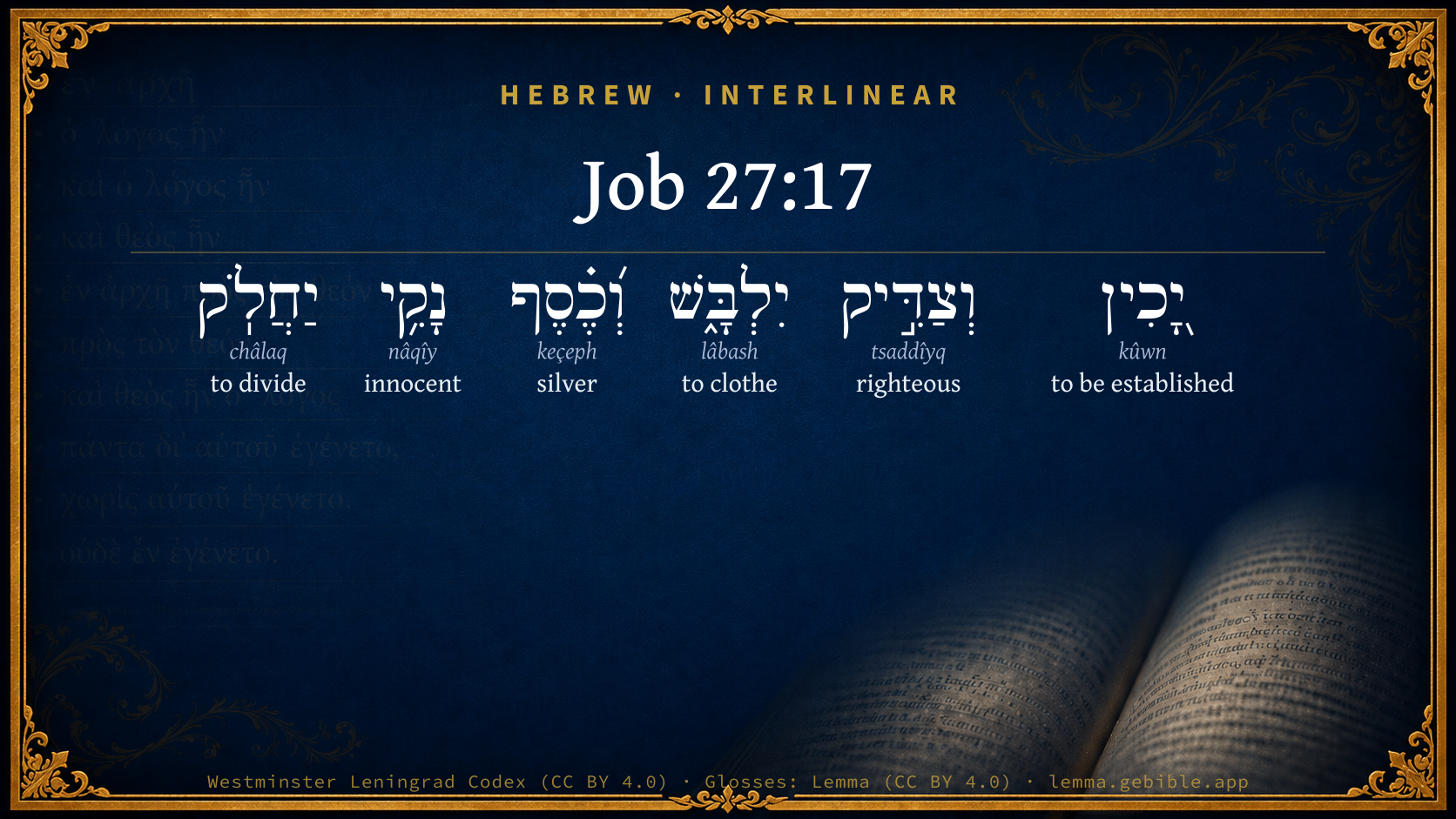
Job 27:17

Hebrew (Westminster Leningrad Codex) Job 27:17 appears in the Hebrew Old Testament. The text above is from the Westminster Leningrad Codex. Each word links to its Strong’s number, a concise gloss, and parsing drawn from the Open Scriptures Hebrew Bible morphology. Click any word for its full Brown-Driver-Briggs (BDB) entry.
Download image
Cite this verse

Job 27:17 (World English Bible). Public Domain. Lemma interlinear Bible study tool, https://lemma.gebible.app/v/job/27/17.

Show BibTeX & RIS
BibTeX
RIS
English Translation
He may prepare it, but the just shall put it on, And the innocent shall divide the silver.
World English Bible · Public Domain
Download a study sheet

One document with this verse’s original text, its word-by-word gloss line, the meaning frame, cross-references with their text, attributed commentary, and full source and license credits — printable, and it pastes into notes with its structure intact.

This verse Autodidact and up

Study sheet (.html) Plain text (.txt)

A passage Seminary Student

Up to 50 verses in one chapter. A passage sheet keeps up to 6 commentary sources and 12 cross-references per verse, in the order this page ranks them, and says so on the sheet whenever that leaves anything out. Ask for a single verse and you get the Autodidact verse sheet above.

Everything on this page stays free to read, with no account — the sheet is a download of what is already on screen, not access to it.

Want to remove ads? Support Godless Engineer
Compare translations 3

The same verse in 3 English versions, stacked beneath the original-language interlinear above. Click any original word for its lexicon entry.

Each is an independent rendering of the whole verse — the interlinear is not word-aligned to these translations.

Highlighted words mark where these versions differ — a whole-verse word diff, not a word-by-word alignment.

  • World English Bible Public Domain
    He may prepare it, but the just shall put it on, And the innocent shall divide the silver.
  • King James Version Public Domain
    He may prepare it, but the just shall put it on, and the innocent shall divide the silver.
  • unfoldingWord Literal Text CC BY-SA 4.0
    he piles up, but the righteous clothes himself and the innocent receives silver.

unfoldingWord Literal Text — © unfoldingWord, licensed CC BY-SA 4.0. Word-aligned USFM3 via Door43 (git.door43.org/unfoldingWord/en_ult).

Versions to compare (up to 4)

3 of 4 selected

Show all 18 translations

Every available English version of this verse, each an independent rendering of the whole verse.

  • World English Bible Public Domain
    He may prepare it, but the just shall put it on, And the innocent shall divide the silver.
  • Berean Standard Bible Public Domain
    what he lays up, the righteous will wear, and his silver will be divided by the innocent.
  • Majority Standard Bible Public Domain
    what he lays up, the righteous will wear, and his silver will be divided by the innocent.
  • King James Version Public Domain
    He may prepare it, but the just shall put it on, and the innocent shall divide the silver.
  • American Standard Version (1901) Public Domain
    He may prepare it, but the just shall put it on, And the innocent shall divide the silver.
  • Revised Version (1885) Public Domain
    He may prepare it, but the just shall put it on, and the innocent shall divide the silver.
  • Geneva Bible (1599) Public Domain
    He may prepare it, but the iust shall put it on, and the innocent shall deuide the siluer.
  • Douay-Rheims (1899) Public Domain
    He shall prepare indeed, but the just man shall be clothed with it: and the innocent shall divide the silver.
  • Young's Literal Translation Public Domain
    He prepareth -- and the righteous putteth `it' on, And the silver the innocent doth apportion.
  • Literal Standard Version CC BY-SA 4.0
    He prepares—and the righteous puts [it] on, || And the innocent apportions the silver.
  • Unlocked Literal Bible CC BY-SA 4.0
    he may heap up clothing, but righteous people will put it on, and innocent people will divide up the silver among themselves.
  • unfoldingWord Literal Text CC BY-SA 4.0
    he piles up, but the righteous clothes himself and the innocent receives silver.
  • Darby Bible Public Domain
    He may prepare it, but the just shall put it on; and the innocent shall divide the silver.
  • World Messianic Bible Public Domain
    he may prepare it, but the just will put it on, and the innocent will divide the silver.
  • Webster's Bible Public Domain
    He may prepare it, but the just shall put it on, and the innocent shall divide the silver.
  • Free Bible Version CC BY-SA 4.0
    those who do good will wear the clothes and the innocent will divide the silver among them.
  • Bible in Basic English Public Domain
    He may get them ready, but the upright will put them on, and he who is free from sin will take the silver for a heritage.
  • JPS Tanakh (1917) Public Domain
    He may prepare it, but the just shall put it on, and the innocent shall divide the silver.

Literal Standard Version (2020), Covenant Press — licensed CC BY-SA 4.0. Text via the HelloAO Bible API (eBible.org). Unlocked Literal Bible (unfoldingWord) — licensed CC BY-SA 4.0. Text via the HelloAO Bible API (eBible.org). unfoldingWord Literal Text — © unfoldingWord, licensed CC BY-SA 4.0. Word-aligned USFM3 via Door43 (git.door43.org/unfoldingWord/en_ult). Free Bible Version, Dr. Jonathan Gallagher — licensed CC BY-SA 4.0. Text via the HelloAO Bible API (eBible.org).

Word by word

More ways to search: Search by grammar → Find every occurrence → Compare this word →

Practice this passage: Drill this verse → Learn its vocabulary →

About this verse

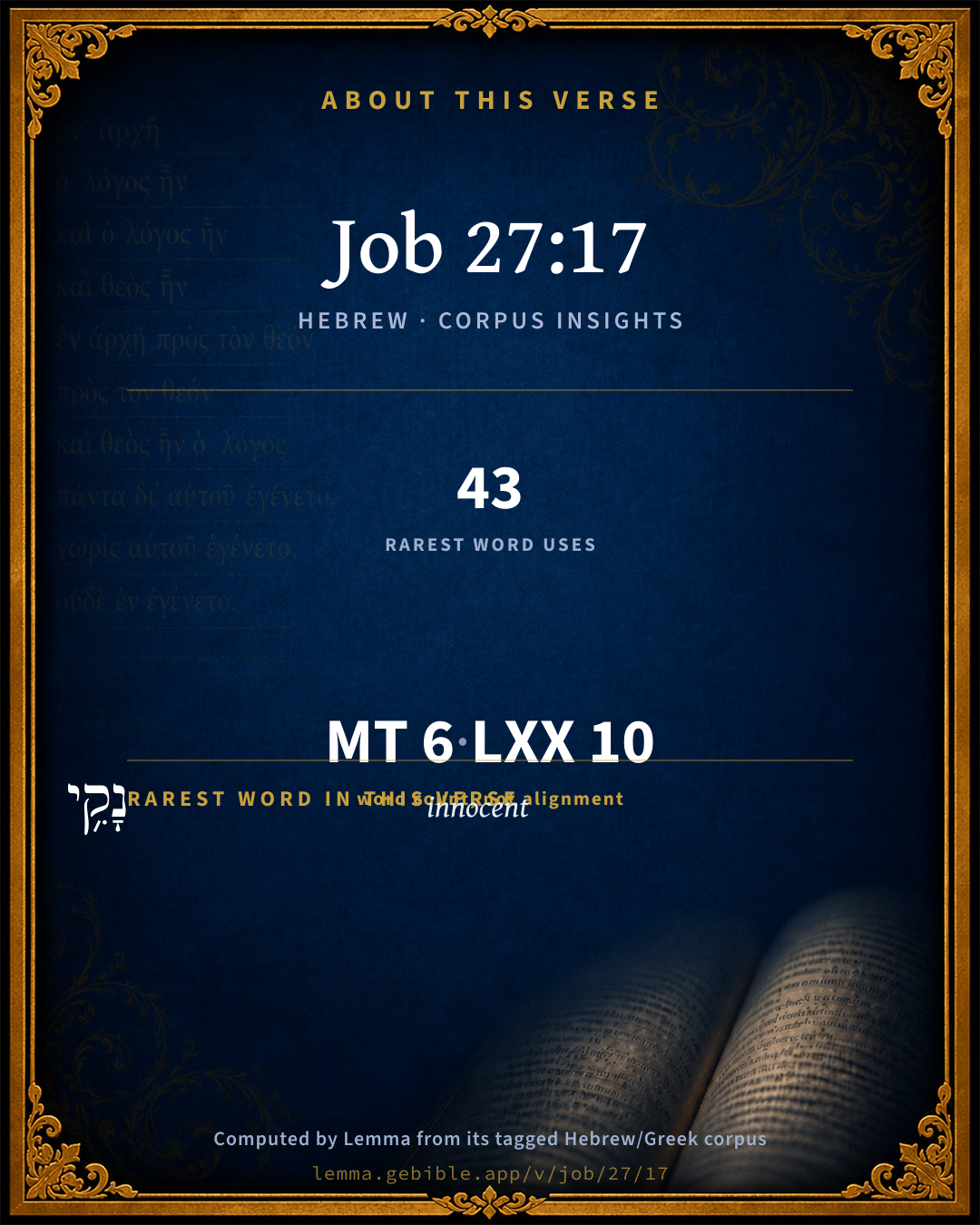
These counts appear in no published source. They are computed here, from the morphology-tagged text and Lemma’s own curated glosses. What Lemma adds →

6
words
6
distinct lemmas
Wisdom
section

Shared distinctive vocabulary

נָקִ֥י innocent H5355 occurs in 42 verses of the Hebrew Bible. Also found in:

Grammatical profile

  • 3 verbs
  • 1 noun
  • 2 adjectives

Verb forms

  • יָ֭כִין Hiphil · Imperfect
  • יִלְבָּ֑שׁ Qal · Imperfect
  • יַחֲלֹֽק Qal · Imperfect

Hebrew & Septuagint length

In English translation the verse runs 18 words from the Hebrew and 14 from the Septuagint (LXX English) — closely comparable.

A rough comparison of the two English renderings, which tokenize alike — not a word-level alignment.

Word counts can differ between the Hebrew and the Greek without any difference in meaning — e.g. the Hebrew direct-object marker אֵת has no separate Greek word, and Greek often adds the article ὁ.

In the original languages it is 6 Hebrew tokens and 10 Greek tokens — but the two are counted differently (Hebrew bundles its prefixes and suffixes into one token; the Greek is in lemma form), so that isn’t a like-for-like length.

Cross-references

3

Topical passages linked to Job 27:17 in the Treasury of Scripture Knowledge — connected by theme and wording, ordered by reader-vote popularity; previews shown in the World English Bible.

  • Proverbs 13:22 A good man leaves an inheritance to his children's children, But the wealth of the sinner is stored for the righteous.
  • Proverbs 28:8 He who increases his wealth by excessive interest Gathers it for one who has pity on the poor.
  • Ecclesiastes 2:26 For to the man who pleases him, God gives wisdom, knowledge, and joy; but to the sinner he gives travail, to gather and to heap up, that he may give to him who pleases God. This also is vanity and a chasing after wind.

Cross-references courtesy of OpenBible.info (CC BY 4.0).

Hebrew and Greek witnesses Masoretic Hebrew ↔ Greek Septuagint

The same verse in the two great witnesses to the Old Testament, shown verse-for-verse.

These are two independent witnesses, not word-aligned to each other, and the Septuagint is shown in lemma (dictionary) form.

Hebrew Job 27:17 Masoretic · Westminster Leningrad Codex

יָ֭כִין וְצַדִּ֣יק יִלְבָּ֑שׁ וְ֝כֶ֗סֶף נָקִ֥י יַחֲלֹֽק

He may prepare it, but the just shall put it on, And the innocent shall divide the silver.

World English Bible · Public Domain

Greek LXX Job 27:17 Septuagint · lemma form

οὗτος πᾶς δίκαιος περιποιέω ὁ δέ χρῆμα αὐτός ἀληθινός καταἔχω

All these things shall the righteous gain, and the true-hearted shall possess his wealth.

LXX2012 (modern English Septuagint) · Public Domain

On this verse, John Gill's Exposition discusses the Septuagint’s reading. Read the note in Commentary ↓

Hebrew: Westminster Leningrad Codex (CC BY 4.0). Greek: Septuagint (public domain); English from LXX2012 (modern English Septuagint) (Public Domain). How the Septuagint differs from the Hebrew →

Commentary

Notes on Job 27:17 from classic Christian and Jewish commentators (each source and its license shown beneath its notes). The classic Christian expositions comment on the surrounding passage and are grouped to its opening verse, so a note may address several verses; the Jewish commentaries on the Tanakh (Rashi and others) are per-verse, so they appear only where the commentator wrote on this verse.

Lemma curates 59 commentaries, every one of them public domain or Creative Commons licensed, each selected and text-cleaned for this edition rather than reprinted as found. About our sources →

Trapp's Complete Commentary

John Trapp

Job 27:17 He may prepare [it], but the just shall put [it] on, and the innocent shall divide the silver.

Ver. 17. He may prepare it, but the just shall put it on.] Well may he prepare it, so Broughton. Let the wicked man toil and take pains for it; God hath prepared for him an executor never mentioned in his will. God gave the Egyptians’ and Canaanites’ goods to Israel; Nabal’s to David; Haman’s to Mordecai. See Pro 28:8 Ecc 2:26. This plague among the rest God threateneth the disobedient with, Deu 28:30. Sed haec non semper, saith Mercer, although we see not this always so to be, but the contrary; yet it is easy to observe that many spend their strength and waste their wits in congerendo et converrendo, in getting and gathering these outward things; and then, when to possess them might seem a happiness, they die and leave them to uncertain heirs, as did Absalom and Alexander the Great, who left his ring to Perdiceas, but his dominions, τω κρατιστω, to him that should best deserve them (Plut.).

And the innocent shall divide the silver] Shall share it among them, as their child’s portions. Soles enim Deus dividere aliis dona, aliis donorum usum et lucrum, saith Brentius here. God gives gifts unto men, even to the rebellious, but the use and enjoyment of those gifts he bestoweth upon the righteous. The former have "great treasure and trouble therewith," Pro 15:16. Misera est magni custodia census (Juvenal). The latter have, howsoever, contented godliness; and though they gather less of this manna here below, yet they have no want.

John Trapp, A Commentary or Exposition upon All the Books of the Old and New Testament (1647–1656) — public domain. Text from a community e-Sword module.

Jamieson, Fausset & Brown

Robert Jamieson, A. R. Fausset & David Brown

Introverted parallelism. (See Introduction). Of the four clauses in the two verses, one answers to four, two to three (so Mat 7:6).

Jamieson, Fausset & Brown — Commentary Critical and Explanatory on the Whole Bible (1871) — public domain (CC PDM 1.0). Text via the HelloAO Bible API.

Adam Clarke's Commentary

Verse 17. The just shall put it on] Money is God's property. "The silver is mine, and the gold is mine, saith the Lord;" and though it may be abused for a time by unrighteous hands, God, in the course of his providence, brings it back to its proper use; and often the righteous possess the inheritance of the wicked.

Adam Clarke's Commentary on the Bible (1810–1826) — public domain. Text from a community e-Sword/MySword module.

The Cambridge Bible for Schools and Colleges

gen. ed. J. J. S. Perowne

17. When the ungodly are swept away the righteous remain and enter into their possessions, and the meek inherit the earth, Psa_37:29; Psa_37:34.

The Cambridge Bible for Schools and Colleges (gen. ed. J. J. S. Perowne; Cambridge University Press, 1878–1918) — public domain. Text from a community e-Sword module.

John Gill's Exposition

He buildeth his house as a moth,.... Which builds its house in a garment by eating into it, and so destroying it, and in time eats itself out of house and home, and however does not continue long in it, but is soon and easily shook out, or brushed off; so a wicked man builds himself an house, a stately palace, like Arcturus (l); so some render the words from Job 9:9, a palace among the stars, an heavenly palace and paradise, and expects it will continue for ever; but as he builds it with the mammon of unrighteousness, and to the prejudice and injury of others, and with their money, or what was due to them, so by his sins and iniquities he brings ruin and destruction upon himself and his family, so that his house soon falls to decay, and at least he and his posterity have but a short lived enjoyment of it. This may be applied in a figurative sense to the hypocrite's hope and confidence, which is like a spider's web, a moth eaten garment, and a house built upon the sand; the Septuagint version here adds, "as a spider", Job 8:13;

and as a booth that the keeper maketh; either a keeper of sheep, who sets up his tent in a certain place for a while, for the sake of pasturage, and then removes it, to which the allusion is, Isa 38:12; or a keeper of fruit, as the Targum, of gardens and orchards, that the fruit is not stolen; or of fig trees and vineyards, as Jarchi and Bar Tzemach, which is only a lodge or hut pitched for a season, until the fruit is gathered in, and then is taken down, see Isa 1:8; and it signifies here the short continuance of the house of the wicked man, which he imagined would continue for ever, Psa 49:11.

(l) "quasi Arcturi", Junius & Tremellius; so Aben Ezra.

John Gill's Exposition of the Whole Bible (1746–1763) — public domain (CC PDM 1.0). Text via the HelloAO Bible API.

Albert Barnes' Notes on the Bible

The just shall put it on - The righteous shall wear it. It shall pass out of the hands of him who prepared it, into the hands of others. The meaning is, that the wicked, though they become rich, would not live to enjoy their ill-gotten gains. These two verses contain a beautiful illustration of what Dr. Jebb calls the introverted parallelism - where the fourth member answers to the first, and the third to the second:

“Though he heap up silver as the dust,

And prepare raiment as the clay,

The just shall put it (raiment) on,

And the innocent shall divide the silver.”

A similar instance occurs in Mat 7:6 :

“Give not that which is holy unto the dogs,

Neither cast ye your pearls before swine,

Lest they (the swine) trample them under their feet.

And (the dogs) turn again and rend you.”

For a full illustration of the nature of Hebrew poetry, the reader may consult DeWette, Einleitung in die Psalmen, translated in the Biblical Repository, vol. iii. pp. 445ff, and Nordheimer’s Hebrew Grammar, vol. ii. pp. 319ff; see also the Introduction to Job, Section V.

The innocent shall divide the silver - That is, the righteous shall come into possession of it, and divide it among themselves. The wicked who had gained it shall not be permitted to enjoy it.

Albert Barnes' Notes on the Bible (1834–1885) — public domain. Text from a community e-Sword/MySword module.

Matthew Poole's English Annotations

The just shall put it on; either because it shall be given to him by the judge to recompense those injuries which he received from that tyrant; or because the right of it is otherwise transferred upon him by Divine Providence.

The innocent shall divide the silver; either,

1. To the poor; he shall distribute that which the oppressor hoarded up and kept as wickedly as he got it. So this suits with Pro 28:8; Ecc 2:26. Or,

2. With others, or to himself; he shall have a share of it, when by the judge’s sentence those ill-gotten goods shall be restored to the right owners.

Matthew Poole's English Annotations on the Holy Bible (1683–1685) — public domain. Text from a community e-Sword/MySword module.

The Pulpit Commentary

He may prepare it, but the just shall put it on. The raiment thus accumulated shall pass from the wicked into the hands of the just, who at his death shall enter upon his inheritance. (Job_20:18, Job_20:28) And the innocent shall divide the silver (see the first clause of ver. 16).

The wicked working for the good.

This is not intentional. But it is a fact of observation and experience. Let us consider first the fact, and then how it is brought about.

I THAT THE WORK OF THE WICKED IS FOR THE ADVANTAGE OF THE GOOD. First there is the negative side of the truth. Bad people do not enjoy the fruits of their own misdeeds. They may heap up riches, but they are not able to keep possession of them; for even if they meet with no reverse of fortune, they must forsake all when they die. But now we are carried a step further. What becomes of the forsaken wealth? Job says that it falls into the hands of the just, who put on the raiment which the wicked have prepared. This does not always happen in the direct manner that Job"s words indicate, though sometimes his statement is literally verified. But in indirect ways it has a much wider application. "All things work together for good to them that love God". (Rom_8:28) The earth helps the woman. (Rev_12:16) The meek shall inherit the earth. (Mat_5:5) Nebuchadnezzar fought for his own advantage only. Yet he was used as God"s servant, (Jer_25:9) and his achievements were turned to the real advantage of the devout remnant of Israel. Persecution has spread the gospel, as when the Church was scattered at the death of Stephen, and so became missionary. Thus "the blood of the martyrs is the seed of the Church." Modern wars have opened up countries to the gospel of Christ not wars of the cross in the interests of Christianity, but selfish, wicked wars, the leaders of which had no good end in view. So it may be that all sin and Satanic evil will be utilized, like offensive manure out of which spring beautiful and fragrant flowers.

II HOW THE WORK OF THE WICKED COMES TO BE FOR THE ADVANTAGE OF THE GOOD. This thing is not aimed at by the wicked, nor do they imagine that it will come about. How, then, is it produced?

1. By the overruling providence of God. God governs even through the wicked deeds of bad men. He "shapes our ends, rough-hew them how we will." "Man proposes, and God disposes." We are not like pawns on the chess-board, because we have free-will. But God is infinitely greater than a skilful chess-player. He does more than manipulate inert things. He works among the wild and wayward wills of men, and so acts that they result in accomplishing his great purposes. Thus God employs unconscious agents and brings good out of evil.

2. Through human fitness. The good must be fit to profit by God"s providential use of the work of the wicked. That work tends to their advantage just in proportion as they are capable of being benefited.

(1) Moral fitness. This is a condition of the special favour that is indicated by the providential action. God will give as a favour what, indeed, is not earned, but what is in a measure the reward of fidelity.

(2) Personal fitness. We can only receive real good in proportion to our capacity for it. There are men who cannot take God"s blessings, simply because they have no susceptibility for them. Now, the real good even of property is not in the thing itself, but in the right use of it. God will make things a blessing to those who are in the condition to use them well. W.F.A.

The Pulpit Commentary (1880–1919), ed. H.D.M. Spence-Jones & Joseph S. Exell — public domain. Text from a community e-Sword module.

Rashi

Rabbi Shlomo Yitzchaki (Rashi)

and He will distribute [his] money to the innocent The Holy One, blessed be He, will distribute the wicked man’s money to an innocent one.

Rashi on the Tanakh — English translations: “The Judaica Press complete Tanach with Rashi, translated by A. J. Rosenberg” (CC BY 4.0); “Pentateuch with Rashi's commentary by M. Rosenbaum and A.M. Silbermann, 1929-1934” (public domain); “The Metsudah Tanach series, Lakewood, N.J” (CC BY 4.0); and “The Book of Joshua, Metsudah Publications, 1997” (CC BY 4.0). Text via Sefaria.

Lesson kit

Teaching starters — assembled from the data on this page, not authored interpretation. Every prompt links to the verse data it draws on. Edit before teaching.

Job, in the Wisdom, opens this verse with 6 words (6 distinct Hebrew lemmas). Its most distinctive word is nâqîy (“innocent”). A historical commentator’s framing appears above. Read the whole chapter for the surrounding context.

Discussion questions

  1. What does “innocent” (nâqîy) contribute to the verse as a whole?
  2. Genesis 24:41 shares the word «innocent» with this verse. How do the two illuminate each other?
  3. These translations render this verse differently. What is at stake in choosing one wording over another?
  4. The verb «יָ֭כִין» is Hiphil Imperfect. How does its form color the action?
  5. Reading how Trapp's Complete Commentary and Jamieson, Fausset & Brown read this verse, where do the two commentators agree and where do they part?

Things to notice

Reading settings

Reading text

Shown beneath each verse's original-language words.

Old Testament
Old Testament edition

Read the OT as the Masoretic Hebrew (MT) or the Greek Septuagint (LXX).

English shown for the Greek Septuagint (in the Hebrew ↔ Greek comparison).

Comparing translations? Open the Compare panel on any verse page to stack up to four side by side.