
Psalms 9:8

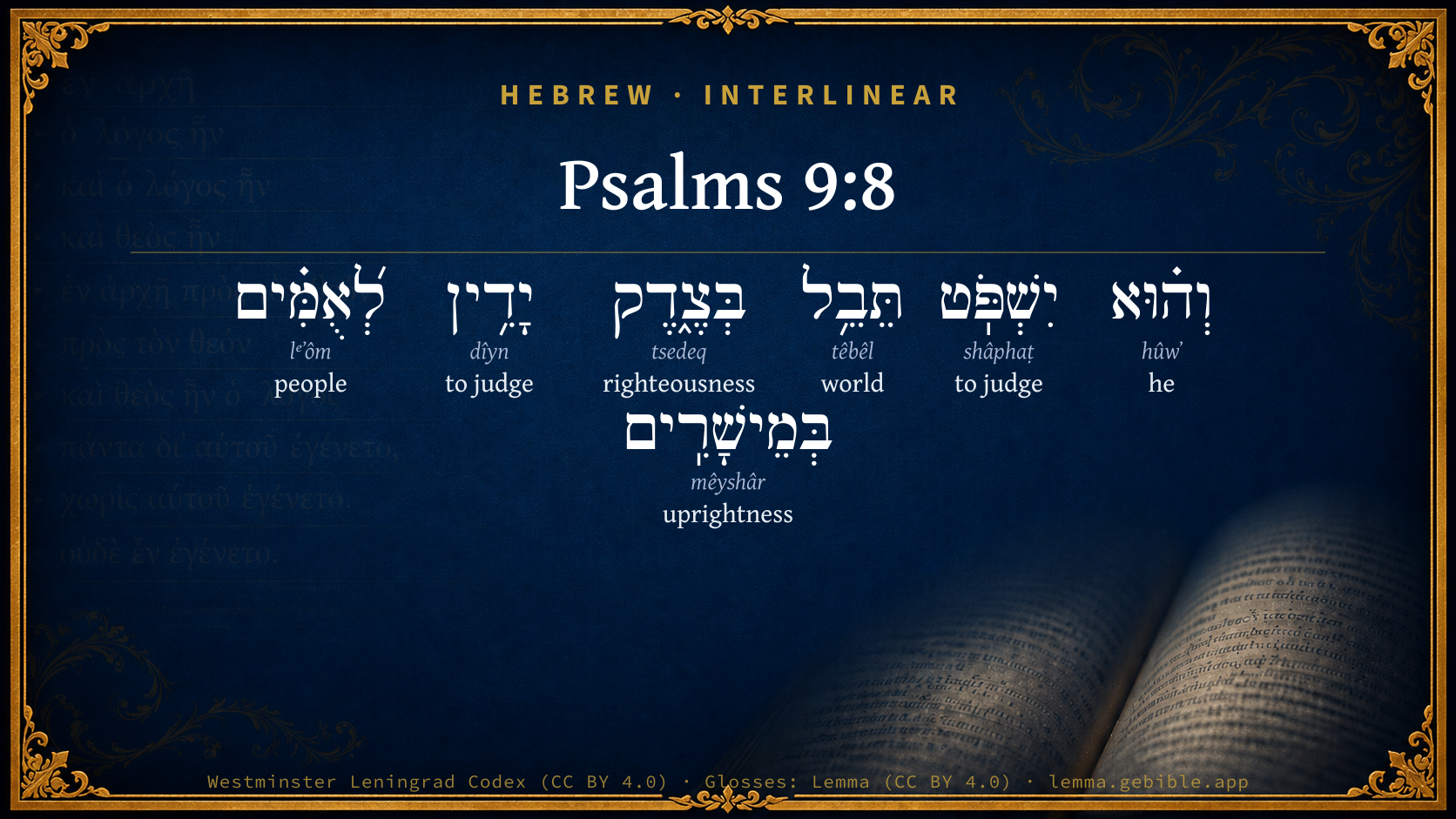
Hebrew (Westminster Leningrad Codex) Psalms 9:8 appears in the Hebrew Old Testament. The text above is from the Westminster Leningrad Codex. Each word links to its Strong’s number, a concise gloss, and parsing drawn from the Open Scriptures Hebrew Bible morphology. Click any word for its full Brown-Driver-Briggs (BDB) entry.
Download image
Cite this verse

Psalms 9:8 (World English Bible). Public Domain. Lemma interlinear Bible study tool, https://lemma.gebible.app/v/psalms/9/8.

Show BibTeX & RIS
BibTeX
RIS
English Translation
He will judge the world in righteousness. He will administer judgment to the peoples in uprightness.
World English Bible · Public Domain
Download a study sheet

One document with this verse’s original text, its word-by-word gloss line, the meaning frame, cross-references with their text, attributed commentary, and full source and license credits — printable, and it pastes into notes with its structure intact.

This verse Autodidact and up

Study sheet (.html) Plain text (.txt)

A passage Seminary Student

Up to 50 verses in one chapter. A passage sheet keeps up to 6 commentary sources and 12 cross-references per verse, in the order this page ranks them, and says so on the sheet whenever that leaves anything out. Ask for a single verse and you get the Autodidact verse sheet above.

Everything on this page stays free to read, with no account — the sheet is a download of what is already on screen, not access to it.

Want to remove ads? Support Godless Engineer
Compare translations 3

The same verse in 3 English versions, stacked beneath the original-language interlinear above. Click any original word for its lexicon entry.

Each is an independent rendering of the whole verse — the interlinear is not word-aligned to these translations.

Highlighted words mark where these versions differ — a whole-verse word diff, not a word-by-word alignment.

  • World English Bible Public Domain
    He will judge the world in righteousness. He will administer judgment to the peoples in uprightness.
  • King James Version Public Domain
    And he shall judge the world in righteousness, he shall minister judgment to the people in uprightness.
  • unfoldingWord Literal Text CC BY-SA 4.0
    as for him, he will judge the world with righteousness, and he will adjudicate for the peoples with fairness.

unfoldingWord Literal Text — © unfoldingWord, licensed CC BY-SA 4.0. Word-aligned USFM3 via Door43 (git.door43.org/unfoldingWord/en_ult).

Versions to compare (up to 4)

3 of 4 selected

Show all 18 translations

Every available English version of this verse, each an independent rendering of the whole verse.

  • World English Bible Public Domain
    He will judge the world in righteousness. He will administer judgment to the peoples in uprightness.
  • Berean Standard Bible Public Domain
    He judges the world with justice; He governs the people with equity.
  • Majority Standard Bible Public Domain
    He judges the world with justice; He governs the people with equity.
  • King James Version Public Domain
    And he shall judge the world in righteousness, he shall minister judgment to the people in uprightness.
  • American Standard Version (1901) Public Domain
    And he will judge the world in righteousness, He will minister judgment to the peoples in uprightness.
  • Revised Version (1885) Public Domain
    And he shall judge the world in righteousness, he shall minister judgment to the peoples in uprightness.
  • Geneva Bible (1599) Public Domain
    For he shall iudge the worlde in righteousnes, and shall iudge the people with equitie.
  • Douay-Rheims (1899) Public Domain
    but the Lord remaineth for ever. He hath prepared his throne in judgment:
  • Young's Literal Translation Public Domain
    And He judgeth the world in righteousness, He judgeth the peoples in uprightness.
  • Literal Standard Version CC BY-SA 4.0
    And He judges the world in righteousness, || He judges the peoples in uprightness.
  • Unlocked Literal Bible CC BY-SA 4.0
    He will judge the world with righteousness, and he will execute judgment for the nations with fairness.
  • unfoldingWord Literal Text CC BY-SA 4.0
    as for him, he will judge the world with righteousness, and he will adjudicate for the peoples with fairness.
  • Darby Bible Public Domain
    And it is he that will judge the world with righteousness; he shall execute judgment upon the peoples with equity.
  • World Messianic Bible Public Domain
    He will judge the world in righteousness. He will administer judgment to the peoples in uprightness.
  • Webster's Bible Public Domain
    \\9:7\\But the LORD shall endure for ever: he hath prepared his throne for judgment.
  • Free Bible Version CC BY-SA 4.0
    The Lord judges the world rightly; he judges the nations fairly.
  • Bible in Basic English Public Domain
    And he will be the judge of the world in righteousness, giving true decisions for the peoples.
  • JPS Tanakh (1917) Public Domain
    (9-9) And He will judge the world in righteousness, He will minister judgment to the peoples with equity.

Literal Standard Version (2020), Covenant Press — licensed CC BY-SA 4.0. Text via the HelloAO Bible API (eBible.org). Unlocked Literal Bible (unfoldingWord) — licensed CC BY-SA 4.0. Text via the HelloAO Bible API (eBible.org). unfoldingWord Literal Text — © unfoldingWord, licensed CC BY-SA 4.0. Word-aligned USFM3 via Door43 (git.door43.org/unfoldingWord/en_ult). Free Bible Version, Dr. Jonathan Gallagher — licensed CC BY-SA 4.0. Text via the HelloAO Bible API (eBible.org).

Word by word

More ways to search: Search by grammar → Find every occurrence → Compare this word →

Practice this passage: Drill this verse → Learn its vocabulary →

About this verse

These counts appear in no published source. They are computed here, from the morphology-tagged text and Lemma’s own curated glosses. What Lemma adds →

7
words
7
distinct lemmas
Wisdom
section

Notable vocabulary

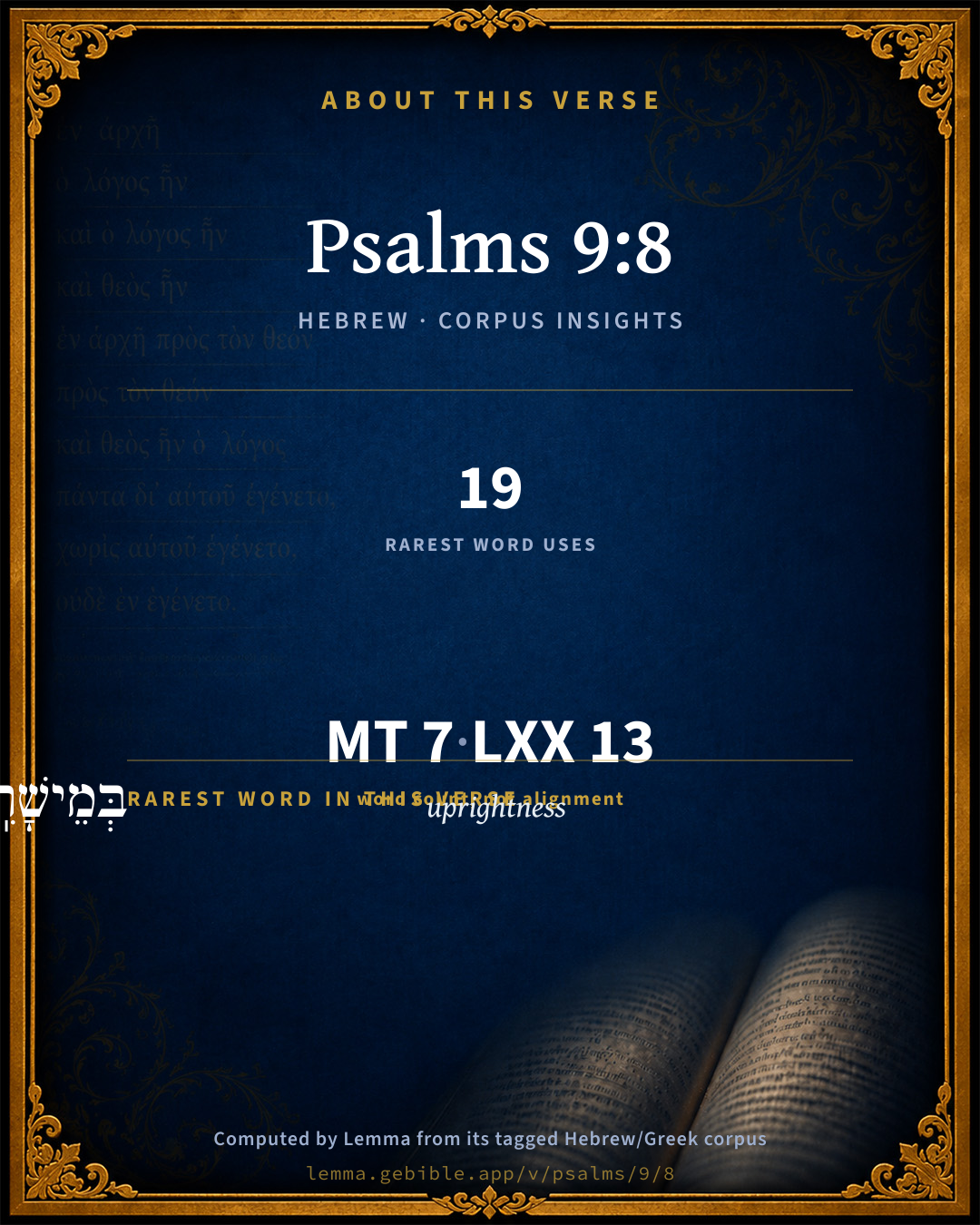
The rarest word here is בְּמֵישָׁרִֽים uprightness H4339 — appearing just 19 times in the whole Hebrew Bible.

Shared distinctive vocabulary

בְּמֵישָׁרִֽים uprightness H4339 occurs in 19 verses of the Hebrew Bible. Also found in:

Grammatical profile

  • 2 verbs
  • 4 nouns
  • 1 pronoun

Verb forms

  • יִשְׁפֹּֽט Qal · Imperfect
  • יָדִ֥ין Qal · Imperfect

Hebrew & Septuagint length

In English translation the verse runs 16 words from the Hebrew and 15 from the Septuagint (LXX English) — closely comparable.

A rough comparison of the two English renderings, which tokenize alike — not a word-level alignment.

Word counts can differ between the Hebrew and the Greek without any difference in meaning — e.g. the Hebrew direct-object marker אֵת has no separate Greek word, and Greek often adds the article ὁ.

In the original languages it is 7 Hebrew tokens and 13 Greek tokens — but the two are counted differently (Hebrew bundles its prefixes and suffixes into one token; the Greek is in lemma form), so that isn’t a like-for-like length.

Cross-references

11

Topical passages linked to Psalms 9:8 in the Treasury of Scripture Knowledge — connected by theme and wording, ordered by reader-vote popularity; previews shown in the World English Bible.

  • Psalms 96:13 Before Yahweh; for he comes, For he comes to judge the earth. He will judge the world with righteousness, The peoples with his truth.
  • Revelation 20:12–13 I saw the dead, the great and the small, standing before the throne, and they opened books. Another book was opened, which is the book of life. The dead were judged out of the things which were written in the books, according to their works.
  • Psalms 98:9 Let them sing before Yahweh, For he comes to judge the earth. He will judge the world with righteousness, And the peoples with equity.
  • Acts 17:31 because he has appointed a day in which he will judge the world in righteousness by the man whom he has ordained; of which he has given assurance to all men, in that he has raised him from the dead."
  • Romans 2:5–6 But according to your hardness and unrepentant heart you are treasuring up for yourself wrath in the day of wrath, revelation, and of the righteous judgment of God;
  • Romans 2:16 in the day when God will judge the secrets of men, according to my Gospel, by Jesus Christ.
  • Genesis 18:25 Be it far from you to do things like that, to kill the righteous with the wicked, that so the righteous should be as the wicked. May that be far from you. Shouldn't the Judge of all the earth do right?"
  • Psalms 50:6 The heavens shall declare his righteousness, For God himself is judge. Selah.
  • Psalms 94:15 For judgment will return to righteousness. All the upright in heart shall follow it.
  • Psalms 99:4 The King's strength also loves justice. You do establish equity. You execute justice and righteousness in Jacob.
  • Isaiah 11:4–5 but with righteousness shall he judge the poor, and decide with equity for the humble of the earth; and he shall strike the earth with the rod of his mouth; and with the breath of his lips shall he kill the wicked.

Cross-references courtesy of OpenBible.info (CC BY 4.0).

Hebrew and Greek witnesses Masoretic Hebrew ↔ Greek Septuagint

The same verse in the two great witnesses to the Old Testament, shown verse-for-verse.

You’re reading Greek Psalm 9 (Hebrew Psalm 9). The Septuagint counts the superscription, so verse numbers can differ from the Hebrew — chapter-level alignment, not verse-by-verse. Numbering follows Rahlfs.

These are two independent witnesses, not word-aligned to each other, and the Septuagint is shown in lemma (dictionary) form.

Hebrew Psalms 9:8 Masoretic · Westminster Leningrad Codex

וְה֗וּא יִשְׁפֹּֽט תֵּבֵ֥ל בְּצֶ֑דֶק יָדִ֥ין לְ֝אֻמִּ֗ים בְּמֵישָׁרִֽים

He will judge the world in righteousness. He will administer judgment to the peoples in uprightness.

World English Bible · Public Domain

Greek LXX Greek Psalm 9:8 Septuagint · lemma form

καί ὁ κύριος εἰς ὁ αἰών μένω ἑτοιμάζω ἐν κρίσις ὁ θρόνος αὐτός

And he will judge the world in righteousness, he will judge the nations in uprightness.

LXX2012 (modern English Septuagint) · Public Domain

On this verse, The Treasury of David discusses the Septuagint’s reading. Read the note in Commentary ↓

Hebrew: Westminster Leningrad Codex (CC BY 4.0). Greek: Septuagint (public domain); English from LXX2012 (modern English Septuagint) (Public Domain). How the Septuagint differs from the Hebrew →

Commentary

Notes on Psalms 9:8 from classic Christian and Jewish commentators (each source and its license shown beneath its notes). The classic Christian expositions comment on the surrounding passage and are grouped to its opening verse, so a note may address several verses; the Jewish commentaries on the Tanakh (Rashi and others) are per-verse, so they appear only where the commentator wrote on this verse.

Lemma curates 59 commentaries, every one of them public domain or Creative Commons licensed, each selected and text-cleaned for this edition rather than reprinted as found. About our sources →

Trapp's Complete Commentary

John Trapp

Psa 9:8 And he shall judge the world in righteousness, he shall minister judgment to the people in uprightness.

Ver. 8. And he shall judge the world, &c.] See on Psa 9:4.

John Trapp, A Commentary or Exposition upon All the Books of the Old and New Testament (1647–1656) — public domain. Text from a community e-Sword module.

J. A. Alexander on Psalms

Joseph Addison Alexander

9. (Psa 9:8). And he, himself, with emphasis upon the pronoun, is to judge the world, the fruitful and cultivated earth, as the Hebrew word properly denotes, here put for its inhabitants, in justice, or righteousness, i. e. in the exercise of this divine perfection. He will judge, a different Hebrew verb, to which we have no equivalent, he will judge nations, peoples, races, not mere individuals, in equities, in equity, the plural form denoting fulness or completeness, as in Psa 1:1. As the preceding verse describes Jehovah's kingship as judicial, so the verse before us represents him in the actual exercise of his judicial functions.

Joseph Addison Alexander, The Psalms Translated and Explained (1850) — public domain. Text from a community e-Sword module.

Adam Clarke's Commentary

Verse 8. He shall judge the world in righteousness] All the dispensations of God's providence are founded in righteousness and truth.

Adam Clarke's Commentary on the Bible (1810–1826) — public domain. Text from a community e-Sword/MySword module.

John Calvin's Commentaries

8. And he shall judge the world in righteousness. As David has just now testified, that the power of God is not inactive, so that he dwells in heaven only indulging himself in pleasures; but that it is a constantly operating power which he exercises in preserving his authority, and governing the world in righteousness and equity; so in this verse he adds the use of this doctrine, which is this, that the power of God is not shut up in heaven, but manifests itself in succouring men. The true doctrine on this subject, is not, like Epicurus, to imagine that God is a being wholly devoted to ease and pleasures, and who, satisfied with himself alone, has no care whatever about mankind, but to place him on the throne of power and equity, so that we may be fully persuaded, that although he does not immediately succor those who are unrighteously oppressed, yet there is not a moment in which he ceases to take a deep interest in them. And when he seems for a time to take no notice of things, the conclusion to which we should come most assuredly is, not that he deserts his office, but that he wishes hereby to exercise the patience of his people, and that, therefore, we should wait the issue in patience, and with tranquillity of mind. The demonstrative pronoun He, in my opinion, is of great weight. The import of it is, as if David had said, No one can deprive God of his office as Judge of the world, nor prevent him from extending his judgments to all nations. Whence it follows, that he will much more be the judge of his own people. David declares these judgments to be righteous, in order to induce us, when we are unrighteously and cruelly molested, to ask assistance from God, in the confident expectation of obtaining it; for since he judges the nations in righteousness, he will not suffer injustice and oppression always to reign with impunity in the world, nor deny his aid to the innocent.

John Calvin's Commentaries (1540-1563) — public domain. Text from the Calvin Translation Society English edition (1840s-50s) via the Christian Classics Ethereal Library (ccel.org). Calvin's coverage is partial (roughly two-thirds of the Bible); uncommented books and verses are honest gaps, never fabricated. The 19th-century editor's footnotes and remarks are omitted so the notes are faithfully Calvin's own voice.

Ellicott's Commentary for English Readers

(8) And he . . . .—Better, and he it is who. The pronoun is emphatic.

A Bible Commentary for English Readers, edited by Charles John Ellicott (1878–1897) — public domain. Text from a community e-Sword module.

The Cambridge Bible for Schools and Colleges

gen. ed. J. J. S. Perowne

8. And he shall judge] He is emphatic. His administration, in contrast to that of so many human rulers, will be one of perfect justice and equity. And it will be universal. The vindication of his right which the Psalmist has just experienced is the earnest of a judgement which will embrace the whole world and all peoples. For people read peoples, and for uprightness, equity, as in Psa_98:9. Cp. Psa_7:8; Psa_96:10; Psa_96:13; Act_17:31.

The Heb. word tçbhçl rendered world denotes the fruitful, habitable part of the earth (cp. οἰκουμένη), here of course including its inhabitants. Cp. Pro_8:31.

The Cambridge Bible for Schools and Colleges (gen. ed. J. J. S. Perowne; Cambridge University Press, 1878–1918) — public domain. Text from a community e-Sword module.

John Gill's Exposition

The Lord also will be a refuge for the oppressed,.... The poor and weak, such as have no might nor power, and are thrown down and trampled upon, as the word (i) signifies; and such are the people of God. They are oppressed with the burden of sin; they are bowed down with Satan and his temptations; and are sometimes pressed out of measure, and above their strength, with the persecutions of men; they are trodden under foot by antichrist, or otherwise are borne down with a variety of sorrows and afflictions; but the Lord is a refuge for them. The Chaldee paraphrase renders it as before, "the Word of the Lord", the eternal Logos, the Son of God: he is a refuge for poor sensible sinners, fleeing from wrath to come; being typified by the cities of refuge, whither the manslayer fled from the avenger of blood: he is the strong hold for the prisoners of hope to turn into; his name is a strong tower and place of defence for oppressed saints; he is a refuge when all others fail, and at all times, in the day of affliction, and in the hour of death, and at judgment;

a refuge in times of trouble; of which the saints have many, as when God hides his face, when corruptions prevail, when grace is low in exercise, and temptations are strong, yet even then Christ is the refuge from the storm; the salvation of his people is of him, and he is their strength in every time of trouble; see Isa 25:4.

(i) "attrito", Cocceius, Gejerus: "contrito", Michaelis.

John Gill's Exposition of the Whole Bible (1746–1763) — public domain (CC PDM 1.0). Text via the HelloAO Bible API.

Albert Barnes' Notes on the Bible

And he shall judge the world in righteousness - The word here rendered world means properly the habitable earth; and then it denotes the inhabitants that dwell upon the earth. The statement here is general, and is suggested by what is referred to in the previous verses. In the particular case on which the psalm turns, God had manifested himself as a just Judge. He had overthrown the enemies of himself and of truth; he had interposed in behalf of the righteous: and from this fact the psalmist makes the natural and proper inference that this would be fouud to be his character in regard to all the world; this indicated what, in all Iris dealings with men he would always be found to be; this showed what he would be whenever he in any way pronounced a judgment on mankind. It may be added here that this will be found to be true in the great final judgment; that it will be in accordance with the principles of eternal justice.

He shall minister judgment - He will declare or pronounce judgment; he will execute the office of judge. “To the people.” To all people; to the nations of the earth. This corresponds with what, in the former part of the verse, is called the world; and the declaration is, that in his dealings with the dwellers on the earth he will be guided by the strictest principles of justice.

In uprightness - In rectitude. He will not be influenced by partiality; he will show no favoritism; he will not be bribed. He will do exact justice to all.

Albert Barnes' Notes on the Bible (1834–1885) — public domain. Text from a community e-Sword/MySword module.

Matthew Poole's English Annotations

The world; not you only, but all the enemies of his people, and all the men of the world.

Matthew Poole's English Annotations on the Holy Bible (1683–1685) — public domain. Text from a community e-Sword/MySword module.

The Treasury of David

Charles H. Spurgeon

Ver. 8. Whatever earthly courts may do, heaven's throne ministers judgment in uprightness. Partiality and respect of persons are things unknown in the dealings of the Holy One of Israel. How the prospect of appearing before the impartial tribunal of the Great King should act as a check to us when tempted to sin, and as a comfort when we are slandered or oppressed.

Ver. 8. He shall judge the world in righteousness. In this judgment tears will not prevail, prayers will not be heard, promises will not be admitted, repentance will be too late; and as for riches, honourable titles, sceptres, and diadems, these will profit much less; and the inquisition shall be so curious and diligent, that not one light thought nor one idle word (not repented of in the life past), shall be forgotten. For truth itself hath said, not in jest, but in earnest, "Of every idle word which men have spoken, they shall give an account in the day of judgment." Oh, how many which now sin with great delight, yea, even with greediness (as if we served a god of wood or of stone, which seeth nothing, or can do nothing), will be then astonished, ashamed, and silent! Then shall the days of thy mirth be ended, and thou shalt be overwhelmed with everlasting darkness; and instead of thy pleasures, thou shalt have everlasting torments. Thomas Tymme.

Ver. 8. He shall judge the world in righteousness. Even Paul, in his great address on Mars' Hill, a thousand years after, could find no better words in which to teach the Athenians the doctrine of the judgment day than the Septuagint rendering of this clause. William S. Plumer.

Ver. 8. The guilty conscience cannot abide this day. The silly sheep, when she is taken, will not bleat, but you may carry her and do what you will with her, and she will be subject; but the swine, if she be once taken, she will roar and cry, and thinks she is never taken but to be slain. So of all things the guilty conscience cannot abide to hear of this day, for they know that when they hear of it, they hear of their own condemnation. I think if there were a general collection made through the whole world that there might be no judgment day, then God would be so rich that the world would go begging and be a waste wilderness. Then the covetous judge would bring forth his bribes; then the crafty lawyer would fetch out his bags; the usurer would give his gain, and a double thereof. But all the money in the world will not serve for our sin, but the judge must answer his bribes, he that hath money must answer how he came by it, and just condemnation must come upon every soul of them; then shall the sinner be ever dying and never dead, like the salamander, that is ever in the fire and never consumed. Henry Smith.

Ver. 8. The justice of God's moral government, especially in relation to the last great day.

Charles H. Spurgeon's The Treasury of David (1869–1885) — public domain. Psalms only. Text from a community e-Sword/MySword module.

The Pulpit Commentary

And he shall judge the world. The "he" is emphatic he himself, and no other. From his throne of judgment he shall judge, not Israel"s enemies only, whom he has just judged (vers. 3-6), but the whole world. In righteousness; i.e. by a strict law of justice, rewarding to all men "after their deserving. He shall minister judgment to the people (rather, the peoples; i.e. all the people of all the earth) in uprightness; literally, in uprightnesses a plural of perfection.

The Pulpit Commentary (1880–1919), ed. H.D.M. Spence-Jones & Joseph S. Exell — public domain. Text from a community e-Sword module.

Rashi

Rabbi Shlomo Yitzchaki (Rashi)

But the Lord shall sit forever, etc. The Name shall be complete and the throne shall be complete, as it is written כסאו, but before it is erased, it is written (in Exod. 17:16): “For a hand is on the throne (כס) of the Eternal (י-ה).” The throne is lacking [i.e., it is spelled defectively] and the Name is divided [i.e., the final two letters of the Tetragrammaton are missing].

Rashi on the Tanakh — English translations: “The Judaica Press complete Tanach with Rashi, translated by A. J. Rosenberg” (CC BY 4.0); “Pentateuch with Rashi's commentary by M. Rosenbaum and A.M. Silbermann, 1929-1934” (public domain); “The Metsudah Tanach series, Lakewood, N.J” (CC BY 4.0); and “The Book of Joshua, Metsudah Publications, 1997” (CC BY 4.0). Text via Sefaria.

Radak

Rabbi David Kimhi (Radak)

But the Lord sitteth enthroned for ever: – These every one may perish; but the Lord sitteth enthroned for ever, and judges these every one. And this is what he means when he says:

He hath prepared His throne for judgment, – as it says (Ps. 102:27), “they shall perish, but Thou remainest.” And the significance of sitteth enthroned (יֵשֵׁב) is that of enduring and stability; and so (in the passage) “The Lord sat enthroned at the flood” (Ps. 29:10).

Radak on the Tanakh — English translations: “Sefaria Community Translation” (CC0 1.0 (public-domain dedication)); “Eliyahu Munk, HaChut Hameshulash” (CC BY 4.0); “Rabbi Mike Feuer, Jerusalem Anthology” (CC BY 4.0); and “R. David Kimhi on the first book of Psalms, Translated by R.G. Finch, London, 1919” (public domain). Text via Sefaria.

Lesson kit

Teaching starters — assembled from the data on this page, not authored interpretation. Every prompt links to the verse data it draws on. Edit before teaching.

Psalms, in the Wisdom, opens this verse with 7 words (7 distinct Hebrew lemmas). Its most distinctive word is mêyshâr (“uprightness”). A historical commentator’s framing appears above. Read the whole chapter for the surrounding context.

Discussion questions

  1. What does “uprightness” (mêyshâr) contribute to the verse as a whole?
  2. How does 1 Chronicles 29:17, which shares the word «uprightness», read alongside this verse?
  3. The translations on this page render this verse differently — a whole-verse word diff, not a word-by-word alignment. What might account for the different wordings?
  4. «יִשְׁפֹּֽט» is a Qal Imperfect verb. How does that grammatical form shape the action described?
  5. Compare how Trapp's Complete Commentary and J. A. Alexander on Psalms read this verse. Where do they agree or differ?

Things to notice

Reading settings

Reading text

Shown beneath each verse's original-language words.

Old Testament
Old Testament edition

Read the OT as the Masoretic Hebrew (MT) or the Greek Septuagint (LXX).

English shown for the Greek Septuagint (in the Hebrew ↔ Greek comparison).

Comparing translations? Open the Compare panel on any verse page to stack up to four side by side.