Numbers 21:27

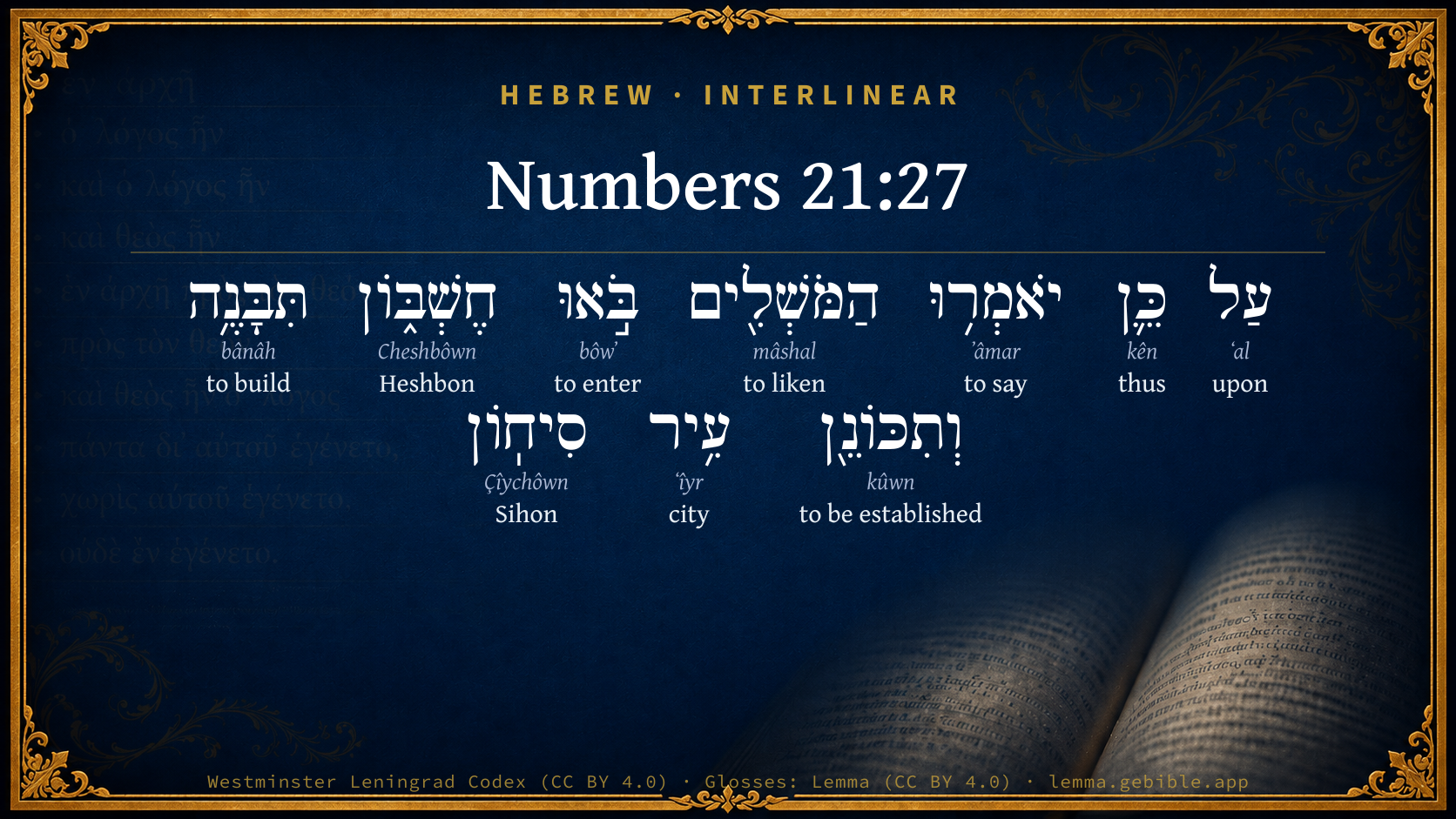
Hebrew (Westminster Leningrad Codex) Numbers 21:27 appears in the Hebrew Old Testament. The text above is from the Westminster Leningrad Codex. Each word links to its Strong’s number, a concise gloss, and parsing drawn from the Open Scriptures Hebrew Bible morphology. Click any word for its full Brown-Driver-Briggs (BDB) entry.
Download image
Cite this verse

Numbers 21:27 (World English Bible). Public Domain. Lemma interlinear Bible study tool, https://lemma.gebible.app/v/numbers/21/27.

Show BibTeX & RIS
BibTeX
RIS
English Translation
Therefore those who speak in proverbs say, Come you to Heshbon; Let the city of Sihon be built and established:
World English Bible · Public Domain
Highlights
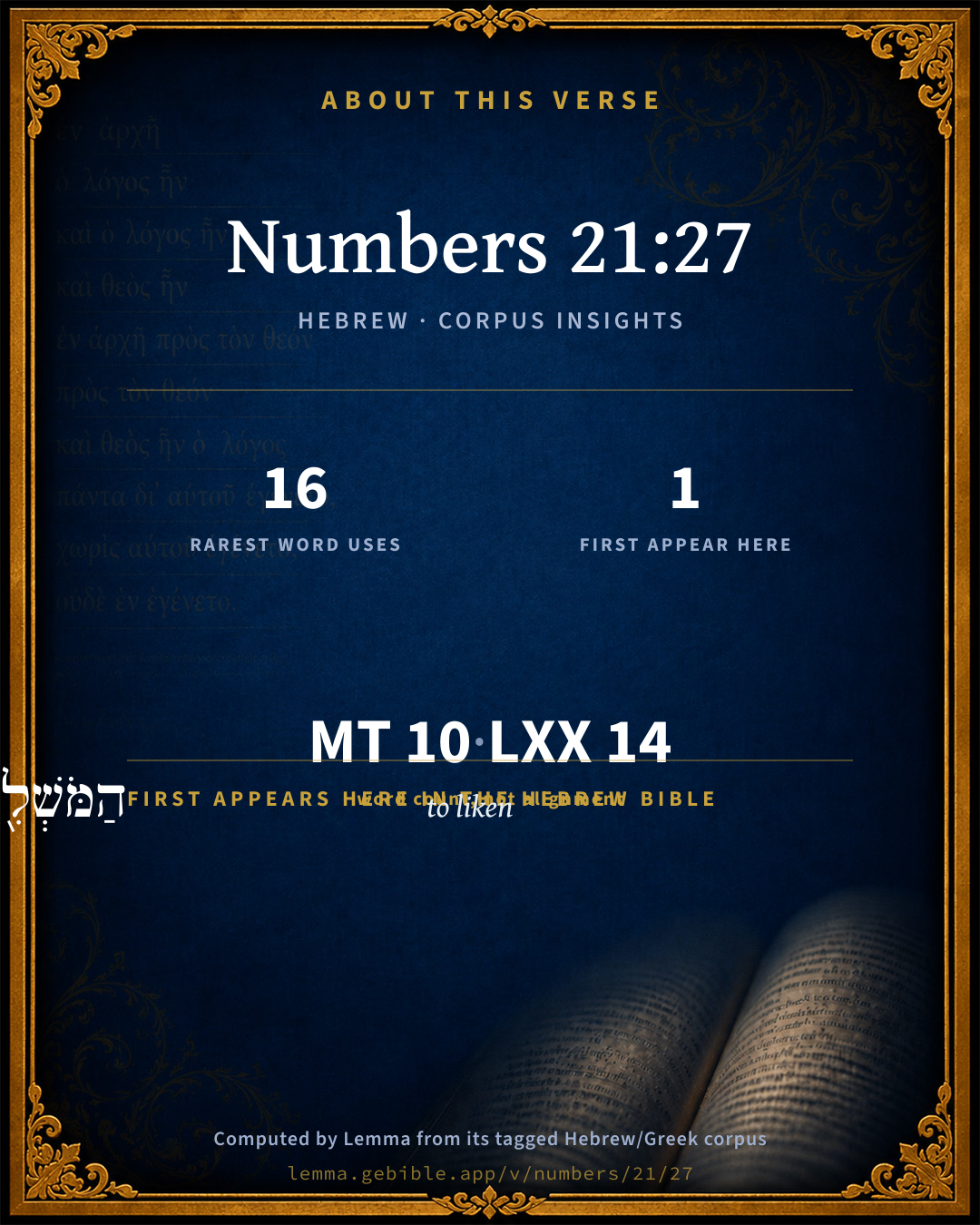
  • 1 first appearance in the Hebrew Bible
Full analysis ↓
Download a study sheet

One document with this verse’s original text, its word-by-word gloss line, the meaning frame, cross-references with their text, attributed commentary, and full source and license credits — printable, and it pastes into notes with its structure intact.

This verse Autodidact and up

Study sheet (.html) Plain text (.txt)

A passage Seminary Student

Up to 50 verses in one chapter. A passage sheet keeps up to 6 commentary sources and 12 cross-references per verse, in the order this page ranks them, and says so on the sheet whenever that leaves anything out. Ask for a single verse and you get the Autodidact verse sheet above.

Everything on this page stays free to read, with no account — the sheet is a download of what is already on screen, not access to it.

Want to remove ads? Support Godless Engineer
Compare translations 3

The same verse in 3 English versions, stacked beneath the original-language interlinear above. Click any original word for its lexicon entry.

Each is an independent rendering of the whole verse — the interlinear is not word-aligned to these translations.

Highlighted words mark where these versions differ — a whole-verse word diff, not a word-by-word alignment.

  • World English Bible Public Domain
    Therefore those who speak in proverbs say, Come you to Heshbon; Let the city of Sihon be built and established:
  • King James Version Public Domain
    Wherefore they that speak in proverbs say, Come into Heshbon, let the city of Sihon be built and prepared:
  • unfoldingWord Literal Text CC BY-SA 4.0
    Therefore the ones speaking in proverbs say, “Come to Heshbon! Let it be built and established, the city of Sihon!

unfoldingWord Literal Text — © unfoldingWord, licensed CC BY-SA 4.0. Word-aligned USFM3 via Door43 (git.door43.org/unfoldingWord/en_ult).

Versions to compare (up to 4)

3 of 4 selected

Show all 18 translations

Every available English version of this verse, each an independent rendering of the whole verse.

  • World English Bible Public Domain
    Therefore those who speak in proverbs say, Come you to Heshbon; Let the city of Sihon be built and established:
  • Berean Standard Bible Public Domain
    That is why the poets say: “Come to Heshbon, let it be rebuilt; let the city of Sihon be restored.
  • Majority Standard Bible Public Domain
    That is why the poets say: “Come to Heshbon, let it be rebuilt; let the city of Sihon be restored.
  • King James Version Public Domain
    Wherefore they that speak in proverbs say, Come into Heshbon, let the city of Sihon be built and prepared:
  • American Standard Version (1901) Public Domain
    Wherefore they that speak in proverbs say, Come ye to Heshbon; Let the city of Sihon be built and established:
  • Revised Version (1885) Public Domain
    Wherefore they that speak in proverbs say, Come ye to Heshbon, Let the city of Sihon be built and established:
  • Geneva Bible (1599) Public Domain
    Wherefore they that speake in prouerbes, say, Come to Heshbon, let the citie of Sihon bee built and repaired:
  • Douay-Rheims (1899) Public Domain
    Therefore it is said in the proverb: Come into Hesebon, let the city of Sehon be built and set up:
  • Young's Literal Translation Public Domain
    therefore those using similes say -- `Enter ye Heshbon, Let the city of Sihon be built and ready,
  • Literal Standard Version CC BY-SA 4.0
    therefore those using allegories say: “Enter Heshbon, || Let the city of Sihon be built and ready,
  • Unlocked Literal Bible CC BY-SA 4.0
    That is why those who speak in proverbs say, “Come to Heshbon. Let the city of Sihon be rebuilt and established again.
  • unfoldingWord Literal Text CC BY-SA 4.0
    Therefore the ones speaking in proverbs say, “Come to Heshbon! Let it be built and established, the city of Sihon!
  • Darby Bible Public Domain
    Therefore the poets say, Come to Heshbon; let the city of Sihon be built and established.
  • World Messianic Bible Public Domain
    Therefore those who speak in proverbs say, “Come to Heshbon. Let the city of Sihon be built and established;
  • Webster's Bible Public Domain
    Wherefore they that speak in proverbs say, Come into Heshbon, let the city of Sihon be built and prepared.
  • Free Bible Version CC BY-SA 4.0
    That's why the old songwriters wrote: “Come to Heshbon and have it be rebuilt; restore the town of Sihon!
  • Bible in Basic English Public Domain
    So the makers of wise sayings say, Come to Heshbon, building up the town of Sihon and making it strong:
  • JPS Tanakh (1917) Public Domain
    Wherefore they that speak in parables say: Come ye to Heshbon! let the city of Sihon be built and established!

Literal Standard Version (2020), Covenant Press — licensed CC BY-SA 4.0. Text via the HelloAO Bible API (eBible.org). Unlocked Literal Bible (unfoldingWord) — licensed CC BY-SA 4.0. Text via the HelloAO Bible API (eBible.org). unfoldingWord Literal Text — © unfoldingWord, licensed CC BY-SA 4.0. Word-aligned USFM3 via Door43 (git.door43.org/unfoldingWord/en_ult). Free Bible Version, Dr. Jonathan Gallagher — licensed CC BY-SA 4.0. Text via the HelloAO Bible API (eBible.org).

Word by word

More ways to search: Search by grammar → Find every occurrence → Compare this word →

Practice this passage: Drill this verse → Learn its vocabulary →

הַמֹּשְׁלִ֖ים
mâshal
H4911
“the · likening”
Particle, Definite Article + Verb, Qal, Participle Active, Masculine, Plural, Absolute
Part of Speech
Particle + Verb
Stem
Qal
Form
Participle Active
Gender
Masculine
Number
Plural
State
Absolute
Full BDB Definition

Origin: denominative from H4912

TWOT: 1258 , 1258b

to represent, liken, be like - (Niphal) to liken, be like, be similar - (Hiphil) to compare - (Hithpael) to become like - to speak in a proverb, use a proverb, speak in parables, speak in sentences of poetry - (Qal) to use a proverb, speak a parable or proverb - (Piel) to make a parable - maker of parables (participle)
  1. עַל ʻal H5921 “upon” Preposition
  2. כֵּ֛ן kên H3651 “thus” Particle, Demonstrative
  3. יֹאמְר֥וּ ʼâmar H559 “to say” Verb, Qal, Imperfect, 3rd Person, Masculine, Plural
  4. בֹּ֣אוּ bôwʼ H935 “enter” Verb, Qal, Imperative, 2nd Person, Masculine, Plural
  5. חֶשְׁבּ֑וֹן Cheshbôwn H2809 “Heshbon” Noun, Proper
  6. תִּבָּנֶ֥ה bânâh H1129 “to build” Verb, Niphal, Jussive, 3rd Person, Feminine, Singular
  7. וְתִכּוֹנֵ֖ן kûwn H3559 “and · to be established” Conjunction + Verb, Hithpolel, Jussive, 3rd Person, Feminine, Singular
  8. עִ֥יר ʻîyr H5892 “city of” Noun, Common, Feminine, Singular, Construct
  9. סִיחֽוֹן Çîychôwn H5511 “Sihon” Noun, Proper

About this verse

These counts appear in no published source. They are computed here, from the morphology-tagged text and Lemma’s own curated glosses. What Lemma adds →

10
words
10
distinct lemmas
Pentateuch
section

Notable vocabulary

The rarest word here is הַמֹּשְׁלִ֖ים to liken H4911 — appearing just 16 times in the whole Hebrew Bible.

First appearance in Scripture

This word makes its first canonical appearance in the Hebrew Bible here:

  • הַמֹּשְׁלִ֖ים to liken H4911

Shared distinctive vocabulary

הַמֹּשְׁלִ֖ים to liken H4911 occurs in 15 verses of the Hebrew Bible. Also found in:

Grammatical profile

  • 5 verbs
  • 3 nouns
  • 1 preposition
  • 1 particle

Verb forms

  • יֹאמְר֥וּ Qal · Imperfect
  • הַמֹּשְׁלִ֖ים Qal · Participle Active
  • בֹּ֣אוּ Qal · Imperative
  • תִּבָּנֶ֥ה Niphal · Jussive
  • וְתִכּוֹנֵ֖ן Hithpolel · Jussive

Hebrew & Septuagint length

In English translation the verse runs 20 words from the Hebrew and 21 from the Septuagint (LXX English) — closely comparable.

A rough comparison of the two English renderings, which tokenize alike — not a word-level alignment.

Word counts can differ between the Hebrew and the Greek without any difference in meaning — e.g. the Hebrew direct-object marker אֵת has no separate Greek word, and Greek often adds the article ὁ.

In the original languages it is 10 Hebrew tokens and 14 Greek tokens — but the two are counted differently (Hebrew bundles its prefixes and suffixes into one token; the Greek is in lemma form), so that isn’t a like-for-like length.

Cross-references

3

Topical passages linked to Numbers 21:27 in the Treasury of Scripture Knowledge — connected by theme and wording, ordered by reader-vote popularity; previews shown in the World English Bible.

  • Numbers 21:14 Therefore it is said in the book of the Wars of Yahweh, Vaheb in Suphah, The valleys of the Arnon,
  • Isaiah 14:4 that you shall take up this parable against the king of Babylon, and say, How has the oppressor ceased! the golden city ceased!
  • Habakkuk 2:6 Won't all these take up a parable against him, and a taunting proverb against him, and say, 'Woe to him who increases that which is not his, and who enriches himself by extortion! How long?'

Cross-references courtesy of OpenBible.info (CC BY 4.0).

Hebrew and Greek witnesses Masoretic Hebrew ↔ Greek Septuagint

The same verse in the two great witnesses to the Old Testament, shown verse-for-verse.

These are two independent witnesses, not word-aligned to each other, and the Septuagint is shown in lemma (dictionary) form.

Hebrew Numbers 21:27 Masoretic · Westminster Leningrad Codex

עַל כֵּ֛ן יֹאמְר֥וּ הַמֹּשְׁלִ֖ים בֹּ֣אוּ חֶשְׁבּ֑וֹן תִּבָּנֶ֥ה וְתִכּוֹנֵ֖ן עִ֥יר סִיחֽוֹן

Therefore those who speak in proverbs say, Come you to Heshbon; Let the city of Sihon be built and established:

World English Bible · Public Domain

Greek LXX Numbers 21:27 Septuagint · lemma form

διά οὗτος εἶπον ὁ αἰνιγματιστής ἔρχομαι εἰς εσεβων ἵνα οἰκοδομέω καί κατασκευάζω πόλις σηων

Therefore say they who deal in dark speeches, Come to Esebon, that the city of Seon may be built and prepared.

LXX2012 (modern English Septuagint) · Public Domain

On this verse, Ellicott's Commentary for English Readers discusses the Septuagint’s reading. Read the note in Commentary ↓

Hebrew: Westminster Leningrad Codex (CC BY 4.0). Greek: Septuagint (public domain); English from LXX2012 (modern English Septuagint) (Public Domain). How the Septuagint differs from the Hebrew →

Targum (Aramaic paraphrase)

2

The Targum is the ancient Jewish Aramaic paraphrase of the Hebrew Scriptures — an interpretive translation, not the Hebrew text itself. Onkelos (literal) and Pseudo-Jonathan (expansive) render the Torah, and Jonathan the Prophets. Coverage is partial: where no permissively-licensed English translation exists for a verse, only the Aramaic is shown. This is verse-level text, not a word-by-word alignment to the Hebrew.

  1. Targum Onkelos Torah (Genesis–Deuteronomy)
    עַל כֵּן יֵימְרוּן מְתָלַיָא עוּלוּ לְחֶשְׁבּוֹן תִּתְבְּנֵי וְתִשְׁתַּכְלַל קַרְתָּא דְסִיחוֹן

    (no public-domain English translation for this verse)

    Targum Onkelos — Aramaic: “Onkelos Genesis” (public domain); “Onkelos Exodus” (public domain); “Onkelos Leviticus” (public domain); “Onkelos Numbers” (public domain); “Onkelos Deuteronomy” (public domain). English: “Sefaria Community Translation” (CC0 1.0 (public-domain dedication)); “J.W. Etheridge. The Targums of Onkelos and Jonathan Ben Uzziel on the Pentateuch. London: Longmans, Green, 1862” (public domain). Text via Sefaria.

  2. Targum Pseudo-Jonathan Torah (Genesis–Deuteronomy)
    עַל כֵּן יֵימְרוּן בְּחִידְתָא מְתוּלַיָיא אָמְרִין צַדִיקַיָא דְשָׁלְטִין בְּיִצְרֵיהוֹן אִיתוּ וְנַחְשׁוֹב זֵיינָא דְעוּבְדָא טָבָא כֻּלוֹ קֳבֵיל אַגְרָא וַאֲגַר עוֹבָדָא בִּישָׁא כֻּלוֹ קֳבֵיל זֵיינָא יִתְבְּנֵי וְיִשְׁתַּכְלַל דְמִיתְעַר וּמְשִ¦יחַ בְּאוֹרַיְיתָא

    Therefore, say the young men, (or the chosen ones,) using proverbs: The righteous who rule their passions say, Come let us reckon (Heshbon) the strength of a good work by the recompense, and the recompense of an evil work by the strength for whoso is watchful and diligent in the law is builded up and perfected;

    Targum Pseudo-Jonathan — Aramaic: “Targum Jonathan on Genesis” (public domain); “Targum Jonathan on Exodus” (public domain); “Targum Jonathan on Leviticus” (public domain); “Targum Jonathan on Numbers” (public domain); “Targum Jonathan on Deuteronomy” (public domain). English: “The Targum of Jonathan ben Uzziel, trans. J. W. Etheridge, London, 1862” (public domain). Text via Sefaria.

Commentary

Notes on Numbers 21:27 from classic Christian and Jewish commentators (each source and its license shown beneath its notes). The classic Christian expositions comment on the surrounding passage and are grouped to its opening verse, so a note may address several verses; the Jewish commentaries on the Tanakh (Rashi and others) are per-verse, so they appear only where the commentator wrote on this verse.

Lemma curates 59 commentaries, every one of them public domain or Creative Commons licensed, each selected and text-cleaned for this edition rather than reprinted as found. About our sources →

Trapp's Complete Commentary

John Trapp

Num 21:27 Wherefore they that speak in proverbs say, Come into Heshbon, let the city of Sihon be built and prepared:

Ver. 27. Wherefore they that speak in proverbs.] Or, Bywords; by way of derision, as Deu 28:17 Hab 2:5. Ballad makers, petty poets, that penned popular songs, such as this was.

John Trapp, A Commentary or Exposition upon All the Books of the Old and New Testament (1647–1656) — public domain. Text from a community e-Sword module.

Joseph Benson's Commentary

Num 21:27. In proverbs — The poets or other ingenious persons of the Amorites or Canaanites, who made this following song over the vanquished Moabites, which is here brought in as a proof that this was now Sihon’s land, and as an evidence of the just judgment of God in spoiling the spoilers, and subduing those who insulted over their conquered enemies. Come into Heshbon — These are the words either of Sihon speaking to his people, or of the people exhorting one another to come and possess the city which they had taken. Of Sihon — That which once was the royal city of the king of Moab, but now is the city of Sihon.

Joseph Benson's Commentary on the Old and New Testaments (1811–1818) — public domain. Text from a community e-Sword module.

Tyndale Open Study Notes

Tyndale Open Resources

21:27-30 This ancient ballad was apparently an old Amorite song focusing on the exploits of King Sihon. Other interpreters assume that Israelite balladeers created it as a taunt song to ridicule Sihon’s defeat and celebrate Israel’s victory. The logical flow of thought from 21:26 to 21:27 would favor the former interpretation, with Israel applying the song to their own victory: Sihon and the Amorites had defeated Moab; now Israel had defeated them! Cp. Judg 11:12-28.

Tyndale Open Study Notes — © Tyndale Open Resources, licensed CC BY-SA 4.0. Text via the HelloAO Bible API.

Jamieson, Fausset & Brown

Robert Jamieson, A. R. Fausset & David Brown

Wherefore they that speak in proverbs--Here is given an extract from an Amorite song exultingly anticipating an extension of their conquests to Arnon. The quotation from the poem of the Amorite bard ends at Num 21:28. The two following verses appear to be the strains in which the Israelites expose the impotence of the usurpers.

Jamieson, Fausset & Brown — Commentary Critical and Explanatory on the Whole Bible (1871) — public domain (CC PDM 1.0). Text via the HelloAO Bible API.

Adam Clarke's Commentary

Verse 27. They that speak in proverbs] המשלים hammoshelim, from משל mashal, to rule, to exercise authority; hence a weighty proverbial saying, because admitted as an axiom for the government of life. The moshelim of the ancient Asiatics were the same, in all probability, as the Poetae among the Greeks and Latins, the [Arabic] shaara among the Arabs, who were esteemed as Divine persons, and who had their name from [Arabic] shaara, he knew, understood; whose poems celebrated past transactions, and especially those which concerned the military history of their nation. These poets were also termed [Arabic] sahebi deewan, companions or lords of the council of state, because their weighty sayings and universal knowledge were held in the highest repute. Similar to these were the bards among the ancient Druids, and the Sennachies among the ancient Celtic inhabitants of these nations.

The ode from the 27th to the 30th verse is composed of three parts. The first takes in verses 27 and 28; the second verse 29; and the third verse 30.

The first records with bitter irony the late insults of Sihon and his subjects over the conquered Moabites.

The second expresses the compassion of the Israelites over the desolations of Moab, with a bitter sarcasm against their god Chemosh, who had abandoned his votaries in their distress, or was not able to rescue them out of the hands of their enemies.

The third sets forth the revenge taken by Israel upon the whole country of Sihon, from Heshbon to Dibon, and from Nophah even to Medeba. See Isa 15:1-2.

The whole poem, divided into its proper hemistichs, as it stands in Kennicott's Hebrew Bible, is as follows: -

VERSE 27. PART I

Come ye to Heshbon, let it be rebuilt;

The city of Sihon, let it be established.

VERSE 28

For from Heshbon the fire went out,

And a flame from the city of Sihon:

It hath consumed the city of Moab,

With the lords of the heights of Arnon.

VERSE 29. PART II

Alas for thee, O Moab!

Thou hast perished, O people of Chemosh!

He hath given up his fugitive sons

And his daughters into captivity,

To the king of the Amorites, Sihon.

VERSE 30. PART III

But on them have WE lifted destruction,

From Heshbon even to Dibon;

We have destroyed even to Nophah,

The fire did reach to Medebah.

See Kennicott's Remarks.

Adam Clarke's Commentary on the Bible (1810–1826) — public domain. Text from a community e-Sword/MySword module.

Ellicott's Commentary for English Readers

(27-30) Come into Heshbon.—These verses appear to commemorate first the victory of the Amorites over the Moabites, and then that of the Israelites over the Amorites. They may be rendered thus:—

“Come ye to Heshbon!

Let the city of Sihon be built up and restored!

For a fire went out from Heshbon—

A flame from the city of Sihon:

It devoured Ar (or, the city) of Moab—

The lords of the high places of Arnon.

Woe to thee, Moab!

Thou art perished, O people of Chemosh:

He (i.e., Chemosh) gave up his sons as fugitives,

And his daughters into captivity,

Unto Sihon, the King of the Amorites.

We cast them down;

Heshbon is perished even unto Dibon:

Yea, we laid them waste even unto Nophah,

Which (reacheth) even unto Medcba.”

Or, if we read esh (fire) instead of asher (which), a reading which derives some support from the Masoretic point over the last letter and from the context (Num_21:28), as well as from the LXX., the last words may be rendered, “With fire, even unto Medeba.”

The Targum understands by “the lords of the high places of Arnon” the priests and worshippers in the temples and at the altars of the idols in Moab. Medeba, now Medaba, was situated at the south of Heshbon. The position of Nophah is unknown. It has been supposed that it may be the same as Nebo, which is mentioned in connection with Dibon and Medeba in Isa_15:2, or with Arneibah, which lies to the east of Medeba.

A Bible Commentary for English Readers, edited by Charles John Ellicott (1878–1897) — public domain. Text from a community e-Sword module.

The Cambridge Bible for Schools and Colleges

gen. ed. J. J. S. Perowne

27. they that speak in proverbs say] they that recite ballads say. The Heb. mâshâl was ‘any suggestive saying that implied more than it actually said.’ This might be a ‘proverb,’ i.e. a sententious or pithy remark containing a proposition which was widely applicable in human life, or a didactic or authoritative utterance, as those of Balaam (chs. 23 f.), or a short song or ode with some special characteristic either in its contents or in its artistic construction, such as a dirge, a taunt-song over a fallen foe, or more generally a ballad. The present song is a ballad, which, if the above interpretation is correct, contains a taunt.

The tense of the verb ‘say’ has a frequentative force, implying that the poem was frequently recited by the ballad-singers, and that the writer knew it not from any book but by hearing it from their lips.

Let the city of Sihon] Poetical parallelism; Heshbon is the city of Sihon.

The Cambridge Bible for Schools and Colleges (gen. ed. J. J. S. Perowne; Cambridge University Press, 1878–1918) — public domain. Text from a community e-Sword module.

John Gill's Exposition

We have shot at them,.... Either the Amorites at the Moabites, or else the Israelites at the Amorites; for, according to Aben Ezra, these are the words of Moses, though they, with Num 21:29, seem rather to be a continuation of the song of the old Amorite bards, describing the ruin of the country of Moab by them; and this clause may be rendered with the next, "their light, or lamp, is perished from Heshbon" (r); or their yoke, as Jarchi, and so the Vulgate Latin version; that is, their kingdom, and the glory of it, as the Targums of Onkelos and Jonathan interpret it, and so Jarchi:

even unto Dibon; which was another city in the land of Moab; see Isa 15:2,

and we have laid them waste even unto Nophah, which reached unto Medeba; Nophah perhaps is the same with Nebo, mentioned along with Medeba, Isa 15:2, however, they were both places in Moab, and are mentioned to show how far the desolation had or would spread; and the whole is observed to prove, that this part of the country of Moab, now possessed by the Israelites, was taken from them, not by them, but by the Amorites, a people Israel now conquered, and so had a right to what they found them in the possession of.

(r) "lucerna eorum, Heshbon (seilicet) periit", Tigurine version; "regnum eorum periit a Chesbon", Pagninus, Vatablus; "imperium eorum", Munster.

John Gill's Exposition of the Whole Bible (1746–1763) — public domain (CC PDM 1.0). Text via the HelloAO Bible API.

Albert Barnes' Notes on the Bible

They that speak in proverbs - The original word is almost equivalent to “the poets.” The word supplies the title of the Book of Proverbs itself; and is used of the parable proper in Eze 17:2; of the prophecies of Balsam in Num 23:7-10; Num 24:3-9; etc.; and of a song of triumph over Babylon in Isa 14:4.

Albert Barnes' Notes on the Bible (1834–1885) — public domain. Text from a community e-Sword/MySword module.

Haydock's Catholic Bible Commentary

Proverb. Hebrew Moshelim: "Those who speak proverbs, or enigmas, say." Those were the ancient poets of the Amorrhites, who composed this canticle on the victory of Sehon. (Calmet) --- Moses inserts it in his work, as an additional proof, that the country was entirely lost to Moab, and as a denunciation of the evils which still hung over the head of that people, and would be inflicted upon them by David, &c., 2 Kings x. i., 4 Kings iii. 16., and Amos i. 13. (Haydock)

George Leo Haydock (1774–1849), Haydock's Catholic Family Bible and Commentary, 1859 edition — public domain. Excludes Psalms (Douay-Rheims chapter numbering differs from Protestant) and Deuterocanonical books (Catholic canon only).

Matthew Poole's English Annotations

That speak in proverbs; the poets, or other ingenious persons, to wit, of the Amorites or Canaanites, who made this following song of triumph over the vanquished Moabites; which is here brought in partly as a proof that this was now Sihon’s land, and partly as an evidence of the just judgment of God in spoiling the spoilers, and subduing these who insulted over their conquered enemies.

Come into Heshbon: these are the words either of Sihon speaking thus to his people, or of the people exhorting one another to come and possess and repair the city which they had taken.

The city of Sihon; that which once was the royal city of the king of Moab, but now is the city of Sihon.

Matthew Poole's English Annotations on the Holy Bible (1683–1685) — public domain. Text from a community e-Sword/MySword module.

Whedon's Commentary on the Bible

Daniel D. Whedon

27. They that speak in proverbs — The ballad-singers. Here we have a scrap of Amorite poetry in three strophes: —

“Come ye to Heshbon,

Let the city of Sihon be built and established!

For fire went forth from Heshbon,

A flame out of the stronghold of Sihon,

Which devoured Ar of Moab,

The lords of the high places of Arnon.

“Woe to thee, Moab!

Thou art undone, O people of Chemosh!

He hath given up his sons as fugitives,

And his daughters into captivity,

To Sihon, king of the Amorites.

“Then we cast them down; Heshbon perished even unto Dibon,

And we laid (it) waste unto Nophah, with fire unto Medeba.”

If this song be of Hebrew origin, then the former part of it is a biting taunt: “Come, ye Amorites, into your city of Heshbon and build it up again. Ye boasted that ye had burnt it and driven out the Moabites; but now we are come in our turn, and have burnt Heshbon and driven you out.”

Daniel D. Whedon (gen. ed.), Commentary on the Old and New Testaments (1874–1909) — public domain. Text from a community e-Sword module.

The Pulpit Commentary

They that speak in proverbs. Septuagint, oi ainigmatistai . A class of persons well marked among the Hebrews, as perhaps in all ancient countries. It was their gift, and almost their profession, to express in the sententious, antistrophic poetry of the age such thoughts or such facts as took hold of men"s minds. At a time when there was little difference between poetry and rhetoric, and when the distinction was hardly drawn between the inventive faculty of man and the Divine afflatus, it is not surprising to find the word mashal applied to the rhapsody of Balsam, (Num_23:7) to the "taunting song" of Isaiah, (Isa_14:4) to the "riddle" of Ezekiel, (Eze_17:2) as well as to the collection of earthly and heavenly wisdom in the Book of Proverbs. That which follows is a taunting song, most like to the one cited from Isaiah, the archaic character of which is marked by its strongly antithetic form and abrupt transitions, as well as by the peculiarity of some of the words. Come to Heshbon. This may be ironically addressed to the Amorites, lately so victorious, now so overthrown; or, possibly, it may be intended to express the jubilation of the Amorites themselves in the day of their pride.

The Pulpit Commentary (1880–1919), ed. H.D.M. Spence-Jones & Joseph S. Exell — public domain. Text from a community e-Sword module.

John Wesley's Explanatory Notes

In Proverbs - The poets or other ingenious persons, of the Amorites or Canaanites, who made this following song of triumph over the vanquished Moabites: which is here brought in, as a proof that this was now Sihon's land, and as an evidence of the just judgment of God in spoiling the spoilers, and subduing those who insulted over their conquered enemies. Come into Heshbon - These are the words either of Sihon speaking to his people, or of the people exhorting one another to come and possess the city which they had taken. Of Sihon - That which once was the royal city of the king of Moab, but now is the city of Sihon.

John Wesley, Explanatory Notes Upon the Whole Bible (1754–1765) — public domain. Text via the GEBible commentary corpus.

unfoldingWord translationNotes

Door43 World Missions Community

Heshbon ... city of Sihon

These are two names that refer to the same city. (See: Parallelism)

Let the city of Sihon be rebuilt and established again

This can be stated in active form. AT: "Let someone rebuild and establish again the city of Sihon" (See: Active or Passive)

rebuilt and established

These two terms are very similar and emphasize that the city will be fully rebuilt. AT: "completely rebuilt" (See: Doublet)

A fire blazed from Heshbon, a flame from the city of Sihon

These two phrases mean basically the same thing and emphasize that destruction will begin at Heshbon. The fire refers to a destroying army. AT: "King Sihon led a strong army from the city of Heshbon" (See: Parallelism and Metaphor)

devoured Ar of Moab

The army of Sihon is spoken of as if it was an animal that ate up the city of Ar. AT: "destroyed the town of Ar in the land of Moab" (See: Metaphor)

translationWords

proverb

fire

devour

high place

unfoldingWord translationNotes — © Distant Shores Media and the Door43 World Missions Community, licensed CC BY-SA 4.0. Source: git.door43.org/Door43/en_tn.

Rashi

Rabbi Shlomo Yitzchaki (Rashi)

על כן (more lit., about this) — about this war which Sihon waged against Moab,

יאמרו המשלים THEY THAT SPEAK IN PARABLES SAY — One of these was Balaam of whom it is said, (Numbers 23:7), "And he took up his parable”.

המשלים THEY THAT SPEAK IN PARABLES — The plural המשלים refers to Balaam and his father Beor (see Rashi on Numbers 24:3). They said —

באו חשבון “COME TO HESHBON”, — For Sihon had been unable to capture it, and he went and hired Balaam to curse it, and this is the meaning of what Balak said, (Numbers 22:6) “For I know (by what has already happened) that whomsoever thou blessest is blessed, [and whomsoever thou cursest is cursed]” (Midrash Tanchuma, Chukat 24).

תבנה ותכונן IT WILL BE BUILT UP AND ESTABLISHED, [SIHON’S CITY] — Heshbon will be rebuilt under Sihon’s name to be his city.

Rashi on the Tanakh — English translations: “The Judaica Press complete Tanach with Rashi, translated by A. J. Rosenberg” (CC BY 4.0); “Pentateuch with Rashi's commentary by M. Rosenbaum and A.M. Silbermann, 1929-1934” (public domain); “The Metsudah Tanach series, Lakewood, N.J” (CC BY 4.0); and “The Book of Joshua, Metsudah Publications, 1997” (CC BY 4.0). Text via Sefaria.

Lesson kit

Teaching starters — assembled from the data on this page, not authored interpretation. Every prompt links to the verse data it draws on. Edit before teaching.

Numbers, in the Pentateuch, opens this verse with 10 words (10 distinct Hebrew lemmas). Its most distinctive word is mâshal (“to liken”). A historical commentator’s framing appears above. Read the whole chapter for the surrounding context.

Discussion questions

  1. The word mâshal carries the sense “to liken.” How does it shape the verse?
  2. The word “to liken” first appears here in Scripture. What is being introduced at this debut?
  3. Job 30:19 shares the word «to liken» with this verse. How do the two illuminate each other?
  4. These translations render this verse differently. What is at stake in choosing one wording over another?
  5. The verb «יֹאמְר֥וּ» is Qal Imperfect. How does its form color the action?
  6. Reading how Trapp's Complete Commentary and Joseph Benson's Commentary read this verse, where do the two commentators agree and where do they part?

Things to notice

Reading settings

Reading text

Shown beneath each verse's original-language words.

Old Testament
Old Testament edition

Read the OT as the Masoretic Hebrew (MT) or the Greek Septuagint (LXX).

English shown for the Greek Septuagint (in the Hebrew ↔ Greek comparison).

Comparing translations? Open the Compare panel on any verse page to stack up to four side by side.