Isaiah 14:21

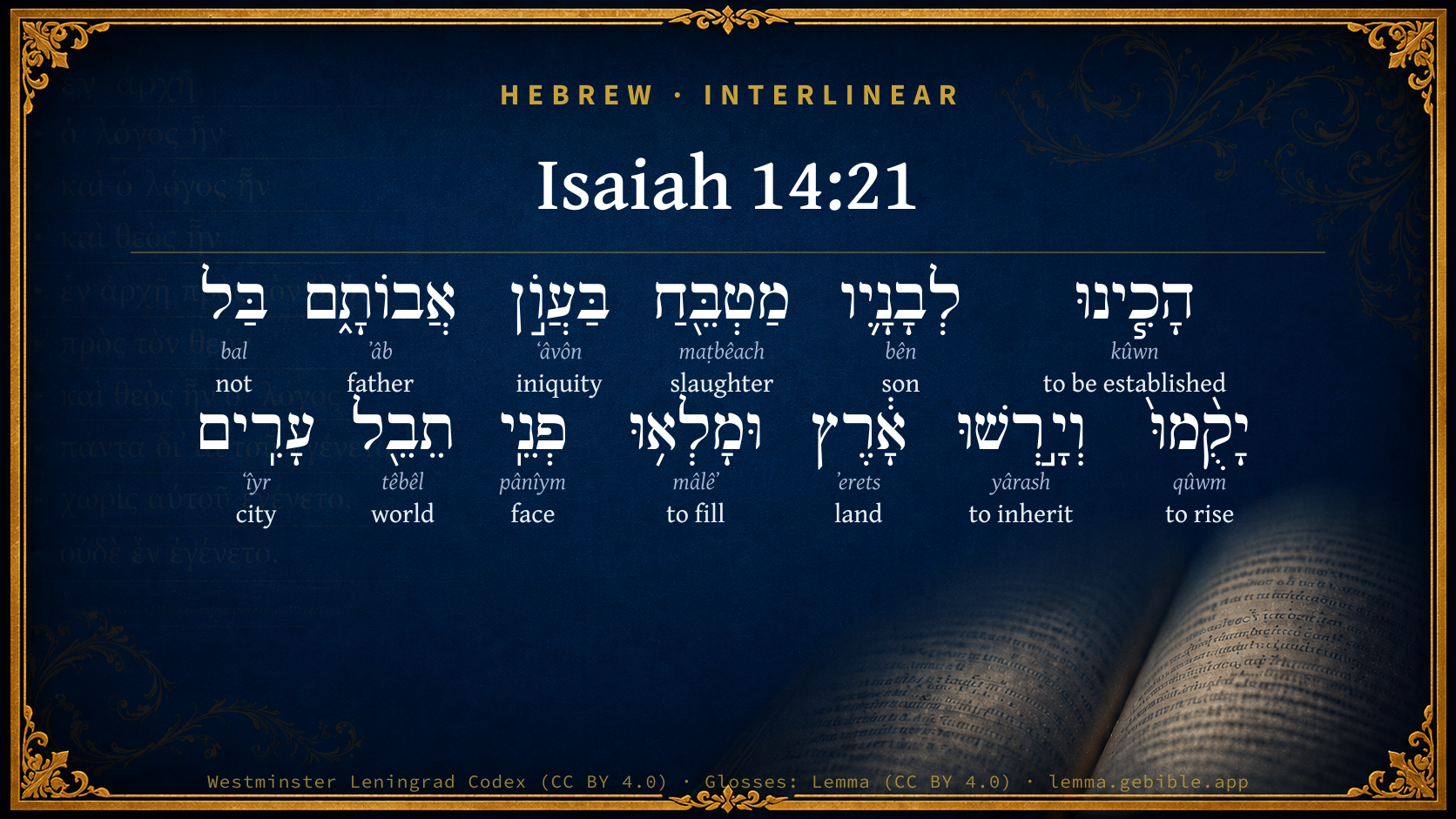
Hebrew (Westminster Leningrad Codex) Isaiah 14:21 appears in the Hebrew Old Testament. The text above is from the Westminster Leningrad Codex. Each word links to its Strong’s number, a concise gloss, and parsing drawn from the Open Scriptures Hebrew Bible morphology. Click any word for its full Brown-Driver-Briggs (BDB) entry.
Download image
Cite this verse

Isaiah 14:21 (World English Bible). Public Domain. Lemma interlinear Bible study tool, https://lemma.gebible.app/v/isaiah/14/21.

Show BibTeX & RIS
BibTeX
RIS
English Translation
Prepare slaughter for his children for the iniquity of their fathers, that they not rise up, and possess the earth, and fill the surface of the world with cities.
World English Bible · Public Domain
Highlights
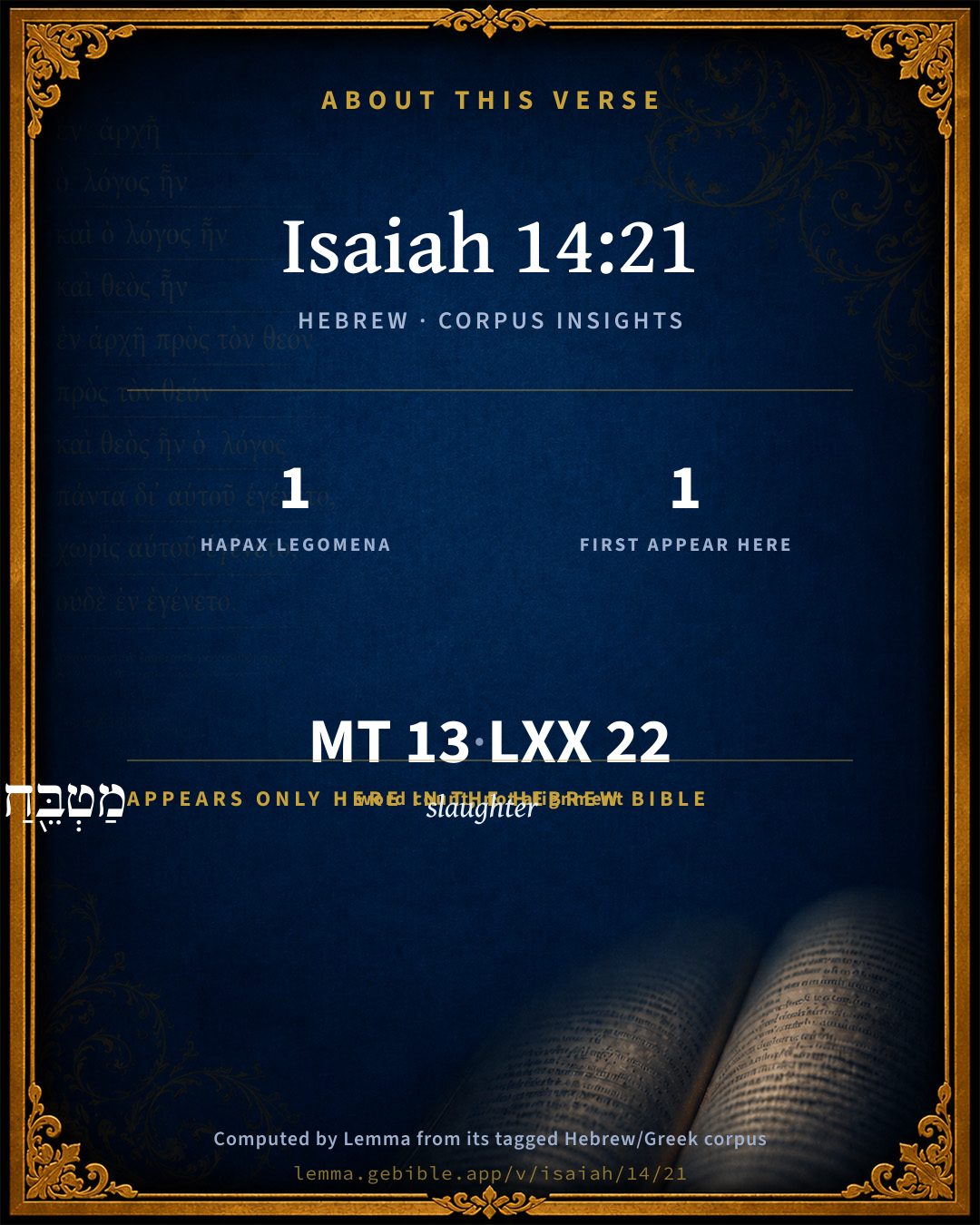
  • 1 hapax legomenon — only here in the Hebrew Bible
  • 1 first appearance in the Hebrew Bible
Full analysis ↓
Download a study sheet

One document with this verse’s original text, its word-by-word gloss line, the meaning frame, cross-references with their text, attributed commentary, and full source and license credits — printable, and it pastes into notes with its structure intact.

This verse Autodidact and up

Study sheet (.html) Plain text (.txt)

A passage Seminary Student

Up to 50 verses in one chapter. A passage sheet keeps up to 6 commentary sources and 12 cross-references per verse, in the order this page ranks them, and says so on the sheet whenever that leaves anything out. Ask for a single verse and you get the Autodidact verse sheet above.

Everything on this page stays free to read, with no account — the sheet is a download of what is already on screen, not access to it.

Want to remove ads? Support Godless Engineer
Compare translations 3

The same verse in 3 English versions, stacked beneath the original-language interlinear above. Click any original word for its lexicon entry.

Each is an independent rendering of the whole verse — the interlinear is not word-aligned to these translations.

Highlighted words mark where these versions differ — a whole-verse word diff, not a word-by-word alignment.

  • World English Bible Public Domain
    Prepare slaughter for his children for the iniquity of their fathers, that they not rise up, and possess the earth, and fill the surface of the world with cities.
  • King James Version Public Domain
    Prepare slaughter for his children for the iniquity of their fathers; that they do not rise, nor possess the land, nor fill the face of the world with cities.
  • unfoldingWord Literal Text CC BY-SA 4.0
    Prepare a slaughter for his sons for the iniquity of their fathers, lest they arise and possess the earth and fill the face of the world cities.”

unfoldingWord Literal Text — © unfoldingWord, licensed CC BY-SA 4.0. Word-aligned USFM3 via Door43 (git.door43.org/unfoldingWord/en_ult).

Versions to compare (up to 4)

3 of 4 selected

Show all 18 translations

Every available English version of this verse, each an independent rendering of the whole verse.

  • World English Bible Public Domain
    Prepare slaughter for his children for the iniquity of their fathers, that they not rise up, and possess the earth, and fill the surface of the world with cities.
  • Berean Standard Bible Public Domain
    Prepare a place to slaughter his sons for the iniquities of their forefathers. They will never rise up to possess a land or cover the earth with their cities.
  • Majority Standard Bible Public Domain
    Prepare a place to slaughter his sons for the iniquities of their forefathers. They will never rise up to possess a land or cover the earth with their cities.
  • King James Version Public Domain
    Prepare slaughter for his children for the iniquity of their fathers; that they do not rise, nor possess the land, nor fill the face of the world with cities.
  • American Standard Version (1901) Public Domain
    Prepare ye slaughter for his children for the iniquity of their fathers, that they rise not up, and possess the earth, and fill the face of the world with cities.
  • Revised Version (1885) Public Domain
    Prepare ye slaughter for his children for the iniquity of their fathers; that they rise not up, and possess the earth, and fill the face of the world with cities.
  • Geneva Bible (1599) Public Domain
    Prepare a slaughter for his children, for the iniquitie of their fathers: let them not rise vp nor possesse the land, nor fil the face of the world with enemies.
  • Douay-Rheims (1899) Public Domain
    Prepare his children for slaughter for the iniquity of their fathers: they shall not rise up, nor inherit the land, nor fill the face of the world with cities.
  • Young's Literal Translation Public Domain
    Prepare ye for his sons slaughter; Because of the iniquity of their fathers, They rise not, nor have possessed the land, Nor filled the face of the world `with' cities.
  • Literal Standard Version CC BY-SA 4.0
    Prepare slaughter for his sons; Because of the iniquity of their fathers, || They do not rise, nor have possessed the land, || Nor filled the face of the world [with] cities.
  • Unlocked Literal Bible CC BY-SA 4.0
    Prepare your slaughter for his children, for the iniquity of their ancestors, so they will not rise up and possess the earth and fill the whole world with cities.
  • unfoldingWord Literal Text CC BY-SA 4.0
    Prepare a slaughter for his sons for the iniquity of their fathers, lest they arise and possess the earth and fill the face of the world cities.”
  • Darby Bible Public Domain
    Prepare ye slaughter for his children, because of the iniquity of their fathers; that they may not rise up and possess the earth, nor fill the face of the world with cities.
  • World Messianic Bible Public Domain
    Prepare for slaughter of his children because of the iniquity of their fathers, that they not rise up and possess the earth, and fill the surface of the world with cities.
  • Webster's Bible Public Domain
    Prepare slaughter for his children for the iniquity of their fathers; that they may not rise, nor possess the land, nor fill the face of the world with cities.
  • Free Bible Version CC BY-SA 4.0
    Get ready to execute his sons because of their fathers' sins. Don't let them take over the earth; don't let them fill the whole world with their cities.
  • Bible in Basic English Public Domain
    Make ready a place of death for his children, because of the evil-doing of their father; so that they may not come up and take the earth for their heritage, covering the face of the world with waste places.
  • JPS Tanakh (1917) Public Domain
    Prepare ye slaughter for his children for the iniquity of their fathers; that they rise not up, and possess the earth, and fill the face of the world with cities.

Literal Standard Version (2020), Covenant Press — licensed CC BY-SA 4.0. Text via the HelloAO Bible API (eBible.org). Unlocked Literal Bible (unfoldingWord) — licensed CC BY-SA 4.0. Text via the HelloAO Bible API (eBible.org). unfoldingWord Literal Text — © unfoldingWord, licensed CC BY-SA 4.0. Word-aligned USFM3 via Door43 (git.door43.org/unfoldingWord/en_ult). Free Bible Version, Dr. Jonathan Gallagher — licensed CC BY-SA 4.0. Text via the HelloAO Bible API (eBible.org).

Word by word

More ways to search: Search by grammar → Find every occurrence → Compare this word →

Practice this passage: Drill this verse → Learn its vocabulary →

מַטְבֵּ֖חַ
maṭbêach
H4293
“slaughter”
Noun, Common, Masculine, Singular, Absolute
Part of Speech
Noun
Type
Common
Gender
Masculine
Number
Singular
State
Absolute
Full BDB Definition

Origin: from H2873

TWOT: 786e

slaughtering place, slaughter
  1. הָכִ֧ינוּ kûwn H3559 “be established” Verb, Hiphil, Imperative, 2nd Person, Masculine, Plural
  2. לְבָנָ֛יו bên H1121 “to/for · sons · his” Preposition + Noun, Common, Masculine, Plural, Construct + Suffix, Personal, 3rd Person, Masculine, Singular
  3. בַּעֲוֺ֣ן ʻâvôn H5771 “in/at · iniquity of” Preposition + Noun, Common, Both, Singular, Construct
  4. אֲבוֹתָ֑ם ʼâb H1 “fathers · their” Noun, Common, Masculine, Plural, Construct + Suffix, Personal, 3rd Person, Masculine, Plural
  5. בַּל bal H1077 “not” Particle, Negative
  6. יָקֻ֨מוּ֙ qûwm H6965 “to rise” Verb, Qal, Imperfect, 3rd Person, Masculine, Plural
  7. וְיָ֣רְשׁוּ yârash H3423 “and · to inherit” Conjunction + Verb, Qal, Sequential Perfect, 3rd Person, Common, Plural
  8. אָ֔רֶץ ʼerets H776 “land” Noun, Common, Both, Singular, Absolute
  9. וּמָלְא֥וּ mâlêʼ H4390 “and · to fill” Conjunction + Verb, Qal, Sequential Perfect, 3rd Person, Common, Plural
  10. פְנֵֽי pânîym H6440 “face(s) of” Noun, Common, Both, Plural, Construct
  11. תֵבֵ֖ל têbêl H8398 “world” Noun, Common, Feminine, Singular, Absolute
  12. עָרִֽים ʻîyr H5892 “cities” Noun, Common, Feminine, Plural, Absolute

About this verse

These counts appear in no published source. They are computed here, from the morphology-tagged text and Lemma’s own curated glosses. What Lemma adds →

13
words
13
distinct lemmas
Prophets
section

Notable vocabulary

1 hapax legomenon — a word that appears only here in the entire Hebrew Bible:

  • מַטְבֵּ֖חַ slaughter H4293

First appearance in Scripture

This word makes its first canonical appearance in the Hebrew Bible here:

  • מַטְבֵּ֖חַ slaughter H4293

Shared distinctive vocabulary

תֵבֵ֖ל world H8398 occurs in 36 verses of the Hebrew Bible. Also found in:

Grammatical profile

  • 4 verbs
  • 8 nouns
  • 1 particle

Verb forms

  • הָכִ֧ינוּ Hiphil · Imperative
  • יָקֻ֨מוּ֙ Qal · Imperfect
  • וְיָ֣רְשׁוּ Qal · Sequential Perfect
  • וּמָלְא֥וּ Qal · Sequential Perfect

Hebrew & Septuagint length

In English translation the verse runs 29 words from the Hebrew and 26 from the Septuagint (LXX English) — closely comparable.

A rough comparison of the two English renderings, which tokenize alike — not a word-level alignment.

Word counts can differ between the Hebrew and the Greek without any difference in meaning — e.g. the Hebrew direct-object marker אֵת has no separate Greek word, and Greek often adds the article ὁ.

In the original languages it is 13 Hebrew tokens and 22 Greek tokens — but the two are counted differently (Hebrew bundles its prefixes and suffixes into one token; the Greek is in lemma form), so that isn’t a like-for-like length.

Cross-references

5

Topical passages linked to Isaiah 14:21 in the Treasury of Scripture Knowledge — connected by theme and wording, ordered by reader-vote popularity; previews shown in the World English Bible.

  • Exodus 20:5 you shall not bow yourself down to them, nor serve them, for I, Yahweh your God, am a jealous God, visiting the iniquity of the fathers on the children, on the third and on the fourth generation of those who hate me,
  • Leviticus 26:39 Those of you who are left will pine away in their iniquity in your enemies' lands; and also in the iniquities of their fathers shall they pine away with them.
  • Habakkuk 2:8–12 Because you have plundered many nations, all the remnant of the peoples will plunder you, because of men's blood, and for the violence done to the land, to the city and to all who dwell in it.
  • Matthew 23:35 that on you may come all the righteous blood shed on the earth, from the blood of righteous Abel to the blood of Zachariah son of Barachiah, whom you killed between the sanctuary and the altar.
  • Isaiah 27:6 In days to come shall Jacob take root; Israel shall blossom and bud; and they shall fill the surface of the world with fruit.

Cross-references courtesy of OpenBible.info (CC BY 4.0).

Hebrew and Greek witnesses Masoretic Hebrew ↔ Greek Septuagint

The same verse in the two great witnesses to the Old Testament, shown verse-for-verse.

These are two independent witnesses, not word-aligned to each other, and the Septuagint is shown in lemma (dictionary) form.

Hebrew Isaiah 14:21 Masoretic · Westminster Leningrad Codex

הָכִ֧ינוּ לְבָנָ֛יו מַטְבֵּ֖חַ בַּעֲוֺ֣ן אֲבוֹתָ֑ם בַּל יָקֻ֨מוּ֙ וְיָ֣רְשׁוּ אָ֔רֶץ וּמָלְא֥וּ פְנֵֽי תֵבֵ֖ל עָרִֽים

Prepare slaughter for his children for the iniquity of their fathers, that they not rise up, and possess the earth, and fill the surface of the world with cities.

World English Bible · Public Domain

Greek LXX Isaiah 14:21 Septuagint · lemma form

ἑτοιμάζω ὁ τέκνον σύ σφάζω ὁ ἁμαρτία ὁ πατήρ σύ ἵνα μή ἀναἵστημι καί ὁ γῆ κληρονομέω καί ἐνπίμπλημι ὁ γῆ πόλις

Prepare your children to be slain for the sins of their father; that they arise not, and inherit the earth, nor fill the earth with wars.

LXX2012 (modern English Septuagint) · Public Domain

On this verse, Joseph Benson's Commentary discusses the Septuagint’s reading. Read the note in Commentary ↓

Hebrew: Westminster Leningrad Codex (CC BY 4.0). Greek: Septuagint (public domain); English from LXX2012 (modern English Septuagint) (Public Domain). How the Septuagint differs from the Hebrew →

Targum (Aramaic paraphrase)

1

The Targum is the ancient Jewish Aramaic paraphrase of the Hebrew Scriptures — an interpretive translation, not the Hebrew text itself. Onkelos (literal) and Pseudo-Jonathan (expansive) render the Torah, and Jonathan the Prophets. Coverage is partial: where no permissively-licensed English translation exists for a verse, only the Aramaic is shown. This is verse-level text, not a word-by-word alignment to the Hebrew.

  1. Targum Jonathan Prophets (Joshua–Malachi)
    אַתְקִינוּ לִבְנֵיהוֹן קִטוֹל בְּחוֹבַי אֲבָהַתְהוֹן דִלְמָא יְקוּמוּן וְיַחְסְנוּן אַרְעָא וְיִתְמְלוּן אַפֵּי תֵבֵל בְּעֵיל דְבָבוּ:

    Prepare ye slaughter for his children, for the iniquity of their fathers; lest they rise and possess the earth, and the faces of the world be filled with enemies.

    Targum Jonathan — Aramaic: “Mikraot Gedolot” (public domain). English: “Sefaria Community Translation” (CC0 1.0 (public-domain dedication)); “London "Chaldee Paraphrase," 1871” (public domain). Text via Sefaria.

Commentary

Notes on Isaiah 14:21 from classic Christian and Jewish commentators (each source and its license shown beneath its notes). The classic Christian expositions comment on the surrounding passage and are grouped to its opening verse, so a note may address several verses; the Jewish commentaries on the Tanakh (Rashi and others) are per-verse, so they appear only where the commentator wrote on this verse.

Lemma curates 59 commentaries, every one of them public domain or Creative Commons licensed, each selected and text-cleaned for this edition rather than reprinted as found. About our sources →

Jamieson, Fausset & Brown

Robert Jamieson, A. R. Fausset & David Brown

GOD'S DETERMINATION TO DESTROY BABYLON. (Isa 14:21-23)

Prepare, &c.--charge to the Medes and Persians, as if they were God's conscious instruments.

his children--Belshazzar's (Exo 20:5).

rise--to occupy the places of their fathers.

fill . . . with cities--MAURER translates, "enemies," as the Hebrew means in Sa1 28:16; Psa 139:20; namely, lest they inundate the world with their armies. VITRINGA translates, "disturbers." In English Version the meaning is, "lest they fill the land with such cities" of pride as Babylon was.

Jamieson, Fausset & Brown — Commentary Critical and Explanatory on the Whole Bible (1871) — public domain (CC PDM 1.0). Text via the HelloAO Bible API.

Trapp's Complete Commentary

John Trapp

Isa 14:21 Prepare slaughter for his children for the iniquity of their fathers; that they do not rise, nor possess the land, nor fill the face of the world with cities.

Ver. 21. Prepare another slaughter for his children.] For Belshazzar’s posterity. This is God’s charge to the Medes and Persians. See on Isa 14:20.

John Trapp, A Commentary or Exposition upon All the Books of the Old and New Testament (1647–1656) — public domain. Text from a community e-Sword module.

Joseph Benson's Commentary

Isa 14:21-23. Prepare slaughter for his children — O ye Medes and Persians, cut off all the branches of the royal family. This, it is probable, was actually done, for Belshazzar being slain, and the monarchy translated to the people last mentioned, it is not likely that any related to the family of the former monarchs were suffered to survive. That they do not rise, nor possess the land — Not recover their former power, nor fill the face of the world with cities — “It was the ambition of the great monarchs of those times, to build new cities, and call them by their own names, thereby to perpetuate their memory. Hence the cities took their rise, which were called by the names of Seleucia, Ptolemais, Alexandria, &c. Some render the latter part of the verse, Nor fill the face of the world with enemies, such as should continue a succession of war and bloodshed, and disturb the peace and quiet of mankind.” — Lowth. I will cut off from Babylon the name, &c. — The remembrance of those that are dead, and the persons of those who yet survive. I will make it a possession for the bittern — A great water-fowl, which delights in solitary places, as also in watery grounds, such as those were about Babylon. And pools of water — The ground about Babylon was of itself very moist, because of the great river Euphrates running by it, which was kept from overflowing the country with charge and labour; this being neglected, when the city was destroyed, it was easily turned into pools of water. And I will sweep it with the besom of destruction — I will make a clear riddance of all its wealth and substance: see similar expressions 2Ki 21:13. Bishop Lowth translates this clause nearly according to the version of the LXX. And I will plunge it in the miry gulf of destruction, saith Jehovah, God of hosts.

Joseph Benson's Commentary on the Old and New Testaments (1811–1818) — public domain. Text from a community e-Sword module.

Tyndale Open Study Notes

Tyndale Open Resources

14:21 As another sign of disgrace, the king of Babylon would have no children to provide a future legacy. • because of their father’s sins: God looks at individuals in relationship to their families and their people. Here, the Babylonian king’s children had joint responsibility for their father’s actions (see also Deut 5:9-10).

Tyndale Open Study Notes — © Tyndale Open Resources, licensed CC BY-SA 4.0. Text via the HelloAO Bible API.

Geneva Bible (1599)

Geneva Bible translators

He called to the Medes and Persians, and all those that should execute God’s vengeance.

Geneva Bible (1599) marginal notes — public domain. Text via Bolls.life.

Ellicott's Commentary for English Readers

(21) Prepare slaughter for his children.—Literally, as in Jer_51:40, a slaughter house. The command may be addressed to the Medes of Isa_13:17, or to any minister of the Divine vengeance. In the judgment of God, as seen in history, that judgment falls necessarily on the last members of an evil and cruel dynasty. In this sense the sins of the fathers are visited on the children, while, in the eternal judgment which lies behind the veil, each single soul stands, as in Eze_18:4, on its own personal responsibility, and may win pardon for itself. Penitent or impenitent (and the latter seems here implied), the children of the evil-doers should cease to be conquerors and rulers.

Nor fill the face of the world with cities.—The words describe the boast of the great monarchs, who, like Nimrod, built cities to perpetuate their fame. (Comp. Gen_10:10-12; Dan_4:30.) The Babylonian and Assyrian kings record their destructive and constructive work with equal exultation (Records of the Past, v., pp. 80, 119, 123). Various readings have been suggested, giving ruined heaps, or terrible ones, or enemies, or conflicts; but there seems no need for any change.

A Bible Commentary for English Readers, edited by Charles John Ellicott (1878–1897) — public domain. Text from a community e-Sword module.

The Cambridge Bible for Schools and Colleges

gen. ed. J. J. S. Perowne

21. slaughter] a place of slaughter (R.V. marg.).

that they do not rise … land] R.V. that they rise not up, and possess the earth.

full the face of the world with cities] This could hardly be reckoned a crime, for it would be undoing the wrong that their father had wrought (Isa_14:17). Some render “enemies” or gain that sense by an emendation. Others change the word ‘ârîm (cities) into ‘iyyîm (ruined heaps). The easiest correction is simply to omit the word, the sense being complete without it.

The elegy ends here.—The passage just considered (Isa_14:9-20) bears a close resemblance to Ezekiel’s dirge over the fall of Pharaoh and his host (Eze_32:19 ff.). Many questions of great interest and importance are suggested by both. The most important is how far such representations are to be taken as expressing the fixed belief of the writers or their age with regard to the state after death. Their affinities with Babylonian speculation on that subject, taken in connexion with the fact that such elaborate descriptions of the underworld do not occur before the Exile, may indicate that the imagination of the writers had been influenced by their contact with the religion of their conquerors. In that case it may be reasonable to suppose that they freely availed themselves of the material thus laid to their hand merely as poetic imagery, without meaning to attribute strict objective reality to all the conceptions. At the same time there was a common basis of belief underlying the Hebrew and Babylonian ideas regarding the future state, and all that is essential to the understanding of this passage was probably familiar to the minds of the Israelites before the Exile. In the conception as here presented the following points are to be noted. (1) Sheol, which is figured as a vast subterranean region, is the common gathering-place of all the dead. They exist there as shades, rìphâ’îm (Isa_14:9), a word which is usually explained to mean “feeble ones,”—weak, pithless adumbrations of the living form. These are represented as capable of being roused to a transient interest in human affairs by the arrival amongst them of so distinguished a personage as the king of Babylon; but their ordinary condition is one of utter inactivity, a sort of conscious death rather than life. It is true that the writer speaks only of kings and potentates, and throws little light on the state of the common man after death. Still the Old Testament as a whole knows nothing of separate spheres of existence for the righteous and for the wicked, and that idea is certainly not to be imported into the present passage. (2) We seem to find a clear trace of the antique notion that the lot of the shade in Sheol depends on the fate of the body on earth. The kings who have received due interment sit each on his throne retaining the semblance of their former greatness, while he who was “cast forth away from his sepulchre” is relegated to the “recesses of the pit.” This, however, is connected with the conviction that the fate of the body is not accidental; a dishonoured death expresses the final judgment of God on a career of exceptional wickedness. And it is this judgment of God, executed on earth, which is regarded as reflected and perpetuated in the condition of the disembodied spirit. (3) In this way the idea of retribution is extended to the other world. There is indeed an essential difference between the application of the principle here given and that to which a fuller revelation has led us. As we have seen, the retribution here spoken of is only the counterpart of a retribution already manifest on earth, whereas we have learned to look to the future life to redress the inequalities of the present, and to bring about a perfect correspondence between character and destiny, never realised in this world.

The Cambridge Bible for Schools and Colleges (gen. ed. J. J. S. Perowne; Cambridge University Press, 1878–1918) — public domain. Text from a community e-Sword module.

John Gill's Exposition

Prepare slaughter for his children,.... These words are directed to the Medes and Persians, to prepare instruments of slaughter, and make use of them; and prepare themselves for the slaughter of the whole royal family, Belshazzar and all his children. So it is threatened to Jezebel, or the Romish antichrist, that all her children should be killed with death, Rev 2:23,

for the iniquity of their fathers; they imitating and following them in their sins, partaking of them, and filling up the measure of their iniquities:

that they do not rise, nor possess the land; stand up and succeed him in the government of the land, as their inheritance:

nor fill the face of the world with cities; as their ancestors had done, which were built by them to perpetuate their name and glory, and to keep the nations in awe subdued by them. The Targum renders it, "with enemies"; which is followed by Aben Ezra, Jarchi, and Kimchi; and so the Septuagint, Syriac, and Arabic versions, "with wars"; to the great disturbance of the peace of the world, and to the disquietude of the inhabitants of it; which is a great plague to the world, and a judgment in it.

John Gill's Exposition of the Whole Bible (1746–1763) — public domain (CC PDM 1.0). Text via the HelloAO Bible API.

Albert Barnes' Notes on the Bible

Prepare slaughter for his children - That is, cut them off not only from inheriting the honor of their father, but from life. This command seems to be directed to the Medes and Persians, and denotes that they would thus cut off his children.

For the iniquity of their fathers - On account of the crimes of their ancestors - the pride, haughtiness, and oppression of the kings of Babylon. This is the statement of a general principle of the divine administration, that the consequences of crime often pass over from the perpetrator, and impinge on his descendants (see Exo 20:5).

That they do not rise - That they do not rise to occupy the places of their fathers; that they be degraded and reduced from their elevation and honored.

Nor fill the face of the world with cities - The Septuagint renders this, ‘And fill the land with wars.’ The Chaldee, ‘And fill the face of the world with “enemies.”’ The Syriac, ‘And fill the face of the earth with war.’ These versions evidently took the word ערים ‛ārı̂ym to mean “enemies” or “wars” - a sense which the word sometimes may have. But the common interpretation is to be preferred. The apprehension was, that they would fill the land, if they lived, with such cities of pride, magnificence, and wickedness, as “Babylon” was, and that thus crimes would be multiplied and prolonged; and hence, the purpose of God was not only to cut off Babylon - the “model” of all cities of arrogance and pride - but also to cut off those who would be disposed to rear similar cities, and to fill the land again with crime.

Albert Barnes' Notes on the Bible (1834–1885) — public domain. Text from a community e-Sword/MySword module.

Matthew Poole's English Annotations

Prepare slaughter for his children; O ye Medes and Persians, cut off all the branches of the royal family of Babylon.

For the iniquity of their fathers; in the guilt whereof the children are justly involved, partly because of that community of nature and interest which is between parents and children, which makes them for the most part bear a share with them, as in their rewards and advantages, so also in their punishments and miseries; and partly because they justified their sins by their impenitency, and imitation of their wicked example.

Do not rise, i.e. not recover their former splendour and power.

With cities; erected by them, either as instruments of tyranny, to keep the country round about them in slavery, or as monuments of their power and riches, as Babylon was, Dan 4:30.

Matthew Poole's English Annotations on the Holy Bible (1683–1685) — public domain. Text from a community e-Sword/MySword module.

Whedon's Commentary on the Bible

Daniel D. Whedon

21. Prepare slaughter for his children — Such is the impulse of inexorable sentiment with the Oriental to this day; and such, too, the reasons for it as are here given. In this case the iniquity of their fathers was judicially visited upon their children. This is considered as prophetically addressed to the Medes, if to any people in particular.

Daniel D. Whedon (gen. ed.), Commentary on the Old and New Testaments (1874–1909) — public domain. Text from a community e-Sword module.

The Pulpit Commentary

Prepare slaughter for his children. Belshazzar had "wives and concubines", (Dan_5:2) and therefore probably children. The magnanimity of Cyrus may have spared them; but neither Cambyses nor Darius Hystaspis had the same merciful disposition. As soon as there was seen to be danger of Babylon revolting, they would almost certainly be put to death. For the iniquity of their fathers. (comp. Exo_20:5) The destruction of their posterity was a part of the punishment of the fathers. That they do not rise; i.e. "that they do not recover themselves and become great monarchs once more, and once more build great cities, "such as those which they were famous for Babel, Erech, Accad, Calneh, Ur, Sepharvaim, Borsippa, Opts, Teredon, etc. It was as city-builders that the Babylonians were especially celebrated. (Gen_10:10 Dan_4:30; Herod., 1:178, etc.)

Children suffering for the fathers.

The idea finding poetical expression here is, that the judgments of God necessarily fall on the last members the children-of a corrupt and wicked dynasty. It is in the public and open administrations of providence, it is in the events and circumstances and history of this world, and not in the secret dealings of God with each individual soul, that the law of this text applies. For the sake of moral influence upon the whole race, children are seen to suffer for their parents" wrongdoing. But no children can bear, before God, the burden of their parents" guilt. The law of the children suffering, generation after generation, belongs to the solidarity of the race. But that is a purely material conception. Souls are individual, and every soul must bear entirely its own burden. It may share, it can share, no one else"s. "So, then, each one of us must give account of himself to God." This truth may be fully illustrated along the following line.

I CHILDREN SUFFERING FOR THE FATHERS IS A PHYSICAL LAW. Much has recently been discovered concerning the law of heredity, but only the fringe of a great subject has yet been touched. No greater calamity rests on men than the bodily bias and tendency given by diseased or degraded parentage. The familiar illustration is drunkenness; the fact equally applies to other sins.

II CHILDREN SUFFERING FOR THE FATHERS IS A MORAL CONDITION. That is, as an established and recognized fact it is designed to be a moral power on parents. It is a persuasion to righteousness for the children"s sake. No higher moral force on affectionate natures can be provided than this consideration, "You physically injure those whom you love best, if you are self-indulgent.

III CHILDREN SUFFERING FOR THE FATHERS IS A DIVINE JUDGMENT. Striking men in one of their tenderest places. Men would bear an extreme of suffering, if they might bear it all themselves; but it is terrible to think that they drag their children under, and the weight will crush them. Only let us see quite clearly, that it is the disability and the suffering of sin, but not the guilt of it, which thus passes from generation to generation. R.T.

The Pulpit Commentary (1880–1919), ed. H.D.M. Spence-Jones & Joseph S. Exell — public domain. Text from a community e-Sword module.

John Wesley's Explanatory Notes

Children - Cut off all the branches of the royal family. Rise - Not recover their former power.

John Wesley, Explanatory Notes Upon the Whole Bible (1754–1765) — public domain. Text via the GEBible commentary corpus.

Keil & Delitzsch

C. F. Keil & F. Delitzsch

"Prepare a slaughter-house for his sons, because of the iniquity of their fathers! They shall not rise and conquer lands, and fill the face of the earth with cities." They exhortation is addressed to the Medes, if the prophet had any particular persons in his mind at all. After the nocturnal storming of Babylon by the Medes, the new Babylonian kingdom and royal house which had been established by Nabopolassar vanished entirely from history. The last shoot of the royal family of Nabopolassar was slain as a child of conspirators. The second Nebuchadnezzar deceived the people (as Darius says in the great inscription of Behistan), declaring, "I am Nabukudrac ara the son of Nabunita." בּל (used poetically for אל, like בּלי in Isa 14:6 for לא) expresses a negative wish (as pen does a negative intention): Let no Babylonian kingdom ever arise again! Hitzig corrects ערים into עיּים (heaps of ruins), Ewald into עריצים (tyrants), Knobel into רעים, and Meier into עדים, which are said to signify conflicts, whilst Maurer will not take ערים in the sense of cities, but of enemies. But there is no necessity for this at all. Nimrod, the first founder of a Babylonio-Assyrian kingdom, built cities to strengthen his monarchy. The king of Asshur built cities for the Medes, for the purpose of keeping them better in check. And it is to this building of cities, as a support to despotism, that the prophet here refers.

Keil & Delitzsch — Biblical Commentary on the Old Testament (1861–1891) — public domain (CC PDM 1.0). Text via the HelloAO Bible API. (Old Testament only.)

J. A. Alexander on Isaiah

Joseph Addison Alexander

That the downfall of the Babylonian power shall be perpetual, is now expressed by a command to slaughter the children of the king. “Prepare for his sons a slaughter, for the iniquity of their fathers. Let them not arise and possess the earth, and fill the face of the world with cities.” The dramatic form of the prediction is repeatedly shifted, so that the words of the triumphant Jews, of the Dead, of the Prophet; and of God himself, succeed each other as it were insensibly, and without any attempt to make the points of the transition prominent. The command in the first clause is not addressed specifically to the Medes and Persians, but more indefinitely to the executioners of God’s decree against Babylon. The Hebrew construction is, they shall not arise (or let them not arise), and the negative may either be confined to the first two verbs or extended to the third. The last, however, is more natural on account of the exact resemblance in the form of the two members. The best sense, on the whole, is afforded by the old interpretation which understands the clause to mean, lest they overspread and colonize the earth.

Joseph Addison Alexander, The Prophecies of Isaiah (1846–1847; New York: Scribner, 1870–1878) — public domain. Text from a community e-Sword module.

unfoldingWord translationNotes

Door43 World Missions Community

Prepare your slaughter for his children

This can be reworded so that the abstract noun "slaughter" is expressed with the verb "kill." AT: "Get ready to kill the children of the king of Babylon" (See: Abstract Nouns)

for the iniquity of their ancestors

This can be reworded so that the abstract noun "iniquity" is expressed as the verb "sinned greatly." AT: "because their forefathers have sinned greatly" (See: Abstract Nouns)

so they will not rise up

Here "rise up" represents either becoming powerful or attacking. AT: "so they will not become powerful" or "so they will not attack" (See: Metonymy)

possess the earth

This represents taking control of the people on the earth, in this case by conquering them. AT: "take control of the peoples on the earth" or "conquer the peoples on the earth" (See: Metaphor)

fill the whole world with cities

This represents causing the world to have many cities on it. AT: "build cities all over the world" (See: Metaphor)

I will rise up against them

This means that God will do something against them. The word "them" refers to the people of Babylon. AT: "I will attack them" or "I will send people to attack them" (See: Metonymy)

this is the declaration of Yahweh of hosts

Yahweh speaks of himself by name to express the certainty of what he is declaring. AT: "this is what Yahweh of hosts has declared" or "this is what I, Yahweh of hosts, have declared" (See: First, Second, or Third Person)

Yahweh of hosts

See how you translated this in Isaiah 1:9.

I will cut off from Babylon name, descendant, and posterity

"Cut off" represents destroying. Here "Babylon" refers to the people of Babylon. Also, "name" refers either to Babylon's fame or to Babylon itself as a kingdom. AT: "I will destroy Babylon, along with the people's children and grandchildren" (See: Metonymy)

I will also make her

The word "her" refers to the city of Babylon. Cities were often spoken of as if they were women. AT: "I will also make it" (See: Personification)

a possession of owls

This represents wild animals living in the city because there are no people there. AT: "a place where owls live" or "a place where wild animals live" (See: Metaphor)

into pools of water

Causing there to be swamps or ponds of stagnant water where the city was is spoken of as making the city into those things. AT: "into a place where there are stagnant ponds" (See: Metaphor)

I will sweep her with the broom of destruction

This represents completely destroying Babylon and making it no longer exist as if it is worthless dirt that people sweep away. AT: "I will destroy it completely, like sweeping it away with a broom" (See: Metaphor)

translationWords

children

iniquity

earth

world

declare

Yahweh of hosts

cut off

Babylon

name

descend

unfoldingWord translationNotes — © Distant Shores Media and the Door43 World Missions Community, licensed CC BY-SA 4.0. Source: git.door43.org/Door43/en_tn.

Rashi

Rabbi Shlomo Yitzchaki (Rashi)

Prepare a slaughter for his sons lest they rise and inherit the land, and the land will be filled with enemies and oppressors. So did Jonathan render עַָרִים, enemies. Comp. (I Sam. 28:16) “And has become your adversary (עָרֶךְ).” It can also be interpreted: And fill the surface of the earth with cities. In contrast with what he said before (verse 17): “Who made the land like a desert and demolished his cities,” he says further: His seed shall perish, and the inhabitants of the cities shall return to their place, and the surface of the earth shall be filled with cities.

Rashi on the Tanakh — English translations: “The Judaica Press complete Tanach with Rashi, translated by A. J. Rosenberg” (CC BY 4.0); “Pentateuch with Rashi's commentary by M. Rosenbaum and A.M. Silbermann, 1929-1934” (public domain); “The Metsudah Tanach series, Lakewood, N.J” (CC BY 4.0); and “The Book of Joshua, Metsudah Publications, 1997” (CC BY 4.0). Text via Sefaria.

Ibn Ezra

Rabbi Abraham ibn Ezra

To his sons. To Belshazzar and his whole family.

Their fathers. His father Evil Merodach and his grandfather Nebuchadnezzar.

ערים Enemies. עיר═ציר messenger; ארע ═ ארץ earth. A. V., Cities. Comp. ערך thine enemy (1 Sam. 28:16). ומלאו וגו׳ Nor fill, etc. For they would stir up hatred everywhere; ולא מלאו═ומלאו. According to others: the face of the world will then be filled with cities, because the Babylonian kings will no longer be the masters of the earth.

Ibn Ezra on the Tanakh — English translations: “Sefaria Community Translation” (CC0 1.0 (public-domain dedication)); “Yalkut, Sifsei Chachomim Chumash, Metsudah Publications, 2009” (CC BY 4.0); and “Commentary of Ibn Ezra on Isaiah - trans. by M. Friedlander, 1873” (public domain). Text via Sefaria.

Lesson kit

Teaching starters — assembled from the data on this page, not authored interpretation. Every prompt links to the verse data it draws on. Edit before teaching.

Isaiah, in the Prophets, opens this verse with 13 words (13 distinct Hebrew lemmas). Its most distinctive word is maṭbêach (“slaughter”). A historical commentator’s framing appears above. Read the whole chapter for the surrounding context.

Discussion questions

  1. How does “slaughter” (maṭbêach) shape what this verse is saying?
  2. 1 word here appears nowhere else in the Hebrew Bible. Why might the author reach for such rare wording?
  3. This is the first place “slaughter” appears in Scripture (first appears here). What does its debut here establish?
  4. How does 1 Samuel 2:8, which shares the word «world», read alongside this verse?
  5. These translations render this verse differently; the difference is in the English rendering, not the original. What questions does that raise?
  6. «הָכִ֧ינוּ» is a Hiphil Imperative verb. How does that grammatical form shape the action described?
  7. Compare how Jamieson, Fausset & Brown and Trapp's Complete Commentary read this verse. Where do they agree or differ?

Things to notice

Reading settings

Reading text

Shown beneath each verse's original-language words.

Old Testament
Old Testament edition

Read the OT as the Masoretic Hebrew (MT) or the Greek Septuagint (LXX).

English shown for the Greek Septuagint (in the Hebrew ↔ Greek comparison).

Comparing translations? Open the Compare panel on any verse page to stack up to four side by side.