

Psalms 9:7

Hebrew (Westminster Leningrad Codex) Psalms 9:7 appears in the Hebrew Old Testament. The text above is from the Westminster Leningrad Codex. Each word links to its Strong’s number, a concise gloss, and parsing drawn from the Open Scriptures Hebrew Bible morphology. Click any word for its full Brown-Driver-Briggs (BDB) entry.
Download image
Cite this verse

Psalms 9:7 (World English Bible). Public Domain. Lemma interlinear Bible study tool, https://lemma.gebible.app/v/psalms/9/7.

Show BibTeX & RIS
BibTeX
RIS
English Translation
But Yahweh reigns forever. He has prepared his throne for judgment.
World English Bible · Public Domain
Download a study sheet

One document with this verse’s original text, its word-by-word gloss line, the meaning frame, cross-references with their text, attributed commentary, and full source and license credits — printable, and it pastes into notes with its structure intact.

This verse Autodidact and up

Study sheet (.html) Plain text (.txt)

A passage Seminary Student

Up to 50 verses in one chapter. A passage sheet keeps up to 6 commentary sources and 12 cross-references per verse, in the order this page ranks them, and says so on the sheet whenever that leaves anything out. Ask for a single verse and you get the Autodidact verse sheet above.

Everything on this page stays free to read, with no account — the sheet is a download of what is already on screen, not access to it.

Want to remove ads? Support Godless Engineer
Compare translations 3

The same verse in 3 English versions, stacked beneath the original-language interlinear above. Click any original word for its lexicon entry.

Each is an independent rendering of the whole verse — the interlinear is not word-aligned to these translations.

Highlighted words mark where these versions differ — a whole-verse word diff, not a word-by-word alignment.

  • World English Bible Public Domain
    But Yahweh reigns forever. He has prepared his throne for judgment.
  • King James Version Public Domain
    But the LORD shall endure for ever: he hath prepared his throne for judgment.
  • unfoldingWord Literal Text CC BY-SA 4.0
    but Yahweh will sit forever. He has established his throne for justice,

unfoldingWord Literal Text — © unfoldingWord, licensed CC BY-SA 4.0. Word-aligned USFM3 via Door43 (git.door43.org/unfoldingWord/en_ult).

Versions to compare (up to 4)

3 of 4 selected

Show all 18 translations

Every available English version of this verse, each an independent rendering of the whole verse.

  • World English Bible Public Domain
    But Yahweh reigns forever. He has prepared his throne for judgment.
  • Berean Standard Bible Public Domain
    But the LORD abides forever; He has established His throne for judgment.
  • Majority Standard Bible Public Domain
    But the LORD abides forever; He has established His throne for judgment.
  • King James Version Public Domain
    But the LORD shall endure for ever: he hath prepared his throne for judgment.
  • American Standard Version (1901) Public Domain
    But Jehovah sitteth `as king' for ever: He hath prepared his throne for judgment;
  • Revised Version (1885) Public Domain
    But the LORD sitteth as king for ever: he hath prepared his throne for judgment.
  • Geneva Bible (1599) Public Domain
    But the Lord shall sit for euer: hee hath prepared his throne for iudgement.
  • Douay-Rheims (1899) Public Domain
    The swords of the enemy have failed unto the end: and their cities thou hast destroyed. Their memory hath perished with a noise.
  • Young's Literal Translation Public Domain
    And Jehovah to the age abideth, He is preparing for judgment His throne.
  • Literal Standard Version CC BY-SA 4.0
    And YHWH abides for all time, || He is preparing His throne for judgment.
  • Unlocked Literal Bible CC BY-SA 4.0
    But Yahweh remains forever; he has established his throne for justice.
  • unfoldingWord Literal Text CC BY-SA 4.0
    but Yahweh will sit forever. He has established his throne for justice,
  • Darby Bible Public Domain
    But Jehovah sitteth for ever; he hath ordained his throne for judgment.
  • World Messianic Bible Public Domain
    But the LORD reigns forever. He has prepared his throne for judgment.
  • Webster's Bible Public Domain
    \\9:6\\O thou enemy, destructions are come to a perpetual end: and thou hast destroyed cities; their memorial hath perished with them.
  • Free Bible Version CC BY-SA 4.0
    But the Lord rules forever, his throne is set up for judgment.
  • Bible in Basic English Public Domain
    But the Lord is King for ever: he has made ready his high seat for judging.
  • JPS Tanakh (1917) Public Domain
    (9-8) But the LORD is enthroned for ever; He hath established His throne for judgment.

Literal Standard Version (2020), Covenant Press — licensed CC BY-SA 4.0. Text via the HelloAO Bible API (eBible.org). Unlocked Literal Bible (unfoldingWord) — licensed CC BY-SA 4.0. Text via the HelloAO Bible API (eBible.org). unfoldingWord Literal Text — © unfoldingWord, licensed CC BY-SA 4.0. Word-aligned USFM3 via Door43 (git.door43.org/unfoldingWord/en_ult). Free Bible Version, Dr. Jonathan Gallagher — licensed CC BY-SA 4.0. Text via the HelloAO Bible API (eBible.org).

Word by word

More ways to search: Search by grammar → Find every occurrence → Compare this word →

Practice this passage: Drill this verse → Learn its vocabulary →

About this verse

These counts appear in no published source. They are computed here, from the morphology-tagged text and Lemma’s own curated glosses. What Lemma adds →

6
words
6
distinct lemmas
Wisdom
section

Grammatical profile

  • 2 verbs
  • 4 nouns

Verb forms

  • יֵשֵׁ֑ב Qal · Imperfect
  • כּוֹנֵ֖ן Polel · Perfect

Hebrew & Septuagint length

In English translation the verse runs 11 words from the Hebrew and 13 from the Septuagint (LXX English) — closely comparable.

A rough comparison of the two English renderings, which tokenize alike — not a word-level alignment.

Word counts can differ between the Hebrew and the Greek without any difference in meaning — e.g. the Hebrew direct-object marker אֵת has no separate Greek word, and Greek often adds the article ὁ.

Cross-references

10

Topical passages linked to Psalms 9:7 in the Treasury of Scripture Knowledge — connected by theme and wording, ordered by reader-vote popularity; previews shown in the World English Bible.

  • Psalms 103:19 Yahweh has established his throne in the heavens. His kingdom rules over all.
  • Hebrews 13:8 Jesus Christ is the same yesterday, today, and forever.
  • Revelation 20:11 I saw a great white throne, and him who sat on it, from whose face the earth and the heaven fled away. There was found no place for them.
  • Psalms 89:14 Righteousness and justice are the foundation of your throne. Loving kindness and truth go before your face.
  • Psalms 102:12 But you, Yahweh, will abide forever; Your renown endures to all generations.
  • Psalms 50:3–5 Our God comes, and does not keep silent. A fire devours before him. It is very tempestuous around him.
  • Psalms 102:24–27 I said, "My God, don't take me away in the midst of my days. Your years are throughout all generations.
  • Hebrews 1:11–12 They will perish, but you continue. They all will grow old like a garment does.
  • 2 Peter 3:8 But don't forget this one thing, beloved, that one day is with the Lord as a thousand years, and a thousand years as one day.
  • Psalms 90:2 Before the mountains were brought forth, Or ever you had formed the earth and the world, Even from everlasting to everlasting, you are God.

Cross-references courtesy of OpenBible.info (CC BY 4.0).

Hebrew and Greek witnesses Masoretic Hebrew ↔ Greek Septuagint

The same verse in the two great witnesses to the Old Testament, shown verse-for-verse.

You’re reading Greek Psalm 9 (Hebrew Psalm 9). The Septuagint counts the superscription, so verse numbers can differ from the Hebrew — chapter-level alignment, not verse-by-verse. Numbering follows Rahlfs.

These are two independent witnesses, not word-aligned to each other, and the Septuagint is shown in lemma (dictionary) form.

Hebrew Psalms 9:7 Masoretic · Westminster Leningrad Codex

וַֽ֭יהוָה לְעוֹלָ֣ם יֵשֵׁ֑ב כּוֹנֵ֖ן לַמִּשְׁפָּ֣ט כִּסְאֽוֹ

But Yahweh reigns forever. He has prepared his throne for judgment.

World English Bible · Public Domain

Greek LXX Greek Psalm 9:7 Septuagint · lemma form

ὁ ἐχθρός ἐκλείπω ὁ ῥομφαία εἰς τέλος καί πόλις κατααἱρέω ἀποὀλλύω ὁ μνημόσυνον αὐτός μετά ἦχος

but the Lord endures for ever: he has prepared his throne for judgment.

LXX2012 (modern English Septuagint) · Public Domain

Hebrew: Westminster Leningrad Codex (CC BY 4.0). Greek: Septuagint (public domain); English from LXX2012 (modern English Septuagint) (Public Domain). How the Septuagint differs from the Hebrew →

Commentary

Notes on Psalms 9:7 from classic Christian and Jewish commentators (each source and its license shown beneath its notes). The classic Christian expositions comment on the surrounding passage and are grouped to its opening verse, so a note may address several verses; the Jewish commentaries on the Tanakh (Rashi and others) are per-verse, so they appear only where the commentator wrote on this verse.

Lemma curates 59 commentaries, every one of them public domain or Creative Commons licensed, each selected and text-cleaned for this edition rather than reprinted as found. About our sources →

The Cambridge Bible for Schools and Colleges

gen. ed. J. J. S. Perowne

7. But the Lord, in contrast to the enemies of His people, shall sit enthroned for ever, as King and Judge. For this pregnant sense of sit, cp. Psa_29:10; Exo_18:14.

7–10. A stanza of four verses, each (as the text stands) beginning with the letter Vâv. But Psa_9:7 may originally have begun with Hç. [In Dr Scrivener’s text Hç is prefixed to Psa_9:6; but this verse should belong to the stanza of Gimel). The eternity of Jehovah’s sovereignty is contrasted with the annihilation of His enemies: the righteousness of His rule with the injustice of the wicked.

The Cambridge Bible for Schools and Colleges (gen. ed. J. J. S. Perowne; Cambridge University Press, 1878–1918) — public domain. Text from a community e-Sword module.

Trapp's Complete Commentary

John Trapp

Psa 9:7 But the LORD shall endure for ever: he hath prepared his throne for judgment.

Ver. 7. But the Lord shall endure for ever] Vivit Christus regnatque; alioqui lotus desperassem, said that good Dutch divine, upon the view of the Church’s enemies; i.e. Christ liveth and reigneth for ever, setting one foot on the earth and the other on the sea, as Lord of both; otherwise I should have been altogether hopeless. "Blessed be God that he is God," was a learned divine’s motto.

John Trapp, A Commentary or Exposition upon All the Books of the Old and New Testament (1647–1656) — public domain. Text from a community e-Sword module.

The Biblical Illustrator

Joseph S. Exell

Psa_9:7-8

The Lord shall endure forever.

The abiding God

David here draws a contrast between changing man and the unchanging God; between evermore vanishing thrones and the throne of God, high and lifted up--His throne of judgment--a throne erected to try and determine the cause, not of David only, nor of his people only, but all men--to judge the world in righteousness. He teaches that right and wrong everywhere are objects of the Divine regard, and will be through all time, and will be when time shall be no more; that the Divine judgment, like the Divine Omnipresence, embraces every creature in the vastness of its range. In this way David ascends in his reasoning from the particular to the general, and from the general to the universal, making the Lords dealing with him, and His people Israel, the basis of the conclusion, that so He will deal with all men. He thus encourages all men everywhere to pursue the right, assuring them that, in pursuing it, the God of all righteousness is with them, and will in due time decide it in their favour. (David Caldwell, A. M.)

And He shall judge the world in righteousness.

The witness of conscience to righteousness

Corwin, the great orator and humorist, was once talking with several gentlemen. The conversation, which had been witty and epigrammatic, became grave and serious. One of the company made a remark about the unknown future. Corwin took it up, and said, When I reflect that I am to be judged by a righteous and omnipotent God, I nearly go mad. So it is that the conscience within bears unequivocal testimony to our responsibility, not to a Something, of which we can form no conception, but to a Personal Being, who is the righteous and omnipotent God, whose offspring we are as a Father, and whose subjects we are as Sovereign Lord Supreme.

The Biblical Illustrator, edited by Joseph S. Exell (c. 1880s–1900s) — public domain. Text from a community e-Sword module.

Joseph Benson's Commentary

Psa 9:7-9. But the Lord shall endure for ever — Though cities and people may perish, yet the Lord abides for ever. Which is sufficient for the terror of his enemies, and the comfort of his church. He hath prepared his throne — Or, established it by his immutable purpose and his irrevocable promise. And he shall judge the world — Not you only, but all the enemies of his people and all the men in the world. The Lord will be a refuge for the oppressed — God will not only judge the world at the last day, and then give sentence for his people against their enemies, but even at present he will give them his protection.

Joseph Benson's Commentary on the Old and New Testaments (1811–1818) — public domain. Text from a community e-Sword module.

J. A. Alexander on Psalms

Joseph Addison Alexander

8. (Psa 9:7). And Jehovah to eternity, for ever, will sit, as he sits now, upon the throne and judgment-seat. He has set up for judgment, for the purpose of acting as a judge, his throne. It is not as an absolute or arbitrary ruler, but as a just judge, that Jehovah reigns. This recognition of God's judicial character and office as perpetual is intended to prepare the way for an appeal to his righteous intervention in the present case.

Joseph Addison Alexander, The Psalms Translated and Explained (1850) — public domain. Text from a community e-Sword module.

Tyndale Open Study Notes

Tyndale Open Resources

9:7-10 The godly do not put their hope in corruptible human government but in God’s everlasting rule of justice and fairness (see Pss 96–100).

Tyndale Open Study Notes — © Tyndale Open Resources, licensed CC BY-SA 4.0. Text via the HelloAO Bible API.

Geneva Bible (1599)

Geneva Bible translators

Or, reign as Judge.

Geneva Bible (1599) marginal notes — public domain. Text via Bolls.life.

Jamieson, Fausset & Brown

Robert Jamieson, A. R. Fausset & David Brown

God's eternal possession of a throne of justice is contrasted with the ruin of the wicked.

Jamieson, Fausset & Brown — Commentary Critical and Explanatory on the Whole Bible (1871) — public domain (CC PDM 1.0). Text via the HelloAO Bible API.

Adam Clarke's Commentary

Verse 7. But the Lord shall endure] All things shall have an end but God and holy spirits.

Adam Clarke's Commentary on the Bible (1810–1826) — public domain. Text from a community e-Sword/MySword module.

Ellicott's Commentary for English Readers

(7) But the Lord shall endure.—Better, but Jehovah sits enthroned for ever, being in close parallelism with the next clause, “For judgment has erected his throne.”

A Bible Commentary for English Readers, edited by Charles John Ellicott (1878–1897) — public domain. Text from a community e-Sword module.

John Gill's Exposition

And he shall judge the world in righteousness,.... The word rendered "world", is, as Ben Melech well observes, a general name for all the countries of the habitable world; and so shows that it is the universal judgment that is here spoken of; and which will be carried on and finished with the utmost righteousness, and according to the strictest rules of justice and equity; and is therefore called the righteous judgment of God, Rom 2:5; see Psa 96:13;

he shall minister judgment to the people in uprightness; which signifies the same with the former clause, unless by the "world" there, should be meant the wicked of the world; and by the "people" here, the people of God; to whom the righteous Judge will give the crown of righteousness.

John Gill's Exposition of the Whole Bible (1746–1763) — public domain (CC PDM 1.0). Text via the HelloAO Bible API.

Albert Barnes' Notes on the Bible

But the Lord shall endure for ever - Yahweh is eternal - always the same. Though these cities have become desolate, and the enemy has been permitted to triumph, and nations and people have passed away, yet God is ever the same, unaffected by these changes and desolations, and in due time he will always interfere and vindicate his own character, and defend the oppressed and the wronged.

He hath prepared his throne for judgment - See Psa 9:4. He sits as a just judge among the nations, and he will see that right is done. The wicked, though temporarily prosperous, cannot always triumph; and the righteous, though cast down and oppressed, cannot always remain thus, for God, the just Judge, will rise in their defense and for their deliverance. The unchangeableness of God, therefore, is at the same time the ground of confidence for the righteous, and the ground of dread for the wicked. The eternal principles of right will ultimately triumph.

Albert Barnes' Notes on the Bible (1834–1885) — public domain. Text from a community e-Sword/MySword module.

Matthew Poole's English Annotations

Though cities and people may perish for ever, yet the Lord abides for ever; which is sufficient for the enemies’ terror, and for the comfort of his church.

He hath prepared, or established, by his immutable purpose, and his irrevocable promise.

Matthew Poole's English Annotations on the Holy Bible (1683–1685) — public domain. Text from a community e-Sword/MySword module.

The Treasury of David

Charles H. Spurgeon

Ver. 7. The enduring existence and unchanging dominion of our Jehovah, are the firm foundations of our joy. The enemy and his destructions shall come to a perpetual end, but God and his throne shall endure for ever. The eternity of divine sovereignty yields unfailing consolation. By the throne being prepared for judgment, are we not to understand the swiftness of divine justice. In heaven's court suitors are not worn out with long delays. Term time lasts all the year round in the court of King's Bench above. Thousands may come at once to the throne of the Judge of all the earth, but neither plaintiff nor defendant shall have to complain that he is not prepared to give their cause a fair hearing.

None.

Ver. 7. (first clause). The eternity of God the comfort of saints, the terror of sinners.

Charles H. Spurgeon's The Treasury of David (1869–1885) — public domain. Psalms only. Text from a community e-Sword/MySword module.

Whedon's Commentary on the Bible

Daniel D. Whedon

7-10. The eternity of God, his universal dominion, and his discriminating judgments, which preserve the righteous and encourage trust in him, are here contrasted with the view just given of the perpetual destruction of the wicked and their vain hopes.

Prepared his throne—Established his tribunal.

For judgment—For righteousness. These are formal statements of a most solemn truth. The world is under righteous government. The preparations for justice are already established.

Judge… minister judgment—The words are not synonymous. The former, שׁפשׂ, (shaphat,) means judicial sentence, the latter דינ, (deen,) to conduct the cause, as between the parties, to a righteous conclusion. The former relates to absolute equity, the latter to the mode of judicial procedure.

Refuge for the oppressed— “Refuge,” here, means a high place, or a strong castle upon a high place, the surest defence known in ancient fortification. In this and the following verses the strongest inducement to lovingly trust and seek God is held out, for his judgments are tenderly protective of such, and terrible only to the wicked.

Daniel D. Whedon (gen. ed.), Commentary on the Old and New Testaments (1874–1909) — public domain. Text from a community e-Sword module.

The Pulpit Commentary

But the Lord shall endure for ever; rather, but the Lord is seated (i.e. upon his throne) for ever. Cities and nations perish, but Jehovah remains a King for evermore. While all is change and disturbance upon earth, the unchanged and unchangeable Eternal One continues constantly seated, in serene majesty, in heaven. He hath prepared (or rather, established) his throne for judgment (compare the second clause of ver. 4).

Vers. 7-12. A righteous God.

Experience is the great teacher; and especially as to our knowledge of the Divine nature. From what God has done (vers. 3-6) we are able to learn what he is, viz. righteous, and a Helper of the oppressed.

I GOD"S RULE IS A CONTINUAL EXERCISE OF JUDGMENT. (Vers. 7-9)

1. This seals the doom of the unrighteous. It will destroy them and their works (vers. 5, 6).

2. This secures the safety and the triumph of the righteous. Ultimately and really, if not immediately and in appearance.

3. This is a comfort and a refuge for those who suffer from injustice and oppression. (Ver. 9) God is a strong Tower, into which they may run and find shelter from their troubles.

II THE GROUNDS OF FAITH IN GOD.

1. When we know how to name him. (Ver. 10) Jacob wanted to know the name of the Being who wrestled with him, because the true name indicates the true nature. In our ignorance of the nature of things, we give arbitrary names; but if we have learnt anything of the nature of God, we shall know his true name, and then shall be able to trust in him without fear at all times.

2. God reveals himself as the faithful God to those who earnestly seek him. (Ver. 10) And to none else. We can never prove the fidelity of any one of whom we have never felt the need. And we never seek earnestly for any one unless he becomes in some way necessary to us. And it is only thus, by experience, we find that God does not forsake those who seek him. Knowledge, faith; and experience are thus connected.

III GROUNDS OF THE JOYFUL WORSHIP OF GOD.

1. God specially dwells in the Church. (Ver. 11) The glory between the cherubim was in Zion. He gathers with his people where they gather, and specially manifests himself. "Where two or three are gathered together," etc.

2. It is a high privilege to know and declare to others the Divine work. (Ver. 11) To be able to expound God"s work truly is to help to bring God nearer to men, and so to help to save them.

3. God always remembers the cause of the afflicted. (Ver. 12) The meaning is God will not let the murderer go unpunished, but will avenge the relatives of the murdered man, and so relieve and console their sufferings. But he hears the cry of all afflicted ones, whatever the cause of their suffering, and comforts them by his Spirit. S.

The Pulpit Commentary (1880–1919), ed. H.D.M. Spence-Jones & Joseph S. Exell — public domain. Text from a community e-Sword module.

John Wesley's Explanatory Notes

But - Though cities and people may perish, yet the Lord abides forever. Which is sufficient for the terror of his enemies, and the comfort of his church.

John Wesley, Explanatory Notes Upon the Whole Bible (1754–1765) — public domain. Text via the GEBible commentary corpus.

Keil & Delitzsch

C. F. Keil & F. Delitzsch

(Heb.: 9:8-9) Without a trace even of the remembrance of them the enemies are destroyed, while on the other hand Jahve endureth for ever. This strophe is the continuation of the preceding with the most intimate connection of contrast (just as the ב-strophe expresses the ground for what is said in the preceding strophe). The verb ישׁב has not the general signification "to remain" here (like עמד to endure), but just the same meaning as in Psa 29:10. Everything that is opposed to Him comes to a terrible end, whereas He sits, or (which the fut. implies) abides, enthroned for ever, and that as Judge: He hath prepared His throne for the purpose of judgment. This same God, who has just given proof that He lives and reigns, will by and by judge the nations still more comprehensively, strictly, and impartially. תּכל, a word exclusively poetic and always without the article, signifies first (in distinction from ארץ the body of the earth and אדמה the covering or soil of the earth) the fertile (from יבל) surface of the globe, the οἰκουμένη. It is the last Judgment, of which all preceding judgments are harbingers and pledges, that is intended. In later Psalms this Davidic utterance concerning the future is repeated.

Keil & Delitzsch — Biblical Commentary on the Old Testament (1861–1891) — public domain (CC PDM 1.0). Text via the HelloAO Bible API. (Old Testament only.)

Kretzmann's Popular Commentary

Paul E. Kretzmann

A Prophetic View of the Victory of Faith

v. 7. But the Lord shall endure forever, sitting secure on the throne of His majesty; He hath prepared His throne for judgment, and the last Great Day is foreshadowed by every individual punishment upon nations.

v. 8. And He shall judge the world in righteousness, dispensing justice by virtue of His righteousness; He shall minister judgment to the people in uprightness, as the highest principles of divine right demand it.

v. 9. The Lord also will be a Refuge, a height, or stronghold, for the oppressed, where they may be safe from the attacks of their enemies, a Refuge in times of trouble, when all hope seems to be cut off.

v. 10. And they that know Thy name will put their trust in Thee, sure of a safe refuge under the shadow of His wings; for Thou, Lord, hast not forsaken them that seek Thee. Cf Luk 21:16-19; Luk 22:30.

v. 11. Sing praises to the Lord, which dwelleth in Zion, intoning psalms to Jehovah, as He dwells in the midst of His people, His Church; declare among the people His doings, every believer feeling constrained to publish the facts pertaining to his salvation.

v. 12. When He maketh inquisition for blood, He remembereth them, rather, "For the Avenger of blood, He who avenges bloodshed by punishing the murderers, remembers them"; He forgetteth not the cry of the humble, those who are subject to violence at the hands of the wicked.

v. 13. Have mercy upon me, O Lord, showing him His divine favor or grace; consider my trouble which I suffer of them that hate me, being afflicted by them on all sides, Thou that liftest me up from the gates of death, where he was almost ready to be imprisoned, as the enemies sought his life,

v. 14. that I may show forth all Thy praise in the gates of the daughter of Zion, proclaiming it in public, making it known to numbers of people everywhere. I will rejoice in Thy salvation, happy over his deliverance from the hands of all enemies, whether physical or spiritual.

v. 15. The heathen, the enemy nations who hoped to gain a victory over Israel, are sunk down in the pit that they made, being plunged down suddenly; in the net which they hid, hoping to snare the members of the Lord’s people, is their own foot taken.

v. 16. The Lord is known by the judgment which He executeth, in overthrowing the plans of the wicked; the wicked is snared in the work of his own hands, his plans resulting in his own detriment. Higgaion, that is, meditation, a long pause being made here in order to impress the truth of the last statements upon the hearers. Selah.

v. 17. The wicked shall be turned into hell, to suffer everlasting punishment, and all the nations that forget God.

v. 18. For the needy shall not alway be forgotten, though it may often seem that his misery will never be ended; the expectation of the poor shall not perish for ever, those humbled by strokes of affliction will finally see their deliverance.

v. 19. Arise, O Lord, David’s usual powerful appeal; let not man prevail, grow strong to carry out his evil designs; let the heathen be judged in Thy sight, the condemnation striking them and preventing their wicked designs.

v. 20. Put them in fear, O Lord, constant terror keeping them in subjection, that the nations may know themselves to be but men, a fact which ought to keep them from every form and show of conceit and arrogance, ever humble in the sight of Jehovah. Selah. The prayer of all afflicted believers is this, that God would make the enemies realize their puny strength and keep them from harming the Church of God.

Paul E. Kretzmann, Popular Commentary of the Bible (1921–1924) — public domain. Text from a community e-Sword module.

unfoldingWord translationNotes

Door43 World Missions Community

Yahweh remains forever

"Remain" probably represents sitting on the throne as king. AT: "Yahweh sits on his throne forever" or "Yahweh rules forever" (See: Metonymy)

he has established his throne for justice

The phrase "his throne" represents God's rule. Possible meanings are 1) "He rules in order to judge people" or "He rules over people justly" (See: Metonymy)

He will judge the world with righteousness ... he will execute judgment for the nations with fairness

These two clauses express the same meaning. (See: Parallelism)

He will judge the world with righteousness

Here "the world" refers to all the people in the world. AT: "He will judge all the people of the world righteously" (See: Metonymy)

translationWords

just

judge

nation

unfoldingWord translationNotes — © Distant Shores Media and the Door43 World Missions Community, licensed CC BY-SA 4.0. Source: git.door43.org/Door43/en_tn.

Rashi

Rabbi Shlomo Yitzchaki (Rashi)

The enemy has been destroyed for the swords of hatred are perpetually upon him like a sharp sword. Another explanation: חרבות לנצח that enemy, the swords of whose hatred were upon us forever. That is the one concerning whom it is stated (in Amos 1:11): “and kept their fury forever.” Another explanation: חרבות is an expression of destruction, and this is its interpretation: The enemy has been destroyed; his ruins are perpetual. And so it is stated (in Ezek. 35:9): “I will make you perpetual desolations, and your cities shall not be restored.”

and You have uprooted the cities “Should Edom say, ‘We are poor, but we will return and build the ruins’? So said the Lord of Hosts: ‘They shall build, but I shall demolish’” (Malachi 1:4).

their remembrance is lost at that time.

Rashi on the Tanakh — English translations: “The Judaica Press complete Tanach with Rashi, translated by A. J. Rosenberg” (CC BY 4.0); “Pentateuch with Rashi's commentary by M. Rosenbaum and A.M. Silbermann, 1929-1934” (public domain); “The Metsudah Tanach series, Lakewood, N.J” (CC BY 4.0); and “The Book of Joshua, Metsudah Publications, 1997” (CC BY 4.0). Text via Sefaria.

Radak

Rabbi David Kimhi (Radak)

And thou, O Enemy, they have come to an end, they are desolate for ever; Even the cities which thou hast overthrown, Their very memorial is perished. – The he (of הָאוֹיֵב) is he of the vocative, as (in the passage), “O assembly (הקהל), one statute for you” (Num. 15:15); and as, “O generation (הדור), see ye the word of the Lord” (Jer. 20:31). And as he said, their name Thou hast blotted out, so here he addresses the enemy: “thy name is blotted out as the name of the cities thou hast devastated is blotted out; or, as they have come to an end for ever and their memorial is perished, so has thy memorial perished now.” And my revered father, of blessed memory, expounds: destructions have come to an end, חרבות תמו – i.e. the destructions thou wast making shalt thou cause no more. And the learned Rabbi Abraham ben Ezra, of blessed memory, ex-pounds (ad loc.): because the destructions which thou hast made have come to an end and the cities which thou hast uprooted, their memorial is perished, thou hast thought to escape; and hast forgotten that the Lord sitteth enthroned for ever. The explanation (of המה in) המה וזכרם (their very memorial) is, it intensifies the pronominal suffix, for (the sense) would have been represented sufficiently by the mem of זכרם (their memorial). Or its interpretation may be their memorial has perished so (completely) that those who see it shall say: “These surely are not the cities that were built!” And on this interpretation המה will be explained as (to be read) with a mark of interjection.

Radak on the Tanakh — English translations: “Sefaria Community Translation” (CC0 1.0 (public-domain dedication)); “Eliyahu Munk, HaChut Hameshulash” (CC BY 4.0); “Rabbi Mike Feuer, Jerusalem Anthology” (CC BY 4.0); and “R. David Kimhi on the first book of Psalms, Translated by R.G. Finch, London, 1919” (public domain). Text via Sefaria.

Lesson kit

Teaching starters — assembled from the data on this page, not authored interpretation. Every prompt links to the verse data it draws on. Edit before teaching.

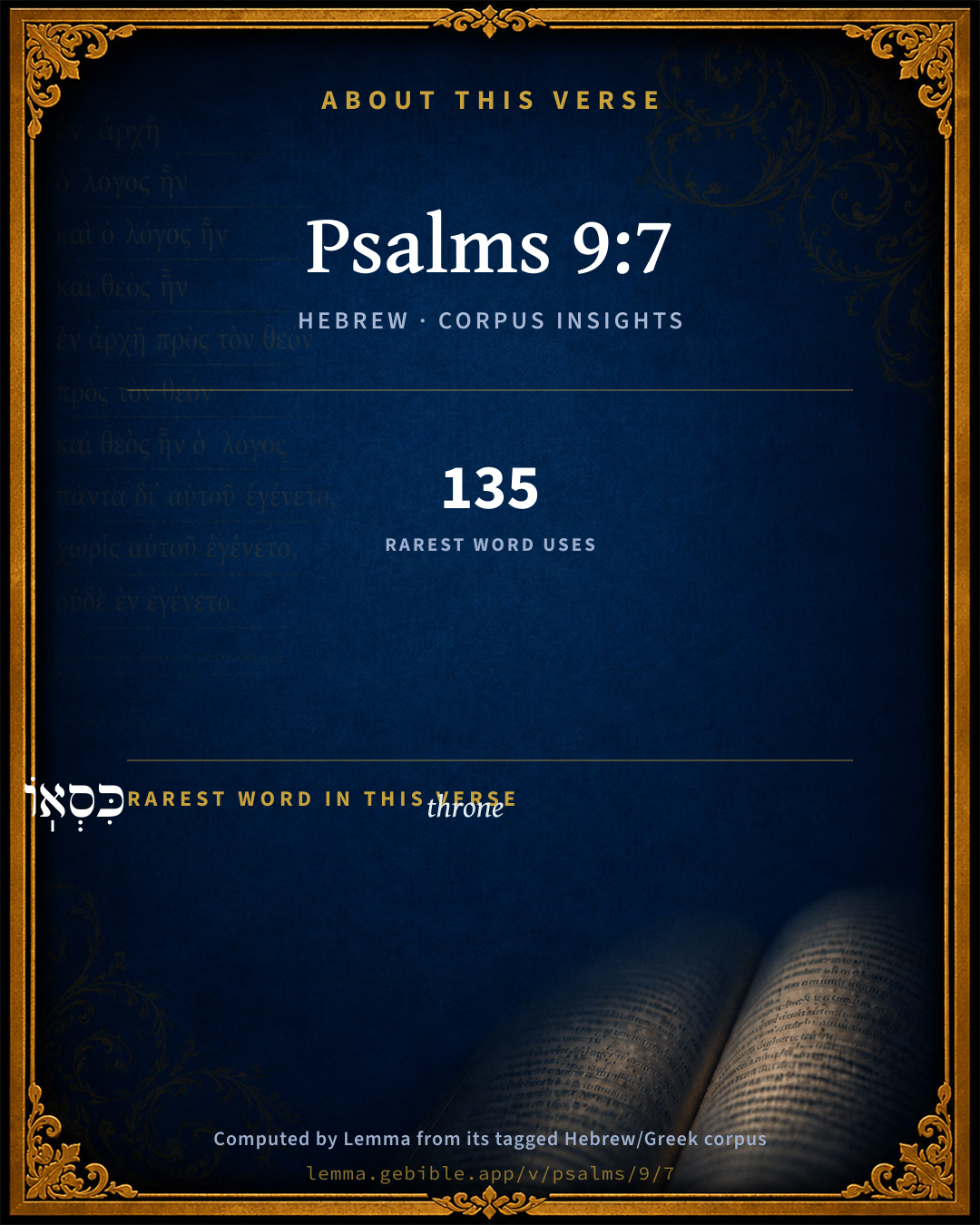
Psalms, in the Wisdom, opens this verse with 6 words (6 distinct Hebrew lemmas). Its most distinctive word is kiççêʼ (“throne”). A historical commentator’s framing appears above. Read the whole chapter for the surrounding context.

Discussion questions

  1. What does “throne” (kiççêʼ) contribute to the verse as a whole?
  2. Psalms 103:19 shares this passage’s theme. How do the two illuminate each other?
  3. The translations on this page render this verse differently — a whole-verse word diff, not a word-by-word alignment. What might account for the different wordings?
  4. The verb «יֵשֵׁ֑ב» is Qal Imperfect. How does its form color the action?
  5. Reading how The Cambridge Bible for Schools and Colleges and Trapp's Complete Commentary read this verse, where do the two commentators agree and where do they part?

Things to notice

Reading settings

Reading text

Shown beneath each verse's original-language words.

Old Testament
Old Testament edition

Read the OT as the Masoretic Hebrew (MT) or the Greek Septuagint (LXX).

English shown for the Greek Septuagint (in the Hebrew ↔ Greek comparison).

Comparing translations? Open the Compare panel on any verse page to stack up to four side by side.