Jeremiah 10:23

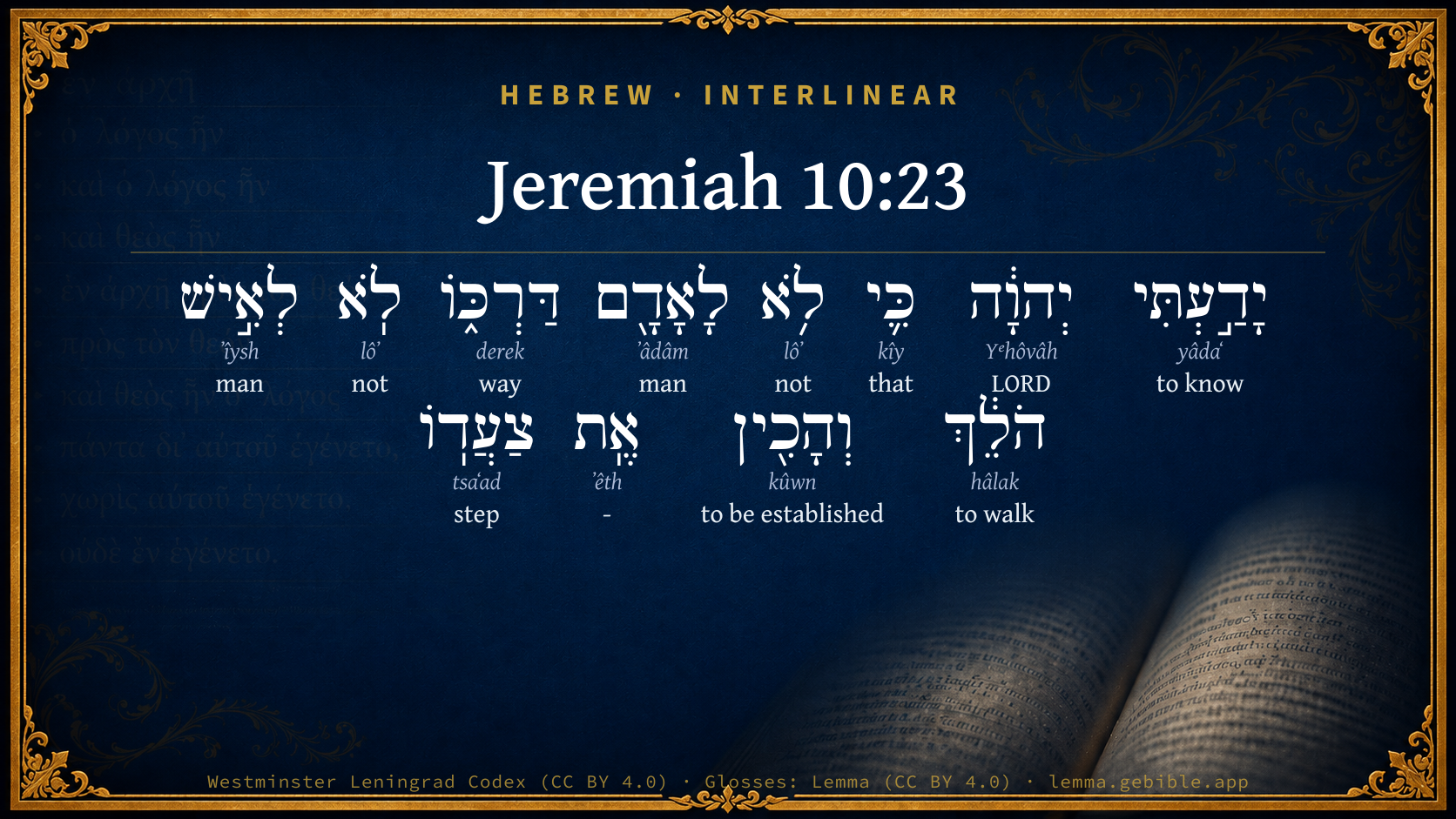
Hebrew (Westminster Leningrad Codex) Jeremiah 10:23 appears in the Hebrew Old Testament. The text above is from the Westminster Leningrad Codex. Each word links to its Strong’s number, a concise gloss, and parsing drawn from the Open Scriptures Hebrew Bible morphology. Click any word for its full Brown-Driver-Briggs (BDB) entry.
Download image
Cite this verse

Jeremiah 10:23 (World English Bible). Public Domain. Lemma interlinear Bible study tool, https://lemma.gebible.app/v/jeremiah/10/23.

Show BibTeX & RIS
BibTeX
RIS
English Translation
Yahweh, I know that the way of man is not in himself: it is not in man who walks to direct his steps.
World English Bible · Public Domain
Download a study sheet

One document with this verse’s original text, its word-by-word gloss line, the meaning frame, cross-references with their text, attributed commentary, and full source and license credits — printable, and it pastes into notes with its structure intact.

This verse Autodidact and up

Study sheet (.html) Plain text (.txt)

A passage Seminary Student

Up to 50 verses in one chapter. A passage sheet keeps up to 6 commentary sources and 12 cross-references per verse, in the order this page ranks them, and says so on the sheet whenever that leaves anything out. Ask for a single verse and you get the Autodidact verse sheet above.

Everything on this page stays free to read, with no account — the sheet is a download of what is already on screen, not access to it.

Want to remove ads? Support Godless Engineer
Compare translations 3

The same verse in 3 English versions, stacked beneath the original-language interlinear above. Click any original word for its lexicon entry.

Each is an independent rendering of the whole verse — the interlinear is not word-aligned to these translations.

Highlighted words mark where these versions differ — a whole-verse word diff, not a word-by-word alignment.

  • World English Bible Public Domain
    Yahweh, I know that the way of man is not in himself: it is not in man who walks to direct his steps.
  • King James Version Public Domain
    O LORD, I know that the way of man is not in himself: it is not in man that walketh to direct his steps.
  • unfoldingWord Literal Text CC BY-SA 4.0
    I know, Yahweh, that of a man not his way, and not to a man walking and make firm his steps.

unfoldingWord Literal Text — © unfoldingWord, licensed CC BY-SA 4.0. Word-aligned USFM3 via Door43 (git.door43.org/unfoldingWord/en_ult).

Versions to compare (up to 4)

3 of 4 selected

Show all 18 translations

Every available English version of this verse, each an independent rendering of the whole verse.

  • World English Bible Public Domain
    Yahweh, I know that the way of man is not in himself: it is not in man who walks to direct his steps.
  • Berean Standard Bible Public Domain
    I know, O LORD, that a man’s way is not his own; no one who walks directs his own steps.
  • Majority Standard Bible Public Domain
    I know, O LORD, that a man’s way is not his own; no one who walks directs his own steps.
  • King James Version Public Domain
    O LORD, I know that the way of man is not in himself: it is not in man that walketh to direct his steps.
  • American Standard Version (1901) Public Domain
    O Jehovah, I know that the way of man is not in himself: it is not in man that walketh to direct his steps.
  • Revised Version (1885) Public Domain
    O LORD, I know that the way of man is not in himself: it is not in man that walketh to direct his steps.
  • Geneva Bible (1599) Public Domain
    O Lord, I knowe, that the way of man is not in himselfe, neyther is it in man to walke and to direct his steps.
  • Douay-Rheims (1899) Public Domain
    I know, O Lord, that the way of a man is not his: neither is it in a man to walk, and to direct his steps.
  • Young's Literal Translation Public Domain
    I have known, O Jehovah, that not of man `is' his way, Not of man the going and establishing of his step.
  • Literal Standard Version CC BY-SA 4.0
    I have known, O YHWH, that not of man [is] his way, || Not of man [is] the going and establishing of his step.
  • Unlocked Literal Bible CC BY-SA 4.0
    I know, Yahweh, that the way of a man does not come from himself. No person walking directs his own steps.
  • unfoldingWord Literal Text CC BY-SA 4.0
    I know, Yahweh, that of a man not his way, and not to a man walking and make firm his steps.
  • Darby Bible Public Domain
    I know, Jehovah, that the way of man is not his own; it is not in a man that walketh to direct his steps.
  • World Messianic Bible Public Domain
    LORD, I know that the way of man is not in himself. It is not in man who walks to direct his steps.
  • Webster's Bible Public Domain
    O LORD, I know that the way of man is not in himself: it is not in man that walketh to direct his steps.
  • Free Bible Version CC BY-SA 4.0
    I realize, Lord, that people don't control their own lives—no one really knows how to choose their way.
  • Bible in Basic English Public Domain
    O Lord, I am conscious that a man's way is not in himself: man has no power of guiding his steps.
  • JPS Tanakh (1917) Public Domain
    O LORD, I know that man's way is not his own; it is not in man to direct his steps as he walketh.

Literal Standard Version (2020), Covenant Press — licensed CC BY-SA 4.0. Text via the HelloAO Bible API (eBible.org). Unlocked Literal Bible (unfoldingWord) — licensed CC BY-SA 4.0. Text via the HelloAO Bible API (eBible.org). unfoldingWord Literal Text — © unfoldingWord, licensed CC BY-SA 4.0. Word-aligned USFM3 via Door43 (git.door43.org/unfoldingWord/en_ult). Free Bible Version, Dr. Jonathan Gallagher — licensed CC BY-SA 4.0. Text via the HelloAO Bible API (eBible.org).

Word by word

More ways to search: Search by grammar → Find every occurrence → Compare this word →

Practice this passage: Drill this verse → Learn its vocabulary →

צַעֲדֽוֹ
tsaʻad
H6806
“step · his”
Noun, Common, Masculine, Singular, Construct + Suffix, Personal, 3rd Person, Masculine, Singular
Part of Speech
Noun
Type
Common
Gender
Masculine
Number
Singular
State
Construct
Full BDB Definition

Origin: from H6804

TWOT: 1943a

step, pace, stride - step, pace - step, steps (of course of life) (figuratively)
  1. יָדַ֣עְתִּי yâdaʻ H3045 “to know” Verb, Qal, Perfect, 1st Person, Common, Singular
  2. יְהוָ֔ה Yᵉhôvâh H3068 “LORD” Noun, Proper
  3. כִּ֛י kîy H3588 “that” Conjunction
  4. לֹ֥א lôʼ H3808 “not” Particle, Negative
  5. לָאָדָ֖ם ʼâdâm H120 “to/for the · man” Preposition, Determined + Noun, Common, Masculine, Singular, Absolute
  6. דַּרְכּ֑וֹ derek H1870 “way · his” Noun, Common, Both, Singular, Construct + Suffix, Personal, 3rd Person, Masculine, Singular
  7. לֹֽא lôʼ H3808 “not” Particle, Negative
  8. לְאִ֣ישׁ ʼîysh H376 “to/for · man” Preposition + Noun, Common, Masculine, Singular, Absolute
  9. הֹלֵ֔ךְ hâlak H1980 “walking” Verb, Qal, Participle Active, Masculine, Singular, Absolute
  10. וְהָכִ֖ין kûwn H3559 “and · to be established” Conjunction + Verb, Hiphil, Infinitive Construct
  11. אֶֽת ʼêth H853 “-” Particle, Direct Object

About this verse

These counts appear in no published source. They are computed here, from the morphology-tagged text and Lemma’s own curated glosses. What Lemma adds →

12
words
11
distinct lemmas
Prophets
section

Notable vocabulary

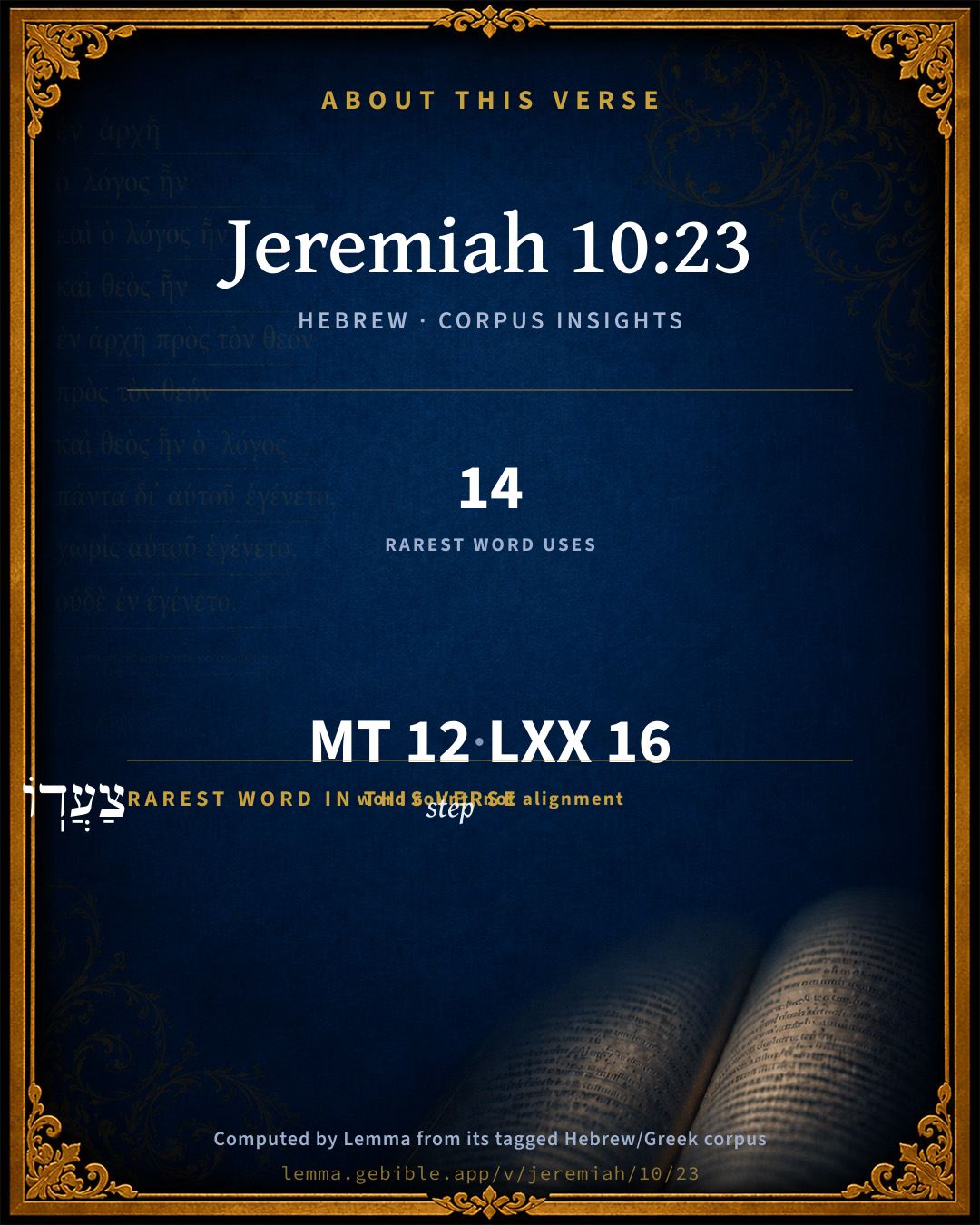
The rarest word here is צַעֲדֽוֹ step H6806 — appearing just 14 times in the whole Hebrew Bible.

Shared distinctive vocabulary

צַעֲדֽוֹ step H6806 occurs in 14 verses of the Hebrew Bible. Also found in:

Grammatical profile

  • 3 verbs
  • 5 nouns
  • 1 conjunction
  • 3 particles

Verb forms

  • יָדַ֣עְתִּי Qal · Perfect
  • הֹלֵ֔ךְ Qal · Participle Active
  • וְהָכִ֖ין Hiphil · Infinitive Construct

Repetition

A word recurs within this verse — often emphatic in Hebrew:

Hebrew & Septuagint length

In the original languages it is 12 Hebrew tokens and 16 Greek tokens — but the two are counted differently (Hebrew bundles its prefixes and suffixes into one token; the Greek is in lemma form), so that isn’t a like-for-like length.

Cross-references

5

Topical passages linked to Jeremiah 10:23 in the Treasury of Scripture Knowledge — connected by theme and wording, ordered by reader-vote popularity; previews shown in the World English Bible.

  • Proverbs 20:24 A man's steps are from Yahweh; How then can man understand his way?
  • Proverbs 16:1 The plans of the heart belong to man, But the answer of the tongue is from Yahweh.
  • Psalms 37:23 A man's goings are established by Yahweh. He delights in his way.
  • Psalms 119:116–117 Uphold me according to your word, that I may live. Let me not be ashamed of my hope.
  • Psalms 17:5 My steps have held fast to your paths, My feet have not slipped.

Cross-references courtesy of OpenBible.info (CC BY 4.0).

Hebrew and Greek witnesses Masoretic Hebrew ↔ Greek Septuagint

The same verse in the two great witnesses to the Old Testament, shown verse-for-verse.

These are two independent witnesses, not word-aligned to each other, and the Septuagint is shown in lemma (dictionary) form.

Hebrew Jeremiah 10:23 Masoretic · Westminster Leningrad Codex

יָדַ֣עְתִּי יְהוָ֔ה כִּ֛י לֹ֥א לָאָדָ֖ם דַּרְכּ֑וֹ לֹֽא לְאִ֣ישׁ הֹלֵ֔ךְ וְהָכִ֖ין אֶֽת צַעֲדֽוֹ

Yahweh, I know that the way of man is not in himself: it is not in man who walks to direct his steps.

World English Bible · Public Domain

Greek LXX Structure differs

In the Septuagint, Jeremiah is about an eighth shorter than the Hebrew and arranges its material differently — the Oracles Against the Nations (Hebrew chapters 46–51) appear in the middle of the Greek book, after 25:13. Because the chapter and verse boundaries do not line up, a verse-for-verse comparison with the Hebrew is not shown.

A verse-for-verse comparison isn’t shown here because the chapters and verses don’t line up. Switch to the LXX edition with the MT / LXX toggle above to read the Greek directly.

Hebrew: Westminster Leningrad Codex (CC BY 4.0). Greek: Septuagint (public domain); English from a public-domain English Septuagint. How the Septuagint differs from the Hebrew →

Targum (Aramaic paraphrase)

1

The Targum is the ancient Jewish Aramaic paraphrase of the Hebrew Scriptures — an interpretive translation, not the Hebrew text itself. Onkelos (literal) and Pseudo-Jonathan (expansive) render the Torah, and Jonathan the Prophets. Coverage is partial: where no permissively-licensed English translation exists for a verse, only the Aramaic is shown. This is verse-level text, not a word-by-word alignment to the Hebrew.

  1. Targum Jonathan Prophets (Joshua–Malachi)
    יְדַעְנָא יְיָ אֲרֵי לָא לֶאֱנָשָׁא אוֹרְחֵיהּ וְלָא לִגְבַר דְאָזִיל וּמַתְקִין יַת פְּסִיעָתֵיהּ:

    (no public-domain English translation for this verse)

    Targum Jonathan — Aramaic: “Mikraot Gedolot” (public domain). English: “Sefaria Community Translation” (CC0 1.0 (public-domain dedication)); “London "Chaldee Paraphrase," 1871” (public domain). Text via Sefaria.

Commentary

Notes on Jeremiah 10:23 from classic Christian and Jewish commentators (each source and its license shown beneath its notes). The classic Christian expositions comment on the surrounding passage and are grouped to its opening verse, so a note may address several verses; the Jewish commentaries on the Tanakh (Rashi and others) are per-verse, so they appear only where the commentator wrote on this verse.

Lemma curates 59 commentaries, every one of them public domain or Creative Commons licensed, each selected and text-cleaned for this edition rather than reprinted as found. About our sources →

The Cambridge Bible for Schools and Colleges

gen. ed. J. J. S. Perowne

23. Man’s weakness is pleaded, either as compared with the Divine power, or, better, as prone to sin.

it is not, etc.] lit. it is not for man to walk and direct his steps.

23–25. See summary before Jer_10:17. Stade, Du. and others (so Gi. in 1905, see his Metrik, p. 23) consider the passage to be the work of a supplementer. Gi. already in his Commentary (1894) surrenders Jer_10:25, probably rightly, while Jer_10:23-24 may at least be held doubtful. Co. agrees with Gi. as to Jer_10:25, saying that, though suitable in a Maccabaean Psalm, as he considers Psalms 79 to be (where the v. is identical with Jer_10:6-7), Jeremiah elsewhere holds the nations to be God’s servants, carrying out His punishments on Jerusalem. On the other hand even Du. admits that Jer_10:23-24 may be Jeremiah’s own. Accordingly Co. fitly asks whether it be not possible that the prophet, forbidden though he was by Jehovah to intercede for his sinful nation (Jer_7:16, Jer_11:14, Jer_14:7), yet felt impelled here to make one final appeal for some amount of mitigation in the penalty.

The Cambridge Bible for Schools and Colleges (gen. ed. J. J. S. Perowne; Cambridge University Press, 1878–1918) — public domain. Text from a community e-Sword module.

Trapp's Complete Commentary

John Trapp

Jer 10:23 O LORD, I know that the way of man [is] not in himself: [it is] not in man that walketh to direct his steps.

Ver. 23. O Lord, I know that the way of man is not in himself.] He is not master of his own way, but is directed and overruled by the powerful providence; even this cruel Chaldean also, that marcheth against us.

It is not in man that walketh to direct his steps.] We know not what to do, or which way to turn ourselves, only our eyes are toward thee. Behold, we submit to thy justice, and implore thy mercy. This text doth mainly make against freewill, saith Oecolampadius; and yet the Pelagians would hence gather that man can, by his own strength, walk in the way to heaven; but he must be helped, say they, by God’s grace, that he may be perfect.

John Trapp, A Commentary or Exposition upon All the Books of the Old and New Testament (1647–1656) — public domain. Text from a community e-Sword module.

Joseph Benson's Commentary

Jer 10:23. O Lord, I know, &c. — The prophet now turns to God, and addresses himself to him, finding it to little purpose to speak to the people. It is some comfort to poor ministers, that, if men will not hear them, God will; and to him they have liberty of access at all times. Let them close their preaching with prayer, as the prophet here does, and then they will have no reason to complain that they have laboured in vain. That the way of man is not in himself — The prophet must here be considered as acknowledging the superintendence and dominion of the divine providence; that by it, and not by their own will and wisdom, the affairs both of nations and particular persons are directed and governed. His words in this verse, taken in connection with the following, may be thus paraphrased: Thy providence, O Lord, superintends all events; all that happens comes to pass through thy permission or appointment. It is not in man to hinder that which has been once resolved on in thy decrees. We know, therefore, that it is not in our power to divert those judgments which are coming upon us, but thou canst moderate and limit them as thou pleasest. If, then, it be thy will that we should feel the awful effects of thy justice, chastise us, but spare our weakness; correct us, but with judgment, not in thine anger, &c. Theodoret applies this to Nebuchadnezzar, and explains the passage thus: “We know, O Lord, that the prince whom thou sendest against us comes not without thy orders; that the success of his arms, and the good fortune of his enterprise, proceed only from thee: but deliver us, O Lord, from this terrible enemy; and if we have merited chastisement, may we receive it at thy hand. Punish us as a father, and not as a judge.” The words, however, are applicable to us all, as well as to Nebuchadnezzar and the Jews. We are not at our own disposal, nor able to direct our own way by our own wisdom, either in matters temporal or spiritual. Nor are we at liberty to choose what line of life we please, or to ensure to ourselves the success and prosperity we may desire. We are under God’s government, and at his disposal, and have continual need of his direction, and of the influence of his grace, without which we shall certainly err from the right way, and shall neither choose nor perform what is truly and lastingly good, and for our happiness.

Joseph Benson's Commentary on the Old and New Testaments (1811–1818) — public domain. Text from a community e-Sword module.

Tyndale Open Study Notes

Tyndale Open Resources

10:23-25 Jeremiah wanted the Lord to pour out his wrath, not simply on Judah, but on the nations who devoured your people Israel; cp. Isa 26:9-11; Hab 1:17. These other kingdoms had gone so far in their brutality that the countryside was a desolate wilderness. Jer 10:25 is a quotation from Ps 79:6-7.

Tyndale Open Study Notes — © Tyndale Open Resources, licensed CC BY-SA 4.0. Text via the HelloAO Bible API.

Geneva Bible (1599)

Geneva Bible translators

He speaketh this because that Nebuchadnezzar purposed to have made war against the Moabites and Ammonites, but hearing of Zedekiah’s rebellion, he turned his power to go against Jerusalem, Ezek. 21:21, therefore the Prophet saith, that this was the Lord’s direction.

Geneva Bible (1599) marginal notes — public domain. Text via Bolls.life.

Jamieson, Fausset & Brown

Robert Jamieson, A. R. Fausset & David Brown

Despairing of influencing the people, he turns to God.

way of man not in himself-- (Pro 16:1; Pro 20:24; Jam 4:13-14). I know, O Jehovah, that the march of the Babylonian conqueror against me (Jeremiah identifying himself with his people) is not at his own discretion, but is overruled by Thee (Isa 10:5-7; compare Jer 10:19).

that walketh--when he walketh, that is, sets out in any undertaking.

direct . . . steps--to give a prosperous issue to (Psa 73:23).

Jamieson, Fausset & Brown — Commentary Critical and Explanatory on the Whole Bible (1871) — public domain (CC PDM 1.0). Text via the HelloAO Bible API.

Adam Clarke's Commentary

Verse 23. O Lord, I know that the way of man is not in himself] I will not pretend to dispute with thee; thou dost every thing wisely and justly; we have sinned, and thou hast a right to punish; and to choose that sort of punishment thou thinkest will best answer the ends of justice. We cannot choose; thou hast appointed us to captivity; we must not repine: yet,

Adam Clarke's Commentary on the Bible (1810–1826) — public domain. Text from a community e-Sword/MySword module.

John Calvin's Commentaries

The Jews confine this to Sennacherib, who had, according to his own will, at one time resolved to attack the Ammonites, at another the Moabites, and to reduce them under his own power; but had been induced by a sudden impulse to go to Judea. But this is frivolous. The Prophet, I doubt not, referred to the Jews, who had for a long time been accustomed to dismiss every fear, as though they were able by their own counsels to consult in the best way for the public good: for we know, that whenever any danger was apprehended from the Assyrians, they usually fled for aid to Egypt or to Chaldea. Thus, then, they provided for themselves, so tlmt they thought that they took good care of their affairs, while they had recourse to this or that expedient; and then, when the prophets denounced on them the vengeance of God, they usually regarded only their then present state, as though God could not; in one instant vibrate his lightnings from the rising to the setting sun.

Since then this security produced torpor and obstinacy, the Prophet in this passage justly exclaims, I know, Jehovah, that his way is not in man’s power; nor is it in the power of a person walking to direct his steps

We now perceive what the Prophet had in view; and this is ever to be remembered — that if we desire to read what has been written with profit, we must consider the meaning intended by the Holy Spirit, and then the purpose for which he has spoken. When we understand these things, then it is easy to make the application to other things: but he who does not weigh the end in view, ever wanders here and there, and though he may say many things, he yet does not reach the chief point. But we must observe that the Prophet, as he had done before, spoke as though he had God alone as his witness, for he saw that his own people were so hardened, that he addressed his words to them in vain: he therefore turned to God, which was a proof that he despaired as to the disposition of the people, as though he had said, “I shall have nothing to do with this perverse people any more; for I have already found out by my experience that their perverseness is untameable. I am now therefore constrained, O Lord, to address thee as though I were alone in the world.” This is the reason why he spoke to God himself. We shall defer the rest fill to-morrow.

John Calvin's Commentaries (1540-1563) — public domain. Text from the Calvin Translation Society English edition (1840s-50s) via the Christian Classics Ethereal Library (ccel.org). Calvin's coverage is partial (roughly two-thirds of the Bible); uncommented books and verses are honest gaps, never fabricated. The 19th-century editor's footnotes and remarks are omitted so the notes are faithfully Calvin's own voice.

Ellicott's Commentary for English Readers

(23) O Lord, I know . . .—The confession is made not by the prophet for himself, but as by and for Israel.

The way of man.—The path which a man takes for good or evil, for failure or success. His conduct in life depends, the prophet says, on something more than his own choice :—

“There’s a divinity that shapes our ends,

Rough-hew them how we will.”

Compare Pro_16:9; Pro_20:24, as expressing the same thought of the necessity of divine guidance. The two Hebrew words for “man” are used in the two clauses, the first expressing the weakness, the latter the strength of men. Even the strong man has to confess that he needs a hand other than his own to direct his steps.

A Bible Commentary for English Readers, edited by Charles John Ellicott (1878–1897) — public domain. Text from a community e-Sword module.

John Gill's Exposition

O Lord, I know that the way of man is not in himself,.... Kimchi and Ben Melech interpret it of that well known man Nebuchadnezzar, whose way was not in himself, and was not master of his own resolutions, but was under the influence and direction of divine Providence: when he set out of Babylon, he thought to have gone against the Ammonites; but when he came to a place where two ways met; the one leading to the children of Ammon, the other to Jerusalem; God changed his mind, and he steered his course to Jerusalem, to chastise Zedekiah for the breach of his oath: but the words seem to have a more general meaning; and the sense to be, that the prophet knew that it was not with him, nor with any of the godly, to escape the judgments that were coming upon them; that they were entirely in the hands of the Lord, to be guided, directed, and disposed of at his pleasure. The words may be accommodated to spiritual things and the affair of salvation; and be rendered thus, "I know, O Lord, that not for man is his way" (d); his own way is not good for him; not his sinful way, for this is opposite to God's way, and a going out of it; it is not according to his word; it is after the course of the world; and it is a dark and crooked way, and leads to, and ends in, destruction and death, if grace prevent not: nor the way of his own righteousness; this is no way of access to God, no way of acceptance with him, no way of justification before him, no way of salvation, no way to heaven, and eternal happiness; that which is the good and right way, the only way of salvation, is not of man, in him, or with him naturally; it is not of his devising and contriving, and much less of his effecting; it is not even within his knowledge; and so far as he knows anything of it, he does not approve of it: but it is of God; the scheme of it is of his forming; it is a work wrought out by Christ; it is a way of salvation revealed in the Gospel; and the thing itself is savingly made known, and applied by the Spirit of God; all which is known and owned when men are spiritually enlightened:

it is not in man that walketh to direct his steps; as not in natural and civil things, much less in religious ones; a good man is one that "walks", which supposes life and strength, without which there can be no walking; and a progression, a going on in a way; which ways are Christ, and his ordinances the path of doctrine and of duty; yet it is not even in this good man "to direct" and order "his steps" of himself; it is the Lord that must do it, and does; he can take no step aright without him; he is guided by him and his Spirit, both in the path of truth and of obedience; and hence it is that the saints persevere unto the end; see Psa 37:23.

(d) "novi, Jehovah, quod non sit homini via ejus", Schmidt; so Vatablus, Cocceius.

John Gill's Exposition of the Whole Bible (1746–1763) — public domain (CC PDM 1.0). Text via the HelloAO Bible API.

Haydock's Catholic Bible Commentary

The way, &c. Notwithstanding man’s free-will, yet he can do no good without God’s help, nor evil without his permission. So that, in the present case, all the evils which Nabuchodonosor was about to bring upon Jerusalem, could not have come but by the will of God. (Challoner) (Worthington) --- This prince succeeds by thy order. (Theodoret) --- Yet chastise us as a father, and have us not to his fury, ver. 24. (Calmet) --- "Let new preachers blush, who say that each one is governed by his own will," (St. Jerome; chap. ix. 23.) and able to do good without God’s grace. (Haydock)

George Leo Haydock (1774–1849), Haydock's Catholic Family Bible and Commentary, 1859 edition — public domain. Excludes Psalms (Douay-Rheims chapter numbering differs from Protestant) and Deuterocanonical books (Catholic canon only).

Matthew Poole's English Annotations

The prophet finding that all he could say prevailed nothing upon this people, but they rather grew worse, he turns himself to God. How far these words concern Pelagianism, or free-will, either one way or other, or whether at all, concerns not this comment; they seem literally to be the words of the prophet, relating either to himself and other holy men: q.d. It is not in our power, neither do we presume, to stop this decree of thine against Judea: or else to the enemies in general, or Nebuchadnezzar in particular: q.d. We know all their marches and designs are of thine appointing, and all their achievements of thine ordering, it is thy providence that directs every step they take against this land, without whom no counsels shall prosper, who alone turnest men’s hearts which way thou pleasest, Pro 21:1, who canst bring men on, or turn them back, as thou seest good, Isa 37:29, so that no man’s way is properly his own, to give them what success he will: or to the people, whereby he doth tacitly insinuate that all the counsels and measures they think to take, whether by their own strength at home, or confederacies and alliances abroad, will avail nothing; however they may think to escape by some devices or stratagems of their own, it is to no purpose, God can overturn all in a moment, when men think their counsels are ripe, and they want nothing but execution: or lastly, as others think, this is by way of petition: q.d. Lord, we know it is not in our power to divert these judgments that are coming upon us by the Chaldeans, but thou canst moderate and limit them as thou pleasest; seeing all their designs are ordered by thy providence, they cannot do any thing against us without thy permission: this the next verse seems to favour.

Matthew Poole's English Annotations on the Holy Bible (1683–1685) — public domain. Text from a community e-Sword/MySword module.

Whedon's Commentary on the Bible

Daniel D. Whedon

23, 24. It is not in man… to direct his steps — A beautiful and spiritual prayer, the language of humility and penitence, of humble dependence on God, and of earnest supplication for his favour.

Correct… with judgment — That is, in such measure as will best correct the evil.

Daniel D. Whedon (gen. ed.), Commentary on the Old and New Testaments (1874–1909) — public domain. Text from a community e-Sword module.

The Pulpit Commentary

Vers. 23-25. These verses confirm the view taken above, of the speaker of this whole section. Jeremiah and the people, each is, in a sense, the speaker; but hero the prophetic faith seems to run rather in advance of that of his fellow-countrymen. They form, however, a fitting sequel to the charges brought against the people in Jer 9. The speaker admits that he (either the People of Judah personified, or Jeremiah as a representative of its best portion) fully deserves chastisement for having attempted to go his own way. (comp. Isa_57:17) He has now attained an insight into the truth that man"s duty is simply to walk in the path which God has marked out for him. He only asks that Jehovah would chastise him with judgment, or, more clearly, according to what is just. The contrast is between punishment inflicted in anger, the object of which is to cause pain to the criminal, and that inflicted as a duty of justice, and of which the object is the criminal"s reformation" (Payne Smith). The fear expressed, however, is not exactly lest thou bring me to nothing, which is too strong for the Hebrew, but lest thou make me small. Israel was secured against annihilation by the promise of Jehovah, but feared he might possibly survive only as the shadow of his former self.

Vers. 23, 24. Confession and correction.

I GENUINE CONFESSION INVOLVES A CLEAR RECOGNITION OF DUTY AND A WILLINGNESS TO RECEIVE NECESSARY CORRECTION.

1. There must be a recognition of duty. We cannot confess the wrong till we know the right. Conscience awakes only when a standard of right outside ourselves is perceived.

2. There must be a willingness to receive necessary correction. If we make honest confession of sin, we imply that we desire to be free from it. But a right understanding of our own condition in the light of God"s requirements makes the necessity of correction apparent.

II A CLEAR RECOGNITION OF DUTY WILL SHOW THAT THIS CONSISTS IN SELF-ABNEGATION TO A HIGHER WILL. The essence of sin is self-will. The first sin was an act of disobedience. All wickedness is a rebellion against a supreme authority. Man is not free to live to himself, swayed only by his own lawless caprice. He has a vocation to fulfill:

1. He has no right to go his own way. He is a servant. He is lawfully subject to a righteous Lord, before whom duty requires him to say, "Not my will, but thine, be done.

2. He has not light enough to direct his own steps. Future accidents cannot be anticipated. The ultimate effects of the simplest action are not to be traced beforehand. Hence the need of a higher direction.

3. He has not power to succeed in his own way. If he starts by himself, making the awful experiment of a self-sustained pilgrimage through the toils and storms of life, he will assuredly make shipwreck. Our duty is not to live for self, nor even for God in our own way or by our own unaided strength, but to do his will, in his way, by his aid. Thus the Christian, looking for authority, guidance, and strength in Christ, is taught to say, "To me to live is Christ.

III A WILLINGNESS TO RECEIVE CORRECTION ARISES FROM A PERCEPTION OF ITS JUSTICE AND UTILITY WHEN VIEWED IN THE LIGHT OF THE REQUIREMENTS OF DUTY.

1. It must be recognized as just, not only merited, but coming in a fair degree. We could not willingly accept a correcting chastisement which was disproportionate to guilt.

2. It must be recognized as given on principles of righteousness, not out of vindictive wrath.

3. It must be recognized as sent for a merciful purpose. It is correction, not simply retribution. This is wholesome, and given, not in anger, which would be fatal, (Psa_2:12) but in love. (Pro_3:12) Such correction we should not murmur under, but welcome, accept as a blessing, and even pray for. But we shall only do this when we are impressed with a right sense of duty, which makes us acknowledge that we are not to live for ourselves, and must be subdued and trained by all necessary means to submission and obedience and a true feeling of our own helplessness, requiring the help of Divine discipline, Because man"s way is not in himself he may naturally ask for wholesome correction.

Vers. 23-25. Fruits of a chastened spirit.

From what foul soil do the fairest flowers spring! Beautiful as they are, they are rooted in that which is altogether unbeautiful. The sweet perfume of many woods, seeds, flowers, will not be given forth until they are gashed with the axe, or bruised, or crushed, or otherwise seemingly maltreated. We could not have the many-hued arch of the exquisitely tinted rainbow were it not for the drear, dark clouds and the descending rain. The most precious of the psalms were wrung out of the heart of David when that heart was well-nigh borne down with grief. And here, in these verses, it is the chastened spirit of Judah, personified in the prophet who speaks, that utters itself in the lowly confession of the twenty-third verse, the holy submission of the prayer of the twenty-fourth verse, and the settled hatred of them who hate God which burns in the twenty-fifth. Consider, then, these fruits, and may God make them to abound in ourselves.

I THE CONFESSION. Ver. 23, "O Lord, I know," etc. Now, this is a confession:

1. Of humble dependence upon God. It is an acknowledgment that, however much man may propose, God will dispose; that man"s goings are of the Lord. The life of each is, as God told Cyrus, (Isa 44) guided, governed by him. Illustrations are everywhere: the cruelty of Joseph"s brethren; the oppression of Israel in Egypt; the crucifixion of our Lord; (cf. Act_2:23) the persecution of the Church; (Act_8:3) Paul"s early life; etc. All these are instances in which, whilst men did exactly as they liked, acting with choice as unfettered as it was evil, they were nevertheless made to subserve the Divine plans, and their evil was compelled to work out good. Man may have power to "walk," but whither his steps will lead he cannot "direct." "The way of man is not in himself." He is free to choose his way, and for his choice he is responsible; but he is not allowed to determine all that shall come of that choice or what its issues and results shall be. Every time that men find their plans turn out altogether differently from what they expected or designed, proves the truth of the prophet"s word. God has planned the life of each one of us. He intends certain results to be secured by our lives. There"s a divinity that shapes our ends, Rough-hew them how we will.

And our wisdom is to see and confess and conform ourselves to the Divine plan happy they who do so and not to thwart or hinder it, as so many are bent upon doing, and hence, in the manifold sorrows of their lives, find it "hard to kick against the pricks." Our wisdom is daily to pray, "Cause me to know the way wherein I should walk; make plain my path before my face.

2. Of their own folly and sin. There are many teachers who will instruct us in this truth of our own incompetence to order our ways; all that is needed is that we be willing to learn. Such teachers are:

(1) Reason. It is reasonable that, as we are the creatures of God, he should have the control of our lives.

(2) Scripture. We have cited some instances already.

(3) Observation. The world is strewn with the wrecks of men who have disregarded the chart given them of God, and have run upon the rocks in consequence.

(4) But the most strenuous and resistless teacher of all is Experience. He will make a man learn, almost whether the man will or no. And it was this teacher who had been instructing, in his emphatic manner, Judah and her people. By the miserable mess they had made of their lives, and the frightful calamities which now were close at their doors (Ver. 22), they had at length come to see and confess their own wretched ordering of their way. Hence now the confession, "O Lord, I know that," etc. It is a blessed fruit for folly and fault to bear. It is not the natural fruit, but one of God"s gracious grafts. Peter"s folly of boasting bore such fruit when "be went out and wept bitterly." Let our prayer be that the faults and follies, the sins and sorrows, with which our lives are scattered over may make us see and own, "O Lord, I know that," etc.

3. Of their trust, nevertheless, in God"s infinite love. For not improbably this confession has not only an upward look to God as the Director of men"s ways, and an inward look upon their own sin, but also an outward look upon those dread foes who were hastening to destroy them. And this was their comfort that, after all, these enemies of theirs were in God"s hands. No doubt they designed fearful things against God"s people (cf. Ver. 25). But then, "the way of man is not," etc. Hence even these fierce, relentless foes might be held in and turned about by the bit and bridle of God. Had not God, in the days of the good King Hezekiah, proved this in regard to the King of Assyria and his army? Had he not, as Isaiah said, "put a hook in his nose.., and turned him back by the way by which he came?" And this confession breathes this hope and trust that God would do the like by their enemies now about to fall upon them. It is a real comfort to know that all our enemies, whether human or spiritual, are under the control of God. Even the apparently omnipotent prince of evil has but a limited power. He, too, cannot direct his own way. "The Lord, he is the true God, the living God, the everlasting King" (Ver. 10).

II THE PRAYER. Ver. 24, "O Lord, correct me, but," etc.

1. This is a model prayer. For:

(1) It confesses wrong. It owns the need of correction. The man is no longer right in his own eyes. He is seen, like the publican, "standing afar off," etc.

(2) It desires to be put right. (cf. Ps 51) As there, so here, there is the longing for renewal, the clean heart, the right spirit.

(3) It deprecates, not the correction, but the wrath of God. The man has a clear view of that wrath its crushing, destroying power. It is good to have this. Without it there is the danger of our looking lightly upon our sin.

2. It is a most instructive prayer. It teaches us:

(1) That all the corrections we have received have been fatherly ones judgment," not "in anger." For had they been in anger we had not been here at all.

(2) That we are alive and in God"s presence proves that the love of God, and not his anger, is ours still. For his anger would have "brought us to nothing.

(3) That there are corrections in anger. There have been such. Where are Egypt, Nineveh, Babylon, Rome? God brought them "to nothing." And there will be for all who harden themselves against God.

(4) That, seeing all need correction and will therefore receive it, either "in judgment" or "in anger," our wisdom is to make this prayer our own. One or other of these corrections we must have. Which shall it be? This prayer was answered for Israel. They have not been brought to nothing, and they were corrected. That sin of idolatry which brought on them God"s correction they have, ever since that correction, utterly abandoned. Then let us make this prayer our own.

III HOLY ANGER AGAINST THE ENEMIES OF GOD. We can readily see that Vers. 23 and 24 are the fruits of a chastened spirit, but this fierce utterance of Ver. 25 seems of another kind. But it is not. No doubt it has somewhat of the fierceness which belonged to that stern age, but it is nonetheless a real fruit of a right spirit. We ought to be very doubtful of our own spirit, however meek and contrite it is, if it be not accompanied with an intense detestation of evil. "Do not I hate them, O Lord, that hate thee? And am not I grieved with those that rise up against thee?" Such sentiment is a true note of the Spirit of God, and a religious life that lacks it is sure to be lacking in vigor, strength, and reliability. It is not personal hatred that finds utterance here, so much as a deep sense of the wrong done to God and the hindrance that is placed in the way of his will. The seventy-ninth psalm is an expression of this petition. Our age, and the temperament that so soft an age induces, are apt to make us be too easy with sin and sinners. We are so bred up in the idea of the "Gentle Jesus, meek and mild," that we forget how anything but gentle and mild he was to the hopelessly bad who were, in regard to the spiritual well-being of his people, doing as is here said, "eating up Jacob, devouring him," etc. What awful words poured forth from the Savior"s lips towards such! Let us suspect a meekness that makes us mild towards such. A man may make the confession of Ver. 23, and offer the prayer of Ver. 24, and fall and fall again; but if he have the stem spirit of Ver. 25, that deep, intense hatred of evil, sin is far less likely to have dominion over him for the future; he will be "strong in the Lord, and in the power of his might." Therefore, whilst we crave that fruit of the Spirit which is seen in Vers. 23, 24, let us crave that also which we have here in Ver. 25. It is the result of our being "strengthened with might by the Spirit of God in the inner man," and leads on, in blessed, successive steps, to our being "filled with all the fullness of God. C.

HOMILIES BY J. WAITE Ver. 23. "The way of man.

The prophet probably speaks here not merely for himself, but in the name of the whole nation. He gives articulate utterance to the better elements of thought and feeling existing among them, their conscious shortsightedness as regards the meaning and issue of their own national experiences, their helpless dependence on the unseen Divine power that is working out through the terrible events of the time its own all-wise purposes. An important view of human life is here presented before us. Consider

(1) the fact asserted;

(2) the influence it may be expected to have over us.

I THE FACT ASSERTED. "The way of man is not in himself," etc. All human life is a way," a journey, a pilgrimage, through various scenes and circumstances, to the "bourn from whence no traveler returns." And, free as we may be and accountable for our own actions, there is a sense in which it is equally true that it is given to none of us to determine what that way shall be. We are called on to recognize a governing power external to ourselves, above and beyond ourselves. Look at this fact in two lights as indicative of:

1. Moral inability. A man"s own judgment and impulse are not in themselves a safe rule for the conduct of his life. He cannot always trace the mutual relation of interests and events, is liable to be deceived by appearances, blinded by the glamour of his own feelings, misled by the force of his own self-will. The very complexity of the circumstances among which he "walks" is often a source of danger. He is as one surrounded by the diverse interlacing paths of a forest; he needs both external guidance and internal influence to direct his choice. The right way is not "in himself.

2. Practical restraint, No man has the actual power to determine altogether the course of his own life. Free as he may think himself to be to take what "steps" he pleases, he is, after all, often ruled by circumstances over which he has no control. He is not always master of his own movements, cannot do the thing that he would, constrained perhaps to do something totally different from what he intended. Who has not found himself to have been drifted, by the silent, unobserved current of events, into a position entirely other than he would have chosen for himself? Who has not had to accept, as the issue of his own doings, something strangely unlike what he looked for? "Man proposes; God disposes." There"s a divinity that shapes our ends, Rough-hew them how we will.

Human history national, social, individual is full of illustrations of the governing and restraining effect of some mysterious force that underlies all the phenomena of life. Faith penetrates the heart of this mystery, and discerns in it a personal Divine providence, the energy of a will that is "holy and just and good.

II THE INFLUENCE THIS FACT MAY BE EXPECTED TO HAVE OVER US. Such a truth, even in the purely negative form in which this passage presents it, may well have a marked effect on the whole habit of our daily thought and action. It teaches several important lessons.

1. Distrust of self. If our judgment is thus fallible, our impulse misleading, our power limited, shall we think to make our own will the sole rule of life? "Trust in the Lord with all thine heart; and lean not unto thine own understanding," etc.; (Pro_3:5, Pro_3:6) "Go to now, ye that say, Today or tomorrow we will go into such a city," etc. (Jam_4:13-16)

2. Thoughtful observation of the course of events, with a view to trace the path of the providence that is over us. Hidden as the power that governs our life may be, the teachable mind discerns ever more and more clearly the method of its working. "The secret of the Lord is with them that fear him,"; (Psa_25:14) "The meek will he guide in judgment," etc. (Psa_25:9)

3. Practical obedience to the call of present duty. Dark as our way may be, we cannot go far wrong if we follow the dictates of conscience. Be true in everything to your own sense of right and to the clear lines of Divine Law, and you may safely leave all issues with God.

4. The calm repose of faith. In the confused conflict of adverse circumstances, in the deep night of our sorrow and our fear, we hear a voice that whispers to us," All is well." It must be so if we believe that almighty Love is Lord of all. W.

The way of man not in himself.

I MAN IS NOT TO BE THE CHOOSER OF HIS WAY. "I know that the way of man is not in himself." It is surely not without significance that is here used for "man." To the Hebrew there must always have been the opportunity of peculiar suggestions upon the occurrence of this word. Adam would rise to mind, the first man, with God"s purposes for him, and his speedy calamitous departure from those purposes. God made Adam that he might go in God"s way. When the two accounts of the creation of man are taken together, it will be seen how abundant is the evidence that the way of Adam was not in himself. His only condition of safety, peace, and happiness was in strict compliance with the Divine injunctions. And with regard to the descendant of Adam, he who can read the account of Adam and see the essential correspondence between ancestor and posterity, is there not everything to teach him that his way also is not in himself? Why, he is some little distance advanced in the way before he is conscious that it is a way at all. The preservation of his life and the direction of it have been at the disposition of others. And when life as far as individual responsibility is concerned really beaus, how wise he proves to be who looks for the pointing of God"s finger, and feels that he must follow it! The man who insists that he can make his own way only finds it perish at last. Because no way can be considered just as a way; whether it is pleasant or painful, easy or difficult, is not the great matter, but whither it leads, what lies at the end of it. As it would be foolish for a man to take charge of a ship, ignorant of his destination and how to reach it, so it is equally foolish for a man to suppose that any way will do so long as it is as comfortable and easy as he can make it. Man"s right way must be according to God"s clear will; arid it is the way of trust in Jesus who is the Son and Christ of God. Note, further, the strong expression of individual assurance here given. "I know," says Jeremiah. He knew it indeed from his own experience. The way in which he now was, of prophet and witness for Jehovah, was not of his choosing. He did not think himself fit for it. And yet so far was he from being right in his own impressions as a young man, that it appears God had chosen him for a special purpose or ever his existence had begun. It is a great blessing to a man when, either from experience of his own wanderings or prudent observation of the wanderings of others, he can say in this matter, "I know." He spares himself much anxiety and shame who is humble enough to put himself under Divine guidance.

II GOD MUST ESTABLISH MAN WHEN HE IS IN THE NIGHT WAY. "It is not in man that walketh to make sure of his steps." In other words, though he may have begun the journey rightly, that is no proof that he will go on without hindrance or disaster to the end. In days when the journeys of most people, oven long journeys, would have to be undertaken on foot, this expression with regard to the walking man would be very significant. The perils of such a journey were well known perils from robbers, perils of losing one"s way in the dark and sometimes probably in the daylight, perils through trusting to strangers who may deceive or insufficiently inform him, perils through sickness far from home and friends. And so in the great spiritual way there is needed humility all through. The way is made up of little steps, and a false step may not be possible to retrieve. Divine knowledge and Divine intimations must stand in the place of our experience. Faith in God"s wisdom which cannot fail, and in God"s Word which cannot lie, must be our resource in all perplexity. There are times when common sense and right feeling are enough to guide our conduct, yet even these are more the gift of God than may at first appear. We cannot, then, be too minutely observant as to our need of Divine light and truth and assurance. Thus, being found in the right way and enduring to the end, we shall be safe. Y.

The Pulpit Commentary (1880–1919), ed. H.D.M. Spence-Jones & Joseph S. Exell — public domain. Text from a community e-Sword module.

John Wesley's Explanatory Notes

It is not - Lord we know it is not in our power to divert these judgments that are coming upon us, but thou canst moderate, and limit them as thou pleasest.

John Wesley, Explanatory Notes Upon the Whole Bible (1754–1765) — public domain. Text via the GEBible commentary corpus.

unfoldingWord translationNotes

Door43 World Missions Community

General Information:

Jeremiah prays for the people of Israel.

that the way of a man does not come from himself. No person walking directs his own steps

These two phrases mean the same thing. This means that no one has control over the various things that will happen to him during his life. AT: "that no person controls what will happen to him; no one is able to direct the events that he will experience" (See: Parallelism and Assumed Knowledge and Implicit Information)

Pour your fury on the nations

Here "the nations" refer to the people who live in them. AT: "In your fury, punish the nations" or "In your anger, punish the nations of the people" (See: Metaphor and Metonymy)

that do not call on your name

This is an idiom. AT: "that do not worship you" (See: Idiom)

For they have devoured Jacob and consumed him so as to completely destroy him

These three phrases have the same meaning. Jeremiah repeats this idea three times to emphasize the utter destruction of Israel. This speaks of the enemy armies attacking the people of Israel as if the armies were a fierce animal attacking and devouring its prey. AT: "For they have fiercely attacked the people of Israel and consumed them so as to completely destroy them" (See: Parallelism and Metaphor)

demolish his habitation

"demolish their homes"

translationWords

discipline

just

family

call

devour

consume

unfoldingWord translationNotes — © Distant Shores Media and the Door43 World Missions Community, licensed CC BY-SA 4.0. Source: git.door43.org/Door43/en_tn.

Rashi

Rabbi Shlomo Yitzchaki (Rashi)

man’s way is not his For the evil inclination that You created in him leads him astray from the way. Another explanation is: I know, O Lord, that man’s way is not his; not every man has the power to make his way prosper, and if it were not for Your command, the enemy would have no power to destroy Your Temple.

Rashi on the Tanakh — English translations: “The Judaica Press complete Tanach with Rashi, translated by A. J. Rosenberg” (CC BY 4.0); “Pentateuch with Rashi's commentary by M. Rosenbaum and A.M. Silbermann, 1929-1934” (public domain); “The Metsudah Tanach series, Lakewood, N.J” (CC BY 4.0); and “The Book of Joshua, Metsudah Publications, 1997” (CC BY 4.0). Text via Sefaria.

Lesson kit

Teaching starters — assembled from the data on this page, not authored interpretation. Every prompt links to the verse data it draws on. Edit before teaching.

Jeremiah, in the Prophets, opens this verse with 12 words (11 distinct Hebrew lemmas). Its most distinctive word is tsaʻad (“step”). A historical commentator’s framing appears above. Read the whole chapter for the surrounding context.

Discussion questions

  1. What does “step” (tsaʻad) contribute to the verse as a whole?
  2. How does 2 Samuel 6:13, which shares the word «step», read alongside this verse?
  3. What does the repetition of “not” (2× in this one verse) do in this verse?
  4. These translations render this verse differently. What is at stake in choosing one wording over another?
  5. «יָדַ֣עְתִּי» is a Qal Perfect verb. How does that grammatical form shape the action described?
  6. Compare how The Cambridge Bible for Schools and Colleges and Trapp's Complete Commentary read this verse. Where do they agree or differ?

Things to notice

Reading settings

Reading text

Shown beneath each verse's original-language words.

Old Testament
Old Testament edition

Read the OT as the Masoretic Hebrew (MT) or the Greek Septuagint (LXX).

English shown for the Greek Septuagint (in the Hebrew ↔ Greek comparison).

Comparing translations? Open the Compare panel on any verse page to stack up to four side by side.