Ezra 7:10

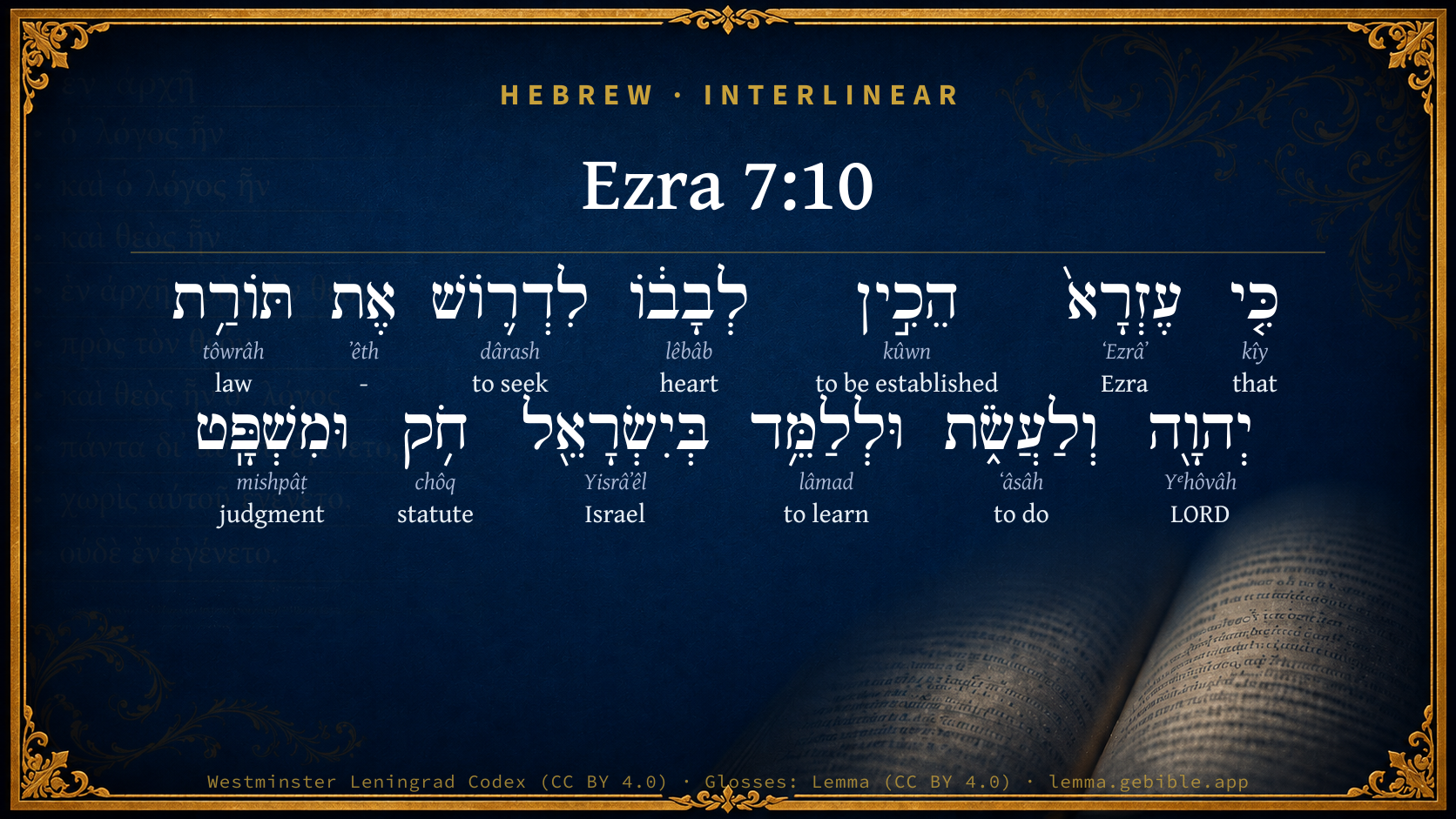
Hebrew (Westminster Leningrad Codex) Ezra 7:10 appears in the Hebrew Old Testament. The text above is from the Westminster Leningrad Codex. Each word links to its Strong’s number, a concise gloss, and parsing drawn from the Open Scriptures Hebrew Bible morphology. Click any word for its full Brown-Driver-Briggs (BDB) entry.
Download image
Cite this verse

Ezra 7:10 (World English Bible). Public Domain. Lemma interlinear Bible study tool, https://lemma.gebible.app/v/ezra/7/10.

Show BibTeX & RIS
BibTeX
RIS
English Translation
For Ezra had set his heart to seek the law of Yahweh, and to do it, and to teach in Israel statutes and ordinances.
World English Bible · Public Domain
Download a study sheet

One document with this verse’s original text, its word-by-word gloss line, the meaning frame, cross-references with their text, attributed commentary, and full source and license credits — printable, and it pastes into notes with its structure intact.

This verse Autodidact and up

Study sheet (.html) Plain text (.txt)

A passage Seminary Student

Up to 50 verses in one chapter. A passage sheet keeps up to 6 commentary sources and 12 cross-references per verse, in the order this page ranks them, and says so on the sheet whenever that leaves anything out. Ask for a single verse and you get the Autodidact verse sheet above.

Everything on this page stays free to read, with no account — the sheet is a download of what is already on screen, not access to it.

Want to remove ads? Support Godless Engineer
Compare translations 3

The same verse in 3 English versions, stacked beneath the original-language interlinear above. Click any original word for its lexicon entry.

Each is an independent rendering of the whole verse — the interlinear is not word-aligned to these translations.

Highlighted words mark where these versions differ — a whole-verse word diff, not a word-by-word alignment.

  • World English Bible Public Domain
    For Ezra had set his heart to seek the law of Yahweh, and to do it, and to teach in Israel statutes and ordinances.
  • King James Version Public Domain
    For Ezra had prepared his heart to seek the law of the LORD, and to do it, and to teach in Israel statutes and judgments.
  • unfoldingWord Literal Text CC BY-SA 4.0
    For Ezra had made his heart firm to seek the law of Yahweh, and to do it, and to teach statute and ordinance in Israel.

unfoldingWord Literal Text — © unfoldingWord, licensed CC BY-SA 4.0. Word-aligned USFM3 via Door43 (git.door43.org/unfoldingWord/en_ult).

Versions to compare (up to 4)

3 of 4 selected

Show all 18 translations

Every available English version of this verse, each an independent rendering of the whole verse.

  • World English Bible Public Domain
    For Ezra had set his heart to seek the law of Yahweh, and to do it, and to teach in Israel statutes and ordinances.
  • Berean Standard Bible Public Domain
    For Ezra had set his heart to study the Law of the LORD, to practice it, and to teach its statutes and ordinances in Israel.
  • Majority Standard Bible Public Domain
    For Ezra had set his heart to study the Law of the LORD, to practice it, and to teach its statutes and ordinances in Israel.
  • King James Version Public Domain
    For Ezra had prepared his heart to seek the law of the LORD, and to do it, and to teach in Israel statutes and judgments.
  • American Standard Version (1901) Public Domain
    For Ezra had set his heart to seek the law of Jehovah, and to do it, and to teach in Israel statutes and ordinances.
  • Revised Version (1885) Public Domain
    For Ezra had set his heart to seek the law of the LORD, and to do it, and to teach in Israel statutes and judgments.
  • Geneva Bible (1599) Public Domain
    For Ezra had prepared his heart to seeke the Lawe of the Lord, and to doe it, and to teach the precepts and iudgements in Israel.
  • Douay-Rheims (1899) Public Domain
    For Esdras had prepared his heart to seek the law of the Lord, and to do and to teach in Israel the commandments and judgment.
  • Young's Literal Translation Public Domain
    for Ezra hath prepared his heart to seek the law of Jehovah, and to do, and to teach in Israel statute and judgment.
  • Literal Standard Version CC BY-SA 4.0
    for Ezra has prepared his heart to seek the Law of YHWH, and to do, and to teach in Israel statute and judgment.
  • Unlocked Literal Bible CC BY-SA 4.0
    Ezra had established his heart to study, carry out, and teach the statutes and decrees of the law of Yahweh.
  • unfoldingWord Literal Text CC BY-SA 4.0
    For Ezra had made his heart firm to seek the law of Yahweh, and to do it, and to teach statute and ordinance in Israel.
  • Darby Bible Public Domain
    For Ezra had directed his heart to seek the law of Jehovah and to do it, and to teach in Israel the statutes and the ordinances.
  • World Messianic Bible Public Domain
    For Ezra had set his heart to seek the LORD’s law, and to do it, and to teach statutes and ordinances in Israel.
  • Webster's Bible Public Domain
    For Ezra had prepared his heart to seek the law of the LORD, and to do it, and to teach in Israel statutes and judgments.
  • Free Bible Version CC BY-SA 4.0
    For Ezra had committed himself to gaining insights from the Law of the Lord, wanting to practice it and to teach in Israel its rules and how to live.
  • Bible in Basic English Public Domain
    For Ezra had given his mind to learning the law of the Lord and doing it, and to teaching his rules and decisions in Israel.
  • JPS Tanakh (1917) Public Domain
    For Ezra had set his heart to seek the law of the LORD, and to do it, and to teach in Israel statutes and ordinances.

Literal Standard Version (2020), Covenant Press — licensed CC BY-SA 4.0. Text via the HelloAO Bible API (eBible.org). Unlocked Literal Bible (unfoldingWord) — licensed CC BY-SA 4.0. Text via the HelloAO Bible API (eBible.org). unfoldingWord Literal Text — © unfoldingWord, licensed CC BY-SA 4.0. Word-aligned USFM3 via Door43 (git.door43.org/unfoldingWord/en_ult). Free Bible Version, Dr. Jonathan Gallagher — licensed CC BY-SA 4.0. Text via the HelloAO Bible API (eBible.org).

Word by word

More ways to search: Search by grammar → Find every occurrence → Compare this word →

Practice this passage: Drill this verse → Learn its vocabulary →

עֶזְרָא֙
ʻEzrâʼ
H5830
“Ezra”
Noun, Proper
Part of Speech
Noun
Type
Proper
Full BDB Definition

Origin: a variation of H5833

TWOT: None

Ezra = "help" - the priest and scribe who led the reforms of the returned exiles in Jerusalem; co-worker with Nehemiah - a priest with Zerubbabel - another post-exilic Jew
  1. כִּ֤י kîy H3588 “that” Conjunction
  2. הֵכִ֣ין kûwn H3559 “to be established” Verb, Hiphil, Perfect, 3rd Person, Masculine, Singular
  3. לְבָב֔וֹ lêbâb H3824 “heart · his” Noun, Common, Masculine, Singular, Construct + Suffix, Personal, 3rd Person, Masculine, Singular
  4. לִדְר֛וֹשׁ dârash H1875 “to seek” Preposition + Verb, Qal, Infinitive Construct
  5. אֶת ʼêth H853 “-” Particle, Direct Object
  6. תּוֹרַ֥ת tôwrâh H8451 “law of” Noun, Common, Feminine, Singular, Construct
  7. יְהוָ֖ה Yᵉhôvâh H3068 “LORD” Noun, Proper
  8. וְלַעֲשֹׂ֑ת ʻâsâh H6213 “and · to do” Conjunction + Preposition + Verb, Qal, Infinitive Construct
  9. וּלְלַמֵּ֥ד lâmad H3925 “and · to learn” Conjunction + Preposition + Verb, Piel, Infinitive Construct
  10. בְּיִשְׂרָאֵ֖ל Yisrâʼêl H3478 “in/at · Israel” Preposition + Noun, Proper
  11. חֹ֥ק chôq H2706 “statute” Noun, Common, Masculine, Singular, Absolute
  12. וּמִשְׁפָּֽט mishpâṭ H4941 “and · judgment” Conjunction + Noun, Common, Masculine, Singular, Absolute

About this verse

These counts appear in no published source. They are computed here, from the morphology-tagged text and Lemma’s own curated glosses. What Lemma adds →

13
words
13
distinct lemmas
Historical
section

Notable vocabulary

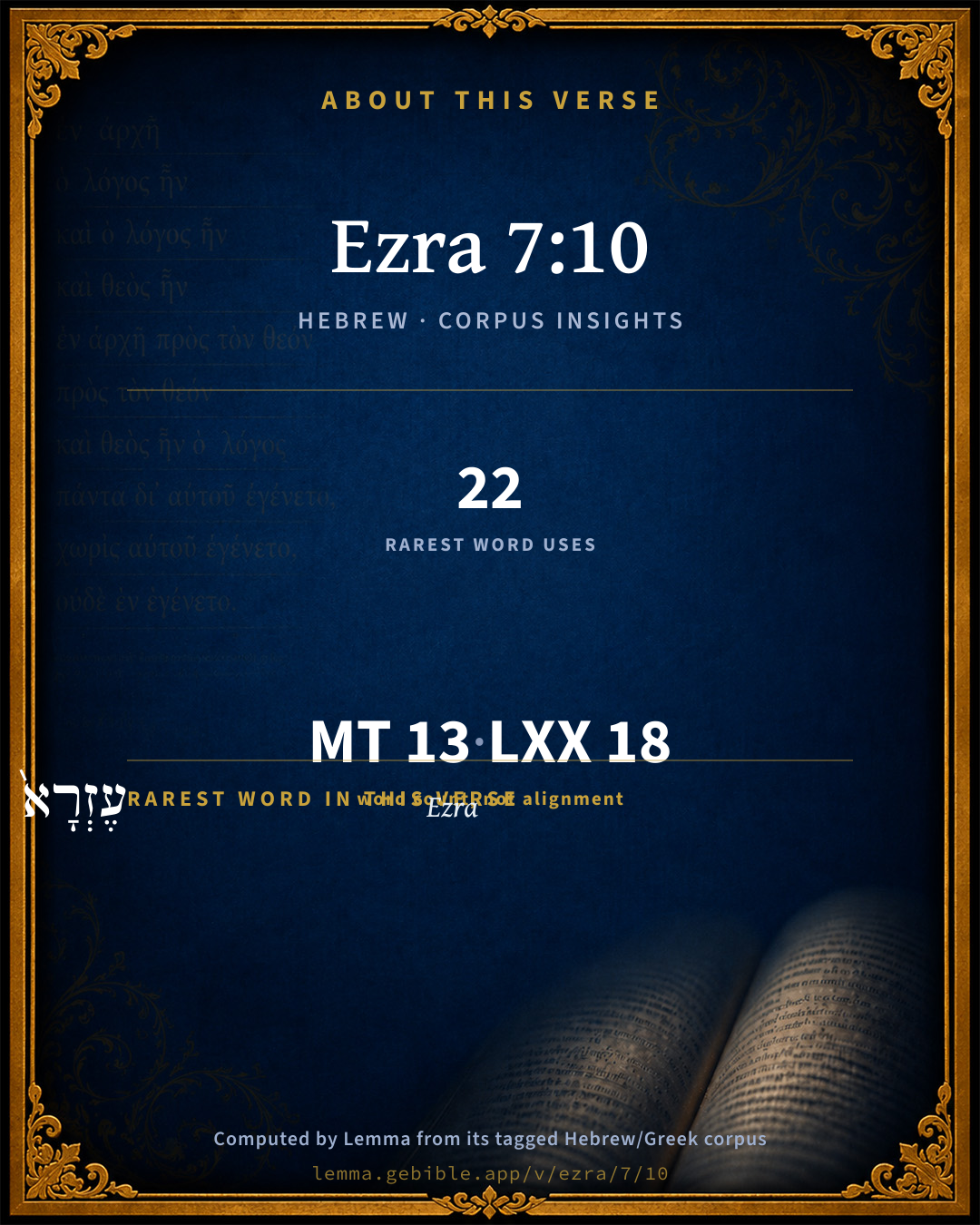
The rarest word here is עֶזְרָא֙ Ezra H5830 — appearing just 22 times in the whole Hebrew Bible.

Shared distinctive vocabulary

עֶזְרָא֙ Ezra H5830 occurs in 22 verses of the Hebrew Bible. Also found in:

Grammatical profile

  • 4 verbs
  • 7 nouns
  • 1 conjunction
  • 1 particle

Verb forms

  • הֵכִ֣ין Hiphil · Perfect
  • לִדְר֛וֹשׁ Qal · Infinitive Construct
  • וְלַעֲשֹׂ֑ת Qal · Infinitive Construct
  • וּלְלַמֵּ֥ד Piel · Infinitive Construct

Hebrew & Septuagint length

In English translation the verse runs 24 words from the Hebrew and 22 from the Septuagint (LXX English) — closely comparable.

A rough comparison of the two English renderings, which tokenize alike — not a word-level alignment.

Word counts can differ between the Hebrew and the Greek without any difference in meaning — e.g. the Hebrew direct-object marker אֵת has no separate Greek word, and Greek often adds the article ὁ.

In the original languages it is 13 Hebrew tokens and 18 Greek tokens — but the two are counted differently (Hebrew bundles its prefixes and suffixes into one token; the Greek is in lemma form), so that isn’t a like-for-like length.

Cross-references

28

Topical passages linked to Ezra 7:10 in the Treasury of Scripture Knowledge — connected by theme and wording, ordered by reader-vote popularity; previews shown in the World English Bible.

  • Malachi 2:7 For the priest's lips should keep knowledge, and they should seek the law at his mouth; for he is the messenger of Yahweh of Hosts.
  • 2 Timothy 4:2 preach the word; be urgent in season and out of season; reprove, rebuke, and exhort, with all patience and teaching.
  • Matthew 7:24 "Everyone therefore who hears these words of mine, and does them, I will liken him to a wise man, who built his house on a rock.
  • John 13:17 If you know these things, blessed are you if you do them.
  • Psalms 1:2 But his delight is in Yahweh's law; On his law he meditates day and night.
  • Ezra 7:25 You, Ezra, after the wisdom of your God who is in your hand, appoint magistrates and judges, who may judge all the people who are beyond the River, all such as know the laws of your God; and teach you him who doesn't know them.
  • Psalms 19:7 Yahweh's law is perfect, restoring the soul. Yahweh's testimony is sure, making wise the simple.
  • Deuteronomy 33:10 They shall teach Jacob your ordinances, Israel your law: They shall put incense before you, Whole burnt offering on your altar.
  • 1 Chronicles 29:18 Yahweh, the God of Abraham, of Isaac, and of Israel, our fathers, keep this forever in the imagination of the thoughts of the heart of your people, and prepare their heart to you;
  • Ezra 7:6 this Ezra went up from Babylon: and he was a ready scribe in the law of Moses, which Yahweh, the God of Israel, had given; and the king granted him all his request, according to the hand of Yahweh his God on him.
  • Psalms 10:17 Yahweh, you have heard the desire of the humble. You will prepare their heart. You will cause your ear to hear,
  • Titus 2:1 But say the things which fit sound doctrine,
  • 1 Samuel 7:3 Samuel spoke to all the house of Israel, saying, If you do return to Yahweh with all your heart, then put away the foreign gods and the Ashtaroth from among you, and direct your hearts to Yahweh, and serve him only; and he will deliver you out of the hand of the Philistines.
  • 2 Chronicles 17:8–9 and with them the Levites, even Shemaiah, and Nethaniah, and Zebadiah, and Asahel, and Shemiramoth, and Jehonathan, and Adonijah, and Tobijah, and Tob-adonijah, the Levites; and with them Elishama and Jehoram, the priests.
  • 2 Chronicles 19:3 Nevertheless there are good things found in you, in that you have put away the Asheroth out of the land, and have set your heart to seek God.
  • 2 Chronicles 30:22 Hezekiah spoke comfortably to all the Levites who had good understanding [in the service] of Yahweh. So they ate throughout the feast for the seven days, offering sacrifices of peace-offerings, and making confession to Yahweh, the God of their fathers.
  • Psalms 57:7 My heart is steadfast, God, my heart is steadfast. I will sing, yes, I will sing praises.
  • Psalms 119:45 I will walk in liberty, For I have sought your precepts.
  • Psalms 119:96–100 I have seen a limit to all perfection, But your commands are boundless.
  • 1 Timothy 3:2 The overseer therefore must be without reproach, the husband of one wife, temperate, sensible, modest, hospitable, good at teaching;
  • Deuteronomy 16:12 You shall remember that you were a bondservant in Egypt: and you shall observe and do these statutes.
  • 2 Chronicles 12:14 He did that which was evil, because he didn't set his heart to seek Yahweh.
  • Nehemiah 8:1–9 All the people gathered themselves together as one man into the broad place that was before the water gate; and they spoke to Ezra the scribe to bring the book of the law of Moses, which Yahweh had commanded to Israel.
  • Acts 1:1 The first book I wrote, Theophilus, concerned all that Jesus began both to do and to teach,
  • Titus 2:15 Say these things and exhort and reprove with all authority. Let no man despise you.
  • Revelation 22:14 Blessed are those who do his commandments, that they may have the right to the tree of life, and may enter in by the gates into the city.
  • Matthew 5:19 Whoever, therefore, shall break one of these least commandments, and teach others to do so, shall be called least in the Kingdom of Heaven; but whoever shall do and teach them shall be called great in the Kingdom of Heaven.
  • Job 11:13 "If you set your heart aright, Stretch out your hands toward him.

Cross-references courtesy of OpenBible.info (CC BY 4.0).

Hebrew and Greek witnesses Masoretic Hebrew ↔ Greek Septuagint

The same verse in the two great witnesses to the Old Testament, shown verse-for-verse.

These are two independent witnesses, not word-aligned to each other, and the Septuagint is shown in lemma (dictionary) form.

Hebrew Ezra 7:10 Masoretic · Westminster Leningrad Codex

כִּ֤י עֶזְרָא֙ הֵכִ֣ין לְבָב֔וֹ לִדְר֛וֹשׁ אֶת תּוֹרַ֥ת יְהוָ֖ה וְלַעֲשֹׂ֑ת וּלְלַמֵּ֥ד בְּיִשְׂרָאֵ֖ל חֹ֥ק וּמִשְׁפָּֽט

For Ezra had set his heart to seek the law of Yahweh, and to do it, and to teach in Israel statutes and ordinances.

World English Bible · Public Domain

Greek LXX Ezra 7:10 Septuagint · lemma form

ὅτι εσδρας δίδωμι ἐν καρδία αὐτός ζητέω ὁ νόμος καί ποιέω καί διδάσκω ἐν ἰσραήλ πρόσταγμα καί κρίμα

For Esdras had determined in his heart to seek the law, and to do and teach the ordinances and judgments in Israel.

LXX2012 (modern English Septuagint) · Public Domain

In the Septuagint this is one book — Esdras B (2 Esdras): Ezra is chapters 1–10, Nehemiah 11–23.

Hebrew: Westminster Leningrad Codex (CC BY 4.0). Greek: Septuagint (public domain); English from LXX2012 (modern English Septuagint) (Public Domain). How the Septuagint differs from the Hebrew →

Commentary

Notes on Ezra 7:10 from classic Christian and Jewish commentators (each source and its license shown beneath its notes). The classic Christian expositions comment on the surrounding passage and are grouped to its opening verse, so a note may address several verses; the Jewish commentaries on the Tanakh (Rashi and others) are per-verse, so they appear only where the commentator wrote on this verse.

Lemma curates 59 commentaries, every one of them public domain or Creative Commons licensed, each selected and text-cleaned for this edition rather than reprinted as found. About our sources →

Trapp's Complete Commentary

John Trapp

Ezr 7:10 For Ezra had prepared his heart to seek the law of the LORD, and to do [it], and to teach in Israel statutes and judgments.

Ver. 10. For Ezra had prepared his heart] Which, without due preparation, would not have been drawn to any good. See 1Sa 7:3 Job 11:13 Amo 4:12. An instrument must be tuned ere it can be played upon; sour wines need good sweetening.

To seek the law of the Lord] To dive into the very bosom and bottom of it. Qui nucleum vult, nucem frangat. The Rabbis have a saying, that there is a mountain of sense hanging upon every tittle of God’s law.

And to do it] His knowledge and practice ran parallel, and mutually transfused warmth into one another. He was not of those orators blamed by Diogenes, for that they studied bene dicere, non bene facere, to speak commendably, but not to live accordingly. He knew well that his forefathers (the high priests) had pomegranates for savour as well as bells for sound.

And to teach in Israel] He knew the truth of that Hebrew proverb, Lilmod Lelammed, Men must therefore learn, that they may teach others, and not bury their talents, lest the canker of their great skill prove a swift witness one day against them.

John Trapp, A Commentary or Exposition upon All the Books of the Old and New Testament (1647–1656) — public domain. Text from a community e-Sword module.

Joseph Benson's Commentary

Ezr 7:10. For Ezra had prepared his heart, &c. — He had set his mind and affections upon it, and made it his chief business. To seek the law of the Lord — To search and find out the true sense and meaning of it, and thence to learn what sins or errors were to be reformed, and what duties were to be performed. And to do it, and to teach in Israel — The order of things in this verse is very observable: first, he endeavours to understand God’s law and word, and that not for curiosity or ostentation, but in order to practice; next, he conscientiously practises what he did understand, which made his doctrine much more effectual; and then he earnestly desires and labours to instruct others, that they also might know and do it.

Joseph Benson's Commentary on the Old and New Testaments (1811–1818) — public domain. Text from a community e-Sword module.

Tyndale Open Study Notes

Tyndale Open Resources

7:10 Ezra had three life goals: (1) to study God’s word, (2) to obey what God said, and (3) to teach . . . the people of Israel. He allowed God’s word to transform his character and behavior so that he could influence the lives of others.

Tyndale Open Study Notes — © Tyndale Open Resources, licensed CC BY-SA 4.0. Text via the HelloAO Bible API.

Jamieson, Fausset & Brown

Robert Jamieson, A. R. Fausset & David Brown

Ezra had prepared his heart to seek the law of the Lord, &c.--His reigning desire had been to study the divine law--its principles, institutions, privileges, and requirements; and now from love and zeal, he devoted himself, as the business of his life, to the work of instructing, reforming, and edifying others.

Jamieson, Fausset & Brown — Commentary Critical and Explanatory on the Whole Bible (1871) — public domain (CC PDM 1.0). Text via the HelloAO Bible API.

Adam Clarke's Commentary

Verse 10. Ezra had prepared his heart] Here is a fine character of a minister of God: He prepares, הכין hechin, he fixes, purposes, and determines, לבבו lebabo, with his heart - with all his powers and affections, to seek the law of God, and to do it himself, that he may be properly qualified to teach its statutes and judgments to Israel.

Adam Clarke's Commentary on the Bible (1810–1826) — public domain. Text from a community e-Sword/MySword module.

Ellicott's Commentary for English Readers

(10) For Ezra had prepared his heart.—It must be remembered that the providence of God over him immediately precedes—not as the reward of his preparing his heart, but as the reason of it. First, he gave himself to study the law, then to practise it himself, and lastly to teach its positive statutes or ordinances and its moral judgments or precepts—a perfect description of a teacher in the congregation. There is nothing discordant in Ezra saying of himself that he had thus “set his heart.”

A Bible Commentary for English Readers, edited by Charles John Ellicott (1878–1897) — public domain. Text from a community e-Sword module.

The Cambridge Bible for Schools and Colleges

gen. ed. J. J. S. Perowne

10. For Ezra had prepared (R.V. set) his heart &c.] The precise meaning of the ‘for’ which determines the connexion of the verse, is not very evident. The verse either explains the preceding clause and attributes God’s favour towards Ezra during the journey to the latter’s devotion to the Divine Law, or is added as a general comment on the whole preceding section, explanatory of Ezra’s resolve and expedition. Those who take the former view illustrate it by ch. Ezr_8:31-32. But the latter interpretation of the verse is to be preferred. It corresponds better with the somewhat abrupt mention of Ezra’s rule of life. It harmonizes with the description of Ezra’s character. ‘Ezra had set his heart &c.’ That fact lay at the bottom of the religious movement which he set on foot. It explained something very much more than the mere fortunate issue of the journey.

‘Had set his heart’. A not uncommon phrase, cf. 2Ch_12:14; 2Ch_19:3; 2Ch_30:19. In every instance the R.V. has rightly changed ‘prepare his heart’ to ‘set his heart’. The idea of the original is not ‘preparedness for the unforeseen’, but ‘fixity and stability of purpose’. Compare the expression ‘my heart is fixed’ (Psa_57:7; Psa_108:1; Psa_112:7) where the same verb occurs.

to seek the law of the Lord] Cf. Psa_119:45; Psa_119:155; 1Ch_28:8. The search, no mere investigation of the letter, but for the sake of ascertaining the true principles of practical life embodied in the law, cf. 2Ch_14:4 ‘(Asa) commanded Judah to seek the Lord the God of their fathers, and to do the law and the commandment’.

and to teach] Those principles are self-diffusive, the teaching by example as much as by precept, cf. 2Ch_17:9 ‘And they (the priests) taught in Judah, having the book of the law with them’. Ezra’s purpose to search for truth, to live by it and to teach it his countrymen is an epitome of the ideal scribe’s career. We may compare Act_1:1 ‘All that Jesus began both to do and to teach’.

statutes and judgments] These words in the Hebrew are singular, and are rendered ‘a statute and an ordinance’ in Exo_15:25; Jos_24:25, where they are found together. The singular is generic. The two words are frequently found together in the plural: e.g. Lev_26:46; Deu_4:1; Deu_4:5; Deu_4:8; Deu_4:14; Deu_5:1; Deu_5:31; Deu_11:32; Deu_12:1 &c.; 2Ch_7:17; 2Ch_19:10 and Mal_4:4 ‘statutes and judgments’. ‘Statutes’ are the appointed rules or regulations of conduct or ceremony, ‘judgments’ are the duties and rights determined by equity, authority, or custom. The phrase is however used very generally without any close distinction in the shades of meaning.

The Cambridge Bible for Schools and Colleges (gen. ed. J. J. S. Perowne; Cambridge University Press, 1878–1918) — public domain. Text from a community e-Sword module.

John Gill's Exposition

Now this is the copy of the letter that the King Artaxerxes gave unto Ezra the priest,.... This title relating to his office is justly given him, since he was the son of an high priest, and lineally descended from Aaron, as the above account of his pedigree shows:

the scribe, even a scribe of the words of the commandments of the Lord, and of his statutes to Israel; the doubling of the word "scribe" shows that he was very wise and learned in the law, in the commandments and statutes of it the Lord gave to Israel; not only in the language of it in which it was written, but in the matter and substance of it, in the things contained in it; for "dibre", signfiies "things" as well as words.

John Gill's Exposition of the Whole Bible (1746–1763) — public domain (CC PDM 1.0). Text via the HelloAO Bible API.

Haydock's Catholic Bible Commentary

Heart. Thinking continually (Menochius) how he might keep the law himself, and direct others. (Haydock) --- It would be well if all would thus teach by example, like Jesus Christ, who began to do and then to teach. (Haydock) --- Judgment. Both these terms express the same thing. (Menochius)

George Leo Haydock (1774–1849), Haydock's Catholic Family Bible and Commentary, 1859 edition — public domain. Excludes Psalms (Douay-Rheims chapter numbering differs from Protestant) and Deuterocanonical books (Catholic canon only).

Matthew Poole's English Annotations

Ezra had prepared his heart, or, directed, &c., i.e. he had set his mind and affections upon it, and made it his chief design and business.

To seek the law, i.e. to search and find out the true sense and meaning of it, and thence to learn what sins or errors were to be reformed, and what duties were to be performed.

And to teach in Israel. The order of things in this verse is very observable; first he endeavours to understand God’s law and word, and that not for curiosity or ostentation, but in order to practice; next he conscientiously practiseth what he did understand, which made his doctrine much more effectual; and then he earnestly desires and labours to instruct and edify others, that they also might know and do it.

Matthew Poole's English Annotations on the Holy Bible (1683–1685) — public domain. Text from a community e-Sword/MySword module.

Whedon's Commentary on the Bible

Daniel D. Whedon

10. Prepared his heart to seek the law — Or, set his heart to search the law. It had been the great aim and purpose of his life to be a student and expounder of the law. And the sequel shows how God honoured his efforts.

Daniel D. Whedon (gen. ed.), Commentary on the Old and New Testaments (1874–1909) — public domain. Text from a community e-Sword module.

The Pulpit Commentary

For Ezra had prepared his heart, etc. God"s favour towards Ezra, and the prosperous issue of his journey, were the consequences of his having set his heart on learning God"s will, and doing it, and teaching it to others. To seek the law is to aim at obtaining a complete knowledge of it. To teach statutes and judgments is to inculcate both the ceremonial and the moral precepts. Ezra appears as a teacher of righteousness in Ezr_10:10, Ezr_10:11, and again in Neh_8:2-18

The Pulpit Commentary (1880–1919), ed. H.D.M. Spence-Jones & Joseph S. Exell — public domain. Text from a community e-Sword module.

John Wesley's Explanatory Notes

To teach - The order of things in this verse is very observable; first he endeavours to understand God's law and word, and that not for curiosity or ostentation, but in order to practice: next he consciously practices what he did understand, which made his doctrine much more effectual: and then he earnestly desires and labours to instruct others, that they also might know and do it.

John Wesley, Explanatory Notes Upon the Whole Bible (1754–1765) — public domain. Text via the GEBible commentary corpus.

Rashi

Rabbi Shlomo Yitzchaki (Rashi)

For Ezra... Therefore, he went and prospered in his way, because Ezra prepared his heart, etc. He gives a reason for his words.

Rashi on the Tanakh — English translations: “The Judaica Press complete Tanach with Rashi, translated by A. J. Rosenberg” (CC BY 4.0); “Pentateuch with Rashi's commentary by M. Rosenbaum and A.M. Silbermann, 1929-1934” (public domain); “The Metsudah Tanach series, Lakewood, N.J” (CC BY 4.0); and “The Book of Joshua, Metsudah Publications, 1997” (CC BY 4.0). Text via Sefaria.

Lesson kit

Teaching starters — assembled from the data on this page, not authored interpretation. Every prompt links to the verse data it draws on. Edit before teaching.

Ezra, in the Historical, opens this verse with 13 words (13 distinct Hebrew lemmas). Its most distinctive word is ʻEzrâʼ (“Ezra”). A historical commentator’s framing appears above. Read the whole chapter for the surrounding context.

Discussion questions

  1. How does “Ezra” (ʻEzrâʼ) shape what this verse is saying?
  2. Ezra 7:1 shares the word «Ezra» with this verse. How do the two illuminate each other?
  3. These translations render this verse differently; the difference is in the English rendering, not the original. What questions does that raise?
  4. The verb «הֵכִ֣ין» is Hiphil Perfect. How does its form color the action?
  5. Reading how Trapp's Complete Commentary and Joseph Benson's Commentary read this verse, where do the two commentators agree and where do they part?

Things to notice

Reading settings

Reading text

Shown beneath each verse's original-language words.

Old Testament
Old Testament edition

Read the OT as the Masoretic Hebrew (MT) or the Greek Septuagint (LXX).

English shown for the Greek Septuagint (in the Hebrew ↔ Greek comparison).

Comparing translations? Open the Compare panel on any verse page to stack up to four side by side.