
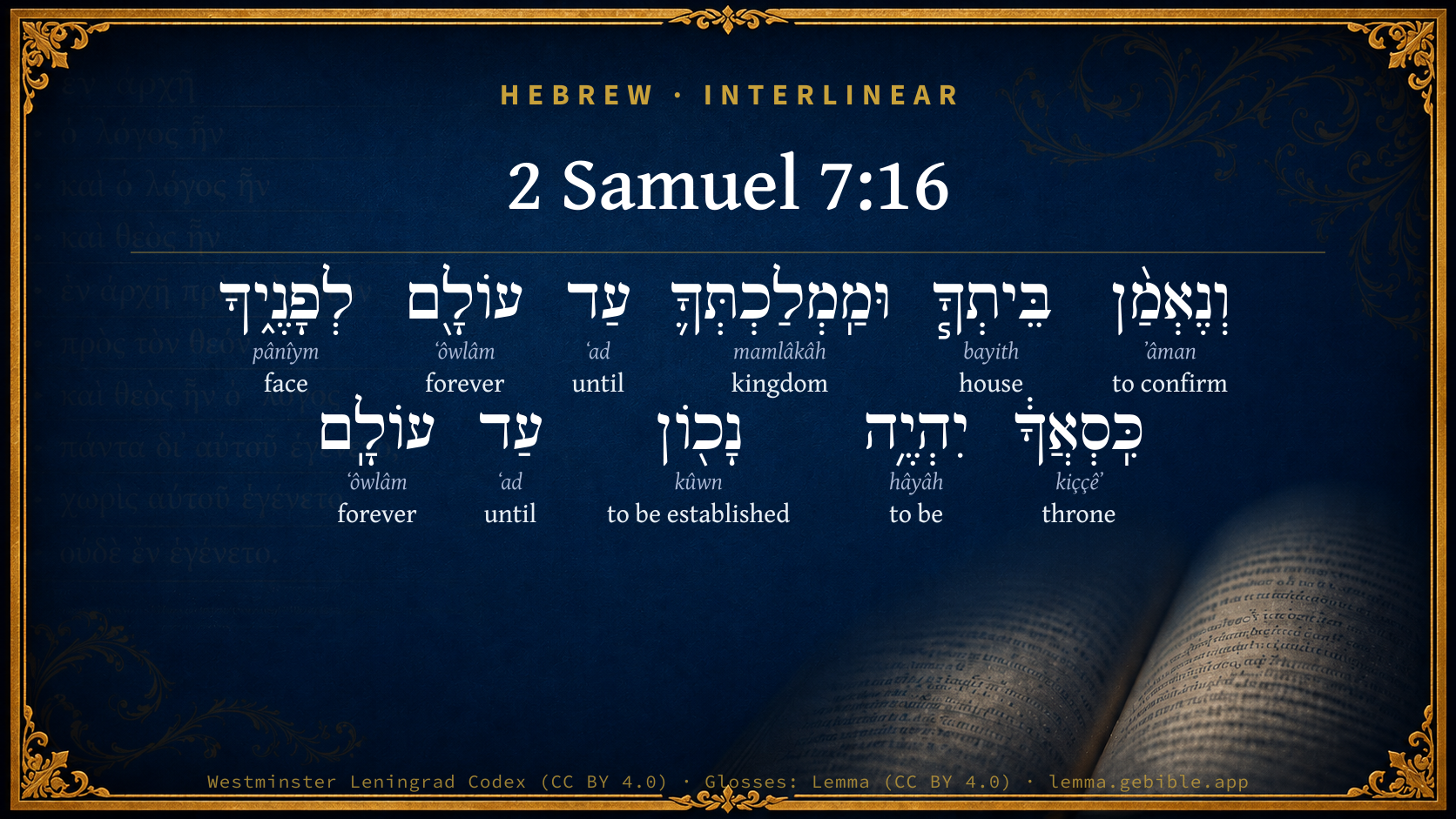
2 Samuel 7:16

Hebrew (Westminster Leningrad Codex) 2 Samuel 7:16 appears in the Hebrew Old Testament. The text above is from the Westminster Leningrad Codex. Each word links to its Strong’s number, a concise gloss, and parsing drawn from the Open Scriptures Hebrew Bible morphology. Click any word for its full Brown-Driver-Briggs (BDB) entry.
Download image
Cite this verse

2 Samuel 7:16 (World English Bible). Public Domain. Lemma interlinear Bible study tool, https://lemma.gebible.app/v/2-samuel/7/16.

Show BibTeX & RIS
BibTeX
RIS
English Translation
Your house and your kingdom shall be made sure for ever before you: your throne shall be established forever.
World English Bible · Public Domain
Download a study sheet

One document with this verse’s original text, its word-by-word gloss line, the meaning frame, cross-references with their text, attributed commentary, and full source and license credits — printable, and it pastes into notes with its structure intact.

This verse Autodidact and up

Study sheet (.html) Plain text (.txt)

A passage Seminary Student

Up to 50 verses in one chapter. A passage sheet keeps up to 6 commentary sources and 12 cross-references per verse, in the order this page ranks them, and says so on the sheet whenever that leaves anything out. Ask for a single verse and you get the Autodidact verse sheet above.

Everything on this page stays free to read, with no account — the sheet is a download of what is already on screen, not access to it.

Want to remove ads? Support Godless Engineer
Compare translations 3

The same verse in 3 English versions, stacked beneath the original-language interlinear above. Click any original word for its lexicon entry.

Each is an independent rendering of the whole verse — the interlinear is not word-aligned to these translations.

Highlighted words mark where these versions differ — a whole-verse word diff, not a word-by-word alignment.

  • World English Bible Public Domain
    Your house and your kingdom shall be made sure for ever before you: your throne shall be established forever.
  • King James Version Public Domain
    And thine house and thy kingdom shall be established for ever before thee: thy throne shall be established for ever.
  • unfoldingWord Literal Text CC BY-SA 4.0
    And your house and your kingdom will be confirmed to forever to your face. Your throne will be established to forever.”’”

unfoldingWord Literal Text — © unfoldingWord, licensed CC BY-SA 4.0. Word-aligned USFM3 via Door43 (git.door43.org/unfoldingWord/en_ult).

Versions to compare (up to 4)

3 of 4 selected

Show all 18 translations

Every available English version of this verse, each an independent rendering of the whole verse.

  • World English Bible Public Domain
    Your house and your kingdom shall be made sure for ever before you: your throne shall be established forever.
  • Berean Standard Bible Public Domain
    Your house and kingdom will endure forever before Me, and your throne will be established forever.”
  • Majority Standard Bible Public Domain
    Your house and kingdom will endure forever before Me, and your throne will be established forever.”
  • King James Version Public Domain
    And thine house and thy kingdom shall be established for ever before thee: thy throne shall be established for ever.
  • American Standard Version (1901) Public Domain
    And thy house and thy kingdom shall be made sure for ever before thee: thy throne shall be established for ever.
  • Revised Version (1885) Public Domain
    And thine house and thy kingdom shall be made sure for ever before thee: thy throne shall be established for ever.
  • Geneva Bible (1599) Public Domain
    And thine house shall be stablished and thy kingdome for euer before thee, euen thy throne shalbe stablished for euer.
  • Douay-Rheims (1899) Public Domain
    And thy house shall be faithful, and thy kingdom for ever before thy face, and thy throne shall be firm for ever.
  • Young's Literal Translation Public Domain
    and stedfast `is' thy house and thy kingdom unto the age before thee, thy throne is established unto the age.'
  • Literal Standard Version CC BY-SA 4.0
    and your house and your kingdom [are] steadfast before you for all time, your throne is established for all time.”
  • Unlocked Literal Bible CC BY-SA 4.0
    Your house and kingdom will be confirmed forever before you. Your throne will be established forever.'”
  • unfoldingWord Literal Text CC BY-SA 4.0
    And your house and your kingdom will be confirmed to forever to your face. Your throne will be established to forever.”’”
  • Darby Bible Public Domain
    And thy house and thy kingdom shall be made firm for ever before thee: thy throne shall be established for ever.
  • World Messianic Bible Public Domain
    Your house and your kingdom will be made sure forever before you. Your throne will be established forever.”’”
  • Webster's Bible Public Domain
    And thy house and thy kingdom shall be established for ever before thee: thy throne shall be established for ever.
  • Free Bible Version CC BY-SA 4.0
    Your house and your kingdom will last forever; your dynasty will be secure forever.”
  • Bible in Basic English Public Domain
    And your family and your kingdom will keep their place before me for ever: the seat of your authority will never be overturned.
  • JPS Tanakh (1917) Public Domain
    And thy house and thy kingdom shall be made sure for ever before thee; thy throne shall be established for ever.'

Literal Standard Version (2020), Covenant Press — licensed CC BY-SA 4.0. Text via the HelloAO Bible API (eBible.org). Unlocked Literal Bible (unfoldingWord) — licensed CC BY-SA 4.0. Text via the HelloAO Bible API (eBible.org). unfoldingWord Literal Text — © unfoldingWord, licensed CC BY-SA 4.0. Word-aligned USFM3 via Door43 (git.door43.org/unfoldingWord/en_ult). Free Bible Version, Dr. Jonathan Gallagher — licensed CC BY-SA 4.0. Text via the HelloAO Bible API (eBible.org).

Word by word

More ways to search: Search by grammar → Find every occurrence → Compare this word →

Practice this passage: Drill this verse → Learn its vocabulary →

וְנֶאְמַ֨ן
ʼâman
H539
“and · to confirm”
Conjunction + Verb, Niphal, Sequential Perfect, 3rd Person, Masculine, Singular
Part of Speech
Conjunction + Verb
Stem
Niphal
Form
Sequential Perfect
Person
3rd Person
Gender
Masculine
Number
Singular
Full BDB Definition

Origin: a primitive root

TWOT: 116

to support, confirm, be faithful - (Qal) - to support, confirm, be faithful, uphold, nourish - foster-father (substantive) - foster-mother, nurse - pillars, supporters of the door - (Niphal) - to be established, be faithful, be carried, make firm - to be carried by a nurse - made firm, sure, lasting - confirmed, established, sure - verified, confirmed - reliable, faithful, trusty - (Hiphil) - to stand firm, to trust, to be certain, to believe in - stand firm - trust, believe
  1. בֵּיתְךָ֧ bayith H1004 “house · your” Noun, Common, Masculine, Singular, Construct + Suffix, Personal, 2nd Person, Masculine, Singular
  2. וּמַֽמְלַכְתְּךָ֛ mamlâkâh H4467 “and · kingdom · your” Conjunction + Noun, Common, Feminine, Singular, Construct + Suffix, Personal, 2nd Person, Masculine, Singular
  3. עַד ʻad H5704 “until” Preposition
  4. עוֹלָ֖ם ʻôwlâm H5769 “forever” Noun, Common, Masculine, Singular, Absolute
  5. לְפָנֶ֑יךָ pânîym H6440 “to/for · face(s) · your” Preposition + Noun, Common, Both, Plural, Construct + Suffix, Personal, 2nd Person, Masculine, Singular
  6. כִּֽסְאֲךָ֔ kiççêʼ H3678 “throne · your” Noun, Common, Masculine, Singular, Construct + Suffix, Personal, 2nd Person, Masculine, Singular
  7. יִהְיֶ֥ה hâyâh H1961 “to be” Verb, Qal, Imperfect, 3rd Person, Masculine, Singular
  8. נָכ֖וֹן kûwn H3559 “being established” Verb, Niphal, Participle Active, Masculine, Singular, Absolute
  9. עַד ʻad H5704 “until” Preposition
  10. עוֹלָֽם ʻôwlâm H5769 “forever” Noun, Common, Masculine, Singular, Absolute

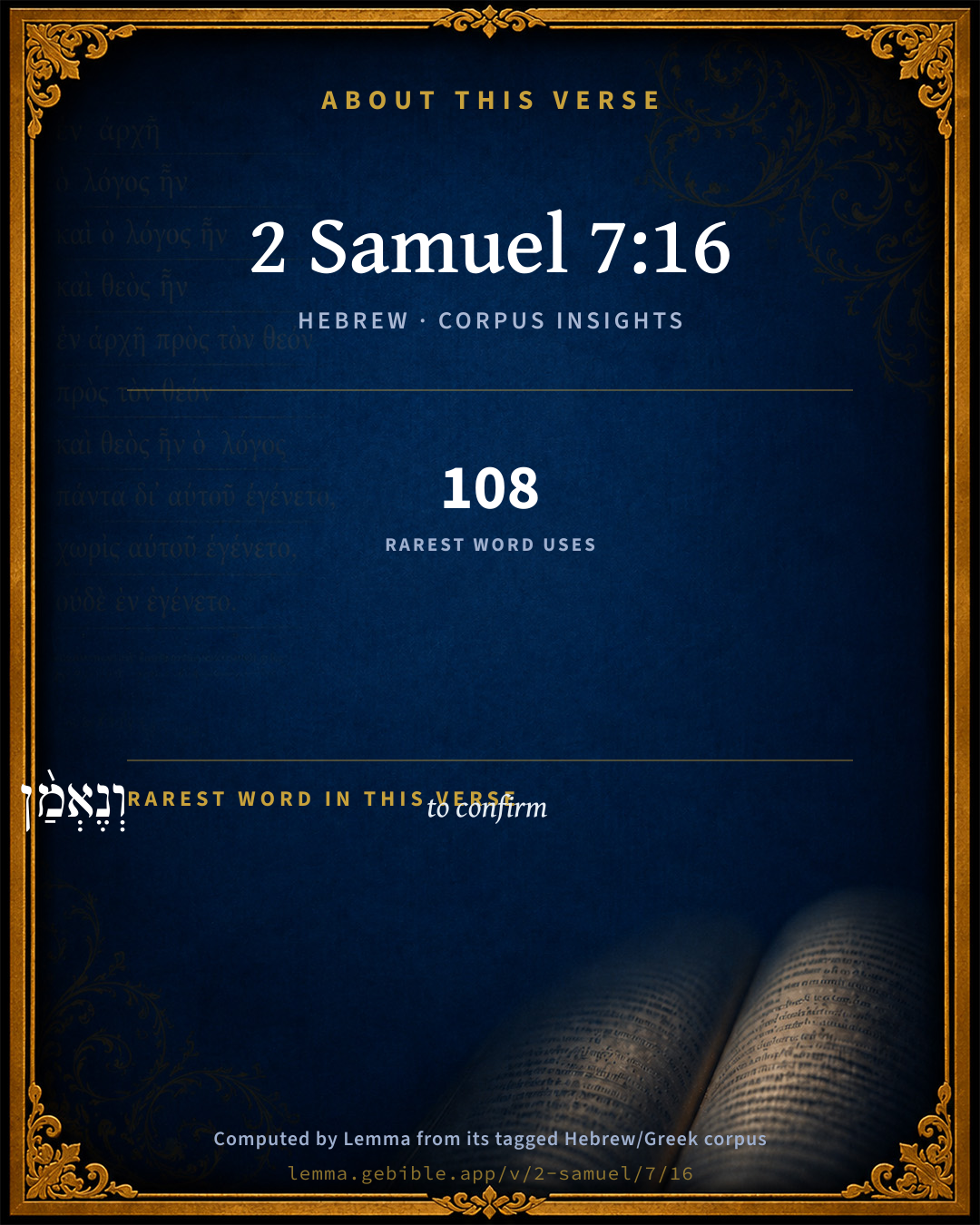
About this verse

These counts appear in no published source. They are computed here, from the morphology-tagged text and Lemma’s own curated glosses. What Lemma adds →

11
words
9
distinct lemmas
Historical
section

Grammatical profile

  • 3 verbs
  • 6 nouns
  • 2 prepositions

Verb forms

  • וְנֶאְמַ֨ן Niphal · Sequential Perfect
  • יִהְיֶ֥ה Qal · Imperfect
  • נָכ֖וֹן Niphal · Participle Active

Repetition

Words recur within this verse — often emphatic in Hebrew:

  • עַד until H5704 ×2
  • עוֹלָ֖ם forever H5769 ×2

Hebrew & Septuagint length

In English translation the verse runs 19 words from the Hebrew and 23 from the Septuagint (LXX English) — closely comparable.

A rough comparison of the two English renderings, which tokenize alike — not a word-level alignment.

Word counts can differ between the Hebrew and the Greek without any difference in meaning — e.g. the Hebrew direct-object marker אֵת has no separate Greek word, and Greek often adds the article ὁ.

Cross-references

16

Topical passages linked to 2 Samuel 7:16 in the Treasury of Scripture Knowledge — connected by theme and wording, ordered by reader-vote popularity; previews shown in the World English Bible.

  • Luke 1:32–33 He will be great, and will be called the Son of the Most High. The Lord God will give him the throne of his father, David,
  • Psalms 89:36–37 His seed will endure forever, His throne like the sun before me.
  • 2 Samuel 7:13 He shall build a house for my name, and I will establish the throne of his kingdom forever.
  • Isaiah 9:7 Of the increase of his government and of peace there shall be no end, on the throne of David, and on his kingdom, to establish it, and to uphold it with justice and with righteousness from henceforth even forever. The zeal of Yahweh of Hosts will perform this.
  • Genesis 49:10 The scepter will not depart from Judah, Nor the ruler's staff from between his feet, Until he comes to whom it belongs. To him will the obedience of the peoples be.
  • Psalms 45:6 Your throne, God, is forever and ever. A scepter of equity is the scepter of your kingdom.
  • Daniel 2:44 In the days of those kings shall the God of heaven set up a kingdom which shall never be destroyed, nor shall the sovereignty of it be left to another people; but it shall break in pieces and consume all these kingdoms, and it shall stand forever.
  • Daniel 7:14 There was given him dominion, and glory, and a kingdom, that all the peoples, nations, and languages should serve him: his dominion is an everlasting dominion, which shall not pass away, and his kingdom that which shall not be destroyed.
  • 1 Chronicles 17:13–14 I will be his father, and he shall be my son: and I will not take my loving kindness away from him, as I took it from him that was before you;
  • Revelation 11:15 The seventh angel sounded, and great voices in heaven followed, saying, "The kingdom of the world has become the Kingdom of our Lord, and of his Christ. He will reign forever and ever!"
  • Hebrews 1:8 but of the Son he says, "Your throne, O God, is forever and ever; The scepter of uprightness is the scepter of your Kingdom.
  • 2 Kings 19:34 For I will defend this city to save it, for my own sake, and for my servant David's sake.
  • John 12:34 The multitude answered him, "We have heard out of the law that the Christ remains forever. How do you say, 'The Son of Man must be lifted up?' Who is this Son of Man?"
  • Psalms 72:5 They shall fear you while the sun endures; And as long as the moon, throughout all generations.
  • Psalms 72:17–19 His name endures forever. His name continues as long as the sun. Men shall be blessed by him. All nations will call him blessed.
  • Matthew 16:18 I also tell you that you are Peter, and on this rock I will build my assembly, and the gates of Hades will not prevail against it.

Cross-references courtesy of OpenBible.info (CC BY 4.0).

Hebrew and Greek witnesses Masoretic Hebrew ↔ Greek Septuagint

The same verse in the two great witnesses to the Old Testament, shown verse-for-verse.

These are two independent witnesses, not word-aligned to each other, and the Septuagint is shown in lemma (dictionary) form.

Hebrew 2 Samuel 7:16 Masoretic · Westminster Leningrad Codex

וְנֶאְמַ֨ן בֵּיתְךָ֧ וּמַֽמְלַכְתְּךָ֛ עַד עוֹלָ֖ם לְפָנֶ֑יךָ כִּֽסְאֲךָ֔ יִהְיֶ֥ה נָכ֖וֹן עַד עוֹלָֽם

Your house and your kingdom shall be made sure for ever before you: your throne shall be established forever.

World English Bible · Public Domain

Greek LXX 2 Samuel 7:16 Septuagint · lemma form

καί πιστόω ὁ οἶκος αὐτός καί ὁ βασιλεία αὐτός ἕως αἰών ἐνώπιον ἐγώ καί ὁ θρόνος αὐτός εἰμί ἀναὀρθόω εἰς ὁ αἰών

And his house shall be made sure, and his kingdom for ever before me, and his throne shall be set up for ever.

LXX2012 (modern English Septuagint) · Public Domain

On this verse, Ellicott's Commentary for English Readers discusses the Septuagint’s reading. Read the note in Commentary ↓

Hebrew: Westminster Leningrad Codex (CC BY 4.0). Greek: Septuagint (public domain); English from LXX2012 (modern English Septuagint) (Public Domain). How the Septuagint differs from the Hebrew →

Targum (Aramaic paraphrase)

1

The Targum is the ancient Jewish Aramaic paraphrase of the Hebrew Scriptures — an interpretive translation, not the Hebrew text itself. Onkelos (literal) and Pseudo-Jonathan (expansive) render the Torah, and Jonathan the Prophets. Coverage is partial: where no permissively-licensed English translation exists for a verse, only the Aramaic is shown. This is verse-level text, not a word-by-word alignment to the Hebrew.

  1. Targum Jonathan Prophets (Joshua–Malachi)
    וְקַיֵים בֵּיתָךְ וּמַלְכוּתָךְ עַד עָלְמָא קֳדָמָךְ כּוּרְסֵי מַלְכוּתָךְ יְהֵי מְתַקַן עַד עָלְמָא:

    (no public-domain English translation for this verse)

    Targum Jonathan — Aramaic: “Mikraot Gedolot” (public domain). English: “Sefaria Community Translation” (CC0 1.0 (public-domain dedication)); “London "Chaldee Paraphrase," 1871” (public domain). Text via Sefaria.

Commentary

Notes on 2 Samuel 7:16 from classic Christian and Jewish commentators (each source and its license shown beneath its notes). The classic Christian expositions comment on the surrounding passage and are grouped to its opening verse, so a note may address several verses; the Jewish commentaries on the Tanakh (Rashi and others) are per-verse, so they appear only where the commentator wrote on this verse.

Lemma curates 59 commentaries, every one of them public domain or Creative Commons licensed, each selected and text-cleaned for this edition rather than reprinted as found. About our sources →

Trapp's Complete Commentary

John Trapp

2Sa 7:16 And thine house and thy kingdom shall be established for ever before thee: thy throne shall be established for ever.

Ver. 16. Thy throne shall be established for ever.] It shall, it shall - take my word for it: - in Christ, howsoever, who shall reign as God-man throughout all eternity.

John Trapp, A Commentary or Exposition upon All the Books of the Old and New Testament (1647–1656) — public domain. Text from a community e-Sword module.

The Biblical Illustrator

Joseph S. Exell

2Sa_7:16-17

Thy house and thy kingdom shall be established for ever.

The advantages of civil government contrasted with the blessings of the spiritual kingdom of Jesus Christ

I. The first and primary advantage expected from every well-constituted human government is security and the sense of security. The depravity of our nature has introduced such a universal selfishness and rapacity among mankind is their natural state, that men in every age and country have been convinced of the expediency and necessity of attempting to organise some form of government for the purpose of their common security. While every individual is left to exert his own power as he chooses, none can be secure either in his property or person: it becomes absolutely indispensable, therefore, if men would escape the intolerable evils of such a state, to collect and embody this scattered and uncertain force of the many, in some public depository of power: such a provision is necessary for the protection and preservation of every community. Hence almost all nations, even the most uncivilised, have attempted some constitution of this kind, however rude, for the prevention or the redress of those injuries to which the subjects were continually liable by the passions of our nature. But the utmost degree of personal security that can be enjoyed under any form of civil power, is a most imperfect shadow of the safety which Jesus Christ bestows upon the subjects of his spiritual reign. Until a man submits to His mediatorial authority, he remains exposed to unutterable evils.

II. The second benefit expected from human governments is liberty. So far as this advantage is consistent with the former, or with the public security, the more largely it is enjoyed the better. But, suppose the utmost possible degree of civil liberty enjoyed, what is it in comparison with that spiritual, real freedom, which Jesus Christ confers? The former is, at the best, only an external, circumstantial blessing; it does not enter into the inner man. But if the Son shall make you free, you shall be free indeed: where the Spirit of the Lord is, there is the only true liberty. The Christian is the genuine freeman, and none beside is such except in name.

III. The next advantage derived from a good government is plenty. To secure this advantage, you are aware that there are arrangements in nature, in a great measure independent of human institutions, and beyond the control of human policy. But perhaps, in this respect, there has been often much error on the part of those in power. But in the kingdom of Jesus Christ there exists an infinite plenty of all the provisions that can be desired for all the wants of the soul. None are neglected here: the poorest may be enriched beyond the most splendid opulence of this world, even with the unsearchable riches of Christ; as the apostles, though poor, could make many rich,--though they had nothing, they possessed all things. For in Jesus Christ all fulness dwells, for the supply of spiritual destitution.

IV. A tendency to improvement in its social institutions, is a fourth benefit which ought to accompany every well-ordered government. The best of these institutions are such as will be at once permanent and progressive, by their intrinsic wisdom and excellence,--by their adaptation to all the varying circumstances of the nation,--by their power of providing for unseen and possible emergencies: they will gradually rise from security to convenience, and then exalt convenience into ornament--into just refinement and diffused illumination: such has been the aim of the greatest legislators. But the difference between the most moral and the most flagitious of natural characters, is less than the difference that subsists between the subjects of Jesus Christ and the children of this world; because the latter is the difference between the spiritually dead and living.

V. The fifth and last requisite of a well-constituted government is stability: this is the crown of all its other advantages. Nothing can be wanting to such a reign but that it should last: and this is what the text emphatically expresses--Thy throne shall he established for ever: as the Psalmist says of the Messiah, He shall reign as long as the sun and moon endure. In this the kingdom of David was an emblem, however faint, of that which would be erected by Jesus Christ; wonderfully preserved as was the throne of Judah, while the greatest monarchies were marked by perpetual vicissitudes: the kings of Israel were ever changing in their line, while the descendants of David maintained a direct succession, (R. Hall, M. A.)

A long tenure of blessing

If a man might have a cottage on a hundred years lease, he would prize it much more than the possession of a palace for a day. Of course he would; and this it is which adds so much preciousness to the joys of heaven, for they are eternal. The pleasures of this world, however bright they seem, are but for this one day of life, which is already half over. If they were all they profess to be, and a thousand times more, they would not be worthy to be mentioned in comparison with pleasures for evermore at Gods right hand. (C. H. Spurgeon.)

Christs reign foreshadowed

Apart from the fact that the kingdom in the form in which Davids descendants ruled over it, has long since crumbled away, the large words of the promise must be regarded as inflated and exaggerated, if, by for ever they only mean for long generations. A seed, or line of perishable men, can only last for ever if it closes in a Person who is not subject to the law of mortality. Unless we can with our hearts rejoicingly confess, Thou art the King of glory, O Christ. Thy kingdom is an everlasting kingdom, we do not pierce to the full understanding of Nathans prophecy. All the glorious prerogatives shadowed in it were but partially fulfilled in Israels monarchs. Their failures and their successes, their sins and their virtues, equally declared them to be but shadowy forerunners of him in whom all that they at the best imperfectly aimed at and possessed is completely and for ever fulfilled. They were prophetic persons by their office, and pointed on to him. (A. Maclaren, D. D.)

The Biblical Illustrator, edited by Joseph S. Exell (c. 1880s–1900s) — public domain. Text from a community e-Sword module.

Tyndale Open Study Notes

Tyndale Open Resources

7:16 for all time . . . forever: God’s promises do not negate human responsibility and accountability (7:14). Wrongdoing requires a just response from God. However, no wayward son of David could move God to withdraw his promise to preserve David’s dynasty. Although the dynasty disappeared for hundreds of years, David’s house and kingdom were renewed in Jesus Christ, the sinless descendant of David who reigns forever.

Tyndale Open Study Notes — © Tyndale Open Resources, licensed CC BY-SA 4.0. Text via the HelloAO Bible API.

Geneva Bible (1599)

Geneva Bible translators

This was begun in Solomon, as a figure, but accomplished in Christ.

Geneva Bible (1599) marginal notes — public domain. Text via Bolls.life.

Ellicott's Commentary for English Readers

(16) Established.—Two different Hebrew words are so translated in this verse. The first is the same word as that used in 2Sa_7:12-13, while the second is translated sure in 1Sa_2:35; Isa_55:3, and would be better rendered here also made sure.

Before thee.—The LXX. has unnecessarily changed this to before me. The thought is, that David is now made the head of the line in which shall be fulfilled the primeval promise “The seed of the woman shall bruise the serpent’s head.” This was originally given simply to the human race (Gen_3:15); then restricted to the nation descended from Abraham (Gen_22:18, &c); then limited to the tribe of Judah (Gen_49:10, comp. Eze_21:27), and now its fulfilment is promised in the family of David.

A Bible Commentary for English Readers, edited by Charles John Ellicott (1878–1897) — public domain. Text from a community e-Sword module.

The Cambridge Bible for Schools and Colleges

gen. ed. J. J. S. Perowne

16. thy kingdom shall be stablished] Better, thy kingdom shall be made sure. Two different words are translated “shall be stablished” in this verse. The second corresponds to that in 2Sa_7:13 : the first is that rendered in 1Sa_2:35, “a sure house, and in Isa_55:3, “the sure mercies of David.”

before thee] The explanation that “David is regarded as seeing all his descendants pass before him in a vision,” is forced, and it is best to follow the LXX. in reading before me. This reading moreover seems to be required by 2Sa_7:26; 2Sa_7:29.

The Cambridge Bible for Schools and Colleges (gen. ed. J. J. S. Perowne; Cambridge University Press, 1878–1918) — public domain. Text from a community e-Sword module.

John Gill's Exposition

And thine house and thy kingdom shall be established for ever before thee,.... That is, both his family and his government should be perpetuated, or he should always have one of his family to sit upon his throne; the accomplishment of which, in the beginning of it, he saw with his eyes in his son Solomon, and with an eye of faith in his greater Son the Messiah, in whom only these words will have their complete fulfilment; and so Abarbinel says this vision or prophecy is explained by some of the days of the Messiah; and this house and kingdom, in Ch1 17:14; are called by the Lord "my" house, and "my" kingdom:

thy throne shall be established for ever; which is a repetition of the same in other words for the confirmation of it.

John Gill's Exposition of the Whole Bible (1746–1763) — public domain (CC PDM 1.0). Text via the HelloAO Bible API.

Haydock's Catholic Bible Commentary

Faithful; or continue a long time. (Menochius) (3 Kings xi. 38.) --- Where is not the house of David? or how is this accomplished, except in the Church? --- Thy face. Septuagint, "before me," which is conformable to Psalm lxxxviii. 38. David saw Solomon on the throne, and beheld the Messias in spirit. (Calmet) --- Souls departed still see what regards them, (Sa) if they be happy. (Haydock)

George Leo Haydock (1774–1849), Haydock's Catholic Family Bible and Commentary, 1859 edition — public domain. Excludes Psalms (Douay-Rheims chapter numbering differs from Protestant) and Deuterocanonical books (Catholic canon only).

Matthew Poole's English Annotations

Before thee; thine eyes in some sort beholding it; for he lived to see his wise and godly son Solomon actually placed in the throne, with great reputation and general applause, 1Ki 1:39,40, which was in itself a good presage of the continuance of the kingdom in his family; and being considered, together with the infallible certainty of God’s promise to him and his for ever, of the accomplishment whereof this was an earnest, gave him good assurance thereof; especially considering that he had his eyes and thoughts upon the Messia, Psa 90:1, &c., whose day he saw by faith, as Abraham did, Joh 8:56, and whom he knew that God would raise out of the fruit of his loins to sit on his throne, as is affirmed, Act 2:30, and that for ever: and so the eternity of his kingdom is rightly said to be before him. The LXX. and Syriac read before me, which is a usual phrase, which makes no great variation in the Hebrew text.

Matthew Poole's English Annotations on the Holy Bible (1683–1685) — public domain. Text from a community e-Sword/MySword module.

Whedon's Commentary on the Bible

Daniel D. Whedon

16. For ever… for ever — of all the words of promise that fell on David’s ears these were the most charming. They find repeated utterance in his prayer, (2Sa_7:19; 2Sa_7:25; 2Sa_7:29,) often in the Psalms, (Psa_18:50; Psa_89:29,) and even echo in the angel’s words of salutation to the mother of our Lord. Luk_1:32-33. By them we see that this message of Nathan to David was largely a Messianic prophecy.

Daniel D. Whedon (gen. ed.), Commentary on the Old and New Testaments (1874–1909) — public domain. Text from a community e-Sword module.

The Pulpit Commentary

Glimpses of the King Messiah.

Looked at in the light of the development of the Divine purpose, rather than of the conscious knowledge of the time,

(1) the royal office of David and Solomon (in its typical significance), and

(2) the promises and prophecies uttered more or less directly in connection therewith, especially as recorded in the last words of David (ch. 23.) and in the Psalms, clearly pointed to the coming of an extraordinary, theocratic, Divine King. They indicate that he would be:

1. The Anointed of Jehovah. His Servant, chosen and beloved (ver. 8; ch. Act_4:27 Act_10:28) Psalm 89., "The faithfulness of the Lord.

Once thou spakest in vision to thy beloved, and saidst: I have laid help upon a mighty one, I have exalted one chosen out of the people. I have found David my servant, With my holy oil have I anointed him. (Psa_89:19, Psa_89:20)

2. The Son of David "according to the flesh" (ver. 12; Act_2:29-31 Act_13:22-23)

Jehovah hath sworn unto David In truth that which he will not recall: Of the fruit of thy body Do I appoint a possessor of thy throne. (Psa_132:11)

3. The Son of God. (Ver. 14; Psa_16:10 Luk_5:35; Act_4:25 (Rom_1:4) Psalm 2., "The triumph of the Lord"s Anointed.

Jehovah saith unto me: Thou art my Son: I have this day begotten thee. (Psa_2:7)

He shall cry unto me: My Father art thou, My God, and the Rock of my salvation! Also I will make him my Firstborn, Highest of the kings of the earth. (Psa_89:26, Psa_89:27)

"In the Old Testament the relation between father and son denotes the deepest. intimacy of love; and love is perfected in unity of nature, in the communication to the son of all that the father hath. "The Father loveth the Son, and hath given all things into his hand". (Joh_3:35) Sonship, therefore, includes the government of the world" (Keil).

4. The King of righteousness and peace; Prophet and Priest; the Conqueror of all opposing powers (through conflict and suffering); the Saviour and Benefactor of those who trust in him; the supreme Lord (ver. 13; Psalm 22.; 40:6 1 (Mat_22:45; Heb_1:8)

The oracle of Jehovah unto my Lord: Sit thou at my right hand Until I make thine enemies thy footstool. (Psa_105:1)

Thy throne, O God, is forever and ever; A sceptre of uprightness is the sceptre of thy kingdom. (Psa_45:6)

5. The Builder of the temple. (Ver. 13; (Zec_6:12, Zec_6:13; Joh_1:14 Joh_2:19 Joh_14:23; 1Co_6:19; Eph_1:20-23 Eph_2:20-22; 1Pe_2:5; Rev_21:1-3)

Thou hast received gifts among men, Yea, even the rebellious, that the Lord Jehovah might dwell among them. (Psa_68:18)

6. The Possessor of universal dominion. (1Sa_2:10; 2 Samuel Psa_22:27)

He shall have dominion from sea to sea, And from the river to the ends of the earth. (Psa_72:8)

7. The King who should reign forever. (Ver. 16; Psa_61:6, 7 89:36, 37)

His Name shall endure forever; His Name shall be continued as long as the sun. (Psa_72:17)

"An allegory may serve to illustrate the way in which the Old Testament proclamation of salvation unfolds itself. The Old Testament in relation to the day of the New Testament is night. In this night there rise in opposite directions two stars of promise. The one describes its fall from above downwards; it is the promise of Jehovah who is about to come. (Psa_96:13 Psa_98:9) The other describes its path from below upwards; it is the hope which rests on the seed of David, the prophecy of the Son of David, Which at the outset assumes a thoroughly human and merely earthly character. These two stars meet at last, they blend together in one star; the night vanishes, and it is day. This one star is Jesus Christ, Jehovah and the Son of David in one Person; the King of Israel and at the same time the Redeemer of the world; in one word, the God-Man" (Delitzsch, in Ps 72). D.

The Pulpit Commentary (1880–1919), ed. H.D.M. Spence-Jones & Joseph S. Exell — public domain. Text from a community e-Sword module.

John Wesley's Explanatory Notes

Before thee - Thine eyes in some sort beholding it: for he lived to see his wise son Solomon actually placed in the throne, with reputation and general applause, which was in itself a good presage of the continuance of the kingdom in his family: and being considered, together with the infallible certainty of God's promise to him and his, (of the accomplishment whereof, this was an earnest,) gave him good assurance thereof; especially considering that he had his eyes and thoughts upon the Messiah, Psalm cx, 1, &c. whose day he saw by faith, as Abraham did, John viii, 56, and whom he knew that God would raise out of the fruit of his loins to sit on his throne, and that forever: and so the eternity of his kingdom is rightly said to be before him.

John Wesley, Explanatory Notes Upon the Whole Bible (1754–1765) — public domain. Text via the GEBible commentary corpus.

Scofield Reference Notes

C. I. Scofield

The Davidic Covenant

The Davidic Covenant 2Sa 7:8-17.

This covenant, upon which the glorious kingdom of Christ "of the seed of David according to the flesh" is to be founded, secures:

(1) A Davidic "house"; i.e. posterity, family

(2) A "throne"; i.e. royal authority

(3) A kingdom; i.e. sphere of rule

(4) In perpetuity; "for ever"

(5) And this fourfold covenant has but one condition: disobedience in the Davidic family is to be visited with chastisement; but not to the abrogation of the covenant 2Sa 7:15; Psa 89:20-37; Isa 24:5; Isa 54:3.

The chastisement fell; first in the division of the kingdom under Rehoboam, and, finally, in the captivities. 2Ki 25:1-7. Since that time but one King of the Davidic family has been crowned at Jerusalem and He was crowned with thorns. But the Davidic Covenant confirmed to David by the oath of Jehovah, and renewed to Mary by the angel Gabriel, is immutable Psa 89:30-37 and the Lord God will yet give to that thorn-crowned One "the throne of his father David."; Luk 1:31-33; Act 2:29-32; Act 15:14-17.

See, for the other seven covenants:

EDENIC, (See Scofield "Gen 1:28") ADAMIC, See Scofield "Gen 3:15" NOAHIC, See Scofield "Gen 9:1" ABRAHAMIC, See Scofield "Gen 15:18" MOSAIC, See Scofield "Exo 19:25" PALESTINIAN, See Scofield "Deu 30:3" NEW, See Scofield "Heb 8:8"

The Scofield Reference Bible (1917 edition), notes by C. I. Scofield — public domain. Text from a community e-Sword module.

Lesson kit

Teaching starters — assembled from the data on this page, not authored interpretation. Every prompt links to the verse data it draws on. Edit before teaching.

2 Samuel, in the Historical, opens this verse with 11 words (9 distinct Hebrew lemmas). Its most distinctive word is ʼâman (“to confirm”). A historical commentator’s framing appears above. Read the whole chapter for the surrounding context.

Discussion questions

  1. The word ʼâman carries the sense “to confirm.” How does it shape the verse?
  2. How does Luke 1:32–33, which shares this passage’s theme, read alongside this verse?
  3. What does the repetition of “until” (2× in this one verse) do in this verse?
  4. The translations on this page render this verse differently — a whole-verse word diff, not a word-by-word alignment. What might account for the different wordings?
  5. «וְנֶאְמַ֨ן» is a Niphal Sequential Perfect verb. How does that grammatical form shape the action described?
  6. Compare how Trapp's Complete Commentary and The Biblical Illustrator read this verse. Where do they agree or differ?

Things to notice

Reading settings

Reading text

Shown beneath each verse's original-language words.

Old Testament
Old Testament edition

Read the OT as the Masoretic Hebrew (MT) or the Greek Septuagint (LXX).

English shown for the Greek Septuagint (in the Hebrew ↔ Greek comparison).

Comparing translations? Open the Compare panel on any verse page to stack up to four side by side.