2 Samuel 7:26

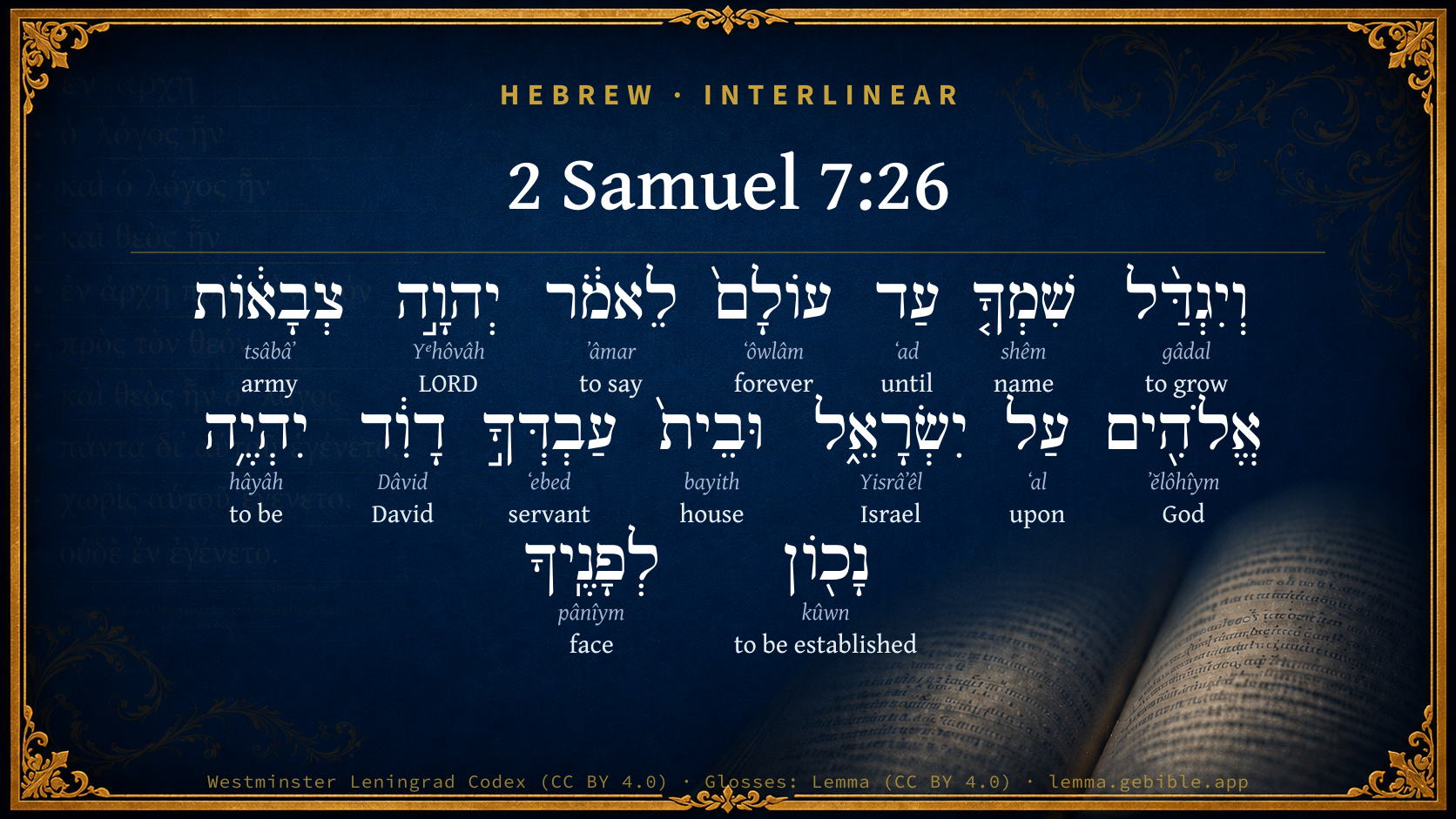
Hebrew (Westminster Leningrad Codex) 2 Samuel 7:26 appears in the Hebrew Old Testament. The text above is from the Westminster Leningrad Codex. Each word links to its Strong’s number, a concise gloss, and parsing drawn from the Open Scriptures Hebrew Bible morphology. Click any word for its full Brown-Driver-Briggs (BDB) entry.
Download image
Cite this verse

2 Samuel 7:26 (World English Bible). Public Domain. Lemma interlinear Bible study tool, https://lemma.gebible.app/v/2-samuel/7/26.

Show BibTeX & RIS
BibTeX
RIS
English Translation
Let your name be magnified forever, saying, Yahweh of hosts is God over Israel; and the house of your servant David shall be established before you.
World English Bible · Public Domain
Download a study sheet

One document with this verse’s original text, its word-by-word gloss line, the meaning frame, cross-references with their text, attributed commentary, and full source and license credits — printable, and it pastes into notes with its structure intact.

This verse Autodidact and up

Study sheet (.html) Plain text (.txt)

A passage Seminary Student

Up to 50 verses in one chapter. A passage sheet keeps up to 6 commentary sources and 12 cross-references per verse, in the order this page ranks them, and says so on the sheet whenever that leaves anything out. Ask for a single verse and you get the Autodidact verse sheet above.

Everything on this page stays free to read, with no account — the sheet is a download of what is already on screen, not access to it.

Want to remove ads? Support Godless Engineer
Compare translations 3

The same verse in 3 English versions, stacked beneath the original-language interlinear above. Click any original word for its lexicon entry.

Each is an independent rendering of the whole verse — the interlinear is not word-aligned to these translations.

Highlighted words mark where these versions differ — a whole-verse word diff, not a word-by-word alignment.

  • World English Bible Public Domain
    Let your name be magnified forever, saying, Yahweh of hosts is God over Israel; and the house of your servant David shall be established before you.
  • King James Version Public Domain
    And let thy name be magnified for ever, saying, The LORD of hosts is the God over Israel: and let the house of thy servant David be established before thee.
  • unfoldingWord Literal Text CC BY-SA 4.0
    And may your name be great to forever, saying, ‘Yahweh of Armies God over Israel,’ and the house of your servant David will be established to your face.

unfoldingWord Literal Text — © unfoldingWord, licensed CC BY-SA 4.0. Word-aligned USFM3 via Door43 (git.door43.org/unfoldingWord/en_ult).

Versions to compare (up to 4)

3 of 4 selected

Show all 18 translations

Every available English version of this verse, each an independent rendering of the whole verse.

  • World English Bible Public Domain
    Let your name be magnified forever, saying, Yahweh of hosts is God over Israel; and the house of your servant David shall be established before you.
  • Berean Standard Bible Public Domain
    so that Your name will be magnified forever when it is said, ‘The LORD of Hosts is God over Israel.’ And the house of Your servant David will be established before You.
  • Majority Standard Bible Public Domain
    so that Your name will be magnified forever when it is said, ‘The LORD of Hosts is God over Israel.’ And the house of Your servant David will be established before You.
  • King James Version Public Domain
    And let thy name be magnified for ever, saying, The LORD of hosts is the God over Israel: and let the house of thy servant David be established before thee.
  • American Standard Version (1901) Public Domain
    And let thy name be magnified for ever, saying, Jehovah of hosts is God over Israel; and the house of thy servant David shall be established before thee.
  • Revised Version (1885) Public Domain
    And let thy name be magnified for ever, saying, The LORD of hosts is God over Israel: and the house of thy servant David shall be established before thee.
  • Geneva Bible (1599) Public Domain
    And let thy Name bee magnified for euer by them that shall say, The Lord of hostes is the God ouer Israel: and let the house of thy seruant Dauid be stablished before thee.
  • Douay-Rheims (1899) Public Domain
    That thy name may be magnified for ever, and it may be said: The Lord of hosts is God over Israel. And the house of thy servant David shall be established before the Lord.
  • Young's Literal Translation Public Domain
    And Thy Name is great unto the age, saying, Jehovah of Hosts `is' God over Israel, and the house of Thy servant David is established before Thee,
  • Literal Standard Version CC BY-SA 4.0
    And Your Name is great for all time, saying, YHWH of Hosts [is] God over Israel, and the house of Your servant David is established before You,
  • Unlocked Literal Bible CC BY-SA 4.0
    May your name be forever great, so the people will say, 'Yahweh of hosts is the God of Israel,' while the house of me, David, your servant is established before you.
  • unfoldingWord Literal Text CC BY-SA 4.0
    And may your name be great to forever, saying, ‘Yahweh of Armies God over Israel,’ and the house of your servant David will be established to your face.
  • Darby Bible Public Domain
    And let thy name be magnified for ever, saying, Jehovah of hosts is God over Israel; and let the house of thy servant David be established before thee.
  • World Messianic Bible Public Domain
    Let your name be magnified forever, saying, ‘The LORD of Hosts is God over Israel; and the house of your servant David will be established before you.’
  • Webster's Bible Public Domain
    And let thy name be magnified for ever, saying, The LORD of hosts is the God over Israel: and let the house of thy servant David be established before thee.
  • Free Bible Version CC BY-SA 4.0
    and may your true nature be honored forever, with people declaring, ‘The Lord Almighty is Israel's God!’ May the house of your servant David continue to be there in your presence.
  • Bible in Basic English Public Domain
    And let your name be made great for ever, and let men say, The Lord of armies is God over Israel: and let the family of David your servant be made strong before you!
  • JPS Tanakh (1917) Public Domain
    And let Thy name be magnified for ever, that it may be said: The LORD of hosts is God over Israel; and the house of Thy servant David shall be established before Thee.

Literal Standard Version (2020), Covenant Press — licensed CC BY-SA 4.0. Text via the HelloAO Bible API (eBible.org). Unlocked Literal Bible (unfoldingWord) — licensed CC BY-SA 4.0. Text via the HelloAO Bible API (eBible.org). unfoldingWord Literal Text — © unfoldingWord, licensed CC BY-SA 4.0. Word-aligned USFM3 via Door43 (git.door43.org/unfoldingWord/en_ult). Free Bible Version, Dr. Jonathan Gallagher — licensed CC BY-SA 4.0. Text via the HelloAO Bible API (eBible.org).

Word by word

More ways to search: Search by grammar → Find every occurrence → Compare this word →

Practice this passage: Drill this verse → Learn its vocabulary →

וְיִגְדַּ֨ל
gâdal
H1431
“and · to grow”
Conjunction + Verb, Qal, Imperfect, 3rd Person, Masculine, Singular
Part of Speech
Conjunction + Verb
Stem
Qal
Form
Imperfect
Person
3rd Person
Gender
Masculine
Number
Singular
Full BDB Definition

Origin: a primitive root

TWOT: 315

to grow, become great or important, promote, make powerful, praise, magnify, do great things - (Qal) - to grow up - to become great - to be magnified - (Piel) - to cause to grow - to make great, powerful - to magnify - (Pual) to be brought up - (Hiphil) - to make great - to magnify - to do great things - (Hithpael) to magnify oneself
  1. שִׁמְךָ֤ shêm H8034 “name · your” Noun, Common, Masculine, Singular, Construct + Suffix, Personal, 2nd Person, Masculine, Singular
  2. עַד ʻad H5704 “until” Preposition
  3. עוֹלָם֙ ʻôwlâm H5769 “forever” Noun, Common, Masculine, Singular, Absolute
  4. לֵאמֹ֔ר ʼâmar H559 “to say” Preposition + Verb, Qal, Infinitive Construct
  5. יְהוָ֣ה Yᵉhôvâh H3068 “LORD” Noun, Proper
  6. צְבָא֔וֹת tsâbâʼ H6635 “armies” Noun, Common, Both, Plural, Absolute
  7. אֱלֹהִ֖ים ʼĕlôhîym H430 “God(s)” Noun, Common, Masculine, Plural, Absolute
  8. עַל ʻal H5921 “upon” Preposition
  9. יִשְׂרָאֵ֑ל Yisrâʼêl H3478 “Israel” Noun, Proper
  10. וּבֵית֙ bayith H1004 “and · house of” Conjunction + Noun, Common, Masculine, Singular, Construct
  11. עַבְדְּךָ֣ ʻebed H5650 “servant · your” Noun, Common, Masculine, Singular, Construct + Suffix, Personal, 2nd Person, Masculine, Singular
  12. דָוִ֔ד Dâvid H1732 “David” Noun, Proper
  13. יִהְיֶ֥ה hâyâh H1961 “to be” Verb, Qal, Imperfect, 3rd Person, Masculine, Singular
  14. נָכ֖וֹן kûwn H3559 “being established” Verb, Niphal, Participle Active, Masculine, Singular, Absolute
  15. לְפָנֶֽיךָ pânîym H6440 “to/for · face(s) · your” Preposition + Noun, Common, Both, Plural, Construct + Suffix, Personal, 2nd Person, Masculine, Singular

About this verse

These counts appear in no published source. They are computed here, from the morphology-tagged text and Lemma’s own curated glosses. What Lemma adds →

16
words
16
distinct lemmas
Historical
section

Grammatical profile

  • 4 verbs
  • 10 nouns
  • 2 prepositions

Verb forms

  • וְיִגְדַּ֨ל Qal · Imperfect
  • לֵאמֹ֔ר Qal · Infinitive Construct
  • יִהְיֶ֥ה Qal · Imperfect
  • נָכ֖וֹן Niphal · Participle Active

Hebrew & Septuagint length

In English translation the verse runs 26 words from the Hebrew and 7 from the Septuagint (LXX English) — the Septuagint runs noticeably shorter here. See the side-by-side →

A rough comparison of the two English renderings, which tokenize alike — not a word-level alignment.

Word counts can differ between the Hebrew and the Greek without any difference in meaning — e.g. the Hebrew direct-object marker אֵת has no separate Greek word, and Greek often adds the article ὁ.

Cross-references

8

Topical passages linked to 2 Samuel 7:26 in the Treasury of Scripture Knowledge — connected by theme and wording, ordered by reader-vote popularity; previews shown in the World English Bible.

  • 1 Chronicles 17:23–24 Now, Yahweh, let the word that you have spoken concerning your servant, and concerning his house, be established forever, and do as you have spoken.
  • Psalms 72:18–19 Praise be to Yahweh God, the God of Israel, Who alone does marvelous deeds.
  • Matthew 6:9 Pray like this: 'Our Father in heaven, may your name be kept holy.
  • Genesis 17:18 Abraham said to God, "Oh that Ishmael might live before you!"
  • 1 Chronicles 29:10–13 Therefore David blessed Yahweh before all the assembly; and David said, You are blessed, Yahweh, the God of Israel our father, forever and ever.
  • Psalms 89:36 His seed will endure forever, His throne like the sun before me.
  • Psalms 115:1 Not to us, Yahweh, not to us, But to your name give glory, For your loving kindness, and for your truth's sake.
  • John 12:28 Father, glorify your name!" Then there came a voice out of the sky, saying, "I have both glorified it, and will glorify it again."

Cross-references courtesy of OpenBible.info (CC BY 4.0).

Hebrew and Greek witnesses Masoretic Hebrew ↔ Greek Septuagint

The same verse in the two great witnesses to the Old Testament, shown verse-for-verse.

Here the Septuagint runs noticeably shorter than the Hebrew — LXX2012 (modern English Septuagint) 7 words vs World English Bible 26. A rough length comparison of the two English translations, not a word-level alignment — read both below.

These are two independent witnesses, not word-aligned to each other, and the Septuagint is shown in lemma (dictionary) form.

Hebrew 2 Samuel 7:26 Masoretic · Westminster Leningrad Codex

וְיִגְדַּ֨ל שִׁמְךָ֤ עַד עוֹלָם֙ לֵאמֹ֔ר יְהוָ֣ה צְבָא֔וֹת אֱלֹהִ֖ים עַל יִשְׂרָאֵ֑ל וּבֵית֙ עַבְדְּךָ֣ דָוִ֔ד יִהְיֶ֥ה נָכ֖וֹן לְפָנֶֽיךָ

Let your name be magnified forever, saying, Yahweh of hosts is God over Israel; and the house of your servant David shall be established before you.

World English Bible · Public Domain

Greek LXX 2 Samuel 7:26 Septuagint · lemma form

μεγαλύνω ὁ ὄνομα σύ ἕως αἰών

Let your name be magnified for ever.

LXX2012 (modern English Septuagint) · Public Domain

Hebrew: Westminster Leningrad Codex (CC BY 4.0). Greek: Septuagint (public domain); English from LXX2012 (modern English Septuagint) (Public Domain). How the Septuagint differs from the Hebrew →

Targum (Aramaic paraphrase)

1

The Targum is the ancient Jewish Aramaic paraphrase of the Hebrew Scriptures — an interpretive translation, not the Hebrew text itself. Onkelos (literal) and Pseudo-Jonathan (expansive) render the Torah, and Jonathan the Prophets. Coverage is partial: where no permissively-licensed English translation exists for a verse, only the Aramaic is shown. This is verse-level text, not a word-by-word alignment to the Hebrew.

  1. Targum Jonathan Prophets (Joshua–Malachi)
    וְיִסְגֵי שְׁמָךְ עַד עָלְמָא לְמֵימַר יְיָ צְבָאוֹת אֱלֹהִים עַל יִשְׂרָאֵל וּבֵית עַבְדָךְ דָוִד יְהֵי מְתַקֵן קֳדָמָךְ:

    (no public-domain English translation for this verse)

    Targum Jonathan — Aramaic: “Mikraot Gedolot” (public domain). English: “Sefaria Community Translation” (CC0 1.0 (public-domain dedication)); “London "Chaldee Paraphrase," 1871” (public domain). Text via Sefaria.

Commentary

Notes on 2 Samuel 7:26 from classic Christian and Jewish commentators (each source and its license shown beneath its notes). The classic Christian expositions comment on the surrounding passage and are grouped to its opening verse, so a note may address several verses; the Jewish commentaries on the Tanakh (Rashi and others) are per-verse, so they appear only where the commentator wrote on this verse.

Lemma curates 59 commentaries, every one of them public domain or Creative Commons licensed, each selected and text-cleaned for this edition rather than reprinted as found. About our sources →

Trapp's Complete Commentary

John Trapp

2Sa 7:26 And let thy name be magnified for ever, saying, The LORD of hosts [is] the God over Israel: and let the house of thy servant David be established before thee.

Ver. 26. And let thy name be magnified for ever.] That God may be glorified by his benefits on us conferred, should be the principal end of our prayers Propter Te, Domine, propter Te, cried that holy man in story.

John Trapp, A Commentary or Exposition upon All the Books of the Old and New Testament (1647–1656) — public domain. Text from a community e-Sword module.

Tyndale Open Study Notes

Tyndale Open Resources

7:26 Although God had promised to make David’s name great (7:9), David was concerned that God’s name be honored. David knew that if God were not the focus of the people’s praise, then David’s dynasty would count for nothing.

Tyndale Open Study Notes — © Tyndale Open Resources, licensed CC BY-SA 4.0. Text via the HelloAO Bible API.

Geneva Bible (1599)

Geneva Bible translators

This prayer is most effectual, when we chiefly seek God’s glory, and the accomplishment of his promise.

Geneva Bible (1599) marginal notes — public domain. Text via Bolls.life.

Ellicott's Commentary for English Readers

(26) Let thy name be magnified.—David here, in the true spirit of the Lord’s prayer, puts in the forefront of his petition the “hallowed be thy name;” and this is the striking feature of all his life, into whatever sins he may at times have been betrayed, that his main object was to live to the glory of God.

A Bible Commentary for English Readers, edited by Charles John Ellicott (1878–1897) — public domain. Text from a community e-Sword module.

The Cambridge Bible for Schools and Colleges

gen. ed. J. J. S. Perowne

26. let the house of thy servant David be established] Rather, the house of thy servant David shall be established; an expression of confident assurance, the ground of which is introduced by the “for” of 2Sa_7:27.

The Cambridge Bible for Schools and Colleges (gen. ed. J. J. S. Perowne; Cambridge University Press, 1878–1918) — public domain. Text from a community e-Sword module.

John Gill's Exposition

And let thy name be magnified for ever,.... David desired the performance of the above things not so much for his own sake, and for the sake of his family, as for the glory of God; his great concern was, that God might be magnified, and his greatness displayed, in making him and his family great; and particularly that he might be magnified and glorified in that famous Son of his, the Messiah, as he has been, Joh 13:31; and by all his people in succeeding ages:

saying, the Lord of hosts is the God over Israel; the Lord of armies above and below, is God over all, and in a special and peculiar manner God over Israel, literal and spiritual, that takes care of them, supplies, protects, and defends them:

and let the house of thy servant David be established before thee; as he had promised, Sa2 7:16.

John Gill's Exposition of the Whole Bible (1746–1763) — public domain (CC PDM 1.0). Text via the HelloAO Bible API.

Matthew Poole's English Annotations

The Lord of hosts is the God over Israel, i.e. do thou never cease to manifest thyself to be the God and Governor of Israel.

Matthew Poole's English Annotations on the Holy Bible (1683–1685) — public domain. Text from a community e-Sword/MySword module.

The Pulpit Commentary

God"s Name magnified in his people.

Any name of God is magnified when it is made to appear great in the eyes of his intelligent creatures, and they esteem and declare it great. This is done when he himself adds to the significance of the name by yet more glorious works or revelations; and when they come to larger conceptions of its significance, and consequently use the name with greater fulness of meaning. Thus as "the sons of God" watched the various stages of creation, the name of "Creator" would acquire greater significance and glory. The name "Jehovah of hosts" would become more glorious as the hosts themselves in the heavens and on earth grew more numerous. But David here assumes that additional glory to this great name of God might and would arise from his relation to Israel; that to say, "Jehovah of hosts is the God over Israel," would be to add lustre to the name. And rightly, for his Name has been magnified by what he did amongst and for that people, by the revelations of himself which he gave them, and by the results in their national history, in the character and deeds of many of them, and in the history of the world. He made through them such manifestations of his greatness and goodness, righteousness and mercy, as befitted himself; and for which vast multitudes have magnified and do magnify him in their thoughts and thanksgivings. Until the Christ came, no name of God was more illustrious than this, "Jehovah of hosts, the God of Israel." In fact, the coming of Christ and all that has grown out of it was included in that name. Hence another name of God greater still, "the God and Father of our Lord Jesus Christ," and "the God and Father of Christ"s people." Yea, the whole Name of God, his whole character, all the terms and declarations by which he is made known, is magnified by what he has said and done in Christ. The great threefold name, Father, Son, and Holy Spirit, is as never before declared and glorified in the work of salvation.

I HOW GOD"S NAME IS MAGNIFIED IN AND BY HIS PEOPLE. This is effected by:

1. The work wrought for them.

"Twas great to speak a world from nought; "Twas greater to redeem.

1. The revelations made to them. In the Person, teaching, miracles, death, resurrection, and ascension of the Lord Jesus; and by the teaching of the Holy Spirit through the. evangelists and apostles. In these God is manifested more fully and clearly than by all his works besides. Never before did his Name appear so great and glorious.

2. The work wrought in them. The regeneration and sanctification of souls is a more interesting and illustrious display of Divine power than the creation of suns and stars, and reveals more of the Divine nature. The spiritual beauty and glory thus produced surpass all the beauty and glory of the natural world, and in them more of God appears. In "the fruit of the Spirit" (Gal_5:22) God is magnified more than in all other products of his power.

3. The works done by them. The witness they bear for God by their worship and teaching, and sometimes their sufferings as confessors and martyrs; their godly and loving endeavours for the good of others; the courage and self-sacrifice, faith and patience, with which many of them labour for the spread of the gospel; and the good thus effected; all magnify, the Name of God, from whom all proceed, and to the fulfilment of whose gracious purposes all conduce. The changes wrought by the labours of Christians the whole influence and results of Christianity, notwithstanding all drawbacks (serious as these are), are of such a nature and magnitude as to exalt the Name of God more than anything else in the world.

4. The condition they at length attain. Their ultimate moral and spiritual perfection, their perfect happiness, their vast number. "He shall come to be glorified in his saints, and to be admired in all them that believe". (2Th_1:10)

5. The praises which are given to him on their account. From themselves, from the angelic hosts; on earth, in heaven; forever. In these ways God appears great and ever greater because of his relation to Christ and the Church.

II THE PRAYER OF GOOD MEN RESPECTING IT. "Let thy Name be magnified;" let it become greater and greater in the sight of the intelligent universe, and become more and more admired and praised, through what is done in and for and by thy people.

1. Such a prayer is natural to good men. Because they love God, because they have received so much from him, and because they desire the welfare of others, which is involved in the magnifying of the Name of God,

2. There is much to intensify such a prayer.

(1) The condition of the Church. In which there is so much that does not glorify the Name of God, so little comparatively that does. To say that the Lord of hosts is God of such a people does not tend to honour him so greatly as his zealous servants desire. The prayer from their hearts and lips will mean, "Let Christ"s people become so Christ-like as to make it manifest that their religion is from God, that they themselves are specially his, and that be is indeed a Being glorious in holiness and loving kindness.

(2) The condition of the world. In which God is so little thought of, his Name so little esteemed; in which idols and all manner of vain and even wicked things are magnified more than God; in which men give to themselves and their fellow men the honour which should be his; and whose salvation and whole well being would be ensured by those changes which would magnify the Name of God.

(3) The slow progress of the kingdom of God. The apparent weakness of the Church in reference to her great work, and her real insufficiency for it, should lead all Christians to pray that God would so "arise" and "let his work appear" in the spread and establishment of his kingdom that his Name may be magnified in the earth as it has never yet been.

3. Let the prayer be accompanied by practice. Let each of us who pray, "Hallowed be thy Name," so live as to aid in fulfilling our prayer; first, in our general character and conduct, and then by faithful endeavours to promote the honour of God amongst professing Christians and throughout the world. Also by hearty praise to God for all he has done in connection with Christ and Christianity to make his Name great and glorious.

Observe, finally, that the Name of God is magnified in the punishment of his enemies. Let us beware lest we be made in this manner to glorify him. Let us rather honour his Name as it appears in Jesus Christ by our faith and obedience; then he will honour it in our salvation. G.W.

The Pulpit Commentary (1880–1919), ed. H.D.M. Spence-Jones & Joseph S. Exell — public domain. Text from a community e-Sword module.

John Wesley's Explanatory Notes

Let thy name - That is, do thou never cease to manifest thyself to be the God and governor of Israel.

John Wesley, Explanatory Notes Upon the Whole Bible (1754–1765) — public domain. Text via the GEBible commentary corpus.

Lesson kit

Teaching starters — assembled from the data on this page, not authored interpretation. Every prompt links to the verse data it draws on. Edit before teaching.

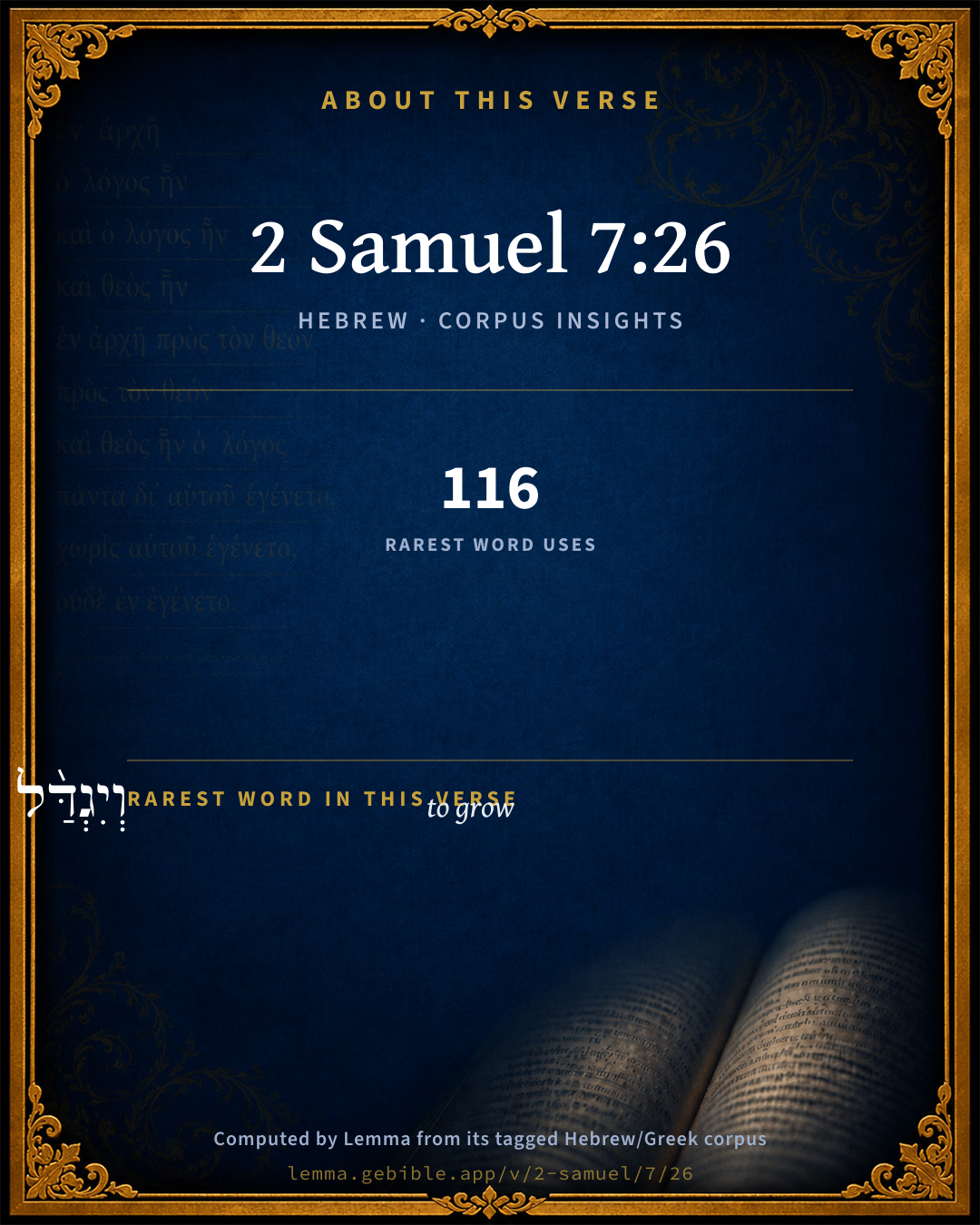
2 Samuel, in the Historical, opens this verse with 16 words (16 distinct Hebrew lemmas). Its most distinctive word is gâdal (“to grow”). The Greek Septuagint runs shorter here. A historical commentator’s framing appears above. Read the whole chapter for the surrounding context.

Discussion questions

  1. How does “to grow” (gâdal) shape what this verse is saying?
  2. 1 Chronicles 17:23–24 shares this passage’s theme. How do the two illuminate each other?
  3. Compared with the Hebrew, the Septuagint runs shorter here. What questions does that raise?
  4. These translations render this verse differently. What is at stake in choosing one wording over another?
  5. The verb «וְיִגְדַּ֨ל» is Qal Imperfect. How does its form color the action?
  6. Reading how Trapp's Complete Commentary and Tyndale Open Study Notes read this verse, where do the two commentators agree and where do they part?

Things to notice

Reading settings

Reading text

Shown beneath each verse's original-language words.

Old Testament
Old Testament edition

Read the OT as the Masoretic Hebrew (MT) or the Greek Septuagint (LXX).

English shown for the Greek Septuagint (in the Hebrew ↔ Greek comparison).

Comparing translations? Open the Compare panel on any verse page to stack up to four side by side.