
Psalms 68:10

Hebrew (Westminster Leningrad Codex) Psalms 68:10 appears in the Hebrew Old Testament. The text above is from the Westminster Leningrad Codex. Each word links to its Strong’s number, a concise gloss, and parsing drawn from the Open Scriptures Hebrew Bible morphology. Click any word for its full Brown-Driver-Briggs (BDB) entry.
Download image
Cite this verse

Psalms 68:10 (World English Bible). Public Domain. Lemma interlinear Bible study tool, https://lemma.gebible.app/v/psalms/68/10.

Show BibTeX & RIS
BibTeX
RIS
English Translation
Your congregation lived therein. You, God, prepared your goodness for the poor.
World English Bible · Public Domain
Download a study sheet

One document with this verse’s original text, its word-by-word gloss line, the meaning frame, cross-references with their text, attributed commentary, and full source and license credits — printable, and it pastes into notes with its structure intact.

This verse Autodidact and up

Study sheet (.html) Plain text (.txt)

A passage Seminary Student

Up to 50 verses in one chapter. A passage sheet keeps up to 6 commentary sources and 12 cross-references per verse, in the order this page ranks them, and says so on the sheet whenever that leaves anything out. Ask for a single verse and you get the Autodidact verse sheet above.

Everything on this page stays free to read, with no account — the sheet is a download of what is already on screen, not access to it.

Want to remove ads? Support Godless Engineer
Compare translations 3

The same verse in 3 English versions, stacked beneath the original-language interlinear above. Click any original word for its lexicon entry.

Each is an independent rendering of the whole verse — the interlinear is not word-aligned to these translations.

Highlighted words mark where these versions differ — a whole-verse word diff, not a word-by-word alignment.

  • World English Bible Public Domain
    Your congregation lived therein. You, God, prepared your goodness for the poor.
  • King James Version Public Domain
    Thy congregation hath dwelt therein: thou, O God, hast prepared of thy goodness for the poor.
  • unfoldingWord Literal Text CC BY-SA 4.0
    Your flock dwelt in it; in your goodness, you prepared for the poor, God.

unfoldingWord Literal Text — © unfoldingWord, licensed CC BY-SA 4.0. Word-aligned USFM3 via Door43 (git.door43.org/unfoldingWord/en_ult).

Versions to compare (up to 4)

3 of 4 selected

Show all 18 translations

Every available English version of this verse, each an independent rendering of the whole verse.

  • World English Bible Public Domain
    Your congregation lived therein. You, God, prepared your goodness for the poor.
  • Berean Standard Bible Public Domain
    Your flock settled therein; O God, from Your bounty You provided for the poor.
  • Majority Standard Bible Public Domain
    Your flock settled therein; O God, from Your bounty You provided for the poor.
  • King James Version Public Domain
    Thy congregation hath dwelt therein: thou, O God, hast prepared of thy goodness for the poor.
  • American Standard Version (1901) Public Domain
    Thy congregation dwelt therein: Thou, O God, didst prepare of thy goodness for the poor.
  • Revised Version (1885) Public Domain
    Thy congregation dwelt therein: thou, O God, didst prepare of thy goodness for the poor.
  • Geneva Bible (1599) Public Domain
    Thy Congregation dwelled therein: for thou, O God, hast of thy goodnesse prepared it for the poore.
  • Douay-Rheims (1899) Public Domain
    Thou shalt set aside for thy inheritance a free rain, O God: and it was weakened, but thou hast made it perfect.
  • Young's Literal Translation Public Domain
    Thy company have dwelt in it, Thou preparest in Thy goodness for the poor, O God.
  • Literal Standard Version CC BY-SA 4.0
    Your creature has dwelt in it, || You prepare for the poor in Your goodness, O God.
  • Unlocked Literal Bible CC BY-SA 4.0
    Your people lived in it; You, God, gave from your goodness to the poor.
  • unfoldingWord Literal Text CC BY-SA 4.0
    Your flock dwelt in it; in your goodness, you prepared for the poor, God.
  • Darby Bible Public Domain
    Thy flock hath dwelt therein: thou hast prepared in thy goodness, for the afflicted, O God!
  • World Messianic Bible Public Domain
    Your congregation lived therein. You, God, prepared your goodness for the poor.
  • Webster's Bible Public Domain
    \\68:9\\Thou, O God, didst send a plentiful rain, by which thou didst confirm thy inheritance, when it was weary.
  • Free Bible Version CC BY-SA 4.0
    Your people settled there, and because of your kindness, God, you looked after the poor. Selah.
  • Bible in Basic English Public Domain
    Those whose resting-place was there, even the poor, were comforted by your good things, O God.
  • JPS Tanakh (1917) Public Domain
    (68-11) Thy flock settled therein; Thou didst prepare in Thy goodness for the poor, O God.

Literal Standard Version (2020), Covenant Press — licensed CC BY-SA 4.0. Text via the HelloAO Bible API (eBible.org). Unlocked Literal Bible (unfoldingWord) — licensed CC BY-SA 4.0. Text via the HelloAO Bible API (eBible.org). unfoldingWord Literal Text — © unfoldingWord, licensed CC BY-SA 4.0. Word-aligned USFM3 via Door43 (git.door43.org/unfoldingWord/en_ult). Free Bible Version, Dr. Jonathan Gallagher — licensed CC BY-SA 4.0. Text via the HelloAO Bible API (eBible.org).

Word by word

More ways to search: Search by grammar → Find every occurrence → Compare this word →

Practice this passage: Drill this verse → Learn its vocabulary →

לֶעָנִ֣י
ʻânîy
H6041
“to/for the · poor”
Preposition, Determined + Adjective, Adjective, Masculine, Singular, Absolute
Part of Speech
Preposition + Adjective
Type
Adjective
Gender
Masculine
Number
Singular
State
Absolute
Full BDB Definition

Origin: from H6031

TWOT: 1652d

poor, afflicted, humble, wretched - poor, needy - poor and weak - poor, weak, afflicted, wretched - humble, lowly
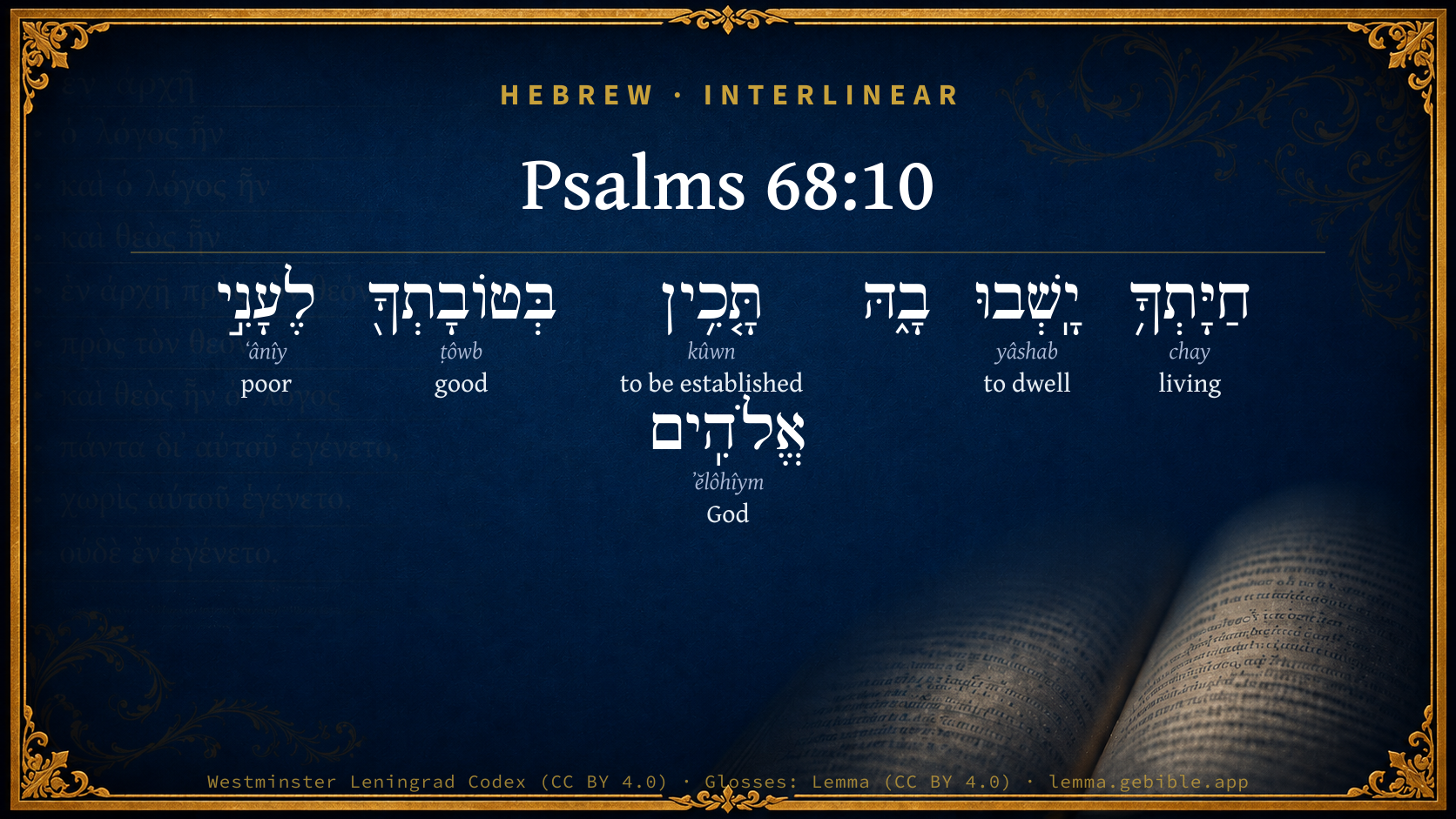
  1. חַיָּתְךָ֥ chay H2416 “living · your” Noun, Common, Feminine, Singular, Construct + Suffix, Personal, 2nd Person, Masculine, Singular
  2. יָֽשְׁבוּ yâshab H3427 “to dwell” Verb, Qal, Perfect, 3rd Person, Common, Plural
  3. תָּ֤כִ֥ין kûwn H3559 “to be established” Verb, Hiphil, Imperfect, 2nd Person, Masculine, Singular
  4. בְּטוֹבָתְךָ֖ ṭôwb H2896 “in/at · good · your” Preposition + Adjective, Adjective, Feminine, Singular, Construct + Suffix, Personal, 2nd Person, Masculine, Singular
  5. אֱלֹהִֽים ʼĕlôhîym H430 “God(s)” Noun, Common, Masculine, Plural, Absolute

About this verse

These counts appear in no published source. They are computed here, from the morphology-tagged text and Lemma’s own curated glosses. What Lemma adds →

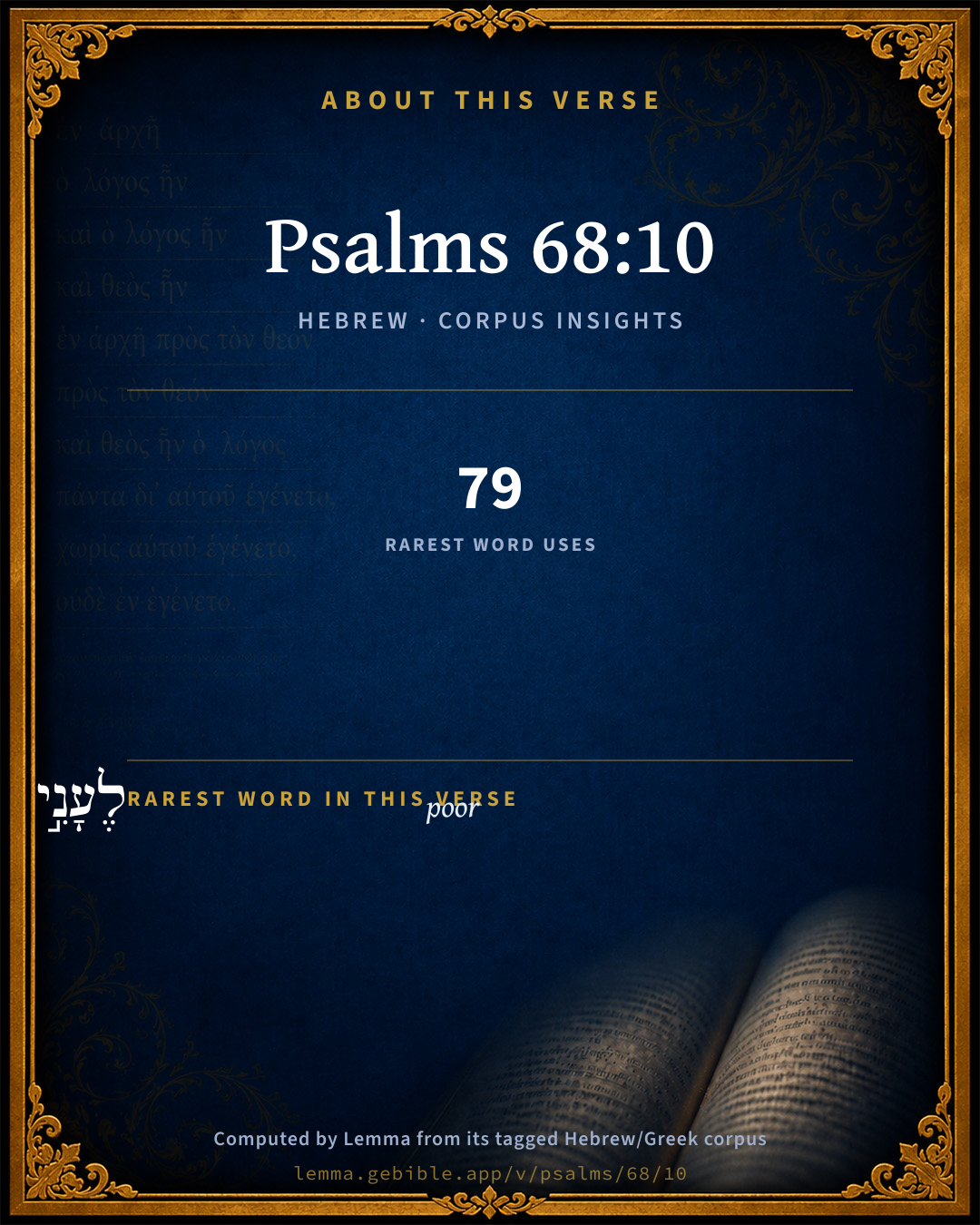
7
words
6
distinct lemmas
Wisdom
section

Grammatical profile

  • 2 verbs
  • 2 nouns
  • 2 adjectives
  • 1 preposition

Verb forms

  • יָֽשְׁבוּ Qal · Perfect
  • תָּ֤כִ֥ין Hiphil · Imperfect

Hebrew & Septuagint length

In English translation the verse runs 12 words from the Hebrew and 14 from the Septuagint (LXX English) — closely comparable.

A rough comparison of the two English renderings, which tokenize alike — not a word-level alignment.

Word counts can differ between the Hebrew and the Greek without any difference in meaning — e.g. the Hebrew direct-object marker אֵת has no separate Greek word, and Greek often adds the article ὁ.

Cross-references

14

Topical passages linked to Psalms 68:10 in the Treasury of Scripture Knowledge — connected by theme and wording, ordered by reader-vote popularity; previews shown in the World English Bible.

  • Deuteronomy 26:9–10 and he has brought us into this place, and has given us this land, a land flowing with milk and honey.
  • Psalms 74:19 Don't deliver the soul of your dove to wild beasts. Don't forget the life of your poor forever.
  • 1 Samuel 2:8 He raises up the poor out of the dust, He lifts up the needy from the dunghill, To make them sit with princes, Inherit the throne of glory: For the pillars of the earth are Yahweh's, He has set the world on them.
  • Matthew 11:5 the blind receive their sight, the lame walk, the lepers are cleansed, the deaf hear, the dead are raised up, and the poor have good news preached to them.
  • Luke 1:53 He has filled the hungry with good things. He has sent the rich away empty.
  • Exodus 19:5–6 Now therefore, if you will indeed obey my voice, and keep my covenant, then you shall be my own possession from among all peoples; for all the earth is mine;
  • Numbers 16:3 and they assembled themselves together against Moses and against Aaron, and said to them, You take too much on you, seeing all the congregation are holy, everyone of them, and Yahweh is among them: why then lift yourselves up above the assembly of Yahweh?
  • Deuteronomy 26:5 You shall answer and say before Yahweh your God, A Syrian ready to perish was my father; and he went down into Egypt, and sojourned there, few in number; and he became there a nation, great, mighty, and populous.
  • Deuteronomy 32:8–14 When the Most High gave to the nations their inheritance, When he separated the children of men, He set the bounds of the peoples According to the number of the children of Israel.
  • Job 5:10–11 Who gives rain on the earth, And sends waters on the fields;
  • Psalms 65:9 You visit the earth, and water it. You greatly enrich it. The river of God is full of water. You provide them grain, for so you have ordained it.
  • Psalms 74:1–2 God, why have you rejected us forever? Why does your anger smolder against the sheep of your pasture?
  • Psalms 78:20 Behold, he struck the rock, so that waters gushed out, Streams overflowed. Can he give bread also? Will he provide flesh for his people?"
  • 1 Peter 5:3 neither as lording it over the charge allotted to you, but making yourselves examples to the flock.

Cross-references courtesy of OpenBible.info (CC BY 4.0).

Hebrew and Greek witnesses Masoretic Hebrew ↔ Greek Septuagint

The same verse in the two great witnesses to the Old Testament, shown verse-for-verse.

You’re reading Greek Psalm 67 (Hebrew Psalm 68). The Septuagint counts the superscription, so verse numbers can differ from the Hebrew — chapter-level alignment, not verse-by-verse. Numbering follows Rahlfs.

These are two independent witnesses, not word-aligned to each other, and the Septuagint is shown in lemma (dictionary) form.

Hebrew Psalms 68:10 Masoretic · Westminster Leningrad Codex

חַיָּתְךָ֥ יָֽשְׁבוּ בָ֑הּ תָּ֤כִ֥ין בְּטוֹבָתְךָ֖ לֶעָנִ֣י אֱלֹהִֽים

Your congregation lived therein. You, God, prepared your goodness for the poor.

World English Bible · Public Domain

Greek LXX Greek Psalm 67:10 Septuagint · lemma form

βροχή ἑκούσιος ἀποὁρίζω ὁ θεός ὁ κληρονομία σύ καί ἀσθενέω σύ δέ καταἀρτίζω αὐτός

Your creatures dwell in it: you have in your goodness prepared for the poor.

LXX2012 (modern English Septuagint) · Public Domain

On this verse, Joseph Benson's Commentary discusses the Septuagint’s reading. Read the note in Commentary ↓

Hebrew: Westminster Leningrad Codex (CC BY 4.0). Greek: Septuagint (public domain); English from LXX2012 (modern English Septuagint) (Public Domain). How the Septuagint differs from the Hebrew →

Commentary

Notes on Psalms 68:10 from classic Christian and Jewish commentators (each source and its license shown beneath its notes). The classic Christian expositions comment on the surrounding passage and are grouped to its opening verse, so a note may address several verses; the Jewish commentaries on the Tanakh (Rashi and others) are per-verse, so they appear only where the commentator wrote on this verse.

Lemma curates 59 commentaries, every one of them public domain or Creative Commons licensed, each selected and text-cleaned for this edition rather than reprinted as found. About our sources →

Trapp's Complete Commentary

John Trapp

Psa 68:10 Thy congregation hath dwelt therein: thou, O God, hast prepared of thy goodness for the poor.

Ver. 10. Thy congregation hath dwelt therein] Pecus tuum, thy cattle, so some render it, and interpret it as the flocks and herds, whereby of his goodness God prepared for his poor, those creatures being profitable both ad esum et ad usum.

John Trapp, A Commentary or Exposition upon All the Books of the Old and New Testament (1647–1656) — public domain. Text from a community e-Sword module.

The Biblical Illustrator

Joseph S. Exell

Psa_68:10

Thou, O God, hast prepared of Thy goodness for the poor.

Gods provision for the poor

We hold it as altogether one of the most forcible sayings of Holy Writ, that the poor shall never cease out of the land. The words may be regarded in the nature of a prophecy; and we think their fulfilment has been every way most surprising. But our great business lies with the fact that poverty is the appointment of God. The rich and the poor meet together: the Lord is the maker of them all. When we have fastened on the truth that God troth appointed poverty, we must set ourselves to show that God hath not overlooked the poor. The Gospel of Christ makes no distinction, whether preached in a palace or in a cottage--whether it addresses itself to ignorant men or to learned men. There is no variation in the message: it speaks to all as being born in sin and shapen in iniquity; and announces to all the same free and glorious tidings--namely, that God hath made Him sin for us who knew no sin, that we might be made the righteousness of God in Him. But not only has God thus introduced a kind of natural counterpoise to the evil of poverty; in the appointment of the method of redemption He may be said to have especially provided for the meanest and the most destitute. There is nothing in the prescribed duties of religion which, in the smallest degree, requires that the man be a man of learning and leisure. The Gospel message is one of such exquisite simplicity--the sum and substance of truth may be gathered into such brief sentences--that all which is necessary to know may be told in a minute, and borne about by the labourer in the field, or the soldier on the battle-plain. Nay, we shall not overstep the boundaries of truth if we carry this statement further. We hold unreservedly that the Bible is even more the poor mans book than the rich mans. There is a vast deal of the Bible which seems to have been written for the very purpose of making good our text: Thou, O God, preparest, etc. But there is yet another point on which we think it well to turn your attention; for it is one which is not a little misunderstood. We know that what are termed the evidences o! Christianity are of a costly and intricate description, scarcely accessible except to the studious. It is hard to suppose that the unlettered man can be master of the arguments which go to the proof of the Divine origin of our faith. We think assuredly that, if you take the experience of the generality of Christians, you will find that they do not believe without proof, and that, therefore, they are not unfurnished with weapons with which to repel infidelity. They do not believe without proof; but the proof lies, as Horsley says, in the surprising manner in which the Bible commends itself to their souls--in the inexhaustible stores which they find in Jesus--in the agreement of the doctrines and precepts of religion--in that exemplar of good, and in that fear, which a devout heart carries about with itself. He that believeth on the Son of God hath the witness in himself. And we think there can he nothing far-fetched in the assertion that there is no evidence of the divinity of the Scripture half so strong as that which a man knocks out for himself with the simple apparatus of a Bible and a conscience. So that we think that God hath so ordered His Word that it carries its own witness to the poor mans intellect and to his heart. (H. Melvill, B. D.)

Harvest

The reference is to Gods care of Israel in the wilderness. But God still cares for men.

I. The nature of His goodness. It is seen in the produce of the ground. The brute creation as wall as man share in this, but the corn is especially for man. Judea was famous for its corn. By a bold metaphor, Moses speaks of the kidneys of the wheat. And as there, so here the barns shall be full of wheat. We are hindered in seeing the goodness of God herein by its constant repetition and by the moans--second causes--which He employs. But if some things hinder our seeing, others may help. Think how easily he could have destroyed all our hopes; and how dreadful if He had; and yet how righteously, for our sins, He might have done this.

II. The subjects of His goodness--the poor. It is not for them exclusively, but they are spoken of as being the mass of mankind: they would be most affected by deficiency: God would encourage them to trust in Him; and He would have the rich care for the poor, for He does. (W. Jay.)

Gods provision, for the poor

What is Gods provision for the poor?

1. He has provided them with a very honourable name. That name has been tarnished and sullied in the course of years. But the name as originally found in the Hebrew contained no idea of shame, guilt, or disgrace. To the poor and weak, not to the rich and self-helping, Gods richest promises are made.

2. God has provided the poor with necessary succour. There is ample provision in the world for the entire human family. The provision is Gods part, the just distribution is the duty of man. If we could only properly distribute the things which we have at our command every one would be provided for. If any man does not get his share it is the fault of his fellow-man; not Gods omission. In one department of individual economics especially there is a special call for the work of the Christian Church. And that is in the region of those numberless casual changes which fall to the lot of man, and, for the time, make him poor. Here is the opportunity for the Christian to go to him and to give him the personal word of cheer. Then again, the Christian, in his dealings with his fellow-man, must adapt the Jewish law concerning not shaking the olive-tree twice, or too nicely gleaning the cornfield. He is ever in his business transactions to set an example of high-souled generosity. He should take a personal interest in those who are dependent upon him. When we turn to the New Testament we naturally expect to find evidence that God has made provision for the poor. Nor are we disappointed. From the time of the founding of the Church the greatest care of the poor was enjoined. An experiment of the Communist system was tried. It early passed, either because there was not sufficient religion to sustain it, or because it was not the method of Gods idea. Its place has been taken by the law of Fraternity. Every one is responsible for the welfare of his fellow-believer. (J. Lorimer.)

The Biblical Illustrator, edited by Joseph S. Exell (c. 1880s–1900s) — public domain. Text from a community e-Sword module.

Joseph Benson's Commentary

Psa 68:10. Thy congregation — Thy people Israel, who are all united in one body, under thee their head and governor. It is true, the word חיה, chajab, here rendered congregation, primarily signifies life, living creature, or animal, and is often put for beast, and wild beast; but, as the best lexicographers observe, it also frequently means cœtus, or caterva, a company or troop of men, as in Psa 68:30 of this chapter, and 2Sa 23:13, compared with 1Ch 11:15, and Psa 74:19. But, retaining the proper signification of the word, the clause may be rendered, as it is by the LXX., τα ζωα σου, thy living creatures, or thy flock, that is, thy people, the sheep of thy pasture, hath dwelt therein, ישׁבו בה, jashebu bah, have dwelt in it, namely, in the inheritance mentioned in the preceding verse, to which the preposition, with the feminine affix, בה, in it, can only properly refer. God often compares himself to a shepherd, and his people to sheep; and he is particularly said to have led his people like a flock, by the hand of Moses and Aaron, Psa 77:20, namely, in the wilderness; and consequently he may be here said to have brought his sheep into, and to have made them dwell in, Canaan, as in a green and good pasture; see Psalms 23., where God speaks of his people under this very metaphor. This interpretation, evidently adopted by our translators, seems much more easy and natural, and more agreeable to the Hebrew text, than that of Dr. Chandler and some others, who would render the word above mentioned, (which we translate thy flock, or thy congregation,) thy food, or the support of thy life; and who thus interpret the clause: thy food, or, as to thy food, the food which thou, O God, gavest them, they dwelt in the midst of it: which is surely a very unnatural and forced exposition. Thou hast prepared of thy goodness, &c. — Dr. Chandler, in consistency with his above-mentioned interpretation of the preceding clause, understands this of the provision made miraculously by God for his people in the wilderness: but, according to our translation, it speaks of the provision made for them in Canaan; the good land which God prepared for his people, by expelling the old inhabitants, sending frequently refreshing and fertilizing rains upon it, making it fruitful by his special blessing, and furnishing it with all sorts of provisions: and all this of his goodness, that is, by his free, unmerited, and singular goodness: and that both as to the cause and measure of this preparation. God did it; not for their righteousness, as he often told them, but of his mere mercy; and he increased the fruits of the earth very wonderfully, that they might be sufficient for the supply of such a numerous people, which, without his extraordinary blessing, would not have been the case, as appears by the state of that land at this day, which is well known to be very barren. For the poor — Thy people of Israel, whom he calls poor, partly to repress that pride and arrogance to which they were exceedingly prone, and to remind them of their entire dependance on God for all they had or hoped for; and partly because they really were poor when God undertook the conduct of them into Canaan, and such they would have been still if God had not provided for them in a singular manner.

Joseph Benson's Commentary on the Old and New Testaments (1811–1818) — public domain. Text from a community e-Sword module.

J. A. Alexander on Psalms

Joseph Addison Alexander

11. (Psa 68:10). Thy flock hath dwelt therein; thou wilt provide, in thy goodness, for the wretched. The first noun strictly means an animal, and more especially a beast, but was probably employed as a collective to denote a herd or flock, in which sense it was figuratively applied in David's time to a company or troop of men, (2Sa 23:11; 2Sa 23:13). Therein, i.e. in the land of promise, which was present to the writer's mind, though not expressly mentioned in the context. See below, Psa 68:14, and compare Isa 8:21. Thou wilt provide, indefinitely, whatsoever may be needed; or more specifically, wilt prepare, i.e. prepare a home, a resting place. The future tense describes it as a customary method of proceeding upon God's part, but specially exemplified in the case of Israel, who, until his settlement in Canaan, might well be called a sufferer, a wretched or afflicted one.

Joseph Addison Alexander, The Psalms Translated and Explained (1850) — public domain. Text from a community e-Sword module.

Geneva Bible (1599)

Geneva Bible translators

God blessed the land of Canaan, because he had chosen that place for his Church.

Geneva Bible (1599) marginal notes — public domain. Text via Bolls.life.

Jamieson, Fausset & Brown

Robert Jamieson, A. R. Fausset & David Brown

Thy congregation--literally, "troop," as in Sa2 23:11, Sa2 23:13 --the military aspect of the people being prominent, according to the figures of the context.

therein--that is, in the land of promise.

the poor--Thy humble people (Psa 68:9; compare Psa 10:17; Psa 12:5).

Jamieson, Fausset & Brown — Commentary Critical and Explanatory on the Whole Bible (1871) — public domain (CC PDM 1.0). Text via the HelloAO Bible API.

Adam Clarke's Commentary

Verse 10. Thy congregation hath dwelt therein] חיתך chaiyathecha, thy living creature; τα ζωα, Septuagint; animalia, Vulgate; so all the Versions. Does not this refer to the quails that were brought to the camp of the Israelites, and dwelt, as it were, round about it? And was not this, with the manna and the refreshing rock, that goodness which God had provided for the poor-the needy Israelites?

Adam Clarke's Commentary on the Bible (1810–1826) — public domain. Text from a community e-Sword/MySword module.

Ellicott's Commentary for English Readers

(10) Thy congregation.—See above. If the emendation there adopted seems unnecessary, we may render here, Thy life dwells in her, i.e., in the people of Israel. (Comp. Psa_143:3.) The vigour consequent on the heavenly food might be called the Divine life, and conceal a higher application.

A Bible Commentary for English Readers, edited by Charles John Ellicott (1878–1897) — public domain. Text from a community e-Sword module.

The Cambridge Bible for Schools and Colleges

gen. ed. J. J. S. Perowne

10. Thy congregation took up its abode therein:

In thy goodness, O God, thou dost provide for the afflicted.

The word rendered congregation, or, as R.V. marg., troop, or family, is a peculiar one. The corresponding Arabic word means “such a kindred group as was guided in war and on the march by one chief, migrating together, and forming generally a single settlement.” Robertson Smith, Kinship and Marriage in Early Arabia, pp. 36 ff. From the meaning life or living, the word came to mean a clan, a group of one blood, on the old Semitic principle that “the life of the flesh lies in the blood” (Lev_17:11). Thou dost provide for the afflicted is a general truth, which found special illustration in regard to Israel, ‘afflicted’ by the bondage of Egypt (Exo_3:7; Exo_3:17).

The Cambridge Bible for Schools and Colleges (gen. ed. J. J. S. Perowne; Cambridge University Press, 1878–1918) — public domain. Text from a community e-Sword module.

John Gill's Exposition

Thy congregation hath dwelt therein,.... That is, in the Lord's inheritance, in the midst of his church and people. The word for "congregation" signifies "beasts" or "living creatures" (w): some understand them of the Gentiles, who, before the Gospel came among them, were comparable to such; but, under the Gospel dispensation, being called and taken out by it, were put among the people of God, and dwelt in his inheritance. Though, without any limitation, it may be applied to all that are quickened and made alive by the grace of God; to all that are written among the living in Jerusalem; and particularly to the ministers of the Gospel, who are signified by the four living creatures, in Ezekiel's vision and in John's Revelation; though not to the exclusion of any living believer, who has a name and a place here, and who are fellow citizens with the saints, and of the household of God:

thou, O God, hast prepared of thy goodness for the poor; blessings of goodness, spiritual blessings, blessings of grace and of glory; which flow from divine goodness, are in themselves good, and in their effects; and these were prepared in the covenant of grace and in Christ from all eternity; and that for persons poor and mean, indigent and helpless; and so the goodness of God in preparing them appears to he free and unmerited. The Targum is,

"thou hast prepared an host of angels to do good to the poor of God.''

Arama interprets it of the manna.

(w) , Sept. "animalia tua", V. L. so Eth. Syr. Arab. & Cocceius; "pecus tuum", Musculus, and some in Vatablus.

John Gill's Exposition of the Whole Bible (1746–1763) — public domain (CC PDM 1.0). Text via the HelloAO Bible API.

Albert Barnes' Notes on the Bible

Thy congregation hath dwelt therein - In the land of promise; for the connection requires us to understand it in this manner. The idea of the writer all along pertains to that land, and to the mercy which God had shown to it. After showing by an historical reference what God had done for the people in the wilderness, he returns here, though without expressly mentioning it, to the land of promise, and to what God had done there for his people. The word tendered “congregation” - חיה châyâh - means properly a beast, an animal, Gen 1:30; Gen 2:19; Gen 8:19; Gen 37:20. Then it comes to be used as a collective noun, meaning a herd or flock; thus, a troop of people, an array or host, 2Sa 23:11, 2Sa 23:13; and it is applied here to the people, under the idea so common in the Scriptures that God is a Shepherd.

Thou, O God, hast prepared of thy goodness for the poor - For thy flock considered as poor or wretched. That is, Thou hast provided for them when they had no resources of their own - when they were a poor, oppressed, and afflicted people - wanderers wholly dependent on thee.

Albert Barnes' Notes on the Bible (1834–1885) — public domain. Text from a community e-Sword/MySword module.

Matthew Poole's English Annotations

Thy congregation; thy people of Israel, who are all united in one body under thee, their Head and Governor. For though this word commonly signifies living creatures, yet sometimes it signifies a company of men, as here below, Psa 68:31, and 2Sa 23:13, compared with 1Ch 11:15; Psa 74:19. Or the proper signification of the word may be retained, and it may be rendered thy flock; for God oft compares himself to a shepherd, and his people to sheep, and particularly he is said to have led his people like a flock by the hand of Moses and Aaron, Psa 77:20, to wit, in the wilderness; and consequently he may be here said to have brought his sheep into and made them to dwell in Canaan, as in a green and good pasture, as God speaks of his people under this very metaphor, Psa 23:2.

Prepared; or, prepared it; which pronoun is oft understood, and here most easily out of the foregoing clause of this verse, where it is expressed. Prepared it, to wit, this land, for the use of thy people; which God did many ways; partly by designing it for them, and expelling the old inhabitants to make way for them; and partly by furnishing it with all sorts of provisions, both for necessity. and delight, and making it fruitful by his special blessing, in giving rain in its proper seasons.

Of thy goodness; by thy free and singular goodness; which may be referred both to the cause of this preparation, God did it not for their righteousness or worthiness, but out of his mere mercy, as God oft telleth them; and to the manner and measure of it, God did wonderfully increase the fruits of it, that it might suffice for the supply of such a numerous people; which without his extraordinary blessing it would not do, as appears by the state of that land at this day, as it is reported by travellers and eye-witnesses of it.

For the poor, to wit, for thy people of Israel, whom he here calls poor, partly to repress that pride and arrogance to which they are exceeding prone, and to mind them of the dependence upon God for all that they have and hope for; and partly because they really were, when God undertook the conduct of them into Canaan, a very poor and beggarly people, and so they would have still been, if God had not provided for them in a singular manner.

Matthew Poole's English Annotations on the Holy Bible (1683–1685) — public domain. Text from a community e-Sword/MySword module.

The Treasury of David

Charles H. Spurgeon

Ver. 10. Thy congregation hath dwelt therein. In the wilderness itself, enclosed as in a wall of fire, thy chosen church has found a home; or, rather, girdled by the shower of free grace which fell all around the camp, thy flock has rested. The congregation of the faithful find the Lord to be their "dwelling place in all generations." Where there were no dwellings of men, God was the dwelling of his people.

Thou, O God, hast prepared of thy goodness for the poor. Within the guarded circle there was plenty for all; all were poor in themselves, yet there were no beggars in all the camp, for celestial fare was to be had for the gathering. We, too, still dwell within the circling protection of the Most High, and find goodness made ready for us: although poor and needy by nature, we are enriched by grace; divine preparations in the decree, the covenant, the atonement, providence, and the Spirit's work, have made ready for us a fulness of the blessing of the Lord. Happy people, though in the wilderness, for all things are ours, in possessing the favour and presence of our God.

Ver. 10. Thy congregation. The words are choice and expressive. Addressing God, (the poet) intentionally and emphatically calls the people of Israel Ktyx thy combined congregation, in contrast to former divisions and various dissensions, to signify, that the people was now welded together, formed into one society, and united at the same time, that it was well ordered, and constituted as the society of God, wherein his laws flourished and were wont to be observed. Hermann Venema.

Ver. 10. Thy congregation. Or, Thy living creatures, Ktyh, ta zwa, LXX animalia, Vulgate; probably a reference to the immense number of quails which were miraculously brought to the camp of the Israelites, and, in a manner, dwelt around it. Note in the "Congregational Bible."

Ver. 10. Thy congregation. Or, Thy living creatures. That desolate place, where only wild beasts before could live, was now by those showers of manna (Ps 68:9) enabled to sustain a multitude of other tamer living creatures, even of men and all their flocks and herds. Henry Hammond.

Ver. 10. (first clause). Rather: --"As for thy food (manna and quails), they dwelt in the midst of it." Edmund Law.

Ver. 10. (first clause). As to thy food, they dwelt amidst it. The ambiguity of the word hyx has occasioned various renderings of this line. Parkhurst considers the radical sense of hyx is "to be vigorous, strong; "hence the noun denotes force, a body of men (2Sa 23:13); and also that which gives strength, the means of support, or food (Jud 6:4 17:10); and compare Ne 9:6. Our translators took the term in the first sense; I take it in the second, because the connection seems to require it, and because (tyx) refers always to a body of men, as soldiers, as actually engaged in some kind of warfare. Hence what is called the troop of Philistines (2Sa 23:13) is called the camp of the Philistines. 1Ch 11:15. And, lastly, because the common version has no antecedent to which hk, in it, or amidst it, can refer; but this version has one in the noun food. I think there is then a reference not only to the manna, but to the quails, which God brought in abundance around the camp. Ex 16:13 Nu 11:31. Thus he prepared in his goodness for the poor. Benjamin Boothroyd.

Ver. 10. Thou hast prepared in thine own sweetness for the poor, O God. In thine own sweetness, not in his sweetness. For the needy he is, for he hath been made weak, in order that he may be made perfect: he hath acknowledged himself indigent, that he may be replenished. Augustine.

Ver. 10. (second clause). Special goodness, for a special people, specially prepared.

Ver. 10. (second clause). It is spoken in reference to the poor, because,

I. They are the larger mass of mankind; and, whatever

pride may think, in the eye of reason, policy, and

revelation, by far the most important, useful, and

necessary part.

II. They would be more peculiarly affected by deficiency.

III. To encourage those in humble and trying life to

depend upon him.

IV. To enforce our attention to them from the divine

example. W. Jay.

Psalms 68:11*

Charles H. Spurgeon's The Treasury of David (1869–1885) — public domain. Psalms only. Text from a community e-Sword/MySword module.

Whedon's Commentary on the Bible

Daniel D. Whedon

10. Thy congregation hath dwelt therein—Literally, Thy living creatures have dwelt in it, that is, in the desert. The word rendered “congregation” denotes any thing that has life, a living creature of any kind, and is often used substantively for animal, beast. Here it includes flocks and herds with the people. So the Septuagint, τα ζωα σου, thy living creatures, or animals: Vulgate, animalia tua habitabunt, thy animals shall dwell. See same word in Psa_68:30. It is spoken of as a wonder that such a multitude of people and animals could subsist so long in the desert of Sinai, where climate and soil yielded no adequate natural supplies, and the simple fact was a standing evidence of the power and care of God. The supposition that it applies to the people alone, considered as a flock, is against usage, and the reference to 2Sa_23:11; 2Sa_23:13 is too dubious to give any satisfaction. The word never means “congregation,” as in the English text.

For the poor—The afflicted, with the accessory idea of humble, meek.

Daniel D. Whedon (gen. ed.), Commentary on the Old and New Testaments (1874–1909) — public domain. Text from a community e-Sword module.

The Pulpit Commentary

Thy congregation hath dwelt therein; thy troop, or thy host. (2Sa_23:11, 2Sa_23:13) The word used (hYj) is an unusual one. Thou, O God, hast prepared of thy goodness for the poor; or, thou, O God, didst in thy goodness make preparation for the poor. "The poor" are the Israelites, brought low by their sufferings in Egypt and the wilderness; the preparations those by which their conquest of Palestine was facilitated. (see Exo_25:28 Jos_24:12)

The Pulpit Commentary (1880–1919), ed. H.D.M. Spence-Jones & Joseph S. Exell — public domain. Text from a community e-Sword module.

John Wesley's Explanatory Notes

Thy congregation - The people of Israel. It - This land for the use of thy people: which God did by designing it for them, and expelling the old inhabitants; by furnishing it with all sorts of provisions, and making it fruitful by his special blessing. Poor - Such thy really were, when God undertook the conduct of them into Canaan.

John Wesley, Explanatory Notes Upon the Whole Bible (1754–1765) — public domain. Text via the GEBible commentary corpus.

Rashi

Rabbi Shlomo Yitzchaki (Rashi)

Generous rain You poured down This too You did for us: if we needed rain, You lifted them and poured upon us constantly rains of generosity and blessing.

Your heritage, which was weary, You established When the heritage of Your land was weary and thirsty for rain, You established it [Your heritage]. I found: Your heritage which was weary Which is called your heritage, and which is weary; i.e., sometimes it is so.

Rashi on the Tanakh — English translations: “The Judaica Press complete Tanach with Rashi, translated by A. J. Rosenberg” (CC BY 4.0); “Pentateuch with Rashi's commentary by M. Rosenbaum and A.M. Silbermann, 1929-1934” (public domain); “The Metsudah Tanach series, Lakewood, N.J” (CC BY 4.0); and “The Book of Joshua, Metsudah Publications, 1997” (CC BY 4.0). Text via Sefaria.

Lesson kit

Teaching starters — assembled from the data on this page, not authored interpretation. Every prompt links to the verse data it draws on. Edit before teaching.

Psalms, in the Wisdom, opens this verse with 7 words (6 distinct Hebrew lemmas). Its most distinctive word is ʻânîy (“poor”). A historical commentator’s framing appears above. Read the whole chapter for the surrounding context.

Discussion questions

  1. What does “poor” (ʻânîy) contribute to the verse as a whole?
  2. How does Deuteronomy 26:9–10, which shares this passage’s theme, read alongside this verse?
  3. These translations render this verse differently; the difference is in the English rendering, not the original. What questions does that raise?
  4. «יָֽשְׁבוּ» is a Qal Perfect verb. How does that grammatical form shape the action described?
  5. Compare how Trapp's Complete Commentary and The Biblical Illustrator read this verse. Where do they agree or differ?

Things to notice

Reading settings

Reading text

Shown beneath each verse's original-language words.

Old Testament
Old Testament edition

Read the OT as the Masoretic Hebrew (MT) or the Greek Septuagint (LXX).

English shown for the Greek Septuagint (in the Hebrew ↔ Greek comparison).

Comparing translations? Open the Compare panel on any verse page to stack up to four side by side.