
1 Kings 2:12

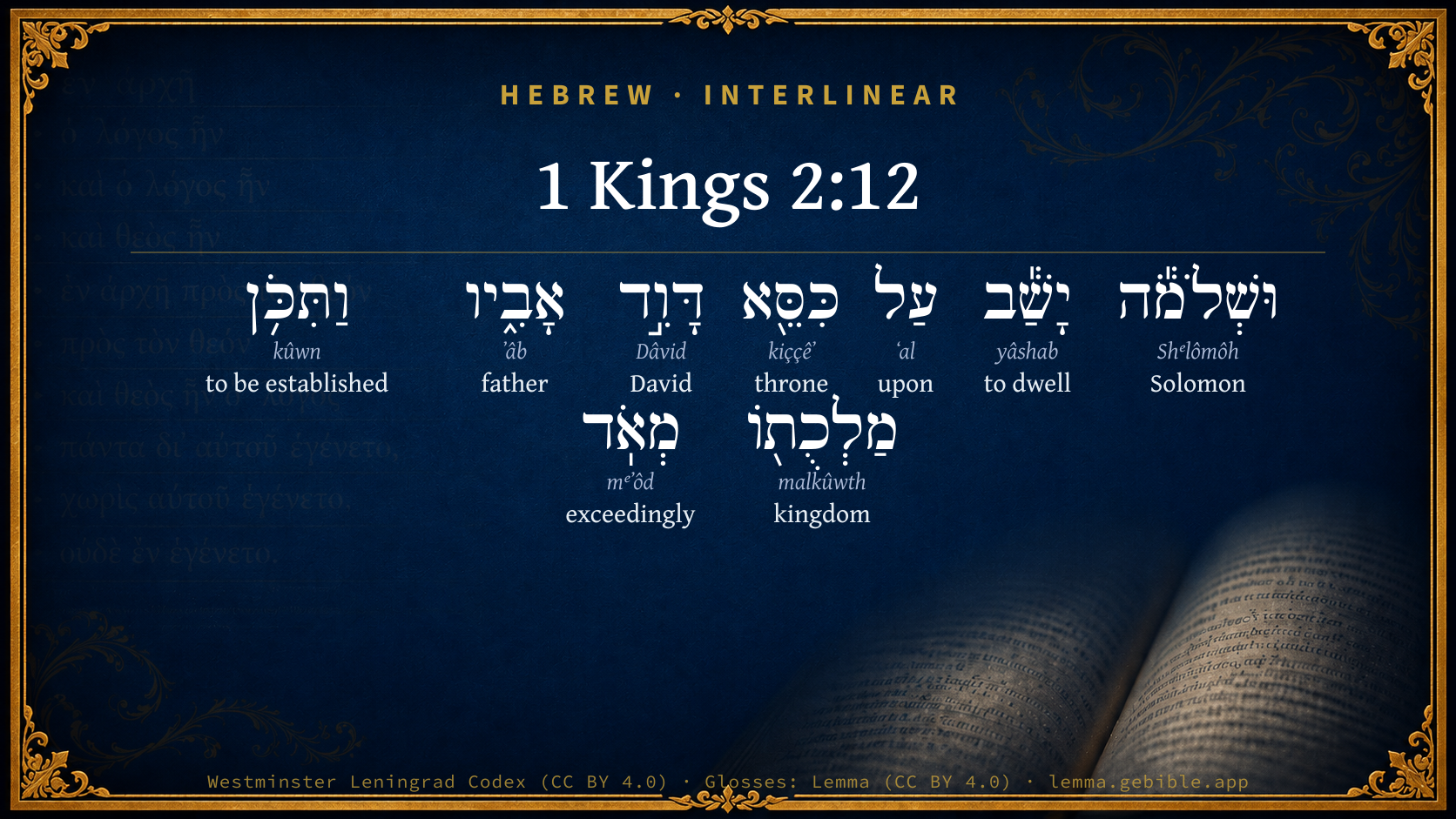
Hebrew (Westminster Leningrad Codex) 1 Kings 2:12 appears in the Hebrew Old Testament. The text above is from the Westminster Leningrad Codex. Each word links to its Strong’s number, a concise gloss, and parsing drawn from the Open Scriptures Hebrew Bible morphology. Click any word for its full Brown-Driver-Briggs (BDB) entry.
Download image
Cite this verse

1 Kings 2:12 (World English Bible). Public Domain. Lemma interlinear Bible study tool, https://lemma.gebible.app/v/1-kings/2/12.

Show BibTeX & RIS
BibTeX
RIS
English Translation
Solomon sat on the throne of David his father; and his kingdom was established greatly.
World English Bible · Public Domain
Download a study sheet

One document with this verse’s original text, its word-by-word gloss line, the meaning frame, cross-references with their text, attributed commentary, and full source and license credits — printable, and it pastes into notes with its structure intact.

This verse Autodidact and up

Study sheet (.html) Plain text (.txt)

A passage Seminary Student

Up to 50 verses in one chapter. A passage sheet keeps up to 6 commentary sources and 12 cross-references per verse, in the order this page ranks them, and says so on the sheet whenever that leaves anything out. Ask for a single verse and you get the Autodidact verse sheet above.

Everything on this page stays free to read, with no account — the sheet is a download of what is already on screen, not access to it.

Want to remove ads? Support Godless Engineer
Compare translations 3

The same verse in 3 English versions, stacked beneath the original-language interlinear above. Click any original word for its lexicon entry.

Each is an independent rendering of the whole verse — the interlinear is not word-aligned to these translations.

Highlighted words mark where these versions differ — a whole-verse word diff, not a word-by-word alignment.

  • World English Bible Public Domain
    Solomon sat on the throne of David his father; and his kingdom was established greatly.
  • King James Version Public Domain
    Then sat Solomon upon the throne of David his father; and his kingdom was established greatly.
  • unfoldingWord Literal Text CC BY-SA 4.0
    And Solomon sat on the throne of David his father, and his kingdom was established greatly.

unfoldingWord Literal Text — © unfoldingWord, licensed CC BY-SA 4.0. Word-aligned USFM3 via Door43 (git.door43.org/unfoldingWord/en_ult).

Versions to compare (up to 4)

3 of 4 selected

Show all 18 translations

Every available English version of this verse, each an independent rendering of the whole verse.

  • World English Bible Public Domain
    Solomon sat on the throne of David his father; and his kingdom was established greatly.
  • Berean Standard Bible Public Domain
    So Solomon sat on the throne of his father David, and his kingdom was firmly established.
  • Majority Standard Bible Public Domain
    So Solomon sat on the throne of his father David, and his kingdom was firmly established.
  • King James Version Public Domain
    Then sat Solomon upon the throne of David his father; and his kingdom was established greatly.
  • American Standard Version (1901) Public Domain
    And Solomon sat upon the throne of David his father; and his kingdom was established greatly.
  • Revised Version (1885) Public Domain
    And Solomon sat upon the throne of David his father; and his kingdom was established greatly.
  • Geneva Bible (1599) Public Domain
    Then sate Salomon vpon the throne of Dauid his father, and his kingdome was stablished mightily.
  • Douay-Rheims (1899) Public Domain
    And Solomon sat upon the throne of his father David, and his kingdom was strengthened exceedingly.
  • Young's Literal Translation Public Domain
    And Solomon hath sat on the throne of David his father, and his kingdom is established greatly,
  • Literal Standard Version CC BY-SA 4.0
    And Solomon has sat on the throne of his father David, and his kingdom is established greatly,
  • Unlocked Literal Bible CC BY-SA 4.0
    Then Solomon sat on the throne of his father David, and his rule was firmly established.
  • unfoldingWord Literal Text CC BY-SA 4.0
    And Solomon sat on the throne of David his father, and his kingdom was established greatly.
  • Darby Bible Public Domain
    And Solomon sat on the throne of David his father; and his kingdom was established greatly.
  • World Messianic Bible Public Domain
    Solomon sat on David his father’s throne; and his kingdom was firmly established.
  • Webster's Bible Public Domain
    Then Solomon was seated upon the throne of David his father; and his kingdom was established greatly.
  • Free Bible Version CC BY-SA 4.0
    Solomon took over as king, sitting on the throne of his father David, and his hold on his kingdom was secure.
  • Bible in Basic English Public Domain
    And Solomon took his place on the seat of David his father, and his kingdom was made safe and strong.
  • JPS Tanakh (1917) Public Domain
    And Solomon sat upon the throne of David his father; and his kingdom was established firmly.

Literal Standard Version (2020), Covenant Press — licensed CC BY-SA 4.0. Text via the HelloAO Bible API (eBible.org). Unlocked Literal Bible (unfoldingWord) — licensed CC BY-SA 4.0. Text via the HelloAO Bible API (eBible.org). unfoldingWord Literal Text — © unfoldingWord, licensed CC BY-SA 4.0. Word-aligned USFM3 via Door43 (git.door43.org/unfoldingWord/en_ult). Free Bible Version, Dr. Jonathan Gallagher — licensed CC BY-SA 4.0. Text via the HelloAO Bible API (eBible.org).

Word by word

More ways to search: Search by grammar → Find every occurrence → Compare this word →

Practice this passage: Drill this verse → Learn its vocabulary →

About this verse

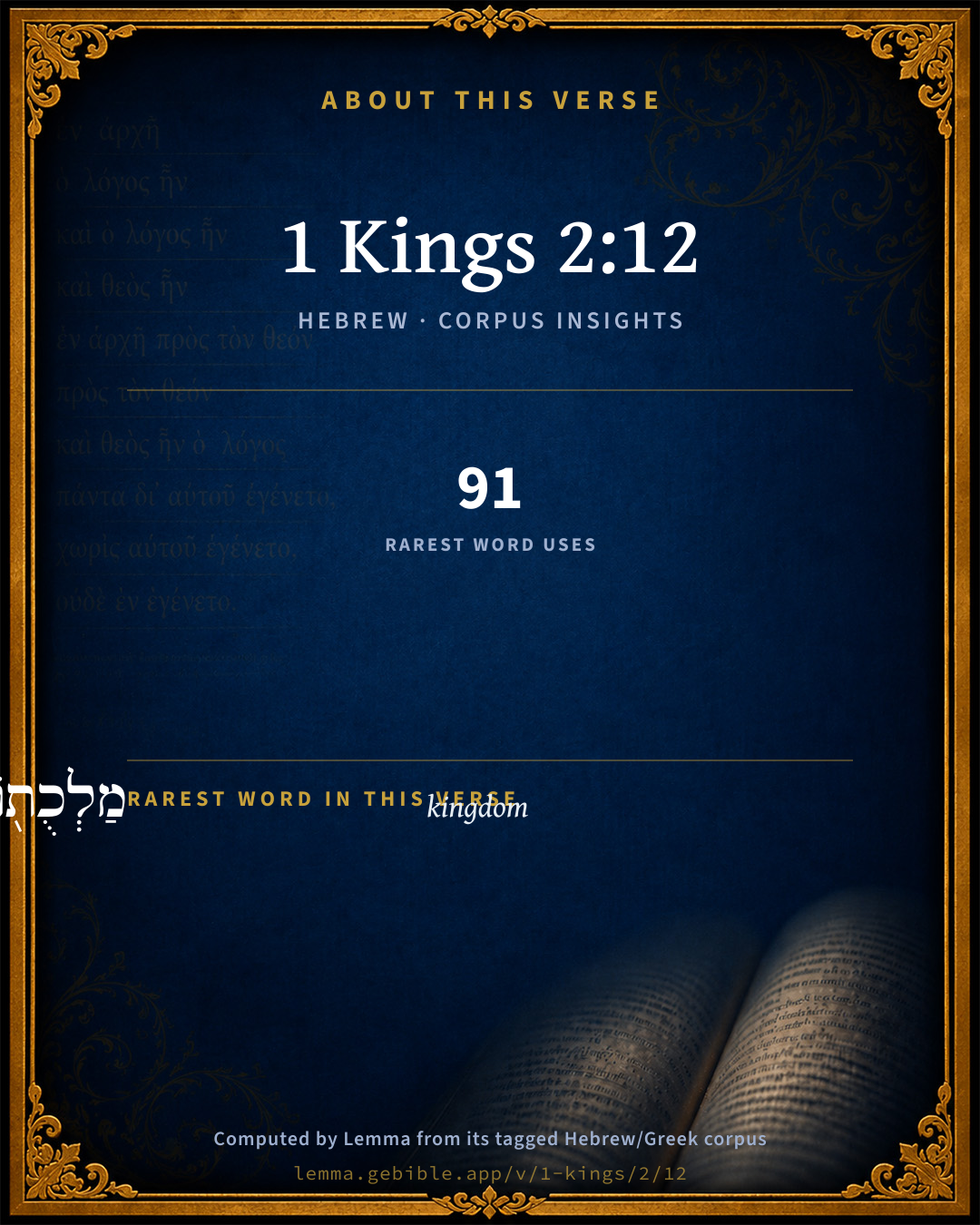
These counts appear in no published source. They are computed here, from the morphology-tagged text and Lemma’s own curated glosses. What Lemma adds →

9
words
9
distinct lemmas
Historical
section

Grammatical profile

  • 2 verbs
  • 5 nouns
  • 1 preposition
  • 1 adverb

Verb forms

  • יָשַׁ֕ב Qal · Perfect
  • וַתִּכֹּ֥ן Niphal · Sequential Imperfect

Hebrew & Septuagint length

In English translation the verse runs 15 words from the Hebrew and 16 from the Septuagint (LXX English) — closely comparable.

A rough comparison of the two English renderings, which tokenize alike — not a word-level alignment.

Word counts can differ between the Hebrew and the Greek without any difference in meaning — e.g. the Hebrew direct-object marker אֵת has no separate Greek word, and Greek often adds the article ὁ.

Cross-references

8

Topical passages linked to 1 Kings 2:12 in the Treasury of Scripture Knowledge — connected by theme and wording, ordered by reader-vote popularity; previews shown in the World English Bible.

  • 2 Chronicles 1:1 Solomon the son of David was strengthened in his kingdom, and Yahweh his God was with him, and magnified him exceedingly.
  • 1 Chronicles 29:23–25 Then Solomon sat on the throne of Yahweh as king instead of David his father, and prospered; and all Israel obeyed him.
  • 2 Samuel 7:12–13 When your days are fulfilled, and you shall sleep with your fathers, I will set up your seed after you, who shall proceed out of your bowels, and I will establish his kingdom.
  • 2 Samuel 7:29 now therefore let it please you to bless the house of your servant, that it may continue forever before you; for you, Lord Yahweh, have spoken it: and with your blessing let the house of your servant be blessed forever.
  • 1 Kings 1:46 Also Solomon sits on the throne of the kingdom.
  • Psalms 72:8–20 He shall have dominion also from sea to sea, From the River to the ends of the earth.
  • Psalms 89:36–37 His seed will endure forever, His throne like the sun before me.
  • Psalms 132:12 If your children will keep my covenant, My testimony that I will teach them, Their children also will sit on your throne forevermore."

Cross-references courtesy of OpenBible.info (CC BY 4.0).

Hebrew and Greek witnesses Masoretic Hebrew ↔ Greek Septuagint

The same verse in the two great witnesses to the Old Testament, shown verse-for-verse.

These are two independent witnesses, not word-aligned to each other, and the Septuagint is shown in lemma (dictionary) form.

Hebrew 1 Kings 2:12 Masoretic · Westminster Leningrad Codex

וּשְׁלֹמֹ֕ה יָשַׁ֕ב עַל כִּסֵּ֖א דָּוִ֣ד אָבִ֑יו וַתִּכֹּ֥ן מַלְכֻת֖וֹ מְאֹֽד

Solomon sat on the throne of David his father; and his kingdom was established greatly.

World English Bible · Public Domain

Greek LXX 1 Kings 2:12 Septuagint · lemma form

καί σαλωμών καταἵζω ἐπί ὁ θρόνος δαυίδ ὁ πατήρ αὐτός υἱός ἔτος δώδεκα καί ἑτοιμάζω ὁ βασιλεία αὐτός σφόδρα

And Solomon sat on the throne of his father David, and his kingdom was established greatly.

LXX2012 (modern English Septuagint) · Public Domain

On this verse, Keil & Delitzsch discusses the Septuagint’s reading. Read the note in Commentary ↓

Hebrew: Westminster Leningrad Codex (CC BY 4.0). Greek: Septuagint (public domain); English from LXX2012 (modern English Septuagint) (Public Domain). How the Septuagint differs from the Hebrew →

Targum (Aramaic paraphrase)

1

The Targum is the ancient Jewish Aramaic paraphrase of the Hebrew Scriptures — an interpretive translation, not the Hebrew text itself. Onkelos (literal) and Pseudo-Jonathan (expansive) render the Torah, and Jonathan the Prophets. Coverage is partial: where no permissively-licensed English translation exists for a verse, only the Aramaic is shown. This is verse-level text, not a word-by-word alignment to the Hebrew.

  1. Targum Jonathan Prophets (Joshua–Malachi)
    וּשְׁלֹמֹה יָתֵיב עַל כּוּרְסֵי מַלְכוּתָא דְדָוִד אֲבוּהִי וְאִתְקִינַת מַלְכוּתֵיהּ לַחֲדָא:

    (no public-domain English translation for this verse)

    Targum Jonathan — Aramaic: “Mikraot Gedolot” (public domain). English: “Sefaria Community Translation” (CC0 1.0 (public-domain dedication)); “London "Chaldee Paraphrase," 1871” (public domain). Text via Sefaria.

Commentary

Notes on 1 Kings 2:12 from classic Christian and Jewish commentators (each source and its license shown beneath its notes). The classic Christian expositions comment on the surrounding passage and are grouped to its opening verse, so a note may address several verses; the Jewish commentaries on the Tanakh (Rashi and others) are per-verse, so they appear only where the commentator wrote on this verse.

Lemma curates 59 commentaries, every one of them public domain or Creative Commons licensed, each selected and text-cleaned for this edition rather than reprinted as found. About our sources →

Matthew Henry's Commentary

Here is, I. Solomon's accession to the throne, Kg1 2:12. He came to it much more easily and peaceably than David did, and much sooner saw his government established. It is happy for a kingdom when the end of one good reign is the beginning of another, as it was here.

II. His just and necessary removal of Adonijah his rival, in order to the establishment of his throne. Adonijah had made some bold pretensions to the crown, but was soon obliged to let them fail and throw himself upon Solomon's mercy, who dismissed him upon his good behaviour, and, had he been easy, he might have been safe. But here we have him betraying himself into the hands of Solomon's justice, and falling by it, the righteous God leaving him to himself, that he might be punished for his former treason and that Solomon's throne might be established. Many thus ruin themselves, because they know not when they are well off, or well done to; and sinners, by presuming on God's patience, treasure up wrath to themselves. Now observe,

1. Adonijah's treasonable project, which was to marry Abishag, David's concubine, not because he was in love with her, but because, by her, he hoped to renew his claim to the crown, which might stand him in stead, or because it was then looked upon as a branch of the government to have the wives of the predecessor, Sa2 12:8. Absalom thought his pretensions much supported by lying with his father's concubines. Adonijah flatters himself that if he may succeed him in his bed, especially with the best of his wives, he may by that means step up to succeed him in his throne. Restless and turbulent spirits reach high. It was but a small game to play at, as it should seem, yet he hoped to make it an after-game for the kingdom, and now to gain that by a wife which he could not gain by force.

2. The means he used to compass this. he durst not make suit to Abishag immediately (he knew she was at Solomon's disposal, and he would justly resent it if his consent were not first obtained, as even Ishbosheth did, in a like case, Sa2 3:7), nor durst he himself apply immediately to Solomon, knowing that he lay under his displeasure; but he engaged Bathsheba to be his friend in this matter, who would be forward to believe it a matter of love, and not apt to suspect it a matter of policy. Bathsheba was surprised to see Adonijah in her apartment, and asked him if he did not come with a design to do her a mischief, because she had been instrumental to crush his late attempt. "No," says he, "I come peaceably (Kg1 2:13), and to beg a favour" (Kg1 2:14), that she would use the great interest she had in her son to gain his consent, that he might marry Abishag (Kg1 2:16, Kg1 2:17), and, if he may but obtain this, he will thankfully accept it, (1.) As a compensation for his loss of the kingdom. He insinuates (Kg1 2:15), "Thou knowest the kingdom was mine, as my father's eldest son, living at the time of his death, and all Israel set their faces on me." This was false; they were but a few that he had on his side; yet thus he would represent himself as an object of compassion, that had been deprived of a crown, and therefore might well be gratified in a wife. If he may not inherit his father's throne, yet let him have something valuable that was his father's, to keep for his sake, and let it be Abishag. (2.) As his reward for his acquiescence in that loss. He owns Solomon's right to the kingdom: "It was his from the Lord. I was foolish in offering to contest it; and now that it is turned about to him I am satisfied." Thus he pretends to be well pleased with Solomon's accession to the throne, when he is doing all he can to give him disturbance. His words were smoother than butter, but war was in his heart.

3. Bathsheba's address to Solomon on his behalf. She promised to speak to the king for him (Kg1 2:18) and did so, Kg1 2:19. Solomon received her with all the respect that was due to a mother, though he himself was a king: He rose up to meet her, bowed himself to her, and caused her to sit on his right hand, according to the law of the fifth commandment. Children, not only when grown up, but when grown great, must give honour to their parents, and behave dutifully and respectfully towards them. Despise not thy mother when she is old. As a further instance of the deference he paid to his mother's wisdom and authority, when he understood she had a petition to present to him, he promised not to say her nay, a promise which both he and she understood with this necessary limitation, provided it be just and reasonable and fit to be granted; but, if it were otherwise, he was sure he should convince her that it was so, and that then she would withdraw it. She tells him her errand at last (Kg1 2:21): Let Abishag be given to Adonijah thy brother. It was strange that she did not suspect the treason, but more strange that she did not abhor the incest, that was in the proposal. But either she did not take Abishag to be David's wife, because the marriage was not consummated, or she thought it might be dispensed with to gratify Adonijah, in consideration of his tame submission to Solomon. This was her weakness and folly: it was well that she was not regent. Note, Those that have the ear of princes and great men, as it is their wisdom not to be too prodigal of their interest, so it is their duty never to use it for the assistance of sin or the furtherance of any wicked design. Let not princes be asked that which they ought not to grant. It ill becomes a good man to prefer a bad request or appear in a bad cause.

4. Solomon's just and judicious rejection of the request. Though his mother herself was the advocate, and called it a small petition, and perhaps it was the first she had troubled him with since he was king, yet he denied it, without violation of the general promise he had made, Kg1 2:20. If Herod had not had a mind to cut off John Baptist's head, he would not have thought himself obliged to do it by a general promise, like this, made to Herodias. The best friend we have in the world must not have such an interest in us as to bring us to do a wrong thing, either unjust or unwise. (1.) Solomon convinces his mother of the unreasonableness of the request, and shows her the tendency of it, which, before, she was not aware of. His reply is somewhat sharp: "Ask for him the kingdom also, Kg1 2:22. To ask that he may succeed the king in his bed is, in effect, to ask that he may succeed him in his throne; for that is it he aims at." Probably he had information, or cause for a strong suspicion, that Adonijah was plotting with Joab and Abiathar to give him disturbance, which warranted him to put this construction upon Adonijah's request. (2.) He convicts and condemns Adonijah for his pretensions, and both with an oath. He convicts him out of his own mouth, Kg1 2:23. His own tongue shall fall upon him; and a heavier load a man needs not fall under. Bathsheba may be imposed upon, but Solomon cannot; he plainly sees what Adonijah aims at, and concludes, "He has spoken this word against his own life; he is snared in the words of his own lips; now he shows what he would be at." He condemns him to die immediately: He shall be put to death this day, Kg1 2:24. God had himself declared with an oath that he would establish David's throne (Psa 89:35), and therefore Solomon pledges the same assurance to secure that establishment, by cutting off the enemies of it. "As God liveth, that establisheth the government, Adonijah shall die, that would unsettle it." Thus the ruin of the enemies of Christ's kingdom is as sure as the stability of his kingdom, and both are as sure as the being and life of God, the founder of it. The warrant is immediately signed for his execution, and no less a man than Benaiah, the son of Jehoiada, general of the army, is ordered to be the executioner, Kg1 2:25. It is strange that Adonijah may not be heard to speak for himself: but Solomon's wisdom did not see it needful to examine the matter any further; it was plain enough that Adonijah aimed at the crown, and Solomon could not be safe while he lived. Ambitious turbulent spirits commonly prepare for themselves the instruments of death. Many a head has been lost by catching at a crown.

Matthew Henry's Commentary on the Whole Bible (1708–1710) — public domain (CC PDM 1.0). Text via the HelloAO Bible API.

Jamieson, Fausset & Brown

Robert Jamieson, A. R. Fausset & David Brown

SOLOMON SUCCEEDS HIM. (Kg1 2:12-24)

Then sat Solomon upon the throne of David his father--His ascension to the royal dignity was made under the happiest auspices. Having been born after his father became monarch of the whole kingdom, his claim, according to the notions of Oriental people, was preferable to that of all, even his elder brothers. The Hebrew kingdom enjoyed internal prosperity; it was respected and renowned abroad, and Solomon well knew how to improve these advantages.

Jamieson, Fausset & Brown — Commentary Critical and Explanatory on the Whole Bible (1871) — public domain (CC PDM 1.0). Text via the HelloAO Bible API.

Trapp's Complete Commentary

John Trapp

1Ki 2:12 Then sat Solomon upon the throne of David his father; and his kingdom was established greatly.

Ver. 12. And his kingdom was established greatly,] sc., After that he had cut off those three arch-rebels Joab, Adonijah, and Shimei.

John Trapp, A Commentary or Exposition upon All the Books of the Old and New Testament (1647–1656) — public domain. Text from a community e-Sword module.

Joseph Benson's Commentary

1Ki 2:12. Then sat Solomon upon the throne, &c. — The kingdom was settled upon him with universal consent and approbation. His kingdom was established — He had the hearty affections of his people, which all men know to be a prince’s best and surest establishment.

Joseph Benson's Commentary on the Old and New Testaments (1811–1818) — public domain. Text from a community e-Sword module.

Whedon's Commentary on the Bible

Daniel D. Whedon

FALL OF ADONIJAH, 1Ki_2:12-25.

12. His (Solomon’s) kingdom was established greatly — By the fact that he was chosen of God, and inaugurated and anointed in his father’s lifetime, and instructed by the wise counsels of David. He was also confirmed in his kingdom, as the writer proceeds to show, by the destruction of those who had conspired against him, and were at heart his enemies. Adonijah, Abiathar, Joab, and Shimei could not be trusted; and the kingdom was not safe with them at liberty. So the sacred writer at once informs us how these dangerous persons were taken out of the way.

Daniel D. Whedon (gen. ed.), Commentary on the Old and New Testaments (1874–1909) — public domain. Text from a community e-Sword module.

Keil & Delitzsch

C. F. Keil & F. Delitzsch

Accession of Solomon and Establishment of his Government. - Kg1 2:12 is a heading embracing the substance of what follows, and is more fully expanded in Ch1 29:23-25. Solomon established his monarchy first of all by punishing the rebels, Adonijah (Ch1 29:13-25) and his adherents (Ch1 29:26 -35), and by carrying out the final instructions of his father (vv. 36-46).

Kg1 2:13-18

Adonijah forfeits his life. - Kg1 2:13-18. Adonijah came to Bathsheba with the request that she would apply to king Solomon to give him Abishag of Shunem as his wife. Bathsheba asked him, "Is peace thy coming?" i.e., comest thou with a peaceable intention? (as in Sa1 16:4), because after what had occurred (Kg1 1:5.) she suspected an evil intention. He introduced his petition with these words: "Thou knowest that the kingdom was mine, and all Israel had set its face upon me that I should be king, then the kingdom turned about and became my brother's; for it became his from the Lord." The throne was his, not because he had usurped it, but because it belonged to him as the eldest son at that time, according to the right of primogeniture. Moreover it might have been the case that many of the people wished him to be king, and the fact that he had found adherents in Joab, Abiathar, and others, confirms this; but his assertion, that all Israel had set its eyes upon him as the future king, went beyond the bounds of truth. At the same time, he knew how to cover over the dangerous sentiment implied in his words in a very skilful manner by adding the further remark, that the transfer of the kingdom to his brother had come from Jehovah; so that Bathsheba did not detect the artifice, and promised to fulfil his request (Kg1 2:16.) to intercede with king Solomon for Abishag to be given him to wife. את־פּני אל־תּשׁבי, "do not turn back my face," i.e., do not refuse my request.

Kg1 2:19

When Bathsheba came to Solomon, he received her with the reverence due to the queen-mother: "he rose up to meet her" (a pregnant expression for "he rose up and went to meet her"), made a low bow, then sat upon his throne again, and bade her sit upon a throne at his right hand. The seat at the right hand of the king was the place of honour among the Israelites (cf. Psa 110:1), also with the ancient Arabian kings (cf. Eichhorn, Monumenta Antiq. Hist. Arab. p. 220), as well as among the Greeks and Romans.

Kg1 2:20-22

To her request, "Let Abishag of Shunem be given to Adonijah thy brother for a wife" (את יתּן, cf. Ges. 143, 1, a.), which she regarded in her womanly simplicity as a very small one (קטנּה), he replied with indignation, detecting at once the intrigues of Adonijah: "And why dost thou ask Abishag of Shunem for Adonijah? ask for him the kingdom, for he is my elder brother; and indeed for him, and for Abiathar the priest, and for Joab the son of Zeruiah." The repetition of לו in ולו (Kg1 2:22), for the purpose of linking on another clause, answers entirely to the emotional character of the words. "For him, and for Abiathar and Joab:" Solomon said this, because these two men of high rank had supported Adonijah's rebellion and wished to rule under his name. There is no ground for any such alterations of the text as Thenius proposes. - Although Abishag had been only David's nurse, in the eyes of the people she passed as his concubine; and among the Israelites, just as with the ancient Persians (Herod. iii. 68), taking possession of the harem of a deceased king was equivalent to an establishment of the claim to the throne (see at Sa2 12:8 and Sa2 3:7-8). According to Sa2 16:21, this cannot have been unknown even to Bathsheba; but as Adonijah's wily words had disarmed all suspicion, she may not have thought of this, or may perhaps have thought that Abishag was not to be reckoned as one of David's concubines, because David had not known her (Kg1 1:4).

Kg1 2:23-24

Solomon thereupon solemnly swore (the formula of an oath, and the כּי introducing the oath, as in Sa1 14:44, etc.), "Adonijah has spoken this word against his own life." בּנפשׁו, at the cost of his life, as in Sa2 23:17, i.e., at the hazard of his life, or to his destruction. Sa2 23:24. "And now, as truly as Jehovah liveth, who hath established me and set me on the throne of my father David, and hath made me a house, as He said (verbatim, Sa2 7:11): yea, to-day shall Adonijah be put to death." Jehovah established Solomon, or founded him firmly, by raising him to the throne in spite of Adonijah's usurpation. In ויושׁיביני the central י has got into the text through a copyist's error. בּית לי עשׂה, i.e., He has bestowed upon me a family or posterity. Solomon had already one son, viz., Rehoboam, about a year old (compare Kg1 11:42 with Kg1 14:21 and Ch2 12:13).

(Note: When Thenius denies this, and maintains that Rehoboam cannot have been 41 years old when he began to reign, referring to his discussion at Kg1 14:21, he answers himself, inasmuch as at Kg1 14:21 he demonstrates the fallacy of the objections which Cappellus has raised against the correctness of the reading "41 years.")

Kg1 2:25

Solomon had this sentence immediately executed upon Adonijah by Benaiah, the chief of the body-guard, according to the oriental custom of both ancient and modern times. The king was perfectly just in doing this. For since Adonijah, even after his first attempt to seize upon the throne had been forgiven by Solomon, endeavoured to secure his end by fresh machinations, duty to God, who had exalted Solomon to the throne, demanded that the rebel should be punished with all the severity of the law, without regard to blood-relationship.

Kg1 2:26-27

Deposition of Abiathar. - The conduct of Solomon towards the high priest Abiathar is a proof how free his actions were from personal revenge or too great severity. Abiathar had also forfeited his life through the part he took in Adonijah's conspiracy; but Solomon simply sent him to Anathoth (i.e., Anata; see at Jos 18:24), to his own fields, i.e., to his property there, telling him, "Thou art indeed a man of death," i.e., thou hast deserved to die, "but I will not put thee to death to-day, because thou hast borne the ark of Jehovah," namely, both on the occasion of its solemn conveyance to Jerusalem (Ch1 15:11.) and also on David's flight from Absalom (Sa2 15:24, Sa2 15:29), that is to say, because of his high-priestly dignity, and because thou didst endure all that my father endured, i.e., thou didst share all his afflictions and sufferings, both in the period of Saul's persecution (Sa1 22:20., Sa1 23:8.), and during the rebellion of Absalom (Sa2 15:24.). ההוּא בּיּום (to-day) puts a limit upon the pardon, because Solomon could not foresee whether Abiathar would always keep quiet, and not forfeit his life again by fresh crimes.

(Note: There is no meaning in the objection of Thenius, that Abiathar did not carry the ark himself, since this was not the duty of the high priest. For, in the first place, it is questionable whether Abiathar did not lend a helping hand at the removal of the ark during Absalom's conspiracy. And, secondly, the duty binding upon the high priest, to superintend and conduct the removal of the ark, might very well be called carrying the ark. The conjecture, that for ארון we should read אפוד, founders on the preterite נשׂאת; for Abiathar had not only worn the ephod once before, but he wore it till the very hour in which Solomon deposed him from his office.)

Kg1 2:27

The banishment of Abiathar to his own private possession involved his deposition from the priesthood. And, as the historian adds, thus was the word of the Lord concerning the house of Eli fulfilled (Sa1 2:30-33). למלּא corresponds to the New Testament ἵνα πληρωθῇ. For further remarks on this prophecy and its fulfilment, see at Sa1 2:30.

(Note: Nothing is related concerning the subsequent fate of Abiathar, since the death of a high priest who had been deprived of his office was a matter of no importance to the history of the kingdom of God. At any rate, he would not survive his deposition very long, as he was certainly eighty years old already (see Comm. on Sam. p. 267). - The inference which Ewald (Gesch. iii. pp. 269,270) draws from Sa1 2:31-36 as to the manner of his death, namely, that he fell by the sword, is one of the numerous fictions founded upon naturalistic assumptions with which this scholar has ornamented the biblical history.)

Thus was the high-priesthood of the house of Eli extinguished, and henceforth this dignity passed through Zadok into the sole possession of the line of Eleazar.

Kg1 2:28-33

Execution of Joab. - When the report (of the execution of Adonijah and the deposition of Abiathar) came to Joab, he fled to the tent of Jehovah (not to the tabernacle, but to the holy tent upon Zion) to seek protection at the altar (see at Kg1 1:50). The words נטה לא...יואב כּי are introduced as a parenthesis to explain Joab's flight: "for Joab had leaned after Adonijah," i.e., taken his side (אהרי נטה, as in Exo 23:2; Jdg 9:3), "but not after Absalom."

(Note: Instead of אבשׁלום the lxx (Cod. Vat.), Vulgate, Syr., and Arab. have adopted the reading שּׁלמה, and both Thenius and Ewald propose to alter the text accordingly. But whatever plausibility this reading may have, especially if we alter the preterite נטה into the participle נטה after the ἦν κεκλικώς of the lxx, as Thenius does, it has no other foundation than an arbitrary rendering of the lxx, who thought, but quite erroneously, that the allusion to Absalom was inapplicable here. For אחר נטה, to take a person's side, would suit very well in the case of Adonijah and Absalom, but not in that of Solomon, whose claim to the throne was not a party affair, but had been previously determined by God.)

There is no foundation in the biblical text for the conjecture, that Joab had given Adonijah the advice to ask for Abishag as his wife, just as Ahithophel had given similar advice to Absalom (Sa2 16:21). For not only is there no intimation of anything of the kind, but Solomon punished Joab solely because of his crimes in the case of Abner and Amasa. Moreover, Abiathar was also deposed, without having any fresh machinations in favour of Adonijah laid to his charge. The punishment of Adonijah and Abiathar was quite sufficient to warn Joab of his approaching fate, and lead him to seek to save his life by fleeing to the altar. It is true that, according to Exo 21:13-14, the altar could afford no protection to a man who had committed two murders. But he probably thought no more of these crimes, which had been committed a long time before, but simply of his participation in Adonijah's usurpation; and he might very well hope that religious awe would keep Solomon from putting him to death in a holy place for such a crime as that. And it is very evident that this hope was not altogether a visionary one, from the fact that, according to Exo 21:30, when Joab refused to leave the altar at the summons addressed to him in the name of the king, Benaiah did not give him the death-blow at once, but informed Solomon of the fact and received his further commands. Solomon, however, did not arrest the course of justice, but ordered him to be put to death there and afterwards buried. The burial of the persons executed was a matter of course, as, according to Deu 21:23, even a person who had been hanged was to be buried before sunset. When, therefore, Solomon gives special orders for the burial of Joab, the meaning is that Benaiah is to provide for the burial with distinct reference to the services which Joab had rendered to his father. "And take away the blood, which Joab shed without cause, from me and my father's house." So long as Joab remained unpunished for the double murder, the blood-guiltiness rested upon the king and his house, on whom the duty of punishment devolved (cf. Num 35:30-31; Deu 19:13). חנּם דּמי, blood without cause, i.e., blood shed in innocence. On the connection of the adverb with the substantive, at which Thenius takes offence, comp. Ges. 151, 1, and Ewald, 287, d. - For V. 32, compare Deu 21:5. The words of Solomon in v. 33a point back to the curse which David uttered upon Joab and his descendants after the murder of Abner (Sa2 3:28-29). "But to David, and his seed, and his house, and his throne, let there be salvation for ever from Jehovah." This wish sprang from a conviction, based upon Sa2 7:14, that the Lord would not fulfil His promise to David unless his successors upon the throne exercised right and justice according to the command of the Lord.

Kg1 2:34

Benaiah went up (ויּעל), inasmuch as the altar by the ark of the covenant stood higher up Mount Zion than Solomon's house. Joab was buried "in his house" (i.e., in the tomb prepared in his house, either in the court or in the garden: cf. Sa1 25:1), "in the desert," probably the wilderness of Judah, as Joab's mother was a step-sister of David, and therefore probably dwelt in the neighbourhood of Bethlehem.

Kg1 2:35

Solomon appointed Benaiah commander-in-chief in the place of Joab, and put Zadok in Abiathar's place (cf. Kg1 1:8-9).

Kg1 2:36-37

Punishment of Shimei. - Solomon thereupon ordered Shimei to come, probably from Bahurim, where his home was (Sa2 16:5), and commanded him to build himself a house in Jerusalem to dwell in, and not to leave the city "any whither" (ואנה אנה), threatening him with death if ever he should cross the brook Kidron. The valley of Kidron is mentioned as the eastern boundary of the city with an allusion to the fact, that Bahurim was to the east of Jerusalem towards the desert.

Kg1 2:38

Shimei vowed obedience, and that on oath, as is supplementarily observed in Kg1 2:42, though it has been arbitrarily interpolated by the lxx here; and he kept his word a considerable time.

Kg1 2:39-40

But after the lapse of three years, when two slaves fled to Gath to king Achish, with whom David had also sought and found refuge (Sa1 27:2, compare Kg1 21:11.), he started for Gath as soon as he knew this, and fetched them back.

Kg1 2:41-43

When this was reported to Solomon, he sent for Shimei and charged him with the breach of his command: "Did I not swear to thee by Jehovah, and testify to thee, etc.? Why hast thou not kept the oath of Jehovah (the oath sworn by Jehovah)...?"

Kg1 2:44

He then reminded him of the evil which he had done to his father: "Thou knowest all the evil, which thy heart knoweth (i.e., which thy conscience must tell thee); and now Jehovah returns the evil upon thy head," namely, by decreeing the punishment of death, which he deserved for blaspheming the anointed of the Lord (Sa2 16:9).

Kg1 2:45

"And king Solomon will be blessed, and the throne of David be established before Jehovah for ever," namely, because the king does justice (compare the remark on Kg1 2:33).

Kg1 2:46

Solomon then ordered him to be executed by Benaiah. This punishment was also just. As Solomon had put Shimei's life in his own hand by imposing upon him confinement in Jerusalem, and Shimei had promised on oath to obey the king's command, the breach of his oath was a crime for which he had no excuse. There is no force at all in the excuses which some commentators adduce in his favour, founded upon the money which his salves had cost him, and the wish to recover possession of them, which was a right one in itself. If Shimei had wished to remain faithful to his oath, he might have informed the king of the flight of his slaves, have entreated the king that they might be brought back, and have awaited the king's decision; but he had no right thus lightly to break the promise given on oath. By the breach of his oath he had forfeited his life. And this is the first thing with which Solomon charges him, without his being able to offer any excuse; and it is not till afterwards that he adduces as a second fact in confirmation of the justice of his procedure, the wickedness that he practised towards his father. - The last clause, "and the kingdom was established by (בּיד) Solomon," is attached to the following chapter in the Cod. Al. of the lxx (in the Cod. Vat. it is wanting, or rather its place is supplied by a long interpolation), in the Vulgate, and in the Syriac; and indeed rightly so, as Thenius has shown, not merely because of the רק in Kg1 3:2, but also because of its form as a circumstantial clause, to which the following account (Kg1 3:1.) is appended.

Keil & Delitzsch — Biblical Commentary on the Old Testament (1861–1891) — public domain (CC PDM 1.0). Text via the HelloAO Bible API. (Old Testament only.)

The Annotated Bible

Arno C. Gaebelein

II. SOLOMON’S GLORIOUS REIGN. HIS FAILURE AND END

1. The Righteous judgment of Solomon

CHAPTER 2:12-46)

1. Solomon upon the throne (1Ki 2:12)

2. Adonijah’s request (1Ki 2:13-18)

3. Bath-sheba before Solomon (1Ki 2:19-21)

4. Solomon’s answer and sentence upon Adonijah (1Ki 2:22-24)

5. Adonijah executed (1Ki 2:25)

6. Abiathar thrust out (1Ki 2:26-27)

7. Joab and Shimei executed (1Ki 2:28-46)

“Then sat Solomon upon the throne of David his father; and his kingdom was established greatly.” Solomon and his glorious reign foreshadows the reign of that greater Son of David, our Lord, in whom the covenant promise made to David will be fully accomplished. The section which begins with the statement of Solomon’s enthronement is deeply interesting and full of the richest typical and prophetic meaning. Solomon’s righteous judgments, his wisdom, his reign in peace, but especially the building of the temple foreshadow Him who will ere long receive the throne and build the temple of the LORD (Zec 6:13). Inasmuch as the critics reject the literal fulfilment of the oath-bound Davidic covenant and the prophetic foreshadowing of the recorded events, they also condemn Solomon’s righteous judgment which occupies the foreground of his reign. We quote from one of these critics: “The reign of Solomon began with a threefold deed of blood. An eastern King surrounded by the many princes of a polygamous family, and liable to endless jealousies and plots, is always in a condition of unstable equilibrium; the death of a rival is regarded as his only safe imprisonment” (Canon Farrar). In such statements God’s governmental ways in righteousness and retribution are entirely ignored.

Adonijah the wicked rebel on probation visits Bath-sheba. He acknowledges freely that the Lord had given the Kingdom to his brother. Then he desired that Bath-sheba should ask her son Solomon to give Abishag the Shunammite to him as wife (1:3). Bath-sheba was completely won by the pathetic plea of Adonijah and did not discover the wicked plot which was hidden beneath his request. Beautiful is the reverence which Solomon showed to his mother. He arose from his throne, he bowed himself unto her, (the Septuagint version reads “he kissed her”) and he made her sit on his right hand. How he honored and loved her! It may foreshadow the love of Him for the believing remnant of Israel, His beloved people, who will have a share in His coming Kingdom. When Bath-sheba states Adonijah’s request the keen discernment and wisdom of Solomon are at once apparent. “And why dost thou ask Abishag the Shunammite for Adonijah? ask for him the kingdom also; for he is mine elder brother; even for him, and for Abiathar the priest, and for Joab the son of Zeruiah.” Adonijah’s request was a scheme to obtain the kingdom. Most likely it was concocted by Abiathar and Joab. To many a deceased king’s wife or concubine was, according to Oriental customs, paramount with claiming the rights of the king (2Sa 12:8; 2Sa 16:21-22). Now Abishag was not the wife of David in the sense of the word, yet she must have been considered as belonging to the departed king. Had Solomon granted the request he would have hopelessly degraded himself in the eyes of the people (2Sa 2:7). Adonijah aimed by this cunning scheme at the throne of Solomon and attempted to obtain the kingdom. Then Solomon pronounced judgment, which Adonijah fully deserved. He was put to death that day. It has been suggested by certain critics that Solomon had a more selfish, carnal reason for putting his elder brother to death. “If, as seems almost certain,” declares a higher critic, “Abishag is the fair Shulamite of the Song of Songs, there can be little doubt that Solomon himself loved her, and that she was the jewel of his seraglio.” But there is absolutely no evidence that Abishag is identical with Shulamite; nor does Jewish tradition sustain such a theory. It is a mere supposition.

Abiathar is next dealt with. His life is spared but Solomon thrusts him out of the priesthood, thus fulfilling the word of the Lord concerning the house of Eli (1Sa 2:31-36). Zadok becomes exclusively priest (verse 35). Joab and Shimei are both executed. Though Joab caught hold of the horns of the altar it did not save him; he paid now by a just retribution for the wicked deeds he had done. Shimei was commanded to remain in Jerusalem; disobedience would mean certain death. When he disobeyed, the sentence of death was executed upon him. And here we have another glimpse of the government of the kingdom in the coming age. In the present age grace reigns through righteousness; in the kingdom age, when the Lord rules over all, righteousness reigns. Disobedience will be swiftly met by judgment as it was with Shimei.

Arno C. Gaebelein, The Annotated Bible (1913–1922) — public domain. Text from a community e-Sword module.

Ellicott's Commentary for English Readers

(12) His kingdom was established greatly.—From the notice in the closing verse of the chapter, that after the deaths of Adonijah, Joab, and Shimei, and the degradation of Abiathar, “the kingdom was established in the hand of Solomon,” it would seem that, under the smooth surface of apparent loyalty, there lurked some elements of disaffection and danger—perhaps aggravated by enmity from without; for we gather from 1Ki_11:14-25 that the death of David was the signal for some attempts at rebellion in the conquered nations. But these are apparently crushed without the slightest effort, though with no little fierceness and severity; and the royalty of Solomon rises at once to a colossal greatness.

A Bible Commentary for English Readers, edited by Charles John Ellicott (1878–1897) — public domain. Text from a community e-Sword module.

John Gill's Exposition

Then sat Solomon on the throne of David his father,.... So he did in his lifetime, with his consent, and by his order, and now by the agreement of the whole people:

and his kingdom was established greatly; all submitting to it, and none opposing it.

John Gill's Exposition of the Whole Bible (1746–1763) — public domain (CC PDM 1.0). Text via the HelloAO Bible API.

Albert Barnes' Notes on the Bible

The “establishment” of the kingdom here intended is probably its universal acceptance both by the tribe of Judah and the other Israelites.

Albert Barnes' Notes on the Bible (1834–1885) — public domain. Text from a community e-Sword/MySword module.

Haydock's Catholic Bible Commentary

Sat, exercising the same authority, as he had done in his father’s life-time, chap. i. 53. (Calmet) (St. Augustine, de C.[City of God?] xvii. 8.) (Salien, the year before Christ 1033.) --- The public assembly of Israel, convoked by David, had already sworn fidelity to him, 1 Paralipomenon xxviii. 1. (Haydock)

George Leo Haydock (1774–1849), Haydock's Catholic Family Bible and Commentary, 1859 edition — public domain. Excludes Psalms (Douay-Rheims chapter numbering differs from Protestant) and Deuterocanonical books (Catholic canon only).

Matthew Poole's English Annotations

Being settled upon him with universal consent and approbation, and with the hearty affections of his people, which all wise men know to be a prince’s best and surest establishment.

Matthew Poole's English Annotations on the Holy Bible (1683–1685) — public domain. Text from a community e-Sword/MySword module.

The Pulpit Commentary

ADONIJAH"S INTRIGUE.

And Solomon sate on the throne of David his father, and his kingdom i.e., dominion, sway was established greatly. (Cf. 2Ch_1:1, 2Ch_1:2) This verse serves as a kind of heading or introduction to the rest of the chapter. It was principally by the removal of rivals and disaffected persons that his sway was established.

The Pulpit Commentary (1880–1919), ed. H.D.M. Spence-Jones & Joseph S. Exell — public domain. Text from a community e-Sword module.

Kretzmann's Popular Commentary

Paul E. Kretzmann

Adonijah Forfeits his Life

v. 12. Then sat Solomon upon the throne of David, his father, having been acknowledged by a second anointing, which took place in the presence of all the representatives of the people; and his kingdom was established greatly, confirmed in a manner which caused all his enemies to abandon hope against him.

v. 13. And Adonijah, the son of Haggith, who had by no means abandoned his intention of possessing the kingdom, came to Bathsheba, the mother of Solomon, hoping to reach his object through the influence of this woman. And she said, Comest thou peaceably? Past experience had made her cautious. And he said, Peaceably, feigning friendship and concealing his real purpose throughout.

v. 14. He said moreover, I have somewhat to say unto thee, thus flattering her by asking her advice and making her his unwitting ally. And she said, Say on.

v. 15. And he said, Thou knowest that the kingdom was mine, and that, all Israel set their faces on me, a rather daring assertion, that I should reign; howbeit, the kingdom is turned about and is become my brother’s; for it was his from the Lord. He proceeded from the assumption that he, as the eldest living prince, would have been the logical successor of David, but shrewdly covered his intention by the pious remark that the present state of affairs was due to Jehovah’s disposition of matters.

v. 16. And now I ask one petition of thee, deny me not, literally, "Turn not away my face," namely, in an unwilling refusal. And she said unto him, Say on.

v. 17. And he said, Speak, I pray thee, unto Solomon the king, (for he will not say thee nay, this probability being the basis of his entire plan,) that he give me Abishag the Shunammite to wife, the plea being, of course, that he honestly loved her.

v. 18. And Bathsheba said, Well; I will speak for thee unto the king. She may have thought that the discontent of Adonijah would be removed by the granting of this request, and the kingdom thus made more secure for her son.

v. 19. Bathsheba therefore went unto King Solomon to speak unto him for Adonijah, to prefer Adonijah’s request. And the king, mindful of the reverence due to parents according to the Fourth Commandment, rose up to meet her, and bowed himself unto her, and sat down on his throne, and caused a seat to be set for the king’s mother; and she sat on his right hand. This was a very high distinction, and Solomon’s conduct might well be emulated by young people in our days, who have apparently forgotten what honoring of their parents requires of them.

v. 20. Then she said, I desire one small petition of thee; I pray thee, say me not nay. She evidently thought only of the love-affair in the matter, the political aspect having entirely escaped her. And the king said unto her, Ask on, my mother; for I will not say thee nay. A small favor he was willing to grant in advance.

v. 21. And she said, let Abishag the Shunammite be given to Adonijah, thy brother, to wife. Bathsheba overlooked the fact that he who took one of the king’s wives thereby put in a claim to the throne; for Abishag was a member of David’s harem, being looked on by the entire nation as David’s last wife, even if he had not known her.

v. 22. And King Solomon, who immediately saw through the intrigue of Adonijah and was fully aware of the consequences, answered and said unto his mother, And why dost thou ask Abishag the Shunammite for Adonijah? Ask for him the kingdom also; for he is mine elder brother, who might base his claim on that fact; even for him and for Abiathar, the priest, and for Joab, the son of Zeruiah, the two men who had sided with Adonijah in his rebellion.

v. 23. Then King Solomon, upon whom it now dawned that Adonijah had tried to use his mother as his tool, sware by the Lord, saying, God do so to me, and more also, if Adonijah have not spoken this word against his own life. The meaning of the oath is that the continual punishment of God should strike him, if he did not carry out the death-sentence upon Adonijah for this trickery on his part.

v. 24. Now, therefore, as the Lord liveth, which hath established me, and set me on the throne of David, my father, and who hath made me an house, given him a son and thus established his family, as he promised, Adonijah shall be put to death this day, having forfeited his life by this new attempt against the king.

v. 25. And King Solomon sent by the hand of Benaiah, the son of Jehoiada; and he fell upon him that he died, he carried out the sentence of execution. If men, after having repented and received forgiveness of sins, deliberately and maliciously fall back into their former transgressions, they must expect to be punished for all their crimes.

Paul E. Kretzmann, Popular Commentary of the Bible (1921–1924) — public domain. Text from a community e-Sword module.

Rashi

Rabbi Shlomo Yitzchaki (Rashi)

And his kingdom was firmly established. [He was] also [ruler] over the heavenly creatures.

Rashi on the Tanakh — English translations: “The Judaica Press complete Tanach with Rashi, translated by A. J. Rosenberg” (CC BY 4.0); “Pentateuch with Rashi's commentary by M. Rosenbaum and A.M. Silbermann, 1929-1934” (public domain); “The Metsudah Tanach series, Lakewood, N.J” (CC BY 4.0); and “The Book of Joshua, Metsudah Publications, 1997” (CC BY 4.0). Text via Sefaria.

Lesson kit

Teaching starters — assembled from the data on this page, not authored interpretation. Every prompt links to the verse data it draws on. Edit before teaching.

1 Kings, in the Historical, opens this verse with 9 words (9 distinct Hebrew lemmas). Its most distinctive word is malkûwth (“kingdom”). A historical commentator’s framing appears above. Read the whole chapter for the surrounding context.

Discussion questions

  1. The word malkûwth carries the sense “kingdom.” How does it shape the verse?
  2. 2 Chronicles 1:1 shares this passage’s theme. How do the two illuminate each other?
  3. The translations on this page render this verse differently — a whole-verse word diff, not a word-by-word alignment. What might account for the different wordings?
  4. The verb «יָשַׁ֕ב» is Qal Perfect. How does its form color the action?
  5. Reading how Matthew Henry's Commentary and Jamieson, Fausset & Brown read this verse, where do the two commentators agree and where do they part?

Things to notice

Reading settings

Reading text

Shown beneath each verse's original-language words.

Old Testament
Old Testament edition

Read the OT as the Masoretic Hebrew (MT) or the Greek Septuagint (LXX).

English shown for the Greek Septuagint (in the Hebrew ↔ Greek comparison).

Comparing translations? Open the Compare panel on any verse page to stack up to four side by side.