
Job 18:12

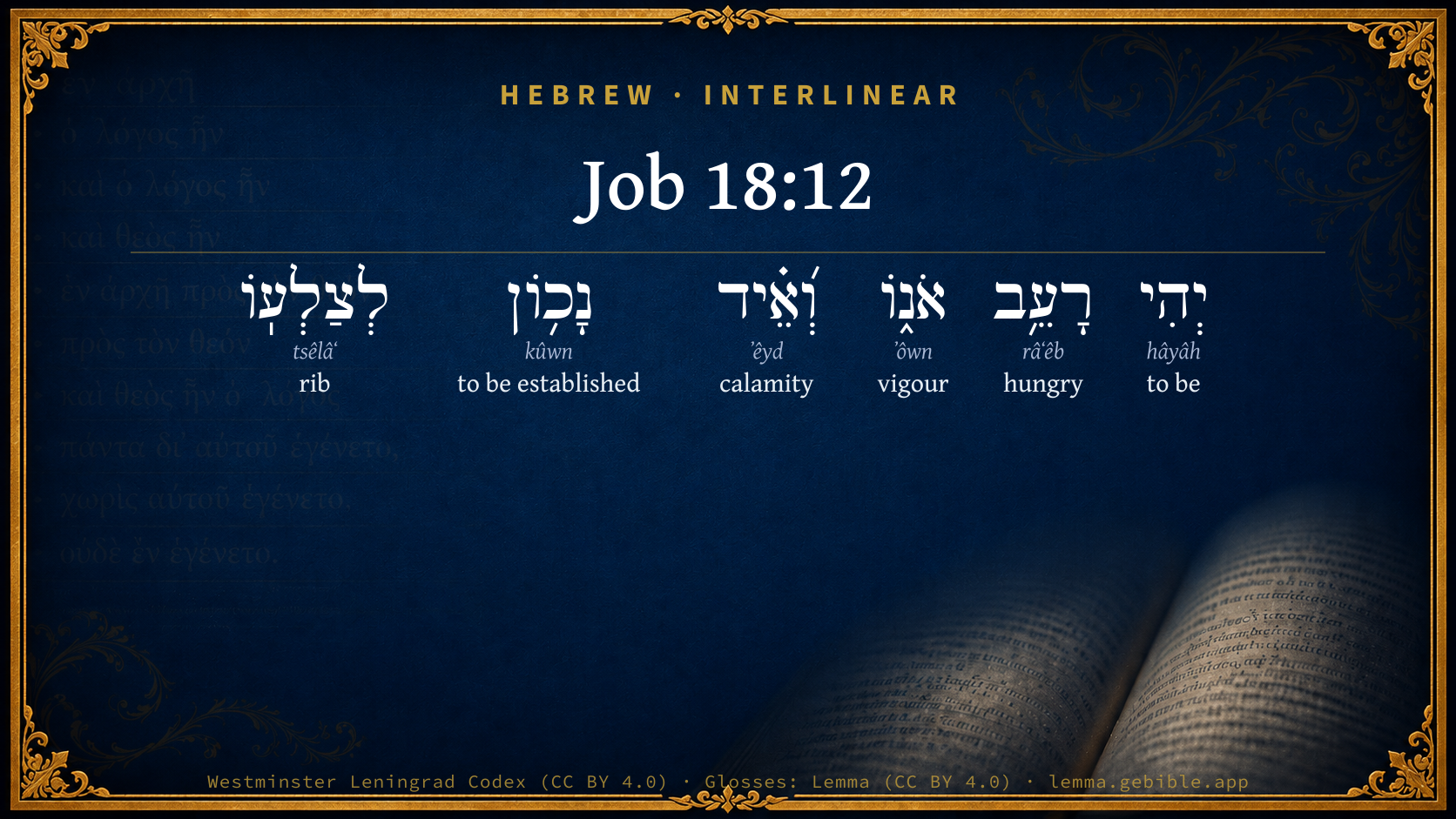
Hebrew (Westminster Leningrad Codex) Job 18:12 appears in the Hebrew Old Testament. The text above is from the Westminster Leningrad Codex. Each word links to its Strong’s number, a concise gloss, and parsing drawn from the Open Scriptures Hebrew Bible morphology. Click any word for its full Brown-Driver-Briggs (BDB) entry.
Download image
Cite this verse

Job 18:12 (World English Bible). Public Domain. Lemma interlinear Bible study tool, https://lemma.gebible.app/v/job/18/12.

Show BibTeX & RIS
BibTeX
RIS
English Translation
His strength shall be famished, Calamity shall be ready at his side.
World English Bible · Public Domain
Download a study sheet

One document with this verse’s original text, its word-by-word gloss line, the meaning frame, cross-references with their text, attributed commentary, and full source and license credits — printable, and it pastes into notes with its structure intact.

This verse Autodidact and up

Study sheet (.html) Plain text (.txt)

A passage Seminary Student

Up to 50 verses in one chapter. A passage sheet keeps up to 6 commentary sources and 12 cross-references per verse, in the order this page ranks them, and says so on the sheet whenever that leaves anything out. Ask for a single verse and you get the Autodidact verse sheet above.

Everything on this page stays free to read, with no account — the sheet is a download of what is already on screen, not access to it.

Want to remove ads? Support Godless Engineer
Compare translations 3

The same verse in 3 English versions, stacked beneath the original-language interlinear above. Click any original word for its lexicon entry.

Each is an independent rendering of the whole verse — the interlinear is not word-aligned to these translations.

Highlighted words mark where these versions differ — a whole-verse word diff, not a word-by-word alignment.

  • World English Bible Public Domain
    His strength shall be famished, Calamity shall be ready at his side.
  • King James Version Public Domain
    His strength shall be hungerbitten, and destruction shall be ready at his side.
  • unfoldingWord Literal Text CC BY-SA 4.0
    His strength becomes hungry, and disaster prepared at his side.

unfoldingWord Literal Text — © unfoldingWord, licensed CC BY-SA 4.0. Word-aligned USFM3 via Door43 (git.door43.org/unfoldingWord/en_ult).

Versions to compare (up to 4)

3 of 4 selected

Show all 18 translations

Every available English version of this verse, each an independent rendering of the whole verse.

  • World English Bible Public Domain
    His strength shall be famished, Calamity shall be ready at his side.
  • Berean Standard Bible Public Domain
    His strength is depleted, and calamity is ready at his side.
  • Majority Standard Bible Public Domain
    His strength is depleted, and calamity is ready at his side.
  • King James Version Public Domain
    His strength shall be hungerbitten, and destruction shall be ready at his side.
  • American Standard Version (1901) Public Domain
    His strength shall be hunger-bitten, And calamity shall be ready at his side.
  • Revised Version (1885) Public Domain
    His strength shall be hunger-bitten and calamity shall be ready for his halting.
  • Geneva Bible (1599) Public Domain
    His strength shalbe famine: and destruction shalbe readie at his side.
  • Douay-Rheims (1899) Public Domain
    Let his strength be wasted with famine, and let hunger invade his ribs.
  • Young's Literal Translation Public Domain
    Hungry is his sorrow, And calamity is ready at his side.
  • Literal Standard Version CC BY-SA 4.0
    His sorrow is hungry, || And calamity is ready at his side.
  • Unlocked Literal Bible CC BY-SA 4.0
    His wealth will turn into hunger, and calamity will be ready at his side.
  • unfoldingWord Literal Text CC BY-SA 4.0
    His strength becomes hungry, and disaster prepared at his side.
  • Darby Bible Public Domain
    His strength is hunger-bitten, and calamity is ready at his side.
  • World Messianic Bible Public Domain
    His strength will be famished. Calamity will be ready at his side.
  • Webster's Bible Public Domain
    His strength shall be hunger-bitten, and destruction shall be ready at his side.
  • Free Bible Version CC BY-SA 4.0
    Hunger robs them of strength; disaster waits for them when they fall.
  • Bible in Basic English Public Domain
    His strength is made feeble for need of food, and destruction is waiting for his falling footstep.
  • JPS Tanakh (1917) Public Domain
    His trouble shall be ravenous, and calamity shall be ready for his fall.

Literal Standard Version (2020), Covenant Press — licensed CC BY-SA 4.0. Text via the HelloAO Bible API (eBible.org). Unlocked Literal Bible (unfoldingWord) — licensed CC BY-SA 4.0. Text via the HelloAO Bible API (eBible.org). unfoldingWord Literal Text — © unfoldingWord, licensed CC BY-SA 4.0. Word-aligned USFM3 via Door43 (git.door43.org/unfoldingWord/en_ult). Free Bible Version, Dr. Jonathan Gallagher — licensed CC BY-SA 4.0. Text via the HelloAO Bible API (eBible.org).

Word by word

More ways to search: Search by grammar → Find every occurrence → Compare this word →

Practice this passage: Drill this verse → Learn its vocabulary →

About this verse

These counts appear in no published source. They are computed here, from the morphology-tagged text and Lemma’s own curated glosses. What Lemma adds →

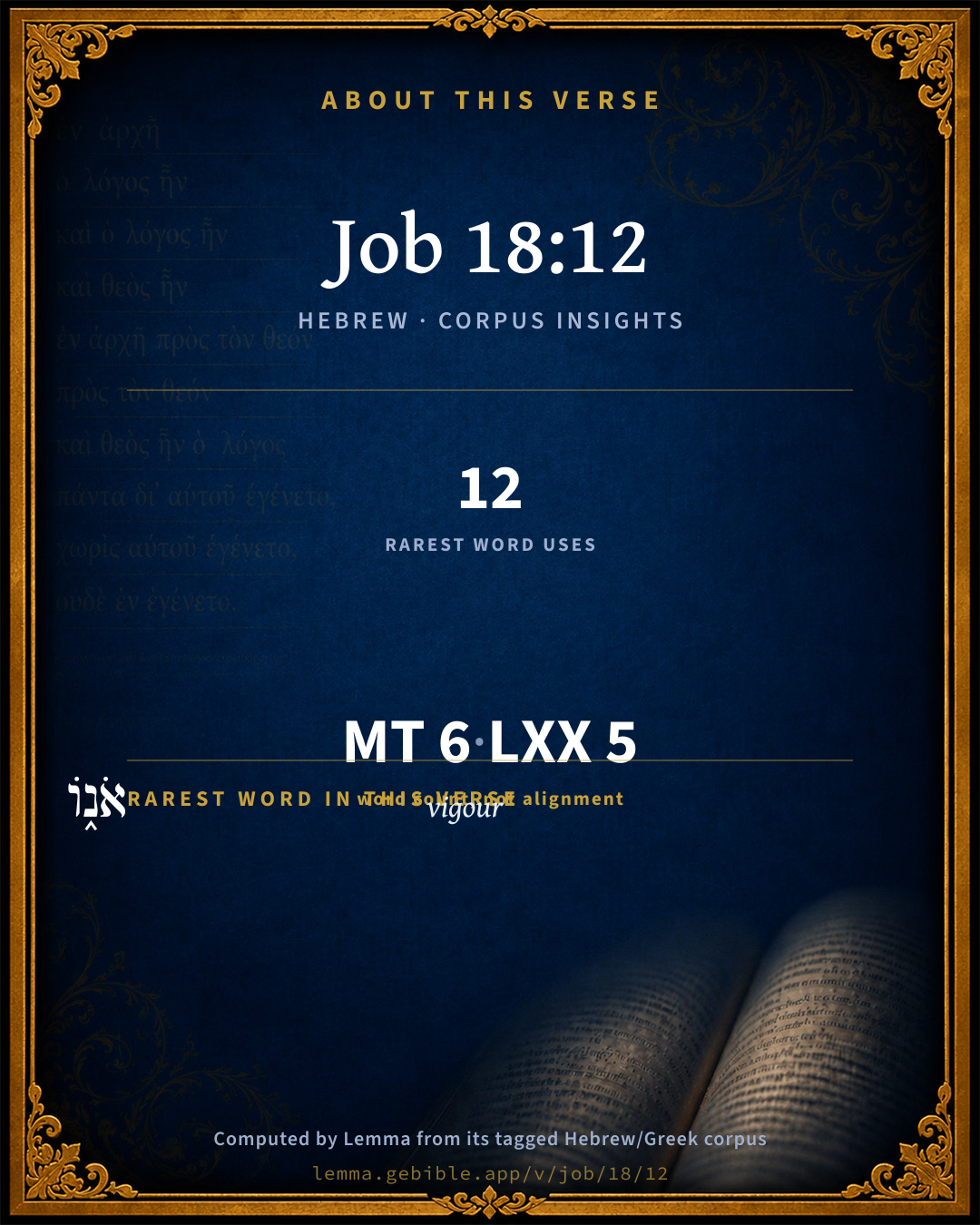
6
words
6
distinct lemmas
Wisdom
section

Notable vocabulary

The rarest word here is אֹנ֑וֹ vigour H202 — appearing just 12 times in the whole Hebrew Bible.

Shared distinctive vocabulary

אֹנ֑וֹ vigour H202 occurs in 12 verses of the Hebrew Bible. Also found in:

Grammatical profile

  • 2 verbs
  • 3 nouns
  • 1 adjective

Verb forms

  • יְהִי Qal · Imperfect
  • נָכ֥וֹן Niphal · Participle Active

Hebrew & Septuagint length

In English translation the verse runs 12 words from the Hebrew and 14 from the Septuagint (LXX English) — closely comparable.

A rough comparison of the two English renderings, which tokenize alike — not a word-level alignment.

Word counts can differ between the Hebrew and the Greek without any difference in meaning — e.g. the Hebrew direct-object marker אֵת has no separate Greek word, and Greek often adds the article ὁ.

In the original languages it is 6 Hebrew tokens and 5 Greek tokens — but the two are counted differently (Hebrew bundles its prefixes and suffixes into one token; the Greek is in lemma form), so that isn’t a like-for-like length.

Cross-references

9

Topical passages linked to Job 18:12 in the Treasury of Scripture Knowledge — connected by theme and wording, ordered by reader-vote popularity; previews shown in the World English Bible.

  • 1 Samuel 2:5 Those who were full have hired out themselves for bread; Those who were hungry have ceased [to hunger]: Yes, the barren has borne seven; She who has many children languishes.
  • 1 Samuel 2:36 It shall happen, that everyone who is left in your house shall come and bow down to him for a piece of silver and a loaf of bread, and shall say, Please put me into one of the priests' offices, that I may eat a morsel of bread.
  • Job 15:23–24 He wanders abroad for bread, saying, 'Where is it?' He knows that the day of darkness is ready at his hand.
  • Psalms 7:12–14 If a man doesn't relent, he will sharpen his sword; He has bent and strung his bow.
  • Psalms 34:10 The young lions do lack, and suffer hunger, But those who seek Yahweh shall not lack any good thing.
  • Psalms 109:10 Let his children be wandering beggars. Let them be sought from their ruins.
  • Isaiah 8:21 They shall pass through it, sore distressed and hungry; and it shall happen that when they shall be hungry, they shall fret themselves, and curse by their king and by their God, and turn their faces upward:
  • 1 Thessalonians 5:3 For when they are saying, "Peace and safety," then sudden destruction will come on them, like birth pains on a pregnant woman; and they will in no way escape.
  • 2 Peter 2:3 In covetousness they will exploit you with deceptive words: whose sentence now from of old doesn't linger, and their destruction will not slumber.

Cross-references courtesy of OpenBible.info (CC BY 4.0).

Hebrew and Greek witnesses Masoretic Hebrew ↔ Greek Septuagint

The same verse in the two great witnesses to the Old Testament, shown verse-for-verse.

These are two independent witnesses, not word-aligned to each other, and the Septuagint is shown in lemma (dictionary) form.

Hebrew Job 18:12 Masoretic · Westminster Leningrad Codex

יְהִי רָעֵ֥ב אֹנ֑וֹ וְ֝אֵ֗יד נָכ֥וֹן לְצַלְעֽוֹ

His strength shall be famished, Calamity shall be ready at his side.

World English Bible · Public Domain

Greek LXX Job 18:12 Septuagint · lemma form

πτῶμα δέ αὐτός ἑτοιμάζω ἐξαίσιος

vex him with distressing hunger: and a signal destruction has been prepared for him.

LXX2012 (modern English Septuagint) · Public Domain

On this verse, Keil & Delitzsch discusses the Septuagint’s reading. Read the note in Commentary ↓

Hebrew: Westminster Leningrad Codex (CC BY 4.0). Greek: Septuagint (public domain); English from LXX2012 (modern English Septuagint) (Public Domain). How the Septuagint differs from the Hebrew →

Commentary

Notes on Job 18:12 from classic Christian and Jewish commentators (each source and its license shown beneath its notes). The classic Christian expositions comment on the surrounding passage and are grouped to its opening verse, so a note may address several verses; the Jewish commentaries on the Tanakh (Rashi and others) are per-verse, so they appear only where the commentator wrote on this verse.

Lemma curates 59 commentaries, every one of them public domain or Creative Commons licensed, each selected and text-cleaned for this edition rather than reprinted as found. About our sources →

Trapp's Complete Commentary

John Trapp

Job 18:12 His strength shall be hungerbitten, and destruction [shall be] ready at his side.

Ver. 12. His strength shall be hunger bitten] Heb. His strength (or wealth) shall be famine, Fit famelicum robur eius. Or, Famine shall be his strength. He, who while, having health and wealth at will, fared deliciously and gathered strength, shall be hunger starved, and hardly have prisoner’s pittance; so much only as will neither keep him alive nor suffer him to die. See 1Sa 2:5; 1Sa 2:36. It is as much, saith Brentius, as we use to say of an extreme poor or feeble person, his wealth is poverty, his strength weakness.

And destruction shall be ready at his side] i.e. Shall suddenly and inevitably seize upon him, there will be no running away from it, for can a man run from his side? The word signifieth not an ordinary calamity, but a dreadful and direful destruction. Some understand it to be the pleurisy, or ulcers in the side of a man. Others of rib rest, as they call it, tortures inflicted on condemned persons, as Heb 11:34, who are beaten with bats.

John Trapp, A Commentary or Exposition upon All the Books of the Old and New Testament (1647–1656) — public domain. Text from a community e-Sword module.

The Biblical Illustrator

Joseph S. Exell

Job_18:12

His strength shall be hunger-bitten.

The hunger-biter

I. A curse which will be fulfilled upon the ungodly. It is not said that they are hunger-bitten, but that their strength is so; and if their strength is hunger-bitten, what must their weakness be? When a mans strength is bitten with hunger, what a hunger must be raging throughout the whole of his nature! A large proportion of men make their gold to be their strength, their castle, and high tower. But every ungodly man ought to know that riches are not forever, and often they take to themselves wings and flee away. If this hunger does not come upon the ungodly man during the former part of his life, it will come to him at the close of it.

II. The kind of discipline through which God puts the self-righteous when He means to save them. Many people are very religious, but are not saved. When God means to save a man, the hunger of the heart comes in and devours all his boasted excellence. Some are very satisfied because, in addition to a commendable life they have performed certain ceremonies to which they impute great sanctity. May your strength be hunger-bitten if you are resting in anything which is external and unspiritual.

III. There are many of Gods servants whose strength is lamentably hunger-bitten. They may be hunger-bitten through not feeding upon the Word of God. (C. H. Spurgeon.)

The Biblical Illustrator, edited by Joseph S. Exell (c. 1880s–1900s) — public domain. Text from a community e-Sword module.

Whedon's Commentary on the Bible

Daniel D. Whedon

Decade, a. — Ravenous calamity, maiming disease, (see note Job_2:7,) and inexorable death — three insatiate furies — remand the wicked to the king of terrors, while the doom of Sodom falls upon his habitation, and all that remains to him, Job_18:12-16.

12. His strength — This might better be read, his calamity shall be hungry, (for him,) though the older interpreters adopt the other meaning of אנ, strength. “Calamity” furnishes a more satisfactory parallel for “destruction,” איד, which is a stronger word, signifying literally “a load of suffering.”

At his side — Others read “for his fall.” Destruction awaits the results which itself accomplishes.

Daniel D. Whedon (gen. ed.), Commentary on the Old and New Testaments (1874–1909) — public domain. Text from a community e-Sword module.

Geneva Bible (1599)

Geneva Bible translators

That which should nourish him shall be consumed by famine.

Geneva Bible (1599) marginal notes — public domain. Text via Bolls.life.

Jamieson, Fausset & Brown

Robert Jamieson, A. R. Fausset & David Brown

The Hebrew is brief and bold, "his strength is hungry."

destruction--that is, a great calamity (Pro 1:27).

ready at his side--close at hand to destroy him (Pro 19:29).

Jamieson, Fausset & Brown — Commentary Critical and Explanatory on the Whole Bible (1871) — public domain (CC PDM 1.0). Text via the HelloAO Bible API.

Ellicott's Commentary for English Readers

(12) His strength.—By “strength” some understand his firstborn son, as Gen_49:3, but it is not necessary to take it otherwise than literally.

Destruction shall be ready at his side.—Or, according to some, for his halting; shall lie in wait for his tripping in order to overthrow him.

A Bible Commentary for English Readers, edited by Charles John Ellicott (1878–1897) — public domain. Text from a community e-Sword module.

The Cambridge Bible for Schools and Colleges

gen. ed. J. J. S. Perowne

12. hunger-bitten] A word formed like “frost-bitten,” “cankerbit” (Lear, 5.3). The word literally means “hungry,” and the figure expresses the idea that his strength shall diminish and become feeble, as one does that is famished; cf. a similar strong figure, Joe_1:12, “Joy is withered away from the sons of men.” On the figure in the second clause cf. ch. Job_15:23.

12–14. The closing scenes in three steps: his strength is weakened; his body consumed by a terrible disease; he is led away to the dark king.

The Cambridge Bible for Schools and Colleges (gen. ed. J. J. S. Perowne; Cambridge University Press, 1878–1918) — public domain. Text from a community e-Sword module.

John Gill's Exposition

It shall devour the strength of his skin,.... Or "the bars of his skin" (x), the strength and support of his body, for which his skin may be put, as the bones; or "the branches of his skin" (y), the veins, which like so many branches run under, and may be seen through the skin: now these, it, famine, or want of food, devours, and destroys the strength and beauty of the skin, cause it to be black like an oven, Lam 4:8; bring a man to a mere skeleton, to skin and bones, waste and consume the members of his body, his flesh, and blood, and bones; the Targum, Jarchi, and Aben Ezra, by "his bars" or "branches" understand his children, which are his bars, the strength of him, and are to him as branches to a tree, proceeding from him; and if we render it, as some do, he "shall devour" (z), or "eat", that is, the wicked man, it points to us the most horrible scene in a famine, which is shocking and shuddering, and yet what has been, as in the sieges of Samaria and Jerusalem, a parent's eating and devouring his own children, Kg2 6:28; but rather the "it is the firstborn of death", in the next clause, which is to be supplied from thence here:

even the firstborn of death shall devour his strength; and so Mr. Broughton translates the whole verse,

"a strange death shall eat all the branches of his body, all its branches shall it eat;''

which the Targum interprets of the angel of death, him which has the power of death: but rather it signifies not what presides over death, but what death first produces, which are corruption and rottenness, dust and worms; these are the firstborn of death, or the firstfruits and effects of it, and which devour and destroy not the skin only, but the whole body and all its members: or "the firstborn death" (a); death, which is a firstborn, it is the firstborn of sin; sin is its parent, last conceives sin, and that brings forth death; death is the child of sin, and is its firstborn, and sin entered into the world, and death by sin; and this is what devours and destroys the strength of men. Some understand by firstborn death a premature one, death before the usual time or common course of nature; wicked men do not live out half their days; and when they are taken off in their youth, in the prime of their days and strength, and amidst all their wealth, riches, and pleasures, this is the first, or firstborn death, as that is a secondary one which is late, in the time of old age. This is the ingenious thought of Pineda; but, perhaps, rather, as the firstborn is the chief and principal, so here may be meant the chiefest of deaths, the most hard, cruel, and severe; the first of those, that death has under it, which are principally the sword, famine, pestilence, and the noisome beast, see Rev 6:8; it is commonly thought that famine is intended, spoken of in the context; but why not rather some thing distinct from it, and particularly the pestilence? since that is emphatically called death by the Jews, and in the passage last referred to, and is the terror by night, and the arrow that flies by day, even the pestilence that walks in darkness, and the destruction that wastes at noonday; by means of which thousands and ten thousands of wicked men fall at the sides of good men, when it does not affect them: and so may be the evil particularly threatened to a wicked man here, see Psa 91:5.

(x) "vectes cutis suae", Tigurine version, Junius & Tremellius, Piscator, Schultens, Michaelis. (y) "Ramos cutis", Montanus, Vatablus, Drusius, Mercerus, Schmidt; "ramos corporis ipsius", Cocceius. (z) "comedet", Pagninus, Montanus, Mercerus. (a) "primogenita mors", V. L.

John Gill's Exposition of the Whole Bible (1746–1763) — public domain (CC PDM 1.0). Text via the HelloAO Bible API.

Albert Barnes' Notes on the Bible

His strength shall be hungerbitten - Shall be exhausted by hunger or famine.

And destruction shall be ready at his side - Hebrew “Shall be fitted” נכוּן nākûn “to his side.” Some have supposed that this refers to some disease, like the pleurisy, that would adhere closely to his side. So Jerome understands it. Schultens has quoted some passages from Arabic poets, in which calamities are represented as “breaking the side.” Bildad refers probably, to some heavy judgments that would crush a man; such that the ribs, or the human frame, could not bear; and the meaning is, that a wicked man would be certainly crushed by misfortune.

Albert Barnes' Notes on the Bible (1834–1885) — public domain. Text from a community e-Sword/MySword module.

Matthew Poole's English Annotations

His strength; either,

1. His children, which are, and are called, a man’s strength, as Gen 49:3; Psa 127:4,5. Or rather,

2. His wealth, and power, and prosperity. Hunger-bitten, or famished, i.e. utterly consumed.

Shall be ready at his side, i.e. shall follow him at the heels, as a most diligent servant, or constant companion.

Matthew Poole's English Annotations on the Holy Bible (1683–1685) — public domain. Text from a community e-Sword/MySword module.

The Pulpit Commentary

His strength shall be hunger-bitten. (So Dillmann, Cook, and the Revised Version.) To the other sufferings of the wicked man shall be added the pangs of hunger. His bodily strength shall disappear, as destitution and famine come upon him. And destruction shall be ready at his side. Ready to seize on him at any moment. Some translate, "ready for his halting" i.e. ready to seize on him in ease of his tripping or halting (so the Revised Version).

The Pulpit Commentary (1880–1919), ed. H.D.M. Spence-Jones & Joseph S. Exell — public domain. Text from a community e-Sword module.

Keil & Delitzsch

C. F. Keil & F. Delitzsch

12 His calamity looketh hunger-bitten,

And misfortune is ready for his fall.

13 It devoureth the members of his skin;

The first-born of death devoureth his members.

14 That in which he trusted is torn away out of his tent,

And he must march on to the king of terrors.

15 Beings strange to him dwell in his tent;

Brimstone is strewn over his habitation.

The description of the actual and total destruction of the evil-doer now begins with יהי (as Job 24:14, after the manner of the voluntative forms already used in Job 24:9). Step by step it traces his course to the total destruction, which leaves no trace of him, but still bears evident marks of being the fulfilment of the curse pronounced upon him. In opposition to this explanation, Targ., Raschi, and others, explain אנו according to Gen 49:3 : the son of his manhood's strength becomes hungry, which sounds comical rather than tragic; another Targ. transl.: he becomes hungry in his mourning, which is indeed inadmissible, because the signif. planctus, luctus, belongs to the derivatives of אנה, אנן, but not to און. But even the translation recently adopted by Ew., Stick., and Schlottm., "his strength becomes hungry," is unsatisfactory; for it is in itself no misfortune to be hungry, and רעב does not in itself signify "exhausted with hunger." It is also an odd metaphor, that strength becomes hungry; we would then rather read with Reiske, רעב באנו, famelicus in media potentia sua. But as און signifies strength (Job 18:7), so און (root אן, to breathe and pant) signifies both wickedness and evil (the latter either as evil = calamity, or as anhelitus, sorrow, Arab. ain); and the thought that his (i.e., appointed to the evil-doer) calamity is hungry to swallow him up (Syr., Hirz., Hahn, and others), suits the parallelism perfectly: "and misfortune stands ready for his fall."

(Note: If רעב elsewhere corresponds to the Arabic rugb, to be voraciously hungry, the Arab. ra‛b, to be paralyzed with fright, might correspond to it in the present passage: "from all sides spectres alarm him (בעתהו from בעת = Arab. bgt, to fall suddenly upon any one; or better: = b‛ṯ, to hunt up, excitare, to cause to rise, to fill with alarm) and urge him forward, seizing on his heels; then his strength becomes a paralyzing fright (רעב), and destruction is ready to overwhelm him." The ro‛b (רעב, thus in Damascus) or ra‛b (רעב, thus in Hauran and among the Beduins) is a state of mind which only occurs among us in a lower degree, but among the Arabs it is worthy of note as a psychological fact. If the wahm (Arab. 'l-whm), or idea of some great and inevitable danger or misfortune, overpowers the Arab, all strength of mind and body suddenly forsakes him, so that he breaks down powerless and defenceless. Thus on July 8, 1860, in Damascus, in a few hours, about 6000 Christian men were slain, without any one raising a hand or uttering a cry for mercy. Both European and native doctors have assured me the ro‛b in Arabia kills, and I have witnessed instances myself. Since it often produces a stiffness of the limbs with chronic paralysis, all kinds of paralysis are called ro‛b, and the paralytics mar‛ûb. - Wetzst.)

איד signifies prop. a weight, burden, then a load of suffering, and gen. calamity (root אד, Arab. âda, e.g., Sur. 2, 256, la jaâduhu, it is not difficult for him, and adda, comp. on Psa 31:12); and לצלעו not: at his side (Ges., Ew., Schlottm., Hahn), but, according to Psa 35:15; Psa 38:18 : for his fall (lxx freely, but correctly: ἐξαίσιοϚ); for instead of "at the side" (Arab. ila ganbi), they no more say in Hebrew than in Germ. "at the ribs."

Job 18:13 figuratively describes how calamity takes possession of him. The members, which are called יצרים in Job 17:7, as parts of the form of the body, are here called בּדּים, as the parts into which the body branches out, or rather, since the word originally signifies a part, as that which is actually split off (vid., on Job 17:16, where it denotes "cross-bars"), or according to appearance that which rises up, and from this primary signification applied to the body and plants, the members (not merely as Farisol interprets: the veins) of which the body consists and into which it is distributed. עור (distinct from גּלד, Job 16:15, similar in meaning to Arab. baschar, but also to the Arab. gild, of which the former signifies rather the epidermis, the latter the skin in the widest sense) is the soluble surface of the naked animal body. בּכור מות devours this, and indeed, as the repetition implies, gradually, but surely and entirely. "The first-born of the poor," Isa 14:30, are those not merely who belong (בּני) to the race of the poor, but the poor in the highest sense and first rank. So here diseases are conceived of as children of death, as in the Arabic malignant fevers are called benât el-menı̂jeh, daughters of fate or death; that disease which Bildad has in his mind, as the one more terrible and dangerous than all others, he calls the "first-born of death," as that in which the whole destroying power of death is contained, as in the first-born the whole strength of his parent.

(Note: In Arabic the positive is expressed in the same metonymies with abu, e.g., abû 'l-chêr, the benevolent; on the other hand, e.g., ibn el̇hhâge is much stronger than abu 'l-hhâge: the person who is called ibn is conceived of as a child of these conditions; they belong to his inmost nature, and have not merely affected him slightly and passed off. The Hebrew בכור represents the superlative, because among Semites the power and dignity of the father is transmitted to the first-born. So far as I know, the Arab does not use this superlative; for what is terrible and revolting he uses "mother," e.g., umm el-fâritt, mother of death, a name for the plague (in one of the modern popular poets of Damascus), umm el-quashshâsh, mother of the sweeping death, a name for war (in the same); for that which awakens the emotions of joy and grief he frequently uses "daughter." In an Arabian song of victory the fatal arrows are called benât el-môt, and the heroes (slayers) in the battle benı̂ el-môt, which is similar to the figure used in the book of Job. Moreover, that disease which eats up the limbs could not be described by a more appropriate epithet than בכור מות. Its proper name is shunned in common life; and if it is necessary to mention those who are affected with it, they always say sâdât el-gudhamâ to avoid offending the company, or to escape the curse of the thing mentioned. - Wetzst.)

The Targ. understands the figure similarly, since it transl. מלאך מותא (angel of death); another Targ. has instead שׁרוּי מותא, the firstling of death, which is intended in the sense of the primogenita (= praematura) mors of Jerome. Least of all is it to be understood with Ewald as an intensive expression for בן־מות, Sa1 20:31, of the evil-doer as liable to death. While now disease in the most fearful form consumes the body of the evil-doer, מבטחו (with Dag.f. impl., as Job 8:14; Job 31:24, Olsh. 198, b) (a collective word, which signifies everything in which he trusted) is torn away out of his tent; thus also Rosenm., Ew., and Umbr. explain, while Hirz., Hlgst., Schlottm., and Hahn regard מבטחו as in apposition to אהלו, in favour of which Job 8:14 is only a seemingly suitable parallel. It means everything that made the ungodly man happy as head of a household, and gave him the brightest hopes of the future. This is torn away (evellitur) from his household, so that he, who is dying off, alone survives. Thus, therefore, Job 18:14 describes how he also himself dies at last. Several modern expositors, especially Stickel, after the example of Jerome (et calcet super eum quasi rex interitus), and of the Syr. (praecipitem eum reddent terrores regis), take בּלּהות as subj., which is syntactically possible (vid., Job 27:20; Job 30:15): and destruction causes him to march towards itself (Ges.: fugant eum) like a military leader; but since הצעיד signifies to cause to approach, and since no אליו (to itself) stands with it, למלך is to be considered as denoting the goal, especially as ל never directly signifies instar. In the passage advanced in its favour it denotes that which anything becomes, that which one makes a thing by the mode of treatment (Job 39:16), or whither anything extends (e.g., in Schultens on Job 13:12 : they had claws li-machlbi, i.e., "approaching to the claws" of wild beasts).

(Note: Comp a note infra on Job 21:4. - Tr.)

One falls into these strange interpretations when one departs from the accentuation, which unites מלך בלהות quite correctly by Munach.

Death itself is called "the king of terrors," in distinction from the terrible disease which is called its first-born. Death is also personified elsewhere, as Isa 28:15, and esp. Psa 49:15, where it appears as a רעה, ruler in Hades, as in the Indian mythology the name of the infernal king Jamas signifies the tyrant or the tamer. The biblical representation does not recognise a king of Hades, as Jamas and Pluto: the judicial power of death is allotted to angels, of whom one, the angel of the abyss, is called Abaddon (אבדון), Rev 9:11; and the chief possessor of this judicial power, ὁ τὸδράτος ἔχων τοῦ θανάτον, is, according to Heb 2:14, the angel-prince, who, according to the prologue of our book, has also brought a fatal disease upon Job, without, however, in this instance being able to go further than to bring him to the brink of the abyss. It would therefore not be contrary to the spirit of the book if we were to understand Satan by the king of terrors, who, among other appellations in Jewish theology, is called שׂר על־התהו, because he has his existence in the Thohu, and seeks to hurl back every living being into the Thohu. But since the prologue casts a veil over that which remains unknown in this world in the midst of tragic woes, and since a reference to Satan is found nowhere else in the book - on the contrary, Job himself and the friends trace back directly to God that mysterious affliction which forms the dramatic knot - we understand (which is perfectly sufficient) by the king of terrors death itself, and with Hirz., Ew., and most expositors, transl.: "and it causes him to march onward to the king of terrors." The "it" is a secret power, as also elsewhere the fem. is used as neut. to denote the "dark power" (Ewald, 294, b) of natural and supernatural events, although sometimes, e.g., Job 4:16; Isa 14:9, the masc. is also so applied. After the evil-doer is tormented for a while with temporary בלהות, and made tender, and reduced to ripeness for death by the first-born of death, he falls into the possession of the king of בלהות himself; slowly and solemnly, but surely and inevitably (as תצעיד implies, with which is combined the idea of the march of a criminal to the place of execution), he is led to this king by an unseen arm.

In Job 18:15 the description advances another step deeper into the calamity of the evil-doer's habitation, which is now become completely desolate. Since Job 18:15 says that brimstone (from heaven, Gen 19:24; Psa 11:6) is strewn over the evil-doer's habitation, i.e., in order to mark it as a place that, having been visited with the fulfilment of the curse, shall not henceforth be rebuilt and inhabited (vid., Deu 29:22., and supra, on Job 15:28), Job 18:15 cannot be intended to affirm that a company of men strange to him take up their abode in his tent. But we shall not, however, on that account take בלהות as the subj. of תּשׁכּון. The only natural translation is: what does not belong to him dwells in his tent (Ew. 294, b); מבּלי, elsewhere praepos. (Job 4:11, Job 4:20; Job 24:7.), is here an adverb of negation, as which it is often used as an intensive of אין, e.g., Exo 14:11. It is unnecessary to take the מ as partitive (Hirz.), although it can have a special signification, as Deu 28:55 (because not), by being separated from בלי. The neutral fem. תשׁכון refers to such inhabitants as are described in Isa 13:20., Job 27:10., Job 34:11., Zep 2:9, and in other descriptions of desolation. Creatures and things which are strange to the deceased rich man, as jackals and nettles, inhabit his domain, which is appointed to eternal unfruitfulness; neither children nor possessions survive him to keep up his name. What does dwell in his tent serves only to keep up the recollection of the curse which has overtaken him.

(Note: The desolation of his house is the most terrible calamity for the Semite, i.e., when all belonging to his family die or are reduced to poverty, their habitation is desolated, and their ruins are become the byword of future generations. For the Beduin especially, although his hair tent leaves no mark, the thought of the desolation of his house, the extinction of his hospitable hearth, is terrible. - Wetzst.)

Keil & Delitzsch — Biblical Commentary on the Old Testament (1861–1891) — public domain (CC PDM 1.0). Text via the HelloAO Bible API. (Old Testament only.)

unfoldingWord translationNotes

Door43 World Missions Community

General Information:

Bildad continues to describe the wicked person.

His wealth will turn into hunger

This speaks of the wicked man becoming poor and hungry as if his wealth were something that turned into something else. AT: "Instead of being wealthy, he will become poor and hungry" (See: Metaphor)

calamity will be ready at his side

The phrase "ready at his side" is an idiom that means that something is continually present. AT: "he will continually experience disaster" or "he will not be able to avoid calamity" (See: Idiom)

The parts of his body will be devoured

This can be stated in active form. Also, this speaks of a disease destroying his body as if it were an animal that had attacked him and was eating him. AT: "Disease will eat away at his skin" or "Disease will destroy his skin" (See: Active or Passive and Metaphor)

the firstborn of death will devour his parts

Here a disease that kills many people is referred to as "the firstborn of death." This speaks of that disease destroying his body as if it were an animal that had attacked him and was eating him. AT: "a deadly disease will destroy the different parts of his body" (See: Metaphor)

translationWords

body

devour

firstborn

die

unfoldingWord translationNotes — © Distant Shores Media and the Door43 World Missions Community, licensed CC BY-SA 4.0. Source: git.door43.org/Door43/en_tn.

Rashi

Rabbi Shlomo Yitzchaki (Rashi)

His son Heb. אֹנוֹ, lit, his strength.

for his wife Heb. לצלעוֹ lit. his rib [alluding to Eve].

Rashi on the Tanakh — English translations: “The Judaica Press complete Tanach with Rashi, translated by A. J. Rosenberg” (CC BY 4.0); “Pentateuch with Rashi's commentary by M. Rosenbaum and A.M. Silbermann, 1929-1934” (public domain); “The Metsudah Tanach series, Lakewood, N.J” (CC BY 4.0); and “The Book of Joshua, Metsudah Publications, 1997” (CC BY 4.0). Text via Sefaria.

Lesson kit

Teaching starters — assembled from the data on this page, not authored interpretation. Every prompt links to the verse data it draws on. Edit before teaching.

Job, in the Wisdom, opens this verse with 6 words (6 distinct Hebrew lemmas). Its most distinctive word is ʼôwn (“vigour”). A historical commentator’s framing appears above. Read the whole chapter for the surrounding context.

Discussion questions

  1. How does “vigour” (ʼôwn) shape what this verse is saying?
  2. How does Genesis 49:3, which shares the word «vigour», read alongside this verse?
  3. The translations on this page render this verse differently — a whole-verse word diff, not a word-by-word alignment. What might account for the different wordings?
  4. «יְהִי» is a Qal Imperfect verb. How does that grammatical form shape the action described?
  5. Compare how Trapp's Complete Commentary and The Biblical Illustrator read this verse. Where do they agree or differ?

Things to notice

Reading settings

Reading text

Shown beneath each verse's original-language words.

Old Testament
Old Testament edition

Read the OT as the Masoretic Hebrew (MT) or the Greek Septuagint (LXX).

English shown for the Greek Septuagint (in the Hebrew ↔ Greek comparison).

Comparing translations? Open the Compare panel on any verse page to stack up to four side by side.