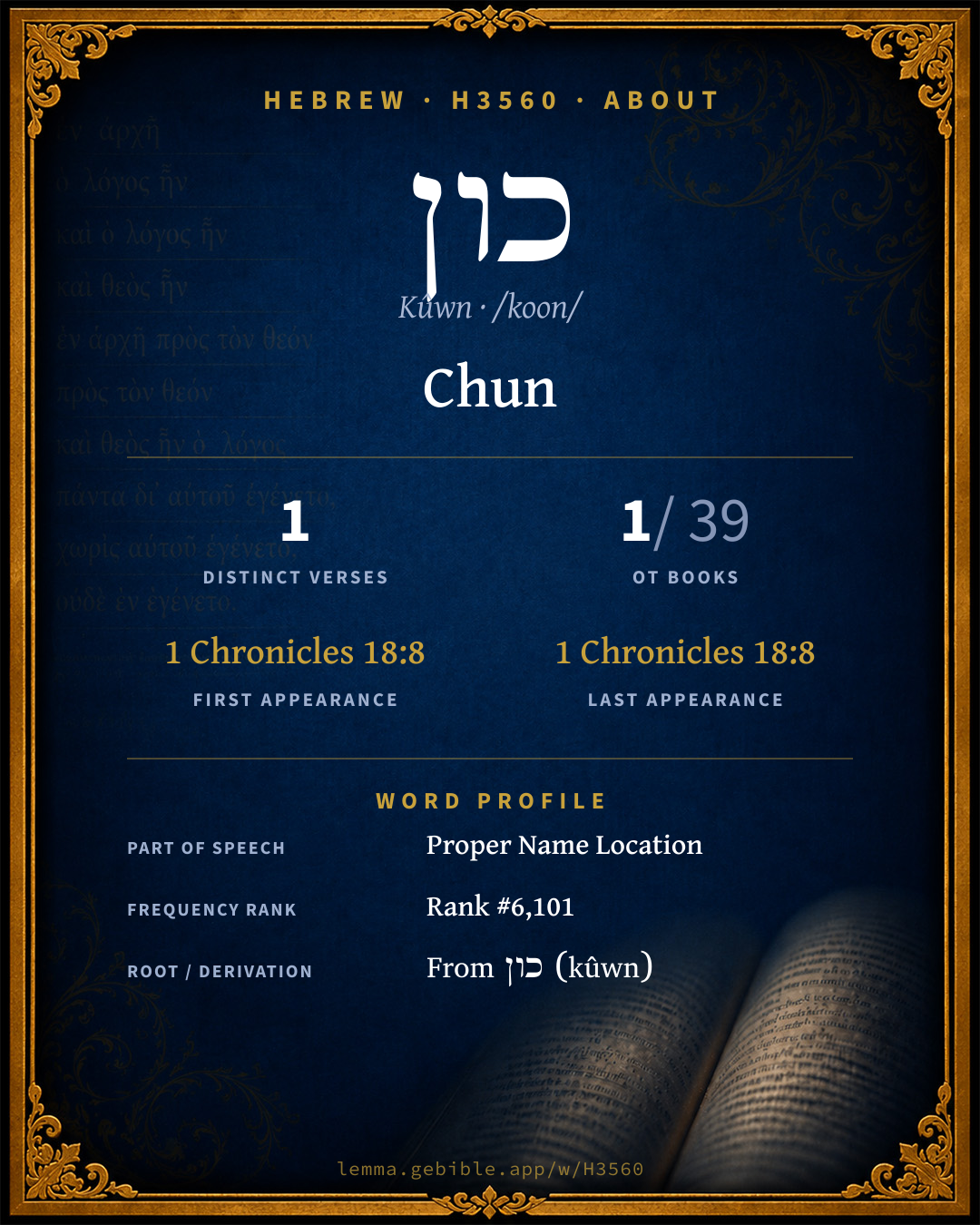
כּוּן
Chun
BDB lists 2 entries for ‘Chun’ fuller range ↓
Full lexicon entry — Brown-Driver-Briggs (BDB)
From Brown-Driver-Briggs (BDB)
Where this word appears
Grammar key — what these labels mean
Noun type
- Proper
- A name of a specific person, place, or people (e.g. Abraham, Zion, Israel).
Every verse where H3560 appears — 1 distinct verse across 1 book. Click any verse to open its interlinear word-by-word view. Verse text shown in the World English Bible for context — . Each verse’s Hebrew form is shown with its reference; the English is not keyword-highlighted, since the data carries no word-level English alignment. Use “Compare translations” on any verse to read it across multiple English versions. This concordance covers the Hebrew Bible; Septuagint (Greek Old Testament) occurrences are not indexed here.
1 Chronicles 1 verse
About this entry
At a glance — auto-summarized from this page’s data, not written by a person. Every figure links to its source below. This summary describes the numbers; it doesn’t interpret them.
כון — transliterated Kûwn — is a Hebrew name carrying the sense “Chun.” The Hebrew Bible uses it only 1 verse. More than three-quarters of its appearances fall in 1 Chronicles. Found nowhere else but 1 Chronicles 18:8. See 1-verse concordance and the renderings breakdown below.
Gloss history
Strong's 1890 vs modern scholarship
About this word
Strong's H3560 catalogs a Hebrew word from the Hebrew Old Testament.
These counts are not copied from any lexicon or concordance. They are computed here, from the morphology-tagged Hebrew Old Testament. What Lemma adds →
- 1
- distinct verses
- The word appears in 1 distinct verse.
- 1 / 39
- OT books
- The word appears in 1 of 39 Old Testament books.
- #6,101
- by frequency
- Rank #6,101 (rank 6,101 of 8,640 Hebrew words by occurrence).
View all 1 occurrence in the concordance →
Most concentrated in
- 1 Chronicles 1 verse 100%
By section of the Old Testament
By traditional corpus
Conventional, traditional groupings — biblical authorship is debated, so this is a traditional corpus grouping, not an authorship claim. Each share is this word’s portion of its verses in that division of the Hebrew canon. Each figure is a share of the word’s 1 distinct verse.
- Writings (Ketuvim) 1 verse · 100%
How translations render this word
Counts come from each version’s own published word-to-Strong’s tagging or interlinear alignment — an approximate guide to how each version renders this word, not a word-level alignment the data otherwise carries. Because each total is that version’s own tagged count, the per-version totals vary from one another and need not match the appearance or distinct-verse counts above. These counts may also differ from a printed concordance because Lemma counts each distinctly tagged rendering and does not collapse phrase taggings into a single head-word total. This is a fixed set of word-tagged versions (KJV, ASV, BSB, ULT) and does not change with the reading translation you choose elsewhere. Each version’s license is shown beside its name below (and on Sources).
BDB lists this Strong’s number as 2 distinct words (homographs). Each count above pools all of them and is not split by sense — see the Senses section below. A low-frequency rendering may belong to a different one of those words, not the primary meaning.
- King James Version†: Chun 1×
- American Standard Version†: Cun 1×
- Berean Standard Bible†: Cun 1×
- unfoldingWord Literal Text†: Kun 1×
King James Version Public Domain
Renders H3560 across 1† tagged occurrence — most commonly:
American Standard Version Public Domain
Renders H3560 across 1† tagged occurrence — most commonly:
Berean Standard Bible Public Domain
Renders H3560 across 1† tagged occurrence — most commonly:
unfoldingWord Literal Text CC BY-SA 4.0
Renders H3560 across 1† tagged occurrence — most commonly:
29 senses and sub-senses in the full BDB
Hebrew verbs can shift meaning by stem (binyan): Qal is the basic action, Niphal is often passive or reflexive, Piel often intensifies or makes it factitive, and Hiphil is typically causative. The senses below are grouped under the stem BDB assigns to each. This entry also uses Hophal (the passive of Hiphil) and one or more reduplicated stems (the Pōlēl/Pilpēl type), which for hollow or geminate roots behave much like Piel — often intensive or iterative.
What do BDB’s symbols mean?
BDB uses these scholarly abbreviations:
| Symbol | Meaning |
|---|---|
| 𝔊 | the Septuagint (the ancient Greek translation, LXX) |
| 𝔙 | the Vulgate (the Latin translation) |
| 𝔖 | the Syriac version (the Peshitta) |
| 𝔗 | the Targum (the Aramaic translation) |
| ψ | the Psalms |
| √ | root (the underlying root or stem) |
| ‖ | parallel passage (a synonymous or contrasted parallel) |
| † | the dagger: every passage where the word occurs is cited |
The 29 senses and sub-senses the full Brown-Driver-Briggs lexicon distinguishes for this word, in lexicon order (not ranked by frequency), with BDB’s own verbatim wording and sub-sense lettering. Shown in Hebrew script with BDB’s own scholarly abbreviations. The condensed entry is in the Lexicon Entry tab.
כון I ob. be firm, only in der. conj. (NH Aramaic כּוּן, in der. conj., כִּיוֵּן arrange, direct
Niphal
- Pf. (on 3 ms. v. Pt. infr.), 2 fs. נָכ֫וֹנָה 1 K 2:46; 3 pl. נָכ֫וֹנוּ Pr 19:29; נָכֹ֫נוּ Ez 16:7; Impf. יִכּוֹן Pr 12:3 +; 3 fs. תִּכּוֹן Je 30:20 +; וַתִּכֹּן 1 K 2:12 2 Ch 8:16, etc.; Imv. חִכּוֹן Am 4:12; הִכֹּן Ez 38:7; pl. הכונוּ 2 Ch 35:4 Kt (Qr הָכִינוּ Hiph.); Pt. נָכוֹן Gn 41:32 + (in ψ 93:2 and perhaps elsewhere the Pf. would be poss.); cstr. נְכוֹן Pr 4:18; f. נְכוֹנָה ψ 5:10 + 2 times; pl. נְכֹנִים Ex 19:11 + 2 times; pass. or neut., and (less often) reflex.:— e.g. 1 Kings 2:46
- 1. be set up, established, fixed:
- a. lit., of house upon (עַל) pillars Ju 16:26, 29, so, in metaph., of temple-mt. Is 2:2 = Mi 4:1, עֲדָתוֹ Je 30:20; be firm, of breasts at puberty Ez 16:7; firmly established, of תֵּבֵל ψ 93:1 = 96:10 = 1 Ch 16:30; firm, i.e. a strong support, of י׳’s hand יָדִי תִּכּוֹן עִמּוֹ ψ 89:22 (‖ זְרוֹעִי תְאַמְּצֶנּוּ). e.g. Judges 16:26
- b. fig., of throne 2 S 7:16 = 1 Ch 17:14, 1 K 2:45 ψ 89:38; 93:2 Pr 16:12; 25:5; 29:14; of king, royal family, kingdom 1 S 20:31 1 K 2:12, 46 2 S 7:26 = 1 Ch 17:24. e.g. 2 Samuel 7:16
- c. of any persons, be established, stable, secure, enduring Jb 21:8 (c. לִפְנֵי) Pr 12:3, also v 19 (subj. שְׂפַת אֱמֶת), ψ 101:7 (c. לְנֶגֶד עֵינָ֑י), 102:29 (c. לְפָנֶיךָ), 140:12 (c. בָּאָרֶץ); of plans Pr 16:3; 20:18; נְכוֹן הַיּוֹם 4:18 the established, stable, (part) of the day, i.e. mid-day, when the sun seems motionless in mid-heaven.—2 S 6:6 v. נָכוֹן n.pr. infr. e.g. Job 21:8
- d. fixed, securely determined נ׳ הַדָּבָר מֵעִם הָאֱלֹהִים (‖ אֱמֶת) Gn 41:32 (E); so כְּשַׁחַר נָכוֹן מֹצָאוֹ Ho 6:3 MT, but read כְּשַׁחֲרֵנוּ כֵּן נִמְצָאֵהוּ Gie Beiträge 208 Wead loc.; substantiated, certain, of an allegation Dt 13:15 = 17:4; אֶל־נָכוֹן according to (what is) certain, = certainly, assuredly 1 S 23:23; 26:4 (v. Dr). e.g. Genesis 41:32
- 2. in moral sense, be directed aright, of ways Pr 4:26 ψ 119:5 (cf. Hiph. 3); be fixed aright, stedfast נָכוֹן לִבִּי ψ 57:8(×2); 108:2, so 112:7; לִבָּם לֹא נָכוֹן עִמּוֹ 78:37; רוּחַ נָכוֹן 51:12 (‖ לֵב טָהוֹר); לא נָכוֹן לעשׂות כן Ex 8:22 (J) is is not right, proper, etc.; pt. f. נְכוֹנָה as subst. = what is right, the right Jb 42:7, 8; = uprightness ψ 5:10. e.g. Proverbs 4:26
- 3. prepare, be ready, pers. Am 4:12 (c. ל inf.); words Pr 22:18; הִכֹּן וְהָכֵן לְךָ Ez 38:7; 2 Ch 35:4 Kt (Qr Hiph.); pt. as adj. = prepared, ready, often c. הָיָה, of persons Ex 19:11, 15; 34:2 Jos 8:4 (all JE); of things, sq. ל pers. Jb 12:5 Ne 8:10, ל loc. Jb 18:12, ל nom. act. ψ 38:18; ב loc. Jb 15:23; e.g. Amos 4:12
- 4. pass. be prepared, of judgments Pr 19:29 (ל pers.); of work be arranged, settled 2 Ch 8:16; fig. of prayer ψ 141:2 be arranged, set in order, as incense before thee (> present itself as incense); be arranged, ordered, of temple service 2 Ch 29:35; 35:10, 16. e.g. Proverbs 19:29
Hiphil
- Pf. הֵכִין Jos 4:4 +; sf. הֱכִינַנִי 1 K 2:24; הֱכִינוֹ 2 S 5:12 1 Ch 14:2; הֱכִינָהּ Jb 28:27; 2 ms. הֲכִינוֹתָ Jb 11:13 +; 3 pl. הֵכִינוּ 1 Ch 12:39 +; וְהֵכִינוּ consec. Ex 16:5; 1 pl. הֲכִינוֹנוּ 1 Ch 29:16; הֵכַנּוּ (Ges§ 72, R. 6) 2 Ch 29:19, etc. Impf. יָכִין Ju 12:6 +; וַיָּ֫כֶן 1 Ch 15:1 + 3 times etc.; Imv. הָכֵן Gn 43:16 +; pl. הָכִינוּ Jos 1:11 +; Inf. abs. הָכֵן Jos 3:17, so הָכִין 4:3 (read הָכֵרו, v. Di), Je 10:23 (v. Gie), Ez 7:14 (v. Sm Co and infr.; see on all Köni. 468); cstr. הָכִין Is 9:6 +; sf. הֲכִינוֹ Na 2:4 Pr 8:27; הֲכִינָתּ Je 33:2; Pt. מֵכִין Je 10:12 + 4 times;—(favourite word in Ch., in various applications) e.g. Joshua 4:4
- 1. establish, set up:
- a. king (or, one as king) 2 S 5:12 1 K 2:24 1 Ch 14:2, royal seed ψ 89:5, kingdom 1 S 13:13 2 S 7:12 = 1 Ch 17:11, 1 Ch 28:7 2 Ch 12:1; 17:5, throne ψ 103:19 1 Ch 22:10; the world תֵּבֵל Je 10:12 = 51:15; mts. ψ 65:7; heavens Pr 8:27; an altar upon (עַל) its base Ezr 3:3. e.g. 2 Samuel 5:12
- b. God’s faithfulness ψ 89:3; heart of humble 10:17. e.g. Psalms 89:3
- c. = accomplish, do Je 33:2 (‖ עשׂה), = make Is 40:20 Jb 28:27. e.g. Jeremiah 33:2
- d. make firm, only inf. abs., as adv. = firmly הָכֵן Jos 3:17; הָכִין 4:3 (v. supr.) e.g. Joshua 3:17
- 2.
- a. fix, so as to be ready, make ready, prepare, a gift Gn 43:25 (J), place Ex 23:20 (JE), 2 Ch 3:1; c. לְ rei 1 Ch 15:1, 3, also (obj. om.) v 12 (vid. Be, and DaSynt. § 144), 2 Ch 1:4 (בַּהֵכִין), v. Ges§ 138 i); often prepare food, acc. + לְ pers. Jos 1:11 (D), ψ 78:20; לְ om. Pr 6:8; 30:25; obj. om. 1 Ch 12:39 2 Ch 35:14(×2), 15; both om. Gn 43:16 (J), 1 Ch 9:32; prepare a road Dt 19:3, a sacrifice Zp 1:7, ambuscades Je 51:12, one’s work Pr 24:27, materials for (לְ) temple 1 Ch 22:3, 14, also v 14b (no לְ), 29:2, 3; weapons (c. לְ pers.) 2 Ch 26:14 and (hostile purpose) ψ 7:14, cf. 57:7, Is 14:21 prepare slaughter-place for (לְ) his children; store-rooms 2 Ch 31:11a, also v 11b (obj. om.); gallows (c. לְ pers.) Est 6:4; 7:10; corn (produce of land) ψ 65:10; land v 10, so (= restore) 68:11; persons (ל) 2 Ch 35:6; fig. of belly preparing deceit Jb 15:35; make preparation (for, לְ rei) 1 Ch 22:5, and v 5 (לְ om.); sq. לִבְנוֹת 1 Ch 28:2, c. acc. material + לִבְנוֹת 1 K 5:32 1 Ch 29:16; without לְ, make ready 1 S 23:22 Na 2:4; Ez 7:14 (read הָכִינוּ הָכֵן Co, for ה׳ הַכֹּל MT) = make full preparation! make thee ready! Je 46:14 (לְ dat. ethiopic), Ez 38:7 (id.), 2 Ch 35:4. e.g. Genesis 43:25
- b. provide for, provide, furnish Nu 23:1, 29; 29:7 Jos 4:4 (all JE), Jb 27:16, 17, food for (לְ) raven Jb 38:41, rain for (לְ) earth ψ 147:8; 1 Ch 29:19 2 Ch 2:6 ψ 74:16. e.g. Numbers 23:1
- 3. direct one’s face towards (אֶל־) Ez 4:3, 7; in moral and spiritual sense, direct one’s step (צַעֲדוֹ) = order aright, Je 10:23 (v. supr.), Pr 16:9, so (פְּעָמַי) ψ 119:133; הֵכִין דְּרָכָיו לִפְנֵי י׳ אֱלֹהָיו 2 Ch 27:6, also (sq. דרכיו only) Pr 21:29 Kt (Qr יָבִין); עַל הַהֵכִין הָאֱלֹהִים לָעָם 2 Ch 29:36 that which God had ordered aright for the people (on art. = pron. rel. v. Ges§ 138, 3, b); sq. לֵב Jb 11:13 ψ 78:8; + לְ, לֹא הֵכִין לִבּוֹ לִדְרוֹשׁ אֶת־י׳ 2 Ch 12:14, so 19:3; 30:19; + לִדְרוֹשׁ אֶת־תּוֹרַת י׳ Ezr 7:10; הכין לבב אֶל־י׳ 1 S 7:3 direct the heart towards י׳, 1 Ch 29:18 (י׳ subj.), so (c. לֵאלֹהִים) 2 Ch 20:33; hence (no obj. expr.) = give attention, sq. inf. Ju 12:6. e.g. Ezekiel 4:3
- 4. arrange, order 2 Ch 29:19 (of sacred vessels; + הִקְדַּשְׁנוּ), 35:20 (of temple). e.g. 2 Chronicles 29:19
Hophal
- Pf. הוּכַן Is 30:33, וְהוּכַן consec. Is 16:5 Zc 5:11; וְהֻכַן Na 2:6; Pt. מוּכָן Pr 21:31, pl. מוּכָנִים Ez 40:43;— e.g. Isaiah 30:33
- 1. be established, of throne Is 16:5; be fastened, of hooks Ez 40:43. e.g. Isaiah 16:5
- 2. be prepared for (לְ pers.) Is 30:33 and (לְ temp.) Pr 21:31; abs. Na 2:6; be ready Zc 5:11. e.g. Isaiah 30:33
Poʿlēl
- Pf. 3 ms. כּוֹנֵן ψ 9:8 + 3 times, וְכוֹנֵן consec. Hb 2:12; sf. כּוֹנְנָהּ Is 45:18; 2 ms. כּוֹנֲנְתָּ ψ 99:4; 119:90, כּוֹנָ֑נְתָּה ψ 8:4, etc.; Impf. 3 ms. יְכוֹנֵן Is 62:7; sf. וַיְכֹנְנֶ֑ךָ Dt 32:6, יְכוֹנְנֶהָ ψ 24:2 +, sf. 1 pl. וַיְכֻנֶנּוּ Jb 31:15 (וַיְכוּנֶּנוּ van d. H.); 2 ms. תְּכוֹנֵן ψ 7:10; 21:13, etc.; Imv. כּוֹנֵן Jb 8:8 (but on text v. infra), כּוֹנְנָה ψ 90:17, sf. כּוֹנְנֵהוּ ψ 90:17;—orig. make firm;— e.g. Psalms 9:8
- 1. set up, establish:
- a. of men, found, a city Hb 2:12 (‖ בנה), ψ 107:36. e.g. Habakkuk 2:12
- b. of God, establish, king’s throne 2 S 7:13 = 1 Ch 17:12, his own throne ψ 9:8 (לְמִשְׁפָּט), sanctuary Ex 15:17 (song), a nation Dt 32:6 (poem; ‖ קנה, עשׂה), a city ψ 48:9; 87:5 Is 62:7, תֵּבֵל ψ 24:2 (c. עַל, ‖ יָסַד), אֶרֶץ 119:90, cf. Is 45:18, also ψ 68:10 (obj. om., read perhaps אֶרֶץ צִיָּה Bi Che), heavens Pr 3:19 (‖ יָסַד־אָ֑רֶץ), moon and stars ψ 8:4; fig., steps of men 40:3, work of men’s hands 90:17(×2), justice 99:4; establish, i.e. vindicate and make secure to righteous (צַדִּיק) 7:10. e.g. 2 Samuel 7:13
- 2. constitute, make, a man (in womb) Jb 31:15 (‖ עשׂה), cf. ψ 119:73 (‖ id.); c. acc. + לְ rei + לְ pers. reflex. 2 S 7:24 thou hast made for thyself (לְךָ), thy people (אֶת־עַמְּךָ) Israel for thyself (לְךָ) into a people (לְעָם) for ever. e.g. Job 31:15
- 3. fix, so as to be ready, arrow upon (עַל) string ψ 11:2 so (חֵץ om.) ψ 21:13 (c. עַל־פְּנֵיהֶם), and poss. (חֵץ om.) Is 51:13 (Di Che al.; but dub., cf. Du; verse corrupt according to CheIntr. Is. 427), a bow ψ 7:13. e.g. Psalms 11:2
- 4. direct (sc. לֵב), sq. לְחֵקֶר Jb 8:8, i.e. give attention to (but no ‖ in Poʿl.; read perhaps בּוֹנֵן, cf. Dt 32:10 v. Ol Di). Poʿlal. Pf. be established: מי׳ מִצְעֲדֵי־גֶבֶר כּוֹנָ֑נוּ ψ 37:23 from י׳ are a man’s steps established; = be prepared כּוֹנָנ֑וּ Ez 28:13 but del. Co Da after A B 𝔖 al. Hithpoʿl. Impf.; be established, of house, 3 ms. יִתְכּוֹנָ֑ן Pr 24:3 (‖ יִבָּנֶה), of nation, 2 fs. תִּכּוֹנָ֑נִי (Ges§ 54. 2. b) Is 54:14; 3 fs. תִּכּוֹנֵן = be restored, of city Nu 21:27 (JE; ‖ תִּבָּנֶה); set oneself, take one’s stand 3 mpl. יִכּוֹנָ֑נוּ ψ 59:5. e.g. Job 8:8
כון II loc. city of Hadarezer (מִטִּבְחַת) וּמִכּוּן עָרֵי ה׳ 1 Ch 18
Senses from the full Brown-Driver-Briggs lexicon (Brown, Driver, Briggs; Oxford 1906 — public domain), digitized via Sefaria, supplemented by the OpenScriptures HebrewLexicon (CC BY 4.0). Full attribution on Sources.
Word origin
I. vb. prob. be firm, only in der. conj. (NH Aramaic כּוּן, in der. conj., כִּיוֵּן arrange, direct; ܟܰܘܶܢ put right, correct; Assyrian kânu, be firm, right DlHWB 321; Arabic كَانَ (med. و) exist, occur, be; so Ethiopic ኮነ Sab. כון DHM ZMG 1875, 599, Ph. כון be (often));—
II. n.pr.loc. city of Hadarezer (מִטִּבְחַת) וּמִכּוּן עָרֵי ה׳ 1 Ch 18:8, 𝔊 ἐκ τῶν ἐκλεκτῶν πολέ(μ)ων (= בֵּרֹתַי 2 S 8:8); = mod. Kuna, near Bereitan (betw. Laodicea and Heliopolis), according to FurrerZPV viii, 34, v. בֵּרוֹתָה p. 92 supr., and Thes.
— Brown-Driver-Briggs (Oxford 1906, public domain), digitized via Sefaria, supplemented by the OpenScriptures HebrewLexicon (CC BY 4.0). See Sources.
Derived from כון (kûwn) (H3559) — to be established.
Jastrow Dictionary
A second Hebrew/Aramaic lexicon for comparison, covering Aramaic and post-biblical (Talmudic, Targumic, Midrashic) usage that the biblical-Hebrew BDB does not. Matched by lemma rather than by Strong’s number, so a lemma may carry more than one Jastrow headword (shown separately below), and the entries cover usage well beyond the Bible.
כּוּן
- (b. h.) to stand, exist, be firm.
- 1. to straighten. Sifré Deut. 308 מְכַוְּונוֹ במעגילה he tries to straighten the wood in a press; Yalk. Deut. 942 (not מכינן); Pesik. Zutr. Haăz. (ed. Bub. V, p. 111) נתנו לאומן שיְכַוְּונוֹ he gave it to a mechanic to straighten it.
- 2. to place in a line, direct. Macc. II, 5 (9ᵇ) מְכַוְּונִין להן דרך וכ׳ Ms. M. (ed. ומְכוּוָּנוֹת להן דרכים, v. infra) we make for them direct roads from one place of refuge to the other.
- 3. to determine exactly (place, time &c.). Y. Erub. V, 22ᶜ לְכַוֵּין את הרוחות how to determine exactly the four cardinal points (v. רָבַע). Ib. bot. הארון היה מְכַוֵּין וכ׳ the Ark indicated for them the points of the compass. Gen. R. s. 15, beg., v. כִּוּוּן. M. Kat. 10ᵃ אין יכול לכַוֵּין אימרא וכ׳ is unable to sew the fringe accurately on the bosom of the shirt. Ber. 7ᵃ לכַוֵּין אותה שעה to seize the opportunity of just that moment; a. fr.
- 4. (with לב or sub. לב) to direct or prepare one’s mind, to pay attention, to do a thing with an intention. Ber. II, 1 אם כ׳ לבו if he (while reading in the Law) had his mind directed (to the Sh’ma); ib. 13ᵃ אם כ׳ לבו לקרות it means, he read with attention (to the sense, not merely like one going over the text for correction). R. Hash. 28ᵇ כ׳ לבו לצאת he had the intention of complying with the law (v. יָצָא); opp. (כ׳) לשמוע he directed his attention to listening, i.e. heard the sound with consciousness (but without devotion); v. כַּוָּונָה. Ber. V, 1 היו שוהין … כדי שיְכַוְּונוּ לבם וכ׳ tarried a while before prayer, in order to direct their hearts to their Father in heaven. Y. ib. II, 5ᵃ חזקה כִּוֵּין the presumption is that he read with attention; a. fr.—Part. pass. מְכוּוָּן, f. מְכוּוָּנָה, מְכוּוֶּנֶת; pl. מְכוּוָּנִים, … נִין; מְכוּוָּנוֹת a) in a line, corresponding. Y. Kil. V, beg. 30ᵇ עריס המכ׳ a straight bed of vines, opp. מעוקם. Ib. מכ׳ הן they (the vines) are in a straight line. Y. Ber. IV, 8ᶜ top בית … מ׳ כנגד … של מעלן the situation of the earthly Holy of Holies corresponds with that of the heavenly &c. Macc. II, 5 ומכוונות להן דרכים (not … נת), v. supra. Ib. 9ᵇ ומכוונות היו כמין וכ׳ (Ms. M. ומכוונין הן) and they (the three towns on this side and those on the other side of the Jordan respectively) were in straight parallel lines like two rows in a vineyard; a. fr.—b) exact, precise. Toh. III, 1 sq. כביצה מ׳ exactly the quantity of an egg. Mikv. VII, 6; Ḥag. 19ᵃ; Gitt. 16ᵃ
- to put in proper position, to prepare; to hold ready, to designate. Bets. 2ᵇ (ref. to Ex. XVI, 5) חול מֵכִין לשבתוכ׳ a week day prepares for the Sabbath (that which has become ready for use on a week day may be used on the Sabbath), but a Holy Day does not prepare for the succeeding Sabbath, ואין שבת מֵכִינָה ליו"ט nor can the Sabbath prepare for a succeeding Holy Day, v. הֲכָנָה.—Meg. 12ᵇ (play on ממוכן, Esth. I, 14) כלום הֵכִינוּ וכ׳ have they (the Persians) arranged a table before thee?; Esth. R. to l. c. מי מֵכִין וכ׳ who arranges an altar &c.?; a. fr.—[Tosef. Maasr. I, 4 משיכינו ed. Zuck., Var. משייבינו, read: משיניצו.]—Part. pass. מוּכָן prepared, designated, ready. Bets. I, 2 עפר מ׳ מבעוד יום dust (for covering the blood) made ready a day before. Ib. אפר כירה מ׳ הוא ashes of the stove are considered ready (destined to be used for the purpose). Ib. III, 4 אין זה מן המ׳ this is not among the things designated for use on the Holy Day. Ib. IV, 6.—Meg. l. c. (play on ממוכן, v. supra) שמ׳ לפורענות he was ready for evil; a. fr. e.g. Exodus 16:5
- 1. to be made straight, to be remedied (cmp. תכן). Pesik. Zutr. l. c. אין אתם מִתְכַּוְּונִים אלא באור you (your crookedness) can be remedied only through fire; Sifré Deut. l. c. אין אתם הולכים אלא לאור; Yalk. Deut. l. c. הולכין אלא לאחור (corr. acc.).
- 2. to prepare one’s self. Y. Meg. I, 71ᶜ (ref. to הִכּוֹן, Am. IV, 12) הִתְכַּוֵּון לקראת וכ׳ put thyself in proper condition to meet thy God. e.g. Amos 4:12
- 3. to intend, propose. B. Kam. VIII, 1 עד שיהא מִתְכַּ יֵן unless he did it with malicious intent. Tosef. Naz. III, 10 לא נִתְכַּוַּונְתִּי אלא כמותה my intention was to be exactly like her (as to her vow). Ib. 14 מי שנ׳ לעלות וכ׳ if he who had the intention to eat the flesh of swine &c.; v. עָלָה. Sabb. 22ᵃ ובלבד שלא יִתְכַּוֵּין וכ׳ provided he has not the intention of making a groove.—Bets. 23ᵃ, a. fr. דבר שאינו מִתְכַּ׳ a forbidden act which was produced without intent, i.e. an unintended but unavoidable effect of a permitted act. R. Hash. 28ᵇ. Pes. 53ᵇ, a. fr. שניהם … נִתְכַּוְּונוּ both meant the same thing; a. fr.
- to establish, base firmly. Ex. R. s. 15 מבקש לְכוֹנֵן עולמים wanted to establish worlds. Ib. על אלו אני מְכוֹנֵן וכ׳ upon those (the patriarchs) I will establish the world.—Part. pass. מְכוֹנָן, f. מְבוֹנֶנֶת. Midr. Sam. ch. XVI (ref. to הכינני, I Kings II, 24) בזכות התורה המ׳ בארון (the world exists) for the sake of the Law that is put up straight in the holy Ark. e.g. 1 Kings 2:24
כּוּן ²
- ; Pa. כַּוֵּון
- 1. to direct, aim, draw a direct line. Targ. Y. Num. XXII, 23. Targ. Num. XXXIV, 7, sq. (h. text תאה). Targ. Y. Deut. X, 5 וכוונית (h. text פנה). Ib. XIX, 3 (h. text תכין, v. preced.); a. e.
- 2. to draw a parallel, compare. Targ. Is. XLVI, 5 (h. text תמשילני).
- 3. (with דעתא, or sub. דעתא) to direct the mind, to pay attention; to do a thing intentionally. Targ. Y. Num. XI, 1 מכ׳ והגיאן ביש intentionally speaking evil.—Ber. 17ᵇ לא מצי לְכַוּוּנֵי דעתיה he cannot collect his mind (for prayer). Ib. 30ᵇ מעיקרא לא כ׳ וכ׳ the first time he read without attention. Ḥull. 31ᵃ דלא קָמְכַוֵּין (or קָמִכַּוֵּין Ithpa.) when he had no intention whatever (to cut); a. fr.—Part. pass. מְכַוַּון a) directed towards, corresponding. Targ. Ez. I, 9. Targ. Ex. XXVI, 5; a. fr.—b) straight, firm, upright. Targ. Job XXI, 8 מְכַוְּונִין Bxt. (Ms. מְכַוְּונַן; ed. מכוין, מְכַוַּון, corr. acc.; h. text נכון). Targ. Ps. LI, 12. Ib. LVII, 8 (ed. Wil. מכוֵן, corr. acc.); a. fr.—Yoma 28ᵇ לא מְכַוְּונֵי Ms. M. (ed. לא מ׳ טובא) the Temple walls were not exactly straight (the lower portions being thicker than the upper); [Ms. M. 2 משום דמכווני because the walls were exactly built in correspondence with the points of the compass]. Y. Snh. IV, beg. 22ᵃ; III, 21ᶜ top [read:] כד הוא חמי סהדו מכַוְּונָא … הכן והכן מְכַוֵּון when he found evidences (of two) exactly corresponding, he cross-examined; but when he found them turning hither and thither (differing in details), he tried to harmonize (allowing for errors in time &c., v. חֲקִירָה).
- , כַּוֵּין …
- 1. to place one’s self, to stand. Targ. Ps. CI, 7.
- 2. to be precise in doing. Ib. XC, 12 מן יִתְכַּ׳ להודע ed. Lag. (oth. ed. כן, corr. acc.) who can exactly make known? (h. text כן הודע). Targ. Y. Lev. XIII, 12.
- 3. to be trained, to be in the habit of. Targ. Y. Num. XXII, 30 (h. text הסכן).
- 4. to intend, mean. Ib. XXX, 5 ויתכ׳ וישתוק and keeps silence intentionally. Targ. Y. Deut. XIX, 4; a. e.—Ḥull. 95ᵃ דאיכ׳ לצעורי׳ וכ׳ who meant to vex his neighbor. Ib. 31ᵃ מִיכַּוֵּין לשום חתיכה had the intention merely to cut (not to slaughter according to the ritual, v. זְבִיחָה). Ib. מה כלים דלא מִיכַּוְּונֵי וכ׳ as vessels (lifeless things) which have no thought &c.; a. e.
- to be prepared, ready (מוּכָן, v. preced.). Ib. 14ᵃ כיון דלא א׳ וכ׳ because it was not prepared (designated for use) yesterday.—V. תכן.
כֵּוָן
- , v. sub כֵּיוָ׳.
A Dictionary of the Targumim, the Talmud Babli and Yerushalmi, and the Midrashic Literature (Marcus Jastrow; London, Luzac, 1903) — Public Domain. Digitized via Sefaria. Digitized via Sefaria. Full attribution on Sources.
Same root — word family
Other BDB entries built from the same root as H3560, grouped by Strong’s listed origin. These share a root / origin per the lexicon — not necessarily a shared meaning. Each links to that word’s own entry.
Derives from
Shares the same root
Proper names from this root
People and places named from this root — a name, not an additional meaning of the word.
- יכין Yâkîyn H3199 Jachin
- יכניה Yᵉkonyâh H3204 Jeconiah
- כונניהו Kôwnanyâhûw H3562 Cononiah
- כיון Kîyûwn H3594 Chiun
- נכון Nâkôwn H5225 Nachon
Compare all same-root words → Showing 4 of 11 — not the complete family. 5 of the same-root words are proper names (people or places). They share a root, not necessarily a meaning.
Bible dictionary
Public-domain dictionary articles matched to this entry by name (Chun). A biblical name can be shared by more than one person or place, so an article may treat several.
Easton's Bible Dictionary · M. G. Easton, 1897
One of the cities of Hadarezer, king of Syria. David procured brass (i.e., bronze or copper) from it for the temple (1 Chr. 18:8). It is called Berothai in 2 Sam. 8:8; probably the same as Berothah in Ezek. 47:16.
Smith's Bible Dictionary · William Smith, 1863
(1 Chronicles 18:8) called Berothai in (2 Samuel 8:8)
Hitchcock's Bible Names Dictionary · Roswell D. Hitchcock, 1869
making ready
Classic public-domain reference works; full attribution on Sources.
Septuagint verse parallels
This word appears in 1 verse that also exists in the Greek Old Testament (Septuagint), out of the 1 Hebrew verse it occurs in. You can read those verses in Greek by switching the Old Testament edition to the Septuagint.
Read these verses in the Septuagint
This is a verse-level parallel only — the same verses exist in both the Hebrew and Greek Old Testaments. No word-level Hebrew↔Greek correspondence is claimed: the data carries no such alignment, so no Greek word is shown as this Hebrew word’s translation. Coverage is not total — the Septuagint omits the deuterocanon and renumbers the Psalms, so some Hebrew verses have no direct Greek parallel.