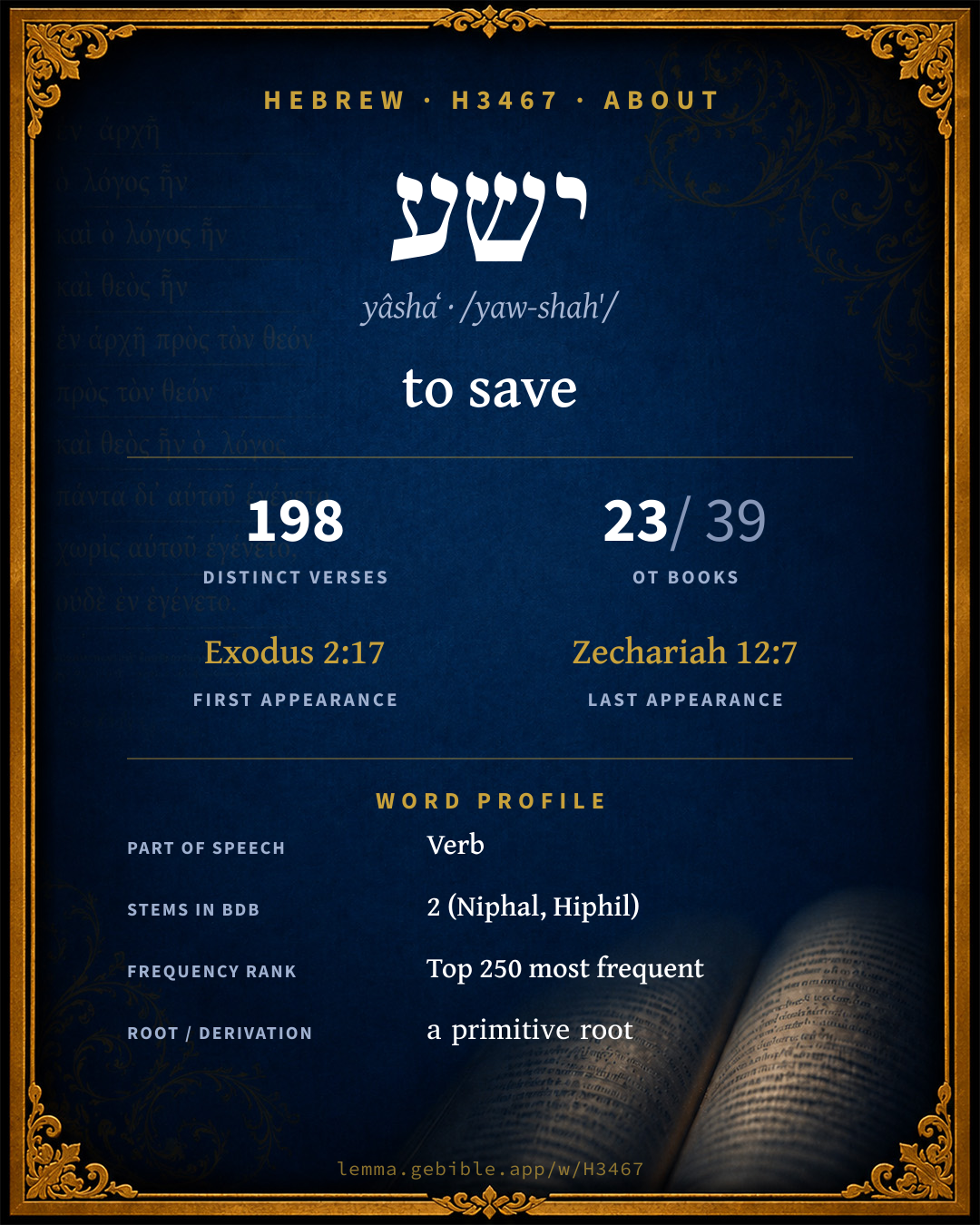
יָשַׁע
to save
also: be saved, be delivered fuller range ↓
Full lexicon entry — Brown-Driver-Briggs (BDB)
From Brown-Driver-Briggs (BDB)
Where this word appears
See every Hiphil verb in the Hebrew Bible →
Grammar key — what these labels mean
Part of speech
- Verb
- An action or state-of-being word.
Noun type
- Common
- A common noun — a general class of person, place, or thing (“king,” “city,” “water”), not a specific name.
Stem
- Hiphil
- The causative active stem (“he caused / brought about”). Here: ‘deliver’
- Niphal
- Usually the simple passive or reflexive of the Qal (“he was written”). Here: ‘be liberated’
Form
- Participle Active
- A verbal adjective expressing ongoing or characteristic action (“writing / one who writes”).
- Infinitive Construct
- A bound verbal noun, frequently with prepositions (“to write / in writing”).
- Imperative
- A direct command (“write!”).
- Sequential Imperfect
- An imperfect with prefixed waw — the standard past-narrative form (waw-consecutive imperfect).
- Imperfect
- An incomplete, ongoing, or future action (“he will / would write”).
- Sequential Perfect
- A perfect with prefixed waw continuing a preceding imperfect or command (waw-consecutive perfect).
- Cohortative
- A first-person volitional form expressing wish or resolve (“let me / let us write”).
- Infinitive Absolute
- An unbound verbal noun, often intensifying or standing in for a finite verb.
- Perfect
- A completed action or state — Hebrew marks aspect (completeness) more than strict tense (“he wrote”).
- Jussive
- A third- or second-person volitional form expressing wish or command (“let him write”).
State
- Absolute
- The independent form of a noun, not bound to a following word.
- Construct
- A noun bound to a following noun in a possessive / “of” relationship (the construct chain).
Person
- 2nd Person
- The one addressed (“you”).
- 3rd Person
- The one spoken about (“he / she / it / they”).
- 1st Person
- The speaker (“I / we”).
Gender
- Masculine
- Grammatically masculine.
- Common
- Either gender — not distinguished for this form.
- Feminine
- Grammatically feminine.
Number
- Singular
- One.
- Plural
- More than one (in Hebrew, generally three or more).
Grammatical forms 41 distinct
- Verb, Hiphil, Imperative, 2nd Person, Masculine, Singular 31 times (15%)
- Verb, Hiphil, Imperfect, 3rd Person, Masculine, Singular 25 times (12%)
- Verb, Hiphil, Participle Active, Masculine, Singular, Absolute 22 times (11%)
- Verb, Hiphil, Infinitive Construct 22 times (11%)
- Verb, Hiphil, Sequential Imperfect, 3rd Person, Masculine, Singular 16 times (8%)
- Verb, Hiphil, Participle Active, Masculine, Singular, Construct 9 times (4%)
- Verb, Hiphil, Imperfect, 1st Person, Common, Singular 7 times (3%)
- Verb, Hiphil, Imperfect, 2nd Person, Masculine, Singular 7 times (3%)
+33 more forms (67 occurrences)
Parsed forms decoded from the imported morphology (morphhb / Westminster Leningrad Codex — WLC text public domain, morphhb tagging CC BY 4.0), counted across 206 parsed occurrences — not distinct verses.
Every verse where H3467 appears — 198 distinct verses across 23 books. Click any verse to open its interlinear word-by-word view. Verse text shown in the World English Bible for context — . Each verse’s Hebrew form is shown with its reference; the English is not keyword-highlighted, since the data carries no word-level English alignment. Use “Compare translations” on any verse to read it across multiple English versions. This concordance covers the Hebrew Bible; Septuagint (Greek Old Testament) occurrences are not indexed here.
Exodus 2 verses
- Exodus 2:17 וַ/יּ֣וֹשִׁעָ֔/ן conj + Hiphil wimpf 3ms + sfx pers 3fp The shepherds came and drove them away; but Moses stood up and helped them, and watered their flock.
- Exodus 14:30 וַ/יּ֨וֹשַׁע conj + Hiphil wimpf 3ms Thus Yahweh saved Israel that day out of the hand of the Egyptians; and Israel saw the Egyptians dead on the seashore.
Numbers 1 verse
Deuteronomy 5 verses
- Deuteronomy 20:4 לְ/הוֹשִׁ֥יעַ prep + Hiphil inf.cs for Yahweh your God is he who goes with you, to fight for you against your enemies, to save you.
- Deuteronomy 22:27 מוֹשִׁ֖יעַ Hiphil ptcp.act ms for he found her in the field, the pledged to be married lady cried, and there was none to save her.
- Deuteronomy 28:29 מוֹשִֽׁיעַ Hiphil ptcp.act ms and you shall grope at noonday, as the blind gropes in darkness, and you shall not prosper in your ways: and you shall be only oppressed and robbed always, and there shall be none to save you.
- Deuteronomy 28:31 מוֹשִֽׁיעַ Hiphil ptcp.act ms Your ox shall be slain before your eyes, and you shall not eat of it: your donkey shall be violently taken away from before your face, and shall not be restored to you: your sheep shall be given to your enemies, and you shall have none to save you.
- Deuteronomy 33:29 נוֹשַׁ֣ע Niphal pf 3ms Happy are you, Israel: Who is like you, a people saved by Yahweh, The shield of your help, The sword of your excellency! Your enemies shall submit themselves to you; You shall tread on their high places.
Joshua 2 verses
- Joshua 10:6 וְ/הוֹשִׁ֤יעָ/ה conj + Hiphil impv 2ms + sfx h The men of Gibeon sent to Joshua to the camp to Gilgal, saying, Don't slack your hand from your servants; come up to us quickly, and save us, and help us: for all the kings of the Amorites that dwell in the hill-country are gathered together against us.
- Joshua 22:22 תּוֹשִׁיעֵ֖/נוּ Hiphil juss 2ms + sfx pers 1cp The Mighty One, God, Yahweh, the Mighty One, God, Yahweh, he knows; and Israel he shall know: if it be in rebellion, or if in trespass against Yahweh (don't save us this day),
Judges 20 verses
- Judges 2:16 וַ/יּ֣וֹשִׁיע֔וּ/ם conj + Hiphil wimpf 3mp + sfx pers 3mp Yahweh raised up judges, who saved them out of the hand of those who despoiled them.
- Judges 2:18 וְ/הֽוֹשִׁיעָ/ם֙ conj + Hiphil wpf 3ms + sfx pers 3mp When Yahweh raised them up judges, then Yahweh was with the judge, and saved them out of the hand of their enemies all the days of the judge: for it repented Yahweh because of their groaning by reason of those who oppressed them and vexed them.
- Judges 3:9 מוֹשִׁ֛יעַ וַ/יּֽוֹשִׁיעֵ֑/ם Hiphil ptcp.act ms conj + Hiphil wimpf 3ms + sfx pers 3mp When the children of Israel cried to Yahweh, Yahweh raised up a savior to the children of Israel, who saved them, even Othniel the son of Kenaz, Caleb's younger brother.
- Judges 3:15 מוֹשִׁ֗יעַ Hiphil ptcp.act ms But when the children of Israel cried to Yahweh, Yahweh raised them up a savior, Ehud the son of Gera, the Benjamite, a man left-handed. The children of Israel sent tribute by him to Eglon the king of Moab.
- Judges 3:31 וַ/יֹּ֥שַׁע conj + Hiphil wimpf 3ms After him was Shamgar the son of Anath, who struck of the Philistines six hundred men with an ox-goad: and he also saved Israel.
- Judges 6:14 וְ/הוֹשַׁעְתָּ֥ conj + Hiphil wpf 2ms Yahweh looked at him, and said, Go in this your might, and save Israel from the hand of Midian: have not I sent you?
- Judges 6:15 אוֹשִׁ֖יעַ Hiphil impf 1cs He said to him, Oh, Lord, with which shall I save Israel? behold, my family is the poorest in Manasseh, and I am the least in my father's house.
- Judges 6:31 תּוֹשִׁיע֣וּ/ן Hiphil impf 2mp + sfx n Joash said to all who stood against him, Will you contend for Baal? Or will you save him? he who will contend for him, let him be put to death while [it is yet] morning: if he be a god, let him contend for himself, because one has broken down his altar.
- Judges 6:36 מוֹשִׁ֧יעַ Hiphil ptcp.act ms Gideon said to God, If you will save Israel by my hand, as you have spoken,
- Judges 6:37 תוֹשִׁ֧יעַ Hiphil impf 2ms behold, I will put a fleece of wool on the threshing floor; if there be dew on the fleece only, and it be dry on all the ground, then shall I know that you will save Israel by my hand, as you have spoken.
- Judges 7:2 הוֹשִׁ֥יעָה Hiphil pf 3fs Yahweh said to Gideon, The people who are with you are too many for me to give the Midianites into their hand, lest Israel vaunt themselves against me, saying, My own hand has saved me.
- Judges 7:7 אוֹשִׁ֣יעַ Hiphil impf 1cs Yahweh said to Gideon, By the three hundred men who lapped will I save you, and deliver the Midianites into your hand; and let all the people go every man to his place.
- Judges 8:22 הוֹשַׁעְתָּ֖/נוּ Hiphil pf 2ms + sfx pers 1cp Then the men of Israel said to Gideon, Rule you over us, both you, and your son, and your son's son also; for you have saved us out of the hand of Midian.
- Judges 10:1 לְ/הוֹשִׁ֣יעַ prep + Hiphil inf.cs After Abimelech there arose to save Israel Tola the son of Puah, the son of Dodo, a man of Issachar; and he lived in Shamir in the hill-country of Ephraim.
- Judges 10:12 וָ/אוֹשִׁ֥יעָ/ה conj + Hiphil wimpf 1cs + sfx h The Sidonians also, and the Amalekites, and the Maonites, did oppress you; and you cried to me, and I saved you out of their hand.
- Judges 10:13 לְ/הוֹשִׁ֥יעַ prep + Hiphil inf.cs Yet you have forsaken me, and served other gods: therefore I will save you no more.
- Judges 10:14 יוֹשִׁ֥יעוּ Hiphil impf 3mp Go and cry to the gods which you have chosen; let them save you in the time of your distress.
- Judges 12:2 הוֹשַׁעְתֶּ֥ם Hiphil pf 2mp Jephthah said to them, I and my people were at great strife with the children of Ammon; and when I called you, you didn't save me out of their hand.
- Judges 12:3 מוֹשִׁ֗יע Hiphil ptcp.act ms When I saw that you didn't save me, I put my life in my hand, and passed over against the children of Ammon, and Yahweh delivered them into my hand: why then are you come up to me this day, to fight against me?
- Judges 13:5 לְ/הוֹשִׁ֥יעַ prep + Hiphil inf.cs for, behold, you shall conceive, and bear a son; and no razor shall come on his head; for the child shall be a Nazirite to God from the womb: and he shall begin to save Israel out of the hand of the Philistines.
1 Samuel 15 verses
- 1 Samuel 4:3 וְ/יֹשִׁעֵ֖/נוּ conj + Hiphil impf 3ms + sfx pers 1cp When the people were come into the camp, the elders of Israel said, Why has Yahweh struck us today before the Philistines? Let us get the ark of the covenant of Yahweh out of Shiloh to us, that it may come among us, and save us out of the hand of our enemies.
- 1 Samuel 7:8 וְ/יֹשִׁעֵ֖/נוּ conj + Hiphil juss 3ms + sfx pers 1cp The children of Israel said to Samuel, "Don't cease to cry to Yahweh our God for us, that he will save us out of the hand of the Philistines."
- 1 Samuel 9:16 וְ/הוֹשִׁ֥יעַ conj + Hiphil pf 3ms Tomorrow about this time I will send you a man out of the land of Benjamin, and you shall anoint him to be prince over my people Israel; and he shall save my people out of the hand of the Philistines: for I have looked on my people, because their cry is come to me.
- 1 Samuel 10:19 מוֹשִׁ֣יעַ Hiphil ptcp.act ms but you have this day rejected your God, who himself saves you out of all your calamities and your distresses; and you have said to him, [No], but set a king over us. Now therefore present yourselves before Yahweh by your tribes, and by your thousands.
- 1 Samuel 10:27 יֹּשִׁעֵ֨/נוּ֙ Hiphil impf 3ms + sfx pers 1cp But certain worthless fellows said, How shall this man save us? They despised him, and brought him no present. But he held his peace.
- 1 Samuel 11:3 מוֹשִׁ֛יעַ Hiphil ptcp.act ms The elders of Jabesh said to him, Give us seven days' respite, that we may send messengers to all the borders of Israel; and then, if there be none to save us, we will come out to you.
- 1 Samuel 14:6 לְ/הוֹשִׁ֥יעַ prep + Hiphil inf.cs Jonathan said to the young man who bore his armor, Come, and let us go over to the garrison of these uncircumcised: it may be that Yahweh will work for us; for there is no restraint to Yahweh to save by many or by few.
- 1 Samuel 14:23 וַ/יּ֧וֹשַׁע conj + Hiphil wimpf 3ms So Yahweh saved Israel that day: and the battle passed over by Beth Aven.
- 1 Samuel 14:39 הַ/מּוֹשִׁ֨יעַ֙ ptcl def.art + Hiphil ptcp.act ms For, as Yahweh lives, who saves Israel, though it be in Jonathan my son, he shall surely die. But there was not a man among all the people who answered him.
- 1 Samuel 17:47 יְהוֹשִׁ֣יעַ Hiphil impf 3ms and that all this assembly may know that Yahweh doesn't save with sword and spear: for the battle is Yahweh's, and he will give you into our hand.
- 1 Samuel 23:2 וְ/הוֹשַׁעְתָּ֖ conj + Hiphil wpf 2ms Therefore David inquired of Yahweh, saying, Shall I go and strike these Philistines? Yahweh said to David, Go, and strike the Philistines, and save Keilah.
- 1 Samuel 23:5 וַ/יֹּ֣שַׁע conj + Hiphil wimpf 3ms David and his men went to Keilah, and fought with the Philistines, and brought away their cattle, and killed them with a great slaughter. So David saved the inhabitants of Keilah.
- 1 Samuel 25:26 וְ/הוֹשֵׁ֥עַ conj + Hiphil inf.abs Now therefore, my lord, as Yahweh lives, and as your soul lives, seeing Yahweh has withheld you from blood guiltiness, and from avenging yourself with your own hand, now therefore let your enemies, and those who seek evil to my lord, be as Nabal.
- 1 Samuel 25:31 וּ/לְ/הוֹשִׁ֥יעַ conj + prep + Hiphil inf.cs that this shall be no grief to you, nor offense of heart to my lord, either that you have shed blood without cause, or that my lord has avenged himself. When Yahweh shall have dealt well with my lord, then remember your handmaid.
- 1 Samuel 25:33 וְ/הֹשֵׁ֥עַ conj + Hiphil inf.abs and blessed be your discretion, and blessed be you, that have kept me this day from blood guiltiness, and from avenging myself with my own hand.
2 Samuel 10 verses
- 2 Samuel 3:18 הוֹשִׁ֜יעַ Hiphil pf 3ms now then do it; for Yahweh has spoken of David, saying, By the hand of my servant David I will save my people Israel out of the hand of the Philistines, and out of the hand of all their enemies.
- 2 Samuel 8:6 וַ/יֹּ֤שַׁע conj + Hiphil wimpf 3ms Then David put garrisons in Syria of Damascus; and the Syrians became servants to David, and brought tribute. Yahweh gave victory to David wherever he went.
- 2 Samuel 8:14 וַ/יּ֤וֹשַׁע conj + Hiphil wimpf 3ms He put garrisons in Edom; throughout all Edom put he garrisons, and all the Edomites became servants to David. Yahweh gave victory to David wherever he went.
- 2 Samuel 10:11 לִֽ/ישׁוּעָ֑ה לְ/הוֹשִׁ֥יעַֽ prep + n c fs prep + Hiphil inf.cs He said, If the Syrians be too strong for me, then you shall help me; but if the children of Ammon be too strong for you, then I will come and help you.
- 2 Samuel 10:19 לְ/הוֹשִׁ֥יעַ prep + Hiphil inf.cs When all the kings who were servants to Hadarezer saw that they were put to the worse before Israel, they made peace with Israel, and served them. So the Syrians feared to help the children of Ammon any more.
- 2 Samuel 14:4 הוֹשִׁ֥עָ/ה Hiphil impv 2ms + sfx h When the woman of Tekoa spoke to the king, she fell on her face to the ground, and did obeisance, and said, Help, O king.
- 2 Samuel 22:3 מֹשִׁעִ֕/י תֹּשִׁעֵֽ/נִי Hiphil ptcp.act ms cs + sfx pers 1cs Hiphil impf 2ms + sfx pers 1cs God, my rock, in him will I take refuge; My shield, and the horn of my salvation, my high tower, and my refuge; My savior, you save me from violence.
- 2 Samuel 22:4 אִוָּשֵֽׁעַ Niphal impf 1cs I will call on Yahweh, who is worthy to be praised: So shall I be saved from my enemies.
- 2 Samuel 22:28 תּוֹשִׁ֑יעַ Hiphil impf 2ms The afflicted people you will save; But your eyes are on the haughty, that you may bring them down.
- 2 Samuel 22:42 מֹשִׁ֑יעַ Hiphil ptcp.act ms They looked, but there was none to save; Even to Yahweh, but he didn't answer them.
2 Kings 7 verses
- 2 Kings 6:26 הוֹשִׁ֖יעָ/ה Hiphil impv 2ms + sfx h As the king of Israel was passing by on the wall, there cried a woman to him, saying, Help, my lord, O king.
- 2 Kings 6:27 יוֹשִׁעֵ֣/ךְ אֽוֹשִׁיעֵ֑/ךְ Hiphil juss 3ms + sfx pers 2fs Hiphil impf 1cs + sfx pers 2fs He said, If Yahweh doesn't help you, whence shall I help you? out of the threshing floor, or out of the winepress?
- 2 Kings 13:5 מוֹשִׁ֔יעַ Hiphil ptcp.act ms (Yahweh gave Israel a savior, so that they went out from under the hand of the Syrians; and the children of Israel lived in their tents as before.
- 2 Kings 14:27 וַ/יּ֣וֹשִׁיעֵ֔/ם conj + Hiphil wimpf 3ms + sfx pers 3mp Yahweh didn't say that he would blot out the name of Israel from under the sky; but he saved them by the hand of Jeroboam the son of Joash.
- 2 Kings 16:7 וְ/הוֹשִׁעֵ֜/נִי conj + Hiphil impv 2ms + sfx pers 1cs So Ahaz sent messengers to Tiglath Pileser king of Assyria, saying, I am your servant and your son: come up, and save me out of the hand of the king of Syria, and out of the hand of the king of Israel, who rise up against me.
- 2 Kings 19:19 הוֹשִׁיעֵ֥/נוּ Hiphil impv 2ms + sfx pers 1cp Now therefore, Yahweh our God, save you us, I beg you, out of his hand, that all the kingdoms of the earth may know that you Yahweh are God alone.
- 2 Kings 19:34 לְ/הֽוֹשִׁיעָ֑/הּ prep + Hiphil inf.cs + sfx pers 3fs For I will defend this city to save it, for my own sake, and for my servant David's sake.
1 Chronicles 6 verses
- 1 Chronicles 11:14 וַ/יּ֥וֹשַׁע conj + Hiphil wimpf 3ms They stood in the midst of the plot, and defended it, and killed the Philistines; and Yahweh saved them by a great victory.
- 1 Chronicles 16:35 הוֹשִׁיעֵ֨/נוּ֙ Hiphil impv 2ms + sfx pers 1cp Say you, Save us, God of our salvation, Gather us together and deliver us from the nations, To give thanks to your holy name, To triumph in your praise.
- 1 Chronicles 18:6 וַ/יּ֤וֹשַׁע conj + Hiphil wimpf 3ms Then David put [garrisons] in Syria of Damascus; and the Syrians became servants to David, and brought tribute. Yahweh gave victory to David wherever he went.
- 1 Chronicles 18:13 וַ/יּ֤וֹשַׁע conj + Hiphil wimpf 3ms He put garrisons in Edom; and all the Edomites became servants to David. Yahweh gave victory to David wherever he went.
- 1 Chronicles 19:12 וְ/הוֹשַׁעְתִּֽי/ךָ conj + Hiphil wpf 1cs + sfx pers 2ms He said, If the Syrians be too strong for me, then you shall help me; but if the children of Ammon be too strong for you, then I will help you.
- 1 Chronicles 19:19 לְ/הוֹשִׁ֥יעַ prep + Hiphil inf.cs When the servants of Hadarezer saw that they were put to the worse before Israel, they made peace with David, and served him: neither would the Syrians help the children of Ammon any more.
2 Chronicles 2 verses
- 2 Chronicles 20:9 וְ/תוֹשִֽׁיעַ conj + Hiphil impf 2ms If evil come on us, the sword, judgment, or pestilence, or famine, we will stand before this house, and before you, (for your name is in this house), and cry to you in our affliction, and you will hear and save.
- 2 Chronicles 32:22 וַ/יּוֹשַׁע֩ conj + Hiphil wimpf 3ms Thus Yahweh saved Hezekiah and the inhabitants of Jerusalem from the hand of Sennacherib the king of Assyria, and from the hand of all [others], and guided them on every side.
Nehemiah 1 verse
Job 4 verses
- Job 5:15 וַ/יֹּ֣שַׁע conj + Hiphil wimpf 3ms But he saves from the sword of their mouth, Even the needy from the hand of the mighty.
- Job 22:29 יוֹשִֽׁעַ Hiphil impf 3ms When they cast down, you shall say, 'be lifted up.' He will save the humble person.
- Job 26:2 ה֝וֹשַׁ֗עְתָּ Hiphil pf 2ms "How have you helped him who is without power! How have you saved the arm that has no strength!
- Job 40:14 תוֹשִׁ֖עַ Hiphil impf 3fs Then I will also admit to you That your own right hand can save you.
Psalms 57 verses
- Psalms 3:7 הוֹשִׁ֘יעֵ֤/נִי Hiphil impv 2ms + sfx pers 1cs Arise, Yahweh! Save me, my God! For you have struck all of my enemies on the cheek bone. You have broken the teeth of the wicked.
- Psalms 6:4 ה֝וֹשִׁיעֵ֗/נִי Hiphil impv 2ms + sfx pers 1cs Return, Yahweh. Deliver my soul, And save me for your loving kindness' sake.
- Psalms 7:1 הוֹשִׁיעֵ֥/נִי Hiphil impv 2ms + sfx pers 1cs Yahweh, my God, I take refuge in you. Save me from all those who pursue me, and deliver me,
- Psalms 7:10 מ֝וֹשִׁ֗יעַ Hiphil ptcp.act ms My shield is with God, Who saves the upright in heart.
- Psalms 12:1 הוֹשִׁ֣יעָ/ה Hiphil impv 2ms + sfx h Help, Yahweh; for the godly man ceases. For the faithful fail from among the children of men.
- Psalms 17:7 מוֹשִׁ֣יעַ Hiphil ptcp.act ms Show your marvelous loving kindness, You who save those who take refuge by your right hand from their enemies.
- Psalms 18:3 אִוָּשֵֽׁעַ Niphal impf 1cs I call on Yahweh, who is worthy to be praised; And I am saved from my enemies.
- Psalms 18:27 תוֹשִׁ֑יעַ Hiphil impf 2ms For you will save the afflicted people, But the haughty eyes you will bring down.
- Psalms 18:41 מוֹשִׁ֑יעַ Hiphil ptcp.act ms They cried, but there was none to save; Even to Yahweh, but he didn't answer them.
- Psalms 20:6 הוֹשִׁ֥יעַ Hiphil pf 3ms Now I know that Yahweh saves his anointed. He will answer him from his holy heaven, With the saving strength of his right hand.
- Psalms 20:9 הוֹשִׁ֑יעָ/ה Hiphil impv 2ms + sfx h Save, Yahweh; Let the King answer us when we call!
- Psalms 22:21 ה֭וֹשִׁיעֵ/נִי Hiphil impv 2ms + sfx pers 1cs Save me from the lion's mouth; Yes, from the horns of the wild oxen you have answered me.
- Psalms 28:9 הוֹשִׁ֤יעָ/ה Hiphil impv 2ms + sfx h Save your people, And bless your inheritance. Be their shepherd also, And bear them up forever.
- Psalms 31:2 לְ/הוֹשִׁיעֵֽ/נִי prep + Hiphil inf.cs + sfx pers 1cs Bow down your ear to me. Deliver me speedily. Be to me a strong rock, A house of defense to save me.
- Psalms 31:16 ה֖וֹשִׁיעֵ֣/נִי Hiphil impv 2ms + sfx pers 1cs Make your face to shine on your servant. Save me in your loving kindness.
- Psalms 33:16 נוֹשָׁ֣ע Niphal ptcp.act ms There is no king saved by the multitude of a host. A mighty man is not delivered by great strength.
- Psalms 34:6 הוֹשִׁיעֽ/וֹ Hiphil pf 3ms + sfx pers 3ms This poor man cried, and Yahweh heard him, And saved him out of all his troubles.
- Psalms 34:18 יוֹשִֽׁיעַ Hiphil impf 3ms Yahweh is near to those who have a broken heart, And saves those who have a crushed spirit.
- Psalms 36:6 תוֹשִׁ֣יעַ Hiphil impf 2ms Your righteousness is like the mountains of God. Your judgments are like a great deep. Yahweh, you preserve man and animal.
- Psalms 37:40 וְ/יוֹשִׁיעֵ֑/ם conj + Hiphil impf 3ms + sfx pers 3mp Yahweh helps them, and rescues them. He rescues them from the wicked, and saves them, Because they have taken refuge in him.
- Psalms 44:3 הוֹשִׁ֪יעָ֫ה Hiphil pf 3fs For they didn't get the land in possession by their own sword, Neither did their own arm save them; But your right hand, and your arm, and the light of your face, Because you were favorable to them.
- Psalms 44:6 תוֹשִׁיעֵֽ/נִי Hiphil impf 3fs + sfx pers 1cs For I will not trust in my bow, Neither shall my sword save me.
- Psalms 44:7 ה֭וֹשַׁעְתָּ/נוּ Hiphil pf 2ms + sfx pers 1cp But you have saved us from our adversaries, And have shamed those who hate us.
- Psalms 54:1 הוֹשִׁיעֵ֑/נִי Hiphil impv 2ms + sfx pers 1cs Save me, God, by your name. Vindicate me in your might.
- Psalms 55:16 יוֹשִׁיעֵֽ/נִי Hiphil impf 3ms + sfx pers 1cs As for me, I will call on God. Yahweh will save me.
- Psalms 57:3 וְֽ/יוֹשִׁיעֵ֗/נִי conj + Hiphil impf 3ms + sfx pers 1cs He will send from heaven, and save me, He rebukes the one who is pursuing me. Selah. God will send out his loving kindness and his truth.
- Psalms 59:2 הוֹשִׁיעֵֽ/נִי Hiphil impv 2ms + sfx pers 1cs Deliver me from the workers of iniquity. Save me from the bloodthirsty men.
- Psalms 60:5 הוֹשִׁ֖יעָ/ה Hiphil impv 2ms + sfx h So that your beloved may be delivered, Save with your right hand, and answer us.
- Psalms 69:1 הוֹשִׁיעֵ֥/נִי Hiphil impv 2ms + sfx pers 1cs Save me, God, For the waters have come up to my neck!
- Psalms 69:35 י֘וֹשִׁ֤יעַ Hiphil impf 3ms For God will save Zion, and build the cities of Judah. They shall settle there, and own it.
- Psalms 71:2 וְ/הוֹשִׁיעֵֽ/נִי conj + Hiphil impv 2ms + sfx pers 1cs Deliver me in your righteousness, and rescue me. Turn your ear to me, and save me.
- Psalms 71:3 לְ/הוֹשִׁיעֵ֑/נִי prep + Hiphil inf.cs + sfx pers 1cs Be to me a rock of refuge to which I may always go. Give the command to save me, For you are my rock and my fortress.
- Psalms 72:4 י֭וֹשִׁיעַ Hiphil impf 3ms He will judge the poor of the people. He will save the children of the needy, And will break the oppressor in pieces.
- Psalms 72:13 יוֹשִֽׁיעַ Hiphil impf 3ms He will have pity on the poor and needy. He will save the souls of the needy.
- Psalms 76:9 לְ/הוֹשִׁ֖יעַ prep + Hiphil inf.cs When God arose to judgment, To save all the afflicted ones of the earth. Selah.
- Psalms 80:3 וְ/נִוָּשֵֽׁעָה conj + Niphal coh 1cp Turn us again, God. Cause your face to shine, And we will be saved.
- Psalms 80:7 וְ/נִוָּשֵֽׁעָה conj + Niphal coh 1cp Turn us again, God of hosts. Cause your face to shine, And we will be saved.
- Psalms 80:19 וְ/נִוָּשֵֽׁעָה conj + Niphal coh 1cp Turn us again, Yahweh God of hosts. Cause your face to shine, and we will be saved.
- Psalms 86:2 הוֹשַׁ֣ע Hiphil impv 2ms Preserve my soul, for I am godly. You, my God, save your servant who trusts in you.
- Psalms 86:16 וְ֝/הוֹשִׁ֗יעָ/ה conj + Hiphil impv 2ms + sfx h Turn to me, and have mercy on me! Give your strength to your servant. Save the son of your handmaid.
- Psalms 98:1 הוֹשִֽׁיעָה Hiphil pf 3fs Sing to Yahweh a new song, For he has done marvelous things! His right hand, and his holy arm, have worked salvation for him.
- Psalms 106:8 וַֽ֭/יּוֹשִׁיעֵ/ם conj + Hiphil wimpf 3ms + sfx pers 3mp Nevertheless he saved them for his name's sake, That he might make his mighty power known.
- Psalms 106:10 וַֽ֭/יּוֹשִׁיעֵ/ם conj + Hiphil wimpf 3ms + sfx pers 3mp He saved them from the hand of him who hated them, And redeemed them from the hand of the enemy.
- Psalms 106:21 מוֹשִׁיעָ֑/ם Hiphil ptcp.act ms cs + sfx pers 3mp They forgot God, their Savior, Who had done great things in Egypt,
- Psalms 106:47 הוֹשִׁיעֵ֨/נוּ Hiphil impv 2ms + sfx pers 1cp Save us, Yahweh, our God, Gather us from among the nations, To give thanks to your holy name, To triumph in your praise!
- Psalms 107:13 יוֹשִׁיעֵֽ/ם Hiphil impf 3ms + sfx pers 3mp Then they cried to Yahweh in their trouble, And he saved them out of their distresses.
- Psalms 107:19 יוֹשִׁיעֵֽ/ם Hiphil impf 3ms + sfx pers 3mp Then they cry to Yahweh in their trouble, He saves them out of their distresses.
- Psalms 108:6 הוֹשִׁ֖יעָ/ה Hiphil impv 2ms + sfx h That your beloved may be delivered, Save with your right hand, and answer us.
- Psalms 109:26 ה֭וֹשִׁיעֵ֣/נִי Hiphil impv 2ms + sfx pers 1cs Help me, Yahweh, my God. Save me according to your loving kindness;
- Psalms 109:31 לְ֝/הוֹשִׁ֗יעַ prep + Hiphil inf.cs For he will stand at the right hand of the needy, To save him from those who judge his soul.
- Psalms 116:6 יְהוֹשִֽׁיעַ Hiphil impf 3ms Yahweh preserves the simple. I was brought low, and he saved me.
- Psalms 118:25 הוֹשִׁ֘יעָ֥/ה Hiphil impv 2ms + sfx h Save us now, we beg you, Yahweh; Yahweh, we beg you, now send prosperity.
- Psalms 119:94 הוֹשִׁיעֵ֑/נִי Hiphil impv 2ms + sfx pers 1cs I am yours. Save me, for I have sought your precepts.
- Psalms 119:117 וְ/אִוָּשֵׁ֑עָה conj + Niphal coh 1cs Hold me up, and I will be safe, And will have respect for your statutes continually.
- Psalms 119:146 הוֹשִׁיעֵ֑/נִי Hiphil impv 2ms + sfx pers 1cs I have called to you. Save me! I will obey your statutes.
- Psalms 138:7 וְ/ת֖וֹשִׁיעֵ֣/נִי conj + Hiphil impf 3fs + sfx pers 1cs Though I walk in the midst of trouble, you will revive me. You will stretch forth your hand against the wrath of my enemies. Your right hand will save me.
- Psalms 145:19 וְ/יוֹשִׁיעֵֽ/ם conj + Hiphil impf 3ms + sfx pers 3mp He will fulfill the desire of those who fear him. He also will hear their cry, and will save them.
Proverbs 2 verses
Isaiah 29 verses
- Isaiah 19:20 מוֹשִׁ֥יעַ Hiphil ptcp.act ms It shall be for a sign and for a witness to Yahweh of Hosts in the land of Egypt; for they shall cry to Yahweh because of oppressors, and he will send them a savior, and a defender, and he will deliver them.
- Isaiah 25:9 וְ/יֽוֹשִׁיעֵ֑/נוּ conj + Hiphil impf 3ms + sfx pers 1cp It shall be said in that day, Behold, this is our God; we have waited for him, and he will save us: this is Yahweh; we have waited for him, we will be glad and rejoice in his salvation.
- Isaiah 30:15 תִּוָּ֣שֵׁע֔וּ/ן Niphal impf 2mp + sfx n For thus said the Lord Yahweh, the Holy One of Israel, In returning and rest shall you be saved; in quietness and in confidence shall be your strength. You would not:
- Isaiah 33:22 יוֹשִׁיעֵֽ/נוּ Hiphil impf 3ms + sfx pers 1cp For Yahweh is our judge, Yahweh is our lawgiver, Yahweh is our king; he will save us.
- Isaiah 35:4 וְ/יֹשַׁעֲ/כֶֽם conj + Hiphil impf 3ms + sfx pers 2mp Tell those who are of a fearful heart, Be strong, don't be afraid: behold, your God will come [with] vengeance, [with] the recompense of God; he will come and save you.
- Isaiah 37:20 הוֹשִׁיעֵ֖/נוּ Hiphil impv 2ms + sfx pers 1cp Now therefore, Yahweh our God, save us from his hand, that all the kingdoms of the earth may know that you are Yahweh, even you only.
- Isaiah 37:35 לְ/הֽוֹשִׁיעָ֑/הּ prep + Hiphil inf.cs + sfx pers 3fs For I will defend this city to save it, for my own sake, and for my servant David's sake.
- Isaiah 38:20 לְ/הוֹשִׁיעֵ֑/נִי prep + Hiphil inf.cs + sfx pers 1cs Yahweh is [ready] to save me: Therefore we will sing my songs with stringed instruments All the days of our life in the house of Yahweh.
- Isaiah 43:3 מוֹשִׁיעֶ֑/ךָ Hiphil ptcp.act ms cs + sfx pers 2ms For I am Yahweh your God, the Holy One of Israel, your Savior; I have given Egypt as your ransom, Ethiopia and Seba in your place.
- Isaiah 43:11 מוֹשִֽׁיעַ Hiphil ptcp.act ms I, even I, am Yahweh; and besides me there is no savior.
- Isaiah 43:12 וְ/הוֹשַׁ֨עְתִּי֙ conj + Hiphil pf 1cs I have declared, and I have saved, and I have shown; and there was no strange [god] among you: therefore you are my witnesses, says Yahweh, and I am God.
- Isaiah 45:15 מוֹשִֽׁיעַ Hiphil ptcp.act ms Most assuredly you are a God who hid yourself, God of Israel, the Savior.'
- Isaiah 45:17 נוֹשַׁ֣ע Niphal pf 3ms [But] Israel shall be saved by Yahweh with an everlasting salvation: you shall not be disappointed nor confounded world without end.
- Isaiah 45:20 יוֹשִֽׁיעַ Hiphil impf 3ms Assemble yourselves and come; draw near together, you who have escaped from the nations: they have no knowledge who carry the wood of their engraved image, and pray to a god that can't save.
- Isaiah 45:21 וּ/מוֹשִׁ֔יעַ conj + Hiphil ptcp.act ms Declare you, and bring [it] forth; yes, let them take counsel together: who has shown this from ancient time? who has declared it of old? Haven't I, Yahweh? and there is no God else besides me, a just God and a Savior; there is no one besides me.
- Isaiah 45:22 וְ/הִוָּשְׁע֖וּ conj + Niphal impv 2mp Look to me, and be you saved, all the ends of the earth; for I am God, and there is none else.
- Isaiah 46:7 יוֹשִׁיעֶֽ/נּוּ Hiphil impf 3ms + sfx pers 3ms They bear it on the shoulder, they carry it, and set it in its place, and it stands, from its place it shall not move: yes, one may cry to it, yet it can not answer, nor save him out of his trouble.
- Isaiah 47:13 וְ/יוֹשִׁיעֻ֜/ךְ conj + Hiphil juss 3mp + sfx pers 2fs You are wearied in the multitude of your counsels: let now the astrologers, the star-gazers, the monthly prognosticators, stand up, and save you from the things that shall come on you.
- Isaiah 47:15 מוֹשִׁיעֵֽ/ךְ Hiphil ptcp.act ms cs + sfx pers 2fs Thus shall the things be to you in which you have labored: those who have trafficked with you from your youth shall wander everyone to his quarter; there shall be none to save you.
- Isaiah 49:25 אוֹשִֽׁיעַ Hiphil impf 1cs But thus says Yahweh, Even the captives of the mighty shall be taken away, and the prey of the terrible shall be delivered; for I will contend with him who contends with you, and I will save your children.
- Isaiah 49:26 מֽוֹשִׁיעֵ֔/ךְ Hiphil ptcp.act ms cs + sfx pers 2fs I will feed those who oppress you with their own flesh; and they shall be drunken with their own blood, as with sweet wine: and all flesh shall know that I, Yahweh, am your Savior, and your Redeemer, the Mighty One of Jacob.
- Isaiah 59:1 מֵֽ/הוֹשִׁ֑יעַ prep + Hiphil inf.cs Behold, Yahweh's hand is not shortened, that it can't save; neither his ear heavy, that it can't hear:
- Isaiah 59:16 וַ/תּ֤וֹשַֽׁע conj + Hiphil wimpf 3fs He saw that there was no man, and wondered that there was no intercessor: therefore his own arm brought salvation to him; and his righteousness, it upheld him.
- Isaiah 60:16 מֽוֹשִׁיעֵ֔/ךְ Hiphil ptcp.act ms cs + sfx pers 2fs You shall also suck the milk of the nations, and shall suck the breast of kings; and you shall know that I, Yahweh, am your Savior, and your Redeemer, the Mighty One of Jacob.
- Isaiah 63:1 לְ/הוֹשִֽׁיעַ prep + Hiphil inf.cs Who is this who comes from Edom, with dyed garments from Bozrah? this who is glorious in his clothing, marching in the greatness of his strength? I who speak in righteousness, mighty to save.
- Isaiah 63:5 וַ/תּ֤וֹשַֽׁע conj + Hiphil wimpf 3fs I looked, and there was none to help; and I wondered that there was none to uphold: therefore my own arm brought salvation to me; and my wrath, it upheld me.
- Isaiah 63:8 לְ/מוֹשִֽׁיעַ prep + Hiphil ptcp.act ms For he said, Surely, they are my people, children who will not deal falsely: so he was their Savior.
- Isaiah 63:9 הֽוֹשִׁיעָ֔/ם Hiphil pf 3ms + sfx pers 3mp In all their affliction he was afflicted, and the angel of his presence saved them: in his love and in his pity he redeemed them; and he bore them, and carried them all the days of old.
- Isaiah 64:5 וְ/נִוָּשֵֽׁעַ conj + Niphal impf 1cp You meet him who rejoices and works righteousness, those who remember you in your ways: behold, you were angry, and we sinned: in them [have we been] of long time; and shall we be saved?
Jeremiah 17 verses
- Jeremiah 2:27 וְ/הוֹשִׁיעֵֽ/נוּ conj + Hiphil impv 2ms + sfx pers 1cp who tell a stock, You are my father; and to a stone, You have brought me forth: for they have turned their back to me, and not their face; but in the time of their trouble they will say, Arise, and save us.
- Jeremiah 2:28 יוֹשִׁיע֖וּ/ךָ Hiphil impf 3mp + sfx pers 2ms But where are your gods that you have made you? let them arise, if they can save you in the time of your trouble: for according to the number of your cities are your gods, Judah.
- Jeremiah 4:14 תִּוָּשֵׁ֑עִי Niphal impf 2fs Jerusalem, wash your heart from wickedness, that you may be saved. How long shall your evil thoughts lodge within you?
- Jeremiah 8:20 נוֹשָֽׁעְנוּ Niphal pf 1cp The harvest is past, the summer is ended, and we are not saved.
- Jeremiah 11:12 וְ/הוֹשֵׁ֛עַ יוֹשִׁ֥יעוּ conj + Hiphil inf.abs Hiphil impf 3mp Then shall the cities of Judah and the inhabitants of Jerusalem go and cry to the gods to which they offer incense: but they will not save them at all in the time of their trouble.
- Jeremiah 14:8 מֽוֹשִׁיע֖/וֹ Hiphil ptcp.act ms cs + sfx pers 3ms You hope of Israel, the Savior of it in the time of trouble, why should you be as a foreigner in the land, and as a wayfaring man who turns aside to stay for a night?
- Jeremiah 14:9 לְ/הוֹשִׁ֑יעַ prep + Hiphil inf.cs Why should you be like a scared man, as a mighty man who can't save? yet you, Yahweh, are in the midst of us, and we are called by your name; don't leave us.
- Jeremiah 15:20 לְ/הוֹשִֽׁיעֲ/ךָ֥ prep + Hiphil inf.cs + sfx pers 2ms I will make you to this people a fortified brazen wall; and they shall fight against you, but they shall not prevail against you; for I am with you to save you and to deliver you, says Yahweh.
- Jeremiah 17:14 הוֹשִׁיעֵ֖/נִי וְ/אִוָּשֵׁ֑עָה Hiphil impv 2ms + sfx pers 1cs conj + Niphal coh 1cs Heal me, O Yahweh, and I shall be healed; save me, and I shall be saved: for you are my praise.
- Jeremiah 23:6 תִּוָּשַׁ֣ע Niphal impf 3fs In his days Judah shall be saved, and Israel shall dwell safely; and this is his name by which he shall be called: Yahweh our righteousness.
- Jeremiah 30:7 יִוָּשֵֽׁעַ Niphal impf 3ms Alas! for that day is great, so that none is like it: it is even the time of Jacob's trouble; but he shall be saved out of it.
- Jeremiah 30:10 מוֹשִֽׁיעֲ/ךָ֙ Hiphil ptcp.act ms cs + sfx pers 2ms Therefore don't you be afraid, O Jacob my servant, says Yahweh; neither be dismayed, Israel: for, behold, I will save you from afar, and your seed from the land of their captivity; and Jacob shall return, and shall be quiet and at ease, and none shall make him afraid.
- Jeremiah 30:11 לְ/הֽוֹשִׁיעֶ֑/ךָ prep + Hiphil inf.cs + sfx pers 2ms For I am with you, says Yahweh, to save you: for I will make a full end of all the nations where I have scattered you, but I will not make a full end of you; but I will correct you in measure, and will in no way leave you unpunished.
- Jeremiah 31:7 הוֹשַׁ֤ע Hiphil impv 2ms For thus says Yahweh, Sing with gladness for Jacob, and shout for the chief of the nations: publish you, praise you, and say, Yahweh, save your people, the remnant of Israel.
- Jeremiah 33:16 תִּוָּשַׁ֣ע Niphal impf 3fs In those days shall Judah be saved, and Jerusalem shall dwell safely; and this is [the name] by which she shall be called: Yahweh our righteousness.
- Jeremiah 42:11 לְ/הוֹשִׁ֧יעַ prep + Hiphil inf.cs Don't be afraid of the king of Babylon, of whom you are afraid; don't be afraid of him, says Yahweh: for I am with you to save you, and to deliver you from his hand.
- Jeremiah 46:27 מוֹשִֽׁעֲ/ךָ֙ Hiphil ptcp.act ms cs + sfx pers 2ms But don't be afraid you, Jacob my servant, neither be dismayed, Israel: for, behold, I will save you from afar, and your seed from the land of their captivity; and Jacob shall return, and shall be quiet and at ease, and none shall make him afraid.
Lamentations 1 verse
Ezekiel 3 verses
- Ezekiel 34:22 וְ/הוֹשַׁעְתִּ֣י conj + Hiphil wpf 1cs therefore will I save my flock, and they shall no more be a prey; and I will judge between sheep and sheep.
- Ezekiel 36:29 וְ/הוֹשַׁעְתִּ֣י conj + Hiphil wpf 1cs I will save you from all your uncleanness: and I will call for the grain, and will multiply it, and lay no famine on you.
- Ezekiel 37:23 וְ/הוֹשַׁעְתִּ֣י conj + Hiphil wpf 1cs neither shall they defile themselves any more with their idols, nor with their detestable things, nor with any of their transgressions; but I will save them out of all their dwelling-places, in which they have sinned, and will cleanse them: so shall they be my people, and I will be their God.
Hosea 4 verses
- Hosea 1:7 וְ/הֽוֹשַׁעְתִּ֖י/ם אֽוֹשִׁיעֵ֗/ם conj + Hiphil wpf 1cs + sfx pers 3mp Hiphil impf 1cs + sfx pers 3mp But I will have mercy on the house of Judah, and will save them by Yahweh their God, and will not save them by bow, nor by sword, nor by battle, by horses, nor by horsemen."
- Hosea 13:4 וּ/מוֹשִׁ֥יעַ conj + Hiphil ptcp.act ms "Yet I am Yahweh your God from the land of Egypt; And you will know no god but me, And besides me there is no savior.
- Hosea 13:10 וְ/יוֹשִֽׁיעֲ/ךָ֖ conj + Hiphil impf 3ms + sfx pers 2ms Where is your king now, that he may save you in all your cities? And your judges, of whom you said, 'Give me a king and princes?'
- Hosea 14:3 יוֹשִׁיעֵ֗/נוּ Hiphil impf 3ms + sfx pers 1cp Assyria can't save us. We won't ride on horses; Neither will we say any more to the work of our hands, 'Our gods!' For in you the fatherless finds mercy."
Obadiah 1 verse
Habakkuk 1 verse
Zephaniah 2 verses
- Zephaniah 3:17 יוֹשִׁ֑יעַ Hiphil impf 3ms Yahweh, your God, is in the midst of you, a mighty one who will save. He will rejoice over you with joy. He will rest in his love. He will rejoice over you with singing.
- Zephaniah 3:19 וְ/הוֹשַׁעְתִּ֣י conj + Hiphil wpf 1cs Behold, at that time I will deal with all those who afflict you, and I will save those who are lame, and gather those who were driven away. I will give them praise and honor, whose shame has been in all the earth.
Zechariah 6 verses
- Zechariah 8:7 מוֹשִׁ֛יעַ Hiphil ptcp.act ms Thus says Yahweh of Hosts: "Behold, I will save my people from the east country, and from the west country;
- Zechariah 8:13 אוֹשִׁ֣יעַ Hiphil impf 1cs It shall come to pass that, as you were a curse among the nations, house of Judah and house of Israel, so will I save you, and you shall be a blessing. Don't be afraid. Let your hands be strong."
- Zechariah 9:9 וְ/נוֹשָׁ֖ע conj + Niphal ptcp.act ms Rejoice greatly, daughter of Zion! Shout, daughter of Jerusalem! Behold, your king comes to you! He is righteous, and having salvation; Lowly, and riding on a donkey, Even on a colt, the foal of a donkey.
- Zechariah 9:16 וְֽ/הוֹשִׁיעָ֞/ם conj + Hiphil pf 3ms + sfx pers 3mp Yahweh their God will save them in that day as the flock of his people; For they are like the jewels of a crown, Lifted on high over his land.
- Zechariah 10:6 אוֹשִׁ֔יעַ Hiphil impf 1cs "I will strengthen the house of Judah, And I will save the house of Joseph, And I will bring them back; For I have mercy on them; And they will be as though I had not cast them off: For I am Yahweh their God, and I will hear them.
- Zechariah 12:7 וְ/הוֹשִׁ֧יעַ conj + Hiphil wpf 3ms Yahweh also will save the tents of Judah first, that the glory of the house of David and the glory of the inhabitants of Jerusalem not be magnified above Judah.
About this entry
At a glance — auto-summarized from this page’s data, not written by a person. Every figure links to its source below. This summary describes the numbers; it doesn’t interpret them.
At its core, ישע (yâshaʻ) means “to save.” It first appears in Exodus 2:17. It turns up in 198 verses across 23 books, a common footprint. The word gravitates to Psalms (29%), then Isaiah and Judges. Read the stem: it spans 2 stems, including Niphal and Hiphil. Dig into 198-verse concordance and the renderings breakdown below.
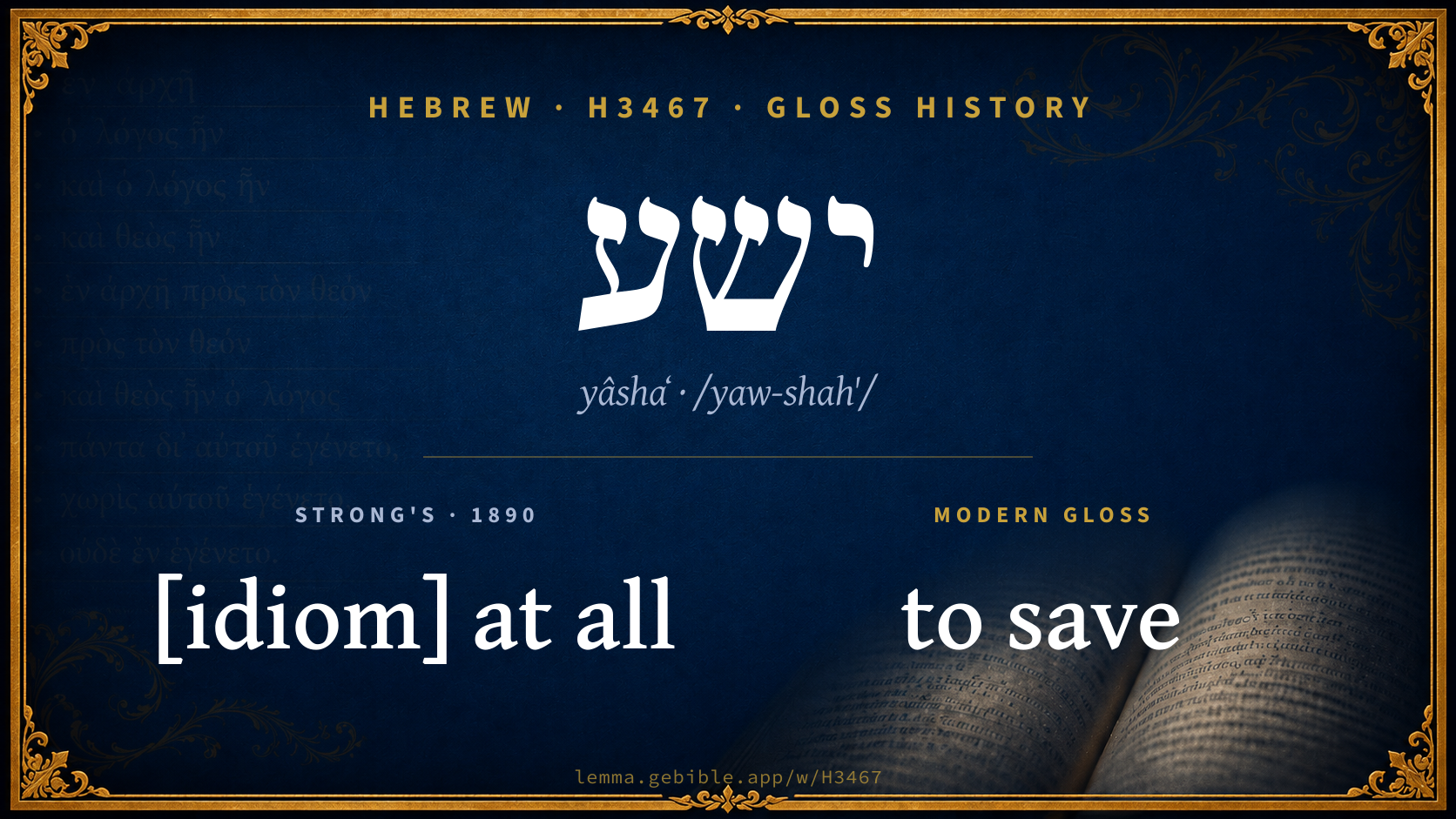
Gloss history
Strong's 1890 vs modern scholarship
About this word
Strong's H3467 catalogs a Hebrew word from the Hebrew Old Testament.
These counts are not copied from any lexicon or concordance. They are computed here, from the morphology-tagged Hebrew Old Testament. What Lemma adds →
- 198
- distinct verses
- The word appears in 198 distinct verses.
- 23 / 39
- OT books
- The word appears in 23 of 39 Old Testament books.
- #232
- by frequency
- Top 250 most frequent Hebrew words (rank 232 of 8,640 Hebrew words by occurrence).
View all 198 occurrences in the concordance →
By section of the Old Testament
By traditional corpus
Conventional, traditional groupings — biblical authorship is debated, so this is a traditional corpus grouping, not an authorship claim. Each share is this word’s portion of its verses in that division of the Hebrew canon. Each figure is a share of the word’s 198 distinct verses.
- Prophets (Nevi'im) 117 verses · 59%
- Writings (Ketuvim) 73 verses · 37%
- Torah (Pentateuch) 8 verses · 4%
How translations render this word
Counts come from each version’s own published word-to-Strong’s tagging or interlinear alignment — an approximate guide to how each version renders this word, not a word-level alignment the data otherwise carries. Because each total is that version’s own tagged count, the per-version totals vary from one another and need not match the appearance or distinct-verse counts above. These counts may also differ from a printed concordance because Lemma counts each distinctly tagged rendering and does not collapse phrase taggings into a single head-word total. This is a fixed set of word-tagged versions (KJV, ASV, BSB, ULT) and does not change with the reading translation you choose elsewhere. Each version’s license is shown beside its name below (and on Sources).
- King James Version: Save 43×, Saved 10×, Saviour 8×
- American Standard Version: Save 44×, Saved 10×, Saviour 10×
- Berean Standard Bible: Save 27×, Save me 17×, Save us 13×
- unfoldingWord Literal Text: Save 34×, Save me 18×, Saved 14×
King James Version Public Domain
Renders H3467 across 205 tagged occurrences — most commonly:
Plus other, less common renderings. Plus 65 renderings that appear only once — usually multi-word phrases or single function words the recovered tagging swept in, not distinct renderings.
American Standard Version Public Domain
Renders H3467 across 204 tagged occurrences — most commonly:
Plus other, less common renderings. Plus 64 renderings that appear only once — usually multi-word phrases or single function words the recovered tagging swept in, not distinct renderings.
Berean Standard Bible Public Domain
Renders H3467 across 203 tagged occurrences — most commonly:
Plus other, less common renderings. Plus 48 renderings that appear only once — usually multi-word phrases or single function words the recovered tagging swept in, not distinct renderings. Not rendered by a distinct English word in 2 further occurrences.
unfoldingWord Literal Text CC BY-SA 4.0
Renders H3467 across 238 tagged occurrences — most commonly:
Plus other, less common renderings. Plus 64 renderings that appear only once — usually multi-word phrases or single function words the recovered tagging swept in, not distinct renderings.
12 senses and sub-senses in the full BDB
Hebrew verbs can shift meaning by stem (binyan): Qal is the basic action, Niphal is often passive or reflexive, Piel often intensifies or makes it factitive, and Hiphil is typically causative. The senses below are grouped under the stem BDB assigns to each.
What do BDB’s symbols mean?
BDB uses these scholarly abbreviations:
| Symbol | Meaning |
|---|---|
| 𝔊 | the Septuagint (the ancient Greek translation, LXX) |
| 𝔙 | the Vulgate (the Latin translation) |
| 𝔖 | the Syriac version (the Peshitta) |
| 𝔗 | the Targum (the Aramaic translation) |
| ψ | the Psalms |
| √ | root (the underlying root or stem) |
| ‖ | parallel passage (a synonymous or contrasted parallel) |
| † | the dagger: every passage where the word occurs is cited |
The 12 senses and sub-senses the full Brown-Driver-Briggs lexicon distinguishes for this word, in lexicon order (not ranked by frequency), with BDB’s own verbatim wording and sub-sense lettering. Shown in Hebrew script with BDB’s own scholarly abbreviations. The condensed entry is in the Lexicon Entry tab. See also the Forms in the corpus table below.
Niphal
- Pf. 3 m. נוֹשַׁע Dt 33:29; Is 45:17; 2 pl. נוֹשַׁעְתֶּם Nu 10:9; 1 pl. נוֹשָׁ֑עְנוּ Je 8:20; Impf. 3 ms. יִוָּשֵׁעַ Je 30:7; Pr 28:18 + 1 S 14:47 (for MT יַרְשִׁיעַ) 𝔊 We Klo Dr Kit Bu; 3 fs. תִּוָּשַׁע Je 23:6; 33:16; אִוָּשֵׁ֑עָה ψ 119:117 Je 17:14 + 8 times Impf.; Imv. pl. הִוָּֽשְׁעוּ Is 45:22; Pt. נוֹשָׁע ψ 33:16 Zc 9:9;— e.g. Deuteronomy 33:29
- 1. be liberated, saved (proposes placed in freedom; cf. for the fig. הִרְחִיב, מֶרְחָב), from external evils Pr 28:18, by God Is 30:15; 45:22; 64:4; Je 4:14; 8:20; 17:14; 23:6; 33:16 ψ 80:4, 8, 20; 119:117; with מִן, Je 30:7; מֵאֹיְבִים Nu 10:9 (P), 2 S 22:4 = ψ 18:4. e.g. Proverbs 28:18
- 2. be saved in battle, victorious Zc 9:9 ψ 33:16 + 1 S 14:47 v. supr.; עַם נוֹשַׁע ביהוה Dt 33:29 a people victorious in י׳ (poem), cf. Is 45:17. e.g. Zechariah 9:9
Hiphil
- Pf. 3 ms. הוֹשִׁיעַ 1 S 9:16 ψ 20:7; הוֹשִׁעַ Zc 12:7; sf. הוֹשִׁיעוֹ ψ 34:7; 1 s. הוֹשַׁעְתִּי Is 43:12 + 4 times, + 14 times Pf.; Impf. יְהוֹשִׁיעַ 1 S 17:47 (v. Dr) ψ 116:6; יוֹשִׁיעַ Is 45:20 + 6 times; וְישַׁע (juss.) Pr 20:22; וַיּוֹשַׁע Ex 14:30 + 7 times; וַיּשַׁע 1 S 23:5 + 2 times; sf. יוֹשִׁיעֲךָ Ho 13:10; יוֹשִׁיעֶנּוּ Is 46:7; ישִׁעֵנוּ 1 S 10:27; ישַׁעֲכֶם Is 35:4 (juss., Dr§ 47. n. 4), etc.; Imv. הוֹשַׁע Je 31:7 ψ 86:2; הוֹשִׁיעָה 2 K 6:26 + 8 times; הוֹשִׁעָה 2 S 14:4 + 19 times Imv.; Inf. abs. הוֹשֵׁעַ 1 S 25:26 + 2 times; cstr. הוֹשִׁיעַ 1 S 14:6 + 14 times + 2 S 3:18 (where read אוֹשִׁיעַ Vrss. Ke We Klo Dr Bu al.), + 7 times Inf.; Pt. מוֹשִׁיעַ Dt 22:27 + 21 times; sf. מוֹשִׁיעָם ψ 106:21 + 8 times sf.; pl. מוֹשִׁיעִים Ob 21 Ne 9:27;— e.g. 1 Samuel 9:16
- 1. deliver, save (proposes give width and breadth to, liberate), in peril, c. acc. pers. vel loc. Ex 2:17 (E) Ju 6:31; 1 S 23:2, 5; 2 S 10:19 = 1 Ch 19:19, 2 K 6:27(×2) ψ 36:7; 72:13 Jb 26:2; with לְ pers. Jos 10:6 (E) Dt 22:27; Ju 10:14; 2 S 10:11 = 1 Ch 19:12 (with acc.), Je 11:12(×2) ψ 72:4; 116:6; abs. הוֹשִׁיעָה הַמֶּלֶךְ Help, O king 2 S 14:4; 2 K 6:26. Specif. save, from evils and troubles: e.g. Exodus 2:17
- a. of heroic men, saving the nation in war Ju 3:31; 6:15; 10:1; 1 S 10:27; Ho 13:10 Je 14:9; these are named מוֹשִׁיעַ saviour Ju 3:9, 15; 2 K 13:5; Is 19:20; Ob 21 Ne 9:27; phr. when they are lacking אֵין מוֹשִׁיעַ Ju 12:3 1 S 11:3; 2 S 22:42 = ψ 18:42, Dt 28:29, 31; Is 47:15; they save מִיַּד from the hand of Ju 2:16; 8:22; 12:2; 13:5 1 S 9:16; Ne 9:27; מכף Ju 6:14; 1 S 4:3; 2 K 16:7. e.g. Judges 3:31
- b. of God, who saves his people from external evils Dt 20:4; Jos 22:22; Ju 3:9; 6:36, 37; 7:7; 10:13; 1 S 14:23, 39; 2 K 14:27; 19:34 = Is 37:35, Is 25:9; 33:22; 35:4; 43:12; 49:25; 63:9; Je 31:7; Ez 34:22; Ho 1:7(×2) Hb 1:2; Zp 3:17, 19; Zc 8:7, 13; 9:16; 10:6; 12:7 ψ 28:9; 69:36; 106:8; 118:25 2 Ch 20:9; or the pious among them Is 38:20; Je 2:27; 17:14 ψ 3:8; 6:5; 7:2; 31:17; 54:3; 55:17; 57:4; 69:2; 71:2, 3; 106:47 = 1 Ch 16:35, ψ 109:26; 119:94, 146; 138:7; Pr 20:22; the king ψ 20:7, 10; David 2 S 8:6, 14; 1 Ch 18:6, 13; thy servant ψ 86:2, 16; חסיד 12:2; דַּכְּאֵי־רוּחַ 34:19; צדיקים 37:40; חוֹסִים 17:7; יראי י׳ 145:19; עם עני 18:28 = 2 S 22:28; עַנְוֵי־אֶרֶץ ψ 76:10; ישׁרי לב 7:11; שַׁח עֵינַיִם Jb 22:29; accordingly God is מוֹשִׁיעַ saviour Is 43:11; 45:15, 21; 63:8; Ho 13:4; מֹשִׁעִי 2 S 22:3; מוֹשִׁיעָם ψ 106:21; מוֹשִׁיעוֹ Je 14:8; מוֹשִׁיעֲךָ Is 43:3; 49:26; 60:16; Je 30:10 = 46:27; is with his people לְהוֹשִׁיעַ Je 15:20; 30:11; 42:11; רַב לְהוֹשִׁיעַ Is 63:1; בֵּית מְצוּדוֹת לְהוֹשִׁיעֵנִי ψ 31:3; Isr. prays הוֹשִׁיעָה יְמִינְךָ O save with thy right hand ψ 60:7 = 108:7, cf. Is 59:1; that from wh. one is saved constr. c. מִן: מִיַּד Ex 14:30 (J) Ju 2:18; 10:12; 1 S 7:8; 2 S 3:18; 2 K 19:19 = Is 37:20, ψ 106:10; 2 Ch 32:22; מֵחָמָס 2 S 22:3; מֵחֶרֶב Jb 5:15; מִכָּל־צָרוֹת ψ 34:7; מִכָּל־רָעוֹת 1 S 10:19; מִצָּרֵינוּ ψ 44:8; מִפִּי אַרְיֵה 22:22; מֹשֹּׁפְטֵי נַפְשׁוֹ 109:31; מֵאַנְשֵׁי דָמִים 59:3; מִמְּצוּקוֹת 107:13, 19. e.g. Deuteronomy 20:4
- c. there is no other salvation, the sword saves not ψ 44:7, or a nation La 4:17, or astrologers Is 47:13, or Asshur Ho 14:4, or other gods Is 45:20; 46:7; Je 2:28. e.g. Psalms 44:7
- 2. save from moral troubles, only in Ez. מִכֹּל מוֹשְׁבֹתֵיהֶם (read, with Co Da al., מְשׁוּבוֹתֵיהֶם) 37:23; מִכֹּל טֻמְאוֹתֵיכֶם 36:29. e.g. Ezekiel 37:23
- 3. give victory to:
- a. of man, c. לְ pers., give victory to, c. agent subj. יַד Ju 7:2; 1 S 25:26, 33, יַד om. v 31; יָמִין Jb 40:14; זְרוֹעַ ψ 44:4. e.g. Judges 7:2
- b. of God, with לְ pers., subj. יָמִין ψ 98:1; זְרוֹעַ Is 59:16; 63:5; Yahweh 1 Ch 18:6, with acc. v 13; abs. gain victory 1 S 14:6; 17:47; וַיּוֹשַׁע תְּשׁוּעָה גְדוֹלָה 1 Ch 11:14. e.g. Psalms 98:1
Senses from the full Brown-Driver-Briggs lexicon (Brown, Driver, Briggs; Oxford 1906 — public domain), digitized via Sefaria, supplemented by the OpenScriptures HebrewLexicon (CC BY 4.0). Full attribution on Sources.
Word origin
vb. Hiph. deliver; Niph. intrans. and pass. (Arabic وَسِعَ be capacious, ii. make wide, spacious, iv. make sufficient, v. viii. be or live in abundance (v. Dr 1 S 14:45) Ph. n.pr. ישע; Sab. יתֿע (royal epith.), n.pr. אליתֿע, יתֿעאל, עמיתֿע, e.g. MordtZMG 1876, 37; 1893, 409, 416, 417, etc. (yet note strange equiv., תֿ = س); not in Aramaic; MI4 השעני he delivered me, l3 (ב)משע deliverance, Sm and So, (but במת ClGann Dr); n.pr.m. משע l1, also l3 [4] Sm and So, but ישע deliverance, ClGann Dr)—
— Brown-Driver-Briggs (Oxford 1906, public domain), digitized via Sefaria, supplemented by the OpenScriptures HebrewLexicon (CC BY 4.0). See Sources.
Origin: a primitive root
Jastrow Dictionary
A second Hebrew/Aramaic lexicon for comparison, covering Aramaic and post-biblical (Talmudic, Targumic, Midrashic) usage that the biblical-Hebrew BDB does not. Matched by lemma rather than by Strong’s number, so a lemma may carry more than one Jastrow headword (shown separately below), and the entries cover usage well beyond the Bible.
יָשַׁע
- cmp. preced. wds.) [to be strong, to recover.]
- to assist, help, deliver. Sot. 34ᵇ (ref. to י̇ה̇וש̇ע̇, Num. XIII, 17) י֗ה֗ יוֹשִׁ֗יעֲ֗ךָ וכ׳ Yah save thee from &c. Meg. 14ᵃ עתידה … שיושִׁיעַ וכ׳ my mother shall bear a son who will deliver Israel; Sot. 11ᵇ שמוֹשִׁיעַ. Midr. Till. to Ps. XVIII, 4 כשתּוֹשִׁיעֵנִי מאויבי when thou shalt have saved me from my enemies. Snh. 73ᵃ, v. מוֹשִׁיעַ. Ber. IV, 4 הוֹשַׁע וכ׳ help, O Lord &c.; a. fr.—V. הוֹשַׁעְנָא. e.g. Numbers 13:17
- to be saved, released. Midr. Till. l. c. אִוָּשֵׁעַ מן וכ׳ let me be delivered from my enemies, and I shall call the Lord the praised One. Tanḥ. Aḥǎré 12 (ref. to ויושע, Ex. XIV, 30) וַיִוָּשַׁע כתיב כביכול הוא נ׳ it may be read vayivvasha (and he was saved), He, as if it were, was delivered. Ib. בעוה"ז הייתם נוֹשָׁעִים ע"י ב"א in this world (the past) you were delivered through human agencies. e.g. Exodus 14:30
A Dictionary of the Targumim, the Talmud Babli and Yerushalmi, and the Midrashic Literature (Marcus Jastrow; London, Luzac, 1903) — Public Domain. Digitized via Sefaria. Digitized via Sefaria. Full attribution on Sources.
Forms in the corpus
The 166 distinct written forms H3467 takes in the Hebrew Bible, most frequent first — each parse links to that stem’s occurrences in the concordance. Hebrew forms include their vowel points and cantillation, so a single lemma takes many written forms.
The 60 most common forms are shown; 106 rarer forms follow in the full concordance.
Same root — word family
Other BDB entries built from the same root as H3467, grouped by Strong’s listed origin. These share a root / origin per the lexicon — not necessarily a shared meaning. Each links to that word’s own entry.
Derived from this word
- ישועה yᵉshûwʻâh H3444 salvation
- ישע yeshaʻ H3468 salvation
- מושעה môwshâʻâh H4190 deliverance
- ωσαννα hōsanná G5614 hosanna
Proper names from this root
People and places named from this root — a name, not an additional meaning of the word.
- הושע Hôwshêaʻ H1954 Hosea
- הושעיה Hôwshaʻyâh H1955 Hoshaiah
- ישעי Yishʻîy H3469 Ishi
- ישעיה Yᵉshaʻyâh H3470 Isaiah
- מישע Mêyshâʻ H4337 Mesha
Compare all same-root words → Showing 4 of 10 — not the complete family. 5 of the same-root words are proper names (people or places). They share a root, not necessarily a meaning.
Septuagint verse parallels
This word appears in 176 verses that also exist in the Greek Old Testament (Septuagint), out of the 198 Hebrew verses it occurs in. You can read those verses in Greek by switching the Old Testament edition to the Septuagint.
Read these verses in the Septuagint
- Exodus 2:17
- Numbers 10:9
- Deuteronomy 20:4
- Joshua 10:6
- Judges 2:16
- 1 Samuel 4:3
- 2 Samuel 3:18
- 2 Kings 6:26
- 1 Chronicles 11:14
- 2 Chronicles 20:9
- Job 5:15
- Psalms 3:7
This is a verse-level parallel only — the same verses exist in both the Hebrew and Greek Old Testaments. No word-level Hebrew↔Greek correspondence is claimed: the data carries no such alignment, so no Greek word is shown as this Hebrew word’s translation. Coverage is not total — the Septuagint omits the deuterocanon and renumbers the Psalms, so some Hebrew verses have no direct Greek parallel.