

Proverbs 20:22

Hebrew (Westminster Leningrad Codex) Proverbs 20:22 appears in the Hebrew Old Testament. The text above is from the Westminster Leningrad Codex. Each word links to its Strong’s number, a concise gloss, and parsing drawn from the Open Scriptures Hebrew Bible morphology. Click any word for its full Brown-Driver-Briggs (BDB) entry.
Download image
Cite this verse

Proverbs 20:22 (World English Bible). Public Domain. Lemma interlinear Bible study tool, https://lemma.gebible.app/v/proverbs/20/22.

Show BibTeX & RIS
BibTeX
RIS
English Translation
Don't say, "I will pay back evil." Wait for Yahweh, and he will save you.
World English Bible · Public Domain
Download a study sheet

One document with this verse’s original text, its word-by-word gloss line, the meaning frame, cross-references with their text, attributed commentary, and full source and license credits — printable, and it pastes into notes with its structure intact.

This verse Autodidact and up

Study sheet (.html) Plain text (.txt)

A passage Seminary Student

Up to 50 verses in one chapter. A passage sheet keeps up to 6 commentary sources and 12 cross-references per verse, in the order this page ranks them, and says so on the sheet whenever that leaves anything out. Ask for a single verse and you get the Autodidact verse sheet above.

Everything on this page stays free to read, with no account — the sheet is a download of what is already on screen, not access to it.

Want to remove ads? Support Godless Engineer
Compare translations 3

The same verse in 3 English versions, stacked beneath the original-language interlinear above. Click any original word for its lexicon entry.

Each is an independent rendering of the whole verse — the interlinear is not word-aligned to these translations.

Highlighted words mark where these versions differ — a whole-verse word diff, not a word-by-word alignment.

  • World English Bible Public Domain
    Don't say, "I will pay back evil." Wait for Yahweh, and he will save you.
  • King James Version Public Domain
    Say not thou, I will recompense evil; but wait on the LORD, and he shall save thee.
  • unfoldingWord Literal Text CC BY-SA 4.0
    Do not say, “I will repay evil.” Wait for Yahweh, and he will save you.

unfoldingWord Literal Text — © unfoldingWord, licensed CC BY-SA 4.0. Word-aligned USFM3 via Door43 (git.door43.org/unfoldingWord/en_ult).

Versions to compare (up to 4)

3 of 4 selected

Show all 18 translations

Every available English version of this verse, each an independent rendering of the whole verse.

  • World English Bible Public Domain
    Don't say, "I will pay back evil." Wait for Yahweh, and he will save you.
  • Berean Standard Bible Public Domain
    Do not say, “I will avenge this evil!” Wait on the LORD, and He will save you.
  • Majority Standard Bible Public Domain
    Do not say, “I will avenge this evil!” Wait on the LORD, and He will save you.
  • King James Version Public Domain
    Say not thou, I will recompense evil; but wait on the LORD, and he shall save thee.
  • American Standard Version (1901) Public Domain
    Say not thou, I will recompense evil: Wait for Jehovah, and he will save thee.
  • Revised Version (1885) Public Domain
    Say not thou, I will recompense evil: wait on the LORD, and he shall save thee.
  • Geneva Bible (1599) Public Domain
    Say not thou, I wil recompense euill: but waite vpon the Lord, and he shall saue thee.
  • Douay-Rheims (1899) Public Domain
    Say not: I will return evil: wait for the Lord and he will deliver thee.
  • Young's Literal Translation Public Domain
    Do not say, `I recompense evil,' Wait for Jehovah, and He delivereth thee.
  • Literal Standard Version CC BY-SA 4.0
    Do not say, “I repay evil,” || Wait for YHWH, and He delivers you.
  • Unlocked Literal Bible CC BY-SA 4.0
    Do not say, “I will pay you back for this wrong!” Wait for Yahweh and he will rescue you.
  • unfoldingWord Literal Text CC BY-SA 4.0
    Do not say, “I will repay evil.” Wait for Yahweh, and he will save you.
  • Darby Bible Public Domain
    Say not, I will recompense evil: wait on Jehovah, and he shall save thee.
  • World Messianic Bible Public Domain
    Don’t say, “I will pay back evil.” Wait for the LORD, and he will save you.
  • Webster's Bible Public Domain
    Say not thou, I will recompense evil; but wait on the LORD, and he shall save thee.
  • Free Bible Version CC BY-SA 4.0
    Don't say, “I'll get you back for doing me wrong.” Leave it to the Lord, and he'll help you.
  • Bible in Basic English Public Domain
    Do not say, I will give punishment for evil: go on waiting for the Lord, and he will be your saviour.
  • JPS Tanakh (1917) Public Domain
    Say not thou: 'I will requite evil'; wait for the LORD, and He will save thee.

Literal Standard Version (2020), Covenant Press — licensed CC BY-SA 4.0. Text via the HelloAO Bible API (eBible.org). Unlocked Literal Bible (unfoldingWord) — licensed CC BY-SA 4.0. Text via the HelloAO Bible API (eBible.org). unfoldingWord Literal Text — © unfoldingWord, licensed CC BY-SA 4.0. Word-aligned USFM3 via Door43 (git.door43.org/unfoldingWord/en_ult). Free Bible Version, Dr. Jonathan Gallagher — licensed CC BY-SA 4.0. Text via the HelloAO Bible API (eBible.org).

Word by word

More ways to search: Search by grammar → Find every occurrence → Compare this word →

Practice this passage: Drill this verse → Learn its vocabulary →

About this verse

These counts appear in no published source. They are computed here, from the morphology-tagged text and Lemma’s own curated glosses. What Lemma adds →

8
words
7
distinct lemmas
Wisdom
section

Shared distinctive vocabulary

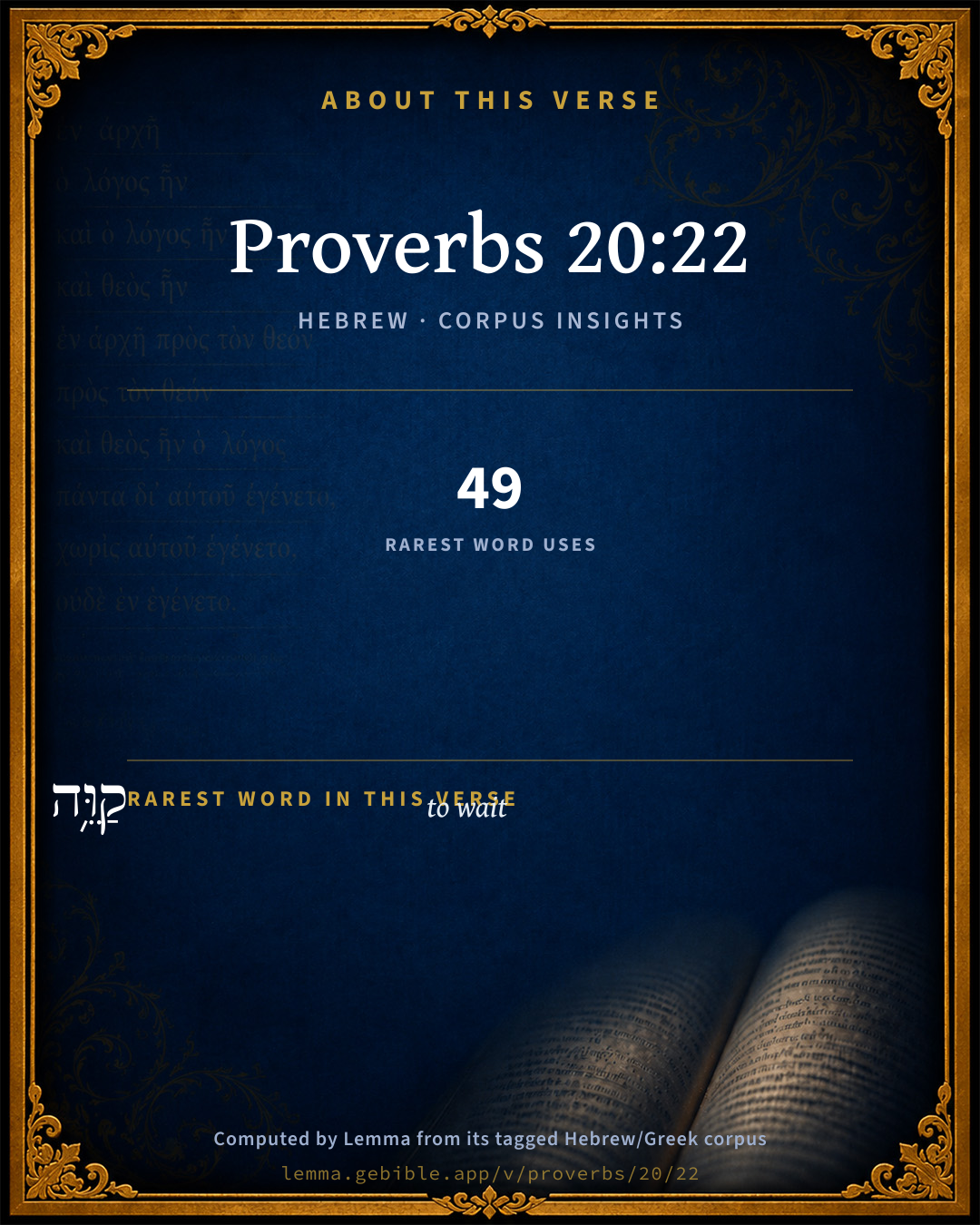
קַוֵּ֥ה to wait H6960 occurs in 45 verses of the Hebrew Bible. Also found in:

Grammatical profile

  • 4 verbs
  • 1 noun
  • 1 adjective
  • 1 preposition
  • 1 particle

Verb forms

  • תֹּאמַ֥ר Qal · Jussive
  • אֲשַׁלְּמָה Piel · Cohortative
  • קַוֵּ֥ה Piel · Imperative
  • וְיֹ֣שַֽׁע Hiphil · Imperfect

Hebrew & Septuagint length

In English translation the verse runs 15 words from the Hebrew and 19 from the Septuagint (LXX English) — closely comparable.

A rough comparison of the two English renderings, which tokenize alike — not a word-level alignment.

Word counts can differ between the Hebrew and the Greek without any difference in meaning — e.g. the Hebrew direct-object marker אֵת has no separate Greek word, and Greek often adds the article ὁ.

Cross-references

14

Topical passages linked to Proverbs 20:22 in the Treasury of Scripture Knowledge — connected by theme and wording, ordered by reader-vote popularity; previews shown in the World English Bible.

  • Romans 12:17–19 Repay no one evil for evil. Respect what is honorable in the sight of all men.
  • 1 Thessalonians 5:15 See that no one returns evil for evil to anyone, but always follow after that which is good, for one another, and for all.
  • Proverbs 24:29 Don't say, "I will do to him as he has done to me; I will render to the man according to his work."
  • Proverbs 17:13 Whoever rewards evil for good, Evil shall not depart from his house.
  • 1 Peter 3:9 not rendering evil for evil, or reviling for reviling; but instead blessing; knowing that to this were you called, that you may inherit a blessing.
  • Deuteronomy 32:35 Vengeance is mine, and recompense, At the time when their foot shall slide: For the day of their calamity is at hand, The things that are to come on them shall make haste.
  • 1 Peter 2:23 Who, when he was cursed, didn't curse back. When he suffered, didn't threaten, but committed himself to him who judges righteously;
  • Matthew 5:39 But I tell you, don't resist him who is evil; but whoever strikes you on your right cheek, turn to him the other also.
  • 1 Peter 4:19 Therefore let them also who suffer according to the will of God in doing good entrust their souls to him, as to a faithful Creator.
  • 2 Samuel 16:12 It may be that Yahweh will look on the wrong done to me, and that Yahweh will requite me good for [his] cursing of me this day.
  • Psalms 27:14 Wait for Yahweh. Be strong, and let your heart take courage. Yes, wait for Yahweh.
  • Psalms 37:34 Wait for Yahweh, and keep his way, And he will exalt you to inherit the land. When the wicked are cut off, you shall see it.
  • Lamentations 3:25–26 Yahweh is good to those who wait for him, to the soul that seeks him.
  • Isaiah 40:31 but those who wait for Yahweh shall renew their strength; they shall mount up with wings as eagles; they shall run, and not be weary; they shall walk, and not faint.

Cross-references courtesy of OpenBible.info (CC BY 4.0).

Hebrew and Greek witnesses Masoretic Hebrew ↔ Greek Septuagint

The same verse in the two great witnesses to the Old Testament, shown verse-for-verse.

These are two independent witnesses, not word-aligned to each other, and the Septuagint is shown in lemma (dictionary) form.

Hebrew Proverbs 20:22 Masoretic · Westminster Leningrad Codex

אַל תֹּאמַ֥ר אֲשַׁלְּמָה רָ֑ע קַוֵּ֥ה לַֽ֝יהוָ֗ה וְיֹ֣שַֽׁע לָֽךְ

Don't say, "I will pay back evil." Wait for Yahweh, and he will save you.

World English Bible · Public Domain

Greek LXX Proverbs 20:22 Septuagint · lemma form
Say not, I will avenge myself on my enemy; but wait on the Lord, that he may help you.

LXX2012 (modern English Septuagint) · Public Domain

On this verse, The Pulpit Commentary discusses the Septuagint’s reading. Read the note in Commentary ↓

Hebrew: Westminster Leningrad Codex (CC BY 4.0). Greek: Septuagint (public domain); English from LXX2012 (modern English Septuagint) (Public Domain). How the Septuagint differs from the Hebrew →

Commentary

Notes on Proverbs 20:22 from classic Christian and Jewish commentators (each source and its license shown beneath its notes). The classic Christian expositions comment on the surrounding passage and are grouped to its opening verse, so a note may address several verses; the Jewish commentaries on the Tanakh (Rashi and others) are per-verse, so they appear only where the commentator wrote on this verse.

Lemma curates 59 commentaries, every one of them public domain or Creative Commons licensed, each selected and text-cleaned for this edition rather than reprinted as found. About our sources →

Trapp's Complete Commentary

John Trapp

Pro 20:22 Say not thou, I will recompense evil; [but] wait on the LORD, and he shall save thee.

Ver. 22. Say not thou, I will recompense evil.] Much less, swear it, as some miscreants do; to whom, Est vindicta bonum, et vita dulcius ipsa. In reason, tallying of injuries is but justice. It is the first office of justice, saith Cicero, to hurt nobody, unless first provoked by injury. Whereupon Lactantius; O quam simplicem veramque sententiam, saith he, duorum verboram adiectione corrupit! Oh what a dainty sentence marred the orator by adding those two last words! How much better Seneca! Immane verbum est ultio. Revenge is a base word, but a worse deed; it being no less an offence to requite an injury than to offer it, as Lactantius {a} hath it. The mild and milken man, as his name speaks him, was such an enemy to revenge, that he dislikes the waging either of law or of war with any that have wronged us. Wherein, though I cannot be of his mind, yet I am clearly of the opinion that not revenge, but right should be sought in both. Neither can I hold it valour, but rashness, in our Richard I, who, being told, as he sat at supper, that the French king had besieged his town of Vernoil in Normandy, protested that he would not turn his back until he had confronted the French; and thereupon he caused the wall of his palace that was before him to be broken down toward the south, and posted to the sea coast immediately into Normandy.

But wait on the Lord.] Who claims vengeance as his, {Deu 32:35 Rom 12:19} {See Trapp on "Deu 32:35"} {See Trapp on "Rom 12:19"} and will strike in for the patient, as he did, Num 12:2-3. While Moses is dumb, God speaks; deaf, God hears and stirs. Make God your chancellor in case no law will relieve, and you shall do yourselves no disservice. If compelled to go a mile, rather than revenge, go two, yea, as far as the shoes of the preparation of the gospel of peace will carry you, and God will bring you back "with everlasting joy." {Isa 35:10} This is the way to be even with him that wrongs you, nay, to be above him.

{a} Non minus mali est injuriam referre quam inferre. - Lact. lnstit., lib. vi. c. 20.

John Trapp, A Commentary or Exposition upon All the Books of the Old and New Testament (1647–1656) — public domain. Text from a community e-Sword module.

Joseph Benson's Commentary

Pro 20:22. Say not thou, I will recompense evil — While we live in the world, we must expect to have injuries done us, affronts given, and much trouble wrongfully created to us. But we must not revenge ourselves; no, not so much as design or think of any such thing. We must not say, no, not in our hearts, I will return evil for evil; but must wait on the Lord, to whom it belongs to execute vengeance, and to deliver his people from all their enemies. We must refer ourselves to him, and leave it to him to plead our cause, or reckon with those that do us wrong, in such a way and manner as he shall think fit, and in his own due time.

Joseph Benson's Commentary on the Old and New Testaments (1811–1818) — public domain. Text from a community e-Sword module.

The Preacher's Complete Homiletical Commentary

Joseph S. Exell (gen. ed.)

MAIN HOMILETICS OF Pro_20:22

THE RECOMPENSER OF EVIL

I. The man who has been wronged is disqualified to punish the offender. A sense of pain and suffering is not helpful to a man’s judgment. He sees neither things nor persons in the light in which he would see them under happier conditions, and would not be likely to deal impartially with the offender. Hence, both the Bible and wise human governments—while freely allowing that he who injures another ought not to go unpunished—forbids men from undertaking the punishment themselves. Every human creature labours under another disqualification also. He is himself a law-breaker in a greater or less degree, and is not himself guiltless in thought and word, and perhaps in deed, of wrong towards his neighbour. The best of men cannot claim to be guiltless in this matter, and the majority are great offenders in one form or another. Therefore on this account also it is not meet for men to avenge their personal wrongs.

II. The most effectual way to rid one’s self of the desire for revenge. We do not understand this proverb to forbid the bringing of men who have wronged us to the bar of human justice, for this may be a duty which we owe to society. It would be criminal in most cases not to apprehend one who had robbed us if it lay in our power to do so, for by letting him go free we should be exposing other innocent men to danger. But there are many cases in which men are greatly wronged in ways which do not come within the cognisance of human law, and when no benefit to anyone would arise from their punishment by any human instrumentality. In such cases, the sure remedy for any vindictive feelings in our own breasts is to lay the matter before Him whose judgment must be impartial, and who will render to every man according to his works. Waiting upon the Lord, too, will remind us so forcibly of our own shortcomings and wrongdoings that we shall be more ready to forget those of our brother.

OUTLINES AND SUGGESTIVE COMMENTS

It is to be observed that it is not said, Wait on the Lord and He will avenge thee, but, He will save thee. By this kind of speech, the Holy Ghost would warn every one that is injured, not to think of the revenge or hurt of his adversary, but of his own defence and salvation.—Muffet.

The question is clearly this: Is your safety and protection best lodged in God’s hand or your own? By indulging your revengeful spirit, you do yourself a greater hurt than your greatest enemy can do you, for you gratify his ill-nature, when you suffer it to make a deep impression on your spirit, without which it could do you little or no hurt; but by committing your cause to God, you turn his ill will to your great advantage, making it an occasion for the exercise of the noblest graces, which are attended with the sweetest fruits, and with the rich blessing of God.—Lawson.

While Moses is dumb, God speaks; deaf, God sees and stirs. Make God your chancellor, in case no law will relieve, and you shall do yourself no disservice. If compelled to go a mile, rather than revenge, go two, yea, as far as the gospel of peace will carry you, and God will bring you back “with everlasting joy (Isa_35:10). This is the way to be even with him that wrongs you, nay, to be above him.—Trapp.

So far should the desire of revenge be from man’s heart, so far the execution of revenge from man’s hand, that his tongue should not say it. Shall any say, I will revenge, when God says, revenge is mine. Neither let any say, I will revenge because I have been wronged. For, as Tertullian says, what difference is there between being the provoker and the provoked; but that he is first found in wickedness, and the other afterward? Do not therefore provoke God to anger, by seeking revenge in thy anger. Let God have his right.—Jermin.

For Homiletics on Pro_20:23, see on chap. Pro_11:1, page 190.

The Preacher's Complete Homiletical Commentary (gen. ed. Joseph S. Exell; Funk & Wagnalls, c. 1892) — public domain (pre-1929). A full-Bible homiletical/sermon-outline anthology covering 65 of 66 books (2 John is absent from the source module). Text from a community e-Sword module.

Tyndale Open Study Notes

Tyndale Open Resources

20:22 See also Rom 12:17-21.

Tyndale Open Study Notes — © Tyndale Open Resources, licensed CC BY-SA 4.0. Text via the HelloAO Bible API.

Matthew Henry's Commentary

Those that live in this world must expect to have injuries done them, affronts given them, and trouble wrongfully created them, for we dwell among briers. Now here we are told what to do when we have wrong done us. 1. We must not avenge ourselves, no, nor so much as think of revenge, or design it: "Say not thou, no, not in thy heart, I will recompense evil for evil. Do not please thyself with the thought that some time or other thou shalt have an opportunity of being quits with him. Do not wish revenge, or hope for it, much less resolve upon it, no, not when the injury is fresh and the resentment of it most deep. Never say that thou wilt do a think which thou canst not in faith pray to God to assist thee in, and that thou canst not do in mediating revenge." 2. We must refer ourselves to God, and leave it to him to plead our cause, to maintain our right, and reckon with those that do us wrong in such a way and manner as he thinks fit and in his own due time: "Wait on the Lord, and attend his pleasure, acquiesce in his will, and he does not say that he will punish him that has injured thee (instead of desiring that thou must forgive him and pray for him), but he will save thee, and that is enough. He will protect thee, so that thy passing by one injury shall not (as is commonly feared) expose thee to another; nay, he will recompense good to thee, to balance thy trouble and encourage thy patience," as David hoped, when Shimei cursed him, Sa2 16:12.

Matthew Henry's Commentary on the Whole Bible (1708–1710) — public domain (CC PDM 1.0). Text via the HelloAO Bible API.

Jamieson, Fausset & Brown

Robert Jamieson, A. R. Fausset & David Brown

(Compare Psa 27:14; Rom 12:17-19).

Jamieson, Fausset & Brown — Commentary Critical and Explanatory on the Whole Bible (1871) — public domain (CC PDM 1.0). Text via the HelloAO Bible API.

Adam Clarke's Commentary

Verse 22. I will recompense evil] Wait on the Lord; judgment is his, and his judgments are sure. In the mean time pray for the conversion of your enemy.

Adam Clarke's Commentary on the Bible (1810–1826) — public domain. Text from a community e-Sword/MySword module.

Ellicott's Commentary for English Readers

(22) Wait on the Lord and he shall save thee.—Do not look for vengeance on enemies (for they are to be forgiven), but for deliverance from their attacks; forget their malice, remember only God’s love for thee, and trust in Him. (Comp. 1Pe_3:13, Rom_8:28.)

A Bible Commentary for English Readers, edited by Charles John Ellicott (1878–1897) — public domain. Text from a community e-Sword module.

The Cambridge Bible for Schools and Colleges

gen. ed. J. J. S. Perowne

22. Comp. Rom_12:17; Rom_12:19.

The Cambridge Bible for Schools and Colleges (gen. ed. J. J. S. Perowne; Cambridge University Press, 1878–1918) — public domain. Text from a community e-Sword module.

John Gill's Exposition

Say not thou, I will recompense evil,.... With evil; do an injury to one that has done one to you; private revenge is not to be taken, but should be left to God, to whom vengeance belongs, Deu 32:35;

but wait on the Lord, and he shall save thee; commit thyself and cause to God; leave it with him to avenge thy wrongs; wait upon him in the way of thy duty, and wait his own time to do thee justice; he will at the proper season, and in his own way, save thee from thine enemy, and make a righteous retribution to him.

John Gill's Exposition of the Whole Bible (1746–1763) — public domain (CC PDM 1.0). Text via the HelloAO Bible API.

Albert Barnes' Notes on the Bible

God’s awarding to everyone according to his works, is the true check to the spirit of vindictiveness (compare Rom 12:17, Rom 12:19). Note that man is not told to wait on the Lord in expectation of seeing vengeance on his enemies, but “He shall save thee.” The difference of the two hopes, in their effect upon the man’s character, is incalculable.

Albert Barnes' Notes on the Bible (1834–1885) — public domain. Text from a community e-Sword/MySword module.

Haydock's Catholic Bible Commentary

Evil. And revenge myself. This belongs to the Lord, Deuteronomy xxxii. 35. Man would be too favourable to himself, and would also pronounce his own condemnation, as he is also a sinner.

George Leo Haydock (1774–1849), Haydock's Catholic Family Bible and Commentary, 1859 edition — public domain. Excludes Psalms (Douay-Rheims chapter numbering differs from Protestant) and Deuterocanonical books (Catholic canon only).

Matthew Poole's English Annotations

Say not thou in thy heart; give not way to any such evil thoughts or purposes.

Wait on the Lord, to whom it belongs to execute vengeance, and to deliver his people from all their enemies.

Matthew Poole's English Annotations on the Holy Bible (1683–1685) — public domain. Text from a community e-Sword/MySword module.

Whedon's Commentary on the Bible

Daniel D. Whedon

22. Recompense evil — Take vengeance, inflict punishment, render evil for evil.

He shall save thee — Or help thee; or, let him help thee: not only do right by thee, but save thee from further injuries. So generally understood. But Miller connects this verse with the preceding, and renders: “Say not, I will make the evil good” — that is, I will do good with the gains unjustly gotten, and thus atone for the wrong. Whether or not this exposition is precisely the meaning of the proverb, it yields a good sense. Men sometimes snatch at gains which their conscience disallows, thinking to afterward repair the evil. Compare Pro_24:29; Deu_32:35; Rom_3:8; Rom_12:17; 1Pe_3:9; 1Th_5:15.

Daniel D. Whedon (gen. ed.), Commentary on the Old and New Testaments (1874–1909) — public domain. Text from a community e-Sword module.

The Pulpit Commentary

Say not thou, I will recompense evil. (Pro_24:29) The jus talonis is the natural feeling of man, to do to others as they have done unto you, to requite evil with evil. But the moralist teaches a better lesson, urging men not to study revenge, and approaching nearer to Christ"s injunction, which gives the law of charity, "Whatsoever ye would (opsa an yelhte ) that men should do to you, do ye even so to them". (Mat_7:12) The Christian rule is expounded fully by St. Paul. (Rom_12:14, Rom_12:17, etc) It was not unknown to the Jews; for we read in RAPC Tob 4:15, "Do that to no man which thou hatest;" and Hillel enjoins, "Do not thou that to thy neighbour which thou hatest when it is done to thee." Even the heathens had excogitated this great principle. There is a saying of Aristotle, preserved by Diogenes Laertius, "Act towards your friends as you would wish them to act towards you." The Chinese have a proverb, "Water does not remain on the mountain, or vengeance in a great mind." Wait on the Lord, and he shall save thee. The pious writer urges the injured person to commit his cause to the Lord, not in the hope of seeing vengeance taken on his enemy, but in the certainty that God will help him to bear the wrong and deliver him in his own good time and way. The Christian takes St. Peter"s view, "Who is he that will harm you if ye be followers of that which is good?", (1Pe_3:13) knowing that "all things work together for good to them that love God". (Rom_8:28; comp. Ecc_2:2, Ecc_2:6) Septuagint, "Say not, I will avenge myself on my enemy, but wait on the Lord, that (ina ) he may help thee." The last clause may be grammatically rendered thus, but it is more in accordance with the spirit of the proverb, as Delitzsch observes, to regard it as a promise. Vulgate, et liberabit te.

The Pulpit Commentary (1880–1919), ed. H.D.M. Spence-Jones & Joseph S. Exell — public domain. Text from a community e-Sword module.

Keil & Delitzsch

C. F. Keil & F. Delitzsch

22 Say not: I will avenge the evil;

Hope in Jahve, so will He help thee.

Men ought always to act toward their neighbours according to the law of love, and not according to the jus talionis, Pro 24:29; they ought not only, by requiting good with evil (Pro 16:13; Psa 7:5, Psa 35:12), not to transgress this law of requital, but they ought to surpass it, by also recompensing not evil with evil (vid., regarding שׁלּם, and synon. to Pro 17:13); and that is what the proverb means, for 22b supposes injustice suffered, which might stir up a spirit of revenge. It does not, however, say that men ought to commit the taking of vengeance to God; but, in the sense of Rom 12:17-19; Pe1 3:9, that, renouncing all dependence on self, they ought to commit their deliverance out of the distress into which they have fallen, and their vindication, into the hands of God; for the promise is not that He will avenge them, but that He will help them. The jussive וישׁע (write וישׁע, according to Metheg-setzung, 42, with Gaja as העמדה, with the ע to secure distinct utterance to the final guttural) states as a consequence, like, e.g., Kg2 5:10, what will then happen (Jerome, Luther, Hitzig) if one lets God rule (Gesen. 128, 2c); equally possible, syntactically, is the rendering: that He may help thee (lxx, Ewald); but, regarded as a promise, the words are more in accordance with the spirit of the proverb, and they round it off more expressively.

Keil & Delitzsch — Biblical Commentary on the Old Testament (1861–1891) — public domain (CC PDM 1.0). Text via the HelloAO Bible API. (Old Testament only.)

Bridges on Proverbs

Charles Bridges

"Vengeance belongeth unto me" — is the awful proclamation of God.†1 Most reverently do his people adore this high prerogative.†2 Who besides is fitted to wield it? He is Omniscient; we know but imperfectly. He is without passions; we are blinded by our selfish lusts. He is just, "without partiality;" we are prejudiced on our own side. What presumption, therefore, not to say impiety, for the angry worm to entrench upon his prerogative! Revenge is indeed a cherished lust of the flesh.†3 Were it not for the Divine restraint upon it, this world would be an "Aceldama — a field of blood." But never did the LORD allow it in his people.†4 Not even an Edomite, their most bitter enemy; not even the Egyptian, their most cruel oppressor — was to be abhorred. (Deu 23:7 .) The folly and sin of this passion are alike manifest. ’He that studieth revenge, keepeth his own wounds open.’†5 His enemy could not do him a greater injury. The tongue, "speaking like the piercings of a sword" (Pro 12:18 ; Pro 25:18 ), is here the instrument of this passion. Yet often, when the open purpose is restrained, the passion broods only the more fiercely within.†6 Or at least it is only a reluctant obedience, not the glorious victory exhibited in the history of the men of God — "overcoming evil with good."†7

What then is the remedy? In humility and faith lay our matters before the LORD. Put them in his hands. Wait on him, and he shall save us. Revenge rises, only because we have no faith. For did we believe that God would take up our cause, should we not leave ourselves implicitly in his hands? How did he plead the cause of "the meekest man upon earth!"†8 With what confidence did David rest himself in the midst of reproach,†9 thus warranting his rule of faith by his own experience!†10 And thus did David’s Lord "commit himself unto him that judgeth righteously." (1Pe 2:23 .) After this blessed example therefore, "let those, that suffer according to the will of God, commit the keeping of their souls to him in well-doing, as unto a faithful Creator." (1Pe 4:19 .) ’Let it suffice thee for the "possessing thine own soul in patience," to know, that all shall be righted one day. God will set all straight at the last; but that day is not yet.’†11 Be satisfied then with his management. Suffice it, that "he shall deliver and save, because we put our trust in him." (Psa 37:39-40 .) Let us stay our souls, as his praying people, on the great consummation. "Shall not God avenge his own elect, which cry day and night unto him, though he bear long with them? I tell you, that he will avenge them speedily." ((Luk 18:7-8 .)

Footnotes:

†1 Deu 32:35. Rom 12:19 . Heb 10:30 .

†2 Psa 94:1. Rev 6:10 .

†3 So even the Heathen acknowledged it —

Est vindicta bonum, et vitâ jucundius ipsâ.

Juven. Sat. 13:180.

†4 Pro 24:29. Lev 19:18 . Observe the identity of this standard with that of the New Testament — the teaching of our Lord — Mat 5:38-39, and his apostles, Rom 12:17, Rom 12:19-21 . 1Th 5:15 . 1Pe 3:9 . Compare Sir 28:1-8 .

†5 Lord Bacon.

†6 Gen 27:41. 2Sa 13:22 .

†7 Rom 12:21. Compare Joseph, Gen 45:5 ; Gen 50:20 . David, 1Sa 24:18-21 .

†8 Num 12:1-10.

†9 2Sa 16:12 . Psa 38:12-15 .

†10 Psa 37:5-6.

†11 Bp. Sanderson on Pro 24:10-12 .

Charles Bridges, An Exposition of the Book of Proverbs (1846) — public domain. Text from a community e-Sword module.

Kretzmann's Popular Commentary

Paul E. Kretzmann

v. 22. Say not thou, I will recompense evil, avenging evil with evil after the manner practiced by the ungodly; but wait on the Lord, placing the outcome entirely in His hands, and He shall save thee. Cf Psa 27:14; Rom 12:17-19.

Paul E. Kretzmann, Popular Commentary of the Bible (1921–1924) — public domain. Text from a community e-Sword module.

Lesson kit

Teaching starters — assembled from the data on this page, not authored interpretation. Every prompt links to the verse data it draws on. Edit before teaching.

Proverbs, in the Wisdom, opens this verse with 8 words (7 distinct Hebrew lemmas). Its most distinctive word is qâvâh (“to wait”). A historical commentator’s framing appears above. Read the whole chapter for the surrounding context.

Discussion questions

  1. How does “to wait” (qâvâh) shape what this verse is saying?
  2. How does Genesis 1:9, which shares the word «to wait», read alongside this verse?
  3. These translations render this verse differently. What is at stake in choosing one wording over another?
  4. «תֹּאמַ֥ר» is a Qal Jussive verb. How does that grammatical form shape the action described?
  5. Compare how Trapp's Complete Commentary and Joseph Benson's Commentary read this verse. Where do they agree or differ?

Things to notice

Reading settings

Reading text

Shown beneath each verse's original-language words.

Old Testament
Old Testament edition

Read the OT as the Masoretic Hebrew (MT) or the Greek Septuagint (LXX).

English shown for the Greek Septuagint (in the Hebrew ↔ Greek comparison).

Comparing translations? Open the Compare panel on any verse page to stack up to four side by side.