
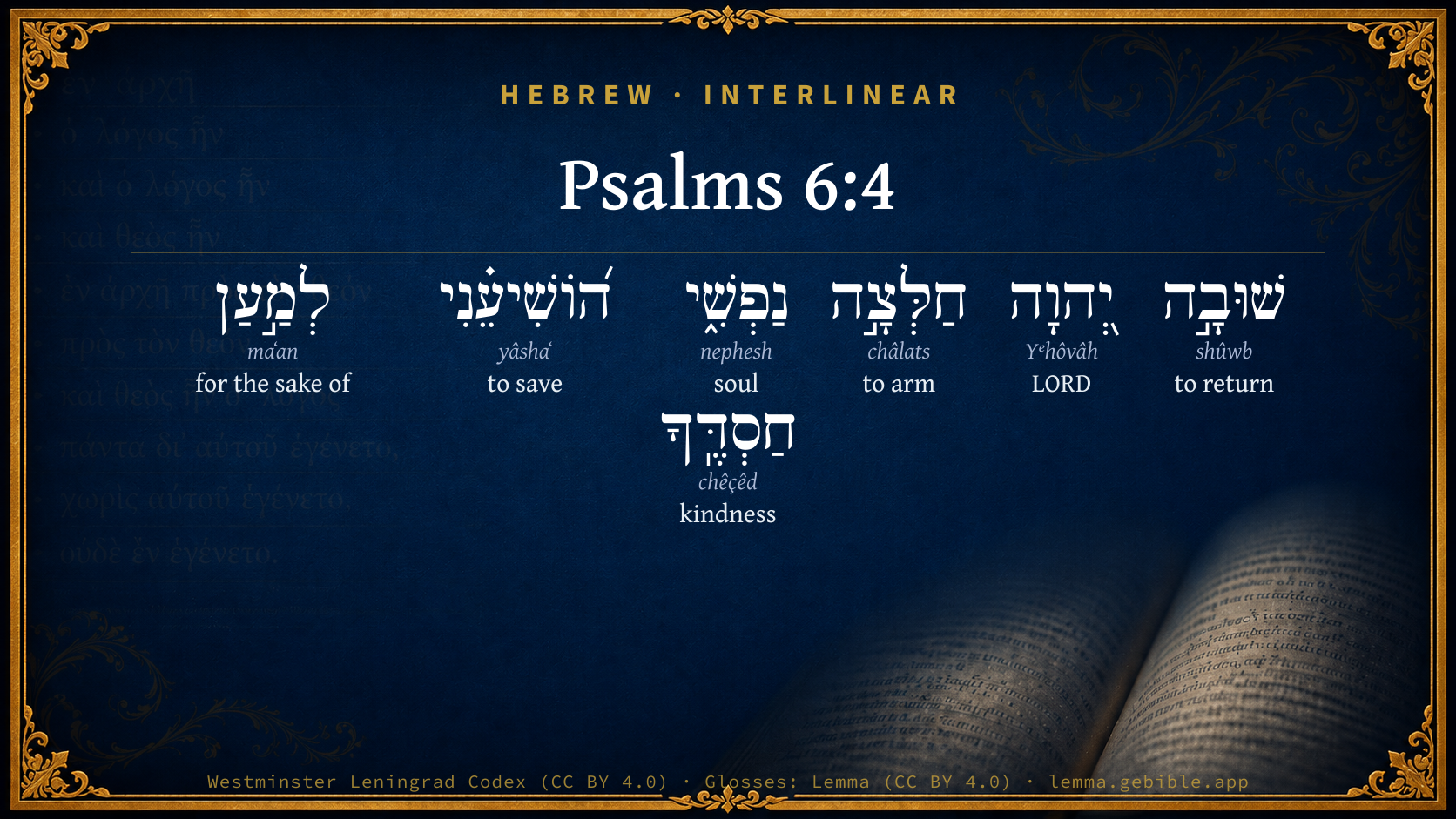
Psalms 6:4

Hebrew (Westminster Leningrad Codex) Psalms 6:4 appears in the Hebrew Old Testament. The text above is from the Westminster Leningrad Codex. Each word links to its Strong’s number, a concise gloss, and parsing drawn from the Open Scriptures Hebrew Bible morphology. Click any word for its full Brown-Driver-Briggs (BDB) entry.
Download image
Cite this verse

Psalms 6:4 (World English Bible). Public Domain. Lemma interlinear Bible study tool, https://lemma.gebible.app/v/psalms/6/4.

Show BibTeX & RIS
BibTeX
RIS
English Translation
Return, Yahweh. Deliver my soul, And save me for your loving kindness' sake.
World English Bible · Public Domain
Download a study sheet

One document with this verse’s original text, its word-by-word gloss line, the meaning frame, cross-references with their text, attributed commentary, and full source and license credits — printable, and it pastes into notes with its structure intact.

This verse Autodidact and up

Study sheet (.html) Plain text (.txt)

A passage Seminary Student

Up to 50 verses in one chapter. A passage sheet keeps up to 6 commentary sources and 12 cross-references per verse, in the order this page ranks them, and says so on the sheet whenever that leaves anything out. Ask for a single verse and you get the Autodidact verse sheet above.

Everything on this page stays free to read, with no account — the sheet is a download of what is already on screen, not access to it.

Want to remove ads? Support Godless Engineer
Compare translations 3

The same verse in 3 English versions, stacked beneath the original-language interlinear above. Click any original word for its lexicon entry.

Each is an independent rendering of the whole verse — the interlinear is not word-aligned to these translations.

Highlighted words mark where these versions differ — a whole-verse word diff, not a word-by-word alignment.

  • World English Bible Public Domain
    Return, Yahweh. Deliver my soul, And save me for your loving kindness' sake.
  • King James Version Public Domain
    Return, O LORD, deliver my soul: oh save me for thy mercies' sake.
  • unfoldingWord Literal Text CC BY-SA 4.0
    Turn back, Yahweh! Rescue my soul! Save me for the sake of your covenant faithfulness!

unfoldingWord Literal Text — © unfoldingWord, licensed CC BY-SA 4.0. Word-aligned USFM3 via Door43 (git.door43.org/unfoldingWord/en_ult).

Versions to compare (up to 4)

3 of 4 selected

Show all 18 translations

Every available English version of this verse, each an independent rendering of the whole verse.

  • World English Bible Public Domain
    Return, Yahweh. Deliver my soul, And save me for your loving kindness' sake.
  • Berean Standard Bible Public Domain
    Turn, O LORD, and deliver my soul; save me because of Your loving devotion.
  • Majority Standard Bible Public Domain
    Turn, O LORD, and deliver my soul; save me because of Your loving devotion.
  • King James Version Public Domain
    Return, O LORD, deliver my soul: oh save me for thy mercies' sake.
  • American Standard Version (1901) Public Domain
    Return, O Jehovah, deliver my soul: Save me for thy lovingkindness' sake.
  • Revised Version (1885) Public Domain
    Return, O LORD, deliver my soul: save me for thy lovingkindness’ sake.
  • Geneva Bible (1599) Public Domain
    Returne, O Lord: deliuer my soule: saue me for thy mercies sake.
  • Douay-Rheims (1899) Public Domain
    And my soul is troubled exceedingly: but thou, O Lord, how long?
  • Young's Literal Translation Public Domain
    Turn back, O Jehovah, draw out my soul, Save me for Thy kindness' sake.
  • Literal Standard Version CC BY-SA 4.0
    Turn back, O YHWH, draw out my soul, || Save me for Your kindness’ sake.
  • Unlocked Literal Bible CC BY-SA 4.0
    Return, Yahweh! rescue me. Save me because of your covenant faithfulness!
  • unfoldingWord Literal Text CC BY-SA 4.0
    Turn back, Yahweh! Rescue my soul! Save me for the sake of your covenant faithfulness!
  • Darby Bible Public Domain
    Return, Jehovah, free my soul; save me for thy loving-kindness' sake.
  • World Messianic Bible Public Domain
    Return, LORD. Deliver my soul, and save me for your loving kindness’ sake.
  • Webster's Bible Public Domain
    \\6:3\\My soul is also greatly disquieted: but thou, O LORD, how long?
  • Free Bible Version CC BY-SA 4.0
    Turn, Lord, and rescue me! Save me because of your trustworthy love!
  • Bible in Basic English Public Domain
    Come back, O Lord, make my soul free; O give me salvation because of your mercy.
  • JPS Tanakh (1917) Public Domain
    (6-5) Return, O LORD, deliver my soul; save me for Thy mercy's sake.

Literal Standard Version (2020), Covenant Press — licensed CC BY-SA 4.0. Text via the HelloAO Bible API (eBible.org). Unlocked Literal Bible (unfoldingWord) — licensed CC BY-SA 4.0. Text via the HelloAO Bible API (eBible.org). unfoldingWord Literal Text — © unfoldingWord, licensed CC BY-SA 4.0. Word-aligned USFM3 via Door43 (git.door43.org/unfoldingWord/en_ult). Free Bible Version, Dr. Jonathan Gallagher — licensed CC BY-SA 4.0. Text via the HelloAO Bible API (eBible.org).

Word by word

More ways to search: Search by grammar → Find every occurrence → Compare this word →

Practice this passage: Drill this verse → Learn its vocabulary →

חַלְּצָ֣ה
châlats
H2502
“arm”
Verb, Piel, Imperative, 2nd Person, Masculine, Singular + Suffix, h
Part of Speech
Verb
Stem
Piel
Form
Imperative
Person
2nd Person
Gender
Masculine
Number
Singular
Full BDB Definition

Origin: a primitive root

TWOT: 667 , 668

to remove, draw out, draw off, take off, withdraw, equip (for war), arm for war, rescue, be rescued - (Qal) equipped (participle) - (Niphal) - to be equipped - to go equipped - to be armed - (Hiphil) - to make strong, brace up - to invigorate - to draw off or out, withdraw - (Qal) - to draw, draw off - to withdraw - (Niphal) - to be delivered - to be saved - (Piel) - to pull out, tear out - to rescue, deliver, set free - to take away, plunder
  1. שׁוּבָ֣ה shûwb H7725 “return” Verb, Qal, Imperative, 2nd Person, Masculine, Singular + Suffix, h
  2. יְ֭הוָה Yᵉhôvâh H3068 “LORD” Noun, Proper
  3. נַפְשִׁ֑י nephesh H5315 “soul · my” Noun, Common, Both, Singular, Construct + Suffix, Personal, 1st Person, Common, Singular
  4. ה֝וֹשִׁיעֵ֗נִי yâshaʻ H3467 “save · me” Verb, Hiphil, Imperative, 2nd Person, Masculine, Singular + Suffix, Personal, 1st Person, Common, Singular
  5. לְמַ֣עַן maʻan H4616 “for the sake of” Preposition
  6. חַסְדֶּֽךָ chêçêd H2617 “kindness · your” Noun, Common, Masculine, Singular, Construct + Suffix, Personal, 2nd Person, Masculine, Singular

About this verse

These counts appear in no published source. They are computed here, from the morphology-tagged text and Lemma’s own curated glosses. What Lemma adds →

7
words
7
distinct lemmas
Wisdom
section

Shared distinctive vocabulary

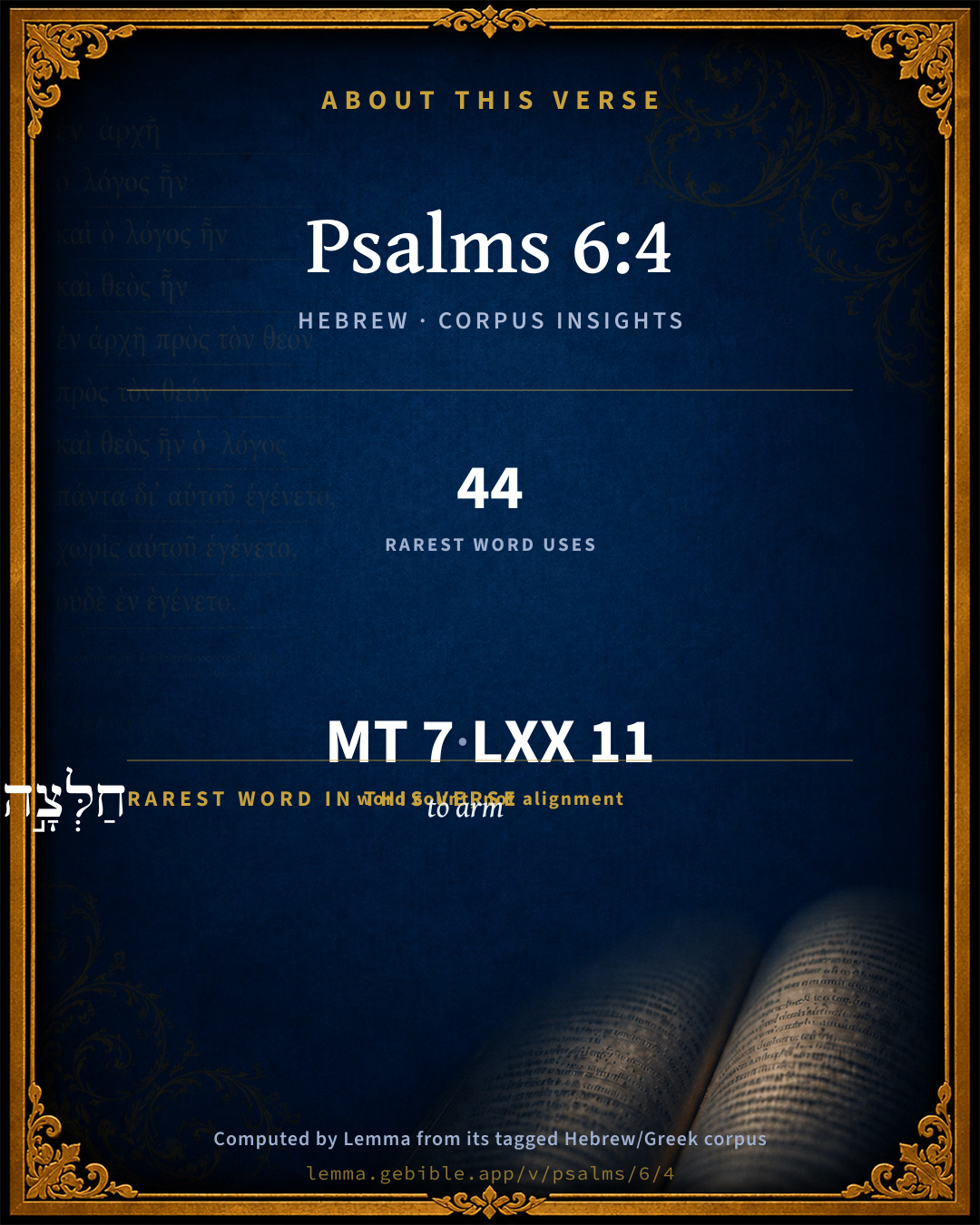
חַלְּצָ֣ה to arm H2502 occurs in 44 verses of the Hebrew Bible. Also found in:

Grammatical profile

  • 3 verbs
  • 3 nouns
  • 1 preposition

Verb forms

  • שׁוּבָ֣ה Qal · Imperative
  • חַלְּצָ֣ה Piel · Imperative
  • ה֝וֹשִׁיעֵ֗נִי Hiphil · Imperative

Hebrew & Septuagint length

In English translation the verse runs 13 words from the Hebrew and 12 from the Septuagint (LXX English) — closely comparable.

A rough comparison of the two English renderings, which tokenize alike — not a word-level alignment.

Word counts can differ between the Hebrew and the Greek without any difference in meaning — e.g. the Hebrew direct-object marker אֵת has no separate Greek word, and Greek often adds the article ὁ.

In the original languages it is 7 Hebrew tokens and 11 Greek tokens — but the two are counted differently (Hebrew bundles its prefixes and suffixes into one token; the Greek is in lemma form), so that isn’t a like-for-like length.

Cross-references

17

Topical passages linked to Psalms 6:4 in the Treasury of Scripture Knowledge — connected by theme and wording, ordered by reader-vote popularity; previews shown in the World English Bible.

  • Daniel 9:18 My God, turn your ear, and hear; open your eyes, and see our desolations, and the city which is called by your name: for we do not present our petitions before you for our righteousness, but for your great mercies' sake.
  • Psalms 17:13 Arise, Yahweh, Confront him, cast him down. Deliver my soul from the wicked by your sword;
  • Psalms 116:4 Then called I on the name of Yahweh: "Yahweh, I beg you, deliver my soul."
  • Ephesians 2:7–8 that in the ages to come he might show the exceeding riches of his grace in kindness toward us in Christ Jesus;
  • Psalms 22:20 Deliver my soul from the sword, My precious life from the power of the dog.
  • Psalms 80:14 Turn again, we beg you, God of hosts. Look down from heaven, and see, and visit this vine,
  • Psalms 90:13 Relent, Yahweh! How long? Have compassion on your servants!
  • Psalms 121:7 Yahweh will keep you from all evil. He will keep your soul.
  • Malachi 3:7 From the days of your fathers you have turned aside from my ordinances, and have not kept them. Return to me, and I will return to you," says Yahweh of Hosts. "But you say, 'How shall we return?'
  • Psalms 25:7 Don't remember the sins of my youth, nor my transgressions. Remember me according to your loving kindness, For your goodness' sake, Yahweh.
  • Psalms 69:13 But as for me, my prayer is to you, Yahweh, in an acceptable time. God, in the abundance of your loving kindness, answer me in the truth of your salvation.
  • Psalms 79:8–9 Don't hold the iniquities of our forefathers against us. Let your tender mercies speedily meet us, For we are in desperate need.
  • Psalms 86:13 For your loving kindness is great toward me. You have delivered my soul from the lowest Sheol.
  • Psalms 116:8 For you have delivered my soul from death, My eyes from tears, And my feet from falling.
  • Psalms 120:2 Deliver my soul, Yahweh, from lying lips, From a deceitful tongue.
  • Isaiah 38:17 Behold, [it was] for [my] peace [that] I had great bitterness: But you have in love to my soul delivered it from the pit of corruption; For you have cast all my sins behind your back.
  • Ephesians 1:6 to the praise of the glory of his grace, by which he freely bestowed favor on us in the Beloved,

Cross-references courtesy of OpenBible.info (CC BY 4.0).

Hebrew and Greek witnesses Masoretic Hebrew ↔ Greek Septuagint

The same verse in the two great witnesses to the Old Testament, shown verse-for-verse.

You’re reading Greek Psalm 6 (Hebrew Psalm 6). The Septuagint counts the superscription, so verse numbers can differ from the Hebrew — chapter-level alignment, not verse-by-verse. Numbering follows Rahlfs.

These are two independent witnesses, not word-aligned to each other, and the Septuagint is shown in lemma (dictionary) form.

Hebrew Psalms 6:4 Masoretic · Westminster Leningrad Codex

שׁוּבָ֣ה יְ֭הוָה חַלְּצָ֣ה נַפְשִׁ֑י ה֝וֹשִׁיעֵ֗נִי לְמַ֣עַן חַסְדֶּֽךָ

Return, Yahweh. Deliver my soul, And save me for your loving kindness' sake.

World English Bible · Public Domain

Greek LXX Greek Psalm 6:4 Septuagint · lemma form

καί ὁ ψυχή ἐγώ ταράσσω σφόδρα καί σύ κύριος ἕως πότε

Return, O Lord, deliver my soul: save me for your mercy's sake.

LXX2012 (modern English Septuagint) · Public Domain

Hebrew: Westminster Leningrad Codex (CC BY 4.0). Greek: Septuagint (public domain); English from LXX2012 (modern English Septuagint) (Public Domain). How the Septuagint differs from the Hebrew →

Commentary

Notes on Psalms 6:4 from classic Christian and Jewish commentators (each source and its license shown beneath its notes). The classic Christian expositions comment on the surrounding passage and are grouped to its opening verse, so a note may address several verses; the Jewish commentaries on the Tanakh (Rashi and others) are per-verse, so they appear only where the commentator wrote on this verse.

Lemma curates 59 commentaries, every one of them public domain or Creative Commons licensed, each selected and text-cleaned for this edition rather than reprinted as found. About our sources →

Trapp's Complete Commentary

John Trapp

Psa 6:4 Return, O LORD, deliver my soul: oh save me for thy mercies’ sake.

Ver. 4. Return, O Lord, deliver my soul] He calleth hard upon Jehovah, which sweet name of God he hath now five times in these four first verses made use of, as one that knew, and could improve, the full import of it. Here David begs of him to return, not by change of place, for God filleth all places (being

Enter, praesenter Deus hic et ubique potenter),

but miserationis serenitate, by a beam of his mercy, and by a dispensation of his gracious providence, altering his condition for the better, Deu 30:9 Act 15:16.

Oh save me for thy mercies’ sake] Quam pulcherrime ista supplicatio propriis et profieientibus sermonibus explicatur, saith Cassiodore concerning this text, i.e. How finely and fitly is this request set forth! David pleaded not merit, but humbly craveth mercy. The heart (that piece of proud flesh) must be brought to such a temper and tameness, as to crouch to God for the crumbs that fall from his table.

John Trapp, A Commentary or Exposition upon All the Books of the Old and New Testament (1647–1656) — public domain. Text from a community e-Sword module.

The Biblical Illustrator

Joseph S. Exell

Psa_6:4

Return, O Lord, deliver my soul.

A postulatory prayer

O Lord, return implies a former presence, a present absence, and a confidence for the future. This is Gods return to us, in a general apprehension. After He hath made us, and blest us in our nature and by His natural means, He returns to make us again, to make us better, first by His preventing grace and then by a succession of His particular graces. In Scripture there are three significations of the word translated return.

1. To return to that place to which a thing is naturally affected. So heavy things return to the centre, and light things to the expansion. The Church is Gods place, Gods centre, to which He is naturally affected.

2. The word is also referred to the passion of God, to the anger of God; and so the returning of God--that is, of Gods anger--is the allaying, the becalming, the departing of His anger. When God returns, God stays; His anger is returned from us, but God is still with us.

3. The word applies to our returning to Him. There goes no more to salvation but such a turning. So that this returning of the Lord is an operative, an effectual returning, that tunes our hearts, and eyes, and hands, and feet to the ways of God, and produces in us repentance and obedience; for these be the two legs which our conversion to God stands upon. When the Lord comes to us by any way, though He come in corrections, in chastisements, not to turn to Him is an irreverent and unrespective negligence We come now to the reasons of these petitions in Davids prayer. His first reason is grounded on God Himself. Do it for Thy mercys sake. And in his second reason, though David himself and all men with him seem to have a part, yet at last we shall see the reason itself to determine wholly or entirely in God, too, and in His glory. Do it, Lord, for in death there is no remembrance of Thee. (John Donne.)

The obscured presence of God

As the sun goeth not out of Thee, though it may be obscured by overcasting clouds, or some other natural impediments, so, albeit the clouds of our sins and miseries hide the fair, shining face of God from us, yet He will pierce through and dissipate those clouds, and, shine clearly upon us in His own appointed time. God is said to return to us, not by change of place, for He is in all places, but by the dispensation of His gracious providence, and declaration of His new mercies and benefits to us. (A. Symson.)

For the sake of mercy

Indeed, this motive, for His mercys sake, is the first mover of all motives to God for showing His favour. He had never delivered the Israelites out of Egypt but for His mercys sake; He had never saved Noah in the ark but for His mercys sake; but, above all, He had never sent His Son to save the world but for His mercys sake. And how, then, can I doubt, and not rather be confident, that for His mercys sake He will also deliver my soul and save me? Never, therefore, my soul, look after any further motives; for upon this motive will I set up my rest. His mercy shall be both my anchor and my harbour; it shall be both my armour and my fortress; it shall be both my ransom and my garland; it shall be both my deliverance and my salvation. (Sir Richard Baker.)

The Biblical Illustrator, edited by Joseph S. Exell (c. 1880s–1900s) — public domain. Text from a community e-Sword module.

Joseph Benson's Commentary

Psa 6:4-5. Return — Unto me, from whom thou hast withdrawn thy smiling countenance and helping hand. Deliver my soul — From guilt and fear; or preserve my life, for the word soul often signifies life. David, and other pious men in those times, were much averse to, and afraid of death, partly because the manifestations of God’s love to his people, and the discoveries of an immortal state of glory awaiting them after death, were then more dark and doubtful; and partly because thereby they were deprived of all opportunities of advancing God’s glory and kingdom in the world. For in death — Or among the dead, or in the grave, as it follows; there is no remembrance of thee — This is meant only of the bodies of persons deceased; not of their souls, which still survive, and do not sleep till the resurrection, as some have vainly imagined: and yet even their souls are incapable, when departed from the body, of remembering, praising, and glorifying God, in his church on earth; of celebrating his mercy and grace in the land of the living; of propagating his worship, or of exciting others to piety by their example: which is the remembrance of God of which he speaks. Hence, also, good men have often desired to have their lives prolonged, even under the Christian, as well as under the Patriarchal and Jewish dispensation, that they might be capable of glorifying God, and of fully executing his will in this world, in order, as the Hebrews speak, to increase the reward of their souls in the world to come.

Joseph Benson's Commentary on the Old and New Testaments (1811–1818) — public domain. Text from a community e-Sword module.

J. A. Alexander on Psalms

Joseph Addison Alexander

5. (Psa 6:4). The expostulatory question is now followed by direct petition. Return, O Lord, Jehovah, deliver my soul, my life, my self, from this impending death. As God seems to be absent when his people suffer, so relief is constantly described as his return to them. (Oh) save me, a still more comprehensive term than that used in the first clause, for the sake of thy mercy, not merely according to it, as a rule or measure, but to vindicate it from reproach, and do it honour, as a worthy end to be desired and accomplished.

Joseph Addison Alexander, The Psalms Translated and Explained (1850) — public domain. Text from a community e-Sword module.

Tyndale Open Study Notes

Tyndale Open Resources

6:4-5 The experience was so painful that the psalmist might as well have been dead, or perhaps he feared for his life.

Tyndale Open Study Notes — © Tyndale Open Resources, licensed CC BY-SA 4.0. Text via the HelloAO Bible API.

Jamieson, Fausset & Brown

Robert Jamieson, A. R. Fausset & David Brown

Return--that is, to my relief; or, "turn," as now having His face averted.

for thy mercies' sake--to illustrate Thy mercy.

Jamieson, Fausset & Brown — Commentary Critical and Explanatory on the Whole Bible (1871) — public domain (CC PDM 1.0). Text via the HelloAO Bible API.

Adam Clarke's Commentary

Verse 4. Return, O Lord] Once I had the light of thy countenance, by sin I have forfeited this; I have provoked thee to depart: O Lord, return! It is an awful thing to be obliged to say, Return, O Lord, for this supposes backsliding; and yet what a mercy it is that a backslider may RETURN to God, with the expectation that God will return to him!

Adam Clarke's Commentary on the Bible (1810–1826) — public domain. Text from a community e-Sword/MySword module.

John Calvin's Commentaries

4. Return, O Lord. In the preceding verses the Psalmist bewailed the absence of God, and now he earnestly requests the tokens of his presence, for our happiness consists in this, that we are the objects of the Divine regard, but we think he is alienated from us, if he does not give us some substantial evidence of his care for us. That David was at this time in the utmost peril, we gather from these words, in which he prays both for the deliverance of his soul, as it were, from the jaws of death, and for his restoration to a state of safety. Yet no mention is made of any bodily disease, and, therefore, I give no judgment with respect to the kind of his affliction. David, again, confirms what he had touched upon in the second verse concerning the mercy of God, namely, that this is the only quarter from which he hopes for deliverance: Save me for thy mercy’s sake Men will never find a remedy for their miseries until, forgetting their own merits, by trusting to which they only deceive themselves, they have learned to betake themselves to the free mercy of God.

John Calvin's Commentaries (1540-1563) — public domain. Text from the Calvin Translation Society English edition (1840s-50s) via the Christian Classics Ethereal Library (ccel.org). Calvin's coverage is partial (roughly two-thirds of the Bible); uncommented books and verses are honest gaps, never fabricated. The 19th-century editor's footnotes and remarks are omitted so the notes are faithfully Calvin's own voice.

The Cambridge Bible for Schools and Colleges

gen. ed. J. J. S. Perowne

4. Return] For Jehovah seems to have abandoned him. Cp. Psa_90:13.

O save me for thy mercy’s sake] R.V., save me for thy lovingkindness’ sake. Jehovah declares Himself to be “a God … plenteous in lovingkindness and truth, who keeps lovingkindness for thousands” (Exo_34:7-8), and the Psalmist intreats Him to be true to this central attribute in His own revelation of His character.

4–7. He renews his prayer, and in a calmer tone, reasons with God.

The Cambridge Bible for Schools and Colleges (gen. ed. J. J. S. Perowne; Cambridge University Press, 1878–1918) — public domain. Text from a community e-Sword module.

John Gill's Exposition

Return, O Lord,.... By this it seems that the Lord had withdrawn himself, and was departed from the psalmist, wherefore he entreats him to return unto him, and grant him his gracious presence. God is immense and omnipresent, he is everywhere: going away and returning cannot be properly ascribed to him; but he, nay be said to depart from his people, as to sensible communion with him, and enjoyment of him, when he hides his face, withdraws his gracious presence, and the comfortable discoveries and influences of his love; and he may be said to return when he visits them again, and manifests his love and favour to them: the Jewish writers (d) interpret it,

"return from the fierceness of thine anger,''

as in Psa 85:3; and though there is no such change in God, as from love to wrath, and from wrath to love; but inasmuch as there is a change in his dispensations towards his people, it is as if it was so; and thus it is apprehended by them;

deliver my soul; from the anxiety, distress, and sore vexation it was now in, for of all troubles soul troubles are the worst: and from all enemies and workers of iniquity which were now about him, and gave him much grief and uneasiness; and from death itself, he was in fear of;

O, save me for thy mercy's sake; out of all troubles of soul and body, and out of the hands of all enemies, inward and outward; and with temporal, spiritual, and eternal salvation; not for his righteousness's sake, as Kimchi well observes; for salvation is according to the abundant mercy of God, and not through works of righteousness done by men, otherwise it would not be of grace.

(d) Jarchi, Aben Ezra, Kimchi, & Ben Melech in loc.

John Gill's Exposition of the Whole Bible (1746–1763) — public domain (CC PDM 1.0). Text via the HelloAO Bible API.

Albert Barnes' Notes on the Bible

Return, O Lord, deliver my soul - As if he had departed from him, and had left him to die. The word “soul” in this place is used, as it often is, in the sense of “life,” for in the next verse he speaks of the grave to which he evidently felt he was rapidly descending.

O save me - Save my life; save me from going down to the grave. Deliver me from these troubles and dangers.

For thy mercies’ sake -

(a) As an act of mere mercy, for he felt that he had no claim, and could not urge it as a matter of right and justice; and

(b) in order that God’s mercy might be manifest, or because he was a merciful Being, and might, therefore, be appealed to on that ground.

These are proper grounds, now, on which to make an appeal to God for his interposition in our behalf; and, indeed, these are the only grounds on which we can plead with him to save us.

Albert Barnes' Notes on the Bible (1834–1885) — public domain. Text from a community e-Sword/MySword module.

Matthew Poole's English Annotations

Return unto me, from whom thou hast withdrawn thyself, and thy smiling countenance, and thy helping hand.

Deliver my soul, i.e. save me or my life, as the soul oft signifies, as Gen 9:5; 12:5; Job 36:4; Psa 33:19. David and other good men in those times were much afraid of death, partly because the manifestations of God’s grace to his people were then more dark and doubtful, and partly because thereby they were deprived of all opportunities of advancing God’s glory and kingdom in the world. Compare Isa 38:1-3.

Matthew Poole's English Annotations on the Holy Bible (1683–1685) — public domain. Text from a community e-Sword/MySword module.

The Treasury of David

Charles H. Spurgeon

Ver. 4. Return, O Lord; deliver my soul. As God's absence was the main cause of his misery, so his return would be enough to deliver him from his trouble.

Oh save me for thy mercies' sake. He knows where to look, and what arm to lay hold upon. He does not lay hold on God's left hand of justice, but on his right hand of mercy. He knew his iniquity too well to think of merit, or appeal to anything but the grace of God.

For thy mercies' sake. What a plea that is! How prevalent it is with God! If we turn to justice, what plea can we urge? but if we turn to mercy we may still cry, notwithstanding the greatness of our guilt, "Save me for thy mercies' sake."

Observe how frequently David here pleads the name of Jehovah, which is always intended where the word LORD is given in capitals. Five times in four verses we here meet with it. Is not this a proof that the glorious name is full of consolation to the tempted saint? Eternity, Infinity, Immutability, Self-existence, are all in the name Jehovah, and all are full of comfort.

Ver. 4. Return, O Lord, deliver my soul, etc. In this his besieging of God, he brings up his works from afar off, closer; he begins in this Psalm, at a deprecatory prayer; he asks nothing, but that God would do nothing, that he would forbear himrebuke me not, correct me not. Now, it costs the king less to give a pardon than to give a pension, and less to give a reprieve than to give a pardon, and less to connive, not to call in question, than either reprieve, pardon, or pension; to forbear is not much. But then as the mathematician said, that he could make an engine, a screw, that should move the whole frame of the world, if he could have a place assigned him to fix that engine, that screw upon, that so it might work upon the world; so prayer, when one petition hath taken hold upon God, works upon God, moves God, prevails with God, entirely for all. David then having got this ground, this footing in God, he brings his works closer; he comes from the deprecatory to a postulatory prayer; not only that God would do nothing against him, but that he would do something for him. God hath suffered man to see Arcana imperii, the secrets of his state, how he governs he governs by precedent; by precedents of his predecessors, he cannot, he hath none; by precedents of other gods he cannot, there are none; and yet he proceeds by precedents, by his own precedents, he does as he did before, habenti dat, to him that hath received he gives more, and is willing to be wrought and prevailed upon, and pressed with his own example. And, as though his doing good were but to learn how to do good better, still he writes after his own copy, and nulla dies sine linea. He writes something to us, that is, he doth something for us every day. And then, that which is not often seen in other masters, his copies are better than the originals; his latter mercies larger than his former; and in this postulatory prayer, larger than the deprecatory, enters our text, Return, O Lord; deliver my soul: O save me, etc. John Donne.

Ver. 4. Return, O Lord. A prayer suggested by a sense of the Lord's absence, excited by grace, attended with heart searching and repentance, backed by pressing danger, guaranteed as to its answer, and containing a request for all mercies.

Ver. 4. The praying of the deserted saint.

1. His state: his soul is evidently in bondage and danger;

2. His hope:it is the Lord's return.

3. His plea: mercy only.

Ver 5. And now David was in great fear of deathdeath temporal, and perhaps death eternal. Read the passage as you will, the following verse is full of power.

For in death there is no remembrance of thee; in the grave who shall give thee thanks? Churchyards are silent places; the vaults of the sepulchre echo not with songs. Damp earth covers dumb mouths. "O Lord!" saith he, "if thou wilt spare me I will praise thee. If I die, then must my mortal praise at least be suspended; and if I perish in hell, then thou wilt never have any thanksgiving from me. Songs of gratitude cannot rise from the flaming pit of hell. True, thou wilt doubtless be glorified, even in my eternal condemnation, but then O Lord, I cannot glorify thee voluntarily; and among the sons of men, there will be one heart the less to bless thee." Ah! poor trembling sinners, may the Lord help you to use this forcible argument! It is for God's glory that a sinner should be saved. When we seek pardon, we are not asking God to do that which will stain his banner, or put a blot on his escutcheon. He delighteth in mercy. It is his peculiar, darling attribute. Mercy honours God. Do not we ourselves say, "Mercy blesseth him that gives, and him that takes?" And surely, in some diviner sense, this is true of God, who, when he gives mercy, glorifies himself.

Charles H. Spurgeon's The Treasury of David (1869–1885) — public domain. Psalms only. Text from a community e-Sword/MySword module.

The Pulpit Commentary

Return, O Lord. God seemed to have withdrawn himself, to have, forsaken the mourner, and gone far away. (comp. Psa_22:1) Hence the cry, "Return". (comp. Psa_80:14 Psa_90:13) Nothing is so hard to endure as the feeling of being deserted by God. Deliver my soul. "The psalmist feels himself so wretched in soul and body, that he believes himself to be near death" (Hengstenberg). His prayer here is, primarily, for deliverance from this impending danger, as appears clearly from the following verse, Save me for thy mercys" sake. Either a repetition of the preceding prayer in other words, or an enlargement of it so as to include salvation of every kind.

The Pulpit Commentary (1880–1919), ed. H.D.M. Spence-Jones & Joseph S. Exell — public domain. Text from a community e-Sword module.

Keil & Delitzsch

C. F. Keil & F. Delitzsch

(Heb.: 6:5-8) God has turned away from him, hence the prayer שׁוּבה, viz., אלי. The tone of שׁוּבה is on the ult., because it is assumed to be read שׁוּבה אדני. The ultima accentuation is intended to secure its distinct pronunciation to the final syllable of שׁובה, which is liable to be drowned and escape notice in connection with the coming together of the two aspirates (vid., on Psa 3:8). May God turn to him again, rescue (חלּץ from חלץ, which is transitive in Hebr. and Aram., to free, expedire, exuere, Arab. chalaṣa, to be pure, prop. to be loose, free) his soul, in which his affliction has taken deep root, from this affliction, and extend to him salvation on the ground of His mercy towards sinners. He founds this cry for help upon his yearning to be able still longer to praise God, - a happy employ, the possibility of which would be cut off from him if he should die. זכר, as frequently הזכּיר, is used of remembering one with reverence and honour; הודה (from ודה) has the dat. honoris after it. שׁאול, Psa 6:6, ἅδης (Rev 20:13), alternates with מות. Such is the name of the grave, the yawning abyss, into which everything mortal descends (from שׁאל = שׁוּל Arab. sâl, to be loose, relaxed, to hang down, sink down: a sinking in, that which is sunken in,

(Note: The form corresponds to the Arabic form fi‛âlun, which, though originally a verbal abstract, has carried over the passive meaning into the province of the concrete, e.g., kitâb = maktûb and ilâh, אלוהּ = ma‛lûh = ma‛bûd (the feared, revered One).)

a depth). The writers of the Psalms all (which is no small objection against Maccabean Psalms) know only of one single gathering-place of the dead in the depth of the earth, where they indeed live, but it is only a quasi life, because they are secluded from the light of this world and, what is the most lamentable, from the light of God's presence. Hence the Christian can only join in the prayer of v. 6 of this Psalm and similar passages (Psa 30:10; Psa 88:11-13; Psa 115:17; Isa 38:18.) so far as he transfers the notion of hades to that of gehenna.

(Note: An adumbration of this relationship of Christianity to the religion of the Old Testament is the relationship of Islam to the religion of the Arab wandering tribes, which is called the "religion of Abraham" (Din Ibrâhim), and knows no life after death; while Islam has taken from the later Judaism and from Christianity the hope of a resurrection and heavenly blessedness.)

In hell there is really no remembrance and no praising of God. David's fear of death as something in itself unhappy, is also, according to its ultimate ground, nothing but the fear of an unhappy death. In these "pains of hell" he is wearied with (בּ as in Psa 69:4) groaning, and bedews his couch every night with a river of tears. Just as the Hiph. השׂחה signifies to cause to swim from שׂחה to swim, so the Hiph. המסה signifies to dissolve, cause to melt, from מסה (cogn. מסס) to melt. דּמעה, in Arabic a nom. unit. a tear, is in Hebrew a flood of tears.

In Psa 6:8 עיני does not signify my "appearance" (Num 11:7), but, as becomes clear from Psa 31:10; Psa 88:10, Job 17:7, "my eye;" the eye reflects the whole state of a man's health. The verb עשׁשׁ appears to be a denominative from עשׁ: to be moth-eaten.

(Note: Reuchlin in his grammatical analysis of the seven Penitential Psalms, which he published in 1512 after his Ll. III de Rudimentis Hebraicis (1506), explains it thus: עשׁשׁה Verminavit. Sic a vermibus dictum qui turbant res claras puras et nitidas, and in the Rudim. p. 412: Turbatus est a furore oculus meus, corrosus et obfuscatus, quasi vitro laternae obductus.)

The signification senescere for the verb עתק is more certain. The closing words בּכל־צוררי (cf. Num 10:9 הצּר הצּרר the oppressing oppressor, from the root צר Arab. tsr, to press, squeeze, and especially to bind together, constringere, coartare

(Note: In Arabic ציר dir is the word for a step-mother as the oppressor of the step-children; and צרר dirr, a concubine as the oppressor of her rival.)),

in which the writer indicates, partially at least, the cause of his grief (כּעס, in Job 18:7 כּעשׁ), are as it were the socket into which the following strophe is inserted.

Keil & Delitzsch — Biblical Commentary on the Old Testament (1861–1891) — public domain (CC PDM 1.0). Text via the HelloAO Bible API. (Old Testament only.)

Rashi

Rabbi Shlomo Yitzchaki (Rashi)

and You, O Lord, how long will You look on and not heal [me]?

Rashi on the Tanakh — English translations: “The Judaica Press complete Tanach with Rashi, translated by A. J. Rosenberg” (CC BY 4.0); “Pentateuch with Rashi's commentary by M. Rosenbaum and A.M. Silbermann, 1929-1934” (public domain); “The Metsudah Tanach series, Lakewood, N.J” (CC BY 4.0); and “The Book of Joshua, Metsudah Publications, 1997” (CC BY 4.0). Text via Sefaria.

Radak

Rabbi David Kimhi (Radak)

My soul also is sore vexed: – My bones are vexed and my soul also is sore vexed with respect to my fear and anxiety that I shall die from this sickness.

And Thou (ואת), – written (Kethib) without he (ה), but to be read (Keri) with he (ה); but it is without significance, for it is found (written) without he; thus (for example): “And if Thou (אַתְּ) deal thus with me” (Num. 11:15).

O Lord, how long – wilt Thou crush me with sickness and not heal me?

Radak on the Tanakh — English translations: “Sefaria Community Translation” (CC0 1.0 (public-domain dedication)); “Eliyahu Munk, HaChut Hameshulash” (CC BY 4.0); “Rabbi Mike Feuer, Jerusalem Anthology” (CC BY 4.0); and “R. David Kimhi on the first book of Psalms, Translated by R.G. Finch, London, 1919” (public domain). Text via Sefaria.

Lesson kit

Teaching starters — assembled from the data on this page, not authored interpretation. Every prompt links to the verse data it draws on. Edit before teaching.

Psalms, in the Wisdom, opens this verse with 7 words (7 distinct Hebrew lemmas). Its most distinctive word is châlats (“to arm”). A historical commentator’s framing appears above. Read the whole chapter for the surrounding context.

Discussion questions

  1. How does “to arm” (châlats) shape what this verse is saying?
  2. Leviticus 14:40 shares the word «to arm» with this verse. How do the two illuminate each other?
  3. These translations render this verse differently. What is at stake in choosing one wording over another?
  4. The verb «שׁוּבָ֣ה» is Qal Imperative. How does its form color the action?
  5. Reading how Trapp's Complete Commentary and The Biblical Illustrator read this verse, where do the two commentators agree and where do they part?

Things to notice

Reading settings

Reading text

Shown beneath each verse's original-language words.

Old Testament
Old Testament edition

Read the OT as the Masoretic Hebrew (MT) or the Greek Septuagint (LXX).

English shown for the Greek Septuagint (in the Hebrew ↔ Greek comparison).

Comparing translations? Open the Compare panel on any verse page to stack up to four side by side.