
Proverbs 28:18

Hebrew (Westminster Leningrad Codex) Proverbs 28:18 appears in the Hebrew Old Testament. The text above is from the Westminster Leningrad Codex. Each word links to its Strong’s number, a concise gloss, and parsing drawn from the Open Scriptures Hebrew Bible morphology. Click any word for its full Brown-Driver-Briggs (BDB) entry.
Download image
Cite this verse

Proverbs 28:18 (World English Bible). Public Domain. Lemma interlinear Bible study tool, https://lemma.gebible.app/v/proverbs/28/18.

Show BibTeX & RIS
BibTeX
RIS
English Translation
Whoever walks blamelessly is kept safe; But one with perverse ways will fall suddenly.
World English Bible · Public Domain
Download a study sheet

One document with this verse’s original text, its word-by-word gloss line, the meaning frame, cross-references with their text, attributed commentary, and full source and license credits — printable, and it pastes into notes with its structure intact.

This verse Autodidact and up

Study sheet (.html) Plain text (.txt)

A passage Seminary Student

Up to 50 verses in one chapter. A passage sheet keeps up to 6 commentary sources and 12 cross-references per verse, in the order this page ranks them, and says so on the sheet whenever that leaves anything out. Ask for a single verse and you get the Autodidact verse sheet above.

Everything on this page stays free to read, with no account — the sheet is a download of what is already on screen, not access to it.

Want to remove ads? Support Godless Engineer
Compare translations 3

The same verse in 3 English versions, stacked beneath the original-language interlinear above. Click any original word for its lexicon entry.

Each is an independent rendering of the whole verse — the interlinear is not word-aligned to these translations.

Highlighted words mark where these versions differ — a whole-verse word diff, not a word-by-word alignment.

  • World English Bible Public Domain
    Whoever walks blamelessly is kept safe; But one with perverse ways will fall suddenly.
  • King James Version Public Domain
    Whoso walketh uprightly shall be saved: but he that is perverse in his ways shall fall at once.
  • unfoldingWord Literal Text CC BY-SA 4.0
    One walking blameless will be saved, but one crooked of ways will fall into one.

unfoldingWord Literal Text — © unfoldingWord, licensed CC BY-SA 4.0. Word-aligned USFM3 via Door43 (git.door43.org/unfoldingWord/en_ult).

Versions to compare (up to 4)

3 of 4 selected

Show all 18 translations

Every available English version of this verse, each an independent rendering of the whole verse.

  • World English Bible Public Domain
    Whoever walks blamelessly is kept safe; But one with perverse ways will fall suddenly.
  • Berean Standard Bible Public Domain
    He who walks with integrity will be kept safe, but whoever is perverse in his ways will suddenly fall.
  • Majority Standard Bible Public Domain
    He who walks with integrity will be kept safe, but whoever is perverse in his ways will suddenly fall.
  • King James Version Public Domain
    Whoso walketh uprightly shall be saved: but he that is perverse in his ways shall fall at once.
  • American Standard Version (1901) Public Domain
    Whoso walketh uprightly shall be delivered; But he that is perverse in `his' ways shall fall at once.
  • Revised Version (1885) Public Domain
    Whoso walketh uprightly shall be delivered: but he that is perverse in his ways shall fall at once.
  • Geneva Bible (1599) Public Domain
    He that walketh vprightly, shalbe saued: but he that is froward in his wayes, shall once fall.
  • Douay-Rheims (1899) Public Domain
    He that walketh uprightly, shall be saved: he that is perverse in his ways shall fall at once.
  • Young's Literal Translation Public Domain
    Whoso is walking uprightly is saved, And the perverted of ways falleth at once.
  • Literal Standard Version CC BY-SA 4.0
    Whoever is walking uprightly is saved, || And the perverted of ways falls at once.
  • Unlocked Literal Bible CC BY-SA 4.0
    Whoever walks with integrity will be kept safe, but the one whose way is crooked will suddenly fall.
  • unfoldingWord Literal Text CC BY-SA 4.0
    One walking blameless will be saved, but one crooked of ways will fall into one.
  • Darby Bible Public Domain
    Whoso walketh in integrity shall be saved; but he that is perverted in [his] double ways, shall fall in one [of them].
  • World Messianic Bible Public Domain
    Whoever walks blamelessly is kept safe; but one with perverse ways will fall suddenly.
  • Webster's Bible Public Domain
    He who walketh uprightly shall be saved: but he that is perverse in his ways shall fall at once.
  • Free Bible Version CC BY-SA 4.0
    If you have integrity, you'll be kept safe, but if you live deviously, you'll fall.
  • Bible in Basic English Public Domain
    He whose ways are upright will be safe, but sudden will be the fall of him whose ways are twisted.
  • JPS Tanakh (1917) Public Domain
    Whoso walketh uprightly shall be saved; but he that is perverse in his ways shall fall at once.

Literal Standard Version (2020), Covenant Press — licensed CC BY-SA 4.0. Text via the HelloAO Bible API (eBible.org). Unlocked Literal Bible (unfoldingWord) — licensed CC BY-SA 4.0. Text via the HelloAO Bible API (eBible.org). unfoldingWord Literal Text — © unfoldingWord, licensed CC BY-SA 4.0. Word-aligned USFM3 via Door43 (git.door43.org/unfoldingWord/en_ult). Free Bible Version, Dr. Jonathan Gallagher — licensed CC BY-SA 4.0. Text via the HelloAO Bible API (eBible.org).

Word by word

More ways to search: Search by grammar → Find every occurrence → Compare this word →

Practice this passage: Drill this verse → Learn its vocabulary →

וְנֶעְקַ֥שׁ
ʻâqash
H6140
“and · twisted”
Conjunction + Verb, Niphal, Participle Passive, Masculine, Singular, Construct
Part of Speech
Conjunction + Verb
Stem
Niphal
Form
Participle Passive
Gender
Masculine
Number
Singular
State
Construct
Full BDB Definition

Origin: a primitive root

TWOT: 1684

to be perverse, twist, pervert, make crooked, prove perverse, declare perverse - (Niphal) to be crooked - (Piel) to twist, distort, pervert, make crooked - (Hiphil) to declare crooked - (Qal) perverse
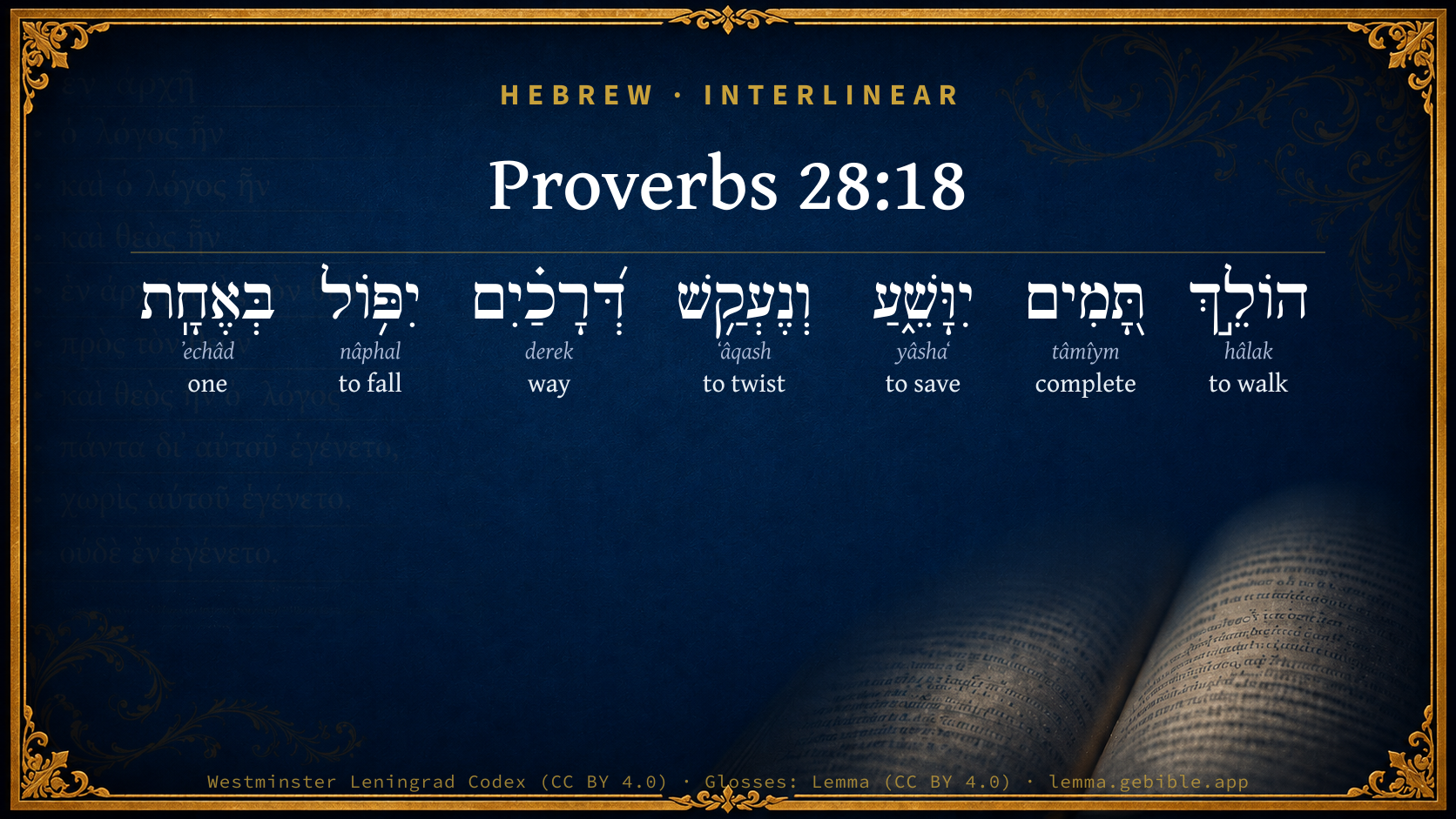
  1. הוֹלֵ֣ךְ hâlak H1980 “walking” Verb, Qal, Participle Active, Masculine, Singular, Absolute
  2. תָּ֭מִים tâmîym H8549 “complete” Adjective, Adjective, Masculine, Singular, Absolute
  3. יִוָּשֵׁ֑עַ yâshaʻ H3467 “to save” Verb, Niphal, Imperfect, 3rd Person, Masculine, Singular
  4. דְּ֝רָכַ֗יִם derek H1870 “ways” Noun, Common, Both, Dual, Absolute
  5. יִפּ֥וֹל nâphal H5307 “to fall” Verb, Qal, Imperfect, 3rd Person, Masculine, Singular
  6. בְּאֶחָֽת ʼechâd H259 “in/at · one” Preposition + Adjective, Cardinal number, Feminine, Singular, Absolute

About this verse

These counts appear in no published source. They are computed here, from the morphology-tagged text and Lemma’s own curated glosses. What Lemma adds →

7
words
7
distinct lemmas
Wisdom
section

Notable vocabulary

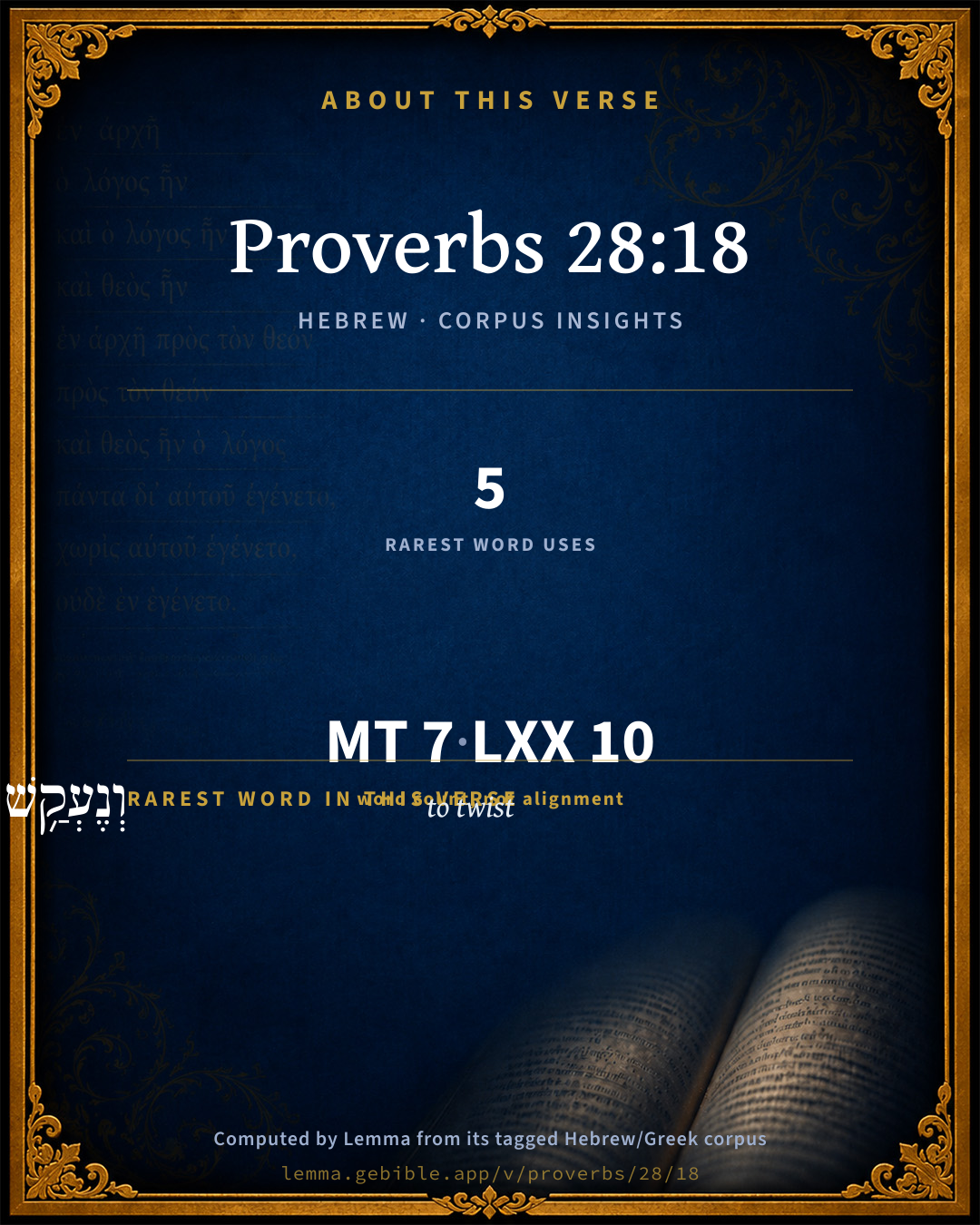
The rarest word here is וְנֶעְקַ֥שׁ to twist H6140 — appearing just 5 times in the whole Hebrew Bible.

Shared distinctive vocabulary

וְנֶעְקַ֥שׁ to twist H6140 occurs in 5 verses of the Hebrew Bible. Also found in:

Grammatical profile

  • 4 verbs
  • 1 noun
  • 2 adjectives

Verb forms

  • הוֹלֵ֣ךְ Qal · Participle Active
  • יִוָּשֵׁ֑עַ Niphal · Imperfect
  • וְנֶעְקַ֥שׁ Niphal · Participle Passive
  • יִפּ֥וֹל Qal · Imperfect

Hebrew & Septuagint length

In English translation the verse runs 14 words from the Hebrew and 17 from the Septuagint (LXX English) — closely comparable.

A rough comparison of the two English renderings, which tokenize alike — not a word-level alignment.

Word counts can differ between the Hebrew and the Greek without any difference in meaning — e.g. the Hebrew direct-object marker אֵת has no separate Greek word, and Greek often adds the article ὁ.

In the original languages it is 7 Hebrew tokens and 10 Greek tokens — but the two are counted differently (Hebrew bundles its prefixes and suffixes into one token; the Greek is in lemma form), so that isn’t a like-for-like length.

Cross-references

14

Topical passages linked to Proverbs 28:18 in the Treasury of Scripture Knowledge — connected by theme and wording, ordered by reader-vote popularity; previews shown in the World English Bible.

  • Proverbs 10:9 He who walks blamelessly walks surely, But he who perverts his ways will be found out.
  • Proverbs 28:6 Better is the poor who walks in his integrity, Than he who is perverse in his ways, and he is rich.
  • Revelation 3:3 Remember therefore how you have received and heard. Keep it, and repent. If therefore you won't watch, I will come as a thief, and you won't know what hour I will come upon you.
  • Psalms 84:11 For Yahweh God is a sun and a shield. Yahweh will give grace and glory. He withholds no good thing from those who walk blamelessly.
  • Proverbs 11:3–6 The integrity of the upright shall guide them, But the perverseness of the treacherous shall destroy them.
  • Numbers 22:32 The angel of Yahweh said to him, Why have you struck your donkey these three times? behold, I am come forth for an adversary, because your way is perverse before me:
  • Psalms 25:21 Let integrity and uprightness preserve me, For I wait for you.
  • Psalms 26:11 But as for me, I will walk in my integrity. Redeem me, and be merciful to me.
  • Psalms 73:18–20 Surely you set them in slippery places. You throw them down to destruction.
  • Psalms 125:5 But as for those who turn aside to their crooked ways, Yahweh will lead them away with the workers of iniquity. Peace be on Israel.
  • Proverbs 10:25 When the whirlwind passes, the wicked is no more; But the righteous stand firm forever.
  • 1 Thessalonians 5:3 For when they are saying, "Peace and safety," then sudden destruction will come on them, like birth pains on a pregnant woman; and they will in no way escape.
  • 2 Peter 2:1–3 But there also arose false prophets among the people, as among you also there will be false teachers, who will secretly bring in destructive heresies, denying even the Master who bought them, bringing on themselves swift destruction.
  • Galatians 2:14 But when I saw that they didn't walk uprightly according to the truth of the Gospel, I said to Peter before them all, "If you, being a Jew, live as the Gentiles do, and not as the Jews do, why do you compel the Gentiles to live as the Jews do?

Cross-references courtesy of OpenBible.info (CC BY 4.0).

Hebrew and Greek witnesses Masoretic Hebrew ↔ Greek Septuagint

The same verse in the two great witnesses to the Old Testament, shown verse-for-verse.

These are two independent witnesses, not word-aligned to each other, and the Septuagint is shown in lemma (dictionary) form.

Hebrew Proverbs 28:18 Masoretic · Westminster Leningrad Codex

הוֹלֵ֣ךְ תָּ֭מִים יִוָּשֵׁ֑עַ וְנֶעְקַ֥שׁ דְּ֝רָכַ֗יִם יִפּ֥וֹל בְּאֶחָֽת

Whoever walks blamelessly is kept safe; But one with perverse ways will fall suddenly.

World English Bible · Public Domain

Greek LXX Proverbs 28:18 Septuagint · lemma form

ὁ πορεύομαι δικαίως βοηθέω ὁ δέ σκολιός ὁδός πορεύομαι ἐνπλέκω

He that walks justly is assisted: but he that walks in crooked ways shall be entangled therein.

LXX2012 (modern English Septuagint) · Public Domain

On this verse, The Pulpit Commentary discusses the Septuagint’s reading. Read the note in Commentary ↓

Hebrew: Westminster Leningrad Codex (CC BY 4.0). Greek: Septuagint (public domain); English from LXX2012 (modern English Septuagint) (Public Domain). How the Septuagint differs from the Hebrew →

Commentary

Notes on Proverbs 28:18 from classic Christian and Jewish commentators (each source and its license shown beneath its notes). The classic Christian expositions comment on the surrounding passage and are grouped to its opening verse, so a note may address several verses; the Jewish commentaries on the Tanakh (Rashi and others) are per-verse, so they appear only where the commentator wrote on this verse.

Lemma curates 59 commentaries, every one of them public domain or Creative Commons licensed, each selected and text-cleaned for this edition rather than reprinted as found. About our sources →

Trapp's Complete Commentary

John Trapp

Pro 28:18 Whoso walketh uprightly shall be saved: but [he that is] perverse [in his] ways shall fall at once.

Ver. 18. Whoso walketh uprightly shall be saved,] {See Trapp on "Pro 10:9"} "Shall be saved"; a little word, but of large extent. It properly noteth the privative part of a man’s happiness, deliverance from evil; but is put here, and everywhere almost, for the positive part too - fruition of good as well as freedom from evil: it comprehendeth (1.) Malorum ademptionem; ( 2.) Bonorum adeptionem.

But he that is perverse in his ways.] Heb., In his two ways, shall fall in one of them. "Evil shall hunt the wicked man to destroy him"; and albeit he may shuffle for a season from side to side, as Balaam’s ass did, to avoid the angel’s sword, yet he shall not escape mischief. Let our political professors look to it that can tune their fiddle to the bass of the times, that call shift their sails to the sitting of every wind, that like the planet Mercury can be good in conjunction with good, and bad with bad.

John Trapp, A Commentary or Exposition upon All the Books of the Old and New Testament (1647–1656) — public domain. Text from a community e-Sword module.

Joseph Benson's Commentary

Pro 28:18. Whoso walketh uprightly shall be saved — Namely, from destruction, because God hath undertaken and promised to protect him; but he that is perverse in his ways — Hebrew, in two ways, of which see on Pro 28:6; shall fall at once — Once for all, so as he shall never rise more.

Joseph Benson's Commentary on the Old and New Testaments (1811–1818) — public domain. Text from a community e-Sword module.

Matthew Henry's Commentary

Note, 1. Those that are honest are always safe. He that acts with sincerity, that speaks as he thinks, has a single eye, in every thing, to the glory of God and the good of his brethren, that would not, for a world, do an unjust thing if he knew it, that in all manner of conversation walks uprightly, he shall be saved hereafter. We find a glorious company of those in whose mouth was found no guile, Rev 14:5. They shall be safe now. Integrity and uprightness will preserve men, will give them a holy security in the worst of times; for it will preserve their comfort, their reputation, and all their interests. They may be injured, but they cannot be hurt. 2. Those that are false and dishonest are never safe: He that is perverse in his ways, that thinks to secure himself by fraudulent practices, by dissimulation and treachery, or by an estate ill-got, he shall fall, nay, he shall fall at once, not gradually, and with warning given, but suddenly, without previous notice, for he is least safe when he is most secure. He falls at once, and so has neither time to guard against his ruin nor to provide for it; and, being a surprise upon him, it will be so much the greater terror to him.

Matthew Henry's Commentary on the Whole Bible (1708–1710) — public domain (CC PDM 1.0). Text via the HelloAO Bible API.

Jamieson, Fausset & Brown

Robert Jamieson, A. R. Fausset & David Brown

(Compare Pro 10:9; Pro 17:20). Double dealing is eventually fatal.

Jamieson, Fausset & Brown — Commentary Critical and Explanatory on the Whole Bible (1871) — public domain (CC PDM 1.0). Text via the HelloAO Bible API.

Adam Clarke's Commentary

Verse 18. Shall fall at once] Shall fall without resource, altogether.

Adam Clarke's Commentary on the Bible (1810–1826) — public domain. Text from a community e-Sword/MySword module.

Ellicott's Commentary for English Readers

(18) He that is perverse in his ways.—Literally, two ways. (Comp. note on Pro_28:6.)

At once—i.e., all of a sudden, without warning.

A Bible Commentary for English Readers, edited by Charles John Ellicott (1878–1897) — public domain. Text from a community e-Sword module.

The Cambridge Bible for Schools and Colleges

gen. ed. J. J. S. Perowne

18. that is perverse in his ways] Or, walketh (understood from the first clause of the verse) perversely in two ways. “Heb. perverse of two ways.” R.V. marg. See Pro_28:6, note.

at once] Some commentators render, not very happily, in one of them, i.e. of the two ways mentioned in the first clause of the verse.

The Cambridge Bible for Schools and Colleges (gen. ed. J. J. S. Perowne; Cambridge University Press, 1878–1918) — public domain. Text from a community e-Sword module.

John Gill's Exposition

Whoso walketh uprightly shall be saved, Or "be safe" (r) from those that seek his life, plot against him, shoot at him, as the wicked do at the upright in heart, but the Lord protects him; and it is even well with him in times of public calamities; the Lord has his chambers and hiding places for him; and he is safe from falling, as may be gathered from the opposite clause; for he walks surely, and is in the hands of Christ, and is kept by him from a final and total falling away: and he shall be saved also with an everlasting salvation; from sin, and all the effects of it; from the curse of the law, from wrath to come, from hell and damnation. Not that his upright walk is the cause of this; the moving cause of salvation is the grace of God; the procuring cause, our Lord Jesus Christ, the only Author of it: but this is a descriptive character of the persons that are and shall be saved; it is a clear case that such have the grace of God, and therefore shall have glory; See Gill on Pro 10:9;

but he that is perverse in his ways; "in his two ways", as in Pro 27:6; or many ways, and all perverse and wicked:

shall fall at once; his destruction shall come suddenly upon him, when he is not aware of it, and when he cries, Peace, peace, to himself: or in one of them; in one or other of his perverse ways.

(r) "erit salvus", Pagninus, Montanus, V. L. Mercerus, Cocceius, Gejerus.

John Gill's Exposition of the Whole Bible (1746–1763) — public domain (CC PDM 1.0). Text via the HelloAO Bible API.

Albert Barnes' Notes on the Bible

In his ways - Rather “in his double ways” (as in Pro 28:6). The evil of vacillation rather than that of craft, the want of the one guiding principle of right, is contrasted with the straightforwardness of the man that “walketh uprightly.”

Shall fall at once - Better, shall fall in one of them (his ways). The attempt to combine incompatibilities is sure to fail. Men cannot serve God and Mammon.

Albert Barnes' Notes on the Bible (1834–1885) — public domain. Text from a community e-Sword/MySword module.

Matthew Poole's English Annotations

Shall be saved, to wit, from destruction, because God hath undertaken and promised to protect him.

In his ways, Heb. in two ways, of which phrase see above on Pro 28:6.

Shall fall at once; once for all, so as he shall not need a second thrust, 1Sa 26:8, and so as he shall never rise more. Or, in one, to wit, of his ways. Though he hath various ways and arts to secure himself, yet none of them shall save him, but he shall perish in one or other of them, and shall be given up by God to the mistake of his way, that he shall choose that course which will be most pernicious to him.

Matthew Poole's English Annotations on the Holy Bible (1683–1685) — public domain. Text from a community e-Sword/MySword module.

Whedon's Commentary on the Bible

Daniel D. Whedon

18. Walketh uprightly — Or, as a perfect man.

Shall be saved — From danger and evil shall be safe.

Perverse… shall fall — That is, a man of tortuous way, whatever his turns or shifts, shall eventually fall in one or another of his crooked ways. Thus many critics. But Conant prefers the Authorized Version.

At once — Suddenly, unexpectedly to himself. Compare Pro_29:1.

Daniel D. Whedon (gen. ed.), Commentary on the Old and New Testaments (1874–1909) — public domain. Text from a community e-Sword module.

The Pulpit Commentary

Whoso walketh uprightly shall be saved. "Uprightly" (tamim); innocently, blamelessly. (Psa_15:2) Vulgate, simpliciter; Septuagint, dikaiwv ; Aquila, Symmachus, teleiov . "He is helped (bebohyhtai )," Septuagint. Things shall prosper with him; God will work with him, and save him in dangers temporal and spiritual. But he that is perverse in his ways shall fall at once. "He that is perverse of two ways," or "in a double way," as ver. 6. The man who is not straightforward, but vacillates between right and wrong, or pretends to be pursuing one path while he is really taking another, shall fall suddenly and without warning. tjaB means "all at once," or "once for all," and so that nothing else is possible, equivalent to penitus. Schultens quotes Virgil, "AEneid," 11:418"Procubuit moriens et humum semel ore momordit. Septuagint, "He that walketh in crooked ways will be entangled.

See homily on Pro_11:30. C.

The Pulpit Commentary (1880–1919), ed. H.D.M. Spence-Jones & Joseph S. Exell — public domain. Text from a community e-Sword module.

John Wesley's Explanatory Notes

At once - Once for all; so he shall never rise more.

John Wesley, Explanatory Notes Upon the Whole Bible (1754–1765) — public domain. Text via the GEBible commentary corpus.

Keil & Delitzsch

C. F. Keil & F. Delitzsch

18 He who walketh blamelessly is helped,

And he who is perverse in a double way suddenly perisheth.

The lxx translate תמים by δικαίως (as the accusative of manner), Aquila and Theodotion by τέλειος; but it may also be translated τέλειον or τελειότητα, as the object accus. of Pro 2:7. Instead of עקּשׁ דּרכים, Pro 28:6, there is here נעקּשׁ דּרכים, obliquely directed in a double way, or reflex bending himself. At Pro 28:6 we have interpreted the dual דּרכים rightly, thus בּאחת cannot refer back to one of these two ways; besides, דּרך as fem. is an anomaly, if not a solecism. בּאחת signifies, like the Aram. כּחרא, either all at once (for which the Mish. כּאחת, Aram. כּחרא), or once (= בּפּעם אחת), and it signifies in the passage before us, not: once, aliquando, as Nolde, with Flacius, explains, but: all at once, i.e., as Geier explains: penitus, sic ut pluribus casibus porro non sit opus. Schultens compares:

"Procubuit moriens et humum semel ore momordit."

(Note: Aeneid, xi. 418.)

Rightly Fleischer: repente totus concidet.

Keil & Delitzsch — Biblical Commentary on the Old Testament (1861–1891) — public domain (CC PDM 1.0). Text via the HelloAO Bible API. (Old Testament only.)

Bridges on Proverbs

Charles Bridges

This contrast has been lately drawn. (Pro 28:6 .) Indeed the Proverb itself in substance has been given. The "security of the upright," before marked, is here included in his salvation. The hypocrite’s "known"†1 ruin is here set out as complete — at once.†2

This upright walk will shew itself in extreme carefulness; in all doubtful points keeping on the safer side; not venturing upon a precipice, when we can walk upon even ground. This is indeed Christian perfection — "walking before God." (Gen 17:1 .) There is no need for Jacob’s vision†3 to realize his presence. "Faith seeth that which is invisible."†4 This life may seem to miss much temporal advantage. But what — if the upright be not rich, honorable, esteemed? ’If God shall not cease to be; if he will not let go the reins; if his word cannot deceive — he that walketh uprightly doth proceed upon sure grounds.’†5 He is saved. This one blessing includes all. It is the substance of time, and of eternity. All besides is shadow and vanity. To dwell in the presence of God; in the sunshine of his countenance;†6 in the light and gladness of his joy,†7 and at length in his unclouded glory†8 — such is the salvation of the upright. (Psa 125:4 .) Christian! would you part with this portion for kingdoms? What earthly comforts can be a substitute for it? This supplies the place of all.

Any want of uprightness will bring the child of God under the rod. But he that is perverse in his way will fall at once. None of his many shifts shall prosper. (Psa 125:5 .) His double ways, and his vain attempt to "serve two masters," only bring him to shame. (Mat 6:24 .) What need have I in the highest walk of conscious integrity still to cry — "Redeem me, and be merciful unto me"! (Psa 26:11 .)

Footnotes:

†1 Pro 10:9.

†2 Pro 24:16; Pro 29:1 .

†3 Gen 28:17.

†4 Heb 11:1, Heb 11:27 .

†5 Barrow’s Sermons. Psa 140:13 .

†6 Psa 11:7.

†7 Psa 97:11.

†8 Psa 15:1-2. Rev 14:5 .

Charles Bridges, An Exposition of the Book of Proverbs (1846) — public domain. Text from a community e-Sword module.

Kretzmann's Popular Commentary

Paul E. Kretzmann

The Advantages of Integrity

v. 18. Whoso walketh uprightly, in the integrity of pious conduct, shall be saved, delivered or helped by the Lord; but he that is perverse in his ways, trying to hide his wickedness under the mantle of hypocrisy, shall fall at once, be brought to sudden ruin.

v. 19. He that tilleth his land, working in the sweat of his face, shall have plenty of bread, as the reward of his labor; but he that followeth after vain persons, being engaged in all kinds of vain and foolish pursuits, leading the life of an idle drone, shall have poverty enough, be surfeited with it. Cf Pro 12:11.

v. 20. A faithful man, one using the strictest fidelity and uprightness in all his dealings, shall abound with blessings, given to him by the Lord in recognition of his faithful conduct; but he that maketh haste to be rich, thereby becoming guilty of dishonorable dealings, shall not be innocent, his guilt, rather, being charged to his account with a full reckoning.

v. 21. To have respect of persons is not good, that is, to let one’s judgment be guided by personal considerations; for a piece of bread, for a very small bribe, that man, one readily hired by a bribe, will transgress, a trifle will sway his judgment.

v. 22. He that hasteth to be rich hath an evil eye, one showing the covetous nature of his heart, and considereth not that poverty shall come upon him; for riches are perishable, and God will bring him to want before he realizes his plight.

v. 23. He that rebuketh a man, earnestly bringing his backsliding tendency to his attention, afterwards shall find more favor than he that flattereth with the tongue, for a person saved from a foolish step by a word of warning will esteem the fearless reprover and despise the fawning flatterer.

v. 24. Whoso robbeth his father or his mother, simply appropriating goods belonging to them, and saith, It is no transgression, trying to make light of sin, the same is the companion of a destroyer, to be ranked with, and treated like, highwaymen.

v. 25. He that is of a proud heart, rather, the covetous man, with his grasping ways, stirreth up strife, excites quarrels; but he that putteth his trust In the Lord, trusting in His goodness and bounty for all good gifts, shall be made fat, with a rich reward of God’s kindness.

v. 26. He that trusteth in his own heart, guided solely by first impressions and impulses, without careful reasoning and weighing of all facts, is a fool, for the feelings are an uncertain foundation of actions; but whoso walketh wisely, taking into account the course suggested by wisdom, he shall be delivered, from foolish moves and resulting harm.

v. 27. He that giveth unto the poor, practicing charity in the right manner, shall not lack, the Lord Himself preserving him from want; but he that hideth his eyes, deliberately closing them against evidence of need, in an utter lack of sympathy, shall have many a curse, namely, the curses of the poor whom he neglects.

v. 28. When the wicked rise, attaining to positions of power and influence, men hide themselves, fearing oppression; but when they perish, the righteous increase, since they no longer are oppressed by tyrants, they can once more form a numerous and strong party. It is for this reason that we pray for a good government, that we may lead a quiet and peaceable life in all godliness and honesty.

Paul E. Kretzmann, Popular Commentary of the Bible (1921–1924) — public domain. Text from a community e-Sword module.

Rashi

Rabbi Shlomo Yitzchaki (Rashi)

will fall in one In one evil, and there will be no rising up after his downfall.

Rashi on the Tanakh — English translations: “The Judaica Press complete Tanach with Rashi, translated by A. J. Rosenberg” (CC BY 4.0); “Pentateuch with Rashi's commentary by M. Rosenbaum and A.M. Silbermann, 1929-1934” (public domain); “The Metsudah Tanach series, Lakewood, N.J” (CC BY 4.0); and “The Book of Joshua, Metsudah Publications, 1997” (CC BY 4.0). Text via Sefaria.

Lesson kit

Teaching starters — assembled from the data on this page, not authored interpretation. Every prompt links to the verse data it draws on. Edit before teaching.

Proverbs, in the Wisdom, opens this verse with 7 words (7 distinct Hebrew lemmas). Its most distinctive word is ʻâqash (“to twist”). A historical commentator’s framing appears above. Read the whole chapter for the surrounding context.

Discussion questions

  1. The word ʻâqash carries the sense “to twist.” How does it shape the verse?
  2. Job 9:20 shares the word «to twist» with this verse. How do the two illuminate each other?
  3. The translations on this page render this verse differently — a whole-verse word diff, not a word-by-word alignment. What might account for the different wordings?
  4. The verb «הוֹלֵ֣ךְ» is Qal Participle Active. How does its form color the action?
  5. Reading how Trapp's Complete Commentary and Joseph Benson's Commentary read this verse, where do the two commentators agree and where do they part?

Things to notice

Reading settings

Reading text

Shown beneath each verse's original-language words.

Old Testament
Old Testament edition

Read the OT as the Masoretic Hebrew (MT) or the Greek Septuagint (LXX).

English shown for the Greek Septuagint (in the Hebrew ↔ Greek comparison).

Comparing translations? Open the Compare panel on any verse page to stack up to four side by side.