
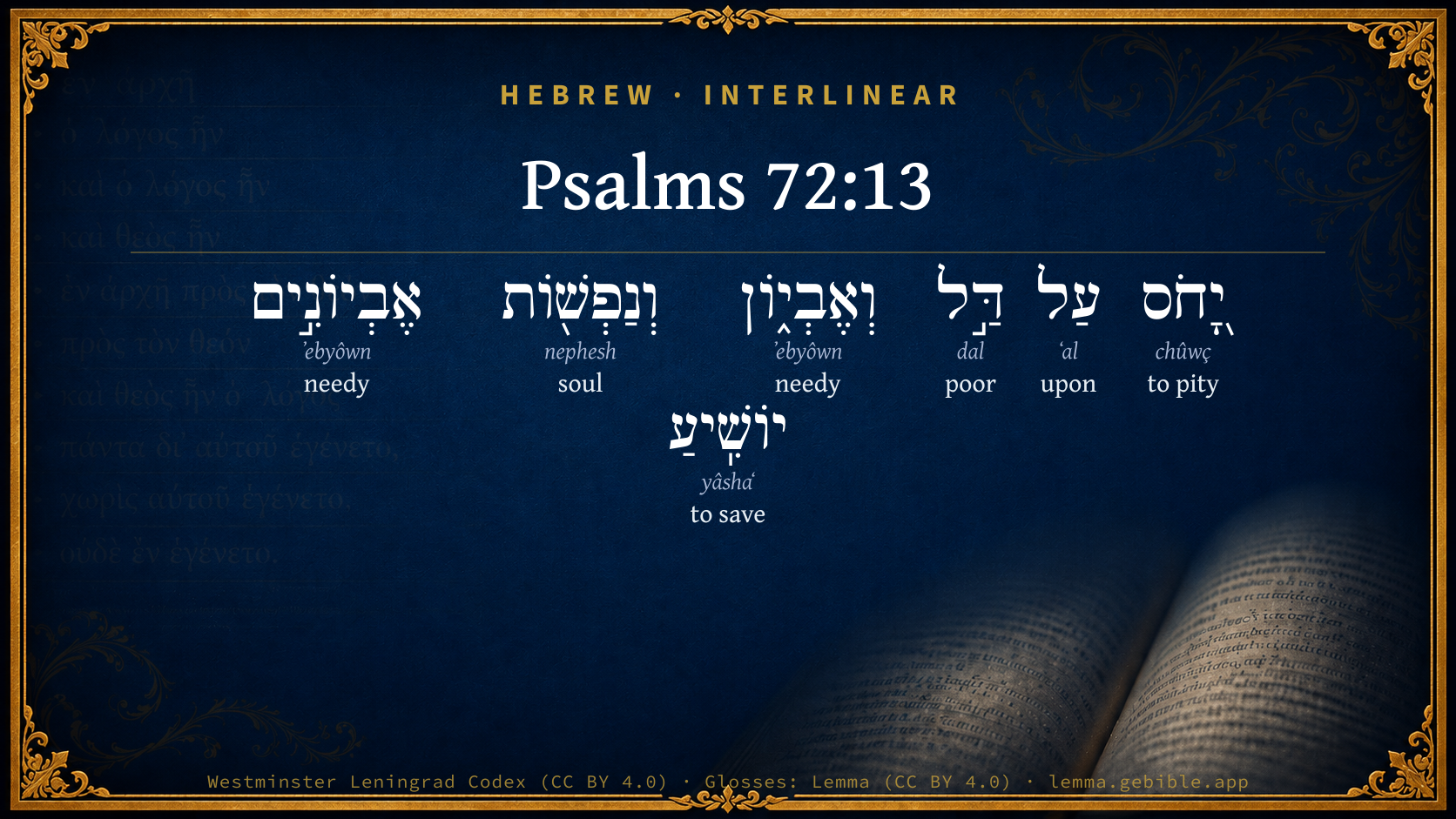
Psalms 72:13

Hebrew (Westminster Leningrad Codex) Psalms 72:13 appears in the Hebrew Old Testament. The text above is from the Westminster Leningrad Codex. Each word links to its Strong’s number, a concise gloss, and parsing drawn from the Open Scriptures Hebrew Bible morphology. Click any word for its full Brown-Driver-Briggs (BDB) entry.
Download image
Cite this verse

Psalms 72:13 (World English Bible). Public Domain. Lemma interlinear Bible study tool, https://lemma.gebible.app/v/psalms/72/13.

Show BibTeX & RIS
BibTeX
RIS
English Translation
He will have pity on the poor and needy. He will save the souls of the needy.
World English Bible · Public Domain
Download a study sheet

One document with this verse’s original text, its word-by-word gloss line, the meaning frame, cross-references with their text, attributed commentary, and full source and license credits — printable, and it pastes into notes with its structure intact.

This verse Autodidact and up

Study sheet (.html) Plain text (.txt)

A passage Seminary Student

Up to 50 verses in one chapter. A passage sheet keeps up to 6 commentary sources and 12 cross-references per verse, in the order this page ranks them, and says so on the sheet whenever that leaves anything out. Ask for a single verse and you get the Autodidact verse sheet above.

Everything on this page stays free to read, with no account — the sheet is a download of what is already on screen, not access to it.

Want to remove ads? Support Godless Engineer
Compare translations 3

The same verse in 3 English versions, stacked beneath the original-language interlinear above. Click any original word for its lexicon entry.

Each is an independent rendering of the whole verse — the interlinear is not word-aligned to these translations.

Highlighted words mark where these versions differ — a whole-verse word diff, not a word-by-word alignment.

  • World English Bible Public Domain
    He will have pity on the poor and needy. He will save the souls of the needy.
  • King James Version Public Domain
    He shall spare the poor and needy, and shall save the souls of the needy.
  • unfoldingWord Literal Text CC BY-SA 4.0
    May he have pity on the weak and the needy, and may he save the lives of the needy.

unfoldingWord Literal Text — © unfoldingWord, licensed CC BY-SA 4.0. Word-aligned USFM3 via Door43 (git.door43.org/unfoldingWord/en_ult).

Versions to compare (up to 4)

3 of 4 selected

Show all 18 translations

Every available English version of this verse, each an independent rendering of the whole verse.

  • World English Bible Public Domain
    He will have pity on the poor and needy. He will save the souls of the needy.
  • Berean Standard Bible Public Domain
    He will take pity on the poor and needy and save the lives of the oppressed.
  • Majority Standard Bible Public Domain
    He will take pity on the poor and needy and save the lives of the oppressed.
  • King James Version Public Domain
    He shall spare the poor and needy, and shall save the souls of the needy.
  • American Standard Version (1901) Public Domain
    He will have pity on the poor and needy, And the souls of the needy he will save.
  • Revised Version (1885) Public Domain
    He shall have pity on the poor and needy, and the souls of the needy he shall save.
  • Geneva Bible (1599) Public Domain
    He shalbe mercifull to the poore and needie, and shall preserue the soules of the poore.
  • Douay-Rheims (1899) Public Domain
    He shall spare the poor and needy: and he shall save the souls of the poor.
  • Young's Literal Translation Public Domain
    He hath pity on the poor and needy, And the souls of the needy he saveth,
  • Literal Standard Version CC BY-SA 4.0
    He has pity on the poor and needy, || And He saves the souls of the needy,
  • Unlocked Literal Bible CC BY-SA 4.0
    He has pity on the poor and needy, and he saves the lives of needy people.
  • unfoldingWord Literal Text CC BY-SA 4.0
    May he have pity on the weak and the needy, and may he save the lives of the needy.
  • Darby Bible Public Domain
    He will have compassion on the poor and needy, and will save the souls of the needy:
  • World Messianic Bible Public Domain
    He will have pity on the poor and needy. He will save the souls of the needy.
  • Webster's Bible Public Domain
    He shall spare the poor and needy, and shall save the souls of the needy.
  • Free Bible Version CC BY-SA 4.0
    He has pity on the poor and needy—he saves their lives!
  • Bible in Basic English Public Domain
    He will have pity on the poor, and be the saviour of those who are in need.
  • JPS Tanakh (1917) Public Domain
    He will have pity on the poor and needy, and the souls of the needy he will save.

Literal Standard Version (2020), Covenant Press — licensed CC BY-SA 4.0. Text via the HelloAO Bible API (eBible.org). Unlocked Literal Bible (unfoldingWord) — licensed CC BY-SA 4.0. Text via the HelloAO Bible API (eBible.org). unfoldingWord Literal Text — © unfoldingWord, licensed CC BY-SA 4.0. Word-aligned USFM3 via Door43 (git.door43.org/unfoldingWord/en_ult). Free Bible Version, Dr. Jonathan Gallagher — licensed CC BY-SA 4.0. Text via the HelloAO Bible API (eBible.org).

Word by word

More ways to search: Search by grammar → Find every occurrence → Compare this word →

Practice this passage: Drill this verse → Learn its vocabulary →

About this verse

These counts appear in no published source. They are computed here, from the morphology-tagged text and Lemma’s own curated glosses. What Lemma adds →

7
words
6
distinct lemmas
Wisdom
section

Notable vocabulary

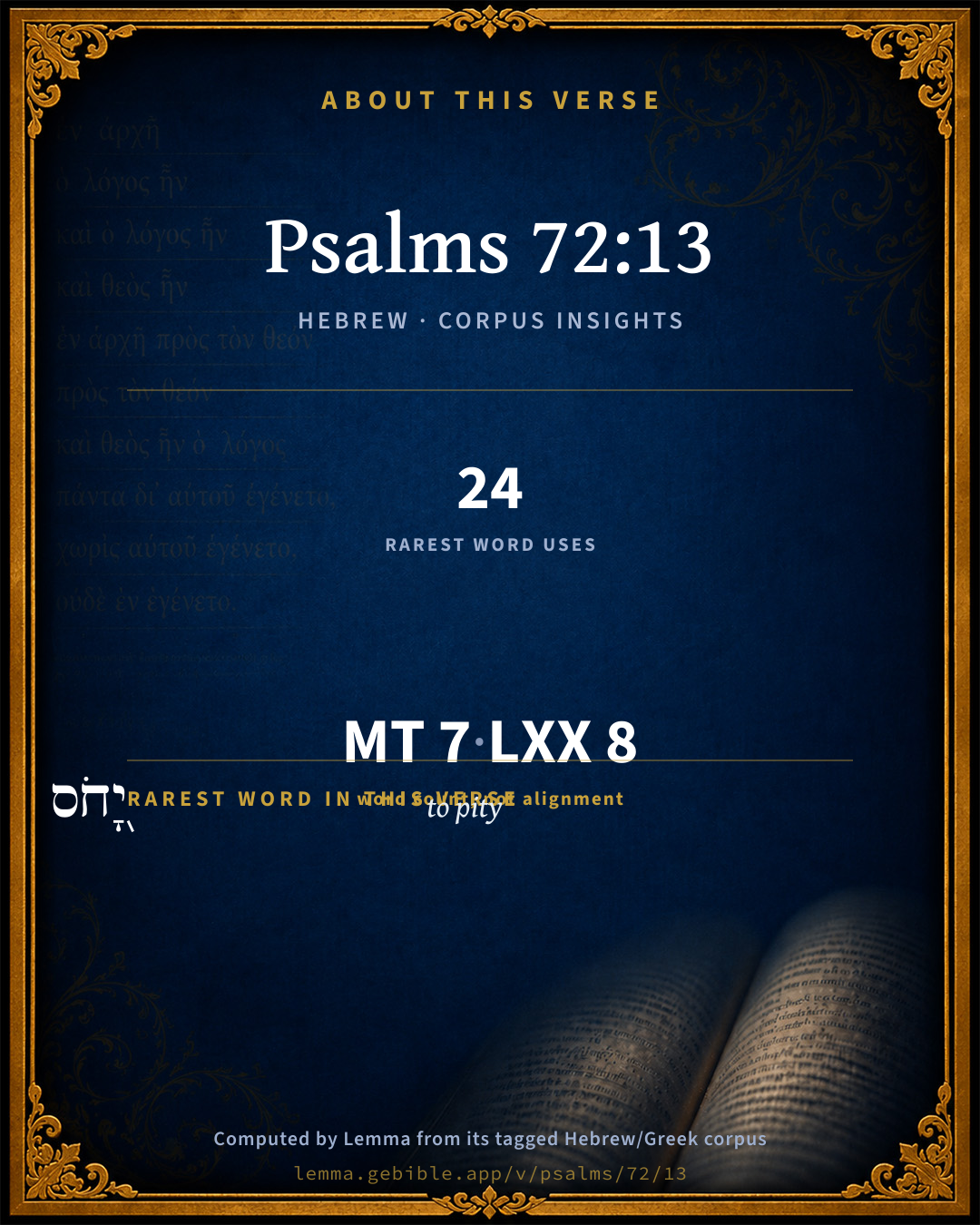
The rarest word here is יָ֭חֹס to pity H2347 — appearing just 24 times in the whole Hebrew Bible.

Shared distinctive vocabulary

יָ֭חֹס to pity H2347 occurs in 24 verses of the Hebrew Bible. Also found in:

Grammatical profile

  • 2 verbs
  • 1 noun
  • 3 adjectives
  • 1 preposition

Verb forms

  • יָ֭חֹס Qal · Imperfect
  • יוֹשִֽׁיעַ Hiphil · Imperfect

Repetition

A word recurs within this verse — often emphatic in Hebrew:

  • וְאֶבְי֑וֹן needy H34 ×2

Hebrew & Septuagint length

In English translation the verse runs 17 words from the Hebrew and 15 from the Septuagint (LXX English) — closely comparable.

A rough comparison of the two English renderings, which tokenize alike — not a word-level alignment.

Word counts can differ between the Hebrew and the Greek without any difference in meaning — e.g. the Hebrew direct-object marker אֵת has no separate Greek word, and Greek often adds the article ὁ.

In the original languages it is 7 Hebrew tokens and 8 Greek tokens — but the two are counted differently (Hebrew bundles its prefixes and suffixes into one token; the Greek is in lemma form), so that isn’t a like-for-like length.

Cross-references

6

Topical passages linked to Psalms 72:13 in the Treasury of Scripture Knowledge — connected by theme and wording, ordered by reader-vote popularity; previews shown in the World English Bible.

  • Ezekiel 34:16 I will seek that which was lost, and will bring back that which was driven away, and will bind up that which was broken, and will strengthen that which was sick: but the fat and the strong I will destroy; I will feed them in justice.
  • Psalms 109:31 For he will stand at the right hand of the needy, To save him from those who judge his soul.
  • Matthew 5:3 "Blessed are the poor in spirit, For theirs is the Kingdom of Heaven.
  • Job 5:15–16 But he saves from the sword of their mouth, Even the needy from the hand of the mighty.
  • Matthew 18:10 See that you don't despise one of these little ones, for I tell you that in heaven their angels always see the face of my Father who is in heaven.
  • James 2:5–6 Listen, my beloved brothers. Didn't God choose those who are poor in this world to be rich in faith, and heirs of the Kingdom which he promised to those who love him?

Cross-references courtesy of OpenBible.info (CC BY 4.0).

Hebrew and Greek witnesses Masoretic Hebrew ↔ Greek Septuagint

The same verse in the two great witnesses to the Old Testament, shown verse-for-verse.

You’re reading Greek Psalm 71 (Hebrew Psalm 72). The Septuagint counts the superscription, so verse numbers can differ from the Hebrew — chapter-level alignment, not verse-by-verse. Numbering follows Rahlfs.

These are two independent witnesses, not word-aligned to each other, and the Septuagint is shown in lemma (dictionary) form.

Hebrew Psalms 72:13 Masoretic · Westminster Leningrad Codex

יָ֭חֹס עַל דַּ֣ל וְאֶבְי֑וֹן וְנַפְשׁ֖וֹת אֶבְיוֹנִ֣ים יוֹשִֽׁיעַ

He will have pity on the poor and needy. He will save the souls of the needy.

World English Bible · Public Domain

Greek LXX Greek Psalm 71:13 Septuagint · lemma form

φείδομαι πτωχός καί πένης καί ψυχή πένης σώζω

He shall spare the poor and needy, and shall deliver the souls of the needy.

LXX2012 (modern English Septuagint) · Public Domain

Hebrew: Westminster Leningrad Codex (CC BY 4.0). Greek: Septuagint (public domain); English from LXX2012 (modern English Septuagint) (Public Domain). How the Septuagint differs from the Hebrew →

Commentary

Notes on Psalms 72:13 from classic Christian and Jewish commentators (each source and its license shown beneath its notes). The classic Christian expositions comment on the surrounding passage and are grouped to its opening verse, so a note may address several verses; the Jewish commentaries on the Tanakh (Rashi and others) are per-verse, so they appear only where the commentator wrote on this verse.

Lemma curates 59 commentaries, every one of them public domain or Creative Commons licensed, each selected and text-cleaned for this edition rather than reprinted as found. About our sources →

Trapp's Complete Commentary

John Trapp

Psa 72:13 He shall spare the poor and needy, and shall save the souls of the needy.

Ver. 13. He shall spare the poor and needy] Hereby David showeth his son and all his successors, Qualis debeat esse rex bonus, what manner of man a king ought to be. Regiment without righteousness turneth into tyranny; it is but robbery with authority. O. Scipio Nasica for his good government was surnamed Optimus by the Senate, and had a house given him at the public charge, in Via Sacra, that the poor might repair to him.

John Trapp, A Commentary or Exposition upon All the Books of the Old and New Testament (1647–1656) — public domain. Text from a community e-Sword module.

J. A. Alexander on Psalms

Joseph Addison Alexander

Psa 72:13. He will have pity on (or spare) the poor and needy, and the souls (or lives) of the needy he will save. In the first clause the adjectives are of the singular number, and properly denote the poor (man) and the needy (man). The change to the plural in the second clause, needy (ones) or needy (people), shews that the singular was not meant to denote a real individual, but rather an ideal person, representing a whole class, which is then directly designated by the plural.

Joseph Addison Alexander, The Psalms Translated and Explained (1850) — public domain. Text from a community e-Sword module.

Tyndale Open Study Notes

Tyndale Open Resources

72:13 Like a father, the king feels pity for those in need (see Mal 3:17).

Tyndale Open Study Notes — © Tyndale Open Resources, licensed CC BY-SA 4.0. Text via the HelloAO Bible API.

The Cambridge Bible for Schools and Colleges

gen. ed. J. J. S. Perowne

13. He shall have pity on the weak and needy,

And the souls of the needy shall he save.

The weak may include the sick as well as the poor. Cp. Psa_40:1; Psa_82:3-4; Isa_10:1; Isa_11:4; Amo_4:1. Souls primarily = lives, and so in Psa_72:14.

The Cambridge Bible for Schools and Colleges (gen. ed. J. J. S. Perowne; Cambridge University Press, 1878–1918) — public domain. Text from a community e-Sword module.

John Gill's Exposition

He shall spare the poor and needy,.... Pity them, have mercy and compassion on them, and sympathize with them; such an one is Christ, a merciful King, as well as High Priest, who is touched with a feeling of his people's infirmities, and who in his love and pity has redeemed them;

and shall save the souls of the needy; not to the exclusion of their bodies, which are also his care and charge, are bought with his blood, are preserved by him, will be raised from the dead, and made like his glorious body; but souls are mentioned as being the most excellent part of man, and which having sinned, are liable to damnation and the second death; and are therefore the special objects of redemption and salvation; these are saved by him from all their sins, and from wrath to come they deserve; hence his name is called "Jesus", a Saviour.

John Gill's Exposition of the Whole Bible (1746–1763) — public domain (CC PDM 1.0). Text via the HelloAO Bible API.

Albert Barnes' Notes on the Bible

He shall spare the poor and needy - He will have pity on; he will show mercy or favor to them.

And shall save the souls of the needy - Will guard and defend them; will be their protector and friend. His administration will have special respect to those who are commonly overlooked, and who are exposed to oppression and wrong.

Albert Barnes' Notes on the Bible (1834–1885) — public domain. Text from a community e-Sword/MySword module.

Matthew Poole's English Annotations

The souls, properly so called; this being Christ’s proper work to save souls; or, the lives, which oppressors shall endeavour to take away.

Matthew Poole's English Annotations on the Holy Bible (1683–1685) — public domain. Text from a community e-Sword/MySword module.

The Treasury of David

Charles H. Spurgeon

Ver. 13. He shall spare the poor and needy. His pity shall be manifested to them; he will not allow their trials to overwhelm them; his rod of correction shall fall lightly; he will be sparing of his rebukes, and not sparing in his consolations.

And shall save the souls of the needy. His is the dominion of souls, a spiritual and not a worldly empire; and the needy, that is to say, the consciously unworthy and weak, shall find that he will give them his salvation. Jesus calls not the righteous, but sinners to repentance. He does not attempt the superfluous work of aiding proud Pharisees to air their vanity; but he is careful of poor Publicans whose eyes dare not look up to heaven by reason of their sense of sin. We ought to be anxious to be among these needy ones whom the Great King so highly favours.

Ver. 13. He shall spare; more correctly, compassionate or comfort the poor and needy; and shall save their souls, or preserve the lives of the needy. William Henry Alexander, in "The Book of Praises: being the Book of Psalms... with Notes Original and Selected." 1867.

Ver. 13. And shall save the souls of the needy. Scipio used to say, that he would rather save a single citizen than slay a thousand enemies. Of this mind ought all princes to be towards their subjects; but this affection and love rose to the highest excellence and power in the breast of Christ. So ardent is his love for his own, that he suffers not one of them to perish, but leads them to full salvation, and, opposing himself to both devils and tyrants who seek to destroy their souls, he constrains their fury and confounds their rage. Mollerus.

None.

Psalms 72:14*

Charles H. Spurgeon's The Treasury of David (1869–1885) — public domain. Psalms only. Text from a community e-Sword/MySword module.

The Pulpit Commentary

He shall spare the poor and needy; or, the weak and needy. And shall save the souls of the needy. He shall not merely deliver them from their cruel oppressors in this life (ver. 4), but also give health and life to their souls.

The Pulpit Commentary (1880–1919), ed. H.D.M. Spence-Jones & Joseph S. Exell — public domain. Text from a community e-Sword module.

unfoldingWord translationNotes

Door43 World Missions Community

He has pity on the poor and needy

"He wants to stop the poor and needy from suffering"

the poor and needy

Here the nominal adjectives "poor" and "needy" mean basically the same thing and emphasize that they are unable to help themselves. AT: "those who are poor and those who are needy" (See: Doublet and Nominal Adjectives)

redeems their lives

Here "lives" refers to the whole person. AT: "redeems them" or "saves them" or "rescues them" (See: Synecdoche)

oppression and violence

These two words mean basically the same thing and emphasize how badly the needy suffer. These abstract nouns can be stated as verbs. AT: "those who oppress them and hurt them" (See: Doublet and Abstract Nouns)

their blood is precious in his sight

Here "their blood" is a metonym for their well-being. The sight of Yahweh represents his judgment or evaluation. AT: "their well-being is very important to him" or "he wants them to live well" (See: Metonymy)

in his sight

See how this phrase is translated in Psalms 19:14.

translationWords

save

redeem

oppress

blood

precious

unfoldingWord translationNotes — © Distant Shores Media and the Door43 World Missions Community, licensed CC BY-SA 4.0. Source: git.door43.org/Door43/en_tn.

Lesson kit

Teaching starters — assembled from the data on this page, not authored interpretation. Every prompt links to the verse data it draws on. Edit before teaching.

Psalms, in the Wisdom, opens this verse with 7 words (6 distinct Hebrew lemmas). Its most distinctive word is chûwç (“to pity”). A historical commentator’s framing appears above. Read the whole chapter for the surrounding context.

Discussion questions

  1. What does “to pity” (chûwç) contribute to the verse as a whole?
  2. How does Genesis 45:20, which shares the word «to pity», read alongside this verse?
  3. What does the repetition of “needy” (2× in this one verse) do in this verse?
  4. The translations on this page render this verse differently — a whole-verse word diff, not a word-by-word alignment. What might account for the different wordings?
  5. «יָ֭חֹס» is a Qal Imperfect verb. How does that grammatical form shape the action described?
  6. Compare how Trapp's Complete Commentary and J. A. Alexander on Psalms read this verse. Where do they agree or differ?

Things to notice

Reading settings

Reading text

Shown beneath each verse's original-language words.

Old Testament
Old Testament edition

Read the OT as the Masoretic Hebrew (MT) or the Greek Septuagint (LXX).

English shown for the Greek Septuagint (in the Hebrew ↔ Greek comparison).

Comparing translations? Open the Compare panel on any verse page to stack up to four side by side.