
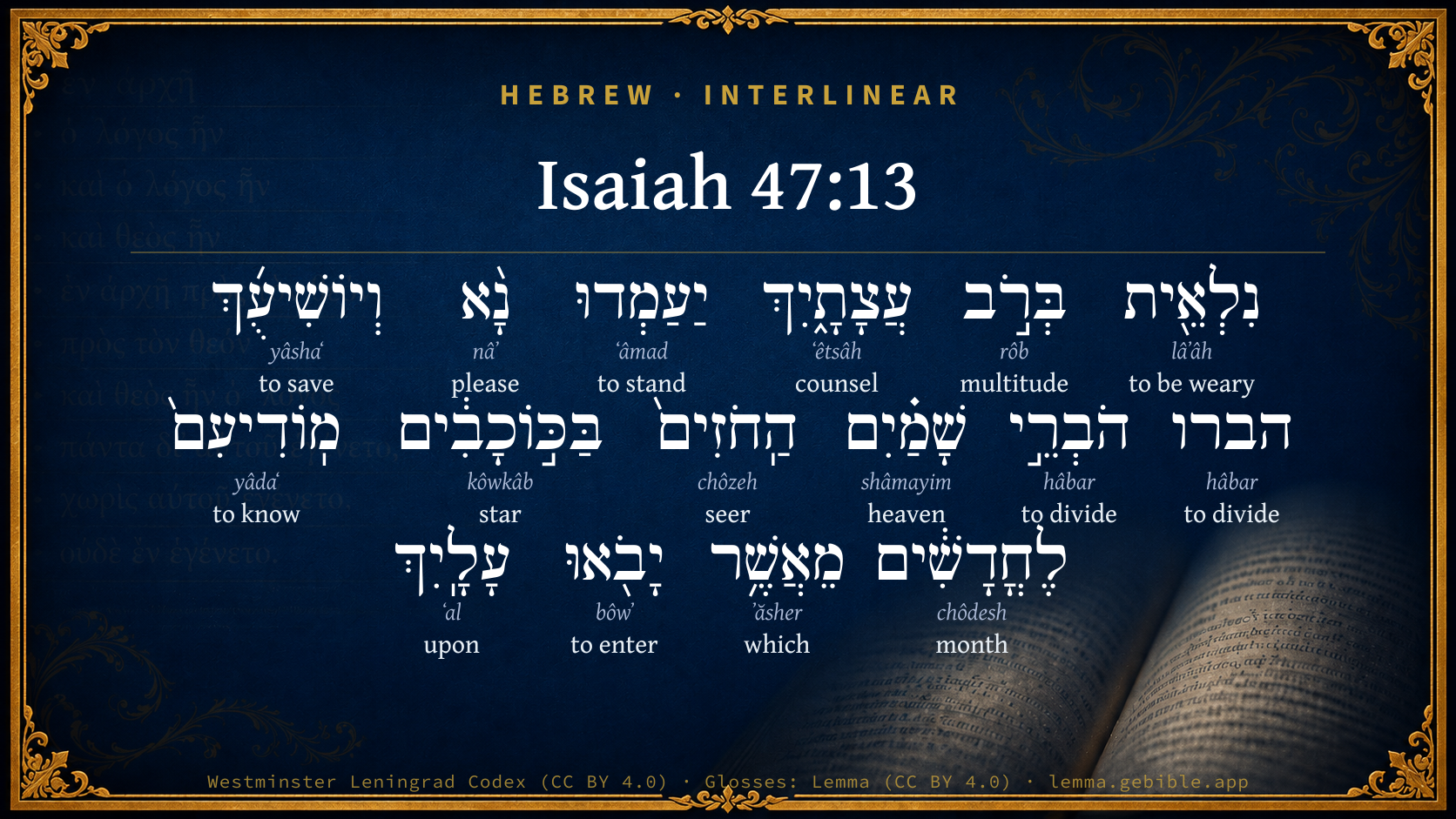
Isaiah 47:13

Hebrew (Westminster Leningrad Codex) Isaiah 47:13 appears in the Hebrew Old Testament. The text above is from the Westminster Leningrad Codex. Each word links to its Strong’s number, a concise gloss, and parsing drawn from the Open Scriptures Hebrew Bible morphology. Click any word for its full Brown-Driver-Briggs (BDB) entry.
Download image
Cite this verse

Isaiah 47:13 (World English Bible). Public Domain. Lemma interlinear Bible study tool, https://lemma.gebible.app/v/isaiah/47/13.

Show BibTeX & RIS
BibTeX
RIS
English Translation
You are wearied in the multitude of your counsels: let now the astrologers, the star-gazers, the monthly prognosticators, stand up, and save you from the things that shall come on you.
World English Bible · Public Domain
Highlights
  • 1 first appearance in the Hebrew Bible
Full analysis ↓
Download a study sheet

One document with this verse’s original text, its word-by-word gloss line, the meaning frame, cross-references with their text, attributed commentary, and full source and license credits — printable, and it pastes into notes with its structure intact.

This verse Autodidact and up

Study sheet (.html) Plain text (.txt)

A passage Seminary Student

Up to 50 verses in one chapter. A passage sheet keeps up to 6 commentary sources and 12 cross-references per verse, in the order this page ranks them, and says so on the sheet whenever that leaves anything out. Ask for a single verse and you get the Autodidact verse sheet above.

Everything on this page stays free to read, with no account — the sheet is a download of what is already on screen, not access to it.

Want to remove ads? Support Godless Engineer
Compare translations 3

The same verse in 3 English versions, stacked beneath the original-language interlinear above. Click any original word for its lexicon entry.

Each is an independent rendering of the whole verse — the interlinear is not word-aligned to these translations.

Highlighted words mark where these versions differ — a whole-verse word diff, not a word-by-word alignment.

  • World English Bible Public Domain
    You are wearied in the multitude of your counsels: let now the astrologers, the star-gazers, the monthly prognosticators, stand up, and save you from the things that shall come on you.
  • King James Version Public Domain
    Thou art wearied in the multitude of thy counsels. Let now the astrologers, the stargazers, the monthly prognosticators, stand up, and save thee from these things that shall come upon thee.
  • unfoldingWord Literal Text CC BY-SA 4.0
    You have been tired by the abundance of your counsels. Let them stand, please, and save you, the dividers of the heavens, the seers of the stars, the ones making known by months, from what will come upon you.

unfoldingWord Literal Text — © unfoldingWord, licensed CC BY-SA 4.0. Word-aligned USFM3 via Door43 (git.door43.org/unfoldingWord/en_ult).

Versions to compare (up to 4)

3 of 4 selected

Show all 18 translations

Every available English version of this verse, each an independent rendering of the whole verse.

  • World English Bible Public Domain
    You are wearied in the multitude of your counsels: let now the astrologers, the star-gazers, the monthly prognosticators, stand up, and save you from the things that shall come on you.
  • Berean Standard Bible Public Domain
    You are wearied by your many counselors; let them come forward now and save you—your astrologers who observe the stars, who monthly predict your fate.
  • Majority Standard Bible Public Domain
    You are wearied by your many counselors; let them come forward now and save you—your astrologers who observe the stars, who monthly predict your fate.
  • King James Version Public Domain
    Thou art wearied in the multitude of thy counsels. Let now the astrologers, the stargazers, the monthly prognosticators, stand up, and save thee from these things that shall come upon thee.
  • American Standard Version (1901) Public Domain
    Thou art wearied in the multitude of thy counsels: let now the astrologers, the star-gazers, the monthly prognosticators, stand up, and save thee from the things that shall come upon thee.
  • Revised Version (1885) Public Domain
    Thou art wearied in the multitude of thy counsels: let now the astrologers, the stargazers, the monthly prognosticators, stand up, and save thee from the things that shall come upon thee.
  • Geneva Bible (1599) Public Domain
    Thou art wearied in the multitude of thy counsels: let now the astrologers, the starre gasers, and prognosticatours stand vp, and saue thee from these things, that shall come vpon thee.
  • Douay-Rheims (1899) Public Domain
    Thou hast failed in the multitude or thy counsels: let now the astrologers stand and save thee, they that gazed at the stars, and counted the months, that from them they might tell the things that shall come to thee.
  • Young's Literal Translation Public Domain
    Thou hast been wearied in the multitude of thy counsels, Stand up, I pray thee, and save thee, Let the charmers of the heavens, Those looking on the stars, Those teaching concerning the months, From those things that come on thee!
  • Literal Standard Version CC BY-SA 4.0
    You have been wearied in the multitude of your counsels, || Now stand up and let them save you—The charmers of the heavens, || Those looking on the stars, || Those teaching concerning the months—From those things that come on you!
  • Unlocked Literal Bible CC BY-SA 4.0
    You are tired out with your many consultations; let those men stand up and save you—those who chart the heavens and look at the stars, those who declare the new moons—let them save you from what will happen to you.
  • unfoldingWord Literal Text CC BY-SA 4.0
    You have been tired by the abundance of your counsels. Let them stand, please, and save you, the dividers of the heavens, the seers of the stars, the ones making known by months, from what will come upon you.
  • Darby Bible Public Domain
    Thou art wearied in the multitude of thy counsels. Let now the interpreters of the heavens, the observers of the stars, who predict according to the new moons what shall come upon thee, stand up, and save thee.
  • World Messianic Bible Public Domain
    You are wearied in the multitude of your counsels. Now let the astrologers, the stargazers, and the monthly prognosticators stand up and save you from the things that will happen to you.
  • Webster's Bible Public Domain
    Thou art wearied in the multitude of thy counsels. Let now the astrologers, the star-gazers, the monthly prognosticators, stand up, and save thee from these things that shall come upon thee.
  • Free Bible Version CC BY-SA 4.0
    All the advice you've received has worn you out! Where are your astrologers, those who look to the stars for guidance, who give you their predictions every month? Let them stand up and save you from what's coming down on you!
  • Bible in Basic English Public Domain
    But your mind is troubled by the number of your guides: let them now come forward for your salvation: the measurers of the heavens, the watchers of the stars, and those who are able to say from month to month what things are coming on you.
  • JPS Tanakh (1917) Public Domain
    Thou art wearied in the multitude of thy counsels; let now the astrologers, the stargazers, the monthly prognosticators, stand up, and save thee from the things that shall come upon thee.

Literal Standard Version (2020), Covenant Press — licensed CC BY-SA 4.0. Text via the HelloAO Bible API (eBible.org). Unlocked Literal Bible (unfoldingWord) — licensed CC BY-SA 4.0. Text via the HelloAO Bible API (eBible.org). unfoldingWord Literal Text — © unfoldingWord, licensed CC BY-SA 4.0. Word-aligned USFM3 via Door43 (git.door43.org/unfoldingWord/en_ult). Free Bible Version, Dr. Jonathan Gallagher — licensed CC BY-SA 4.0. Text via the HelloAO Bible API (eBible.org).

Word by word

More ways to search: Search by grammar → Find every occurrence → Compare this word →

Practice this passage: Drill this verse → Learn its vocabulary →

הברו
hâbar
H1895
“to divide”
Verb, Qal, Perfect, 3rd Person, Common, Plural
Part of Speech
Verb
Stem
Qal
Form
Perfect
Person
3rd Person
Gender
Common
Number
Plural
Full BDB Definition

Origin: a primitive root of uncertain derivation

TWOT: 465

(Qal) to divide - be an astrologer (with object - heavens)
  1. נִלְאֵ֖ית lâʼâh H3811 “to be weary” Verb, Niphal, Perfect, 2nd Person, Feminine, Singular
  2. בְּרֹ֣ב rôb H7230 “in/at · multitude of” Preposition + Noun, Common, Both, Singular, Construct
  3. עֲצָתָ֑יִךְ ʻêtsâh H6098 “counsels · your” Noun, Common, Feminine, Plural, Construct + Suffix, Personal, 2nd Person, Feminine, Singular
  4. יַעַמְדוּ ʻâmad H5975 “to stand” Verb, Qal, Jussive, 3rd Person, Masculine, Plural
  5. נָ֨א nâʼ H4994 “please” Particle, Exhortation
  6. וְיוֹשִׁיעֻ֜ךְ yâshaʻ H3467 “and · to save · you” Conjunction + Verb, Hiphil, Jussive, 3rd Person, Masculine, Plural + Suffix, Personal, 2nd Person, Feminine, Singular
  7. הֹבְרֵ֣י hâbar H1895 “dividing” Verb, Qal, Participle Active, Masculine, Plural, Construct
  8. שָׁמַ֗יִם shâmayim H8064 “heaven(s)” Noun, Common, Masculine, Plural, Absolute
  9. הַֽחֹזִים֙ chôzeh H2374 “the · seer” Particle, Definite Article + Verb, Qal, Participle Active, Masculine, Plural, Absolute
  10. בַּכּ֣וֹכָבִ֔ים kôwkâb H3556 “in/at the · stars” Preposition, Determined + Noun, Common, Masculine, Plural, Absolute
  11. מֽוֹדִיעִם֙ yâdaʻ H3045 “knowing” Verb, Hiphil, Participle Active, Masculine, Plural, Absolute
  12. לֶחֳדָשִׁ֔ים chôdesh H2320 “to/for the · months” Preposition, Determined + Noun, Common, Masculine, Plural, Absolute
  13. מֵאֲשֶׁ֥ר ʼăsher H834 “from · which” Preposition + Particle, Relative
  14. יָבֹ֖אוּ bôwʼ H935 “to enter” Verb, Qal, Imperfect, 3rd Person, Masculine, Plural
  15. עָלָֽיִךְ ʻal H5921 “upon · you” Preposition + Suffix, Personal, 2nd Person, Feminine, Singular

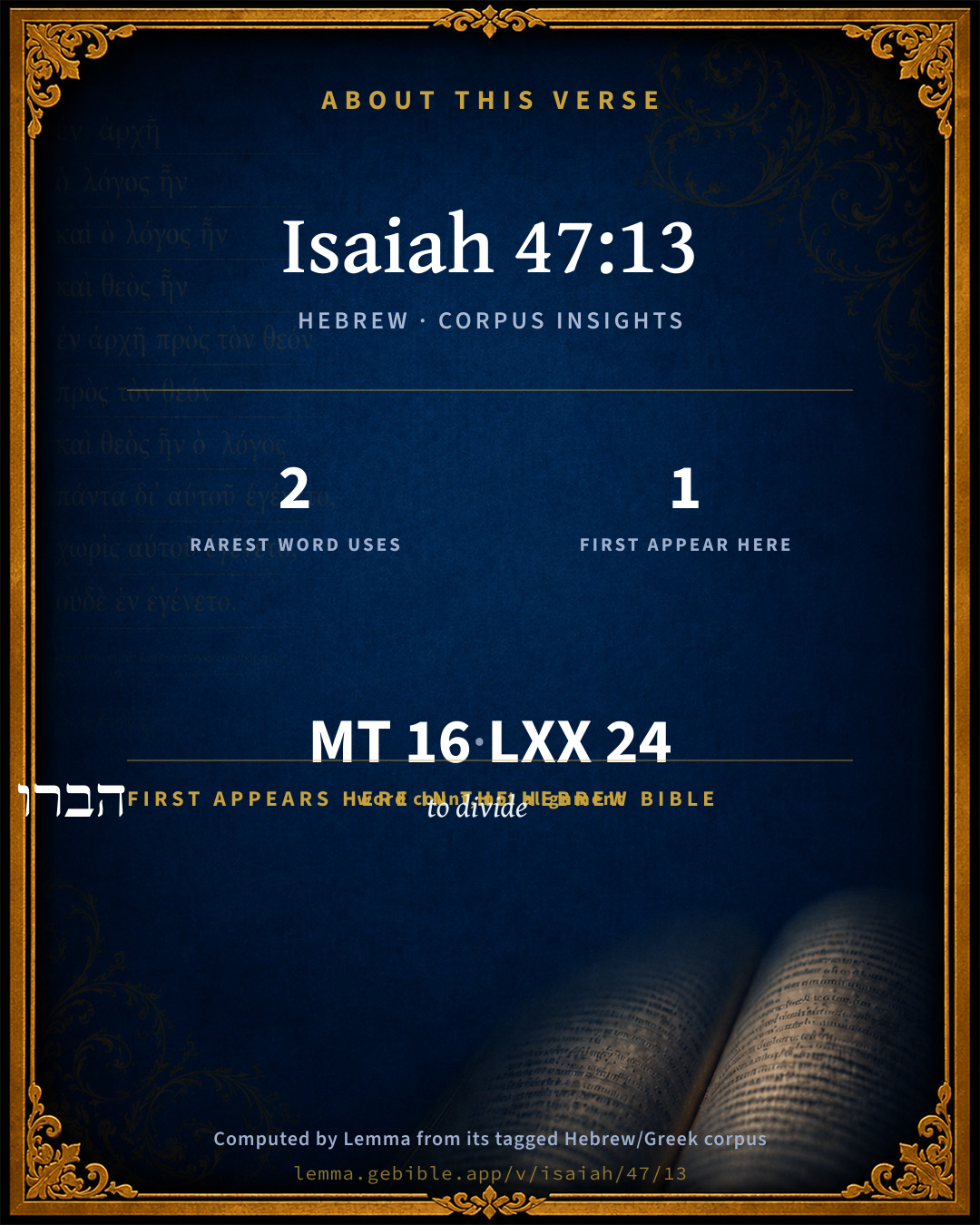
About this verse

These counts appear in no published source. They are computed here, from the morphology-tagged text and Lemma’s own curated glosses. What Lemma adds →

16
words
15
distinct lemmas
Prophets
section

Notable vocabulary

The rarest word here is הברו to divide H1895 — appearing just 2 times in the whole Hebrew Bible.

First appearance in Scripture

This word makes its first canonical appearance in the Hebrew Bible here:

  • הברו to divide H1895

Grammatical profile

  • 8 verbs
  • 5 nouns
  • 1 preposition
  • 2 particles

Verb forms

  • נִלְאֵ֖ית Niphal · Perfect
  • יַעַמְדוּ Qal · Jussive
  • וְיוֹשִׁיעֻ֜ךְ Hiphil · Jussive
  • הברו Qal · Perfect
  • הֹבְרֵ֣י Qal · Participle Active
  • הַֽחֹזִים֙ Qal · Participle Active
  • מֽוֹדִיעִם֙ Hiphil · Participle Active
  • יָבֹ֖אוּ Qal · Imperfect

Repetition

A word recurs within this verse — often emphatic in Hebrew:

  • הברו to divide H1895 ×2

Hebrew & Septuagint length

In English translation the verse runs 31 words from the Hebrew and 32 from the Septuagint (LXX English) — closely comparable.

A rough comparison of the two English renderings, which tokenize alike — not a word-level alignment.

Word counts can differ between the Hebrew and the Greek without any difference in meaning — e.g. the Hebrew direct-object marker אֵת has no separate Greek word, and Greek often adds the article ὁ.

In the original languages it is 16 Hebrew tokens and 24 Greek tokens — but the two are counted differently (Hebrew bundles its prefixes and suffixes into one token; the Greek is in lemma form), so that isn’t a like-for-like length.

Cross-references

10

Topical passages linked to Isaiah 47:13 in the Treasury of Scripture Knowledge — connected by theme and wording, ordered by reader-vote popularity; previews shown in the World English Bible.

  • Isaiah 44:25 who frustrates the signs of the liars, and makes diviners mad; who turns wise men backward, and makes their knowledge foolish;
  • Isaiah 57:10 You were wearied with the length of your way; yet you didn't say, It is in vain: you found a reviving of your strength; therefore you weren't faint.
  • Jeremiah 51:58 Thus says Yahweh of hosts: The broad walls of Babylon shall be utterly overthrown, and her high gates shall be burned with fire; and the peoples shall labor for vanity, and the nations for the fire; and they shall be weary.
  • Ezekiel 24:12 She has wearied [herself] with toil; yet her great rust doesn't go forth out of her; her rust doesn't [go forth] by fire.
  • Daniel 2:2–10 Then the king commanded to call the magicians, and the enchanters, and the sorcerers, and the Chaldeans, to tell the king his dreams. So they came in and stood before the king.
  • Isaiah 47:15 Thus shall the things be to you in which you have labored: those who have trafficked with you from your youth shall wander everyone to his quarter; there shall be none to save you.
  • Daniel 5:7–8 The king cried aloud to bring in the enchanters, the Chaldeans, and the soothsayers. The king spoke and said to the wise men of Babylon, Whoever shall read this writing, and show me the interpretation of it, shall be clothed with purple, and have a chain of gold about his neck, and shall be the third ruler in the kingdom.
  • Daniel 5:15–16 Now the wise men, the enchanters, have been brought in before me, that they should read this writing, and make known to me the interpretation of it; but they could not show the interpretation of the thing.
  • Daniel 5:30 In that night Belshazzar the Chaldean King was slain.
  • Habakkuk 2:13 Behold, isn't it of Yahweh of Hosts that the peoples labor for the fire, and the nations weary themselves for vanity?

Cross-references courtesy of OpenBible.info (CC BY 4.0).

Hebrew and Greek witnesses Masoretic Hebrew ↔ Greek Septuagint

The same verse in the two great witnesses to the Old Testament, shown verse-for-verse.

These are two independent witnesses, not word-aligned to each other, and the Septuagint is shown in lemma (dictionary) form.

Hebrew Isaiah 47:13 Masoretic · Westminster Leningrad Codex

נִלְאֵ֖ית בְּרֹ֣ב עֲצָתָ֑יִךְ יַעַמְדוּ נָ֨א וְיוֹשִׁיעֻ֜ךְ הברו הֹבְרֵ֣י שָׁמַ֗יִם הַֽחֹזִים֙ בַּכּ֣וֹכָבִ֔ים מֽוֹדִיעִם֙ לֶחֳדָשִׁ֔ים מֵאֲשֶׁ֥ר יָבֹ֖אוּ עָלָֽיִךְ

You are wearied in the multitude of your counsels: let now the astrologers, the star-gazers, the monthly prognosticators, stand up, and save you from the things that shall come on you.

World English Bible · Public Domain

Greek LXX Isaiah 47:13 Septuagint · lemma form

κοπιάω ἐν ὁ βουλή σύ ἵστημι καί σώζω σύ ὁ ἀστρολόγος ὁ οὐρανός ὁ ὁράω ὁ ἀστήρ ἀναἀγγέλλω σύ τίς μέλλω ἐπί σύ ἔρχομαι

You are wearied in your counsels. Let now the astrologers of the heaven stand and deliver you, let them that see the stars tell you what is about to come upon you.

LXX2012 (modern English Septuagint) · Public Domain

On this verse, Adam Clarke's Commentary discusses the Septuagint’s reading. Read the note in Commentary ↓

Hebrew: Westminster Leningrad Codex (CC BY 4.0). Greek: Septuagint (public domain); English from LXX2012 (modern English Septuagint) (Public Domain). How the Septuagint differs from the Hebrew →

Targum (Aramaic paraphrase)

1

The Targum is the ancient Jewish Aramaic paraphrase of the Hebrew Scriptures — an interpretive translation, not the Hebrew text itself. Onkelos (literal) and Pseudo-Jonathan (expansive) render the Torah, and Jonathan the Prophets. Coverage is partial: where no permissively-licensed English translation exists for a verse, only the Aramaic is shown. This is verse-level text, not a word-by-word alignment to the Hebrew.

  1. Targum Jonathan Prophets (Joshua–Malachi)
    לָאֵית בִּסְגִיאוּת מַלְכַּךְ יְקוּמוּן כְּעַן וְיִפְרְקוּנִיךְ דְמַסְכִּין לְמַזָלַת שְׁמַיָא וּדְחָזָן בְּכוֹכְבַיָא מְהוֹדְעִין זִמְנַיָא מַטְעָן לִיךְ לְמֵימָר כֵּן עֲתִיד לְמֵיתֵי עֲלָךְ יְרַח בִּירָח:

    Thou art wearied in the multitude of thy counsels. Let them now rise up, and save thee, who are familiar with the Zodiac of the heavens, who look at the stars, who make known appointed seasons: deceiving thee, saying, Thus it shall happen unto thee each month.

    Targum Jonathan — Aramaic: “Mikraot Gedolot” (public domain). English: “Sefaria Community Translation” (CC0 1.0 (public-domain dedication)); “London "Chaldee Paraphrase," 1871” (public domain). Text via Sefaria.

Commentary

Notes on Isaiah 47:13 from classic Christian and Jewish commentators (each source and its license shown beneath its notes). The classic Christian expositions comment on the surrounding passage and are grouped to its opening verse, so a note may address several verses; the Jewish commentaries on the Tanakh (Rashi and others) are per-verse, so they appear only where the commentator wrote on this verse.

Lemma curates 59 commentaries, every one of them public domain or Creative Commons licensed, each selected and text-cleaned for this edition rather than reprinted as found. About our sources →

Trapp's Complete Commentary

John Trapp

Isa 47:13 Thou art wearied in the multitude of thy counsels. Let now the astrologers, the stargazers, the monthly prognosticators, stand up, and save thee from [these things] that shall come upon thee.

Ver. 13. Thou art wearied in the multitude of thy counsels.] As all such are sure to be, with a woe to boot, as "take counsel, but not of God; and that cover with a covering, but not by his Spirit, that they may add sin to sin" {Isa 30:1} Thus do those vain astrologers, that pretend to read men’s fates and fortunes in the heavens, velut in Minervae peplo, and thence to foretell good and evil. But experience frequently confuteth them, as it did Abraham the Jew, who foretold by the stars the coming of their Messiah, A.D. 1464; and Albumazar, a Mohammedan wizard, who predicted an end of the Christian religion, A.D. 1460 at utmost. A great flood was foretold by these diviners to occur in the year 1524, cum planetae comitia in piscibus celebrarent. This caused the prior of St Bartholomew’s, in London, wise manlike, to go and build him a house at Harrow-on-the-hill, for his better security. {a}

Stand up, and save thee.] Save thee if they can: but Belshazzar found they could not, though he called for them all, {Dan 5:7-8} and they likely had promised him an everlasting monarchy - as some did the Romans imperium sine fine, but falsely; for now the Roman empire is at a very low ebb, and who shall be emperor is much questioned. {b}

{a} Hollinsh. in 1524.

{b} This was written, Sept. 19, 1637.

John Trapp, A Commentary or Exposition upon All the Books of the Old and New Testament (1647–1656) — public domain. Text from a community e-Sword module.

Tyndale Open Study Notes

Tyndale Open Resources

47:13 Babylon was advanced in astronomy, which the astrologers and stargazers used as a form of divination (see Dan 2:2, 10; 5:7).

Tyndale Open Study Notes — © Tyndale Open Resources, licensed CC BY-SA 4.0. Text via the HelloAO Bible API.

Jamieson, Fausset & Brown

Robert Jamieson, A. R. Fausset & David Brown

wearied--(compare Isa 57:10; Eze 24:12).

astrologers--literally, those who form combinations of the heavens; who watch conjunctions and oppositions of the stars. "Casters of the configurations of the sky" [HORSLEY]. GESENIUS explains it: the dividers of the heavens. In casting a nativity they observed four signs:--the horoscope, or sign which arose at the time one was born; the mid-heaven; the sign opposite the horoscope towards the west; and the hypogee.

monthly prognosticators--those who at each new moon profess to tell thereby what is about to happen. Join, not as English Version, "save . . . from those things," &c.; but, "They that at new moons make known from (by means of) them the things that shall come upon thee" [MAURER].

Jamieson, Fausset & Brown — Commentary Critical and Explanatory on the Whole Bible (1871) — public domain (CC PDM 1.0). Text via the HelloAO Bible API.

Adam Clarke's Commentary

Verse 13. From these things - "What are the events"] For מאשר measher, read מה אשר mah asher, so the Septuagint, "what is to happen to thee."

Adam Clarke's Commentary on the Bible (1810–1826) — public domain. Text from a community e-Sword/MySword module.

Ellicott's Commentary for English Readers

(13) Let now the astrologers . . .—The three words describe two aspects of the same art—(1) the dividers of the heavens, assigning stellar influences to the signs of the Zodiac; (2) the “star-gazers,” further defined as those who make known things to come at the new moon. The Assyrian and Chaldæan observers compiled an almanack, in which the days of the month were noted as severally lucky or unlucky for the incidents of war or of home-life, as the case might be.

A Bible Commentary for English Readers, edited by Charles John Ellicott (1878–1897) — public domain. Text from a community e-Sword module.

The Cambridge Bible for Schools and Colleges

gen. ed. J. J. S. Perowne

13. let now the astrologers &c.] Render: let them stand forth (Isa_47:12) now and save thee,—they that have divided the heavens, they that gaze on the stars, that announce month by month something of what shall befall thee.

astrologers is an apt equivalent of “they that divided the heavens” (i.e. into the constellations of the Zodiac, for astrological purposes). This at least seems the most probable meaning, although the verb for “divide” does not occur elsewhere in Hebrew (in Arab. it means to “divide into great pieces”), and the Ancient Versions render otherwise [LXX. οἱ ἀστρολόγοι τοῦ οὐρανοῦ]. So monthly prognosticators is a felicitous condensation of the thought of the last clause, although the E.V. (following some Jewish authorities) has mistaken the syntactical construction. The special reference here is to the preparation of monthly almanacs (based on astrological calculations) in which coming disasters were foretold, lucky and unlucky days pointed out, &c. A specimen of these almanacs is translated by Sayce in Trans. of the Society of Bibl. Archæology, III. 229 ff.

13–15. The last strophe dwells on the futility of all the resources that the “daughter of Babel” can call to her aid.

The Cambridge Bible for Schools and Colleges (gen. ed. J. J. S. Perowne; Cambridge University Press, 1878–1918) — public domain. Text from a community e-Sword module.

John Gill's Exposition

Thou art wearied in the multitude of thy counsels,.... Taken of astrologers, diviners, and soothsayers; who were never able to give any satisfactory answers to questions put to them, or to give good advice in cases of emergency; as appears from Nebuchadnezzar's consultation with them about his dream; and Belshazzar's about the handwriting upon the wall, which was the very night that the city was taken, Dan 2:2,

let now the astrologers; or, "viewers of the heavens" (s); not that look upon them, and consider them as the work of God's hands, in order to glorify him; but that examine the face of the skies, and the position of the heavenly bodies, their conjunctions with, and aspects on each other, in order to foretell what shall be below: or, "the dividers of the heavens" (t), as it may be rendered, from the use of the word in the Arabic language; who divide the heavens into so many parts, or houses; who, as Kimchi (u), from the same use of the word, fix and determine things according to the stars; and who next are called "the stargazers"; that look at them, and, according to their position, conjunction, aspect, and influence, judge what will come to pass among men. So Cicero observes (w), that the Chaldeans, by long observation of the stars, were thought to have formed a science, whereby they could foretell what should happen to everyone, and what fate he was born to:

the monthly prognosticators; or "that make known months", or "for the months" (x); what shall be in every month; what weather it will be, and what things shall happen; such as our almanac makers. Let these now all meet together,

and stand up and save thee from those things that shall come upon thee; which they were never able to do; for if they could not foretell these things by their art, it could not be thought they could give any directions how to escape them, or put upon any methods that would secure from them.

(s) "speculantes coelos", Pagninus, Montanus, Tigurine version; "contemplatores coelorum", Vitringa. (t) "resecuit, amputavit", Golius, Castel. (u) Sepher Shorash. rad. (w) De Divinatione, l. 1. c. 1. (x) "cognoscere faciunt menses", Pagninus; "facientes", Montanus; "qui notas faciunt in menses", Junius & Tremellius, Piscator; i.e. "praedictiones suas notificantes in menses", Cocceius; "indicantes novilunia", Vitringa.

John Gill's Exposition of the Whole Bible (1746–1763) — public domain (CC PDM 1.0). Text via the HelloAO Bible API.

Albert Barnes' Notes on the Bible

Thou art wearied - Thou hast practiced so many arts, and practiced them so long, that thou art exhausted in them. The ‘counsels’ here referred to, are those which the astrologers and diviners would take in examining the prognostications, and the supposed indications of future events.

Let now the astrologers - Call in now the aid of the various classes of diviners on whom thou hast relied to save thee from the impending calamity and ruin. The words rendered here ‘astrologers’ (שׁמים הברי hoberēy shâmayim) mean properly “the dividers of the heavens;” those who divided, or cut up the heavens for the purpose of augury, or to take a horoscope (Gesenius). What this art was is not certainly known. It is probable that it referred to their designating certain stars, or constellations, or conjunctions of the planets in certain parts of the heavens, as being fortunate and propitious, and certain others as unfortunate and unpropitious. At first, astrology was synonymous with astronomy. But in process of time, it came to denote the science which professes to discover certain connections between the position and movements of the heavenly bodies, and the events which occur on the earth.

It was supposed that the rising and setting, the conjunction and opposition of the planets, exerted a powerful influence over the fates of people; over the health of their bodies, the character of their minds, and the vicissitudes of their lives. Some regarded, it would seem, the positions of the stars as mere signs of the events which were to follow; and others, and probably by far the larger portion, supposed that those positions had a positive influence in directing and controlling the affairs of this lower world. The origin of this science is involved in great obscurity. Aristotle ascribes the invention to the Babylonians and Egyptians. Ptolemy concurs in this opinion, and Cicero traces it to the same origin. Lucian says that both these nations, as well as the Lybians, borrowed it from the Ethiopians, and that the Greeks owed their knowledge of this pretended science to the poet Orpheus. The science prevailed, it is probable, however, much more early in India; and in China it appears to be coeval with their history.

The Arabians have been distinguished for their attachment to it; and even Tycho Brahe was a zealous defender of astrology, and Kepler believed that the conjunctions of the planets were capable of producing great effects on human affairs. It is also a remarkable fact that Lord Bacon thought that the science required to be purified from errors rather than altogether rejected. Those who wish to inquire into the various systems of astrology, and the arts by which this absurd science has maintained an influence in the world, may consult the “Edin. Encyclopedia,” Art. “Astrology,” and the authorities enumerated there. The thing referred to in the passage before us, and which was practiced in Babylon, was, probably, that of forecasting future events, or telling what would occur by the observation of the positions of the heavenly bodies.

The star-gazers - Those who endeavor to tell what will occur by the contemplation of the relative positions of the stars.

The monthly prognosticators - Margin, ‘That give knowledge concerning the months.’ That is, at the commencement of the months they give knowledge of what events might be expected to occur during the month; - perhaps from the dip of the moon, or its riding high or low, etc. Something of this kind is still retained by those persons who speak of a dry or wet moon; or who expect a change of weather at the change of the moon - all of which is just as wise as were the old systems of astrology among the Chaldeans. This whole passage would have been more literally and better translated by preserving the order of the Hebrew. ‘Let them stand up now and save thee, who are astrologers; who gaze upon the stars, and who make known at the new moons what things will come upon thee.’

Albert Barnes' Notes on the Bible (1834–1885) — public domain. Text from a community e-Sword/MySword module.

Haydock's Catholic Bible Commentary

Months, to tell which would prove lucky, Esther iii. 7.

George Leo Haydock (1774–1849), Haydock's Catholic Family Bible and Commentary, 1859 edition — public domain. Excludes Psalms (Douay-Rheims chapter numbering differs from Protestant) and Deuterocanonical books (Catholic canon only).

Matthew Poole's English Annotations

Thou art wearied; thou hast spent thy time and strength in going from one to another, in trying all manner of experiments, and all to no purpose.

Stand up, and save thee to succour thee, or to inquire for thee.

Matthew Poole's English Annotations on the Holy Bible (1683–1685) — public domain. Text from a community e-Sword/MySword module.

Whedon's Commentary on the Bible

Daniel D. Whedon

13. Multitude of thy counsels — The whole magian school.

Astrologers — Rawlinson (Monarchies, 3:425) says: “Most of the astronomical tablets discovered at Babylon are of an astrological character, recording the supposed influences of the heavenly bodies, singly, in conjunction, or in opposition, upon all sublunary affairs.”

Stargazers — The zodiacal system is supposed to be in a great measure due to the Babylonians. The object of astrology was mainly to bring to light on each new moon what was to happen, by dividing the heavens into sections, watching conjunctions, oppositions, etc., of the planets, and making out the horoscope or sign which arose at the time when one was born.

Daniel D. Whedon (gen. ed.), Commentary on the Old and New Testaments (1874–1909) — public domain. Text from a community e-Sword module.

The Pulpit Commentary

Thou art wearied in the multitude of thy counsels. Mr. Cheyne"s rendering is more intelligible, "Thou hast wearied thyself with the multitude of thy consultations." Those at the head of affairs had consulted the diviners of all classes, till they were utterly weary of so doing. (compare the "consultations" of Nebuchadnezzar and Belshazzar with such persons, Dan_2:2-11 Dan_5:7, Dan_5:8) Yet let one further effort be made. Let now the astrologers, the stargazers, the monthly prognosticators, stand up. These are scarcely three classes of persons, but rather the same class under three designations: "astrologers" (literally, "dividers of the heavens"); "star-gazers," or observers of the stars; and "monthly prognosticators," or almanack-makers. The astronomy of the Babylonians consisted primarily in "dividing the heavens" into "houses," or constellations, and thus mapping them out in such a way that the infinite multiplicity, which at first baffles the beholder, might be grasped, reduced to order, and brought within the sphere of distinct cognizance. This work was an eminently useful one, and maintains its place in astronomy to the present day ("Ancient Monarchies," vol. 2, p. 573). After the heavens were mapped out, and the courses of the sun and moon through the "houses" laid down, star-gazers" directed their attention mainly to sun, moon, and planets, noting eclipses, occultations, conjunctions, and the like. All this was legitimate science; but, finally, the greater part of the astronomers launched into astrology, and undertook to prognosticate events from the changing phenomena of the heavens.

Almanacks were put forth, in which predictions were made, either specially for a particular year, or generally for all time, based upon astronomical considerations; and on these great dependence was placed. (For a specimen of such an almanack, see "Records of the Past," vol. 1. pp. 158-161.)

HOMILIES BY W.M. STATHAM Ver. 13. Many counsellors.

"Thou art wearied in the multitude of thy counsels." The mind of man will seek counsel. For men everywhere, in the old Athenian groves and gardens, and in the fellowship of modern clubs and associations, will seek for "opinion" to guide and help them. They are so slow to trust alone to conscience and to God.

I THE UNSATISFYING ORACLES. "Thou art wearied." You have tried them so often without results of guidance and good. All is vain. Men go here and there, but, alas! too often to those who are the most likely to fall in with their desires and whims. Like Absalom, men consult counsellors like Ahithophel, who pander to their folly. Then, when times of real emergency and anxiety come, when the poor tired heart needs rest and peace, it is led to new pleasures, new excitements and interests, until weariness ensues. How contrasted is the Christian"s lot! "Commit thy way unto him.

II THE MANIFOLD FAILURE. It is a failure all round. Think of the multitude of counsellors. Men go to a minister instead of to the Bible; or to a priest instead of to a Saviour; or to their passions instead of their conscience; or to man instead of to God. Humbly let us seek the heavenly guidance. "The meek will he guide in judgment: and the meek will he teach his way. W.M.S.

The weariness of self-service.

"Thou art wearied in the multitude of thy counsels." Babylon was trusting self, trying to find its own way out of calamities; and it was proving what weary, hopeless work that always is. Astrologer was the final resource of the despairing Babylonians.

I THE WEARINESS OF VARIETY. A vain searching for some new device. A restless dissatisfaction with everything.

II THE WEARINESS OF MULTIPLICITY. Bewildered with the many helpers, who yet were all vain helpers. Multitude is suggested by the different terms, "astrologers, star-gazers, monthly prognosticators." Illustrate by the weariness of Athens, in her multiplicity of idols and altars.

III THE WEARINESS OF REPEATED FAILURES. Nothing is more depressing than to fail again and again. Yet precisely this is the ever-repeated consequence of self-trust and self-help. Blessed is it when weariness does not pass into despair, but leads to the abandonment of self-reliance, that full trust may be placed in God. R.T.

The Pulpit Commentary (1880–1919), ed. H.D.M. Spence-Jones & Joseph S. Exell — public domain. Text from a community e-Sword module.

John Wesley's Explanatory Notes

Wearied - Thou hast spent thy time and strength in going from one to another, and all to no purpose.

John Wesley, Explanatory Notes Upon the Whole Bible (1754–1765) — public domain. Text via the GEBible commentary corpus.

J. A. Alexander on Isaiah

Joseph Addison Alexander

“Thou art wearied in the multitude of thy counsel,” not merely weary of it, but exhausted by it, and in the very act of using it. By counsel we are to understand all the devices of the government for self-defense. “Let now (or pray let) them stand and save thee.” We may take ‘stand’ either in the same sense which it has above in v. 12, or in that of ‘appearing, coming forward, presenting themselves’. The subject of the verbs is then defined. “The dividers of the heavens,” (i.e., the astrologers) so called because they divided the heavens into sections with a view to their prognostications. The same class of persons is then spoken of as ‘star-gazers’, an English phrase which well expresses the peculiar force of the Hebrew word followed by the preposition. Some however give the former word its frequent sense of seers or prophets, and regard what follows as a limiting or qualifying term, the whole corresponding to the English phrase ‘star-prophets’ (i.e., such as prophesy by means of the stars). The next phrase does not mean ‘making known the new moons’, for these returned at stated intervals and needed no prognosticator to reveal them. The sense is either ‘at the new moons’, or ‘by means of the new moons,’ (i.e., the changes of the moon), of which the former is the simpler explanation. Interpreters are much divided as to the way in which the remaining words of this verse are to be connected with what goes before.

Joseph Addison Alexander, The Prophecies of Isaiah (1846–1847; New York: Scribner, 1870–1878) — public domain. Text from a community e-Sword module.

Rashi

Rabbi Shlomo Yitzchaki (Rashi)

astrologers Heb. הֹבְרֵי שָׁמַיִם. Jonathan renders it like ‘the gazers of the heavens,’ who gaze at the constellations of the heavens. He compares it to (Song 6:10) “Clear (בָּרָה) as the sun,” and to (Job 33: 3) “Spoke a clear (בָּרוּר) word.” And so did Menahem associate it with them (Machbereth Menahem p. 47f.); those who clarify the orbit of the constellations, and he interpreted it thus because the diviners are unable to determine the seconds of the day and the night until the heaven is perfectly clear to them. Micah, too, said in prophecy (3:6), “It has become too dark for you to divine.” This teaches us that on a dark day the stars are sealed, and they cannot divine (ibid. p. 13).

the monthly prognosticators of what will come upon you For when the moon is in its first phase [lit. renewed], they see at the time of its ‘birth’ part of what is destined to come, but they do not know it clearly. Therefore, it is stated, “of what.” Similarly, he says elsewhere (supra 8:19): “who chirp and mutter,” like these birds who chirp and mutter and do not know why.

Rashi on the Tanakh — English translations: “The Judaica Press complete Tanach with Rashi, translated by A. J. Rosenberg” (CC BY 4.0); “Pentateuch with Rashi's commentary by M. Rosenbaum and A.M. Silbermann, 1929-1934” (public domain); “The Metsudah Tanach series, Lakewood, N.J” (CC BY 4.0); and “The Book of Joshua, Metsudah Publications, 1997” (CC BY 4.0). Text via Sefaria.

Ibn Ezra

Rabbi Abraham ibn Ezra

עֲצׇתׇיׅךְ Thy counsels. It is an irregular form, a combination of the singular and plural; comp. מֲכּׂתְךְ thy plagues (Deut. 28:59), which shows the same peculiarity in the opposite order.

הברי שמים Astrologers. Some derive הברי from ברר to be clear, because the astrologers cannot know the exact time unless the heaven be clear and cloudless. This is far-fetched; besides, the ה is radical, and the word is in form similar to שמרי watchmen of (Song 5:7).

מודיעים לחדשים The monthly prognosticators. This is their wisdom; they look to the stars for the knowledge of changes in the weather, and of events concerning the countries, only at the time of the conjunction of the planets, which is the source of their wisdom, and is here indicated by the word מאשר יבאו עליך.לחרשים

From these things that shall come upon thee. This phrase is not to be joined with מודיעים לחדשים, but with ויושעוך and save thee, though distant from it; comp. אשד עבדו שם הגוים אשר אתם יורשים אותם את אלהיהם wherein the nations which ye shall possess, served their gods (Deut. 12:2)

Ibn Ezra on the Tanakh — English translations: “Sefaria Community Translation” (CC0 1.0 (public-domain dedication)); “Yalkut, Sifsei Chachomim Chumash, Metsudah Publications, 2009” (CC BY 4.0); and “Commentary of Ibn Ezra on Isaiah - trans. by M. Friedlander, 1873” (public domain). Text via Sefaria.

Lesson kit

Teaching starters — assembled from the data on this page, not authored interpretation. Every prompt links to the verse data it draws on. Edit before teaching.

Isaiah, in the Prophets, opens this verse with 16 words (15 distinct Hebrew lemmas). Its most distinctive word is hâbar (“to divide”). A historical commentator’s framing appears above. Read the whole chapter for the surrounding context.

Discussion questions

  1. How does “to divide” (hâbar) shape what this verse is saying?
  2. The word “to divide” first appears here in Scripture. What is being introduced at this debut?
  3. Isaiah 44:25 shares this passage’s theme. How do the two illuminate each other?
  4. “to divide” occurs 2× in this one verse. What is the effect of the repetition?
  5. These translations render this verse differently. What is at stake in choosing one wording over another?
  6. The verb «נִלְאֵ֖ית» is Niphal Perfect. How does its form color the action?
  7. Reading how Trapp's Complete Commentary and Tyndale Open Study Notes read this verse, where do the two commentators agree and where do they part?

Things to notice

Reading settings

Reading text

Shown beneath each verse's original-language words.

Old Testament
Old Testament edition

Read the OT as the Masoretic Hebrew (MT) or the Greek Septuagint (LXX).

English shown for the Greek Septuagint (in the Hebrew ↔ Greek comparison).

Comparing translations? Open the Compare panel on any verse page to stack up to four side by side.