
Job 40:14

Hebrew (Westminster Leningrad Codex) Job 40:14 appears in the Hebrew Old Testament. The text above is from the Westminster Leningrad Codex. Each word links to its Strong’s number, a concise gloss, and parsing drawn from the Open Scriptures Hebrew Bible morphology. Click any word for its full Brown-Driver-Briggs (BDB) entry.
Download image
Cite this verse

Job 40:14 (World English Bible). Public Domain. Lemma interlinear Bible study tool, https://lemma.gebible.app/v/job/40/14.

Show BibTeX & RIS
BibTeX
RIS
English Translation
Then I will also admit to you That your own right hand can save you.
World English Bible · Public Domain
Download a study sheet

One document with this verse’s original text, its word-by-word gloss line, the meaning frame, cross-references with their text, attributed commentary, and full source and license credits — printable, and it pastes into notes with its structure intact.

This verse Autodidact and up

Study sheet (.html) Plain text (.txt)

A passage Seminary Student

Up to 50 verses in one chapter. A passage sheet keeps up to 6 commentary sources and 12 cross-references per verse, in the order this page ranks them, and says so on the sheet whenever that leaves anything out. Ask for a single verse and you get the Autodidact verse sheet above.

Everything on this page stays free to read, with no account — the sheet is a download of what is already on screen, not access to it.

Want to remove ads? Support Godless Engineer
Compare translations 3

The same verse in 3 English versions, stacked beneath the original-language interlinear above. Click any original word for its lexicon entry.

Each is an independent rendering of the whole verse — the interlinear is not word-aligned to these translations.

Highlighted words mark where these versions differ — a whole-verse word diff, not a word-by-word alignment.

  • World English Bible Public Domain
    Then I will also admit to you That your own right hand can save you.
  • King James Version Public Domain
    Then will I also confess unto thee that thine own right hand can save thee.
  • unfoldingWord Literal Text CC BY-SA 4.0
    And then I will praise you, because your right hand can save you.

unfoldingWord Literal Text — © unfoldingWord, licensed CC BY-SA 4.0. Word-aligned USFM3 via Door43 (git.door43.org/unfoldingWord/en_ult).

Versions to compare (up to 4)

3 of 4 selected

Show all 18 translations

Every available English version of this verse, each an independent rendering of the whole verse.

  • World English Bible Public Domain
    Then I will also admit to you That your own right hand can save you.
  • Berean Standard Bible Public Domain
    Then I will confess to you that your own right hand can save you.
  • Majority Standard Bible Public Domain
    Then I will confess to you that your own right hand can save you.
  • King James Version Public Domain
    Then will I also confess unto thee that thine own right hand can save thee.
  • American Standard Version (1901) Public Domain
    Then will I also confess of thee That thine own right hand can save thee.
  • Revised Version (1885) Public Domain
    Then wilt I also confess of thee that thine own right hand can save thee.
  • Geneva Bible (1599) Public Domain
    He is the chiefe of the wayes of God: he that made him, will make his sworde to approch vnto him.
  • Douay-Rheims (1899) Public Domain
    He is the beginning of the ways of God, who made him, he will apply his sword.
  • Young's Literal Translation Public Domain
    And even I -- I do praise thee, For thy right hand giveth salvation to thee.
  • Literal Standard Version CC BY-SA 4.0
    And even I praise you, || For your right hand gives salvation to you.
  • Unlocked Literal Bible CC BY-SA 4.0
    Then will I also acknowledge about you that your own right hand can save you.
  • unfoldingWord Literal Text CC BY-SA 4.0
    And then I will praise you, because your right hand can save you.
  • Darby Bible Public Domain
    Then will I also praise thee, because thy right hand saveth thee.
  • World Messianic Bible Public Domain
    Then I will also admit to you that your own right hand can save you.
  • Webster's Bible Public Domain
    \\40:19\\He is the chief of the ways of God: he that made him can make his sword to approach him.
  • Free Bible Version CC BY-SA 4.0
    Then I will also agree that your own strength can save you.
  • Bible in Basic English Public Domain
    He is the chief of the ways of God, made by him for his pleasure.
  • JPS Tanakh (1917) Public Domain
    Then will I also confess unto thee that thine own right hand can save thee.

Literal Standard Version (2020), Covenant Press — licensed CC BY-SA 4.0. Text via the HelloAO Bible API (eBible.org). Unlocked Literal Bible (unfoldingWord) — licensed CC BY-SA 4.0. Text via the HelloAO Bible API (eBible.org). unfoldingWord Literal Text — © unfoldingWord, licensed CC BY-SA 4.0. Word-aligned USFM3 via Door43 (git.door43.org/unfoldingWord/en_ult). Free Bible Version, Dr. Jonathan Gallagher — licensed CC BY-SA 4.0. Text via the HelloAO Bible API (eBible.org).

Word by word

More ways to search: Search by grammar → Find every occurrence → Compare this word →

Practice this passage: Drill this verse → Learn its vocabulary →

אוֹדֶ֑ךָּ
yâdâh
H3034
“to throw · you”
Verb, Hiphil, Imperfect, 1st Person, Common, Singular + Suffix, Personal, 2nd Person, Masculine, Singular
Part of Speech
Verb
Stem
Hiphil
Form
Imperfect
Person
1st Person
Gender
Common
Number
Singular
Full BDB Definition

Origin: a primitive root; used only as denominative from H3027

TWOT: 847

to throw, shoot, cast - (Qal) to shoot (arrows) - (Piel) to cast, cast down, throw down - (Hiphil) - to give thanks, laud, praise - to confess, confess (the name of God) - (Hithpael) - to confess (sin) - to give thanks
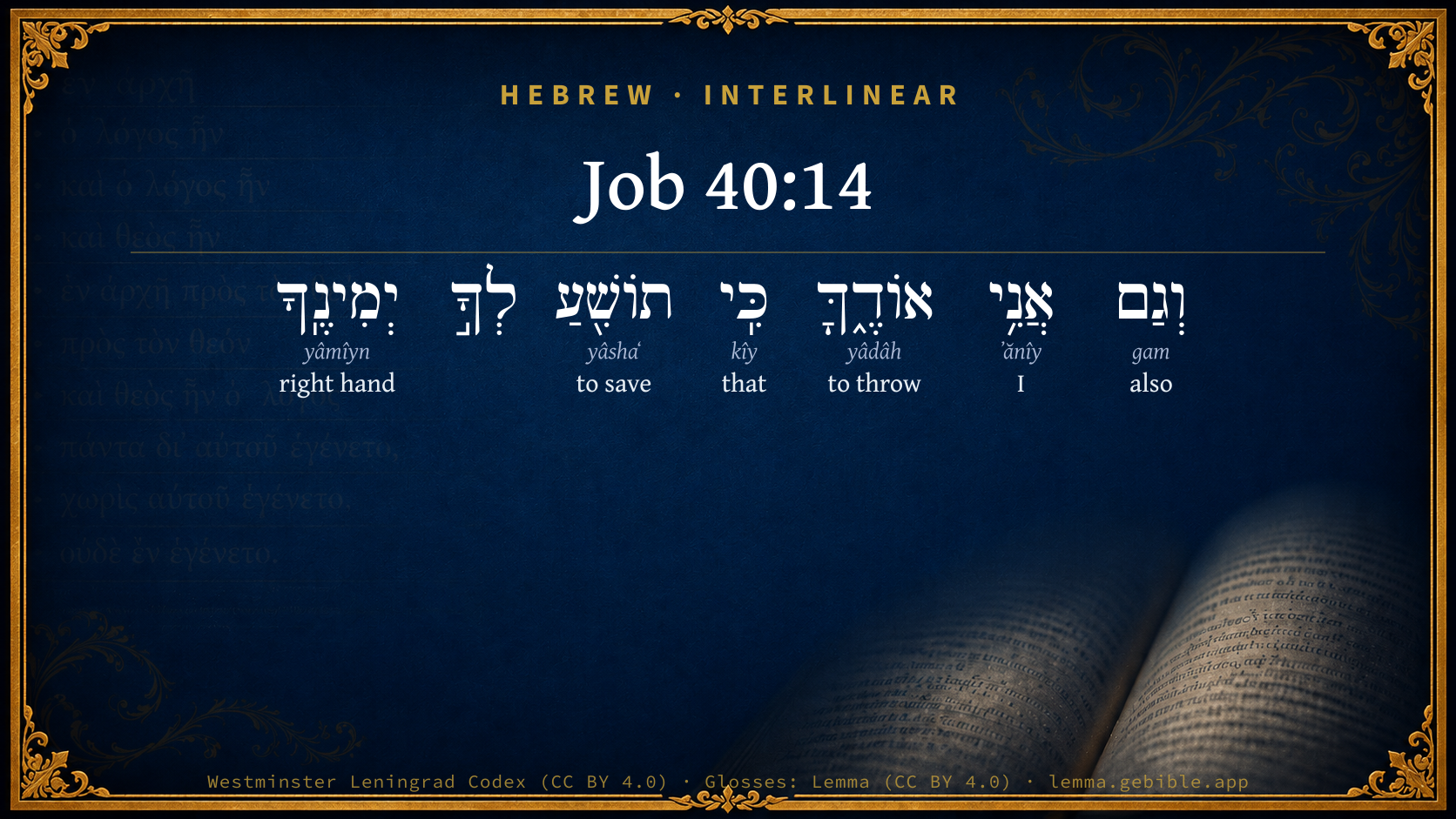
  1. וְגַם gam H1571 “and · also” Conjunction + Particle, Accusative
  2. אֲנִ֥י ʼănîy H589 “I” Pronoun, Personal, 1st Person, Common, Singular
  3. כִּֽי kîy H3588 “that” Conjunction
  4. תוֹשִׁ֖עַ yâshaʻ H3467 “to save” Verb, Hiphil, Imperfect, 3rd Person, Feminine, Singular
  5. יְמִינֶֽךָ yâmîyn H3225 “right hand · your” Noun, Common, Feminine, Singular, Construct + Suffix, Personal, 2nd Person, Masculine, Singular

About this verse

These counts appear in no published source. They are computed here, from the morphology-tagged text and Lemma’s own curated glosses. What Lemma adds →

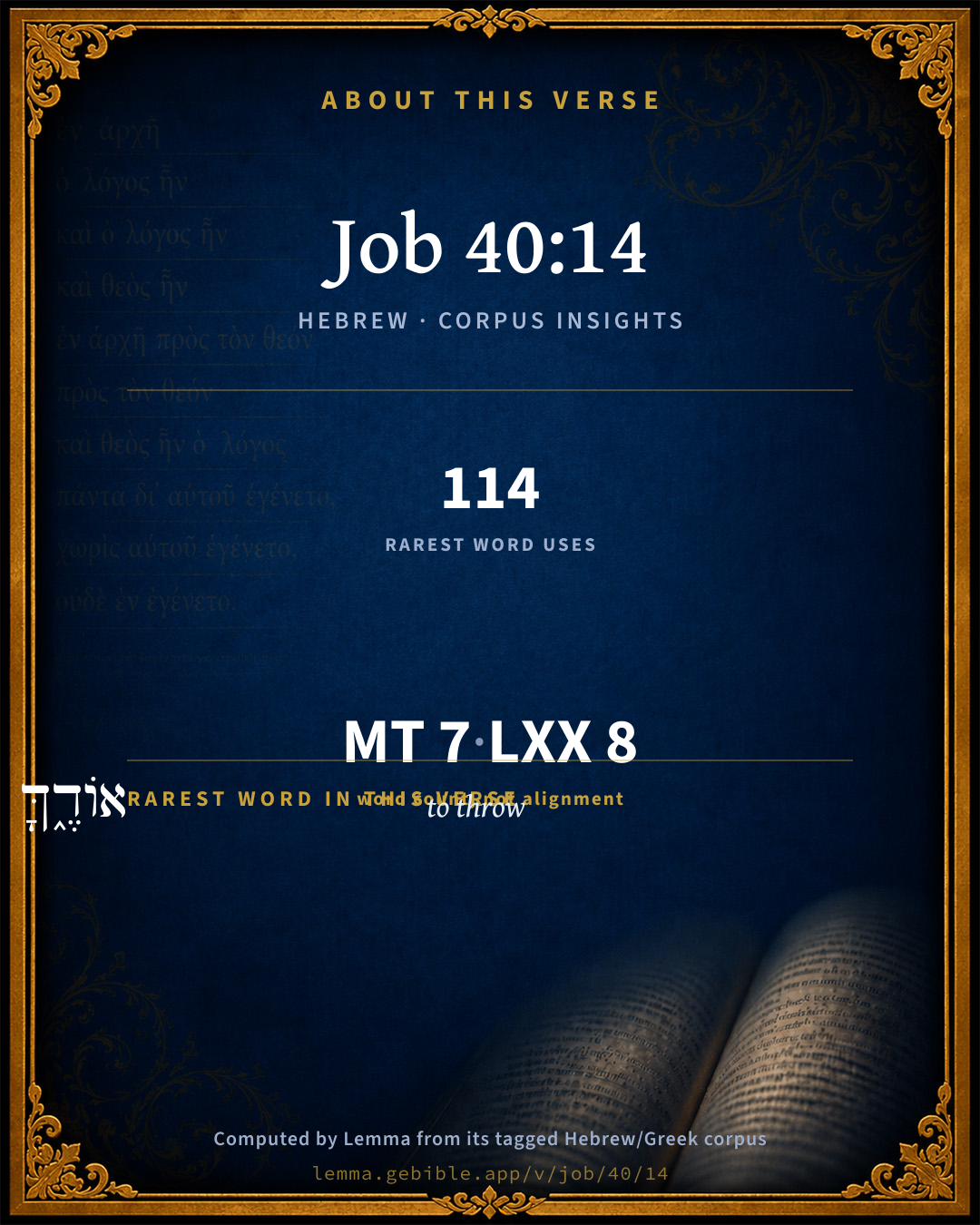
7
words
6
distinct lemmas
Wisdom
section

Grammatical profile

  • 2 verbs
  • 1 noun
  • 1 pronoun
  • 1 preposition
  • 1 conjunction
  • 1 particle

Verb forms

  • אוֹדֶ֑ךָּ Hiphil · Imperfect
  • תוֹשִׁ֖עַ Hiphil · Imperfect

Hebrew & Septuagint length

In English translation the verse runs 15 words from the Hebrew and 18 from the Septuagint (LXX English) — closely comparable.

A rough comparison of the two English renderings, which tokenize alike — not a word-level alignment.

Word counts can differ between the Hebrew and the Greek without any difference in meaning — e.g. the Hebrew direct-object marker אֵת has no separate Greek word, and Greek often adds the article ὁ.

In the original languages it is 7 Hebrew tokens and 8 Greek tokens — but the two are counted differently (Hebrew bundles its prefixes and suffixes into one token; the Greek is in lemma form), so that isn’t a like-for-like length.

Cross-references

5

Topical passages linked to Job 40:14 in the Treasury of Scripture Knowledge — connected by theme and wording, ordered by reader-vote popularity; previews shown in the World English Bible.

  • Psalms 44:3 For they didn't get the land in possession by their own sword, Neither did their own arm save them; But your right hand, and your arm, and the light of your face, Because you were favorable to them.
  • Psalms 44:6 For I will not trust in my bow, Neither shall my sword save me.
  • Isaiah 40:29 He gives power to the faint; and to him who has no might he increases strength.
  • Romans 5:6 For while we were yet weak, at the right time Christ died for the ungodly.
  • Ephesians 2:4–9 But God, being rich in mercy, for his great love with which he loved us,

Cross-references courtesy of OpenBible.info (CC BY 4.0).

Hebrew and Greek witnesses Masoretic Hebrew ↔ Greek Septuagint

The same verse in the two great witnesses to the Old Testament, shown verse-for-verse.

These are two independent witnesses, not word-aligned to each other, and the Septuagint is shown in lemma (dictionary) form.

Hebrew Job 40:14 Masoretic · Westminster Leningrad Codex

וְגַם אֲנִ֥י אוֹדֶ֑ךָּ כִּֽי תוֹשִׁ֖עַ לְךָ֣ יְמִינֶֽךָ

Then I will also admit to you That your own right hand can save you.

World English Bible · Public Domain

Greek LXX Job 40:14 Septuagint · lemma form

ὁμολογέω ἄρα ὅτι δύναμαι ὁ δεξιός σύ σώζω

This is the chief of the creation of the Lord; made to be played with by his angels.

LXX2012 (modern English Septuagint) · Public Domain

On this verse, John Gill's Exposition discusses the Septuagint’s reading. Read the note in Commentary ↓

Hebrew: Westminster Leningrad Codex (CC BY 4.0). Greek: Septuagint (public domain); English from LXX2012 (modern English Septuagint) (Public Domain). How the Septuagint differs from the Hebrew →

Commentary

Notes on Job 40:14 from classic Christian and Jewish commentators (each source and its license shown beneath its notes). The classic Christian expositions comment on the surrounding passage and are grouped to its opening verse, so a note may address several verses; the Jewish commentaries on the Tanakh (Rashi and others) are per-verse, so they appear only where the commentator wrote on this verse.

Lemma curates 59 commentaries, every one of them public domain or Creative Commons licensed, each selected and text-cleaned for this edition rather than reprinted as found. About our sources →

Trapp's Complete Commentary

John Trapp

Job 40:14 Then will I also confess unto thee that thine own right hand can save thee.

Ver. 14. Then will I also confess unto thee, &c.] Or, I will give praise unto thee, as thou by right shouldest do to me; not for my goodness only, but for my greatness and majesty also, in destroying the wicked. See David doing it, Psa 18:27, and Moses, Exo 15:1, and the whole choir of heaven, Rev 19:1-2.

And that thine own right hand can save thee] That thou art self sufficient, and my peer; strong enough to maintain thine own cause, and that thou hast some show of reason to withstand me, Et ego quoque praedicabo te heroa (Tig.). This is that which we all naturally, but foolishly, fancy, viz. that we are petty gods within ourselves; we would be absolute and independent, when in truth all that we have is derivative: the Church’s beauty is borrowed, Eze 16:3-14, and we may say of all that we are, as he did with his hatchet, Alas! master, I borrowed it, 2Ki 6:5.

John Trapp, A Commentary or Exposition upon All the Books of the Old and New Testament (1647–1656) — public domain. Text from a community e-Sword module.

Geneva Bible (1599)

Geneva Bible translators

He is one of the chiefest works of God among the beasts.

Though man dare not come near him, yet God can kill him.

Geneva Bible (1599) marginal notes — public domain. Text via Bolls.life.

Jamieson, Fausset & Brown

Robert Jamieson, A. R. Fausset & David Brown

confess--rather, "extol"; "I also," who now censure thee. But since thou canst not do these works, thou must, instead of censuring, extol My government.

thine own . . . hand . . . save-- (Psa 44:3). So as to eternal salvation by Jesus Christ (Isa 59:16; Isa 63:5).

Jamieson, Fausset & Brown — Commentary Critical and Explanatory on the Whole Bible (1871) — public domain (CC PDM 1.0). Text via the HelloAO Bible API.

Adam Clarke's Commentary

Verse 14. Thine own right hand can save thee.] It is the prerogative of God alone to save the human soul. Nothing less than unlimited power, exerted under the direction and impulse of unbounded mercy, can save a sinner. This is most clearly asserted in this speech of Jehovah: When thou canst extend an arm like God, i.e., an uncontrollable power - when thou canst arm thyself with the lightning of heaven, and thunder with a voice like God - when thou canst deck thyself with the ineffable glory, beauty, and splendour of the supreme majesty of Jehovah - when thou canst dispense thy judgments over all the earth, to abase the proud, and tread down the wicked - when thou canst as having the keys of hell and death, blend the high and the low in the dust together; then I will acknowledge to thee that thy own right hand can save thee. In other words: Salvation belongeth unto the Lord; no man can save his own soul by works of righteousness which he has done, is doing, or can possibly do, to all eternity. Without Jesus every human spirit must have perished everlastingly. Glory be to God for his unspeakable gift!

Adam Clarke's Commentary on the Bible (1810–1826) — public domain. Text from a community e-Sword/MySword module.

The Cambridge Bible for Schools and Colleges

gen. ed. J. J. S. Perowne

14. The verse reads,

Then will I also praise thee,

That thine own right hand can save thee.

If Job will shew himself worthy of that place to which he aspires when he reproves the rule of God in the universe, then even Jehovah Himself, who elsewhere says, “Is there a God beside me? yea there is no God; I know not any” (Isa_44:8), will admit his independent might, and laud him as one whose own right hand can save him, comp. Psa_98:1; Isa_59:16; Isa_63:5.

15—ch. Job_41:34. Description of two monsters, Behemoth and Leviathan.

Many writers consider the two passages, ch. Job_40:15-24 and ch. 41, in which Behemoth and Leviathan are described, to be interpolations (see the Introduction). Whether the passages be interpolations or parts of the original poem, the meaning of their introduction in this place will be the same.

In ch. Job_40:6-14 Jehovah invited Job to assume the rule of the world, and to bring low all opposing forces of evil. He is able to do this, seeing he challenges the rule of the Almighty. And to bring to his consciousness whether he is able or not two creatures, the work of God’s hand like himself (Job_40:15), are brought before him and the question put, Is he able to enter into conflict with them and subdue them? Is he therefore able to assume the rule of the world or to enter into conflict with the Creator of these formidable monsters?—“Who then will stand before me?” ch. Job_41:9-11.

The Cambridge Bible for Schools and Colleges (gen. ed. J. J. S. Perowne; Cambridge University Press, 1878–1918) — public domain. Text from a community e-Sword module.

John Gill's Exposition

Then will I also confess unto thee that thine own right hand can save thee. From all his enemies temporal and spiritual, and out of all evils and calamities whatsoever; and that he stood in no need of his help and assistance, yea, that he was a match for him, and might be allowed to contend with him; but whereas he was not able to do the above things proposed to him, it could not be admitted that his own right hand could save him; and therefore ought quietly to submit to the sovereignty of God over him, and to all the dispensations of his providence, and be humbled under his mighty hand, since no hand but his could save him; as no man's right hand can save him from temporal evils and enemies, and much less from spiritual ones, or with an everlasting salvation; nor any works of righteousness done by him, only the arm of the Lord has wrought salvation, and his right hand only supports and saves. Two instances are given in this and the following chapter, the one of a land animal, the other of a sea animal, as is generally supposed; or it may be of amphibious ones, that live both on land and water.

Then will I also confess unto thee that thine own right hand can save thee. From all his enemies temporal and spiritual, and out of all evils and calamities whatsoever; and that he stood in no need of his help and assistance, yea, that he was a match for him, and might be allowed to contend with him; but whereas he was not able to do the above things proposed to him, it could not be admitted that his own right hand could save him; and therefore ought quietly to submit to the sovereignty of God over him, and to all the dispensations of his providence, and be humbled under his mighty hand, since no hand but his could save him; as no man's right hand can save him from temporal evils and enemies, and much less from spiritual ones, or with an everlasting salvation; nor any works of righteousness done by him, only the arm of the Lord has wrought salvation, and his right hand only supports and saves. Two instances are given in this and the following chapter, the one of a land animal, the other of a sea animal, as is generally supposed; or it may be of amphibious ones, that live both on land and water.

Job 40:15

job 40:15

job 40:15

job 40:15Behold, now behemoth,.... The word is plural, and signifies beasts, and may be used to denote the chiefest and largest of beasts, and therefore is commonly understood of the elephant; and certain it is that a single beast is described in the following account, and so the word is rendered, Psa 73:22; The word is here rendered by the Septuagint "beasts"; which is the word used by the Greeks (c) for elephants as "belluae", a word of the same signification, is by the Latins (d): and so the Sabines called an elephant "barrus", and the Indians "barro" (e), a "beast"; and it may be observed, that ivory is called "shenhabbim", Kg1 10:22; that is, "shenhabehim", "behem" or "behemoth" (f), the tooth of the beast: and it may be also observed, that Seneca (g) says, that the Nile produces beasts like the sea; meaning particularly the crocodile and hippopotamus. Bochart dissents from the commonly received opinion of the elephant being meant; and thinks the "hippopotamus", or river horse, is intended so called from its having a head like a horse; and is said to have a mane, and to neigh like one, and to bear some resemblance to it in its snout, eyes, ears, and back (h). And the reasons that celebrated author has given for this his opinion have prevailed on many learned men to follow him; and there are some things in the description of behemoth, as will be observed, which seem better to agree with the river horse than with the elephant. It is an amphibious creature, and sometimes lives upon the land, and sometimes in the water; and by various (i) writers is often called a beast and four footed one:

which I made with thee; or as well as thee; it being equally the work of my hands, a creature as thou art: or made on the continent, as than art, so Aben Ezra; and made on the same day man was made; which those observe, who understand it of the elephant; or, which cometh nearest to thee, the elephant being, as Pliny (k) says, the nearest to man in sense; and no beast more prudent, as Cicero (l) affirms. But the above learned writer, who interprets it of the river horse, takes the meaning of this phrase to be; that it was a creature in Job's neighbourhood, an inhabitant of the river Nile in Egypt, to which Arabia joined, where Job lived; which is testified by many writers (m): and therefore it is thought more probable that a creature near at hand, and known should be instanced in, and not one that it may be was never seen nor known by Job. But both Diodorus Siculus (n) and Strabo (o) speak of herds of elephants in Arabia, and of that as abounding: with them; and of various places called from them, and the hunting of them, and even of men from eating them;

he eateth grass as an one; which is true both of the elephant and of the river horse: that a land animal should eat grass is not so wonderful; but that a creature who lives in the water should come out of it and eat grass is very strange and worthy of admiration, it is observed: and that the river horse feeds in corn fields and on grass many writers (p) assure us; yea, in the river it feeds not on fishes, but on the roots of the water lily, which fishermen therefore use to bait their hooks with to take it. Nor is it unlike an ox in its shape, and in some parts of its body: hence the Italians call it "bomaris", the "sea ox"; but it is double the size of an ox (q). Olaus Magnus (r) speaks of a sea horse, found between Britain and Norway; which has the head of a horse, and neighs like one; has cloven feet with hoofs like a cow; and seeks its food both in the sea and on the land, and grows to the bigness of an ox, and has a forked tail like a fish.

(See Definition for 0930. Editor)

(c) Suidas in voce Plutarch in Eumenc. (d) Terent. Eunuch. Act. 3. Sc. 1. Plin. Nat. Hist. l. 8. c. 3. (e) Isidor. Origin. l. 12, c. 2. Vid. Horat. Epod. 12. v. 1. (f) Hiller. Oaomastic, Sacr. p. 434. (g) Nat. Quaest. l. 4. c. 2. (h) Vid. lsidor. Origin. l. 12. c. 6. Plin. Nat. Hist. l. 8. c. 25. Aristot. Hist. Animal. l. 2. c. 7. (i) Herodot. Euterpe, sive, l. 2. c. 71. Plin. ib. Ammian, Marcellin. l. 22. Leo African. Descript. African, l. 9. p. 758. (k) Nat. Hist. l. 8. c. 1. (l) De Natur. Deor. l. 1. (m) Solin. Polyhist. c. 45. Aelian. de Animal. l. 5. c. 53. Philo de Praemiis, p. 924. Plin. Afric. ut supra. (Nat. Hist. l. 8. c. 1.) (n) Bibliothec. l. 2. p. 136. & l. 3. p. 173, 174, 175. (o) Geograph. l. 16. p. 531, 533. (p) Diodor. Sic. l. 1. p. 31. Aelian. Plin. Solin. Ammian. ut supra. (q) Ludolf. Ethiop. Hist. l. 1. c. 11. (r) De Ritu Septent. Gent. l. 21. c. 26.

John Gill's Exposition of the Whole Bible (1746–1763) — public domain (CC PDM 1.0). Text via the HelloAO Bible API.

Albert Barnes' Notes on the Bible

Then will I also confess unto thee ... - If you can do all this, it will be full proof that you can save yourself, and that you do not need the divine interposition. If he could do all this, then it might be admitted that he was qualified to pronounce a judgment on the divine counsels and dealings. He would then show that he had qualifications for conducting the affairs of the universe.

Albert Barnes' Notes on the Bible (1834–1885) — public domain. Text from a community e-Sword/MySword module.

Haydock's Catholic Bible Commentary

Beginning, or prince. (Haydock) --- The elephant may be considered as the king of beasts for strength, agility, gratitude, longevity, &c. None approaches so near to man. (Pliny viii. 1.; Calmet; Lipsius, 1 ep. 50.; Amama) --- Sword; which is the rhinoceros, killing the elephant under the belly with its horn; (Pliny viii. 20.; Grotius) or God seems to have entrusted his sword to the elephant, for the destruction of his enemies. Nothing can withstand its fury, as it overturns houses and trees with its trunk. (Junius) (Calmet)

George Leo Haydock (1774–1849), Haydock's Catholic Family Bible and Commentary, 1859 edition — public domain. Excludes Psalms (Douay-Rheims chapter numbering differs from Protestant) and Deuterocanonical books (Catholic canon only).

Matthew Poole's English Annotations

i.e. That thou art mine equal, and mayst venture to contend with me. But since thou canst do none of these things, it behoves thee to submit to me, and to acquiesce in my dealings with thee.

Matthew Poole's English Annotations on the Holy Bible (1683–1685) — public domain. Text from a community e-Sword/MySword module.

Whedon's Commentary on the Bible

Daniel D. Whedon

14. Confess unto — The Hebrew also means praise, and is thus rendered by Ewald, Delitzsch, etc. If Job can do all this which God has suggested, then God will acknowledge that he is not only great in speech and faultfinding, (Hirtzel,) but that he is mighty to “save himself,” and able to carry into execution his inflated ideas of justice.

Daniel D. Whedon (gen. ed.), Commentary on the Old and New Testaments (1874–1909) — public domain. Text from a community e-Sword module.

The Pulpit Commentary

Then will I also confess unto thee that thine own right hand and save thee. When he has done what he has been challenged to do in vers. 9-13, then Job may venture to contend with God. He will have established his own independence, and God will acknowledge him as an antagonist entitled to argue with him.

Self-salvation.

When Job is strong enough to humble the proud he may be able to save himself; but as he cannot do the first work he is not equal to the second. Thus we are introduced to the impossibility of self-salvation.

I THE VAIN ATTEMPT. Men are continually trying to save themselves.

1. In danger. We feel that we need deliverance. Job desired to be saved from disease, poverty, injustice, cruelty. We all wish to escape from trouble. Some of us may be more anxious to escape from sin, our greatest enemy. There are evils, then, and the perception of them urges us to save ourselves.

2. In distrust. We ought to look to the Almighty for strength, and to the All-merciful for deliverance. But if we forget God we are tempted to rely on the arm of flesh. If we had a due appreciation of God"s ability and willingness to save, we should not dream of trying to save ourselves.

3. In self-confidence. We must think little of our sin, or much of ourselves, if we imagine that we can effect our own salvation. We have not yet discovered our own weakness, nor the depth of our fall, if we suppose that there is no greater mischief with us than what we can remedy.

II THE CERTAIN FAILURE. No man has yet saved himself. Is it likely that the latest to try the experiment will succeed? We have not yet conquered our own hearts, although we have often determined to do so. Is it probable that our next attempt will be more successful? There are good grounds for being assured that it will not.

1. The greatness and power of sin. No one who has not tried to break its yoke knows how terrific this is. We simply cannot get away from our own sin. Not only does the sin harden into a habit and so become a second nature, but it weakens the moral fiber of the soul. The prisoner languishing in the dungeon is not only held in by stone walls and iron bars, but the unhealthy condition of his confinement weakens his body so that he has not strength to break away from even smaller constraints.

2. The justice of God. This does not hold us to our sin, but it binds us to its consequences. We cannot deny that we deserve the wrath of Heaven. We cannot atone for sin. All our subsequent service is no more than is due from us, and the old debt still remains uncanceled.

III THE GLORIOUS ALTERNATIVE. We have to learn that we cannot save ourselves, not merely to discourage useless efforts, but to lead us to the true salvation of God. What we cannot do for ourselves God can and will do if we will let him.

1. Though Jesus Christ. He was called Jesus because he would save his people from their sins. (Mat_1:21) He is the "Lamb of God which taketh away the sin of the world". (Joh_1:29) Christ delivers from sin as well as from its result death. His power to save springs from his atoning sacrifice; but he saves now as a living, present Redeemer. He is the hand of God put forth to deliver the helpless and ruined.

2. In regeneration. We need to be born again. (Joh_3:3) So great a change cannot be brought about by ourselves; Christ alone can effect it. He has not come so much to bestow on us gifts as to change our whole life, so that we may become new creatures in Christ Jesus. W.F.A. (2Co_5:17)

The Pulpit Commentary (1880–1919), ed. H.D.M. Spence-Jones & Joseph S. Exell — public domain. Text from a community e-Sword module.

Lesson kit

Teaching starters — assembled from the data on this page, not authored interpretation. Every prompt links to the verse data it draws on. Edit before teaching.

Job, in the Wisdom, opens this verse with 7 words (6 distinct Hebrew lemmas). Its most distinctive word is yâdâh (“to throw”). A historical commentator’s framing appears above. Read the whole chapter for the surrounding context.

Discussion questions

  1. The word yâdâh carries the sense “to throw.” How does it shape the verse?
  2. Psalms 44:3 shares this passage’s theme. How do the two illuminate each other?
  3. These translations render this verse differently; the difference is in the English rendering, not the original. What questions does that raise?
  4. The verb «אוֹדֶ֑ךָּ» is Hiphil Imperfect. How does its form color the action?
  5. Reading how Trapp's Complete Commentary and Geneva Bible (1599) read this verse, where do the two commentators agree and where do they part?

Things to notice

Reading settings

Reading text

Shown beneath each verse's original-language words.

Old Testament
Old Testament edition

Read the OT as the Masoretic Hebrew (MT) or the Greek Septuagint (LXX).

English shown for the Greek Septuagint (in the Hebrew ↔ Greek comparison).

Comparing translations? Open the Compare panel on any verse page to stack up to four side by side.