
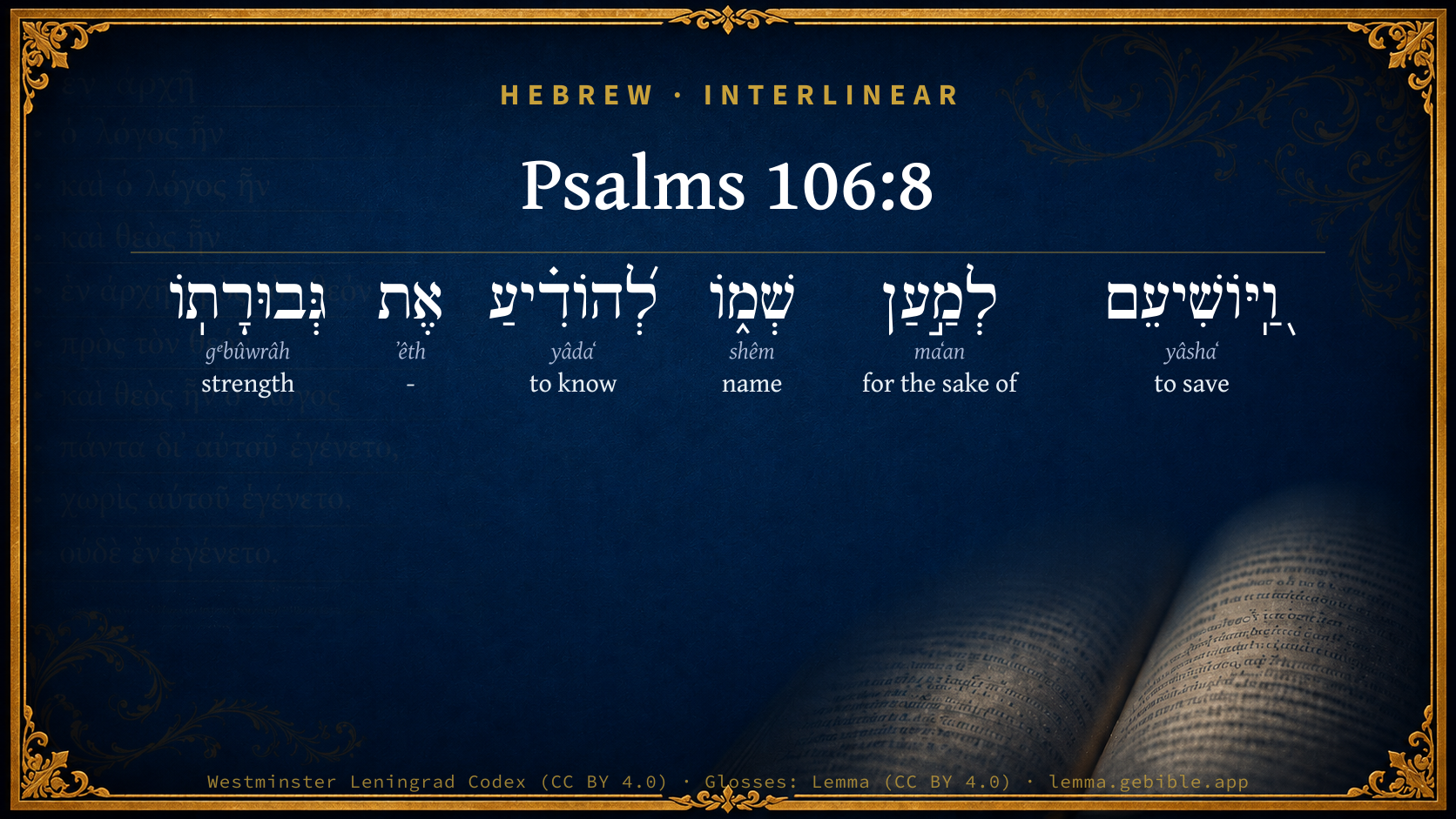
Psalms 106:8

Hebrew (Westminster Leningrad Codex) Psalms 106:8 appears in the Hebrew Old Testament. The text above is from the Westminster Leningrad Codex. Each word links to its Strong’s number, a concise gloss, and parsing drawn from the Open Scriptures Hebrew Bible morphology. Click any word for its full Brown-Driver-Briggs (BDB) entry.
Download image
Cite this verse

Psalms 106:8 (World English Bible). Public Domain. Lemma interlinear Bible study tool, https://lemma.gebible.app/v/psalms/106/8.

Show BibTeX & RIS
BibTeX
RIS
English Translation
Nevertheless he saved them for his name's sake, That he might make his mighty power known.
World English Bible · Public Domain
Download a study sheet

One document with this verse’s original text, its word-by-word gloss line, the meaning frame, cross-references with their text, attributed commentary, and full source and license credits — printable, and it pastes into notes with its structure intact.

This verse Autodidact and up

Study sheet (.html) Plain text (.txt)

A passage Seminary Student

Up to 50 verses in one chapter. A passage sheet keeps up to 6 commentary sources and 12 cross-references per verse, in the order this page ranks them, and says so on the sheet whenever that leaves anything out. Ask for a single verse and you get the Autodidact verse sheet above.

Everything on this page stays free to read, with no account — the sheet is a download of what is already on screen, not access to it.

Want to remove ads? Support Godless Engineer
Compare translations 3

The same verse in 3 English versions, stacked beneath the original-language interlinear above. Click any original word for its lexicon entry.

Each is an independent rendering of the whole verse — the interlinear is not word-aligned to these translations.

Highlighted words mark where these versions differ — a whole-verse word diff, not a word-by-word alignment.

  • World English Bible Public Domain
    Nevertheless he saved them for his name's sake, That he might make his mighty power known.
  • King James Version Public Domain
    Nevertheless he saved them for his name's sake, that he might make his mighty power to be known.
  • unfoldingWord Literal Text CC BY-SA 4.0
    But he saved them on account of his name, to make known his power.

unfoldingWord Literal Text — © unfoldingWord, licensed CC BY-SA 4.0. Word-aligned USFM3 via Door43 (git.door43.org/unfoldingWord/en_ult).

Versions to compare (up to 4)

3 of 4 selected

Show all 18 translations

Every available English version of this verse, each an independent rendering of the whole verse.

  • World English Bible Public Domain
    Nevertheless he saved them for his name's sake, That he might make his mighty power known.
  • Berean Standard Bible Public Domain
    Yet He saved them for the sake of His name, to make His power known.
  • Majority Standard Bible Public Domain
    Yet He saved them for the sake of His name, to make His power known.
  • King James Version Public Domain
    Nevertheless he saved them for his name's sake, that he might make his mighty power to be known.
  • American Standard Version (1901) Public Domain
    Nevertheless he saved them for his name's sake, That he might make his mighty power to be known.
  • Revised Version (1885) Public Domain
    Nevertheless he saved them for his name’s sake, that he might make his mighty power to be known.
  • Geneva Bible (1599) Public Domain
    Neuerthelesse he saued them for his Names sake, that he might make his power to be knowen.
  • Douay-Rheims (1899) Public Domain
    And he saved them for his own name's sake: that he might make his power known.
  • Young's Literal Translation Public Domain
    And He saveth them for His name's sake, To make known His might,
  • Literal Standard Version CC BY-SA 4.0
    And He saves them for His Name’s sake, || To make His might known,
  • Unlocked Literal Bible CC BY-SA 4.0
    Nevertheless, he saved them for his name's sake so that he might reveal his power.
  • unfoldingWord Literal Text CC BY-SA 4.0
    But he saved them on account of his name, to make known his power.
  • Darby Bible Public Domain
    Yet he saved them for his name's sake, that he might make known his might.
  • World Messianic Bible Public Domain
    Nevertheless he saved them for his name’s sake, that he might make his mighty power known.
  • Webster's Bible Public Domain
    Nevertheless he saved them for his name's sake, that he might make his mighty power to be known.
  • Free Bible Version CC BY-SA 4.0
    Even so he saved them because of the kind of person he is, and to show his power
  • Bible in Basic English Public Domain
    But he was their saviour because of his name, so that men might see his great power.
  • JPS Tanakh (1917) Public Domain
    Nevertheless He saved them for His name's sake, that He might make His mighty power to be known.

Literal Standard Version (2020), Covenant Press — licensed CC BY-SA 4.0. Text via the HelloAO Bible API (eBible.org). Unlocked Literal Bible (unfoldingWord) — licensed CC BY-SA 4.0. Text via the HelloAO Bible API (eBible.org). unfoldingWord Literal Text — © unfoldingWord, licensed CC BY-SA 4.0. Word-aligned USFM3 via Door43 (git.door43.org/unfoldingWord/en_ult). Free Bible Version, Dr. Jonathan Gallagher — licensed CC BY-SA 4.0. Text via the HelloAO Bible API (eBible.org).

Word by word

More ways to search: Search by grammar → Find every occurrence → Compare this word →

Practice this passage: Drill this verse → Learn its vocabulary →

About this verse

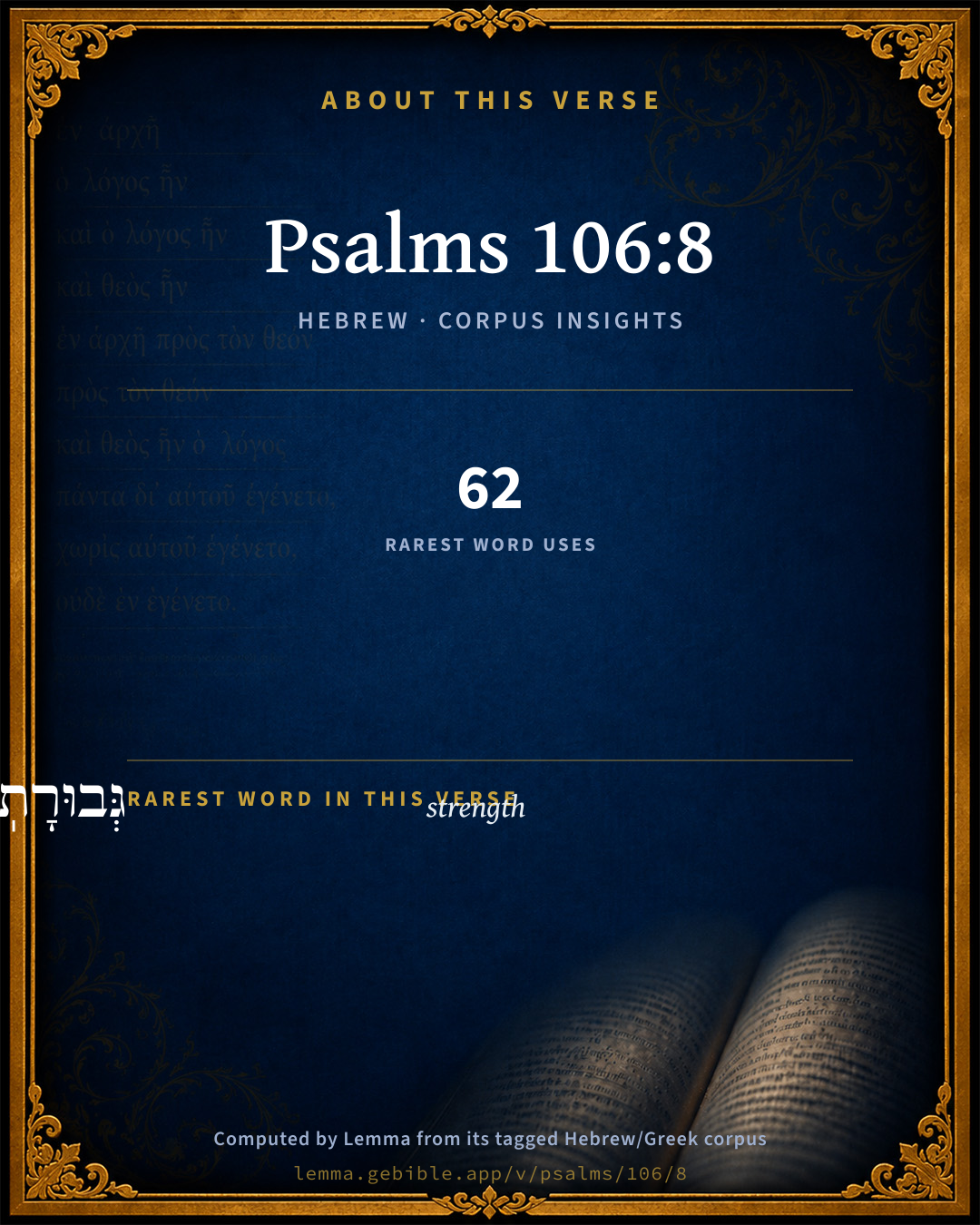
These counts appear in no published source. They are computed here, from the morphology-tagged text and Lemma’s own curated glosses. What Lemma adds →

6
words
6
distinct lemmas
Wisdom
section

Grammatical profile

  • 2 verbs
  • 2 nouns
  • 1 preposition
  • 1 particle

Verb forms

  • וַֽ֭יּוֹשִׁיעֵם Hiphil · Sequential Imperfect
  • לְ֝הוֹדִ֗יעַ Hiphil · Infinitive Construct

Hebrew & Septuagint length

In English translation the verse runs 16 words from the Hebrew and 18 from the Septuagint (LXX English) — closely comparable.

A rough comparison of the two English renderings, which tokenize alike — not a word-level alignment.

Word counts can differ between the Hebrew and the Greek without any difference in meaning — e.g. the Hebrew direct-object marker אֵת has no separate Greek word, and Greek often adds the article ὁ.

Cross-references

15

Topical passages linked to Psalms 106:8 in the Treasury of Scripture Knowledge — connected by theme and wording, ordered by reader-vote popularity; previews shown in the World English Bible.

  • Exodus 9:16 but indeed for this cause I have made you stand: to show you my power, and that my name may be declared throughout all the earth;
  • Ezekiel 20:9 But I worked for my name's sake, that it should not be profaned in the sight of the nations, among which they were, in whose sight I made myself known to them, in bringing them forth out of the land of Egypt.
  • Ezekiel 20:14 But I worked for my name's sake, that it should not be profaned in the sight of the nations, in whose sight I brought them out.
  • Jeremiah 14:21 Do not abhor [us], for your name's sake; do not disgrace the throne of your glory: remember, don't break your covenant with us.
  • Ezekiel 20:22 Nevertheless I withdrew my hand, and worked for my name's sake, that it should not be profaned in the sight of the nations, in whose sight I brought them forth.
  • Ezekiel 20:44 You shall know that I am Yahweh, when I have dealt with you for my name's sake, not according to your evil ways, nor according to your corrupt doings, you house of Israel, says the Lord Yahweh.
  • Romans 9:17 For the Scripture says to Pharaoh, "For this very purpose I caused you to be raised up, that I might show in you my power, and that my name might be published abroad in all the earth."
  • Exodus 15:6 Your right hand, Yahweh, is glorious in power, Your right hand, Yahweh, dashes the enemy in pieces.
  • Numbers 14:13–16 Moses said to Yahweh, Then the Egyptians will hear it; for you brought up this people in your might from among them;
  • Deuteronomy 32:26–27 I said, I would scatter them afar, I would make the memory of them to cease from among men;
  • Joshua 7:9 For the Canaanites and all the inhabitants of the land will hear of it, and will compass us round, and cut off our name from the earth: and what will you do for your great name?
  • Daniel 9:17–19 Now therefore, our God, listen to the prayer of your servant, and to his petitions, and cause your face to shine on your sanctuary that is desolate, for the Lord's sake.
  • Psalms 111:6 He has shown his people the power of his works, In giving them the heritage of the nations.
  • Psalms 143:11 Revive me, Yahweh, for your name's sake. In your righteousness, bring my soul out of trouble.
  • Jeremiah 14:7 Though our iniquities testify against us, work you for your name's sake, Yahweh; for our backslidings are many; we have sinned against you.

Cross-references courtesy of OpenBible.info (CC BY 4.0).

Hebrew and Greek witnesses Masoretic Hebrew ↔ Greek Septuagint

The same verse in the two great witnesses to the Old Testament, shown verse-for-verse.

You’re reading Greek Psalm 105 (Hebrew Psalm 106). The Septuagint counts the superscription, so verse numbers can differ from the Hebrew — chapter-level alignment, not verse-by-verse. Numbering follows Rahlfs.

These are two independent witnesses, not word-aligned to each other, and the Septuagint is shown in lemma (dictionary) form.

Hebrew Psalms 106:8 Masoretic · Westminster Leningrad Codex

וַֽ֭יּוֹשִׁיעֵם לְמַ֣עַן שְׁמ֑וֹ לְ֝הוֹדִ֗יעַ אֶת גְּבוּרָתֽוֹ

Nevertheless he saved them for his name's sake, That he might make his mighty power known.

World English Bible · Public Domain

Greek LXX Greek Psalm 105:8 Septuagint · lemma form

καί σώζω αὐτός ἕνεκεν ὁ ὄνομα αὐτός ὁ γνωρίζω ὁ δυναστεία αὐτός

Yet he saved them for his name's sake, that he might cause his mighty power to be known.

LXX2012 (modern English Septuagint) · Public Domain

Hebrew: Westminster Leningrad Codex (CC BY 4.0). Greek: Septuagint (public domain); English from LXX2012 (modern English Septuagint) (Public Domain). How the Septuagint differs from the Hebrew →

Commentary

Notes on Psalms 106:8 from classic Christian and Jewish commentators (each source and its license shown beneath its notes). The classic Christian expositions comment on the surrounding passage and are grouped to its opening verse, so a note may address several verses; the Jewish commentaries on the Tanakh (Rashi and others) are per-verse, so they appear only where the commentator wrote on this verse.

Lemma curates 59 commentaries, every one of them public domain or Creative Commons licensed, each selected and text-cleaned for this edition rather than reprinted as found. About our sources →

Trapp's Complete Commentary

John Trapp

Psa 106:8 Nevertheless he saved them for his name’s sake, that he might make his mighty power to be known.

Ver. 8. Nevertheless he saved them for his name’s sake] Here he comes, in with a Non-obstante. So Isa 57:17. Now, if God will save for his name’s sake, what people is there whom he may not save?

That he might make his miqhly power to be known] The Lord hath other things to look unto than presently to punish his people when they most deserve it.

John Trapp, A Commentary or Exposition upon All the Books of the Old and New Testament (1647–1656) — public domain. Text from a community e-Sword module.

The Biblical Illustrator

Joseph S. Exell

Psa_106:8

Nevertheless He saved them for His names sake.

Why are men saved?

I. A glorious Saviour--He saved them. Who is to be understood by that pronoun he? Possibly many may answer, Why, the Lord Jesus Christ is the Saviour of men. Right; but not all the truth. Jesus Christ is the Saviour; but not more so than God the Father, or God the Holy Ghost. Thou canst not be saved by the Son without the Father, nor by the Father without the Son, nor by Father and Son without the Spirit. But as they are one in creation, so are they one in salvation. But, note here, how this Divine being claims salvation wholly to Himself. Nevertheless He saved them. But, Moses, where art thou? Didst not thou save them, Moses? Thou didst stretch the rod over the sea, and it clave in halves. And thou, Aaron, thou didst offer the bullocks which God accepted; thou didst lead them, with Moses, through the wilderness. Wast not thou their Saviour? They answer, Nay, we were the instruments, but He saved them. God made use of us, but unto His name be all the glory, and none unto ourselves. But, Israel, thou wast a strong and mighty people; didst not thou save thyself? Perhaps it was by thine own holiness that the Red Sea was dried up; perhaps the parted floods were frighted at the piety of the saints that stood upon their margin; perhaps it was Israel that delivered itself. Nay, nay, saith Gods Word; He saved them; they did not save themselves, nor did their fellow-men redeem them.

II. The favoured persons. He saved them.Who are they? In the first place, they were a stupid people--Our fathers understood not Thy wonders in Egypt. In the next place, they were an ungrateful people--they remembered not the multitude of Thy mercies. In the third place, they were a provoking people--they provoked Him at the sea, even at the Red Sea. Ah, these are the people whom free grace saves, these are the men and these the women whom the God of all grace condescends to take to His bosom and to make anew.

III. The reason of salvation. For His names sake.

1. He saved them, first, that He might manifest His nature. God was all love, and He wanted to manifest it; He did show it when He made the sun, the moon, and the stars, and scattered flowers oer the green and laughing earth. He did show His love when He gave the air balmy to the body, and the sunshine cheering be the eye. How can I show them that, I love them with all My infinite heart? I will give My Son to die be save the very worst of them, and so will I manifest My nature. And God has done it; He has manifested His power, His justice, His love, His faithfulness, and His truth; He has manifested His whole self on the great platform of salvation.

2. He did it, again, to vindicate His name. Some say God is cruel; they wickedly call Him tyrant. Ah! says God, but I will save the worst of sinners, and vindicate My name; I will blot out the stigma; they shall not be able to say that, unless they be liars, for I will be abundantly merciful. I will take away this stain, and they shall see that My great name is a name of love. And said He, again, I will do this for My names sake; that is, to make these people love My name. I know if I take the best of men, and save them, they will love My name; but if I take the worst of men, oh, how they will love me! If I go and take some of the offscouring of the earth, and make them My children, oh, how they will love Me! Then they will cleave to My name; they will think it more sweet than music; it will be more precious to them than the spikenard of the Eastern merchants; they will value it as gold, yea, as much fine gold. The man who loves Me best, is the man who has most sins forgiven; he owes much, therefore he will love much. This is the reason why God often selects the worst of men to make them His. (C. H. Spurgeon.)

Salvation entirely free

God is a sovereign and jealous of:His prerogative. Especially is He jealous of the undivided honour of redeeming man from the degradation and ruins of the fall. In the salvation of sinners by Jesus Christ, He has taken, as it should seem, extraordinary pains to establish and illustrate this fact; for this reason; that therein He, or His name, is more deeply interested--that thereby His name is more highly magnified and more abundantly glorified, both in heaven and in earth, than by any other of His most stupendous works.

I. The nature of the salvation granted to the people of God. It is a spiritual and eternal salvation--a salvation of the sinner from the power, the love, the pollution, the practice, and the punishment of sin.

II. Upon what grounds or upon what terms this salvation is vouchsafed. For His names sake. By the name of God we may understand His person and attributes. For the sake, therefore, of illustrating His power, mercy, wisdom, truth and faithfulness, justice and holiness, He devised the great work of redemption.

III. In opposition to what impediments this salvation is vouchsafed. Nevertheless He saved them--nevertheless what? In spite of what, according to the calculations of reason and of conscience, were utterly insuperable difficulties. But, blessed be God, His thoughts are not as our thoughts. Notwithstanding therefore the sins of Israel were so numerous and so heinous He saved them; and to judge of their enormity you have only to consult this psalm--by which it appears they were guilty of the most abominable idolatries, of the blackest ingratitude, of the most determined rebellion. Notwithstanding all which God saved them for His names sake. Yes, and so likewise are we encouraged to hope that He will save us. (Essex Remembrancer.)

The Biblical Illustrator, edited by Joseph S. Exell (c. 1880s–1900s) — public domain. Text from a community e-Sword module.

Joseph Benson's Commentary

Psa 106:8-12. Nevertheless, he saved them for his name’s sake — That he might glorify his name, and vindicate it from the blasphemous reproaches which the Egyptians and others would have cast upon it if the Israelites had been destroyed. He rebuked the sea also — For standing in their way, and retarding their march; and it was dried up — Immediately; as, in the creation, at God’s rebuke the waters fled, Psa 104:7. He led them through the depths as through the wilderness — As securely as if they had walked upon the dry land. He saved them from him that hated them — From Pharaoh, who pursued them with cruel rage and hatred. The waters covered their enemies — So as to slay them, but not so as to conceal their shame; for, the next tide, they were thrown up dead upon the shore. There was not one of them left — To carry tidings what was become of the rest. Then believed they his words — The Israelites acknowledged that God was with them of a truth, and had, in mercy to them, brought them out of Egypt, and not with any design to slay them in the wilderness. Then they feared the Lord, and his servant Moses, Exo 14:31. They sang his praise — In that song of Moses, penned on this great occasion, Exo 15:1. Observe, reader, in what a gracious and merciful way God sometimes silences the unbelief of his people, and turns their fears into praises!

Joseph Benson's Commentary on the Old and New Testaments (1811–1818) — public domain. Text from a community e-Sword module.

J. A. Alexander on Psalms

Joseph Addison Alexander

8. (Psa 106:8) And he saved them for his name's sake, to make known his might. This is an answer to a tacit objection, namely, that their conduct had been sanctioned by God's saving them. True, he did save them, because they were necessary to his purpose. He saved them not for their sake but his own, to accomplish his own ends, and exhibit his own power.

Joseph Addison Alexander, The Psalms Translated and Explained (1850) — public domain. Text from a community e-Sword module.

Geneva Bible (1599)

Geneva Bible translators

The inestimable goodness of God appeareth in this, that he would change the order of nature, rather than his people should not be delivered, although they were wicked.

Geneva Bible (1599) marginal notes — public domain. Text via Bolls.life.

Adam Clarke's Commentary

Verse 8. He saved them for his name's sake] למען שמו lemaan shemo, "on account of his name;" to manifest his own power, goodness, and perfections. There was nothing which he could draw from them as a reason why he should save them; therefore he drew the reason from himself. There is a singular gloss in the old Psalter on this verse: "Whan thai cam oute of Egypt to the rede Se, whare thai were closed on a syde with a hylle that na man mygt passe: on another side was the rede See: behynde tham was men of Egypt foluand; and for this thai began to gruch, forgetand Gods mygt: bot than he safed tham, depertand the Se in twelfe, to ilk kynde of Isrel a passage." It seems as if this author thought there were twelve passages made through the Red Sea, that each tribe should have a passage to itself.

Adam Clarke's Commentary on the Bible (1810–1826) — public domain. Text from a community e-Sword/MySword module.

John Calvin's Commentaries

8 And saved them The prophet here teaches what any one could easily learn from the preceding sentence, that the Israelites were saved, not on account of their deserving to be so, but because God had a regard to his own glory. That obstacle being removed, God went on to accomplish that deliverance which he had commenced, in order that his holy name might not become a reproach among the heathen. Besides, we must not overlook the antithesis between the name of God and the merits of men, because God, out of a regard to his own glory, can find in us no cause wherefore he should be moved to save us. The inestimable kindness of God, which, for the sake of a people so perverse, altered the usual order of nature, is more illustriously displayed by the account which is afterwards given of the means by which they were preserved. When he says that the sea was rebuked, he extols the power of God, at whose command and will the sea was dried up — the waters receded, so that a free passage was opened up between the opposite heaps of waters. With the design of magnifying the miracle, he employs a similitude, which, in all likelihood, was drawn from Isaiah; for in the sixty-third chapter and thirteenth verse, he says, “Thou hast made thy people to walk through the deeps, as an horse in the wilderness, that he might not stumble.” When the people walked through the sea as upon a dry plain, the prophet informs us that this was done solely by the astonishing power of God. It is quite possible, that in the desert in which the people wandered, there was many an abyss, the path rugged, and many a hill and dale and ragged rock. But it cannot be doubted that the prophet extols the power of God in the passage through the sea, and enhances it by this consideration, that the path through that deep sea was smooth. Besides, he gives greater strength to the miracle in saying that their enemies were drowned; because, when the sea afforded a free passage to the children of Israel, and covered and engulfed the Egyptians, so that not one of them escaped alive, whence proceeded this instantaneous difference, but from this, that God made a distinction between the one people and the other?

John Calvin's Commentaries (1540-1563) — public domain. Text from the Calvin Translation Society English edition (1840s-50s) via the Christian Classics Ethereal Library (ccel.org). Calvin's coverage is partial (roughly two-thirds of the Bible); uncommented books and verses are honest gaps, never fabricated. The 19th-century editor's footnotes and remarks are omitted so the notes are faithfully Calvin's own voice.

The Cambridge Bible for Schools and Colleges

gen. ed. J. J. S. Perowne

8. Their conduct would have justified Jehovah in taking them at their word, and leaving them to return to Egypt, but for His name’s sake, in order to uphold His character as a God of mercy, and to make known His might to the nations of the earth (Psa_77:14), He delivered them. Cp. Eze_20:9; Eze_20:14, a chapter evidently in the Psalmist’s mind: see Psa_106:26-27.

The Cambridge Bible for Schools and Colleges (gen. ed. J. J. S. Perowne; Cambridge University Press, 1878–1918) — public domain. Text from a community e-Sword module.

John Gill's Exposition

Nevertheless, he saved them for his name's sake,.... Not for any worth or worthiness in them; not for their righteousness sake, for they were a rebellious and disobedient people; but for his name's sake, because his name was called upon them, and he was called the God of the Hebrews, as Aben Ezra observes; and the God of Abraham, Isaac, and Jacob, their ancestors; to whom he had promised the land of Canaan, and was their covenant God; and because of his covenant, and of his divine perfections, and the glory of them, which were engaged to make it good; therefore he saved them, see Eze 20:9. And so the spiritual Israel of God are saved, not for any superior excellencies in them, for they are in no wise better than others; nor for their righteousness sake; but to display the wisdom and faithfulness of God, his grace and mercy, his justice and holiness, power, goodness, and truth. And so here it follows;

that he might make his mighty power to be known; not only among the Israelites, but among the nations of the world; who, had he not saved them, might have thought, and said, that it was for want of power, and that he could not do it; see Deu 9:28.

John Gill's Exposition of the Whole Bible (1746–1763) — public domain (CC PDM 1.0). Text via the HelloAO Bible API.

Albert Barnes' Notes on the Bible

Nevertheless, he saved them for his name’s sake - For the promotion of his own honor and glory; that it might be seen that he is powerful and merciful. This is constantly given as the reason why God saves people; why he forgives sin; why he redeems the soul; why he delivers from danger and from death. Compare Eze 36:22, Eze 36:32; Isa 37:35; Isa 43:25; Isa 48:9; Jer 14:7; Psa 6:4; Psa 23:3; Psa 25:11; Psa 31:16; Psa 44:26. This is the highest reason which can be assigned for pardoning and saving sinners.

That he might make his mighty power to be known - Exo 9:16. Compare the notes at Rom 9:17.

Albert Barnes' Notes on the Bible (1834–1885) — public domain. Text from a community e-Sword/MySword module.

Matthew Poole's English Annotations

For his name’s sake; that he might glorify his name, and vindicate it from the blasphemous reproaches which the Egyptians and others would have cast upon it, if they had been destroyed. This argument was urged by Moses, Num 14:13, &c.

Matthew Poole's English Annotations on the Holy Bible (1683–1685) — public domain. Text from a community e-Sword/MySword module.

The Treasury of David

Charles H. Spurgeon

Ver. 8. Nevertheless he saved them for his name's sake, that he might make his mighty power to be known. When he could find no other reason for his mercy he found it in his own glory, and seized the opportunity to display his power. If Israel does not deserve to be saved, yet Pharaoh's pride needs to be crushed, and therefore Israel shall be delivered. The Lord very jealously guards his own name and honour. It shall never be said of him that he cannot or will not save his people, or that he cannot abate the haughtiness of his defiant foes. This respect unto his own honour ever leads him to deeds of mercy, and hence we may well rejoice that he is a jealous God.

Ver. 8. Nevertheless he saved them. If God should not shew mercy to his people with a nevertheless, how should the glory of his mercy appear? If a physician should only cure a man that hath the headache or the toothache; one that hath taken cold, or some small disease; it would not argue any great skill and excellency in the physician. But when a man is nigh unto death, hath one foot in the grave, or is, in the eye of reason, past all recovery; if then the physician cure him, it argues much the skill and excellency of that physician. So now, if God should only cure, and save a people that were less evil and wicked; or that were good indeed, where should the excellence of mercy appear? But when a people shall be drawing near to death, lying bed ridden, as it were, and the Lord out of his free love, for his own name's sake, shall rise, and cure such an unworthy people, this sets out the glory of his mercy. It is said in the verse precedent, "They rebelled at the sea, even at the Red Sea", or, as in the Hebrew, "even in the Red Sea; "when the waters stood like walls on both sides of them; when they saw those walls of waters that never people saw before, and saw the power, the infinite power of God leading them through on dry land; then did they rebel, at the sea, even in the sea; and yet for all this the Lord saved them with a notwithstanding all this. And I say, shall the Lord put forth so much of grace upon a people, that were under the law; and not put forth much more of his grace upon those that are under the gospel? William Bridge.

Ver. 8. For his name's sake. Improve his name in every case; for he hath a name suiting every want, every need. Do you need wonders to be wrought for you? His name is Wonderful; look to him so to do, for his name's sake. Do you need counsel and direction? His name is the Counsellor: cast yourself on him and his name for this. Have you mighty enemies to debate with? His name is the Mighty God; seek that he may exert his power for his name's sake. Do you need his fatherly pity? His name is the everlasting Father; "As a Father pitieth his children, so the Lord pitieth them that fear him." Plead his pity, for his name's sake. Do you need peace external, internal, or eternal? His name is the Prince of Peace; seek for his name's sake, that he may create peace. O sirs, his name is JEHOVAH ROPHI, the Lord, the healer and physician; seek, for his name's sake, that he may heal all your diseases. Do you need pardon? His name is JEHOVAH TSlDKENU, the Lord our righteousness: seek, for his name's sake, that he may be merciful to your unrighteousness. Do you need defence and protection? His name is JEHOVAH NISSI, the Lord your banner; seek, for his name's sake, that his banner of love and grace may be spread over you. Do you need provision in extreme want? His name is JEHOVAH JIREH, in the mount of the Lord it shall be seen, the Lord will provide. Do you need his presence? His name is JEHOVAH SHAMMAH, the Lord is there: IMMANUEL, God with us: look to him to be with you, for his name's sake. Do you need audience of prayer? His name is the Hearer of prayer. Do you need strength? His name is the Strength of Israel. Do you need comfort? His name is the Consolation of Israel. Do you need shelter? His name is the City of Refuge. Have you nothing and need all His name is All in all. Sit down and devise names to your wants and needs, and you will find he hath a name suitable thereunto; for your supply, he hath wisdom to guide you; and power to keep you; mercy to pity you; truth to shield you; holiness to sanctify you; righteousness to justify you; grace to adorn you; and glory to crown you. Trust in his name, who saves for his name's sake. Ralph Erskine, 1685-1752.

Ver. 8. Salvation by grace a grand display of power.

Ver. 8.

"Why are men saved?" See "Spurgeon's Sermons", No. 115.

1. The glorious Saviour, "He."

2. The favoured persons, who are they?

(a) They were a stupid people: "Our fathers understood

not", etc., Ps 106:7.

(b) An ungrateful people: "They remembered not", etc.,

Ps 106:7, 13, 24, etc.

(c) A provoking people.

3. The reason of salvation: "He saved them for his name's sake." The name of God is his person, his attributes, and his nature. We might, perhaps, include this also: "My name is in him" that is, in Christ; he saves us for the sake of Christ, who is the name of God. He saved them that he might manifest his nature: "God is love." He saved them to vindicate his name.

4. The obstacles removed: "Nevertheless."

Psalms 106:9*

Charles H. Spurgeon's The Treasury of David (1869–1885) — public domain. Psalms only. Text from a community e-Sword/MySword module.

Whedon's Commentary on the Bible

Daniel D. Whedon

8. For his name’s sake—This explains God’s apparent partiality of kindness toward the Hebrew nation. It was not because of their righteousness, but “for his name’s sake,”—from respect to his own character and the ultimate fulfilment of his purposes. The fact, therefore, that they were the organic medium through which God manifested before the nations his power, grace, and holiness, is no certain proof or test of their individual piety or good deservings. See Num_14:21; Eze_36:22; Eze_36:32

Daniel D. Whedon (gen. ed.), Commentary on the Old and New Testaments (1874–1909) — public domain. Text from a community e-Sword module.

The Pulpit Commentary

Nevertheless he saved them for his Name"s sake, that he might make his mighty power to be known. (On this motive for the mighty works done in Egypt, see Exo_7:5 Exo_14:4, 18 15:11-16)

The Pulpit Commentary (1880–1919), ed. H.D.M. Spence-Jones & Joseph S. Exell — public domain. Text from a community e-Sword module.

John Wesley's Explanatory Notes

Saved them - That he may vindicate his name from the blasphemous reproaches, which would have been cast upon it, if they had been destroyed.

John Wesley, Explanatory Notes Upon the Whole Bible (1754–1765) — public domain. Text via the GEBible commentary corpus.

unfoldingWord translationNotes

Door43 World Missions Community

Nevertheless, he

"Even though what I have just said is true, he"

for his name's sake

Here "his name" refers to Yahweh. AT: "for the sake of his own reputation" (See: Metonymy)

through the depths, as through a wilderness

Here David compares the way that Yahweh led the Isrealites through the Sea of Reeds to the way people can be led across the dry ground of a wilderness. "The depths" refers the riverbed that appeared after Yahweh parted the waters. AT: "through the Seas of Reeds on dry ground" (See: Simile and Metaphor)

translationWords

save

name

reveal

power

rebuke

desert

unfoldingWord translationNotes — © Distant Shores Media and the Door43 World Missions Community, licensed CC BY-SA 4.0. Source: git.door43.org/Door43/en_tn.

Lesson kit

Teaching starters — assembled from the data on this page, not authored interpretation. Every prompt links to the verse data it draws on. Edit before teaching.

Psalms, in the Wisdom, opens this verse with 6 words (6 distinct Hebrew lemmas). Its most distinctive word is gᵉbûwrâh (“strength”). A historical commentator’s framing appears above. Read the whole chapter for the surrounding context.

Discussion questions

  1. The word gᵉbûwrâh carries the sense “strength.” How does it shape the verse?
  2. How does Exodus 9:16, which shares this passage’s theme, read alongside this verse?
  3. These translations render this verse differently. What is at stake in choosing one wording over another?
  4. «וַֽ֭יּוֹשִׁיעֵם» is a Hiphil Sequential Imperfect verb. How does that grammatical form shape the action described?
  5. Compare how Trapp's Complete Commentary and The Biblical Illustrator read this verse. Where do they agree or differ?

Things to notice

Reading settings

Reading text

Shown beneath each verse's original-language words.

Old Testament
Old Testament edition

Read the OT as the Masoretic Hebrew (MT) or the Greek Septuagint (LXX).

English shown for the Greek Septuagint (in the Hebrew ↔ Greek comparison).

Comparing translations? Open the Compare panel on any verse page to stack up to four side by side.